

Likelihood based observability analysis and confidence intervals for predictions of dynamic models
Open accessThe DOI matches its Crossref record; 22 of the 22 references it cites were found in a registry or an index; 2 of the 21 sources its claims cite were checked for support.
Abstract
BACKGROUND: Predicting a system's behavior based on a mathematical model is a primary task in Systems Biology. If the model parameters are estimated from experimental data, the parameter uncertainty has to be translated into confidence intervals for model predictions. For dynamic models of biochemical networks, the nonlinearity in combination with the large number of parameters hampers the calculation of prediction confidence intervals and renders classical approaches as hardly feasible. RESULTS: In this article reliable confidence intervals are calculated based on the prediction profile likelihood. Such prediction confidence intervals of the dynamic states can be utilized for a data-based observability analysis. The method is also applicable if there are non-identifiable parameters yielding to some insufficiently specified model predictions that can be interpreted as non-observability. Moreover, a validation profile likelihood is introduced that should be applied when noisy validation experiments are to be interpreted. CONCLUSIONS: The presented methodology allows the propagation of uncertainty from experimental to model predictions. Although presented in the context of ordinary differential equations, the concept is general and also applicable to other types of models. Matlab code which can be used as a template to implement the method is provided at http://www.fdmold.uni-freiburg.de/∼ckreutz/PPL.
Overview
CoChat Summary
TL;DR
The paper presents a likelihood-based prediction profile likelihood method for computing confidence intervals for predictions of nonlinear dynamic models without sampling high-dimensional parameter spaces. It applies the method to a small reaction model and a MAP kinase ODE model, and introduces validation profile likelihood and data-based observability analysis.
Key findings
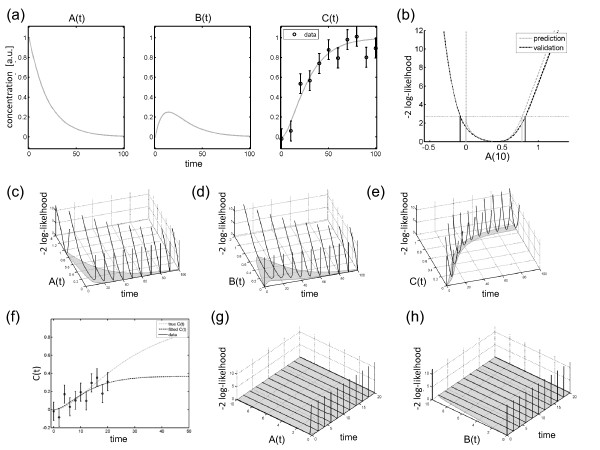
- Prediction profile likelihood (PPL) yields prediction confidence intervals by constrained maximum likelihood, avoiding explicit high-dimensional parameter sampling; thresholding the PPL gives statistically accurate intervals.
- A validation profile likelihood (VPL) extends the approach to noisy validation experiments; validation confidence intervals are larger than prediction confidence intervals because they account for measurement error.
- Flat PPLs produce unbounded prediction confidence intervals and indicate non-observability. In the small model, measuring C only at t = 0,2,…,20 gave unbounded PCIs for A(t) and B(t) for t > 0, while B(0) was known to be zero.
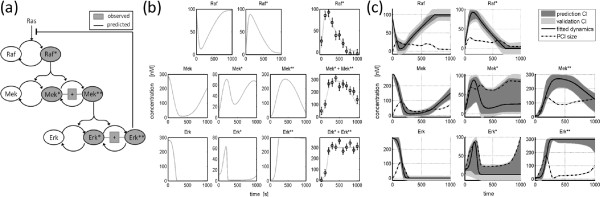
- In the MAP kinase model, 14 parameters were estimated from three times eleven data points; the largest absolute PCI was 176 nM for Erk at t = 181 seconds, Raf/Raf* PCIs were below 40 nM, and Mek* intervals nearly spanned 0–100 nM.
Methods
- For ODE state-space models with additive Gaussian noise, the PPL is defined as the maximum likelihood over parameters satisfying the constraint that the model response equals a fixed prediction value z; confidence intervals use a chi-square threshold. The VPL relaxes this constraint and penalizes deviation from a validation data point by its standard deviation.
- Two examples are used: a small consecutive reaction A→B→C with rates θ1 = 0.05, θ2 = 0.1, initial A(0) = θ3 = 1, B(0) = 0, C(0) = 0, C measured at t = 0,10,…,100 with σ = 0.1; and a MAP kinase ODE model with eight dynamic states, 14 estimated parameters, measurements at 0,100,…,1000 seconds, and σ = 10 nM.
- Analysis uses constrained optimization/profile likelihood calculations, thresholding, and Monte-Carlo coverage checks in Additional file 1; Matlab template code is provided.
Limitations
- Stated: prediction confidence regions are point-wise; multiple predictions from one data set are statistically dependent, and a common region for two dependent predictions would require a two-dimensional prediction profile likelihood, which is beyond the article’s scope.
- Stated: Bayesian MCMC could perform better if a comprehensive prior were available, but in cell biology prior knowledge is very restricted; prior information can be incorporated via maximum a-posteriori estimation.
- Evident from the text: the method relies on reliable numerical parameter optimization and, in the main derivation, assumes additive Gaussian noise with known variance; if assumptions are violated, the threshold must be generated empirically by Monte-Carlo simulations.
Model-written summary. Check it against the paper before relying on it.
Integrity signals
Registry
Cites
Statistics
Figures
Verification
Claims the paper makes
0 Valid · 4 Not valid · 15 Not checked · 62 Own results and interpretations
None of the sources cited for this claim have been checked yet.
In the paper
“For models with tens to hundreds of parameters this is numerically demanding or even infeasible because high dimensional spaces cannot be sampled densely.”
§ Likelihood based observability analysis and confidence intervals for predictions of dynamic models > Background
What the sources say
- Not checked yetcites [9] Marimont RB Shapiro MB Nearest neighbour searches and the curse of dimensionality IMA J Appl Mathematics 1979 24 59 70 [ http://imamat.oxfordjournals.org/content/24/1/59.abstract] 10.1093/imamat/24.1.59 source
- Could not verifycites [10] Scott DW Wand MP Feasibility of multivariate density estimates Biometrika 1991 78 197 205 [ http://www.jstor.org/stable/2336910] 10.1093/biomet/78.1.197 sourceExperimental — accuracy not yet measured
Our copy of Hinkley (1979) is a theoretical paper defining predictive likelihood (Sections 2-5, pp. 2-9) with worked examples in one- and two-parameter exponential-family, uniform and Markov-sequence settings (pp. 3-8); no passage discusses computational cost, numerical infeasibility, or the impossibility of densely sampling high-dimensional parameter spaces. Searches on 'numerically demanding / high dimensional space / sampled densely' and on 'computation difficulty, integration over many parameters, large sample size' returned only the definitional and Lemma 1/Appendix passages (pp. 1-10), none of which addresses the claim's point. Absence here is not contradiction, but the claim's assertion is not made or implied anywhere in our copy. (LLM, conf=0.72)
plainstates a cause- Asserted: passes — The authors put it forward as true.
- Checkable: passes — It can be checked against evidence.
- Load-bearing: passes — The paper’s conclusions depend on it.
- Based: passes — The paper gives a reason why it holds.
A result the paper states — it cites no source for it, so there is none to check. The quote shows it is in the paper.
In the paper
“Prediction- as well as validation confidence intervals always cover the prediction for the maximum likelihood parameter estimates.”
§ Likelihood based observability analysis and confidence intervals for predictions of dynamic models > Results > Small illustration model
plain- Asserted: passes — The authors put it forward as true.
- Checkable: passes — It can be checked against evidence.
- Load-bearing: unclear — It is unclear whether the paper’s conclusions depend on it.
- Based: passes — The paper gives a reason why it holds.
A result the paper reports from its own data — it cites no other source for it, so there is none to check. The quote shows it is in the paper.
In the paper
“For the MAP kinase model, prediction confidence intervals and validation confidence intervals for all dynamic states have been determined on the basis of measurements of the phosphorylated proteins.”
§ Likelihood based observability analysis and confidence intervals for predictions of dynamic models > Conclusions
plainstates a cause- Asserted: passes — The authors put it forward as true.
- Checkable: passes — It can be checked against evidence.
- Load-bearing: passes — The paper’s conclusions depend on it.
- Based: passes — The paper gives a reason why it holds.
- Rests on an assumption not shown here.
A result the paper reports from its own data — it cites no other source for it, so there is none to check. The quote shows it is in the paper.
In the paper
“Similarly, the unphosphorylated states of Mek and Erk have narrow prediction confidence intervals.”
§ Likelihood based observability analysis and confidence intervals for predictions of dynamic models > Results > MAP kinase signaling model
plain- Asserted: passes — The authors put it forward as true.
- Checkable: passes — It can be checked against evidence.
- Load-bearing: unclear — It is unclear whether the paper’s conclusions depend on it.
- Based: passes — The paper gives a reason why it holds.
- Rests on 2 assumptions not shown here.
A result the paper reports from its own data — it cites no other source for it, so there is none to check. The quote shows it is in the paper.
In the paper
“Also an algorithm to improve the threshold is provided which yields slightly smaller confidence intervals with the correct coverage.”
§ Likelihood based observability analysis and confidence intervals for predictions of dynamic models > Results > Small illustration model
plainstates a cause- Asserted: passes — The authors put it forward as true.
- Checkable: passes — It can be checked against evidence.
- Load-bearing: unclear — It is unclear whether the paper’s conclusions depend on it.
- Based: passes — The paper gives a reason why it holds.
42 more claims
Create a free account to see all 81 claims and to verify the 19 references still open.
- Probably not a substantial claim. 20
- It may state two separate claims as one. 15
Claims other papers make about this one
Each is checked against this paper’s own text: does it say what the citing paper says it does?
The cited source says what the claim attributes to it.
In the citing paper
“Techniques for this exist in both a frequentist [13,36,91] as well as a Bayesian setting [87,90].”
From Parameter uncertainty in biochemical models described by ordinary differential equations (2013) · cites this paper as [13]
In the citing paper
“By repeating this procedure for different predictions, reliable confidence intervals can be obtained, considering only one-dimensional scans within prediction space.”
From Parameter uncertainty in biochemical models described by ordinary differential equations (2013) · cites this paper as [13]
Citations
Cites
Integrated Genomic and Proteomic Analyses of a Systematically Perturbed Metabolic Network
Ideker, T., Thorsson, V., Ranish, J. A., Christmas, R., Buhler, J., Eng, J. K., Bumgarner, R., Goodlett, D. R., Aebersold, R., & Hood, L. (2001) · Science · doi:10.1126/science.292.5518.929 · Cited by 2,050 · cited 1×
“The applications range from forecasting climate changes [28] via predicting events in a detector in high-energy physics [29] to modeling biological systems [30].”
BackgroundRaue, A., Kreutz, C., Maiwald, T., Bachmann, J., Schilling, M., Klingmüller, U., & Timmer, J. (2009) · Bioinformatics · doi:10.1093/bioinformatics/btp358 · Cited by 1,442
Self-citationPrediction error estimation: a comparison of resampling methods
Molinaro, A. M., Simon, R., & Pfeiffer, R. M. (2005) · Bioinformatics · doi:10.1093/bioinformatics/bti499 · Cited by 1,339 · cited 1×
“the Markov Chain Monte Carlo (MCMC) methods [11,12], and bootstrap based approaches [4,13] are numerically demanding and provide only rough approximations for ODE models.”
MethodMarkov chain Monte Carlo without likelihoods
Marjoram, P., Molitor, J., Plagnol, V., & Tavaré, S. (2003) · Proceedings of the National Academy of Sciences · doi:10.1073/pnas.0306899100 · Cited by 1,199 · cited 1×
“Discussion Existing approaches for prediction confidence intervals likeMCMC [26] or bootstrap procedures are based on forward evaluations of the model for many parameter values.”
MethodKholodenko, B. N. (2000) · European Journal of Biochemistry · doi:10.1046/j.1432-1327.2000.01197.x · Cited by 643 · cited 6×
“[Kholodenko2000] B. N. Kholodenko.”
MethodInfluentialA method for computing profile-likelihood-based confidence intervals
Venzon, D. J., & Moolgavkar, S. H. (1988) · Applied Statistics · doi:10.2307/2347496 · Cited by 565
The interplay of Bayesian and frequentist analysis
Bayarri, M. J., & Berger, J. O. (2004) · Statistical Science · doi:10.1214/088342304000000116 · Cited by 525 · cited 2×
“the parameter space to be sampled, is well-behaved [14].”
BackgroundSwameye, I., Müller, T. G., Timmer, J., Sandra, O., & Klingmüller, U. (2003) · Proceedings of the National Academy of Sciences · doi:10.1073/pnas.0237333100 · Cited by 316
Self-citationThe detector simulation program for the OPAL experiment at LEP
Allison, J., Banks, J., Barlow, R. J., Batley, J. R., Biebel, O., Brun, R., Buijs, A., Bullock, F. W., Chang, C. Y., Conboy, J. E., et al. (1992) · Nuclear Instruments and Methods in Physics Research Section A: Accelerators, Spectrometers, Detectors and Associated Equipment · doi:10.1016/0168-9002(92)90593-s · Cited by 262 · cited 1×
“The applications range from forecasting climate changes [28] via predicting events in a detector in high-energy physics [29] to modeling biological systems [30].”
BackgroundSystems biology: experimental design
Kreutz, C., & Timmer, J. (2009) · The FEBS Journal · doi:10.1111/j.1742-4658.2008.06843.x · Cited by 257 · cited 1×
“based on the Fisher information [27], the presented procedure is very valuable for ODE models which are typically highly nonlinear.”
MethodSelf-citation
Research works printed but not linked: 4
- Sachs L Applied Statistics 1984 Springer, New York
- Davison A Hinkley D Bootstrap Methods and Their Application 1997 Cambridge University Press, Cambridge
- Gelman A Carlin JB Stern HS Rubin DB Bayesian Data Analysis, Second Edition (Chapman & Hall/CRC Texts in Statistical Science), 2003 Chapman and Hall/CRC, Boca Raton
- Seber G Wild C Nonlinear regression 1989 Wiley, New York
Cited by
On structural and practical identifiability
Wieland, F.-G., Hauber, A. L., Rosenblatt, M., Tönsing, C., & Timmer, J. (2021) · Current Opinion in Systems Biology · doi:10.1016/j.coisb.2021.03.005 · Cited by 325
“Similarly, the prediction profile likelihood (Equation (8)) determines the prediction uncertainty of the model at a potential new measurement time point [59] thus promoting the identifiability of the whole model.”
BackgroundSelf-citationLessons Learned from Quantitative Dynamical Modeling in Systems Biology
Raue, A., Schilling, M., Bachmann, J., Matteson, A., Schelke, M., Kaschek, D., Hug, S., Kreutz, C., Harms, B. D., Theis, F. J., et al. (2013) · PLoS ONE · doi:10.1371/journal.pone.0074335 · Cited by 306
“non-observable [27], and subsequent analysis might not be reliable.”
BackgroundSelf-citationData2Dynamics: a modeling environment tailored to parameter estimation in dynamical systems
Raue, A., Steiert, B., Schelker, M., Kreutz, C., Maiwald, T., Hass, H., Vanlier, J., Tönsing, C., Adlung, L., Engesser, R., et al. (2015) · Bioinformatics · doi:10.1093/bioinformatics/btv405 · Cited by 227
“The software was awarded twice as best performer in the Dialogue for Reverse Engineering Assessments and Methods (DREAM, 2011 and 2012).”
MethodSelf-citationComparison of approaches for parameter identifiability analysis of biological systems
Raue, A., Karlsson, J., Saccomani, M. P., Jirstrand, M., & Timmer, J. (2014) · Bioinformatics · doi:10.1093/bioinformatics/btu006 · Cited by 180
“(2010) that the approach facilitates an iterative experimental design strategy and Kreutz et al. (2012) Table 1.”
MethodSelf-citationProfile likelihood in systems biology
Kreutz, C., Raue, A., Kaschek, D., & Timmer, J. (2013) · The FEBS Journal · doi:10.1111/febs.12276 · Cited by 176
“To account for the this effect prediction, the prediction confidence intervals have been generalized in [15,16] for the validation setting.”
BackgroundMethodInfluentialSelf-citationA protocol for dynamic model calibration
Villaverde, A. F., Pathirana, D., Fröhlich, F., Hasenauer, J., & Banga, J. R. (2022) · Briefings in Bioinformatics · doi:10.1093/bib/bbab387 · Cited by 137
“The prediction profile likelihood method (PPL) calculates confidence intervals for the states by performing constrained optimisation of the likelihood using a fixed prediction value as a nonlinear constraint [49].”
MethodSchneider, N., Wieland, F.-G., Kong, D., Fischer, A. A. M., Hörner, M., Timmer, J., Ye, H., & Weber, W. (2021) · Science Advances · doi:10.1126/sciadv.abd3568 · Cited by 123
Self-citationParameter uncertainty in biochemical models described by ordinary differential equations
Vanlier, J., Tiemann, C. A., Hilbers, P. A. J., & van Riel, N. A. W. (2013) · Mathematical Biosciences · doi:10.1016/j.mbs.2013.03.006 · Cited by 116
“We provide an introduction to some of the techniques available as well as give an overview of the state-of-the-art methods for parameter uncertainty analysis [12–17].”
BackgroundMethodInfluentialIdentifiability analysis for stochastic differential equation models in systems biology
Browning, A. P., Warne, D. J., Burrage, K., Baker, R. E., & Simpson, M. J. (2020) · Journal of The Royal Society Interface · doi:10.1098/rsif.2020.0652 · Cited by 143
A bayesian approach to targeted experiment design
Vanlier, J., Tiemann, C. A., Hilbers, P. A. J., & van Riel, N. A. W. (2012) · Bioinformatics · doi:10.1093/bioinformatics/bts092 · Cited by 98
“We employ a Bayesian approach involving importance sampling of the posterior predictive distribution to predict the efficacy of a new measurement at reducing the uncertainty of a selected prediction.”
MethodConstructing kinetic models of metabolism at genome‐scales: A review
Srinivasan, S., Cluett, W. R., & Mahadevan, R. (2015) · Biotechnology Journal · doi:10.1002/biot.201400522 · Cited by 85
“( Parameter identifiability [model parameterization] and parameter estimation are dependent on the kinetic model framework and the data used for estimation purposes respectively.) but also its estimability from experimental data [66].”
BackgroundParameter estimation and uncertainty quantification for systems biology models
Mitra, E. D., & Hlavacek, W. S. (2019) · Current Opinion in Systems Biology · doi:10.1016/j.coisb.2019.10.006 · Cited by 106
“Prediction uncertainty can be calculated by an analogous approach [56].”
Frequency Modulation of Transcriptional Bursting Enables Sensitive and Rapid Gene Regulation
Li, C., Cesbron, F., Oehler, M., Brunner, M., & Höfer, T. (2018) · Cell Systems · doi:10.1016/j.cels.2018.01.012 · Cited by 76
“The prediction confidence bands (95%) of the dose-response curves are estimated by calculating the prediction profile likelihood using the D2D package (Kreutz et al., 2012; Raue et al., 2015).”
MethodNilsson, A., Haanstra, J. R., Engqvist, M. K. M., Gerding, A., Bakker, B. M., Klingmüller, U., Teusink, B., & Nielsen, J. (2020) · Proceedings of the National Academy of Sciences · doi:10.1073/pnas.1919250117 · Cited by 83
“2A) using the maximum log likelihood (mLL) method (30) (Methods and SI Appendix, Fig.”
MethodExperimental Design for Parameter Estimation of Gene Regulatory Networks
Steiert, B., Raue, A., Timmer, J., & Kreutz, C. (2012) · PLoS ONE · doi:10.1371/journal.pone.0040052 · Cited by 66
Self-citationHigh-dimensional Bayesian parameter estimation: Case study for a model of JAK2/STAT5 signaling
Hug, S., Raue, A., Hasenauer, J., Bachmann, J., Klingmüller, U., Timmer, J., & Theis, F. J. (2013) · Mathematical Biosciences · doi:10.1016/j.mbs.2013.04.002 · Cited by 63
Self-citationEisenberg, M. C., & Jain, H. V. (2017) · Journal of Theoretical Biology · doi:10.1016/j.jtbi.2017.07.018 · Cited by 79
“For more detailed examination of the ways that identifiability can inform experiment design and data collection strategies, the reader is referred to Kreutz et al. (2012), Skanda and Lebiedz (2010), Anguelova et al. (2012), Cheung et al. (2013), Chu and Hahn (2008), Apgar et al. (2010), Banga and…”
BackgroundInfluentialBaaske, J., Gonschorek, P., Engesser, R., Domínguez-Monedero, A., Raute, K., Fischbach, P., Müller, K., Cachat, É., Schamel, W. W. A., Minguet, S., et al. (2018) · Scientific Reports · doi:10.1038/s41598-018-32929-7 · Cited by 66
Self-citationNyman, E., Rajan, M. R., Fagerholm, S., Brännmark, C., Cedersund, G., & Strålfors, P. (2014) · Journal of Biological Chemistry · doi:10.1074/jbc.m114.608927 · Cited by 59
“23, we use an extra cost for deviation from a certain value of the prediction and go through the different possible values of the prediction (25).”
MethodODE Constrained Mixture Modelling: A Method for Unraveling Subpopulation Structures and Dynamics
Hasenauer, J., Hasenauer, C., Hucho, T. B., & Theis, F. J. (2014) · PLoS Computational Biology · doi:10.1371/journal.pcbi.1003686 · Cited by 69
“To obtain uncertainty bounds not only for parameters but also for model predictions, prediction profile likelihoods [80] or Bayesian methods [46] can be used.”
MethodB Cell Development in the Bone Marrow Is Regulated by Homeostatic Feedback Exerted by Mature B Cells
Shahaf, G. L., Zisman‐Rozen, S., Benhamou, D., Melamed, D., & Mehr, R. (2016) · Frontiers in Immunology · doi:10.3389/fimmu.2016.00077 · Cited by 71
Rewiring of cortical glucose metabolism fuels human brain cancer growth
Scott, A. J., Mittal, A., Meghdadi, B., O’Brien, A. M., Bailleul, J., Palavalasa, S., Achreja, A., Zhou, W., Xu, J., Lin, A., et al. (2025) · Nature · doi:10.1038/s41586-025-09460-7 · Cited by 71
Simpson, M. J., & Maclaren, O. J. (2023) · PLoS Computational Biology · doi:10.1371/journal.pcbi.1011515 · Cited by 68
“In the latter case, the literature typically focuses on predictions at a small number of time points [18, 19, 22], which is easier to implement computationally.”
BackgroundMethodInfluentialMechanistic model of MAPK signaling reveals how allostery and rewiring contribute to drug resistance
Fröhlich, F., Gerosa, L., Muhlich, J. L., & Sorger, P. K. (2023) · Molecular Systems Biology · doi:10.15252/msb.202210988 · Cited by 55
“…that minimize the deviation from experimental data) is compute-intensive (Fröhlich et al, 2017) and even after calibration, parameters can assume wide ranges, a property known as non-identifiablity (Kreutz et al, 2012; Raue et al, 2011; Kreutz et al, 2012; Chis et al, 2011; Wieland et al, 2021).”
MethodOptimal experiment design for model selection in biochemical networks
Vanlier, J., Tiemann, C. A., Hilbers, P. A. J., & van Riel, N. A. W. (2014) · BMC Systems Biology · doi:10.1186/1752-0509-8-20 · Cited by 55
“…of the model and the non-Gaussian shape of the parameter distribution, these methods are rarely appropriate for Systems Biology models [27] (See Figure 1 for an example of the effect of model linearization, and how it can skew predictive distributions in cases of large parameter…”
Disentangling molecular mechanisms regulating sensitization of interferon alpha signal transduction
Kok, F., Rosenblatt, M., Teusel, M., Nizharadze, T., Magalhães, V. G., Dächert, C., Maiwald, T., Vlasov, A., Wäsch, M., Tyufekchieva, S., et al. (2020) · Molecular Systems Biology · doi:10.15252/msb.20198955 · Cited by 51
“The corresponding 68%-confidence intervals (shaded areas in Fig 4C) were computed as proposed in Kreutz et al (2012).”
InfluentialSelf-citationMurphy, R. J., Maclaren, O. J., & Simpson, M. J. (2024) · Journal of The Royal Society Interface · doi:10.1098/rsif.2023.0402 · Cited by 58
Haley, B. M., Paunesku, T., Grdina, D. J., & Woloschak, G. E. (2015) · PLoS ONE · doi:10.1371/journal.pone.0140989 · Cited by 47
New types of experimental data shape the use of enzyme kinetics for dynamic network modeling
Tummler, K., Lubitz, T., Schelker, M., & Klipp, E. (2013) · FEBS Journal · doi:10.1111/febs.12525 · Cited by 57
“As the model output depends on the parameters in a non-linear way, the parameter uncertainties must be propagated to confidence bands of the model trajectories by calculating the prediction profile likelihood [108] or by Markov chain Monte Carlo sampling [109].”
MethodParameter estimation and identifiability in a neural population model for electro-cortical activity
Hartoyo, A., Cadusch, P. J., Liley, D. T. J., & Hicks, D. G. (2019) · PLoS Computational Biology · doi:10.1371/journal.pcbi.1006694 · Cited by 50
Jager, T. (2020) · Integrated Environmental Assessment and Management · doi:10.1002/ieam.4333 · Cited by 41
“What we like to construct is the so‐called prediction profile likelihood (Kreutz et al. 2012).”
BackgroundDynamic Modeling, Parameter Estimation, and Uncertainty Analysis in R
Kaschek, D., Mader, W., Fehling-Kaschek, M., Rosenblatt, M., & Timmer, J. (2019) · Journal of Statistical Software · doi:10.18637/jss.v088.i10 · Cited by 46
Self-citationAssessment of Prediction Uncertainty Quantification Methods in Systems Biology
Villaverde, A. F., Raimúndez, E., Hasenauer, J., & Banga, J. R. (2022) · IEEE Transactions on Computational Biology and Bioinformatics · doi:10.1109/tcbb.2022.3213914 · Cited by 50
“Following this concept, Kreutz et al. [13] introduced the concept of prediction profile likelihoods (PPLs) Conceptually, the PPL provides the highest possible likelihood value for a specific value of the (parameter dependent) prediction.”
BackgroundMethodInfluentialAn easy and efficient approach for testing identifiability
Kreutz, C. (2018) · Bioinformatics · doi:10.1093/bioinformatics/bty035 · Cited by 47
Self-citationKrausch, N., Barz, T., Sawatzki, A., Gruber, M., Kamel, S., Neubauer, P. B., & Bournazou, M. N. C. (2019) · Frontiers in Bioengineering and Biotechnology · doi:10.3389/fbioe.2019.00122 · Cited by 45
“Although this has been widely addressed in literature (Balsa-Canto et al., 2001; Raue et al., 2009; Kreutz et al., 2012), Monte Carlo Sampling is still the most accurate method for quantification of parameter uncertainty (Moles et al.”
MethodMerkle, R., Steiert, B., Salopiata, F., Depner, S., Raue, A., Iwamoto, N., Schelker, M., Hass, H., Wäsch, M., Böhm, M. E., et al. (2016) · PLoS Computational Biology · doi:10.1371/journal.pcbi.1005049 · Cited by 41
“To assess the uncertainty of the model dynamics, the prediction profile likelihood [38, 39] was utilized.”
MethodSelf-citationRobust parameter estimation for dynamical systems from outlier-corrupted data
Maier, C., Loos, C., & Hasenauer, J. (2016) · Bioinformatics · doi:10.1093/bioinformatics/btw703 · Cited by 42
“In other cases, the threshold values can be computed numerically using Monte-Carlo sampling (Kreutz et al., 2012).”
MethodParameter Trajectory Analysis to Identify Treatment Effects of Pharmacological Interventions
Tiemann, C. A., Vanlier, J., Oosterveer, M. H., Groen, A. K., Hilbers, P. A. J., & van Riel, N. A. W. (2013) · PLoS Computational Biology · doi:10.1371/journal.pcbi.1003166 · Cited by 36
“Other approaches based on parameter optimization have been proposed to assess the identifiability of parameters [64] and predictions [50] or to probe consistent model behavior (core predictions) among multiple parameter sets [51,52,54,56].”
Correction: Lessons Learned from Quantitative Dynamical Modeling in Systems Biology
Raue, A., Schilling, M., Bachmann, J., Matteson, A., Schelker, M., Kaschek, D., Hug, S., Kreutz, C., Harms, B. D., Theis, F. J., et al. (2013) · PLoS ONE · doi:10.1371/annotation/ea0193d8-1f7f-492a-b0b7-d877629fdcee · Cited by 37
Self-citationSynthetic Biology Makes Polymer Materials Count
Beyer, H. M., Engesser, R., Hörner, M., Koschmieder, J., Beyer, P., Timmer, J., Zurbriggen, M. D., & Weber, W. (2018) · Advanced Materials · doi:10.1002/adma.201800472 · Cited by 30
Self-citationMechanistically detailed systems biology modeling of the HGF/Met pathway in hepatocellular carcinoma
Jafarnejad, M., Sové, R. J., Danilova, L., Mirando, A. C., Zhang, Y., Yarchoan, M. M., Tran, P. T., Pandey, N. B., Fertig, E. J., & Popel, A. S. (2019) · npj Systems Biology and Applications · doi:10.1038/s41540-019-0107-2 · Cited by 29
“Briefly, we used parametric resampling assuming a log-normal distribution about the mean of each time point to obtain 201 resampled datasets; we assumed a 10% measurement error to obtain an estimate of the population standard deviation as in previous studies.(61) Each dataset was used to re-estimate the model paramete…”
MethodSobotta, S., Raue, A., Huang, X., Vanlier, J., Jünger, A., Bohl, S., Albrecht, U., Hahnel, M. J., Wolf, S., Mueller, N. S., et al. (2017) · Frontiers in Physiology · doi:10.3389/fphys.2017.00775 · Cited by 32
“Moreover, uncertainty analysis can give insight into how well a model is constrained and what kind of predictive power one can expect when predicting similar experiments (Kreutz et al., 2012; Vanlier et al., 2013).”
BackgroundSelf-citationTummler, K., & Klipp, E. (2017) · Current Opinion in Systems Biology · doi:10.1016/j.coisb.2017.11.003 · Cited by 30
Dynamic compensation, parameter identifiability, and equivariances
Sontag, E. D. (2017) · PLoS Computational Biology · doi:10.1371/journal.pcbi.1005447 · Cited by 34
Inference-based assessment of parameter identifiability in nonlinear biological models
Daly, A. C., Gavaghan, D. J., Cooper, J., & Tavener, S. (2018) · Journal of The Royal Society Interface · doi:10.1098/rsif.2018.0318 · Cited by 35
L 1 regularization facilitates detection of cell type-specific parameters in dynamical systems
Steiert, B., Timmer, J., & Kreutz, C. (2016) · Bioinformatics · doi:10.1093/bioinformatics/btw461 · Cited by 23
Self-citationTakahashi, M., Barile, M., Chapple, R. H., Tseng, Y.-J., Nakada, D., Busch, K., Fanti, A.-K., Säwén, P., Bryder, D., Höfer, T., et al. (2021) · Stem Cell Reports · doi:10.1016/j.stemcr.2021.02.020 · Cited by 24
“Themodel fit provided a good description of the input data, withmost points lying within the prediction profile likelihood (Kreutz et al., 2012) confidence bounds (Figure 2B) for both label frequency and compartment population size.”
BackgroundQuantifying rotavirus kinetics in the REH tumor cell line using in vitro data
González‐Parra, G., Dobrovolny, H. M., Aranda, D. F., Chen‐Charpentier, B. M., & Guerrero, R. A. (2017) · Virus Research · doi:10.1016/j.virusres.2017.09.023 · Cited by 23
Conformal prediction for uncertainty quantification in dynamic biological systems
Portela, A., Banga, J. R., & Matabuena, M. (2025) · PLoS Computational Biology · doi:10.1371/journal.pcbi.1013098 · Cited by 33
Fast integration-based prediction bands for ordinary differential equation models
Hass, H., Kreutz, C., Timmer, J., & Kaschek, D. (2015) · Bioinformatics · doi:10.1093/bioinformatics/btv743 · Cited by 22
“In Kreutz et al. (2012), profile likelihood-based confidence intervals and their computation have been generalized to confidence and prediction intervals for arbitrary observables.”
BackgroundMethodInfluentialSelf-citationSukys, A., & Grima, R. (2025) · Nucleic Acids Research · doi:10.1093/nar/gkaf295 · Cited by 25
Mathematical modeling improves EC 50estimations from classical dose–response curves
Nyman, E., Lindgren, I., Lövfors, W., Lundengård, K., Cervin, I., Sjöström, T. A., Altimiras, J., & Cedersund, G. (2015) · FEBS Journal · doi:10.1111/febs.13194 · Cited by 25
Prediction Uncertainty Estimation Despite Unidentifiability: An Overview of Recent Developments
Cedersund, G. (2015) · Studies in mechanobiology, tissue engineering and biomaterials · doi:10.1007/978-3-319-21296-8_17 · Cited by 21
“In [17], they tested this claim, by generating many artificial datasets, with different noise realizations, and saw that at least for the therein tested example, the fraction of successful prediction uncertainties converges to a reasonable vicinity”
BackgroundMethodSimpson, M. J., Walker, S. A., Studerus, E. N., McCue, S. W., Murphy, R. J., & Maclaren, O. J. (2022) · Mathematical Biosciences · doi:10.1016/j.mbs.2022.108950 · Cited by 23
Disentangling the Complexity of HGF Signaling by Combining Qualitative and Quantitative Modeling
D’Alessandro, L. A., Samaga, R., Maiwald, T., Rho, S., Bonefas, S., Raue, A., Iwamoto, N., Kienast, A., Robichon, K., Meyer, R., et al. (2015) · PLoS Computational Biology · doi:10.1371/journal.pcbi.1004192 · Cited by 20
“We calculated the prediction profiles of “active PI3K” as described in [39] for the entire observation time frame.”
MethodSelf-citationDifferential equations in data analysis
Dattner, I. (2020) · Wiley Interdisciplinary Reviews Computational Statistics · doi:10.1002/wics.1534 · Cited by 22
“…the following studies: Raue, Becker, Klingmüller, and Timmer (2010), who used profile likelihood to design new experiments for prediction purposes; Kreutz, Raue, and Timmer (2012), where profile likelihood was used to develop confidence intervals; and Raue, Kreutz, Theis, and Timmer (2013), who…”
MethodModel calibration and uncertainty analysis in signaling networks
Heinemann, T., & Raue, A. (2016) · Current Opinion in Biotechnology · doi:10.1016/j.copbio.2016.04.004 · Cited by 18
“Uncertainty in model predictions can also be quantified directly, without the need to quantify uncertainty in model parameters first [34,35].”
BackgroundSelf-citationBrowning, A. P., & Simpson, M. J. (2023) · PLoS Computational Biology · doi:10.1371/journal.pcbi.1010844 · Cited by 21
“, y(n)]⊺, are subject to independent additive normal noise [46, 47], such that”
BackgroundArgyri, K. D., Dionysiou, D. D., Misichroni, F. D., & STAMATAKOS, G. S. (2016) · Biology Direct · doi:10.1186/s13062-016-0114-9 · Cited by 18
“A discussion on identifiability analysis can be found in [67–71].”
BackgroundPrediction uncertainty and optimal experimental design for learning dynamical systems
Letham, B., Letham, P. A., Rudin, C. D., & Browne, E. P. (2016) · Chaos An Interdisciplinary Journal of Nonlinear Science · doi:10.1063/1.4953795 · Cited by 28
A Comparison of Methods for Quantifying Prediction Uncertainty in Systems Biology
Villaverde, A. F., Raimúndez, E., Hasenauer, J., & Banga, J. R. (2019) · IFAC-PapersOnLine · doi:10.1016/j.ifacol.2019.12.234 · Cited by 16
Murphy, R. J., Maclaren, O. J., Calabrese, A. R., Thomas, P. B., Warne, D. J., Williams, E. D., & Simpson, M. J. (2022) · Journal of The Royal Society Interface · doi:10.1098/rsif.2022.0560 · Cited by 17
Mathematical modeling and dynamical analysis of anti-tumor drug dose-response
Xiao, Y., Shen, J., & Zou, X. (2022) · Mathematical Biosciences & Engineering · doi:10.3934/mbe.2022190 · Cited by 15
Weber, P., Kramer, A., Dingler, C., & Radde, N. (2012) · Bioinformatics · doi:10.1093/bioinformatics/bts377 · Cited by 14
“The simulation intensity of the algorithm’s major design step is thereby reasonably affordable.”
BackgroundValidation-based model selection for 13C metabolic flux analysis with uncertain measurement errors
Sundqvist, N., Grankvist, N., Watrous, J. D., Jain, M., Nilsson, R., & Cedersund, G. (2022) · PLoS Computational Biology · doi:10.1371/journal.pcbi.1009999 · Cited by 16
Making Predictions Using Poorly Identified Mathematical Models
Simpson, M. J., & Maclaren, O. J. (2024) · Bulletin of Mathematical Biology · doi:10.1007/s11538-024-01294-0 · Cited by 21
“One of the advantages of the PWA workflow is that it naturally leads to curvewise prediction sets that avoids challenges of computational overhead and interpretation that are inherent in working with pointwise approaches (Hass et al. 2016; Kreutz et al. 2013).”
BackgroundModel Structure Selection and Validation for Dynamic Equivalencing of Distribution Networks
Rabuzin, T., Eriksson, R., & Nordström, L. (2021) · IEEE Transactions on Smart Grid · doi:10.1109/tsg.2021.3135293 · Cited by 14
Dray, K. E., Muldoon, J. J., Mangan, N. M., Bagheri, N., & Leonard, J. N. (2022) · ACS Synthetic Biology · doi:10.1021/acssynbio.1c00528 · Cited by 14
Data-driven prediction of COVID-19 cases in Germany for decision making
Refisch, L., Lorenz, F., Riedlinger, T., Taubenböck, H., Fischer, M., Grabenhenrich, L., Wolkewitz, M., Binder, H., & Kreutz, C. (2022) · BMC Medical Research Methodology · doi:10.1186/s12874-022-01579-9 · Cited by 19
“One could also analyze the uncertainty of a model prediction directly via the prediction profile likelihood method [26].”
MethodSelf-citationChallenges in the calibration of large-scale ordinary differential equation models
Kapfer, E.-M., Stapor, P. L., & Hasenauer, J. (2019) · IFAC-PapersOnLine · doi:10.1016/j.ifacol.2019.12.236 · Cited by 18
Hock, S., Hasenauer, J., & Theis, F. J. (2013) · BMC Bioinformatics · doi:10.1186/1471-2105-14-s10-s7 · Cited by 19
Systems modelling ageing: from single senescent cells to simple multi-cellular models
Guimera, A. M., Welsh, C., Pezze, P. D., Fullard, N., Nelson, G., Roger, M., Przyborski, S. A., & Shanley, D. P. (2017) · Essays in Biochemistry · doi:10.1042/ebc20160087 · Cited by 12
Predicting Radiotherapy Patient Outcomes with Real-Time Clinical Data Using Mathematical Modelling
Browning, A. P., Lewin, T. D., Baker, R. E., Maini, P. K., Moros, E. G., Caudell, J. J., Byrne, H. M., & Enderling, H. (2024) · Bulletin of Mathematical Biology · doi:10.1007/s11538-023-01246-0 · Cited by 19
“We take a standard approach and assume that CT scan data are independent and normally distributed about the model prediction (Kreutz et al. 2012) such that where the standard deviation is assumed to be a linear function of GTV such that the statistical model captures both additive and…”
Ranaee, E., Moghadasi, L., Inzoli, F., Riva, M., & Guadagnini, A. (2017) · Journal of Petroleum Science and Engineering · doi:10.1016/j.petrol.2017.09.062 · Cited by 13
iVUN: interactive Visualization of Uncertain biochemical reaction Networks
Vehlow, C., Hasenauer, J., Kramer, A., Raue, A., Hug, S., Timmer, J., Radde, N., Theis, F. J., & Weiskopf, D. (2013) · BMC Bioinformatics · doi:10.1186/1471-2105-14-s19-s2 · Cited by 11
“file likelihoods based confidence intervals [38,39].”
Self-citationAndreu‐Vilarroig, C., Villanueva, R. J., & González‐Parra, G. (2024) · Infectious Disease Modelling · doi:10.1016/j.idm.2024.04.006 · Cited by 11
“…ð 4 : 73% Þ : Notice that the separation of the reported in vaccinated and unvaccinated cases enables to enrich the available data and improve the identi fi ability of the parameters of the model (Cole, 2020; Kreutz, Raue, & Timmer, 2012; Magal & Webb, 2018; Raue, Kreutz, Theis, & Timmer, 2013).”
A Continuation Technique for Maximum Likelihood Estimators in Biological Models
Cassidy, T. (2023) · Bulletin of Mathematical Biology · doi:10.1007/s11538-023-01200-0 · Cited by 12
“analysis [Castro and de Boer, 2020], often via profile likelihood computation [Kreutz et al., 2012; Raue et al., 2014, 2009], quantify how robust model predictions are to parameter variation.”
MethodBotcha, B., Iquebal, A. S., & Bukkapatnam, S. (2021) · Procedia Manufacturing · doi:10.1016/j.promfg.2021.06.070 · Cited by 11
Mathematical model of early Reelin-induced Src family kinase-mediated signaling
Hass, H., Kipkeew, F., Gauhar, A., Bouché, E., May, P., Timmer, J., & Bock, H. H. (2017) · PLoS ONE · doi:10.1371/journal.pone.0186927 · Cited by 11
Self-citationMinimally sufficient experimental design using identifiability analysis
Gevertz, J. L., & Kareva, I. (2024) · npj Systems Biology and Applications · doi:10.1038/s41540-023-00325-1 · Cited by 22
“We do note that other methods have been proposed for identifying the prediction con fi dence interval, including the prediction pro fi le likelihood approach 21 .”
Aoki, Y., & Sugiyama, Y. (2023) · CPT Pharmacometrics & Systems Pharmacology · doi:10.1002/psp4.13055 · Cited by 17
“13 Roughly speaking, profile likelihood is a surface of maximum likelihood with various fixed parameters.”
BackgroundTönsing, C., Steiert, B., Timmer, J., & Kreutz, C. (2023) · PLoS Computational Biology · doi:10.1371/journal.pcbi.1011417 · Cited by 15
Self-citationTunedal, K., Ebbers, T., & Cedersund, G. (2025) · Computers in Biology and Medicine · doi:10.1016/j.compbiomed.2025.109878 · Cited by 11
A method for the inference of cytokine interaction networks
Jansen, J. E., Aschenbrenner, D., Uhlig, H. H., Coles, M. C., & Gaffney, E. A. (2022) · PLoS Computational Biology · doi:10.1371/journal.pcbi.1010112 · Cited by 13
Scott, F., Li, M., Williams, D. L., Conejeros, R., Hodge, D. B., & Aroca, G. E. (2014) · Bioresource Technology · doi:10.1016/j.biortech.2014.11.062 · Cited by 9
Optimal Experimental Design Based on Two-Dimensional Likelihood Profiles
Litwin, T., Timmer, J., & Kreutz, C. (2022) · Frontiers in Molecular Biosciences · doi:10.3389/fmolb.2022.800856 · Cited by 11
“The range of reasonable measurement outcomes given the current data available before the measurement is quantified via the concept of validation profiles (Kreutz et al., 2012).”
BackgroundMethodSelf-citationPlank, M. J., & Simpson, M. J. (2024) · Royal Society Open Science · doi:10.1098/rsos.240733 · Cited by 9
Jullesson, D., Johansson, R., Rajan, M. R., Strålfors, P., & Cedersund, G. (2014) · FEBS Journal · doi:10.1111/febs.13182 · Cited by 10
Bianconi, F., Antonini, C., Tomassoni, L., & Valigi, P. (2019) · IET Systems Biology · doi:10.1049/iet-syb.2018.5091 · Cited by 10
“However, the frequentist methods aim at maximising the likelihood function through an optimisation algorithm while the Bayesian compute the posterior distribution using sampling based techniques [8, 9].”
MethodRolandi, P. A. (2019) · Computer-aided chemical engineering/Computer aided chemical engineering · doi:10.1016/b978-0-12-818597-1.50023-0 · Cited by 11
Felipe, C. S., Batra, J., Muralidharan, M., Malpotra, S., Anand, D., Bauer, R., Verba, K. A., Swaney, D. L., Krogan, N. J., Grabe, M., et al. (2025) · eLife · doi:10.7554/elife.106484 · Cited by 8
“…(CIs) on parameter estimates generated from ODE analysis, such as bootstrapping (Joshi, Seidel-Morgenstern, and Kremling 2006), they are computationally demanding and often only produce questionable confidence estimates for ODEs that are often difficult to interpret (Kreutz, Raue, and Timmer 2012).”
Mathematical Modeling of Influenza Dynamics: Integrating Seasonality and Gradual Waning Immunity
Andreu‐Vilarroig, C., González‐Parra, G., & Villanueva, R. J. (2025) · Bulletin of Mathematical Biology · doi:10.1007/s11538-025-01454-w · Cited by 11
“Since in this case we only vary the value of the parameter β 0 we are performing a practical identifiability by using the profile likelihood (Kreutz et al. 2012; Raue et al. 2009, 2013).”
About Model Validation in Bioprocessing
Rajamanickam, V., Babel, H., Herrera, L. M., Ehsani, A., Stiefel, F., Haider, S., Presser, B., & Knapp, B. L. (2021) · Processes · doi:10.3390/pr9060961 · Cited by 58
“Here, likelihood values of hypothetical data-points are calculated, and using the X2 distribution, a confidence interval with level α can be determined [64].”
MethodModeling resistance to the broadly neutralizing antibody PGT121 in people living with HIV-1
Cassidy, T., Stephenson, K. E., Barouch, D. H., & Perelson, A. S. (2024) · PLoS Computational Biology · doi:10.1371/journal.pcbi.1011518 · Cited by 9
“Naively, the profile likelihood of θ j , i characterizes the error functional, F j , profile as θ j , i is fixed away from the optimal value for each individual [50, 51].”
BackgroundMethodRecipes for Analysis of Molecular Networks Using the Data2Dynamics Modeling Environment
Steiert, B., Kreutz, C., Raue, A., & Timmer, J. (2019) · Methods in molecular biology · doi:10.1007/978-1-4939-9102-0_16 · Cited by 8
Self-citationCovid-19 in Deutschland – Erklärung, Prognose und Einfluss gesundheitspolitischer Maßnahmen
Donsimoni, J. R., Glawion, R., Hartl, T., Plachter, B., Timmer, J., Wälde, K., Weber, E., & Weiser, C. (2020) · Perspektiven der Wirtschaftspolitik · doi:10.1515/pwp-2020-0019 · Cited by 8
Self-citationImproving dynamic predictions with ensembles of observable models
Massonis, G., Villaverde, A. F., & Banga, J. R. (2022) · Bioinformatics · doi:10.1093/bioinformatics/btac755 · Cited by 9
A variational approach to parameter estimation in ordinary differential equations
Kaschek, D., & Timmer, J. (2012) · BMC Systems Biology · doi:10.1186/1752-0509-6-99 · Cited by 7
“Alternatively, profile likelihoods can be employed [5].”
Self-citationParticle filtering of dynamical networks: Highlighting observability issues
Montanari, A. N., & Aguirre, L. A. (2019) · Chaos An Interdisciplinary Journal of Nonlinear Science · doi:10.1063/1.5085321 · Cited by 6
Akman, T., Arendt, L. M., Geisler, J., Kristensen, V. N., Frigessi, A., & Köhn‐Luque, A. (2024) · Bulletin of Mathematical Biology · doi:10.1007/s11538-023-01253-1 · Cited by 8
“Based on the method of profile likelihood [46], our model is practically identifiable (See.”
MethodInfluential
Metadata
- Authors
- Kreutz, C., Raue, A., & Timmer, J.
- Affiliations
- University of Freiburg (DE)
- Corresponding author
- Kreutz, Clemens
- ORCID
- Kreutz, Clemens
- Venue
- BMC Systems Biology
- Published
- 2012
- Volume
- 6
- Issue
- 1
- Pages
- 120
- ISSN
- 1752-0509 (ISSN-L)
- PMC
- PMC3490710
- OpenAlex
- W2131230954
- Semantic Scholar
- 0f9cbe8c43921560b0e47607dbe3157b9c08b30b
- Cited by
- 134
- References
- 21
- Citations by year
- 2026: 4 · 2025: 19 · 2024: 8 · 2023: 8 · 2022: 12 · 2021: 7 · 2020: 10 · 2019: 13 · 2018: 6 · 2017: 9 · 2016: 8 · 2015: 8 · 2014: 9 · 2013: 9 · 2012: 4
- FWCI
- 3.85
- Type
- journal article
- Language
- en
- Open access
- gold
- doi.org
- Licence
- cc-by
- Locations
- BMC Systems Biology (publishedVersion, cc-by)
- PubMed Central (publishedVersion, cc-by)
- PubMed (publishedVersion)
- arXiv (Cornell University) (submittedVersion)
- DiVA (Linkoping University) (submittedVersion, other-oa)
- DOAJ (DOAJ: Directory of Open Access Journals) (submittedVersion)
- FreiDok plus (Universitätsbibliothek Freiburg) (submittedVersion)
- Site cant be reached (submittedVersion, cc-by)
- OPUS (Augsburg University) (submittedVersion, cc-by)
- arXiv (Cornell University)
- Funders
- Deutsches Krebsforschungszentrum
- Deutsche Forschungsgemeinschaft
- Topics
- Life Sciences › Biochemistry, Genetics and Molecular Biology › Molecular Biology › Gene Regulatory Network Analysis
- Physical Sciences › Engineering › Control and Systems Engineering › Control Systems and Identification
- Life Sciences › Biochemistry, Genetics and Molecular Biology › Molecular Biology › Microbial Metabolic Engineering and Bioproduction
- Keywords
- confidence intervals, observability analysis, parameter uncertainty, dynamic model, biochemical reaction networks, non-identifiable parameters, error propagation, ordinary differential equations, model validation
- MeSH terms
- Models, Biological, Likelihood Functions, Mitogen-Activated Protein Kinases, MAP Kinase Signaling System, Systems Biology
About these checks
Registry, retraction, Cites and statistics results are computed, not judged, with one exception: a printed reference that no index lists is read once by a model before it counts as a citation error. Claims are extracted by a model and kept only when their quote appears verbatim in the text; each cited source is then checked, with a model’s help, for whether it says what the claim relies on. Those verdicts can be wrong — read the claim’s quote and the cited source before relying on one.
The claim verdicts this report counts are experimental: their accuracy is not yet measured.
A language model drew the claims from the paper on 2026-10-05, under version 3 of the claim definition (model deepseek-v4.1-flash, prompt extract-v3).
A second model labelled each claim on 2026-10-05 (model jev-1.13-20260917, definition revision gold-guideline-v0.2).
Cited sources are checked with a language model’s help (qwen3.8-omni-flash).
Statistics and arithmetic are recomputed, not judged.
Confidence bands are shown only for fields calibrated on our annotated test set. None is calibrated yet, so no band is shown.
What counts as a claim ›How we measure confidence ›How we check this ›
Are you an author, or do you see a problem with this page? Request a review
Data sources
Bibliographic data: Semantic Scholar, OpenAlex, Crossref.
Contains information from the Semantic Scholar Academic Graph Datasets, made available under the ODC Attribution License (ODC-BY 1.0).
Semantic Scholar’s data is described in: Kinney, R., et al. (2023). The Semantic Scholar Open Data Platform. arXiv:2301.10140.
