

Implementation and utilisation of community-based mortality surveillance: a case study from Chad
Open accessThe DOI matches its Crossref record; 22 of the 23 references it cites were found in a registry or an index.
Abstract
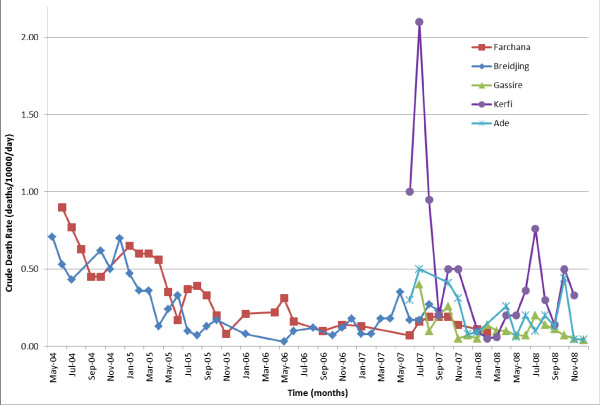
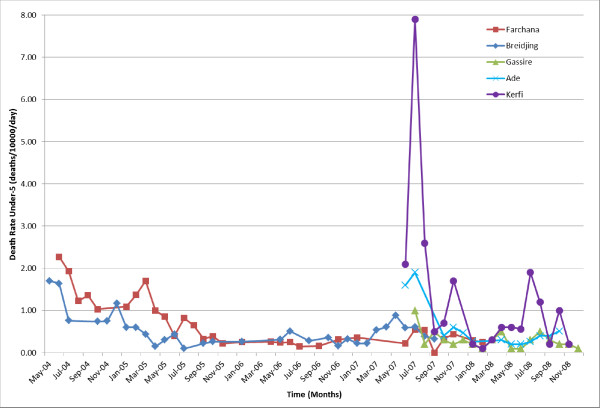
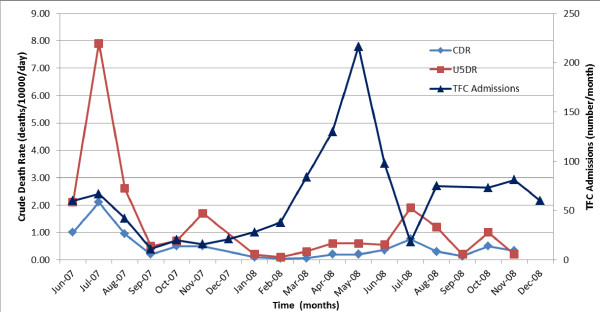
BACKGROUND: Prospective surveillance is a recognised approach for measuring death rates in humanitarian emergencies. However, there is limited evidence on how such surveillance should optimally be implemented and on how data are actually used by agencies. This case study investigates the implementation and utilisation of mortality surveillance data by Médecins Sans Frontières (MSF) in eastern Chad. We aimed to describe and analyse the community-based mortality surveillance system, trends in mortality data and the utilisation of these data to guide MSF's operational response. METHODS: The case study included 5 MSF sites including 2 refugee camps and 3 camps for internally displaced persons (IDPs). Data were obtained through key informant interviews and systematic review of MSF operational reports from 2004-2008. RESULTS: Mortality data were collected using community health workers (CHWs). Mortality generally decreased progressively. In Farchana and Breidjing refugee camps, crude death rates (CDR) decreased from 0.9 deaths per 10,000 person-days in 2004 to 0.2 in 2008 and from 0.7 to 0.1, respectively. In Gassire, Ade and Kerfi IDP camps, CDR decreased from 0.4 to 0.04, 0.3 to 0.04 and 1.0 to 0.3. Death rates among children under 5 years (U5DR) followed similar trends. CDR and U5DR crossed emergency thresholds in one site, Kerfi, where CDR rapidly rose to 2.1 and U5DR to 7.9 in July 2008 before rapidly decreasing to below emergency levels by September 2008. DISCUSSION: Mortality data were used regularly to monitor population health status and on two occasions as a tool for advocacy. Lessons learned included the need for improved population estimates and standardized reporting procedures for improved data quality and dissemination; the importance of a simple and flexible model for data collection; and greater investment in supervising CHWs. CONCLUSIONS: This model of community based mortality surveillance can be adapted and used by humanitarian agencies working in complex settings. Humanitarian organisations should however endeavour to disseminate routinely collected mortality data and improve utilisation of data for operational planning and evaluation. Accurate population estimation continues to be a challenge, limiting the accuracy of mortality estimates.
Overview
The claims and statistics of this paper haven’t been checked yet.
Free: it reads the open-access text and checks the first 5 claims that cite a source we can check. Create a free account to check every claim.
Integrity signals
Registry
Cites
Statistics
Figures
Verification
Claims the paper makes
The claims and statistics of this paper haven’t been checked yet.
Free: it reads the open-access text and checks the first 5 claims that cite a source we can check. Create a free account to check every claim.
Claims other papers make about this one
Each is checked against this paper’s own text: does it say what the citing paper says it does?
The cited source says what the claim attributes to it.
In the citing paper
“In instances where it is conducted, crude mortality (all age groups) and under-five mortality are typically the outcomes of focus.33”
From Estimating stillbirth and neonatal mortality rate among Rohingya refugees in Bangladesh, September 2017 to December 2018: a prospective surveillance (2022) · cites this paper as [33]
Self-check
Percentages, sums and reported differences re-computed from the paper’s own numbers.
The self-check needs the paper’s full text.
Citations
Cites
(2005) · Europe PMC (PubMed Central) · Cited by 1,975
Capture-Recapture Methods in Epidemiology: Methods and Limitations
Hook, E. B., & Regal, R. R. (1995) · Epidemiologic Reviews · doi:10.1093/oxfordjournals.epirev.a036192 · Cited by 731 · cited 1×
“by using capture-recapture techniques [21-23], but these require considerable statistical expertise.”
MethodHumanitarian Charter and Minimum Standards in Humanitarian Response: The Sphere Handbook
The Sphere Project (2011) · The Sphere Project eBooks · doi:10.3362/9781908176202 · Cited by 556
A scandal of invisibility: making everyone count by counting everyone
Setel, P. W., Macfarlane, S. B., Szreter, S., Mikkelsen, L., Jha, P., Stout, S., & AbouZahr, C. (2007) · The Lancet · doi:10.1016/s0140-6736(07)61307-5 · Cited by 469 · cited 1×
“However, in much of the world, deaths are not systematically recorded [1-3]; twothirds of deaths go undocumented globally [2].”
BackgroundTHE PUBLIC HEALTH ASPECTS OF COMPLEX EMERGENCIES AND REFUGEE SITUATIONS
Toole, M., & Waldman, R. (1997) · Annual Review of Public Health · doi:10.1146/annurev.publhealth.18.1.283 · Cited by 381 · cited 1×
“However, the importance of mortality surveillance for programme monitoring means that it should be recognised as an early priority and implemented immediately where feasible [26].”
BackgroundYoung, H., & Harvey, P. (2004) · Disasters · doi:10.1111/j.0361-3666.2004.00245.x · Cited by 255
Galway, L. P., Bell, N. J., Al Shatari, S. A. E., Hagopian, A., Burnham, G. M., Flaxman, A. D., Weiss, W. M., Rajaratnam, J. K., & Takaro, T. K. (2012) · International Journal of Health Geographics · doi:10.1186/1476-072x-11-12 · Cited by 120 · cited 1×
“Death registration is particularly weak in complex emergencies where health and civil infrastructure are often poor and disrupted [4,5].”
BackgroundEthical issues in epidemiologic research and public health practice
Coughlin, S. S. (2006) · Emerging Themes in Epidemiology · doi:10.1186/1742-7622-3-16 · Cited by 106 · cited 1×
“There is an ethical obligation to the community to utilise any routinely collected data [10].”
BackgroundDocumenting Mortality in Crises: What Keeps Us from Doing Better?
Checchi, F., & Roberts, L. (2008) · PLoS Medicine · doi:10.1371/journal.pmed.0050146 · Cited by 96 · cited 4×
“There is however, no known standardised method for communitybased mortality surveillance in emergencies [1,12] and many challenges are faced in obtaining accurate mortality data in such settings.”
BackgroundSelf-citationChecchi, F., & Roberts, L. (2005) · LSHTM Research Online (London School of Hygiene and Tropical Medicine) · Cited by 81
Self-citation
Research works printed but not linked: 5
- Active Learning Network for Accountability and Performance in Humanitarian Action (ALNAP) ALNAP Annual Review 2003: Humanitarian Action: Improving Monitoring to Enhance Accountability and Learning, Introduction. [Online] Available from: http://www.alnap.org/resource/5198.aspx [Accessed 5/5/2011]
- Doctors Without Borders (MSF) 2008 Report: Chad. [Online] 2008 http://stage.doctorswithoutborders.org/publications/ar/report.cfm?id=3788&cat=activity-report[Accessed 3/30/2011]
- Centre for the Research on the Epidemiology of Disasters (CRED) Health in Complex Emergencies: Trends in 8 African Countries [Online] 2011 CE DAT 2011; Available from: http://www.cedat.be/publications. [Accessed: 02/04/2011]
- United Nations High Commissioner for Refugees (UNHCR) 2004 UNHCR statistical yearbook: Chad [Online] 2006 Available from http://www.unhcr.org/pages/49c3646c4d6.html; [Accessed 2/03/2011]
- United Nations High Commissioner for Refugees (UNHCR) 2005 UNHCR Statistical Yearbook: Chad [Online] 2007 Available from http://www.unhcr.org/pages/49c3646c4d6.html; [Accessed 2/03/2011]
Cited by
Understanding the health needs of internally displaced persons: A scoping review
Cantor, D. J., Swartz, J., Roberts, B., Abbara, A., Ager, A., Bhutta, Z. A., Blanchet, K., Bunte, D. M., Chukwuorji, J. C., Daoud, N., et al. (2021) · Journal of Migration and Health · doi:10.1016/j.jmh.2021.100071 · Cited by 204
Checchi, F., Warsame, A., Treacy-Wong, V., Polonsky, J. A., van Ommeren, M., & Prudhon, C. (2017) · The Lancet · doi:10.1016/s0140-6736(17)30702-x · Cited by 192
“Prospective mortality surveillance, consisting of ongoing registration of deaths and population denominator updates by community health workers, is theoretically superior to surveys as it provides data for immediate action, but suffers from under-reporting and inaccurate population estimates if done with limited super…”
Self-citationChecchi, F., Stewart, B. T., Palmer, J. J., & Grundy, C. (2013) · International Journal of Health Geographics · doi:10.1186/1476-072x-12-4 · Cited by 82
“Breidjing Chad (Ouaddaï Region) Refugee camp Sudanese refugees from Darfur 26,770 UNHCR registration (unpublished data) 31 Dec 2005 30 Jan 2006 Médecins Sans Frontières (MSF) demographic surveillance estimated 27,500 people [24].”
Self-citationCommunity health workers in humanitarian settings: Scoping review
Miller, N. P., Ardestani, F. B., Dini, H. S., Shafique, F., & Zunong, N. (2020) · Journal of Global Health · doi:10.7189/jogh.10.020602 · Cited by 72
Community-based surveillance: A scoping review
Guerra, J., Acharya, P., & Barnadas, C. (2019) · PLoS ONE · doi:10.1371/journal.pone.0215278 · Cited by 67
Ratnayake, R., Tammaro, M., Tiffany, A., Kongelf, A., Polonsky, J. A., & McClelland, A. (2020) · The Lancet Planetary Health · doi:10.1016/s2542-5196(20)30221-7 · Cited by 60
Conflict and Health: seven years of advancing science in humanitarian crises
Ratnayake, R., Degomme, O., Roberts, B., & Spiegel, P. B. (2014) · Conflict and Health · doi:10.1186/1752-1505-8-7 · Cited by 57
“First, we are three new Editors-in-Chief and have 2% 2% 2% 2% 2% 2% 3% 3% 3% 3% 4% 5% 6% 6% 6% 9% 10% 11% Afghanistan Ethiopia India South Sudan Guinea Nepal Colombia Kosovo Somalia UNHCR camps Kenya Thailand Myanmar Iraq Not specific to a country Uganda Democratic Republic of Congo Multiple countries 0% 1% 2% 3% 4% 5…”
BackgroundInfluentialThe effect of war on infant mortality in the Democratic Republic of Congo
Lindskog, E. E. (2016) · BMC Public Health · doi:10.1186/s12889-016-3685-6 · Cited by 57
Global Health Security Agenda Implementation: A Case for Community Engagement
Armstrong-Mensah, E. A., & Ndiaye, S. M. (2018) · Health Security · doi:10.1089/hs.2017.0097 · Cited by 27
van Boetzelaer, E., Chowdhury, S., Etsay, B., Faruque, A. S. G., Lenglet, A., Kuehne, A., Martín, A. I. C., Keating, P., Dada, M., Vyncke, J., et al. (2020) · PLoS ONE · doi:10.1371/journal.pone.0244214 · Cited by 23
Performance Assessment of Communicable Disease Surveillance in Disasters: A Systematic Review
Babaie, J., Ardalan, A., Vatandoost, H., Goya, M. M., & Akbarisari, A. (2015) · PLoS Currents · doi:10.1371/currents.dis.c72864d9c7ee99ff8fbe9ea707fe4465 · Cited by 22
Jarrett, P., Zadravecz, F. J., O'Keefe, J., Nshombo, M., Karume, A., & Roberts, L. (2020) · Disasters · doi:10.1111/disa.12370 · Cited by 17
What we do know (and could know) about estimating population sizes of internally displaced people
Ratnayake, R., Abdelmagid, N., & Dooley, C. (2022) · Journal of Migration and Health · doi:10.1016/j.jmh.2022.100120 · Cited by 15
“over- or under-estimation of population denominators and therefore inaccuracy in morbidity, mortality, and service coverage indicators that are used to facilitate vaccination campaigns, health service planning, and overall resource allocation (Diggle et al., 2017; Bowden et al., 2012).”
BackgroundRubenstein, B. L., Spencer, C., Mansourian, H., Noble, E., Munganga, G. B., & Stark, L. (2015) · Child Abuse & Neglect · doi:10.1016/j.chiabu.2015.09.002 · Cited by 13
A rapid assessment of mortality surveillance in Uganda
Zalwango, M. G., Kyozira, C., Nambuya, M., Bulamu, M., & Muruta, A. N. (2025) · PLOS Global Public Health · doi:10.1371/journal.pgph.0003722 · Cited by 11
“Other countries have implemented community-based mortality surveillance through the use of VHTs to collect data, submit it to the sub-national level for verification and later to the national level by the VHT supervisors [13].”
Amsalu, R., Costello, J., Hasna, Z., & Handzel, E. (2022) · BMJ Global Health · doi:10.1136/bmjgh-2021-008110 · Cited by 8
Evaluation of an HIV-Related Mortuary Surveillance System - Nairobi, Kenya, Two Sites, 2015.
Ali, H., Kiama, C., Nyagah, L. M., Waruru, A., Young, P. W., Zielinski-Gutiérrez, E., Waruiru, W., Harklerode, R., Kim, A. A., Swaminathan, M., et al. (2018) · PubMed Central · doi:10.15585/mmwr.ss6714a1 · Cited by 6
Checchi, F. (2023) · Conflict and Health · doi:10.1186/s13031-023-00516-x · Cited by 5
“Firstly, prospective demographic surveillance may be established either exhaustively or in sentinel sites: at its simplest, this consists of home visitors collecting weekly or monthly data on births, deaths and migration from households [20].”
BackgroundSelf-citationDarin, É. (2025) · Big Data & Society · doi:10.1177/20539517251403948 · Cited by 4
“Inadequate population fi gures can produce a distorted picture of reality and lead to inappropriate responses; for example, in eastern Chad, mortality rates were underestimated fourfold between 2006 and 2010 due to an overestimation of the population (Bowden et al., 2012).”
Estimating death rates in complex humanitarian emergencies using the network survival method
Breen, C. F., Rahman, S. U., Kay, C., Smits, J., Azar, A., Ahuka, S. M., & Feehan, D. M. (2025) · American Journal of Epidemiology · doi:10.1093/aje/kwaf101 · Cited by 4
Evaluation of the Performance of OraQuick Rapid HIV-1/2 Test Among Decedents in Kisumu, Kenya
Opollo, V., Nyakeriga, E., Kingwara, L., Sila, A., Oguta, M., Oyaro, B., Onyango, D., Mboya, F. O., Waruru, A., Musingila, P., et al. (2021) · JAIDS Journal of Acquired Immune Deficiency Syndromes · doi:10.1097/qai.0000000000002857 · Cited by 4
Mary, M., Tappis, H., Scudder, E., & Creanga, A. A. (2025) · BMC Public Health · doi:10.1186/s12889-025-24440-2 · Cited by 3
“As in other studies, recruitment of actors to work within the communities where they reside imparts great benefit in terms of community acceptability and buy-in and assists in overcoming socio-cultural barriers [59, 69, 70].”
Mortality Data in Service of Conflict-Affected Populations
Silva, R., & Mizoguchi, N. (2019) · Palgrave Macmillan UK eBooks · doi:10.1057/978-1-137-54984-6_13 · Cited by 2
Health of people who are displaced in their own countries is a neglected global crisis
Cantor, D. J., Roberts, B., & Swartz, J. (2024) · Nature · doi:10.1038/d41586-024-03760-0 · Cited by 2
MacFarlane, M., Rubenstein, B. L., Saw, T., Mekonnen, D. A., Spencer, C., & Stark, L. (2019) · BMC International Health and Human Rights · doi:10.1186/s12914-019-0203-9 · Cited by 2
Assessing data quality in the community health worker (CHW) program in Eastern province, Rwanda
Mitsunaga, T. (2014) · Cited by 2
Tiffany, A. (2016) · edoc (University of Basel) · doi:10.5451/unibas-006699285
Role of Primary Care Providers and Integrated Disease Surveillance in Chad
Samba, D. S. G. (2019) · ScholarWorks (Walden University)
Mortality Estimation in Conflict-Affected Settings: A Scoping Review of the Methodological LandscapePreprint
D’Mello-Guyett, L., Olson, S. K., & Dahab, M. (2026) · Research Square · doi:10.21203/rs.3.rs-11689330/v1
Metadata
- Authors
- Bowden, S., Braker, K., Checchi, F., & Wong, S.
- Affiliations
- Imperial College London (GB)
- London School of Hygiene & Tropical Medicine (GB)
- Médecins Sans Frontières (GB)
- Corresponding author
- Bowden, Sarah
- Venue
- Conflict and Health
- Published
- 2012-11-27
- Volume
- 6
- Issue
- 1
- Pages
- 11-11
- ISSN
- 1752-1505 (ISSN-L)
- PMC
- PMC3560199
- OpenAlex
- W2056390360
- Cited by
- 27
- References
- 23
- Citations by year
- 2025: 4 · 2024: 1 · 2023: 1 · 2022: 2 · 2021: 2 · 2020: 3 · 2019: 4 · 2018: 3 · 2017: 1 · 2016: 1 · 2015: 2 · 2014: 2 · 2013: 1
- FWCI
- 2.84
- Type
- journal article
- Language
- en
- Open access
- gold
- doi.org
- Licence
- cc-by
- creativecommons.org/licenses/by/2.0 (tdm)
- Locations
- Conflict and Health (publishedVersion, cc-by)
- Europe PMC (PubMed Central) (publishedVersion, cc-by)
- PubMed Central (publishedVersion, cc-by)
- PubMed (publishedVersion)
- LSHTM Research Online (London School of Hygiene and Tropical Medicine) (acceptedVersion)
- DOAJ (DOAJ: Directory of Open Access Journals) (submittedVersion, cc-by-sa)
- Medecins Sans Frontieres Field Research (Medecins Sans Frontieres) (submittedVersion)
- Topics
- Health Sciences › Health Professions › General Health Professions › Health and Conflict Studies
- Health Sciences › Medicine › Pediatrics, Perinatology and Child Health › Global Maternal and Child Health
- Health Sciences › Health Professions › Emergency Medical Services › Disaster Response and Management
- Keywords
- humanitarian crisis, Médecins Sans Frontières, refugee camps, internally displaced persons, community health workers, crude death rate, under-five mortality, population estimates, data quality, advocacy, eastern Chad
About these checks
Registry, retraction, Cites and statistics results are computed, not judged, with one exception: a printed reference that no index lists is read once by a model before it counts as a citation error. Claims are extracted by a model and kept only when their quote appears verbatim in the text; each cited source is then checked, with a model’s help, for whether it says what the claim relies on. Those verdicts can be wrong — read the claim’s quote and the cited source before relying on one.
Statistics and arithmetic are recomputed, not judged.
Confidence bands are shown only for fields calibrated on our annotated test set. None is calibrated yet, so no band is shown.
What counts as a claim ›How we measure confidence ›How we check this ›
Are you an author, or do you see a problem with this page? Request a review
Data sources
Bibliographic data: Semantic Scholar, OpenAlex, Crossref.
Contains information from the Semantic Scholar Academic Graph Datasets, made available under the ODC Attribution License (ODC-BY 1.0).
Semantic Scholar’s data is described in: Kinney, R., et al. (2023). The Semantic Scholar Open Data Platform. arXiv:2301.10140.
