

The DOI matches its Crossref record; 38 of the 38 references it cites were found in a registry or an index.
Sexual and gender-based violence in areas of armed conflict: a systematic review of mental health and psychosocial support interventions
Open accessAbstract
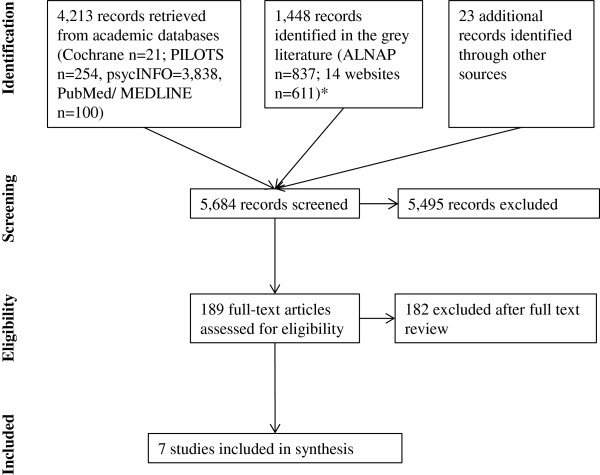
BACKGROUND: Sexual and other forms of gender-based violence are common in conflict settings and are known risk factors for mental health and psychosocial wellbeing. We present findings from a systematic review of the academic and grey literature focused on the effectiveness of mental health and psychosocial support interventions for populations exposed to sexual and other forms of gender-based violence in the context of armed conflicts. METHODS: We searched the Cochrane Database of Systematic Reviews, Cochrane Controlled Trials Register, PubMed/ Medline, psycINFO, and PILOTS, as well as grey literature to search for evaluations of interventions, without date limitations. RESULTS: Out of 5,684 returned records 189 full text papers were assessed for eligibility. Seven studies met inclusion criteria: 1 non-randomized controlled study; 3 non-controlled pre- post-test designs; 1 retrospective cohort with a matched comparison group; and 2 case studies. Studies were conducted in West and Central Africa; Albania; UK and USA, included female participants, and focused on individual and group counseling; combined psychological, medical, social and economic interventions; and cognitive behavioral therapy (two single case studies). CONCLUSIONS: The seven studies, while very limited, tentatively suggest beneficial effects of mental health and psychosocial interventions for this population, and show feasibility of evaluation and implementation of such interventions in real-life settings through partnerships with humanitarian organizations. Robust conclusions on the effectiveness of particular approaches are not possible on the basis of current evidence. More rigorous research is urgently needed.
Overview
The claims and statistics of this paper haven’t been checked yet.
Run the check — free, no account needed. It reads the open-access text and checks the sources it cites.
Integrity signals
Registry
Cites
Statistics
Figures
Verification
Claims the paper makes
The claims and statistics of this paper haven’t been checked yet.
Run the check — free, no account needed. It reads the open-access text and checks the sources it cites.
Claims other papers make about this one
Each is checked against this paper’s own text: does it say what the citing paper says it does?
The check wasn’t confident either way, so it gives no verdict — never disputed.
In the citing paper
“Although previous studies have evaluated effective treatment strategies with conflict-affected women and girls, 5,16 there remains a paucity of knowledge on how to bring mental health supports to the required scale. 17”
From Guided self-help to reduce psychological distress in South Sudanese female refugees in Uganda: A cluster randomised trial (2020) · cites this paper as [17]
Experimental — accuracy not yet measured
Self-check
Percentages, sums and reported differences re-computed from the paper’s own numbers.
The self-check needs the paper’s full text.
Citations
Cites
The world report on violence and health
Krug, E. G., Mercy, J. A., Dahlberg, L. L., & Zwi, A. B. (2002) · The Lancet · doi:10.1016/s0140-6736(02)11133-0 · Cited by 9,110
Downs, S. H., & Black, N. (1998) · Journal of Epidemiology and Community Health · doi:10.1136/jech.52.6.377 · Cited by 8,252
Armed Conflict 1946-2001: A New Dataset
GLEDITSCH, N. P., WALLENSTEEN, P., ERIKSSON, M., SOLLENBERG, M., & STRAND, H. (2002) · Journal of Peace Research · doi:10.1177/0022343302039005007 · Cited by 3,846 · cited 1×
“Data was obtained from the International Peace Research Institute (the Uppsala Conflict Data Program) [15-23] and the Heidelberg Institute for International Conflict Research [24-27].”
MethodIASC Guidelines on Mental Health and Psychosocial Support in Emergency Settings
Carll, E. K. (2008) · PsycEXTRA Dataset · doi:10.1037/e518422011-002 · Cited by 681
Mental health and psychosocial support in humanitarian settings: linking practice and research
Tol, W. A., Barbui, C., Galappatti, A., Silove, D., Betancourt, T. S., Souza, R., Golaz, A., & van Ommeren, M. (2011) · The Lancet · doi:10.1016/s0140-6736(11)61094-5 · Cited by 625 · cited 4×
“Despite the increasing use of MHPSS interventions and publication of consensus guidelines on good practice, a wide gap has been reported between popular practices and knowledge on effectiveness of interventions in this field [14].”
BackgroundMethodInfluentialSelf-citationWessells, M. (2010) · 57th Annual Meeting (October 26-31, 2010) · Cited by 544
Controlled trial of psychotherapy for Congolese survivors of sexual violence
Bass, J. K., Annan, J., McIvor Murray, S., Kaysen, D., Griffiths, S., Cetinoglu, T., Wachter, K., Murray, L. K., & Bolton, P. A. (2013) · New England Journal of Medicine · doi:10.1056/nejmoa1211853 · Cited by 423
Rivas, C. A., Ramsay, J., Sadowski, L. S., Davidson, L. L., Dunne, D., Eldridge, S. M., Hegarty, K. L., Taft, A., & Feder, G. S. (2015) · Cochrane Database of Systematic Reviews · doi:10.1002/14651858.cd005043.pub3 · Cited by 410 · cited 1×
“In addition, we searched the reference lists of a number of relevant reviews [28-33] and the reference lists of included evaluation studies.”
MethodA Systematic Review of Prevalence Studies of Gender-Based Violence in Complex Emergencies
Stark, L., & Ager, A. (2011) · Trauma, Violence, & Abuse · doi:10.1177/1524838011404252 · Cited by 386 · cited 1×
“Despite reports of large amounts of people surviving sexual and other forms of gender-based violence in the context of armed conflicts [8], high levels of psychological distress and mental disorders in this population [9-11], and the increasing popularity of preventive and treatment strategies [7,13], very little is k…”
BackgroundStatistics Notes: Some examples of regression towards the mean
Bland, J. M., & Altman, D. G. (1994) · BMJ · doi:10.1136/bmj.309.6957.780 · Cited by 381
Research works printed but not linked: 11
- Wood EJ: Sexual violence during war: explaining variation. Order, Conflict and Violence Conference. 2004, New Haven, CT: Yale University
- Ward J, Marsh M: Sexual Violence Against Women and Girls in War and Its Aftermath: Realities, Responses, and Required Resources. 2006, Belgium: United Nations Population Fund (UNFPA)
- Inter-Agency Standing Committee [IASC]: Guidelines for Gender-Based Violence Interventions in Humanitarian Settings: Focusing on Prevention of and Response to Sexual Violence in Emergencies (Field Test Version). 2005, Geneva: Inter-Agency Standing Committee
- Heidelberg Institute for International Conflict Research: Conflict Barometer 2006. 2006, Heidelberg, Germany: HIIK
- Heidelberg Institute for International Conflict Research: Conflict Barometer 2007. 2007, Heidelberg, Germany: HIIK
- Heidelberg Institute for International Conflict Research: Conflict Barometer 2008. 2008, Heidelberg, Germany: HIIK
- Heidelberg Institute for International Conflict Research: Conflict Barometer 2009. 2009, Heidelberg, Germany: HIIK
- Dehaybi S: Brief Systematic Review on the Prevalence, Factors, and Psychosocial Therapies Surrounding Global Sexual Violence. 2011, Geneva: World Health Organization
- Ager A, Ager W, Stavrou V, Boothby N: Inter-Agency Guide to the Evaluation of Psychosocial Programming in Emergencies. 2011, New York: UNICEF
- Bolton P: Assessing the Impact of the IRC Program for Survivors of Gender Based Violence in Eastern Democratic Republic of Congo - Final Report. 2009, Washington, DC: USAID; International Rescue Committee; Johns Hopkins Bloomberg School of Public Health
- Plester G: Evaluation of a group counselling for traumatised women in Albani. 2007, Medica Mondiale, http://www.medicamondiale.org/fileadmin/content/07_Infothek/Trauma/Evaluation_group_counselling_Albania_english_summary.pdf .
Cited by
Sorted by citations
Tol, W. A., Leku, M. R., Lakin, D. P., Carswell, K., Augustinavicius, J., Adaku, A., Au, T. M., Brown, F. L., Bryant, R. A., Garcia-Moreno, C., et al. (2020) · The Lancet Global Health · doi:10.1016/s2214-109x(19)30504-2 · Cited by 249
“17 Against these challenges, it is clear that addressing the substantive mental health needs in humanitarian settings will require further innovation.”
BackgroundBa, I., & Bhopal, R. S. (2016) · Public Health · doi:10.1016/j.puhe.2016.07.019 · Cited by 212
Lwamba, E., Shisler, S., Ridlehoover, W., Kupfer, M., Tshabalala, N., Nduku, P. M., Langer, L., Grant, S., Sonnenfeld, A., Anda, D., et al. (2022) · Campbell Systematic Reviews · doi:10.1002/cl2.1214 · Cited by 301
Murray, L. K., Tol, W. A., Jordans, M. J. D., Sabir, G., Amin, A. M., Bolton, P. A., Bass, J., Bonilla-Escobar, F. J., & Thornicroft, G. (2014) · Intervention · doi:10.1097/wtf.0000000000000070 · Cited by 127
Gender-based violence against adolescent girls in humanitarian settings: a review of the evidence
Stark, L., Seff, I., & Reis, C. (2020) · The Lancet Child & Adolescent Health · doi:10.1016/s2352-4642(20)30245-5 · Cited by 90
Kamali, M., Munyuzangabo, M., Siddiqui, F. J., Gaffey, M. F., Meteke, S., Als, D., Jain, R., Radhakrishnan, A., Shah, S., Ataullahjan, A., et al. (2020) · BMJ Global Health · doi:10.1136/bmjgh-2019-002014 · Cited by 104
Kiss, L., Quinlan-Davidson, M., Pasquero, L., Tejero, P. O., Hogg, C. L., Theis, J., PARK, A. W., Zimmerman, C., & Hossain, M. (2020) · Conflict and Health · doi:10.1186/s13031-020-0254-5 · Cited by 87
Gibbs, A., Corboz, J., Chirwa, E. D., Mann, C., Karim, F., Shafiq, M., Mecagni, A., Maxwell-Jones, C., Noble, E., & Jewkes, R. K. (2020) · BMJ Global Health · doi:10.1136/bmjgh-2019-001946 · Cited by 79
“…management approaches show promise in reducing symptoms of depression and poor mental health, including in conflict and humanitarian settings, 18 19 in settings of abject poverty, and where IPV is common, interventions seeking to strengthen women’s livelihoods and reduce IPV experience may also…”
Keith, T., Hyslop, F., & RICHMOND, R. L. (2022) · Trauma Violence & Abuse · doi:10.1177/15248380211068136 · Cited by 78
Paphitis, S. A., Bentley, A., Asher, L., Osrin, D., & Oram, S. (2022) · PLoS ONE · doi:10.1371/journal.pone.0264845 · Cited by 71
Conflict and Health: seven years of advancing science in humanitarian crises
Ratnayake, R., Degomme, O., Roberts, B., & Spiegel, P. B. (2014) · Conflict and Health · doi:10.1186/1752-1505-8-7 · Cited by 57
“One systematic review looked at t he confluence of the two areas by reviewing the effectiveness of mental health inte rventions for persons affected by sexual and gender based violence [38].”
BackgroundSpangaro, J., Toole‐Anstey, C., MacPhail, C. L., Rambaldini‐Gooding, D., Keevers, L., & Garcia‐Moreno, C. (2021) · Conflict and Health · doi:10.1186/s13031-021-00417-x · Cited by 63
Noble, E., Ward, L., French, S., & Falb, K. (2017) · Trauma Violence & Abuse · doi:10.1177/1524838017699601 · Cited by 56
Koebach, A., Ruf‐Leuschner, M., & Elbert, T. R. (2018) · BMC Psychiatry · doi:10.1186/s12888-018-1757-0 · Cited by 57
“PTSD patients typically suffer from the cognitive, emotional, and physiological re-experiencing of their traumatic event(s) (B-criterion), avoidance of trauma reminders (C-criterion), an alteration of mood and cognition (D-criterion), and hyperarousal (E-criterion) [6].”
BackgroundMethodInfluentialHjort, L., Rushiti, F., Wang, S.-J., Fransquet, P., P Krasniqi, S., I Çarkaxhiu, S., Arifaj, D., Xhemaili, V. D., Salihu, M., A Leku, N., et al. (2021) · Epigenomics · doi:10.2217/epi-2021-0015 · Cited by 51
Glass, N. E., Perrin, N., Marsh, M., Clough, A. S., Desgroppes, A., Kaburu, F., Ross, B., & Read-Hamilton, S. (2019) · BMJ Open · doi:10.1136/bmjopen-2018-023819 · Cited by 52
Gray, B., Hanna, F., & Reifels, L. (2020) · International Journal of Environmental Research and Public Health · doi:10.3390/ijerph17061900 · Cited by 50
Annan, J. R., Falb, K., Kpebo, D. O., Hossain, M., & Gupta, J. (2017) · Cambridge Prisms Global Mental Health · doi:10.1017/gmh.2017.19 · Cited by 44
“The review found it difficult to draw robust conclusions due to study limitations; none of the studies included random assignment to treatment and only one of the seven studies had a controlled comparison group (Tol et al. 2013).”
BackgroundDawson, K. S., Schafer, A., Anjuri, D., Ndogoni, L., Musyoki, C., Sijbrandij, M., van Ommeren, M., & Bryant, R. A. (2016) · BMC Psychiatry · doi:10.1186/s12888-016-1117-x · Cited by 43
“Few psychological interventions targeting survivors of GBV in LMIC have undergone rigorous scientific evaluation and therefore their efficacy and effectiveness remain indeterminate [5, 13].”
BackgroundRubini, E., Valente, M., Trentin, M., Facci, G., Ragazzoni, L., & Gino, S. (2023) · International Journal for Equity in Health · doi:10.1186/s12939-023-02038-7 · Cited by 53
Sexual violence as a weapon of war in Ukraine
Boesten, J. (2022) · BMJ · doi:10.1136/bmj.o1172 · Cited by 36
Responding to the needs of survivors of sexual violence: Do we know what works?
Schopper, D. (2014) · International Review of the Red Cross · doi:10.1017/s1816383114000460 · Cited by 36
Ryan, G. K., Bauer, A., Endale, T., Qureshi, O., Doukani, A., Pashoja, A. C., Brar, S. K., Eaton, J., & Bass, J. (2021) · Conflict and Health · doi:10.1186/s13031-021-00363-8 · Cited by 36
Glass, N. E., Perrin, N., Clough, A. S., Desgroppes, A., Kaburu, F., Melton, J., Rink, A., Read-Hamilton, S., & Marsh, M. (2018) · Conflict and Health · doi:10.1186/s13031-018-0138-0 · Cited by 38
Null, C., Hombrados, J. G., (3ie), I. I. F. I. E., Kremer, M. R., Meeks, R. C., Miguel, E. A., & Zwane, A. P. (2012) · doi:10.23846/sr1003 · Cited by 33
Amone‐P’Olak, K., Lekhutlile, T. M., Ovuga, E., Abbott, R., Meiser‐Stedman, R., Stewart, D. G., & Jones, P. B. (2016) · BMC Public Health · doi:10.1186/s12889-016-2735-4 · Cited by 33
Tol, W. A., Greene, M. C., Likindikoki, S. L., Misinzo, L., Ventevogel, P., Bonz, A. G., Bass, J., & Mbwambo, J. K. K. (2017) · BMC Psychiatry · doi:10.1186/s12888-017-1338-7 · Cited by 37
“Development of the Nguvu Intervention: A previous systematic review identified only one randomized controlled trial of a mental health and psychosocial support intervention for gender-based violence affected populations in the context of armed conflict in a low-resource setting [33].”
BackgroundHogwood, J., Mushashi, C., Jones, S., & Auerbach, C. (2017) · Journal of Adolescent Research · doi:10.1177/0743558417713302 · Cited by 33
“So far, only a small amount of research has explored the evaluation of psychosocial interventions in Rwanda (Richters et al., 2013; Tol et al., 2013) from which collectivizing around shared historic trauma has been found to build positive connections by sharing and neutralizing the impact of stigma…”
BackgroundScott, J. A., Mullen, C., Rouhani, S. A., Kuwert, P., Greiner, A. L., Albutt, K. H., Burkhardt, G., Onyango, M. A., VanRooyen, M. J., & Bartels, S. A. (2017) · International Journal of Mental Health Systems · doi:10.1186/s13033-017-0171-1 · Cited by 33
Allwood, M. A., Ghafoori, B., Salgado, C., Slobodin, O., Kreither, J., Waelde, L. C., Larrondo, P., & Ramos, N. (2021) · Journal of Traumatic Stress · doi:10.1002/jts.22748 · Cited by 32
Spangaro, J., Adogu, C., Zwi, A. B., Ranmuthugala, G., & Davies, G. P. (2015) · Conflict and Health · doi:10.1186/s13031-015-0047-4 · Cited by 36
“A third review focusing on mental health and psychosocial support interventions after sexual and other forms of GBV in armed conflicts tentatively concluded that benefits occurred, though noted that robust conclusions on the effectiveness of particular approaches were not possible [20].”
BackgroundOmonijo, D., Uche, O., Nwadiafor, K. L., & Rotimi, O. A. (2013) · Open Journal of Social Science Research · doi:10.12966/ojssr.12.03.2013 · Cited by 32
Devakumar, D., Palfreyman, A., Uthayakumar-Cumarasamy, A., Ullah, N., Ranasinghe, C., Minckas, N., Nadkarni, A., Oram, S., Osrin, D., & Mannell, J. (2021) · Conflict and Health · doi:10.1186/s13031-021-00410-4 · Cited by 42
Woldetsadik, M. A., Acan, G., & Odiya, O. I. (2022) · Conflict and Health · doi:10.1186/s13031-022-00448-y · Cited by 41
“Although there has not been ample evidence of effectiveness of mental health interventions for survivors of CRSV in low-income settings [30], survivor-led groups such as WAN have been successful with providing informal group therapy to CRSV survivors, creating awareness about mental illness associated with CRSV, and r…”
BackgroundAger, A., Bancroft, C., Berger, E., & Stark, L. (2018) · Conflict and Health · doi:10.1186/s13031-018-0140-6 · Cited by 41
“These largely preventive measures need to be complemented by culturally appropriate psychosocial support of survivors [8].”
BackgroundRobbers, G. M. L., & Morgan, A. (2017) · Reproductive Health Matters · doi:10.1080/09688080.2017.1401893 · Cited by 35
“However, studies often lacked rigorous methodology and reporting, especially if conducted in conflict areas.(56,57) In a weak quality trial conducted in the Democratic Republic of Congo (DRC), female SV survivors with high levels of PTSD, anxiety and depression were randomly assigned to either individual support or co…”
BackgroundCapasso, A., Skipalska, H., Guttmacher, S. J., Tikhonovsky, N. G., Navario, P., & Castillo, T. P. (2021) · BMC Public Health · doi:10.1186/s12889-021-10830-9 · Cited by 27
“More evidence is needed on effective, acceptable and feasible interventions for survivors of sexual violence in humanitarian settings [46].”
BackgroundBangpan, M., Lambert, F., Chiumento, A., & Dickson, K. (2016) · doi:10.21201/2016.605150 · Cited by 30
“Citation This report should be cited as: Bangpan M, Felix L, Chiumento A, Dickson, K (2015), The impact of Mental Health and Psychosocial Support interventions on people affected by humanitarian emergencies: a systematic review protocol.”
Conflict-related sexual violence: a review
Stachow, E. (2020) · BMJ Military Health · doi:10.1136/jramc-2019-001376 · Cited by 24
“39”
Denov, M. S., & Piolanti, A. (2019) · Health Care For Women International · doi:10.1080/07399332.2019.1571593 · Cited by 24
Sexual minorities in conflict zones: A review of the literature
Moore, M. W., & Barner, J. R. (2017) · Aggression and Violent Behavior · doi:10.1016/j.avb.2017.06.006 · Cited by 22
Nunbogu, A. M., Elliott, S. J., & Bisung, E. (2022) · Social Science & Medicine · doi:10.1016/j.socscimed.2022.115621 · Cited by 22
Gender-based violence in the context of armed conflict in Northern Ethiopia
Tewabe, D. S., Azage, M., Wubetu, G. Y., Fenta, S. A., Worke, M. D., Asres, A. M., Alemnew, W., Kassie, G. G., Menber, Y., Mekonnen, A., et al. (2024) · Conflict and Health · doi:10.1186/s13031-023-00563-4 · Cited by 34
“Similarly, because women in developing countries are frequently in charge of basic economic support activities essential to their families’ daily lives, violence against them is used as a weapon of social disruption [34, 35].”
BackgroundBhardwaj, A., Bourey, C., Rai, S., Adhikari, R. P., Worthman, C. M., & Kohrt, B. A. (2018) · Cambridge Prisms Global Mental Health · doi:10.1017/gmh.2017.31 · Cited by 22
“Extant literature currently does not demonstrate an increased risk of IPV in armed con fl ict (Tol et al. 2013).”
The Other Red Line: The Use of Rape as an Unlawful Tactic of Warfare
Benshoof, J. (2014) · Global Policy · doi:10.1111/1758-5899.12140 · Cited by 22
Responding to sexual violence in conflict
García‐Moreno, C. (2014) · The Lancet · doi:10.1016/s0140-6736(14)60963-6 · Cited by 23
Lwamba, E., Ridlehoover, W., Kupfer, M., Shisler, S., Sonnenfeld, A., Langer, L., Eyers, J. E., Grant, S., & Barooah, B. (2021) · Campbell Systematic Reviews · doi:10.1002/cl2.1180 · Cited by 24
European refugee crisis: psychological trauma of refugees and care givers
Papadopoulos, I., & Shea, S. (2018) · International Journal of Migration Health and Social Care · doi:10.1108/ijmhsc-08-2016-0032 · Cited by 18
Hlalele, D. J., & Brexa, J. (2015) · Agenda · doi:10.1080/10130950.2015.1073439 · Cited by 17
“Acts of violence leave victims with lasting consequences “including social impacts and negative health outcomes” (Tol et al, 2013:2).”
BackgroundMarulanda, L. C. S., Aguilera-Char, A. A., González-Gil, C., & López‐López, W. (2021) · Archives of Public Health · doi:10.1186/s13690-021-00548-w · Cited by 17
“PR is relevant in reparation processes as it has been proven in different countries, its effects on lessening symptoms at the individualclinical and psychosocial levels by sharing experiences and agency, improving the way in which women victims relate to their community [24, 49].”
BackgroundGreene, M. C., Scognamiglio, T., Likindikoki, S. L., Misinzo, L., Njau, T., Bonz, A. G., Ventevogel, P., Mbwambo, J. K. K., & Tol, W. A. (2022) · Global Public Health · doi:10.1080/17441692.2022.2029926 · Cited by 22
Ryan, G. K., Bauer, A., Bass, J., & Eaton, J. (2018) · BMJ Open · doi:10.1136/bmjopen-2017-018193 · Cited by 17
Sapia, M. R., Wangmo, T., Dagron, S., & Elger, B. S. (2020) · BMC International Health and Human Rights · doi:10.1186/s12914-020-00244-w · Cited by 16
Denov, M. S., & Piolanti, A. (2020) · Child Abuse & Neglect · doi:10.1016/j.chiabu.2020.104560 · Cited by 16
Abrahams, N., & Gevers, A. (2017) · South African Journal of Psychiatry · doi:10.4102/sajpsychiatry.v23.959 · Cited by 16
Mpinga, E. K., Koya, M. M., Hasselgård-Rowe, J., Jeannot, É., Rehani, S. B., & Chastonay, P. (2016) · Trauma Violence & Abuse · doi:10.1177/1524838016650184 · Cited by 16
Kaysen, D. L., Stappenbeck, C. A., Carroll, H. A., Fukunaga, R., Robinette, K., Dworkin, E. R., Murray, S. M., Tol, W. A., Annan, J. R., Bolton, P. A., et al. (2020) · European Journal of Psychotraumatology · doi:10.1080/20008198.2020.1735162 · Cited by 18
“…occur when treating trauma in the context of ongoing conflict (Bass et al., 2013; Gillespie et al., 2002; Murray et al., 2013; Robjant, Roberts, & Katona, 2017; Tol et al., 2013), but expands this work to suggest that the degree of safety risk posed by a setting does not appear to affect outcomes.”
BackgroundResultTrani, J., Escallon, J. V., & Bakhshi, P. (2020) · Conflict and Health · doi:10.1186/s13031-021-00397-y · Cited by 13
Wondie, Y., Zeleke, W. A., & Melesse, M. (2023) · PLoS ONE · doi:10.1371/journal.pone.0289106 · Cited by 15
“This includes 39% of women during the Rwandan genocide, 25% of women in Azerbaijan, 19% of women in Burundi, and 11% displaced women in Cambodia [2, 3].”
BackgroundAmisi, C., Biaba, R., Cikara, A., Østby, G., Nordås, R., Rustad, S. A., & Quattrochi, J. P. (2018) · Medicine Conflict & Survival · doi:10.1080/13623699.2018.1541625 · Cited by 13
“One broader systematic review of the academic and grey literature by Tol et al. (2013) focusing on ‘the effectiveness of mental health and psychosocial support interventions for populations exposed to sexual and other forms of gender-based violence in the context of armed conflicts’ found that…”
BackgroundHigh rates of COVID-19 vaccine refusal among Afghan pregnant women: a cross sectional study
Nemat, A., Yaftali, S., Danishmand, T. J., Nemat, H., Raufi, N. K., & Asady, A. (2022) · Scientific Reports · doi:10.1038/s41598-022-18497-x · Cited by 10
Lobanov‐Rostovsky, S., & Kiss, L. (2022) · Cambridge Prisms Global Mental Health · doi:10.1017/gmh.2022.55 · Cited by 12
“The most recent systematic review of psychosocial interventions for survivors of sexual violence included data ranging from over a decade ago (Tol et al., 2013).”
BackgroundSeff, I., Koris, A., Giuffrida, M., Ibala, R., Anderson, K., Shalouf, H., Deitch, J., & Stark, L. (2022) · International Journal of Environmental Research and Public Health · doi:10.3390/ijerph192215357 · Cited by 10
“Adolescents in Gaza expressed reduced anti-social behavior, depressive sequelae, and aggression in households characterized by increased parental support and warm parenting practices [27,28].”
BackgroundBreaking the silence through MANTRA: Empowering Tamil MAN survivors of torture and rape
Fernandes, P., & Aiello, Y. (2018) · Torture Journal · doi:10.7146/torture.v28i3.111181 · Cited by 10
Wachter, K., & Snyder, S. (2018) · Affilia · doi:10.1177/0886109918766620 · Cited by 12
“…consequences of violence against women in armed conflict and forced displacement (Abrahams et al., 2014; Stark & Ager, 2011; Stark & Wessells, 2012; Tol et al., 2013; Vu et al., 2013), practitioners in the United States and other resettlement sexual violence that may carry into resettlement…”
BackgroundImproving and sustaining livelihoods through group-based interventions: mapping the evidence
(3ie), I. I. F. I. E., Barooah, B., Chinoy, S. L., 3ie, Dubey, P., 3ie, Sarkar, R., 3ie, Bagai, A., 3ie, et al. (2019) · doi:10.23846/egm013 · Cited by 15
Olaluwoye, T., Hoban, E., Connors, P., & Williams, J. W. (2022) · American Journal of Men s Health · doi:10.1177/15579883221084496 · Cited by 9
“Recruiting participants through NGOs may not always be possible considering that there are not many such organizations that support male refugees specifically, and that the male sexual violence survivors themselves may be reluctant to approach the existing organizations (Chynoweth et al., 2017; Spangaro et al., 2013;…”
BackgroundInfluentialAbrahams, N., & Gevers, A. (2017) · South African Journal of Psychiatry · doi:10.4102/sajpsychiatry.v23i0.959 · Cited by 9
Bennett, C., Banda, M., Miller, L., Ciza, J., Clemmer, W., Linehan, M., & Sthreshley, L. (2017) · Development in Practice · doi:10.1080/09614524.2017.1329400 · Cited by 9
“There is a growing evidence base for the efficacy of trauma-focused cognitive behavioural therapy (O’Callaghan et al. 2013), cognitive processing therapy (Bass et al. 2013), and other forms of mental health and psychosocial support interventions in improving mental health outcomes (Tol et al. 2013).”
BackgroundJonas, K. A. W. M., Tang, H., Deng, L.-C., Yu, Y., Baptiste, K. N. J., KISUNGU, B. K., Opoku, S., & Meng, H. (2020) · Journal of Interpersonal Violence · doi:10.1177/0886260520976221 · Cited by 8
“…prevalence rates of the current study were higher even when compared to the levels of sexual and gender-based violence recorded by prior studies conducted in other African countries affected by armed conflict: 11% in Colombia, 19% in Burundi, 39% in Rwanda (Tol et al., 2013; Ward & Marsh, 2006).”
BackgroundResultInfluentialGreene, M. C., Bencomo, C., Rees, S. J., Ventevogel, P., Likindikoki, S. L., Nemiro, A., Bonz, A. G., Mbwambo, J. K. K., Tol, W. A., & McGovern, T. (2021) · International Journal of Environmental Research and Public Health · doi:10.3390/ijerph182312484 · Cited by 15
“Psychological interventions for survivors of IPV have shown promising impacts on reducing the symptoms of common mental health problems [21].”
BackgroundMorgan, R., Asiimwe, L., Ager, A. L., Haq, Z., Thumba, L., & Shcherbinina, D. (2023) · Health Policy and Planning · doi:10.1093/heapol/czad005 · Cited by 8
Murphy, M., Ellsberg, M. C., Balogun, A., & García‐Moreno, C. (2021) · Systematic Reviews · doi:10.1186/s13643-021-01795-2 · Cited by 10
Njoku, E. T. (2019) · Small Wars and Insurgencies · doi:10.1080/09592318.2019.1649830 · Cited by 8
Cornelius, T. L., Jozkowski, K. N., Ross, J. M., Reidy, D. E., Wehle, S. M. J., Temple, J. R., & Drouin, M. A. (2024) · International Journal of Law and Psychiatry · doi:10.1016/j.ijlp.2024.102034 · Cited by 7
‘A woman’s place…’: community-based approaches to gender-based violence in Malawi
Gaynor, N., & Cronin, M. (2017) · Community Development Journal · doi:10.1093/cdj/bsx034 · Cited by 7
“A number of quantitative studies (Abramsky and Devries, 2012, Kohli, 2012, Tol 2013) find CBAs effective in both GBV prevention and in service take-up.”
BackgroundAlbezreh, S., Anastario, M. P., Ulibarrí, B. J., Naimer, K., Johnson, K., McHale, T., Mishori, R., Macias‐Konstantopoulos, W., Olson, R. M., & Nelson, B. D. (2022) · Violence Against Women · doi:10.1177/10778012221099984 · Cited by 7
“Sexual and other forms of gender-based violence increase in prevalence in times of conflict and are known risk factors for mental health conditions and reduced psychosocial well-being (Tol et al., 2013).”
BackgroundAbrahams, N., & Gevers, A. (2017) · South African Journal of Psychiatry · doi:10.4102/sajpsychiatry.v23i1.959 · Cited by 7
Yosep, I., Suryani, S., Mediani, . S., Mardhiyah, A., & Hernawaty, T. (2024) · BMC Nursing · doi:10.1186/s12912-024-02130-5 · Cited by 8
“Another study showed that nursing interventions can effectively reduce symptoms of low self-esteem in victims of sexual violence [14, 15].”
BackgroundSexual and Gender-Based Violence as Warfare
Cherepanov, E. (2021) · Springer eBooks · doi:10.1007/978-3-319-89999-2_106 · Cited by 6
Rasheed, O. S., López‐Rodríguez, L., & Navas, M. (2022) · BMC Psychology · doi:10.1186/s40359-022-00973-8 · Cited by 8
Interventions to promote social cohesion in Sub-Saharan Africa
King, E., & Samii, C. (2012) · doi:10.23846/sr1012 · Cited by 7
Martins, N., Soares, D., Gusmão, C., Nunes, M., Abrantes, L., Valadares, D., Marcal, S., Mali, M. A., Alves, L., Martins, J., et al. (2024) · PLoS ONE · doi:10.1371/journal.pone.0306106 · Cited by 5
Systematic Review of Gender and Humanitarian Situations Across Africa
Nwoke, C., & Cochrane, L. (2022) · Africa Spectrum · doi:10.1177/00020397221128322 · Cited by 8
“However, it has proved difficult to measure the effectiveness of mental health and psychosocial support interventions in such complex contexts (Tol et al., 2013).”
BackgroundZraly, M., & Kagoyire, M. G. (2021) · Springer eBooks · doi:10.1007/978-3-030-66296-7_13 · Cited by 5
Disability in Humanitarian and Conflict Settings
Shah, M. H., Wayn, D. K., & Ali, N. (2025) · Springer eBooks · doi:10.1007/978-3-031-40858-8_460-1 · Cited by 5
Fréel, S., Punski‐Hoogervorst, J. L., Hoeboer, C. M., Ruzek, J. I., Beardmore, L., Olff, M., & Javakhishvili, J. D. (2026) · BMJ Global Health · doi:10.1136/bmjgh-2025-022708 · Cited by 6
“…effective-ness—rather than scope, among either highly specific populations such as women and children, 41 42 refugees and asylum seekers, 43 or following exposure to distinct types of traumatic events including natural disasters or sexual and gender-based violence 44 within armed conflict settings.”
Yalcinoz-Ucan, B., Zilney, L. J., Zientarska-Kayko, A., Ireland, T., & Browne, D. T. (2022) · BMJ Open · doi:10.1136/bmjopen-2021-060479 · Cited by 6
Lenshie, N. E., Miapyen, B. S., Idris, A., & Obi, K. C. (2025) · Society · doi:10.1007/s12115-025-01094-9 · Cited by 4
Sexual and Gender-Based Violence as Warfare
Cherepanov, E. (2019) · Springer eBooks · doi:10.1007/978-3-319-62122-7_106-1 · Cited by 4
El-Khodary, B., Christensen, I. R., Abou-Dagga, S. I., Raji, S., & Lyden, S. C. (2021) · Frontiers in Psychology · doi:10.3389/fpsyg.2021.761303 · Cited by 6
“The teachers all describe how they see psychosocial support as measures for the child’s emotional, physical, and cognitive development, highlighting a resilience perspective, seeing good mental health and developmental outcomes, despite exposure to significant adversity (Tol et al., 2013).”
BackgroundActivity Of Charity and Civil Society Organizations in Gaza
Hamarsha, M. M. (2025) · Civil Szemle · doi:10.62560/csz.2025.02.3 · Cited by 3
Jolof, L., Rocca, P., & Carlsson, T. (2024) · Archives of Public Health · doi:10.1186/s13690-023-01235-8 · Cited by 7
“…a limited number of studies investigating mental health and psychosocial support interventions for populations exposed to sexual abuse and other forms of gender-based violence in the context of armed conflicts, hindering the possibility of drawing any firm conclusions about effectiveness [28].”
BackgroundKaningini, E. W., & Vandeninden, F. (2025) · Conflict and Health · doi:10.1186/s13031-025-00674-0 · Cited by 3
Kansiime, P., van der Westhuizen, C., & Kagee, A. (2018) · Social Work and Social Sciences Review · doi:10.1921/swssr.v19i3.1196 · Cited by 2
“…that sexual violence has always been part of many armed conflicts worldwide, but it differs in the scale, type, target group and tactics (Jewkes, Sen, & Garcia-Moreno, 2012; Tol et al., 2013), and it 2 is globally recognised as a human rights violation and security issue (Cohen & Nordas, 2014).”
BackgroundResultGhafoerkhan, R. S., Lowe, L., Weme, D. N., Griede, E., & Jeffery, L. R. (2024) · Medicine Anthropology Theory · doi:10.17157/mat.11.2.7725 · Cited by 2
Seff, I., Deitch, J., Harker, A., Rodríguez, C., Andia, T. S., Pena, T. A., & Stark, L. (2024) · PLoS ONE · doi:10.1371/journal.pone.0303588 · Cited by 3
", Lassi, Z. S., & Haider, B. A. (2012) · doi:10.23846/sr1014 · Cited by 3
Lyles, E., Glass, N. E., Sidabutar, E., Roa, E. G., Hoyos, C., Pacheco, A., Sarria, D., Golay, A., Friedman, J., Argenti, E., et al. (2025) · Conflict and Health · doi:10.1186/s13031-025-00691-z · Cited by 2
“Consistent with global findings on mental health in global and humanitarian settings [38, 39], women in all three countries reported symptoms of poor mental health.”
Metadata
- Authors
- Tol, W. A., Stavrou, V., Greene, M. C., Mergenthaler, C., van Ommeren, M., & García Moreno, C.
- Affiliations
- Johns Hopkins University (US)
- Columbia University (US)
- Yale University (US)
- Corresponding author
- Tol, Wietse A
- Venue
- Conflict and Health
- Published
- 2013-08-05
- Volume
- 7
- Issue
- 1
- Pages
- 16-16
- ISSN
- 1752-1505 (ISSN-L)
- PMC
- PMC3750365
- OpenAlex
- W2158842686
- Cited by
- 137
- References
- 38
- Citations by year
- 2026: 9 · 2025: 11 · 2024: 15 · 2023: 5 · 2022: 15 · 2021: 23 · 2020: 13 · 2019: 6 · 2018: 10 · 2017: 12 · 2016: 5 · 2015: 2 · 2014: 7 · 2013: 1
- FWCI
- 2.55
- Type
- journal article
- Language
- en
- Open access
- gold
- doi.org
- Licence
- Locations
- Conflict and Health (publishedVersion, cc-by)
- Europe PMC (PubMed Central) (publishedVersion, cc-by)
- PubMed Central (publishedVersion, cc-by)
- PubMed (publishedVersion)
- Funders
- World Health Organization
- Topics
- Social Sciences › Gender Studies › Gender, Security, and Conflict
- Health Sciences › Health Professions › General Health Professions › Health and Conflict Studies
- Social Sciences › Sociology and Political Science › Conflict, Peace, and Violence in Colombia
- Keywords
- sexual violence, gender-based violence, armed conflict, mental health interventions, psychosocial support, post-traumatic stress, cognitive behavioral therapy, group counseling, humanitarian organizations, conflict-affected populations
About these checks
Registry, retraction, Cites and statistics results are computed, not judged, with one exception: a printed reference that no index lists is read once by a model before it counts as a citation error. Claims are extracted by a model and kept only when their quote appears verbatim in the text; each cited source is then checked, with a model’s help, for whether it says what the claim relies on. Those verdicts can be wrong — read the claim’s quote and the cited source before relying on one.
Statistics and arithmetic are recomputed, not judged.
Confidence bands are shown only for fields calibrated on our annotated test set. None is calibrated yet, so no band is shown.
What counts as a claim ›How we measure confidence ›How we check this ›
Are you an author, or do you see a problem with this page? Request a review
