

Primary hypothyroidism with growth failure and pituitary pseudotumor in a 13-year-old female: a case report
Open accessThe DOI matches its Crossref record; 14 of the 15 references it cites were found in a registry or an index; none of the 16 sources its claims cite is checked for support yet.
Abstract
INTRODUCTION: Primary hypothyroidism is a well-known cause of poor linear growth in children. A rare finding with profound or long-standing disease is anterior pituitary enlargement (pituitary pseudotumor). This case highlights this uncommon finding, discusses clinical situations in which gradual dose escalation of levothyroxine may be advisable and reviews adjuvant therapies that have been previously attempted to improve final height in the setting of profound hypothyroidism. CASE PRESENTATION: We report the case of a 13-year-old Hispanic girl initially evaluated for poor linear growth and delayed puberty, and found to have pituitary enlargement secondary to profound primary hypothyroidism. Treatment with progressive doses of levothyroxine normalized her symptoms and led to complete resolution of her pituitary findings, but she then rapidly progressed through puberty, achieving an adult height of only 142cm, significantly below her calculated mid-parental height. CONCLUSIONS: In cases of severe primary hypothyroidism with prolonged elevation of thyroid-stimulating hormone and pituitary pseudotumor, gradual replacement of thyroid hormone with slowly escalating doses of levothyroxine may be beneficial to prevent complications of therapy. Early recognition and treatment of hypothyroidism during childhood is essential for normal growth, as final height is invariably compromised in children with prolonged disease. Additional study is needed to determine the potential beneficial effects of gonadotropin-releasing hormone agonist and recombinant human growth hormone treatment in this setting.
Overview
CoChat Summary
TL;DR
A 13-year-old girl with profound primary hypothyroidism presented with severe growth failure and pituitary enlargement (pseudotumor), which improved with levothyroxine but was followed by rapid puberty and compromised adult height. The case illustrates that pituitary pseudotumor can resolve with thyroid hormone replacement, while final height may remain significantly reduced despite gradual dose escalation.
Key findings
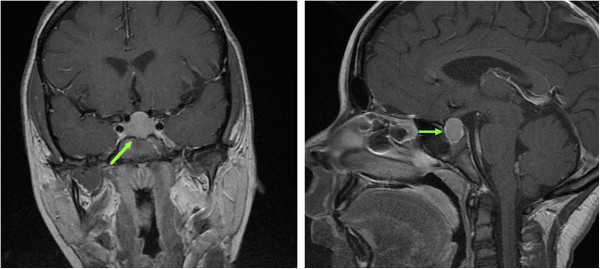
- At presentation: height SDS −5, bone age 5 years at chronological age 13 years, TSH >1000 mU/L, free T4 <0.5 pmol/L, IGF-1 11.2 nmol/L, and an enlarged pituitary measuring 1.4 cm extending into the suprasellar cistern.
- Levothyroxine was started at 25 μg/day (1.1 μg/kg/day) and gradually increased to 100 μg/day; linear growth velocity improved to 12.9 cm/year, and menarche occurred 18 months after treatment began.
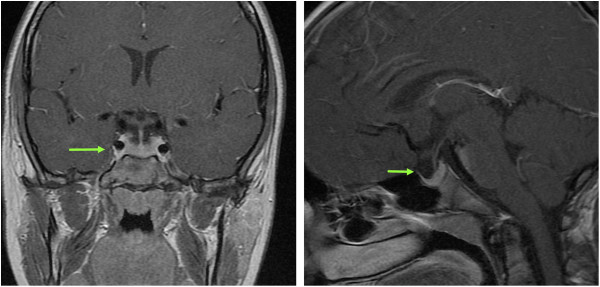
- Final adult height was 142 cm (−3 SDS), significantly below mid-parental height of 161.3 cm (−0.4 SDS); follow-up MRI at 18 months showed a normal positioned and sized pituitary gland, though the sella remained enlarged.
- The authors conclude that gradual levothyroxine escalation may be useful in selected patients with pituitary hyperplasia, cardiac pathology, or adrenal insufficiency, but appears of limited utility for height outcomes; evidence for GnRH agonist and rhGH is insufficient for routine recommendation.
Methods
- Single case report of a 13-year-old Hispanic girl evaluated for poor linear growth and delayed puberty, with clinical examination, laboratory testing, karyotype, bone age, and brain MRI.
- Treatment consisted of levothyroxine initiated at 25 μg/day and gradually increased to 100 μg/day, with follow-up growth, pubertal progression, bone age, and pituitary MRI at 18 months.
- Descriptive case reporting; no formal statistical analysis or comparison group.
Limitations
- The paper states that prolactin was not measured and thyroid peroxidase antibodies were not measured; the authors presume long-standing autoimmune thyroiditis.
- The paper states that additional study is needed to determine potential beneficial effects of GnRH agonist and rhGH treatment in this setting, and that current efficacy data are insufficient to routinely recommend these adjuvant treatments.
- Evident from the text: as a single case report, findings are not generalizable and cannot establish causality or comparative effectiveness of gradual versus rapid levothyroxine replacement.
Model-written summary. Check it against the paper before relying on it.
Integrity signals
Registry
Cites
Statistics
Figures
Verification
Claims the paper makes
0 Valid · 0 Not valid · 13 Not checked · 26 Own results and interpretations
A result the paper reports from its own data — it cites no other source for it, so there is none to check. The quote shows it is in the paper.
In the paper
“She had no breast development.”
§ Primary hypothyroidism with growth failure and pituitary pseudotumor in a 13-year-old female: a case report > Case presentation
plainSingle case- Asserted: passes — The authors put it forward as true.
- Checkable: passes — It can be checked against evidence.
- Load-bearing: unclear — It is unclear whether the paper’s conclusions depend on it.
- Based: passes — The paper gives a reason why it holds.
A result the paper reports from its own data — it cites no other source for it, so there is none to check. The quote shows it is in the paper.
In the paper
“A follow-up pituitary MRI scan that was done 18 months after treatment with levothyroxine was initiated showed persistence of the enlarged sella with a normal positioned and sized pituitary gland including normal stalk and posterior bright spot (Figure 2)”
§ Primary hypothyroidism with growth failure and pituitary pseudotumor in a 13-year-old female: a case report > Case presentation
plainSingle case- Asserted: passes — The authors put it forward as true.
- Checkable: passes — It can be checked against evidence.
- Load-bearing: passes — The paper’s conclusions depend on it.
- Based: passes — The paper gives a reason why it holds.
A result the paper reports from its own data — it cites no other source for it, so there is none to check. The quote shows it is in the paper.
In the paper
“At 14 years and 10 months of age, her bone age was 12 years”
§ Primary hypothyroidism with growth failure and pituitary pseudotumor in a 13-year-old female: a case report > Case presentation
plainSingle case- Asserted: passes — The authors put it forward as true.
- Checkable: passes — It can be checked against evidence.
- Load-bearing: unclear — It is unclear whether the paper’s conclusions depend on it.
- Based: passes — The paper gives a reason why it holds.
A result the paper reports from its own data — it cites no other source for it, so there is none to check. The quote shows it is in the paper.
In the paper
“Upon initial evaluation, she was noted to have had almost no linear growth since six years of age.”
§ Primary hypothyroidism with growth failure and pituitary pseudotumor in a 13-year-old female: a case report > Case presentation
plainSingle case- Asserted: passes — The authors put it forward as true.
- Checkable: passes — It can be checked against evidence.
- Load-bearing: passes — The paper’s conclusions depend on it.
- Based: passes — The paper gives a reason why it holds.
A result the paper reports from its own data — it cites no other source for it, so there is none to check. The quote shows it is in the paper.
In the paper
“Insulin-like growth factor 1 (IGF-1) was low for her age”
§ Primary hypothyroidism with growth failure and pituitary pseudotumor in a 13-year-old female: a case report > Case presentation
plainSingle case- Asserted: passes — The authors put it forward as true.
- Checkable: passes — It can be checked against evidence.
- Load-bearing: unclear — It is unclear whether the paper’s conclusions depend on it.
- Based: passes — The paper gives a reason why it holds.
21 more claims
Create a free account to see all 39 claims and to verify the 14 references still open.
- Probably not a substantial claim. 5
- It may state two separate claims as one. 10
Citations
Cites
Long-Term Growth in Juvenile Acquired Hypothyroidism:
Rivkees, S. A., Bode, H. H., & Crawford, J. D. (1988) · New England Journal of Medicine · doi:10.1056/nejm198803103181003 · Cited by 272 · cited 2×
“Hypothyroidism is a well-known cause of poor linear growth in children [1].”
BackgroundA potential novel mechanism for precocious puberty in juvenile hypothyroidism
Anasti, J. N. (1995) · Journal of Clinical Endocrinology & Metabolism · doi:10.1210/jc.80.1.276 · Cited by 257
Effect of Altered Thyroid Hormone Levels on Hypothalamic-Pituitary-Adrenal Function*
KAMILARIS, T. C., DEBOLD, C. R., PAVLOU, S. N., ISLAND, D. P., HOURSANIDIS, A., & ORTH, D. N. (1987) · The Journal of Clinical Endocrinology & Metabolism · doi:10.1210/jcem-65-5-994 · Cited by 51
Pituitary Gland Enlargement in Primary Hypothyroidism: A Report of 5 Cases with Follow-Up Data
Ahmed, M., Banna, M., Sakati, N., & Woodhouse, N. (1989) · Hormone Research · doi:10.1159/000181287 · Cited by 34
Catch-up Growth in Severe Juvenile Hypothyroidism: Treatment with a GnRH Analog
Teng, L., Bui, H., Bachrach, L., Lee, P., Gagné, N., Deal, C., & Wilson, D. M. (2004) · Journal of Pediatric Endocrinology and Metabolism · doi:10.1515/jpem.2004.17.3.345 · Cited by 21
Kocova, M., Netkov, S., & Sukarova-Angelovska, E. (2001) · Journal of Pediatric Endocrinology and Metabolism · doi:10.1515/jpem.2001.14.9.1665 · Cited by 20
Does clinical management impact height potential in children with severe acquired hypothyroidism?
Nebesio, T. D., Wise, M. D., Perkins, S. M., & Eugster, E. A. (2011) · Journal of Pediatric Endocrinology and Metabolism · doi:10.1515/jpem.2011.310 · Cited by 17
Primary hypothyroidism in a child simulating a prolactin-secreting adenoma
Alves, C., & Alves, A. C. (2008) · Child's Nervous System · doi:10.1007/s00381-008-0689-2 · Cited by 17
Quintos, J. B., & Salas, M. (2005) · Journal of Pediatric Endocrinology and Metabolism · doi:10.1515/jpem.2005.18.5.515 · Cited by 16
Hypothyroidism and Thyroiditis
Brent, G. A., & Davies, T. F. (2011) · Williams Textbook of Endocrinology · doi:10.1016/b978-1-4377-0324-5.00013-4 · Cited by 11
Primary Hypothyroidism Presenting as Growth Delay and Pituitary Enlargement
Farley, J. D., Toth, E. L., & Ryan, E. A. (1988) · Canadian Journal of Neurological Sciences / Journal Canadien des Sciences Neurologiques · doi:10.1017/s0317167100027153 · Cited by 6
Pericardial Effusion in the Emergency Department
Pinsker, J. E., & Ferry, R. J. (2004) · The Endocrinologist · doi:10.1097/01.ten.0000134730.77404.a2 · Cited by 2
Self-citationPrecocious puberty and a sellar mass
Bhansali, A., Jayaprakash, P., Dutta, P., Walia, R., & Ravikumar, P. (2009) · BMJ Case Reports · doi:10.1136/bcr.03.2009.1677 · Cited by 2
Lee, C., & Salvatori, R. (2012) · Endocrine Practice · doi:10.4158/ep12011vv
(2000) · PubMed
Cited by
Thyroid hormone therapy in congenital hypothyroidism and pediatric hypothyroidism
Bauer, A. J., & Wassner, A. J. (2019) · Endocrine · doi:10.1007/s12020-019-02024-6 · Cited by 70
Cao, J., Lei, T., Chen, F., Zhang, C., Ma, C., & Huang, H. (2018) · Medicine · doi:10.1097/md.0000000000012703 · Cited by 26
Kočova, M., Zdraveska, N., Kacarska, R., & Kochova, E. (2015) · Journal of Pediatric Endocrinology and Metabolism · doi:10.1515/jpem-2015-0157 · Cited by 15
“(11) reported a 13-year-old girl with growth failure and primary hypothyroidism, discussing the current controversy on treatment recommendations.”
BackgroundPituitary hyperplasia in childhood primary hypothyroidism: a review
Sapkota, S., Karn, M., & Sapkota, S. (2021) · Child s Nervous System · doi:10.1007/s00381-020-05014-6 · Cited by 14
Yu, W., & Wu, N. (2020) · Annals of Palliative Medicine · doi:10.21037/apm-20-1828 · Cited by 9
“Long-term primary hypothyroidism-induced pituitary hyperplasia has been confirmed by many studies (7,9-25).”
Background
Metadata
- Authors
- Larson, N. S., & Pinsker, J. E.
- Affiliations
- Tripler Army Medical Center (US)
- Corresponding author
- Pinsker, Jordan E
- Venue
- Journal of Medical Case Reports
- Published
- 2013-05-31
- Volume
- 7
- Issue
- 1
- Pages
- 149-149
- ISSN
- 1752-1947 (ISSN-L)
- PMC
- PMC3680092
- OpenAlex
- W2096362889
- Cited by
- 13
- References
- 14
- Citations by year
- 2025: 2 · 2024: 2 · 2021: 2 · 2020: 2 · 2019: 1 · 2018: 1 · 2017: 1 · 2015: 2
- FWCI
- 0.35
- Type
- journal article
- Language
- en
- Open access
- gold
- doi.org
- Licence
- cc-by
- creativecommons.org/licenses/by/2.0 (tdm)
- Locations
- Journal of Medical Case Reports (publishedVersion, cc-by)
- Europe PMC (PubMed Central) (publishedVersion, cc-by)
- PubMed Central (publishedVersion, cc-by)
- PubMed (publishedVersion)
- Topics
- Health Sciences › Medicine › Endocrinology, Diabetes and Metabolism › Thyroid Disorders and Treatments
- Health Sciences › Medicine › Endocrinology, Diabetes and Metabolism › Growth Hormone and Insulin-like Growth Factors
- Health Sciences › Medicine › Endocrinology, Diabetes and Metabolism › Pituitary Gland Disorders and Treatments
- Keywords
- primary hypothyroidism, growth failure, thyroid-stimulating hormone, delayed puberty, adult height, pediatric endocrinology, GnRH agonist, recombinant human growth hormone
About these checks
Registry, retraction, Cites and statistics results are computed, not judged, with one exception: a printed reference that no index lists is read once by a model before it counts as a citation error. Claims are extracted by a model and kept only when their quote appears verbatim in the text; each cited source is then checked, with a model’s help, for whether it says what the claim relies on. Those verdicts can be wrong — read the claim’s quote and the cited source before relying on one.
A language model drew the claims from the paper on 2026-11-28, under version 3 of the claim definition (model deepseek-v4.1-flash, prompt extract-v3).
A second model labelled each claim on 2026-11-28 (model jev-1.13-20260917, definition revision gold-guideline-v0.2).
Statistics and arithmetic are recomputed, not judged.
Confidence bands are shown only for fields calibrated on our annotated test set. None is calibrated yet, so no band is shown.
What counts as a claim ›How we measure confidence ›How we check this ›
Are you an author, or do you see a problem with this page? Request a review
Data sources
Bibliographic data: Semantic Scholar, OpenAlex, Crossref.
Contains information from the Semantic Scholar Academic Graph Datasets, made available under the ODC Attribution License (ODC-BY 1.0).
Semantic Scholar’s data is described in: Kinney, R., et al. (2023). The Semantic Scholar Open Data Platform. arXiv:2301.10140.
