

The DOI matches its Crossref record; 349 of the 350 references it cites were found in a registry or an index, and 1 are not checked yet.
The dominant Anopheles vectors of human malaria in Africa, Europe and the Middle East: occurrence data, distribution maps and bionomic précis
Open accessAbstract
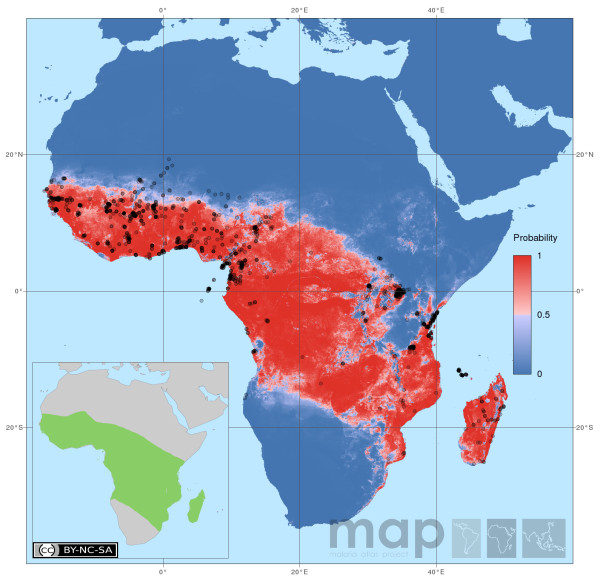
BACKGROUND: This is the second in a series of three articles documenting the geographical distribution of 41 dominant vector species (DVS) of human malaria. The first paper addressed the DVS of the Americas and the third will consider those of the Asian Pacific Region. Here, the DVS of Africa, Europe and the Middle East are discussed. The continent of Africa experiences the bulk of the global malaria burden due in part to the presence of the An. gambiae complex. Anopheles gambiae is one of four DVS within the An. gambiae complex, the others being An. arabiensis and the coastal An. merus and An. melas. There are a further three, highly anthropophilic DVS in Africa, An. funestus, An. moucheti and An. nili. Conversely, across Europe and the Middle East, malaria transmission is low and frequently absent, despite the presence of six DVS. To help control malaria in Africa and the Middle East, or to identify the risk of its re-emergence in Europe, the contemporary distribution and bionomics of the relevant DVS are needed. RESULTS: A contemporary database of occurrence data, compiled from the formal literature and other relevant resources, resulted in the collation of information for seven DVS from 44 countries in Africa containing 4234 geo-referenced, independent sites. In Europe and the Middle East, six DVS were identified from 2784 geo-referenced sites across 49 countries. These occurrence data were combined with expert opinion ranges and a suite of environmental and climatic variables of relevance to anopheline ecology to produce predictive distribution maps using the Boosted Regression Tree (BRT) method. CONCLUSIONS: The predicted geographic extent for the following DVS (or species/suspected species complex*) is provided for Africa: Anopheles (Cellia) arabiensis, An. (Cel.) funestus*, An. (Cel.) gambiae, An. (Cel.) melas, An. (Cel.) merus, An. (Cel.) moucheti and An. (Cel.) nili*, and in the European and Middle Eastern Region: An. (Anopheles) atroparvus, An. (Ano.) labranchiae, An. (Ano.) messeae, An. (Ano.) sacharovi, An. (Cel.) sergentii and An. (Cel.) superpictus*. These maps are presented alongside a bionomics summary for each species relevant to its control.
Overview
The claims and statistics of this paper haven’t been checked yet.
Run the check — free, no account needed. It reads the open-access text and checks the sources it cites.
Integrity signals
Registry
Cites
Statistics
Figures
Verification
Claims the paper makes
The claims and statistics of this paper haven’t been checked yet.
Run the check — free, no account needed. It reads the open-access text and checks the sources it cites.
Claims other papers make about this one
Each is checked against this paper’s own text: does it say what the citing paper says it does?
The source backs part of the claim, not all of it — or backs it for a different population, condition or comparison.
In the citing paper
“An. arabiensis typically inhabit arid savannah landscapes and are often absent in field collections of adult or larval mosquitoes in the humid rainforest zone of southern Nigeria [48].”
From Sibling species of the major malaria vector Anopheles gambiae display divergent preferences for aquatic breeding sites in southern Nigeria (2024) · cites this paper as [48]
Experimental — accuracy not yet measuredThe cited source says what the claim attributes to it.
In the citing paper
“Contrary to their choice of clean water bodies (see review by [48, 57], An. arabiensis larvae occurred in polluted water in drainages in Agbor-Obi.”
From Sibling species of the major malaria vector Anopheles gambiae display divergent preferences for aquatic breeding sites in southern Nigeria (2024) · cites this paper as [48]
Self-check
Percentages, sums and reported differences re-computed from the paper’s own numbers.
The self-check needs the paper’s full text.
Citations
Cites
Items 201–350 of 350
Cano, J., Berzosa, P. J., Roche, J., Rubio, J. M., Moyano, E. M., Guerra-Neira, A., Brochero, H. L. M., Mico, M., Edú, M., & Benito, A. (2004) · Journal of Medical Entomology · doi:10.1603/0022-2585-41.2.158 · Cited by 50
Distribution and ecology of the mosquito fauna in the southwestern Saudi Arabia.
Ma, A., & Merdan, A. I. (1995) · PubMed · Cited by 50
MWANGANGI, J. M., Muturi, E. J., SHILILU, J. I., Muriu, S., Jacob, B., Kabiru, E. W., Mbogo, C. M., Githure, J. I., & Novak, R. J. (2006) · Malaria Journal · doi:10.1186/1475-2875-5-114 · Cited by 49
Self-citationIntegrated programme is key to malaria control
Utzinger, J., Tanner, M., Kammen, D. M., Killeen, G. F., & Singer, B. H. (2002) · Nature · doi:10.1038/419431a · Cited by 49
Sogoba, N., Vounatsou, P., Bagayoko, M. M., Doumbia, S., Dolo, G., Gosoniu, L., Traore, S. F., Touré, Y. T., & Smith, T. A. (2007) · Geospatial health · doi:10.4081/gh.2007.269 · Cited by 49
Cytological studies on a new member of the Anopheles gambiae complex.
White, G. B., & Davidson, G. (1972) · PubMed · Cited by 49
Mnzava, A. E. P., Rwegoshora, R. T., Wilkes, T. J., Tanner, M., & Curtis, C. F. (1995) · Medical and Veterinary Entomology · doi:10.1111/j.1365-2915.1995.tb00140.x · Cited by 47
Bionomical and cytogenetic heterogeneities of Anopheles funestus in Senegal
Lochouarn, L., Dia, I., Boccolini, D., Coluzzi, M., & Fontenille, D. (1998) · Transactions of the Royal Society of Tropical Medicine and Hygiene · doi:10.1016/s0035-9203(98)90782-9 · Cited by 47
Roiz, D., Eritja, R., Escosa, R., Lucientes, J., Marquès, E., Melero-Alcíbar, R., Ruíz, S., & Molina, R. (2007) · Journal of Vector Ecology · doi:10.3376/1081-1710(2007)32[10:asombi]2.0.co;2 · Cited by 47
Habitat stability and occurrences of malaria vector larvae in western Kenya highlands
Himeidan, Y. E., Zhou, G., Yakob, L., Afrane, Y. A., Munga, S., Atieli, H., Rayah, E. A. E., Githeko, A. K., & Yan, G. (2009) · Malaria Journal · doi:10.1186/1475-2875-8-234 · Cited by 47
Linton, Y., Samanidou‐Voyadjoglou, A., & Harbach, R. E. (2002) · Insect Molecular Biology · doi:10.1046/j.1365-2583.2002.00338.x · Cited by 45
Self-citationMinakawa, N., Sonye, G. O., Dida, G. O., Futami, K., & Kaneko, S. (2008) · Malaria Journal · doi:10.1186/1475-2875-7-119 · Cited by 45
Anopheles gambiae Exploits the Treehole Ecosystem in Western Kenya: A New Urban Malaria Risk?
Omlin, F. X., Carlson, J. C., Ogbunugafor, C. B., & Hassanali, A. (2007) · American Journal of Tropical Medicine and Hygiene · doi:10.4269/ajtmh.2007.77.264 · Cited by 44
Yaghoobi‐Ershadi, M. R., Namazi, J., & Piazak, N. (2001) · Acta Tropica · doi:10.1016/s0001-706x(01)00080-8 · Cited by 43
Diversity of malaria in rice growing areas of the Afrotropical region.
Carnevale, P., Guillet, P., Robert, V., Fontenille, D., Doannio, J. M. C., Coosemans, M., & Mouchet, J. (1999) · PubMed · Cited by 43
Review of data on susceptibility of mosquitoes in the USSR to imported strains of malaria parasites.
Dashkova, N. G., & Sp, R. (1982) · Europe PMC (PubMed Central) · Cited by 42
Patsoula, E., Samanidou‐Voyadjoglou, A., Spanakos, G., Kremastinou, J., Nasioulas, G., & Vakalis, N. (2007) · Medical and Veterinary Entomology · doi:10.1111/j.1365-2915.2007.00669.x · Cited by 41
Awono-Ambene, H. P., Diawara, L., & Robert, V. (2001) · American Journal of Tropical Medicine and Hygiene · doi:10.4269/ajtmh.2001.64.32 · Cited by 41
Abdoon, A. M., & Shahrani, A. M. A. (2021) · Eastern Mediterranean Health Journal · doi:10.26719/2003.9.3.240 · Cited by 41
Studies on West African Forest Mosquitos
Mattingly, P. F. (1949) · Bulletin of Entomological Research · doi:10.1017/s0007485300022860 · Cited by 40
Resting habits of Anopheles arabiensis in the Awash river valley of Ethiopia
Ameneshewa, B., & Service, M. W. (1996) · Annals of Tropical Medicine and Parasitology · doi:10.1080/00034983.1996.11813077 · Cited by 39
Bo, R. R., & Coluzzi, M. (1987) · PubMed · Cited by 39
Manga, L., Toto, J.-C., & Carnevale, P. (1995) · PubMed · Cited by 39
The Culicidae of Sardinia and Corsica (Diptera)
Aitken, T. H. G. (1954) · Bulletin of Entomological Research · doi:10.1017/s0007485300029564 · Cited by 38
The mosquitoes of Sardinia: species records 35 years after the malaria eradication campaign
Marchi, A., & Munstermann, L. E. (1987) · Medical and Veterinary Entomology · doi:10.1111/j.1365-2915.1987.tb00327.x · Cited by 37
Oyewole, I. O., & Awolola, T. S. (2006) · PubMed · Cited by 37
Luca, M. D., Boccolini, D., Marinuccil, M., & Romi, R. (2004) · Journal of Medical Entomology · doi:10.1603/0022-2585-41.4.582 · Cited by 37
Discovery of a third member of the Maculipennis Group in SW England
Linton, Y., Lee, A., & Curtis, C. F. (2005) · Cited by 37
The role of Anopheles merus in malaria transmission in an area of southern Mozambique.
Cuamba, N., & Mendis, C. (2009) · PubMed · Cited by 36
Life table analysis of Anopheles gambiae (diptera: culicidae) in relation to malaria transmission.
Olayemi, I. K., & Ande, A. T. (2009) · PubMed · Cited by 36
Shute, P. G. (1940) · Journal of tropical medicine and hygiene · Cited by 36
Blood-Feeding Behavior of Anopheles gambiae and Anopheles melas in Ghana, Western Africa
Tuno, N., Kjærandsen, J., Badu, K., & Kruppa, T. F. (2010) · Journal of Medical Entomology · doi:10.1603/033.047.0104 · Cited by 35
MWANGANGI, J. M., Mbogo, C. M., Muturi, E. J., Nzovu, J. G., Kabiru, E. W., Githure, J. I., Novak, R. J., & Beier, J. C. (2007) · PubMed · Cited by 35
Self-citationTakken, W., Geene, R., Adam, W., Jetten, T. H., & van der Velden, J. A. (2002) · AMBIO · doi:10.1579/0044-7447-31.3.212 · Cited by 35
Severini, C., Menegon, M., Luca, M. D., Abdullaev, I., Majori, G., Razakov, S. A., & Gradoni, L. (2004) · Transactions of the Royal Society of Tropical Medicine and Hygiene · doi:10.1016/j.trstmh.2004.01.003 · Cited by 34
A 2-Year Entomological Study of Potential Malaria Vectors in Central Italy
Luca, M. D., Boccolini, D., Severini, F., Toma, L., Barbieri, F. M., Massa, A. A., & Romi, R. (2009) · Vector-Borne and Zoonotic Diseases · doi:10.1089/vbz.2008.0129 · Cited by 34
SHARP, B. L., & SUEUR, D. L. (1991) · Bulletin of Entomological Research · doi:10.1017/s000748530005330x · Cited by 34
Betson, M., Jawara, M., & Awolola, T. S. (2009) · Malaria Journal · doi:10.1186/1475-2875-8-187 · Cited by 34
Cf, C., & Gb, W. (1984) · PubMed · Cited by 34
Moderate transmission but high prevalence of malaria in Madagascar
Robert, V., Goff, G. L., Andrianaivolambo, L., Randimby, F. M., Domarle, O., Randrianarivelojosia, M., Raharimanga, V., Raveloson, A., Ravaonjanahary, C., & Ariey, F. (2006) · International Journal for Parasitology · doi:10.1016/j.ijpara.2006.06.005 · Cited by 33
Chandler, J. A., & Highton, R. B. (1976) · Journal of Medical Entomology · doi:10.1093/jmedent/13.2.211 · Cited by 33
Girod, R., Orlandi‐Pradines, E., Rogier, C., & Pagès, F. (2006) · Journal of Medical Entomology · doi:10.1603/0022-2585(2006)43[1082:mtairo]2.0.co;2 · Cited by 32
MWANGANGI, J. M., SHILILU, J. I., Muturi, E. J., Gu, W., Mbogo, C. M., Kabiru, E. W., Jacob, B., Githure, J. I., & Novak, R. J. (2006) · Journal of Vector Ecology · doi:10.3376/1081-1710(2006)31[245:doisoa]2.0.co;2 · Cited by 32
Self-citation[Rice: source of life and death on the plateaux of Madagascar].
Laventure, S., Mouchet, J., Blanchy, S., Marrama, L., Rabarison, P., Andrianaivolambo, L., Rajaonarivelo, E., Rakotoarivony, I., & Roux, J. (1996) · PubMed · Cited by 31
[Anopheles funestus and rice agriculture in the Madagascar highlands].
Marrama, L., Rajaonarivelo, E., Laventure, S., & Rabarison, P. (1995) · PubMed · Cited by 31
Malaria transmission dynamics in Niono, Mali: The effect of the irrigation systems
Sogoba, N., Doumbia, S., Vounatsou, P., Bagayoko, M. M., Dolo, G., Traore, S. F., Maïga, H., Touré, Y. T., & Smith, T. A. (2007) · Acta Tropica · doi:10.1016/j.actatropica.2007.02.005 · Cited by 31
History of malaria control in Tajikistan and rapid malaria appraisal in an agro-ecological setting
Matthys, B., Sherkanov, T., Karimov, S. S., Хабиров, З., Mostowlansky, T., Utzinger, J., & Wyss, K. (2008) · Malaria Journal · doi:10.1186/1475-2875-7-217 · Cited by 29
Antonio‐Nkondjio, C., Ndo, C., Costantini, C., Awono‐Ambene, P., Fontenille, D., & Simard, F. (2009) · Acta Tropica · doi:10.1016/j.actatropica.2009.08.009 · Cited by 29
Status of the East African Salt-Water-Breeding Variant of Anopheles GambiaeGiles
Paterson, H. E. H. (1962) · Nature · doi:10.1038/195469a0 · Cited by 29
Mosha, F. W., & Mutero, C. M. (1982) · Bulletin of Entomological Research · doi:10.1017/s0007485300050331 · Cited by 28
Brooke, B. D., & Koekemoer, L. L. (2010) · Parasites & Vectors · doi:10.1186/1756-3305-3-74 · Cited by 28
Dabiré, K. R., Diabaté, A., Paré-Toé, L., Rouamba, J., Ouari, A., Fontenille, D., & Baldet, T. (2008) · Journal of Vector Ecology · doi:10.3376/1081-1710(2008)33[70:ytyasv]2.0.co;2 · Cited by 28
Capinha, C., Gomes, E., Reis, E., Rocha, J., Sousa, C. A., Do Rosário, V. E., & Almeida, A. P. (2009) · Geospatial health · doi:10.4081/gh.2009.219 · Cited by 28
Diop, A., Molez, J.-F., Konaté, L., Fontenille, D., Gaye, O., Diouf, M., Diagne, M. M., & Faye, O. (2002) · Parasite · doi:10.1051/parasite/2002093239 · Cited by 26
Tuno, N., Githeko, A. K., Nakayama, T., Minakawa, N., Takagi, M., & Yan, G. (2005) · Ecological Research · doi:10.1007/s11284-005-0131-0 · Cited by 26
Anopheles gambias giles and anopheles melas Theobald in a coastal area of Liberia, West Africa
Gelfand, H. M. (1955) · Transactions of the Royal Society of Tropical Medicine and Hygiene · doi:10.1016/0035-9203(55)90023-7 · Cited by 26
Antonio‐Nkondjio, C., Ndo, C., Kengne, P., Mukwaya, L. G., Awono‐Ambene, P., Fontenille, D., & Simard, F. (2008) · Malaria Journal · doi:10.1186/1475-2875-7-120 · Cited by 26
Jacob, B. G., Muturi, E. J., HALBIG, P., MWANGANGI, J. M., Wanjogu, R. K., Mpanga, E., Funes, J., SHILILU, J. I., Githure, J. I., Regens, J. L., et al. (2007) · American Journal of Tropical Medicine and Hygiene · doi:10.4269/ajtmh.2007.76.73 · Cited by 26
Field Studies of the Anopheline Mosquitoes of Albania.
Bates, M. (1941) · Proceedings of the Entomological Society of Washington · Cited by 26
Entomological investigations in the region of the last malaria focus in Morocco
Faraj, C., Adlaoui, E. B., Ouahabi, S., Rhajaoui, M., Fontenille, D., & Lyagoubi, M. (2008) · Acta Tropica · doi:10.1016/j.actatropica.2008.09.021 · Cited by 25
Some aspects of epidemiology of resurgent malaria in Turkey
Ramsdale, C. D., & Haas, E. (1978) · Transactions of the Royal Society of Tropical Medicine and Hygiene · doi:10.1016/0035-9203(78)90005-6 · Cited by 25
Koekemoer, L. L., Kamau, L., Garros, C., Manguin, S., Hunt, R. H., & Coetzee, M. (2006) · Journal of Medical Entomology · doi:10.1093/jmedent/43.6.1178 · Cited by 25
Self-citationDoannio, J. M. C., Dossou-yovo, J., Diarrassouba, S., Rakotondraibe, M. E., Chauvancy, G., Chandre, F., Rivière, F., & Carnevale, P. (2002) · PubMed · Cited by 25
Insecticide resistance threatens malaria control in Africa
Baleta, A. (2009) · The Lancet · doi:10.1016/s0140-6736(09)61933-4 · Cited by 23
Risk of Malaria Reemergence in Southern France: Testing Scenarios with a Multiagent Simulation Model
Linard, C., Ponçon, N., Fontenille, D., & Lambin, É. F. (2009) · EcoHealth · doi:10.1007/s10393-009-0236-y · Cited by 23
Charlwood, J. D., Pinto, J., Sousa, C. A., Ferreira, C., Gil, V. S., & do Rosário, V. E. (2003) · Annals of Tropical Medicine and Parasitology · doi:10.1179/000349803225002345 · Cited by 23
Laboratory Studies of Anopheles Atroparvus in Relation to Myxomatosis
Andrewes, C. H., Muirhead-Thomson, R. C., & Stevenson, J. P. (1956) · Epidemiology and Infection · doi:10.1017/s0022172400044764 · Cited by 23
Determination of the human blood index of some anopheline mosquitos by using ELISA.
Adugna, N., & Petros, B. (1996) · PubMed · Cited by 22
Efficacy of Esbiothrin mosquito coils at community level in northern Tanzania
Mosha, F. W., Njau, R., & ALFRED, J. (1992) · Medical and Veterinary Entomology · doi:10.1111/j.1365-2915.1992.tb00033.x · Cited by 22
Prehibernation diet and reproductive condition of female Anopheles messeae in Sweden
THOMAS, G., Jaenson, T. G. T., & Ameneshewa, B. (1991) · Medical and Veterinary Entomology · doi:10.1111/j.1365-2915.1991.tb00547.x · Cited by 22
Giglioli, M. E. C. (1965) · Annals of the Entomological Society of America · doi:10.1093/aesa/58.6.885 · Cited by 22
Spatial and temporal distributions and insecticide susceptibility of malaria vectors in Zimbabwe
Masendu, H., Hunt, R. H., Koekemoer, L. L., Brooke, B. D., Govere, J. M., & Coetzee, M. (2005) · African Entomology · Cited by 22
Self-citationBeier, J. C., Zimmerman, J. H., Kenawy, M., Said, S. M. E., & Abbassy, M. M. (1987) · Journal of Medical Entomology · doi:10.1093/jmedent/24.1.28 · Cited by 21
ENVIRONMENTAL COVARIATES OF ANOPHELES ARABIENSIS IN A RICE AGROECOSYSTEM IN MWEA, CENTRAL KENYA
MWANGANGI, J. M., Muturi, E. J., SHILILU, J. I., Muriu, S., JACOB, B., Kabiru, E. W., Mbogo, C. M., Githure, J. I., & Novak, R. J. (2007) · Journal of the American Mosquito Control Association · doi:10.2987/5605.1 · Cited by 21
Self-citationBarber, M. A., & RICE, J. B. (1937) · The American journal of tropical medicine. · doi:10.4269/ajtmh.1937.s1-17.413 · Cited by 21
Resurgence of Anopheles sacharovi following malaria eradication.
Hadjinicolaou, J., & Betzios, B. C. (1973) · Europe PMC (PubMed Central) · Cited by 20
Mutero, C. M., Mosha, F. W., & Subra, R. (1984) · Annals of Tropical Medicine and Parasitology · doi:10.1080/00034983.1984.11811771 · Cited by 20
Field Studies of the Role of Anopheles Atroparvusin the Transmission of Myxomatosis in England
Muirhead-Thomson, R. C. (1956) · Epidemiology and Infection · doi:10.1017/s0022172400044752 · Cited by 20
Records and Notes on Mosquitoes (Diptera: Culicidae) Collected in Egypt
Harbach, R. E., Harrison, B. A., Gad, A. M., Kenawy, M., & El-Said, S. (1988) · Biodiversity Heritage Library (Smithsonian Institution) · Cited by 20
Self-citationGovere, J. M., Dürrheim, D. N., Coetzee, M., Hunt, R. H., & la Grange, J. J. (2000) · African Entomology · Cited by 20
Self-citationBaseline Entomological Data for a Pilot Malaria Control Program in Equatorial Guinea
Molina, R., Benito, A., Roche, J., Blanca, F., Amela, C., Sanchez, A., & Alvar, J. (1993) · Journal of Medical Entomology · doi:10.1093/jmedent/30.3.622 · Cited by 19
Rajaonarivelo, V., Goff, G. L., Cot, M., & Brutus, L. (2004) · Parasite · doi:10.1051/parasite/200411175 · Cited by 19
Awono-Ambene, H. P., & Robert, V. (1999) · Parasite · doi:10.1051/parasite/1999062179 · Cited by 19
Effect of insecticide-treated bednets for malaria control in Southeast Anatolia-Turkey.
Alten, B., Çağlar, S. S., Şimşek, F. M., & Kaynaş, S. (2003) · PubMed · Cited by 19
Romi, R., Ravoniharimelina, B., Ramiakajato, M., & Majori, G. (1993) · PubMed · Cited by 19
[Rice: source of life and death on the plateaux of Madagascar].
Laventure, S., Mouchet, J., Blanchy, S., Marrama, L., Rabarison, P., Andrianaivolambo, L., Rajaonarivelo, E., Rakotoarivony, I., & Roux, J. (1996) · PubMed · Cited by 19
Giglioli, M. E. C. (1964) · PubMed · Cited by 18
Is vector body size the key to reduced malaria transmission in the irrigated region of Niono, Mali?
Manoukis, N. C., Touré, M. B., Sissoko, I., Doumbia, S., Traoré, S. F., Diuk-wasser, M. A., & Taylor, C. E. (2006) · Journal of Medical Entomology · doi:10.1603/0022-2585(2006)43[820:ivbstk]2.0.co;2 · Cited by 18
Survivorship Of Anopheles gambiae In Relation To Malaria Transmission In Ilorin, NigeriaPreprint
Olayemi, I. K., & Ande, A. T. (2008) · CogPrints (University of Southampton) · Cited by 18
Anopheles nili as a vector of malaria in a lowland region of Ethiopia.
Krafsur, E. S. (1970) · Europe PMC (PubMed Central) · Cited by 17
Larval mosquitoes collected from northern Jordan and the Jordan Valley.
Amr, Z. S., Al-Khalili, Y. H., & Arbaji, A. K. (1997) · PubMed · Cited by 17
The implications of Anopheles sergenti for malaria eradication programmes east of the Mediterranean.
FARID, M. A. (1956) · Europe PMC (PubMed Central) · Cited by 17
Himeidan, Y. E., Rayah, E. A. E., & Rayah, E. E.-A. (2008) · PubMed · Cited by 17
[Vectorial transmission of malaria in shrubby Savannah area at Ganse, Ivory Coast].
Am, A., Ke, N., Kengne, P., Koudou, G. B., Touré, M., Aa, K., Tia, E., Fontenille, D., & Chandre, F. (2006) · PubMed · Cited by 17
Coosemans, M., Petrarca, V., Barutwanayo, M., & Coluzzi, M. (1989) · PubMed · Cited by 17
Kilpatrick, J. W., Tonn, R. J., & Jatanasen, S. (1970) · Europe PMC (PubMed Central) · Cited by 17
Garros, C., Harbach, R. E., & Manguin, S. (2005) · Journal of Medical Entomology · doi:10.1603/0022-2585(2005)042[0522:maampo]2.0.co;2 · Cited by 17
Self-citationKaranja, D. M. S., Githeko, A. K., & VULULE, J. M. (1994) · Acta Tropica · doi:10.1016/0001-706x(94)90107-4 · Cited by 16
Trapido, H., & Aitken, T. H. G. (1953) · American Journal of Tropical Medicine and Hygiene · doi:10.4269/ajtmh.1953.2.658 · Cited by 16
The ecology and behaviour of the forest form of Anopheles gambiae s.s.
Bockarie, M. J., Service, M. W., Touré, Y. T., Traore, S. F., Barnish, G., & Greenwood, B. M. (1993) · PubMed · Cited by 16
The bionomics of salt-water Anopheles gambiae in East Africa.
IYENGAR, R. (1962) · Europe PMC (PubMed Central) · Cited by 15
Fettene, M., Hunt, R. H., Coetzee, M., & Tessema, F. (2004) · African Entomology · Cited by 15
Self-citationFirst record of malaria and associated Anopheles in El Gara Oasis, Egypt.
Kenawy, M., Beier, J. C., & Said, S. M. E. (1986) · PubMed · Cited by 14
Biting activity and resting habits of malaria vectors in baringo district, kenya
Aniedu, I. (1993) · Journal of Pest Science · doi:10.1007/bf01903074 · Cited by 13
Records of the Breeding of ‘Saltwater Anopheles gambiae’ at Inland Localities in Southern Africa
Paterson, H. E. H., PATERSON, J. S., & Eeden, G. J. V. (1964) · Nature · doi:10.1038/201524a0 · Cited by 13
Waka, M., Hopkins, R. J., Akinpelu, O., & Curtis, C. F. (2005) · PubMed · Cited by 12
Antonio‐Nkondjio, C., Ndo, C., Awono‐Ambene, P., Ngassam, P., Fontenille, D., & Simard, F. (2006) · Acta Tropica · doi:10.1016/j.actatropica.2006.12.004 · Cited by 12
The present status of our knowledge of the sub-species of anopheles maculipennis
Hackett, L. W. (1934) · Transactions of the Royal Society of Tropical Medicine and Hygiene · doi:10.1016/s0035-9203(34)90135-8 · Cited by 12
Jacob, B. G., Muturi, E. J., Funes, J., SHILILU, J. I., Githure, J. I., Kakoma, I. I., & Novak, R. J. (2006) · Malaria Journal · doi:10.1186/1475-2875-5-91 · Cited by 12
Awono-Ambene, H. P., Simard, F., Antonio‐Nkondjio, C., Cohuet, A., Kengne, P., & Fontenille, D. (2006) · American Journal of Tropical Medicine and Hygiene · doi:10.4269/ajtmh.2006.75.656 · Cited by 12
Ramsdale, C. D., & ZULUETA, J. D. (1983) · PubMed · Cited by 12
Ameneshewa, B. (2023) · OpenGrey (Institut de l'Information Scientifique et Technique) · doi:10.17638/03176039 · Cited by 12
Distribution of Anopheles mosquitoes in the British Isles
Snow, K. R. (1998) · European mosquito bulletin · Cited by 12
Evaluating genetic differentiation of Anopheles arabiensis in relation to larval habitats in Kenya
Kamau, L., Munyekenye, G. O., VULULE, J. M., & Lehmann, T. (2007) · Infection Genetics and Evolution · doi:10.1016/j.meegid.2006.11.006 · Cited by 11
A new sub-species of Anopheles gambiae giles from Mauritius.
HALCROW, J. G. (1957) · PubMed · Cited by 11
Contribution to the history of malaria epidemiology and control in Portugal and some other places.
Cambournac, F. J. C. (1994) · PubMed · Cited by 11
Nigatu, W., Petros, B., Lulu, M., Adugna, N., & Wirtz, R. A. (1994) · International Journal of Tropical Insect Science · doi:10.1017/s1742758400017707 · Cited by 10
Dossou-yovo, J., Doannio, J. M. C., & Diarrassouba, S. (1998) · PubMed · Cited by 10
Costantini, C., & Diallo, M. (2001) · PubMed · Cited by 10
Notes on the Bionomics of Anopheles sacharovi in Persia and Iraq
Etherington, D., & Sellick, G. (1946) · Bulletin of Entomological Research · doi:10.1017/s0007485300022148 · Cited by 9
Factors affecting the human-feeding behavior of anopheline mosquitoes in Egyptian oases.
Kenawy, M., Beier, J. C., Asiago, C. M., & Said, S. M. E. (1990) · PubMed · Cited by 9
Bionomics of anopheline vectors in Zabid District, Al-Hodeidah Governorate, Republic of Yemen
Maktari, M. T. A., & Bassioumy, H. K. (1999) · Eastern Mediterranean Health Journal · doi:10.26719/1999.5.4.698 · Cited by 8
[Residual mosquitoes in the northern Adriatic seacoast 50 years after the disappearance of malaria].
Zamburlini, R., & Cargnus, E. (1998) · PubMed · Cited by 8
Zahar, A. R. (1990) · Cited by 8
"SALTWATER ANOPHELES GAMBIAE" ON MAURITIUS.
Paterson, H. E. H. (1964) · Europe PMC (PubMed Central) · Cited by 7
Forty years of malaria eradication in Sardinia. A new appraisal of a great enterprise.
de Zulueta, J. (1990) · PubMed · Cited by 6
Field studies on inversion polymorphism in Anopheles superpictus from southern Italy.
Sabatini, A., Coluzzi, M., & Boccolini, D. (1989) · PubMed · Cited by 6
Dossou-yovo, J., Diarrassouba, S., Doannio, J. M. C., Darriet, F., & Carnevale, P. (1999) · PubMed · Cited by 6
Research on the mosquitoes of Portugal (Diptera, Culicidae). XI - The mosquitoes of the Beiras
Ribeiro, H., Ramos, H., Capela, R., & Pires, C. (1989) · Cited by 6
Berberian, D. A. (1946) · Cited by 6
Kenawy, M., Zimmerman, J. H., Beier, J. C., Said, S. M. E., & Abbassy, M. M. (1986) · Journal of Medical Entomology · doi:10.1093/jmedent/23.5.576 · Cited by 5
IMPACT OF ANTIMALARIA SPRAYING ON OCCURRENCE OF ANOPHELES (DIPTERA: CULICIDAE) IN IRAQ
Abul-Hab, J., & Kassal, S. M. A. (1986) · Cited by 5
The Anophelíne mosquitoes of northern Syria.
Abdbl-malek, A. A. (1958) · Bulletin de la Societe Entomologique d'Egypte · Cited by 5
Anopheles sacharovi (Favre 1903) in Turkey.
Gökberk, C. (1961) · Biodiversity Heritage Library (Smithsonian Institution) · Cited by 5
Anopheles gambiae complex in mauritius
Bruce-Chwatt, L. J. (1974) · Transactions of the Royal Society of Tropical Medicine and Hygiene · doi:10.1016/0035-9203(74)90076-5 · Cited by 4
Barkai, A., & Saliternik, Z. (1968) · Bulletin of Entomological Research · doi:10.1017/s0007485300056881 · Cited by 4
Colonization of the oasis malaria vector, Anopheles sergentii, in Egypt.
Beier, J. C., Beier, M. S., Kordy, E., Said, S. M. E., & Kenawy, M. (1986) · PubMed · Cited by 4
Bloodfeeding behavior of Anopheles sacharovi in Turkey.
Demırhan, O., & Kasap, M. (1995) · PubMed · Cited by 4
Spatial and temporal changes in the distribution of Anopheles sacharovi in Israel.
Pener, H., & Kitron, U. D. (1985) · PubMed · Cited by 4
Chinaev, P. P. (1965) · Entomological Review · Cited by 4
Anopheles labranchiae in Sicily: decrease of susceptibility to insecticides
Lavagnino, A. (1983) · Transactions of the Royal Society of Tropical Medicine and Hygiene · doi:10.1016/0035-9203(83)90326-7 · Cited by 3
[Feeding behaviour of Anopheles funestus resting females in Senegal].
Dia, I., Lochouarn, L., Diatta, M., Sokhna, C. S., & Fontenille, D. (2001) · PubMed · Cited by 3
Residual efficacy of pirimiphos methyl (Actellic) on Anopheles sacharovi in Cukurova, Turkey.
Kasap, H., Kasap, M., Akbaba, M., Alptekın, D., Demırhan, O., Lüleyap, H. Ü., Pazarbaşı, A., Akdur, R., & Wade, J. (1992) · PubMed · Cited by 3
Anopheles messeae Falleroni in Serbia and Macedonia (Diptera, Culicidae).
Adamović, Ž. R. (1980) · Acta veterinaria · Cited by 3
Recent Additions to Our Knowledge of " Anopheles maculipennis" Races.
Hackett, L. W. (1937) · Cited by 3
Anopheles labranchiae in Sicily. Observations in an Area where Spraying with DDT had Ceased.
Cefalu, M. S., Oddo, F., & Saccà, G. (1961) · Parassitologia · Cited by 2
The unexpected presence of four malaria vectors in southern Israel.
Pener, H., Orshan, L., Kitron, U. D., & Shalom, U. (1994) · PubMed · Cited by 1
Fontenille, D., Lepers, J. P., Campbell, G. H., Rakotoarivony, I., Coluzzi, M., & Coulanges, P. (1990) · PubMed · Cited by 1
Ecology of Anopheles (Cellia) Sergent II Theobald in the eastern desert, Red Sea Governorate, Egypt.
Gad, A. M., Said, S. M. E., & Hassan, A. N. (1984) · PubMed · Cited by 1
Research works printed but not linked: 36
- Akogbéto M, Yakoubou S: Résistance des vecteurs du paludisme vis-à-vis des pyréthrinoïdes utilisés pour l'imprégnation des moustiquaires au Bénin, Afrique de l'Ouest. Bull Soc Pathol Exot. 1999, 92: 123-130.
- Service MW: Anopheles gambiae: Africa's principal malaria vector, 1902-1984. Bull Entomol Soc Am. 1985, Autumn: 8-12.
- Fontenille D, Lepers JP, Campbell GH, Rakotoarivony I, Coluzzi M, Coulanges P: Les vecteurs du paludisme et leur rôle dans la transmission, a Manarintsoa sur les Hauts Plateaux de Madagascar de 1988 a 1990. Arch Inst Pasteur Madagascar. 1990, 57: 335-368.
- Laventure S, Mouchet J, Blanchy S, Marrama L, Rabarison P, Andrianaivolambo L, Rajaonarivelo E, Rakotoarivony I, Roux J: Le riz source de vie et de mort sur les plateaux de Madagascar. Santé. 1996, 6: 79-86.
- Marrama L, Rajaonarivelo E, Laventure S, Rabarison P: Anopheles funestus et la riziculture sur les plateaux de Madagascar. Santé. 1995, 5: 415-419.
- Dossou-Yovo J, Doannio JM, Diarrassouba S: Préférences trophiques des vecteurs du paludisme dans la ville de Bouake et dans les villages environnants de Côte d'Ivoire. Bull Soc Pathol Exot. 1998, 91: 257-258.
- Doannio JM, Dossou-Yovo J, Diarrassouba S, Rakotondraibe ME, Chauvancy G, Chandre F, Riviere F, Carnevale P: La dynamique de la transmission du paludisme à Kafine, un village rizicole en zone de savane humide de Côte d'Ivoire. Bull Soc Pathol Exot. 2002, 95: 11-16.
- Dossou-Yovo J, Diarrassouba S, Doannio J, Darriet F, Carnevale P: Le cycle d'agressivité d'Anopheles gambiae s.s. à l'intérieur des maisons et la transmission du paludisme dans la région de Bouake (Côte d'Ivoire). Interêt de l'utilisation de la moustiquaire imprégnée. Bull Soc Pathol Exot. 1999, 92: 198-200.
- Kloke RG: New distribution record of Anopheles merus Donitz (Diptera: Culicidae) in Zambia. Afr Entomol. 1997, 5: 361-362.
- Coetzee M, Cross H: Mating experiments with two populations of Anopheles merus Donitz (Diptera: Culicidae). J Entomol Soc S Afr. 1983, 46: 257-259.
- Mouchet J, Gariou J: Anopheles moucheti au Cameroun. Cahiers ORSTOM, Entomol Med Parasitol. 1966, 4: 71-81.
- Carnevale P, Zoulani A: Agressivité d'Anopheles nili (Theobald), 1904 à l'intérieur et à l'extérieur des maisons. Cahiers ORSTOM, Entomol Med Parasitol. 1975, 13: 69-73.
- Pires CA, Ribeiro H, Capela RA, da Cunha Ramos H: Research on the mosquitoes of Portugal (Diptera: Culicidae) VI. The mosquitoes of Alentejo. An do Inst de Hig e Med Trop. 1982, 8: 79-102.
- Zamburlini R, Cargnus E: Anofelismo residuo nel litorale altoadriatico a 50 anni dalla scomparsa della malaria. Parassitologia. 1998, 40: 431-437.
- D'Alessandro G, Bruno Smiraglia C, Lavagnino A: Further studies on the biology of Anopheles labranchiae labranchiae Falleroni in Sicily. 1971, WHO, 1-11.
- Macdonald WW: Anophelines of Libya and their control. Gariounis Med J. 1982, 5: 72-74.
- Coluzzi M, Coluzzi A: Rischio di una ripresa della trasmissione della malaria in Calabria e problemi connessi al controllo dei vettori. Riv Parassitologia. 1980, 41: 117-125.
- Bettini S, Gradoni L, Cocchi M, Tamburro A: Rice culture and Anopheles labranchiae in central Italy. 1978, WHO, 1-6.
- Cefalù M, Oddo F, Saccà G: Vita extra-domestica di Anopheles labranchiae in Sicilia. Osservazioni in un'area di sospensione dei trattamenti con DDT. Parassitologia. 1961, 3: 23-50.
- White GB: Malaria. Geographical distribution of arthropod-borne diseases and their principal vectors. 1989, Geneva: World Health Organization, Division of Vector Biology and Control, 7-22.
- Bublikova LI: Anophelines (Diptera, Nematocera) in the Chu valley (Kirgiz Republic). Entomol Rev. 1998, 78: 398-402.
- Adamovic Z: Vertical distribution of the anopheline mosquitoes in Montenegro, Yugoslavia. Acta Vet (Beograd). 1984, 34: 287-293.
- Adamovic ZR: Distribution and relative abundance of the anophelines (Diptera: Culicidae) in Kacer and Takovo, Serbia. Bull Serbian Acad Sci Arts Sec Sci Math Nat Sci. 1982, 82: 97-104.
- Adamovic Z, Paulus R: Distribution and abundance of anophelines (Diptera: Culicidae) in the Sava Valley from Ljubljana to Zagreb, Yugoslavia. Acta Vet (Beograd). 1988, 38: 31-36.
- Hadjinicolaou J, Betzios B: Gambusia fish as a means of biological control of Anopheles sacharovi in Greece. 1973, WHO, 1-7.
- Gratz NG: The effect of water development programmes on malaria vectors in Turkey. 1987, City: FAO
- Saliternik Z: Historical notes on the bionomics and distribution of malaria vectors in Israel. 1974, WHO, 1-11.
- Kasap H, Akbaba M, Kasap M, Lüleyap Ü, Alpaslan N, Alptekin D: A study of malaria and Anopheles sacharovi in Tuzla, Adana, Turkey. Acta Parasit Turcica. 1995, 19: 535-540.
- Soliman AA: A study of the dispersal of Anopheles sacharovi Favr. from a natural breeding source in the Rouge-Valley (Aleppo-Syria U. A. R.). The Fourth Arab Science Congress; February; Cairo. 1961, 526-530.
- Gad A, Kenawy MA, El-Said S, Merdan AI: Field studies on anopheline mosquito larvae in Egypt (Diptera: Culicidae). I. Different types and characteristics of the breeding places in relation to the abundance of anopheline species in Egypt. J Egypt Public Health Assoc. 1982, 57: 541-562.
- Mulligan HW: Malaria in Iraq and Persia. Protozoology. 1967, 2: 113-146.
- Tshinaev PP: On the ecology and biology of the malarial mosquito Anopheles superpictus Grassi (Diptera: Culicidae) in Uzbekistan. Entomol Rev. 1963, 42: 169-175.
- Latyshev NL: The biology of Anopheles superpictus Grassi in Tadzhikistan. Animal Parasites and parasitic diseases of Tadzhikistan. 1929, 41-59.
- Dia I, Lochouarn L, Diatta M, Sokhna CS, Fontenille D: Préférences trophiques des femelles endophiles d'Anopheles funestus au Sénégal. Bull Soc Pathol Exot. 2001, 94: 210-213.
- Adja AM, N'Goran KE, Kengne P, Koudou GB, Toure M, Koffi AA, Tia E, Fontenille D, Chandre F: Transmission vectorielle du paludisme en savane arborée à Ganse en Côte d'Ivoire. Med Trop (Mars). 2006, 66: 449-455.
- Carnevale P, Boreham PFL: Etudes des préférences trophiques d' Anopheles nili (Theo.), 1904. Cahiers ORSTOM, Entomol Med Parasitol. 1978, 16: 17-22.
Cited by
Sorted by citations
The global distribution of the arbovirus vectors Aedes aegypti and Ae. albopictus
Kraemer, M. U. G., Sinka, M. E., Duda, K. A., Mylne, A., Shearer, F. M., Barker, C. M., Moore, C. G., Carvalho, R. G., Coelho, G. E., Bortel, W. V., et al. (2015) · eLife · doi:10.7554/elife.08347 · Cited by 2,181
Self-citationRefining the Global Spatial Limits of Dengue Virus Transmission by Evidence-Based Consensus
Brady, O. J., Gething, P. W., Bhatt, S., Messina, J. P., Brownstein, J. S., Hoen, A. G., Moyes, C. L., Farlow, A. W. K., Scott, T. W., & Hay, S. I. (2012) · PLoS neglected tropical diseases · doi:10.1371/journal.pntd.0001760 · Cited by 1,859
Self-citationA global map of dominant malaria vectors
Sinka, M. E., Bangs, M. J., Manguin, S., Rubio-Palis, Y., Chareonviriyaphap, T., Coetzee, M., Mbogo, C. M., Hemingway, J., Patil, A. P., Temperley, W. H., et al. (2012) · Parasites & Vectors · doi:10.1186/1756-3305-5-69 · Cited by 792
Self-citationPhillips, M. A., Burrows, J. N., Manyando, C., van Huijsduijnen, R. H., Voorhis, W. C. V., & Wells, T. N. C. (2017) · Nature Reviews Disease Primers · doi:10.1038/nrdp.2017.50 · Cited by 648
Highly evolvable malaria vectors: The genomes of 16 Anopheles mosquitoes
Neafsey, D. E., Waterhouse, R. M., Abai, M. R., Aganezov, S. S., Alekseyev, M. A., Allen, J. E., Amon, J., Arcà, B., Arensburger, P., Николаевич, А. Г., et al. (2014) · Science · doi:10.1126/science.1258522 · Cited by 573
Self-citation
Metadata
- Authors
- Sinka, M. E., Bangs, M. J., Manguin, S., Coetzee, M., Mbogo, C. M., Hemingway, J., Patil, A. P., Temperley, W. H., Gething, P. W., Kabaria, C. W., Okara, R. M., Van Boeckel, T., Godfray, H. C. J., Harbach, R. E., & Hay, S. I.
- Affiliations
- University of Oxford (GB)
- Université de Montpellier (FR)
- National Health Laboratory Service (ZA)
- Kenya Medical Research Institute (KE)
- Liverpool School of Tropical Medicine (GB)
- Kenyatta National Hospital (KE)
- Natural History Museum (GB)
- Corresponding author
- Sinka, Marianne E
- Hay, Simon I
- ORCID
- Venue
- Parasites & Vectors
- Published
- 2010-12
- Volume
- 3
- Issue
- 1
- Pages
- 117-117
- ISSN
- 1756-3305 (ISSN-L)
- PMC
- PMC3016360
- OpenAlex
- W2166231658
- Cited by
- 761
- References
- 350
- Citations by year
- 2026: 39 · 2025: 59 · 2024: 62 · 2023: 67 · 2022: 63 · 2021: 69 · 2020: 57 · 2019: 41 · 2018: 51 · 2017: 34 · 2016: 39 · 2015: 47 · 2014: 45 · 2013: 46 · 2012: 27
- FWCI
- 27.68
- Type
- journal article
- Language
- en
- Open access
- gold
- doi.org
- Licence
- Locations
- Parasites & Vectors (publishedVersion, cc-by)
- PubMed Central (publishedVersion, cc-by)
- PubMed (publishedVersion)
- Dépôt institutionnel de l'Université libre de Bruxelles (Université Libre de Bruxelles) (submittedVersion, other-oa)
- DOAJ (DOAJ: Directory of Open Access Journals) (submittedVersion)
- Greater South Information System
- Funders
- Wellcome Trust (083534, 079080, 079091)
- Topics
- Health Sciences › Medicine › Public Health, Environmental and Occupational Health › Malaria Research and Control
- Health Sciences › Medicine › Public Health, Environmental and Occupational Health › Mosquito-borne diseases and control
- Physical Sciences › Environmental Science › Ecological Modeling › Species Distribution and Climate Change
- Keywords
- malaria vectors, Anopheles, geographic distribution, Anopheles gambiae s.l., Anopheles funestus, Anopheles arabiensis, Anopheles melas, Anopheles merus, Anopheles moucheti, Anopheles nili, Anopheles atroparvus, Anopheles labranchiae, Anopheles messeae, Anopheles sacharovi, Anopheles sergentii, Anopheles superpictus, bionomics
About these checks
Registry, retraction, Cites and statistics results are computed, not judged, with one exception: a printed reference that no index lists is read once by a model before it counts as a citation error. Claims are extracted by a model and kept only when their quote appears verbatim in the text; each cited source is then checked, with a model’s help, for whether it says what the claim relies on. Those verdicts can be wrong — read the claim’s quote and the cited source before relying on one.
Statistics and arithmetic are recomputed, not judged.
Confidence bands are shown only for fields calibrated on our annotated test set. None is calibrated yet, so no band is shown.
What counts as a claim ›How we measure confidence ›How we check this ›
Are you an author, or do you see a problem with this page? Request a review
