

The DOI matches its Crossref record; 349 of the 350 references it cites were found in a registry or an index, and 1 are not checked yet.
The dominant Anopheles vectors of human malaria in Africa, Europe and the Middle East: occurrence data, distribution maps and bionomic précis
Open accessAbstract
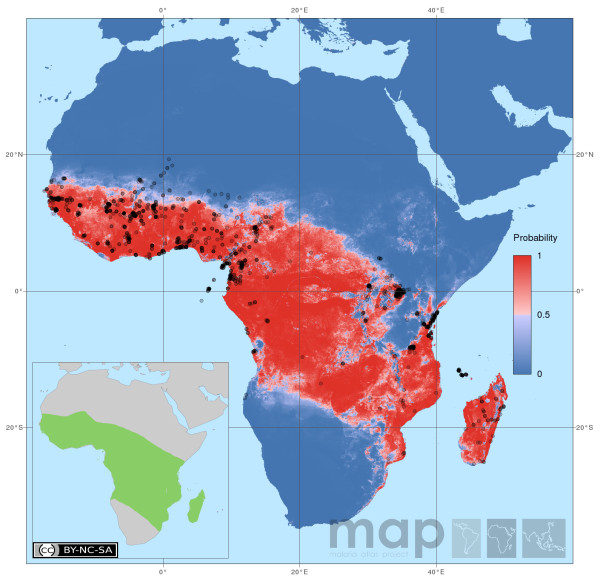
BACKGROUND: This is the second in a series of three articles documenting the geographical distribution of 41 dominant vector species (DVS) of human malaria. The first paper addressed the DVS of the Americas and the third will consider those of the Asian Pacific Region. Here, the DVS of Africa, Europe and the Middle East are discussed. The continent of Africa experiences the bulk of the global malaria burden due in part to the presence of the An. gambiae complex. Anopheles gambiae is one of four DVS within the An. gambiae complex, the others being An. arabiensis and the coastal An. merus and An. melas. There are a further three, highly anthropophilic DVS in Africa, An. funestus, An. moucheti and An. nili. Conversely, across Europe and the Middle East, malaria transmission is low and frequently absent, despite the presence of six DVS. To help control malaria in Africa and the Middle East, or to identify the risk of its re-emergence in Europe, the contemporary distribution and bionomics of the relevant DVS are needed. RESULTS: A contemporary database of occurrence data, compiled from the formal literature and other relevant resources, resulted in the collation of information for seven DVS from 44 countries in Africa containing 4234 geo-referenced, independent sites. In Europe and the Middle East, six DVS were identified from 2784 geo-referenced sites across 49 countries. These occurrence data were combined with expert opinion ranges and a suite of environmental and climatic variables of relevance to anopheline ecology to produce predictive distribution maps using the Boosted Regression Tree (BRT) method. CONCLUSIONS: The predicted geographic extent for the following DVS (or species/suspected species complex*) is provided for Africa: Anopheles (Cellia) arabiensis, An. (Cel.) funestus*, An. (Cel.) gambiae, An. (Cel.) melas, An. (Cel.) merus, An. (Cel.) moucheti and An. (Cel.) nili*, and in the European and Middle Eastern Region: An. (Anopheles) atroparvus, An. (Ano.) labranchiae, An. (Ano.) messeae, An. (Ano.) sacharovi, An. (Cel.) sergentii and An. (Cel.) superpictus*. These maps are presented alongside a bionomics summary for each species relevant to its control.
Overview
The claims and statistics of this paper haven’t been checked yet.
Run the check — free, no account needed. It reads the open-access text and checks the sources it cites.
Integrity signals
Registry
Cites
Statistics
Figures
Verification
Claims the paper makes
The claims and statistics of this paper haven’t been checked yet.
Run the check — free, no account needed. It reads the open-access text and checks the sources it cites.
Claims other papers make about this one
Each is checked against this paper’s own text: does it say what the citing paper says it does?
The source backs part of the claim, not all of it — or backs it for a different population, condition or comparison.
In the citing paper
“An. arabiensis typically inhabit arid savannah landscapes and are often absent in field collections of adult or larval mosquitoes in the humid rainforest zone of southern Nigeria [48].”
From Sibling species of the major malaria vector Anopheles gambiae display divergent preferences for aquatic breeding sites in southern Nigeria (2024) · cites this paper as [48]
Experimental — accuracy not yet measuredThe cited source says what the claim attributes to it.
In the citing paper
“Contrary to their choice of clean water bodies (see review by [48, 57], An. arabiensis larvae occurred in polluted water in drainages in Agbor-Obi.”
From Sibling species of the major malaria vector Anopheles gambiae display divergent preferences for aquatic breeding sites in southern Nigeria (2024) · cites this paper as [48]
Self-check
Percentages, sums and reported differences re-computed from the paper’s own numbers.
The self-check needs the paper’s full text.
Citations
Cites
Very high resolution interpolated climate surfaces for global land areas
Hijmans, R. J., Cameron, S. E., Parra, J. L., Jones, P. G., & Jarvis, A. (2005) · International Journal of Climatology · doi:10.1002/joc.1276 · Cited by 19,860
Novel methods improve prediction of species’ distributions from occurrence data
Elith*, J., H. Graham*, C., P. Anderson, R., Dudík, M., Ferrier, S., Guisan, A., J. Hijmans, R., Huettmann, F., R. Leathwick, J., Lehmann, A., et al. (2006) · Ecography · doi:10.1111/j.2006.0906-7590.04596.x · Cited by 9,088
A working guide to boosted regression trees
Elith, J., Leathwick, J. R., & Hastie, T. (2008) · Journal of Animal Ecology · doi:10.1111/j.1365-2656.2008.01390.x · Cited by 6,484
The interpretation of spectral vegetation indexes
Myneni, R. B., Hall, F. G., Sellers, P. J., & Marshak, A. L. (1995) · IEEE Transactions on Geoscience and Remote Sensing · doi:10.1109/tgrs.1995.8746029 · Cited by 1,425
Becker, N., Petric, D., Zgomba, M., Boase, C., Madon, M., Dahl, C., & Kaiser, A. (2010) · doi:10.1007/978-3-540-92874-4 · Cited by 1,403
BOOSTED TREES FOR ECOLOGICAL MODELING AND PREDICTION
De’ath, G. (2007) · Ecology · doi:10.1890/0012-9658(2007)88[243:btfema]2.0.co;2 · Cited by 1,323
The Epidemiology and Control of Malaria
(1960) · The Medical Journal of Australia · doi:10.5694/j.1326-5377.1960.tb105313.x · Cited by 1,316
A new world malaria map: Plasmodium falciparum endemicity in 2010
Gething, P. W., Patil, A. P., Smith, D. L., Guerra, C. A., Elyazar, I., Johnston, G. L., Tatem, A. J., & Hay, S. I. (2011) · Malaria Journal · doi:10.1186/1475-2875-10-378 · Cited by 1,169
Self-citationA supplement to the Anophelinae of Africa south of the Sahara (Afrotropical Region).
Gillies, M. T., & Coetzee, M. (1987) · IHI Repository · Cited by 812
Self-citationThe Anophelinae of Africa south of the Sahara (Ethiopian Zoogeographical Region).
Gillies, M. T., & Meillon, B. D. (1968) · Cited by 776
Research works printed but not linked: 36
- Akogbéto M, Yakoubou S: Résistance des vecteurs du paludisme vis-à-vis des pyréthrinoïdes utilisés pour l'imprégnation des moustiquaires au Bénin, Afrique de l'Ouest. Bull Soc Pathol Exot. 1999, 92: 123-130.
- Service MW: Anopheles gambiae: Africa's principal malaria vector, 1902-1984. Bull Entomol Soc Am. 1985, Autumn: 8-12.
- Fontenille D, Lepers JP, Campbell GH, Rakotoarivony I, Coluzzi M, Coulanges P: Les vecteurs du paludisme et leur rôle dans la transmission, a Manarintsoa sur les Hauts Plateaux de Madagascar de 1988 a 1990. Arch Inst Pasteur Madagascar. 1990, 57: 335-368.
- Laventure S, Mouchet J, Blanchy S, Marrama L, Rabarison P, Andrianaivolambo L, Rajaonarivelo E, Rakotoarivony I, Roux J: Le riz source de vie et de mort sur les plateaux de Madagascar. Santé. 1996, 6: 79-86.
- Marrama L, Rajaonarivelo E, Laventure S, Rabarison P: Anopheles funestus et la riziculture sur les plateaux de Madagascar. Santé. 1995, 5: 415-419.
- Dossou-Yovo J, Doannio JM, Diarrassouba S: Préférences trophiques des vecteurs du paludisme dans la ville de Bouake et dans les villages environnants de Côte d'Ivoire. Bull Soc Pathol Exot. 1998, 91: 257-258.
- Doannio JM, Dossou-Yovo J, Diarrassouba S, Rakotondraibe ME, Chauvancy G, Chandre F, Riviere F, Carnevale P: La dynamique de la transmission du paludisme à Kafine, un village rizicole en zone de savane humide de Côte d'Ivoire. Bull Soc Pathol Exot. 2002, 95: 11-16.
- Dossou-Yovo J, Diarrassouba S, Doannio J, Darriet F, Carnevale P: Le cycle d'agressivité d'Anopheles gambiae s.s. à l'intérieur des maisons et la transmission du paludisme dans la région de Bouake (Côte d'Ivoire). Interêt de l'utilisation de la moustiquaire imprégnée. Bull Soc Pathol Exot. 1999, 92: 198-200.
- Kloke RG: New distribution record of Anopheles merus Donitz (Diptera: Culicidae) in Zambia. Afr Entomol. 1997, 5: 361-362.
- Coetzee M, Cross H: Mating experiments with two populations of Anopheles merus Donitz (Diptera: Culicidae). J Entomol Soc S Afr. 1983, 46: 257-259.
- Mouchet J, Gariou J: Anopheles moucheti au Cameroun. Cahiers ORSTOM, Entomol Med Parasitol. 1966, 4: 71-81.
- Carnevale P, Zoulani A: Agressivité d'Anopheles nili (Theobald), 1904 à l'intérieur et à l'extérieur des maisons. Cahiers ORSTOM, Entomol Med Parasitol. 1975, 13: 69-73.
- Pires CA, Ribeiro H, Capela RA, da Cunha Ramos H: Research on the mosquitoes of Portugal (Diptera: Culicidae) VI. The mosquitoes of Alentejo. An do Inst de Hig e Med Trop. 1982, 8: 79-102.
- Zamburlini R, Cargnus E: Anofelismo residuo nel litorale altoadriatico a 50 anni dalla scomparsa della malaria. Parassitologia. 1998, 40: 431-437.
- D'Alessandro G, Bruno Smiraglia C, Lavagnino A: Further studies on the biology of Anopheles labranchiae labranchiae Falleroni in Sicily. 1971, WHO, 1-11.
- Macdonald WW: Anophelines of Libya and their control. Gariounis Med J. 1982, 5: 72-74.
- Coluzzi M, Coluzzi A: Rischio di una ripresa della trasmissione della malaria in Calabria e problemi connessi al controllo dei vettori. Riv Parassitologia. 1980, 41: 117-125.
- Bettini S, Gradoni L, Cocchi M, Tamburro A: Rice culture and Anopheles labranchiae in central Italy. 1978, WHO, 1-6.
- Cefalù M, Oddo F, Saccà G: Vita extra-domestica di Anopheles labranchiae in Sicilia. Osservazioni in un'area di sospensione dei trattamenti con DDT. Parassitologia. 1961, 3: 23-50.
- White GB: Malaria. Geographical distribution of arthropod-borne diseases and their principal vectors. 1989, Geneva: World Health Organization, Division of Vector Biology and Control, 7-22.
- Bublikova LI: Anophelines (Diptera, Nematocera) in the Chu valley (Kirgiz Republic). Entomol Rev. 1998, 78: 398-402.
- Adamovic Z: Vertical distribution of the anopheline mosquitoes in Montenegro, Yugoslavia. Acta Vet (Beograd). 1984, 34: 287-293.
- Adamovic ZR: Distribution and relative abundance of the anophelines (Diptera: Culicidae) in Kacer and Takovo, Serbia. Bull Serbian Acad Sci Arts Sec Sci Math Nat Sci. 1982, 82: 97-104.
- Adamovic Z, Paulus R: Distribution and abundance of anophelines (Diptera: Culicidae) in the Sava Valley from Ljubljana to Zagreb, Yugoslavia. Acta Vet (Beograd). 1988, 38: 31-36.
- Hadjinicolaou J, Betzios B: Gambusia fish as a means of biological control of Anopheles sacharovi in Greece. 1973, WHO, 1-7.
- Gratz NG: The effect of water development programmes on malaria vectors in Turkey. 1987, City: FAO
- Saliternik Z: Historical notes on the bionomics and distribution of malaria vectors in Israel. 1974, WHO, 1-11.
- Kasap H, Akbaba M, Kasap M, Lüleyap Ü, Alpaslan N, Alptekin D: A study of malaria and Anopheles sacharovi in Tuzla, Adana, Turkey. Acta Parasit Turcica. 1995, 19: 535-540.
- Soliman AA: A study of the dispersal of Anopheles sacharovi Favr. from a natural breeding source in the Rouge-Valley (Aleppo-Syria U. A. R.). The Fourth Arab Science Congress; February; Cairo. 1961, 526-530.
- Gad A, Kenawy MA, El-Said S, Merdan AI: Field studies on anopheline mosquito larvae in Egypt (Diptera: Culicidae). I. Different types and characteristics of the breeding places in relation to the abundance of anopheline species in Egypt. J Egypt Public Health Assoc. 1982, 57: 541-562.
- Mulligan HW: Malaria in Iraq and Persia. Protozoology. 1967, 2: 113-146.
- Tshinaev PP: On the ecology and biology of the malarial mosquito Anopheles superpictus Grassi (Diptera: Culicidae) in Uzbekistan. Entomol Rev. 1963, 42: 169-175.
- Latyshev NL: The biology of Anopheles superpictus Grassi in Tadzhikistan. Animal Parasites and parasitic diseases of Tadzhikistan. 1929, 41-59.
- Dia I, Lochouarn L, Diatta M, Sokhna CS, Fontenille D: Préférences trophiques des femelles endophiles d'Anopheles funestus au Sénégal. Bull Soc Pathol Exot. 2001, 94: 210-213.
- Adja AM, N'Goran KE, Kengne P, Koudou GB, Toure M, Koffi AA, Tia E, Fontenille D, Chandre F: Transmission vectorielle du paludisme en savane arborée à Ganse en Côte d'Ivoire. Med Trop (Mars). 2006, 66: 449-455.
- Carnevale P, Boreham PFL: Etudes des préférences trophiques d' Anopheles nili (Theo.), 1904. Cahiers ORSTOM, Entomol Med Parasitol. 1978, 16: 17-22.
Cited by
Sorted by citations
The global distribution of the arbovirus vectors Aedes aegypti and Ae. albopictus
Kraemer, M. U. G., Sinka, M. E., Duda, K. A., Mylne, A., Shearer, F. M., Barker, C. M., Moore, C. G., Carvalho, R. G., Coelho, G. E., Bortel, W. V., et al. (2015) · eLife · doi:10.7554/elife.08347 · Cited by 2,181
Self-citationRefining the Global Spatial Limits of Dengue Virus Transmission by Evidence-Based Consensus
Brady, O. J., Gething, P. W., Bhatt, S., Messina, J. P., Brownstein, J. S., Hoen, A. G., Moyes, C. L., Farlow, A. W. K., Scott, T. W., & Hay, S. I. (2012) · PLoS neglected tropical diseases · doi:10.1371/journal.pntd.0001760 · Cited by 1,859
Self-citationA global map of dominant malaria vectors
Sinka, M. E., Bangs, M. J., Manguin, S., Rubio-Palis, Y., Chareonviriyaphap, T., Coetzee, M., Mbogo, C. M., Hemingway, J., Patil, A. P., Temperley, W. H., et al. (2012) · Parasites & Vectors · doi:10.1186/1756-3305-5-69 · Cited by 792
Self-citationPhillips, M. A., Burrows, J. N., Manyando, C., van Huijsduijnen, R. H., Voorhis, W. C. V., & Wells, T. N. C. (2017) · Nature Reviews Disease Primers · doi:10.1038/nrdp.2017.50 · Cited by 648
Highly evolvable malaria vectors: The genomes of 16 Anopheles mosquitoes
Neafsey, D. E., Waterhouse, R. M., Abai, M. R., Aganezov, S. S., Alekseyev, M. A., Allen, J. E., Amon, J., Arcà, B., Arensburger, P., Николаевич, А. Г., et al. (2014) · Science · doi:10.1126/science.1258522 · Cited by 573
Self-citation
Metadata
- Authors
- Sinka, M. E., Bangs, M. J., Manguin, S., Coetzee, M., Mbogo, C. M., Hemingway, J., Patil, A. P., Temperley, W. H., Gething, P. W., Kabaria, C. W., Okara, R. M., Van Boeckel, T., Godfray, H. C. J., Harbach, R. E., & Hay, S. I.
- Affiliations
- University of Oxford (GB)
- Université de Montpellier (FR)
- National Health Laboratory Service (ZA)
- Kenya Medical Research Institute (KE)
- Liverpool School of Tropical Medicine (GB)
- Kenyatta National Hospital (KE)
- Natural History Museum (GB)
- Corresponding author
- Sinka, Marianne E
- Hay, Simon I
- ORCID
- Venue
- Parasites & Vectors
- Published
- 2010-12
- Volume
- 3
- Issue
- 1
- Pages
- 117-117
- ISSN
- 1756-3305 (ISSN-L)
- PMC
- PMC3016360
- OpenAlex
- W2166231658
- Cited by
- 761
- References
- 350
- Citations by year
- 2026: 39 · 2025: 59 · 2024: 62 · 2023: 67 · 2022: 63 · 2021: 69 · 2020: 57 · 2019: 41 · 2018: 51 · 2017: 34 · 2016: 39 · 2015: 47 · 2014: 45 · 2013: 46 · 2012: 27
- FWCI
- 27.68
- Type
- journal article
- Language
- en
- Open access
- gold
- doi.org
- Licence
- Locations
- Parasites & Vectors (publishedVersion, cc-by)
- PubMed Central (publishedVersion, cc-by)
- PubMed (publishedVersion)
- Dépôt institutionnel de l'Université libre de Bruxelles (Université Libre de Bruxelles) (submittedVersion, other-oa)
- DOAJ (DOAJ: Directory of Open Access Journals) (submittedVersion)
- Greater South Information System
- Funders
- Wellcome Trust (083534, 079080, 079091)
- Topics
- Health Sciences › Medicine › Public Health, Environmental and Occupational Health › Malaria Research and Control
- Health Sciences › Medicine › Public Health, Environmental and Occupational Health › Mosquito-borne diseases and control
- Physical Sciences › Environmental Science › Ecological Modeling › Species Distribution and Climate Change
- Keywords
- malaria vectors, Anopheles, geographic distribution, Anopheles gambiae s.l., Anopheles funestus, Anopheles arabiensis, Anopheles melas, Anopheles merus, Anopheles moucheti, Anopheles nili, Anopheles atroparvus, Anopheles labranchiae, Anopheles messeae, Anopheles sacharovi, Anopheles sergentii, Anopheles superpictus, bionomics
About these checks
Registry, retraction, Cites and statistics results are computed, not judged, with one exception: a printed reference that no index lists is read once by a model before it counts as a citation error. Claims are extracted by a model and kept only when their quote appears verbatim in the text; each cited source is then checked, with a model’s help, for whether it says what the claim relies on. Those verdicts can be wrong — read the claim’s quote and the cited source before relying on one.
Statistics and arithmetic are recomputed, not judged.
Confidence bands are shown only for fields calibrated on our annotated test set. None is calibrated yet, so no band is shown.
What counts as a claim ›How we measure confidence ›How we check this ›
Are you an author, or do you see a problem with this page? Request a review
