

Development and evaluation of a novel contamination device that targets multiple life-stages of Aedes aegypti
Open accessThe DOI matches its Crossref record; 36 of the 37 references it cites were found in a registry or an index.
Abstract
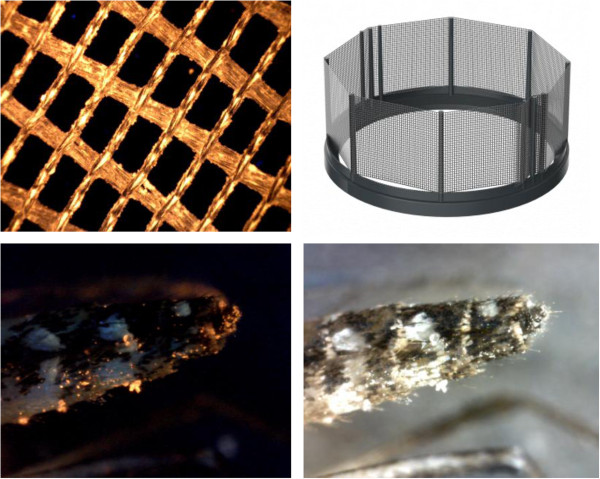
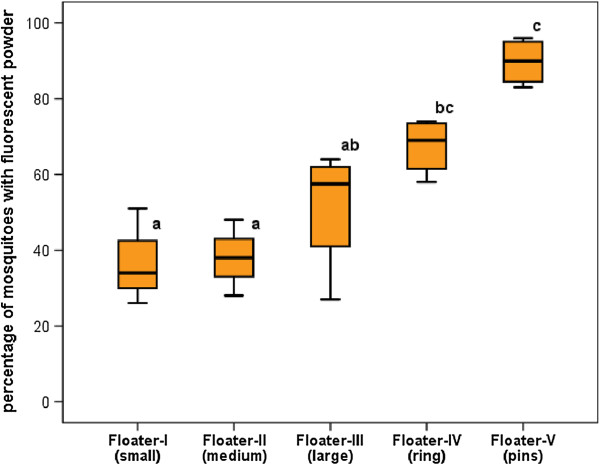
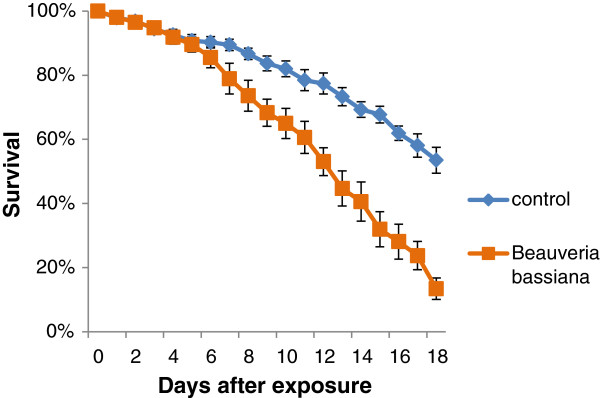
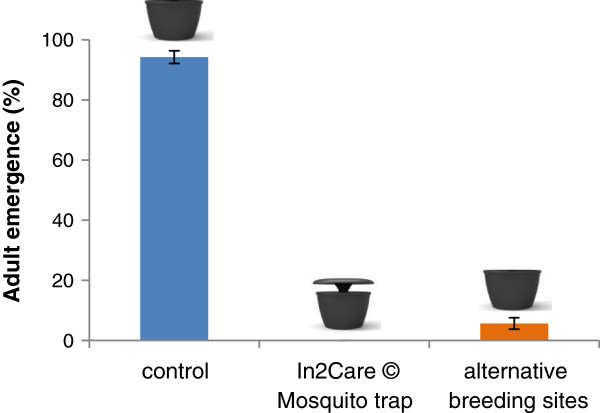
BACKGROUND: The increasing global threat of Dengue demands new and easily applicable vector control methods. Ovitraps provide a low-tech and inexpensive means to combat Dengue vectors. Here we describe the development and optimization process of a novel contamination device that targets multiple life-stages of the Aedes aegypti mosquito. Special focus is directed to the diverse array of control agents deployed in this trap, covering adulticidal, larvicidal and autodissemination impacts. METHODS: Different trap prototypes and their parts are described, including a floater to contaminate alighting gravid mosquitoes. The attractiveness of the trap, different odor lures and floater design were studied using fluorescent powder adhering to mosquito legs and via choice tests. We demonstrate the mosquitocidal impacts of the control agents: a combination of the larvicide pyriproxyfen and the adulticidal fungus Beauveria bassiana. The impact of pyriproxyfen was determined in free-flight dissemination experiments. The effect on larval development inside the trap and in surrounding breeding sites was measured, as well as survival impacts on recaptured adults. RESULTS: The developmental process resulted in a design that consists of a black 3 Liter water-filled container with a ring-shaped floater supporting vertically placed gauze dusted with the control agents. On average, 90% of the mosquitoes in the fluorescence experiments made contact with the gauze on the floater. Studies on attractants indicated that a yeast-containing tablet was the most attractive odor lure. Furthermore, the fungus Beauveria bassiana was able to significantly increase mortality of the free-flying adults compared to controls. Dissemination of pyriproxyfen led to >90% larval mortality in alternative breeding sites and 100% larval mortality in the trap itself, against a control mortality of around 5%. CONCLUSION: This ovitrap is a promising new tool in the battle against Dengue. It has proven to be attractive to Aedes aegypti mosquitoes and effective in contaminating these with Beauveria bassiana. Furthermore, we show that the larvicide pyriproxyfen is successfully disseminated to breeding sites close to the trap. Its low production and operating costs enable large scale deployment in Dengue-affected locations.
Overview
The claims and statistics of this paper haven’t been checked yet.
Free: it reads the open-access text and checks the first 5 claims that cite a source we can check. Create a free account to check every claim.
Integrity signals
Registry
Cites
Statistics
Figures
Verification
Claims the paper makes
The claims and statistics of this paper haven’t been checked yet.
Free: it reads the open-access text and checks the first 5 claims that cite a source we can check. Create a free account to check every claim.
Claims other papers make about this one
Each is checked against this paper’s own text: does it say what the citing paper says it does?
The source backs part of the claim, not all of it — or backs it for a different population, condition or comparison.
In the citing paper
“Electrostatic netting can be useful for house-screening products and point-source applications such as mosquito traps (36).”
From Electrostatic coating enhances bioavailability of insecticides and breaks pyrethroid resistance in mosquitoes (2015) · cites this paper as [36]
Experimental — accuracy not yet measuredThe cited source says what the claim attributes to it.
In the citing paper
“Experiments with Beauveria bassiana spores and pyriproxyfen applied on electrostatic netting inside a novel Aedes ovitrap showed that effective doses of these agents were transferred to gravid aedine mosquitoes, inducing high fungus infection rates and successful larvicide dissemination (36).”
From Electrostatic coating enhances bioavailability of insecticides and breaks pyrethroid resistance in mosquitoes (2015) · cites this paper as [36]
The cited source says what the claim attributes to it.
In the citing paper
“Previous studies show that it can be used effectively to apply novel and biological control agents such as entomopathogens and autodisseminants.”
From Electrostatic coating enhances bioavailability of insecticides and breaks pyrethroid resistance in mosquitoes (2015) · cites this paper as [36]
Self-check
Percentages, sums and reported differences re-computed from the paper’s own numbers.
The self-check needs the paper’s full text.
Citations
Cites
The global distribution and burden of dengue
Bhatt, S., Gething, P. W., Brady, O. J., Messina, J. P., Farlow, A. W., Moyes, C. L., Drake, J. M., Brownstein, J. S., Hoen, A. G., Sankoh, O., et al. (2013) · Nature · doi:10.1038/nature12060 · Cited by 10,037 · cited 1×
“With over 390 million cases annually [2], Dengue is currently the fastest spreading infectious disease in the tropics.”
Insecticide Resistance in Insect Vectors of Human Disease
Hemingway, J., & Ranson, H. (2000) · Annual Review of Entomology · doi:10.1146/annurev.ento.45.1.371 · Cited by 1,558 · cited 1×
“A major disadvantage of these lethal ovitraps is the fact that insecticides deployed in such traps have shown reduced efficacy due to widespread insecticide resistance in Aedes populations [21].”
BackgroundHow to make evolution-proof insecticides for malaria control
Read, A. F., Lynch, P. A., & Thomas, M. B. (2009) · PLoS Biology · doi:10.1371/journal.pbio.1000058 · Cited by 288 · cited 1×
“bassiana provides a long-lasting adult control option by targeting only the older females that can transmit disease, thereby drastically reducing the chances for development of resistance [35].”
BackgroundA preferred oviposition site as a surveillance method for Aedes aegypti.
Fay, R. W., & Eliason, D. A. (1966) · Mosquito news · Cited by 246
Ponnusamy, L., Xu, N., Nojima, S., Wesson, D. M., Schal, C., & Apperson, C. S. (2008) · Proceedings of the National Academy of Sciences · doi:10.1073/pnas.0802505105 · Cited by 244
Reiter, P. (2007) · Vector-Borne and Zoonotic Diseases · doi:10.1089/vbz.2006.0630 · Cited by 242 · cited 1×
“lays small numbers of eggs in multiple sites [4]) and prefers man-made containers as oviposition sites [5].”
Using adult mosquitoes to transfer insecticides to Aedes aegypti larval habitats
Devine, G. J., Perea, E. Z., Killeen, G. F., Stancil, J. D., Clark, S. J., & Morrison, A. C. (2009) · Proceedings of the National Academy of Sciences · doi:10.1073/pnas.0901369106 · Cited by 215 · cited 1×
“Because Aedes mosquitoes are skip-ovipositors, pyriproxyfen can be used as an autodissemination agent for ‘mosquitodriven larval control’; utilizing the gravid female to disperse the larvicide and contaminate multiple breeding sites in the vicinity [25,26].”
Wong, J., Stoddard, S. T., Astete, H., Morrison, A. C., & Scott, T. W. (2011) · PLoS Neglected Tropical Diseases · doi:10.1371/journal.pntd.0001015 · Cited by 207 · cited 2×
“Studies show that volatiles emitting from larvae are attractive to gravid Dengue vectors [12], and can therefore be expected to augment the attractiveness of the trap.”
The “Auto-Dissemination” Approach: A Novel Concept to Fight Aedes albopictus in Urban Areas
Caputo, B., Ienco, A., Cianci, D., Pombi, M., Petrarca, V., Baseggio, A., Devine, G. J., & della Torre, A. (2012) · PLoS Neglected Tropical Diseases · doi:10.1371/journal.pntd.0001793 · Cited by 167
Fungal infection counters insecticide resistance in African malaria mosquitoes
Farenhorst, M., Mouatcho, J. C., Kikankie, C. K., Brooke, B. D., Hunt, R. H., Thomas, M. B., Koekemoer, L. L., Knols, B. G. J., & Coetzee, M. (2009) · Proceedings of the National Academy of Sciences · doi:10.1073/pnas.0908530106 · Cited by 166 · cited 2×
“An additional benefit of this fungus is that it is highly virulent to insecticide-resistant mosquitoes [27,31] and even has the potential to augment the efficacy of chemical insecticides [27,32].”
BackgroundSelf-citationDong, Y., Morton, J. C., Ramirez, J. L., Souza‐Neto, J. A., & Dimopoulos, G. (2011) · Insect Biochemistry and Molecular Biology · doi:10.1016/j.ibmb.2011.11.005 · Cited by 165 · cited 2×
“This infection reduces the mosquito’s vectorial capacity [28,29], inhibits Dengue virus replication inside the mosquito [30] and eventually kills the mosquito.”
Facchinelli, L., VALERIO, L., Pombi, M., Reiter, P., Costantini, C., & della Torre, A. (2007) · Medical and Veterinary Entomology · doi:10.1111/j.1365-2915.2007.00680.x · Cited by 130
An adulticidal sticky ovitrap for sampling container-breeding mosquitoes.
Ritchie, S. A., LONG, S. A., Hart, A. J., Webb, C. E., & Russell, R. C. (2003) · PubMed · Cited by 115
Darbro, J. M., Johnson, P. H., Thomas, M. B., Ritchie, S. A., Kay, B. H., & Ryan, P. A. (2012) · American Journal of Tropical Medicine and Hygiene · doi:10.4269/ajtmh.2012.11-0455 · Cited by 105 · cited 1×
“This infection reduces the mosquito’s vectorial capacity [28,29], inhibits Dengue virus replication inside the mosquito [30] and eventually kills the mosquito.”
Farenhorst, M., Knols, B. G. J., Thomas, M. B., Howard, A. F. V., Takken, W., Rowland, M., & N’Guessan, R. (2010) · PLoS ONE · doi:10.1371/journal.pone.0012081 · Cited by 97
Self-citationBlanford, S., Shi, W., Christian, R., Marden, J. H., Koekemoer, L. L., Brooke, B. D., Coetzee, M., Read, A. F., & Thomas, M. B. (2011) · PLoS ONE · doi:10.1371/journal.pone.0023591 · Cited by 93 · cited 1×
“This infection reduces the mosquito’s vectorial capacity [28,29], inhibits Dengue virus replication inside the mosquito [30] and eventually kills the mosquito.”
Ohba, S., Ohashi, K., Pujiyati, E., Higa, Y., Kawada, H., Mito, N., & Takagi, M. (2013) · PLoS ONE · doi:10.1371/journal.pone.0067045 · Cited by 84 · cited 1×
“Experiments have shown that female mosquitoes can acquire pyriproxyfen crystals when landing on a treated surface and deposit these in breeding sites they subsequently visit [23,24], hence killing their offspring and other larvae already present in those breeding sites at the time when these pupate.”
Ponnusamy, L., Xu, N., Böröczky, K., Wesson, D. M., Ayyash, L. A., Coby Schal, A., & Apperson, C. S. (2010) · Journal of Chemical Ecology · doi:10.1007/s10886-010-9806-2 · Cited by 78 · cited 1×
“) infusions were selected because it was shown that fermenting solutions of organic matter are attractive to Aedes mosquitoes [9,33].”
Kikankie, C. K., Brooke, B. D., Knols, B. G., Koekemoer, L. L., Farenhorst, M., Hunt, R. H., Thomas, M. B., & Coetzee, M. (2010) · Malaria Journal · doi:10.1186/1475-2875-9-71 · Cited by 77
Self-citationSant’Ana, A. L., Roque, R. A., & Eiras, Á. E. (2006) · Journal of Medical Entomology · doi:10.1603/0022-2585(2006)043[0214:cogiao]2.0.co;2 · Cited by 76 · cited 2×
“Egg-laying female mosquitoes are attracted to the trap by the water [6], visual cues [7], natural odors (mostly from plant infusions) [8-11], conspecifics [12], or synthetic odors [5,13-15].”
BackgroundLaboratory testing of a lethal ovitrap for Aedes aegypti
Zeichner, B. C., & Perich, M. J. (1999) · Medical and Veterinary Entomology · doi:10.1046/j.1365-2915.1999.00192.x · Cited by 72 · cited 1×
“These traps include designs such as the ‘sticky’ trap [7,16,17] or ‘double-sticky’ trap [8] in which gravid mosquitoes are captured using glue, or lethal ovitraps [18-20] in which mosquitoes are exposed to insecticides.”
BackgroundPreliminary evaluation of the "Dengue-MI" technology for Aedes aegyptimonitoring and control
Eiras, Á. E., & Resende, M. C. (2009) · Cadernos de Saúde Pública · doi:10.1590/s0102-311x2009001300005 · Cited by 71 · cited 2×
“Egg-laying female mosquitoes are attracted to the trap by the water [6], visual cues [7], natural odors (mostly from plant infusions) [8-11], conspecifics [12], or synthetic odors [5,13-15].”
BackgroundEfficacy of sticky and standard ovitraps for Aedes aegypti in Trinidad, West Indies
Chadee, D. D., & Ritchie, S. A. (2010) · Journal of Vector Ecology · doi:10.1111/j.1948-7134.2010.00098.x · Cited by 69 · cited 2×
“Egg-laying female mosquitoes are attracted to the trap by the water [6], visual cues [7], natural odors (mostly from plant infusions) [8-11], conspecifics [12], or synthetic odors [5,13-15].”
BackgroundGama, R. A., Silva, E. M., da Silva, I. M., de Resende, M. C., & Eiras, Á. E. (2007) · Neotropical Entomology · doi:10.1590/s1519-566x2007000200018 · Cited by 60 · cited 3×
“The black container provides a visually attractive and sheltered breeding site for Dengue mosquitoes and is commonly used for ovitraps [7,15].”
BackgroundRitchie, S. A. (2001) · PubMed · Cited by 58
Does targeting key‐containers effectively reduce Aedes aegypti population density?
Maciel‐de‐Freitas, R., & Lourenço‐de‐Oliveira, R. (2011) · Tropical Medicine & International Health · doi:10.1111/j.1365-3156.2011.02797.x · Cited by 56
Jackson, B. T., Paulson, S. L., Youngman, R. R., Scheffel, S. L., & Hawkins, B. (2005) · Journal of the American Mosquito Control Association · doi:10.2987/8756-971x(2006)21[360:opocra]2.0.co;2 · Cited by 54
Williams, C. R., Ritchie, S. A., Long, S. A., Dennison, N., & Russell, R. C. (2007) · Journal of Medical Entomology · doi:10.1603/0022-2585(2007)44[256:ioablo]2.0.co;2 · Cited by 52 · cited 1×
“These traps include designs such as the ‘sticky’ trap [7,16,17] or ‘double-sticky’ trap [8] in which gravid mosquitoes are captured using glue, or lethal ovitraps [18-20] in which mosquitoes are exposed to insecticides.”
BackgroundHarrington, J., Kroeger, A., Runge‐Ranzinger, S., & O’Dempsey, T. (2013) · Journal of Tropical Medicine · doi:10.1155/2013/756832 · Cited by 51 · cited 1×
“Contemporary mosquito control focuses primarily on larval source management in the form of breeding site removal or larviciding and adult control through fogging with insecticides [3].”
Barbosa, R. M., Souto, A., Eiras, A. E., & Regis, L. (2007) · Memórias do Instituto Oswaldo Cruz · doi:10.1590/s0074-02762007005000058 · Cited by 44 · cited 1×
“quinquefasciatus [16,17,36] and Cx.”
A Biodegradable Lethal Ovitrap for Control of Container-Breeding Aedes
Ritchie, S. A., LONG, S. A., McCaffrey, N., Key, C., Lonergan, G. C., & Williams, C. R. (2008) · Journal of the American Mosquito Control Association · doi:10.2987/5658.1 · Cited by 42
de Santos, E. M. M., de Melo-Santos, M. A. V., de Oliveira, C. M. F., Correia, J. C., & de Albuquerque, C. M. R. (2012) · Parasites & Vectors · doi:10.1186/1756-3305-5-195 · Cited by 40
Itoh, T., Kawada, H., Abe, A., et al. (1994) · PubMed · Cited by 35
Bukhari, T., & Knols, B. G. (2009) · American Journal of Tropical Medicine and Hygiene · doi:10.4269/ajtmh.2009.80.758 · Cited by 27 · cited 1×
“This silicone oil film has been shown to cause female mosquitoes to drown whilst ovipositing [34], meaning that it can be used to determine the first choice of oviposition location for Ae.”
Self-citationField optimisation of MosquiTRAP sampling for monitoring Aedes aegypti Linnaeus (Diptera: Culicidae)
de Resende, M. C., de Ázara, T. M. F., Costa, I. O., Costa, L. H., de Andrade, M. R., Acebal, J. L., & Eiras, Á. E. (2012) · Memórias do Instituto Oswaldo Cruz · doi:10.1590/s0074-02762012000300002 · Cited by 26 · cited 2×
“Egg-laying female mosquitoes are attracted to the trap by the water [6], visual cues [7], natural odors (mostly from plant infusions) [8-11], conspecifics [12], or synthetic odors [5,13-15].”
BackgroundPonlawat, A., Fansiri, T., Kurusarttra, S., Pongsiri, A., McCardle, P. W., Evans, B. P., & Richardson, J. H. (2013) · doi:10.21236/ada586043 · Cited by 21 · cited 2×
“Field studies with pyriproxyfen have shown good potential for this new type of vector control [26].”
Background
Cited by
Control methods against invasive Aedes mosquitoes in Europe: a review
Baldacchino, F., Caputo, B., Chandre, F., Drago, A., della Torre, A., Montarsi, F., & Rizzoli, A. (2015) · Pest Management Science · doi:10.1002/ps.4044 · Cited by 225
Sustained, Area-Wide Control of Aedes aegypti Using CDC Autocidal Gravid Ovitraps
Barrera, R., Amador, M., Acevedo, V., Hemme, R. R., & Felix, G. E. (2014) · American Journal of Tropical Medicine and Hygiene · doi:10.4269/ajtmh.14-0426 · Cited by 116
Andriessen, R., Snetselaar, J., Suer, R. A., Osinga, A. J., Deschietere, J., Lyimo, I. N., Mnyone, L. L., Brooke, B. D., Ranson, H., Knols, B. G. J., et al. (2015) · Proceedings of the National Academy of Sciences · doi:10.1073/pnas.1510801112 · Cited by 86
“Experiments with Beauveria bassiana spores and pyriproxyfen applied on electrostatic netting inside a novel Aedes ovitrap showed that effective doses of these agents were transferred to gravid aedine mosquitoes, inducing high fungus infection rates and successful larvicide dissemination (36).”
BackgroundSelf-citationMosquito-fungus interactions and antifungal immunity
Tawidian, P., Rhodes, V. L. M., & Michel, K. (2019) · Insect Biochemistry and Molecular Biology · doi:10.1016/j.ibmb.2019.103182 · Cited by 107
Dormont, L., Mulatier, M., Carrasco, D., & Cohuet, A. (2021) · Journal of Chemical Ecology · doi:10.1007/s10886-021-01261-2 · Cited by 109
Metadata
- Authors
- Snetselaar, J., Andriessen, R., Suer, R. A., Osinga, A. J., Knols, B. G., & Farenhorst, M.
- Corresponding author
- Farenhorst, Marit
- Venue
- Parasites & Vectors
- Published
- 2014-04-25
- Volume
- 7
- Issue
- 1
- Pages
- 200-200
- ISSN
- 1756-3305 (ISSN-L)
- PMC
- PMC4005817
- OpenAlex
- W2161712247
- Cited by
- 100
- References
- 37
- Citations by year
- 2026: 2 · 2025: 12 · 2024: 5 · 2023: 9 · 2022: 12 · 2021: 13 · 2020: 15 · 2019: 7 · 2018: 5 · 2017: 9 · 2016: 4 · 2015: 5 · 2014: 2
- FWCI
- 6.63
- Type
- journal article
- Language
- en
- Open access
- gold
- doi.org
- Licence
- cc-by
- Locations
- Parasites & Vectors (publishedVersion, cc-by)
- Europe PMC (PubMed Central) (publishedVersion, cc-by)
- PubMed Central (publishedVersion, cc-by)
- PubMed (publishedVersion)
- LSHTM Research Online (London School of Hygiene and Tropical Medicine) (acceptedVersion)
- DOAJ (DOAJ: Directory of Open Access Journals) (submittedVersion)
- Funders
- Bill and Melinda Gates Foundation (OPP1025518)
- Topics
- Health Sciences › Medicine › Public Health, Environmental and Occupational Health › Mosquito-borne diseases and control
- Health Sciences › Medicine › Public Health, Environmental and Occupational Health › Dengue and Mosquito Control Research
- Life Sciences › Agricultural and Biological Sciences › Plant Science › Insect Pest Control Strategies
- Keywords
- Aedes aegypti, ovitraps, dengue vector control, pyriproxyfen, Beauveria bassiana, entomopathogenic fungi, mosquito attractants, larval mortality
- MeSH terms
- Aedes, Animals, Behavior, Animal, Dengue, Female, Insect Vectors, Life Cycle Stages, Mosquito Control, Odorants, Oviposition, Biological Control Agents
About these checks
Registry, retraction, Cites and statistics results are computed, not judged, with one exception: a printed reference that no index lists is read once by a model before it counts as a citation error. Claims are extracted by a model and kept only when their quote appears verbatim in the text; each cited source is then checked, with a model’s help, for whether it says what the claim relies on. Those verdicts can be wrong — read the claim’s quote and the cited source before relying on one.
Statistics and arithmetic are recomputed, not judged.
Confidence bands are shown only for fields calibrated on our annotated test set. None is calibrated yet, so no band is shown.
What counts as a claim ›How we measure confidence ›How we check this ›
Are you an author, or do you see a problem with this page? Request a review
Data sources
Bibliographic data: Semantic Scholar, OpenAlex, Crossref.
Contains information from the Semantic Scholar Academic Graph Datasets, made available under the ODC Attribution License (ODC-BY 1.0).
Semantic Scholar’s data is described in: Kinney, R., et al. (2023). The Semantic Scholar Open Data Platform. arXiv:2301.10140.
