

Good performances but short lasting efficacy of Actellic 50 EC Indoor Residual Spraying (IRS) on malaria transmission in Benin, West Africa
Open accessThe DOI matches its Crossref record; 30 of the 31 references it cites were found in a registry or an index.
Abstract
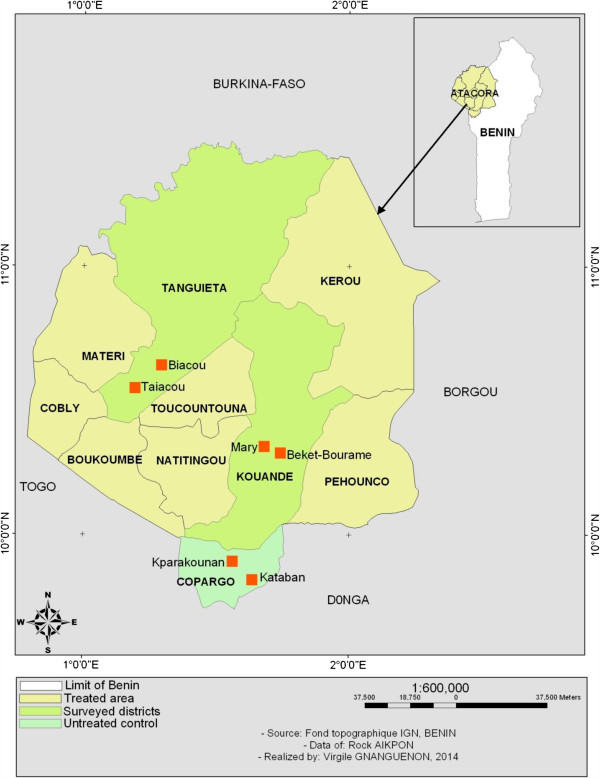
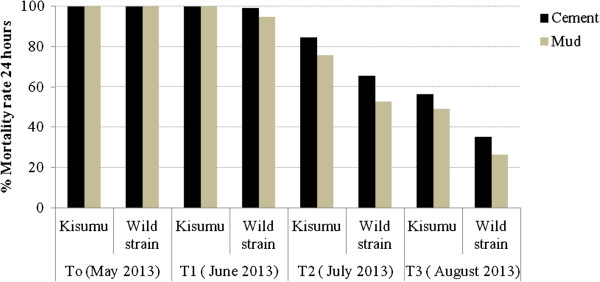
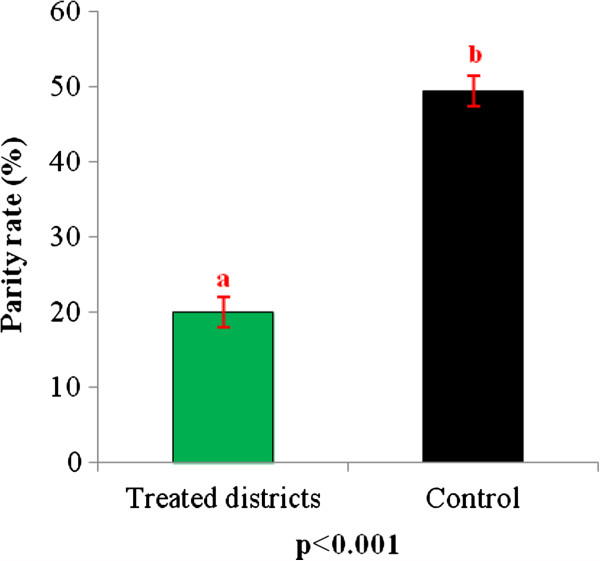
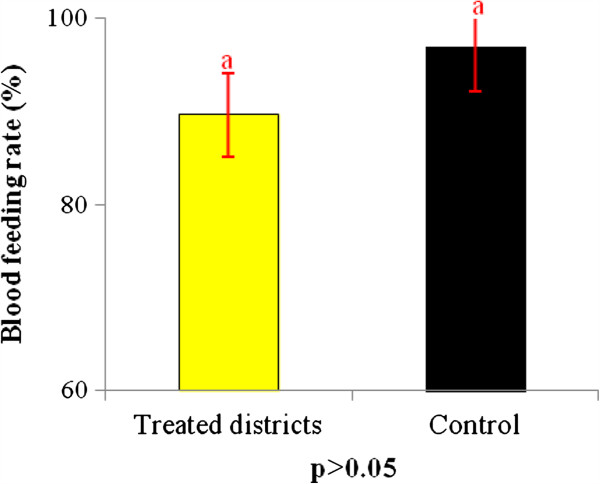
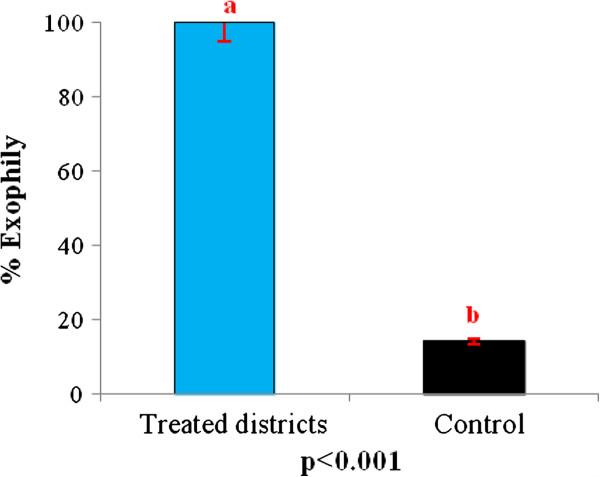
BACKGROUND: The National Malaria Control Program (NMCP) has been using pirimiphos methyl for the first time for indoor residual spraying (IRS) in Benin. The first round was a success with a significant decrease of entomological indicators of malaria transmission in the treated districts. We present the results of the entomological impact on malaria transmission. Entomologic parameters in the control area were compared with those in intervention sites. METHODS: Mosquito collections were carried out in three districts in the Atacora-Dongo region of which two were treated with pirimiphos methyl (Actellic 50EC) (Tanguiéta and Kouandé) and the untreated (Copargo) served as control. Anopheles gambiae s.l. populations were sampled monthly by human landing catch. In addition, window exit traps and pyrethrum spray catches were performed to assess exophagic behavior of Anopheles vectors. In the three districts, mosquito collections were organized to follow the impact of pirimiphos methyl IRS on malaria transmission and possible changes in the behavior of mosquitoes. The residual activity of pirimiphos methyl in the treated walls was also assessed using WHO bioassay test. RESULTS: A significant reduction (94.25%) in human biting rate was recorded in treated districts where an inhabitant received less than 1 bite of An. gambiae per night. During this same time, the entomological inoculation rate (EIR) dramatically declined in the treated area (99.24% reduction). We also noted a significant reduction in longevity of the vectors and an increase in exophily induced by pirimiphos methyl on An. gambiae. However, no significant impact was found on the blood feeding rate. Otherwise, the low residual activity of Actellic 50 EC, which is three months, is a disadvantage. CONCLUSION: Pirimiphos methyl was found to be effective for IRS in Benin. However, because of the low persistence of Actellic 50EC used in this study on the treated walls, the recourse to another more residual formulation of pirimiphos methyl is required.
Overview
The claims and statistics of this paper haven’t been checked yet.
Free: it reads the open-access text and checks the first 5 claims that cite a source we can check. Create a free account to check every claim.
Integrity signals
Registry
Cites
Statistics
Figures
Verification
Claims the paper makes
The claims and statistics of this paper haven’t been checked yet.
Free: it reads the open-access text and checks the first 5 claims that cite a source we can check. Create a free account to check every claim.
Claims other papers make about this one
Each is checked against this paper’s own text: does it say what the citing paper says it does?
The check wasn’t confident either way, so it gives no verdict — never disputed.
In the citing paper
“However, IRS has failed at several sites due to lack of knowledge about the local vector population [10–12].”
From Characterization and abundance of malaria vectors in Sakassou, Central Côte d'Ivoire (2025) · cites this paper as [10]
Experimental — accuracy not yet measured
Self-check
Percentages, sums and reported differences re-computed from the paper’s own numbers.
The self-check needs the paper’s full text.
Citations
Cites
A Method of Computing the Effectiveness of an Insecticide
Abbott, W. S. (1925) · Journal of Economic Entomology · doi:10.1093/jee/18.2.265a · Cited by 16,134 · cited 1×
“When control mortalities were less than 20%, but exceeded 5%, a correction of mortality was made using Abbot’s formula [24].”
MethodIdentification of Single Specimens of the Anopheles Gambiae Complex by the Polymerase Chain Reaction
Scott, J. A., Brogdon, W. G., & Collins, F. H. (1993) · The American Journal of Tropical Medicine and Hygiene · doi:10.4269/ajtmh.1993.49.520 · Cited by 1,659 · cited 1×
“gambiae complex as previously described [29,30].”
Morgan, W. B. (1969) · Cited by 594
Anopheles funestus resistant to pyrethroid insecticides in South Africa
Hargreaves, K., Koekemoer, L. L., Brooke, B. D., Hunt, R. H., Mthembu, J., & Coetzee, M. (2000) · Medical and Veterinary Entomology · doi:10.1046/j.1365-2915.2000.00234.x · Cited by 530 · cited 4×
“Faso [13], Mali [14], Nigeria [15], South Africa [16] and Cameroon [17].”
BackgroundInfluentialCorbel, V., N’Guessan, R., Brengues, C., Chandre, F., Djogbenou, L., Martin, T., Akogbéto, M., Hougard, J. M., & Rowland, M. (2007) · Acta Tropica · doi:10.1016/j.actatropica.2007.01.005 · Cited by 382
Integrated vector management for malaria control
Beier, J. C., Keating, J., Githure, J. I., Macdonald, M. B., Impoinvil, D. E., & Novak, R. J. (2008) · Malaria Journal · doi:10.1186/1475-2875-7-s1-s4 · Cited by 355 · cited 1×
“The current effective vector control tools include the use of Long Lasting Insecticide Nets (LLIN) and Indoor Residual Spraying (IRS) [2].”
MethodFavia, G., Lanfrancotti, A., Spanos, L., Sidén‐Kiamos, I., & Louis, C. (2001) · Insect Molecular Biology · doi:10.1046/j.1365-2583.2001.00236.x · Cited by 278 · cited 1×
“gambiae complex as previously described [29,30].”
Vulule, J. M., Beach, R. F., Atieli, F. K., Mcallister, J. C., Brogdon, W. G., Roberts, J. M., Mwangi, R. W., & Hawley, W. A. (1999) · Medical and Veterinary Entomology · doi:10.1046/j.1365-2915.1999.00177.x · Cited by 214 · cited 4×
“gambiae to common classes of insecticides used in public health has been reported in many countries in Africa, including Côte d’Ivoire [5], Kenya [9], Benin [10,11], Niger [12], Burkina”
BackgroundInfluentialSelf-citationModifications of pyrethroid effects associated with kdr mutation in Anopheles gambiae
Chandre, F., Darriet, F., Duchon, S., Finot, L., Manguin, S., Carnevale, P., & Guillet, P. (2000) · Medical and Veterinary Entomology · doi:10.1046/j.1365-2915.2000.00212.x · Cited by 209
Resistance of Anopheles gambiae s.s. to pyrethroids in Côte d'Ivoire.
Élissa, N., Mouchet, J., Rivière, F., Meunier, J., & Yao, K. (1993) · PubMed · Cited by 204
Research works printed but not linked: 1
- Akogbéto M Yakoubou S Résistance des vecteurs du paludisme vis-à-vis des pyréthrinoïdes utilisés pour l’imprégnation des moustiquaires au Bénin, Afrique de l’Ouest Bull Soc Pathol Exot 1999 92 123 130 10399604
Cited by
Riveron, J. M., Chiumia, M., Menze, B. D., Barnes, K. G., Irving, H., Ibrahim, S. S., Weedall, G. D., Mzilahowa, T., & Wondji, C. S. (2015) · Malaria Journal · doi:10.1186/s12936-015-0877-y · Cited by 138
“funestus is the organophosphates, which should be recommended for IRS using either malathion or pirimiphosmethyl (Actellic) [38].”
MethodMalaria vectors resistance to insecticides in Benin: current trends and mechanisms involved
Gnanguenon, V., Agossa, F. R., Badirou, K., Govoetchan, R., Anagonou, R., Oke-Agbo, F., Azondekon, R., AgbanrinYoussouf, R., Attolou, R., Tokponnon, F. T., et al. (2015) · Parasites & Vectors · doi:10.1186/s13071-015-0833-2 · Cited by 83
Self-citationYankson, R., Anto, E. A., & Chipeta, M. G. (2019) · Malaria Journal · doi:10.1186/s12936-019-2709-y · Cited by 76
Insecticide resistance status in Culex quinquefasciatus in Benin
Yadouleton, A., Badirou, K., Agbanrin, R., Jöst, H., Attolou, R., Srinivasan, R., Padonou, G. G., & Akogbeto, M. C. (2015) · Parasites & Vectors · doi:10.1186/s13071-015-0638-3 · Cited by 78
Coleman, S., Dadzie, S. K., Seyoum, A., Yihdego, Y., Mumba, P., Dengela, D., Ricks, P., George, K., Fornadel, C., Szumlas, D., et al. (2017) · Malaria Journal · doi:10.1186/s12936-017-1971-0 · Cited by 58
“Studies have found that the scale up of IRS and ITNs contribute to changes in vector behaviour [5, 9], and changes in vector species composition or selection for certain traits that may support rapid evolution of insecticide resistance [10].”
BackgroundHaji, K. A., Thawer, N. G., Khatib, B. O., Mcha, J. H., Rashid, A., Ali, A. S., Jones, C., Bagi, J., Magesa, S. M., Ramsan, M. M., et al. (2015) · Parasites & Vectors · doi:10.1186/s13071-015-1239-x · Cited by 47
Akogbéto, M. C., Salako, A. S., Dagnon, F., Aïkpon, R., Kouletio, M., Sovi, A., & Sezonlin, M. (2018) · Malaria Journal · doi:10.1186/s12936-018-2452-9 · Cited by 48
Self-citationAgossa, F. R., Padonou, G. G., Fassinou, A. J. Y. H., Odjo, E. M., Akuoko, O. K., Salako, A. S., Koukpo, C. Z., Nwangwu, U. C., Akinro, B., Sèzonlin, M., et al. (2018) · Malaria Journal · doi:10.1186/s12936-018-2633-6 · Cited by 54
Self-citationKanyangarara, M., Mamini, E., Mharakurwa, S., Munyati, S., Gwanzura, L., Kobayashi, T., Shields, T., Mullany, L. C., Mutambu, S., Mason, P. R., et al. (2016) · PLOS ONE · doi:10.1371/journal.pone.0151971 · Cited by 40
Corrêa, A. P. S. D. A., Galardo, A. K. R., Lima, L. A., Câmara, D. C. P., Müller, J. N., Barroso, J. F. D. S., Lapouble, O. M., Rodovalho, C. D. M., Ribeiro, K. A. N., & Lima, J. B. P. (2019) · Malaria Journal · doi:10.1186/s12936-019-2969-6 · Cited by 40
Salako, A. S., Dagnon, F., Sovi, A., Padonou, G. G., Aïkpon, R., Ahogni, I., Syme, T., Govoétchan, R., Sagbohan, H., Sominahouin, A. A., et al. (2019) · Parasites & Vectors · doi:10.1186/s13071-019-3865-1 · Cited by 32
Self-citationInvolvement of Anopheles nili in Plasmodium falciparum transmission in North Benin
Ossè, R. A., Tokponnon, F., Padonou, G. G., Sidick, A., Aïkpon, R., Fassinou, A., Koukpo, C. Z., Sèwadé, W., Akinro, B., Sovi, A., et al. (2019) · Malaria Journal · doi:10.1186/s12936-019-2792-0 · Cited by 31
Self-citationRumbos, C. I., Dutton, A. C., & Athanassiou, C. G. (2015) · Crop Protection · doi:10.1016/j.cropro.2015.10.002 · Cited by 25
Kweka, E. J., Lyaruu, L. J., & Mahande, A. M. (2017) · Infectious Diseases of Poverty · doi:10.1186/s40249-016-0220-z · Cited by 30
Salako, A. S., Osse, R. A., Padonou, G. G., Dagnon, F., Aïkpon, R. Y., Kpanou, C. D., Sagbohan, H. W., Sovi, A., Sèzonlin, M., & Akogbeto, M. C. (2019) · Vector-Borne and Zoonotic Diseases · doi:10.1089/vbz.2018.2409 · Cited by 24
Self-citationTokponnon, F., Osse, R. A., Padonou, G. G., Affoukou, C. D., Sidick, A., Sewadé, W., Fassinou, A. J. Y. H., Koukpo, C. Z., Akinro, B., Messenger, L. A., et al. (2023) · Insects · doi:10.3390/insects14010052 · Cited by 23
Self-citationRunge, M., Thawer, S. G., Molteni, F., Chacky, F., Mkude, S., Mandike, R., Snow, R. W., Lengeler, C., Mohamed, A., & Pothin, E. (2022) · Malaria Journal · doi:10.1186/s12936-022-04099-5 · Cited by 24
“In addition, the simulated IRS deployments in 2018 and 2020 used the more short-lived Actellic 50EC [72, 73] instead of Actellic 300CS [74, 75], which likely underestimates predicted impact of IRS.”
MethodChinula, D., Hamainza, B., Chizema, E., Kavishe, D. R., Sikaala, C., & Killeen, G. F. (2018) · Parasites & Vectors · doi:10.1186/s13071-018-3121-0 · Cited by 26
Martí-Soler, H., Máquina, M., Opiyo, M., Alafo, C., Sherrard-Smith, E., Malheia, A., Cuamba, N., Sacoor, C. N., Rabinovich, R. N., Aíde, P., et al. (2021) · PLoS ONE · doi:10.1371/journal.pone.0248604 · Cited by 24
Multilevel logistic regression modelling to quantify variation in malaria prevalence in Ethiopia
Zewude, B. T., Debusho, L. K., & Diriba, T. A. (2022) · PLoS ONE · doi:10.1371/journal.pone.0273147 · Cited by 20
Extension of efficacy range for targeted malaria-elimination interventions due to spillover effects
Benjamin‐Chung, J., Li, H., Nguyen, A., Heitmann, G. B., Bennett, A. F., Ntuku, H., Prach, L. M., Tambo, M., Wu, L. C., DRAKELEY, C. J., et al. (2024) · Nature Medicine · doi:10.1038/s41591-024-03134-z · Cited by 19
Akogbeto, M. C., Dagnon, F., Aïkpon, R. Y., Osse, R. A., Salako, A. S., Ahogni, I., Akinro, B., Sominahouin, A. A., Sidick, A., Tokponnon, F., et al. (2020) · Malaria Journal · doi:10.1186/s12936-020-3131-1 · Cited by 16
Self-citationOpiyo, M., Sherrard-Smith, E., Malheia, A., Nhacolo, A., Sacoor, C. N., Nhacolo, A., Máquina, M., Jamu, L., Cuamba, N., Bassat, Q., et al. (2022) · PLOS Global Public Health · doi:10.1371/journal.pgph.0000227 · Cited by 18
“Further, the surface of the household walls may have an impact on the rate of decay of the active ingredient in the sprays [34, 35].”
BackgroundOdjo, E. M., Salako, A. S., Padonou, G. G., Yovogan, B., Adoha, C. J., Adjottin, B., Sominahouin, A. A., Sovi, A., Osse, R. A., Kpanou, C. D., et al. (2023) · Malaria Journal · doi:10.1186/s12936-023-04572-9 · Cited by 13
Osse, R. A., Tokponnon, F., Padonou, G. G., Glitho, M., Sidick, A., Fassinou, A. J. Y. H., Koukpo, C. Z., Akinro, B., Sovi, A., & Akogbeto, M. C. (2023) · Insects · doi:10.3390/insects14030231 · Cited by 10
Tchigossou, G., Dossou, C., Tepa-Yotto, G. T., Boukari, M. K. Y. G., Atoyebi, S. M., Tossou, E., Adanzounon, D., Gouété, M., Sina, H., Tchouakui, M., et al. (2024) · Frontiers in Tropical Diseases · doi:10.3389/fitd.2024.1339811 · Cited by 9
Mugenyi, L., Nankabirwa, J. I., Arinaitwe, E., Rek, J. C., Hens, N., Kamya, M. R., & Dorsey, G. (2020) · PLoS ONE · doi:10.1371/journal.pone.0241033 · Cited by 9
Aïkpon, R. Y., Padonou, G. G., Dagnon, F., Osse, R. A., Hounto, A. O., Tokponnon, F., AÏKPON, G., Lyikirenga, L., & Akogbeto, M. C. (2020) · Malaria Journal · doi:10.1186/s12936-019-3086-2 · Cited by 9
Self-citationHougbe, S. Z., Sovi, A., Koumodji, K. D., Ahouandjinou, M. J., Affolabi, Z.-K., Towakinou, L., Chitou, S., Agbo-Ola, A., Tokponnon, F., Zoungbédji, D. M., et al. (2025) · Tropical Medicine and Health · doi:10.1186/s41182-025-00694-9 · Cited by 8
“Unfortunately, the emergence of bendiocarb resistance in mosquito vector populations [6], has led to its replacement by two formulations of an organophosphate insecticide, pirimiphosmethyl 50 EC and pirimiphos-methyl 300 CS from 2013 to 2019 [7].”
Hien, A. S., Soma, D. D., Somé, F. A., Namountougou, M., Poda, S. B., Ouédraogo, G. A., Diabaté, A., & Dabiré, R. K. (2021) · Journal of Medical Entomology · doi:10.1093/jme/tjaa240 · Cited by 7
Kassem, H. A., Zayed, A. B., Watany, N., Fawaz, E. Y., Hoel, D. F., & Zollner, G. E. (2019) · Journal of Medical Entomology · doi:10.1093/jme/tjy243 · Cited by 5
Odjo, E. M., Akpodji, C. S. T., Djènontin, A., Salako, A. S., Padonou, G. G., Adoha, C. J., Yovogan, B., Adjottin, B., Tokponnon, F., Osse, R. A., et al. (2024) · Malaria Journal · doi:10.1186/s12936-024-04949-4 · Cited by 6
Coleman, S., Yihdego, Y. Y.-E., Gyamfi, F., Kolyada, L., Tongren, J. E., Zigirumugabe, S., Dery, D. B., Badu, K., Obiri‐Danso, K., Boakye, D. A., et al. (2023) · Parasites & Vectors · doi:10.1186/s13071-023-05793-2 · Cited by 6
Aïkpon, R. Y., Missihoun, A. A., Lokossou, A. S., AÏKPON, G., Salifou, S., Dansi, A. A., & Agbangla, C. (2020) · International Journal of Biological and Chemical Sciences · doi:10.4314/ijbcs.v14i8.6 · Cited by 7
Self-citationCharacterization and abundance of malaria vectors in Sakassou, Central Côte d'Ivoire
Bellai, L. G., Koudou, B. G., Utzinger, J., Müller, P., & Edi, C. A. V. (2025) · Malaria Journal · doi:10.1186/s12936-025-05451-1 · Cited by 2
“However, IRS has failed at several sites due to lack of knowledge about the local vector population [10–12].”
Odjo, E. M., Tognidro, M., Govoétchan, R., Missihoun, A. A., Padonou, G. G., Ahouandjinou, M. J., Akinro, B., Koukpo, C. Z., Tokponnon, F., Djènontin, A., et al. (2024) · Tropical Medicine and Health · doi:10.1186/s41182-024-00582-8 · Cited by 2
“These interventions have been effective in reducing malaria transmission [7, 8].”
BackgroundGenetic components of insecticide resistance in Anopheles arabiensis
Howell, P. I. (2018) · University of Liverpool · doi:10.17638/03027687 · Cited by 2
Kpanou, C. D., Sagbohan, H. W., Padonou, G. G., Osse, R. A., Sovi, A., Adoha, C. J., Salako, A. S., Agboho, P., Fassinou, A. J. Y. H., Yovogan, B., et al. (2022) · Acta Entomology and Zoology · doi:10.33545/27080013.2022.v3.i1a.63
Self-citationOdufuwa, O. G., Sheppard, R. J., Ngonyani, S., Mpelepele, A. B., Kobe, D., Njohole, A., Moore, J., Lusoli, J. L., Muganga, J. B., Bosselmann, R., et al. (2026) · BMC Public Health · doi:10.1186/s12889-026-28554-z
Coleman, S., Yihdego, Y. Y.-E., Gyamfi, F., Kolyada, L., Tongren, J. E., Zigirumugabe, S., Dery, D. B., Badu, K., Obiri‐Danso, K., Boakye, D., et al. (2024) · Figshare · doi:10.6084/m9.figshare.26598251
Coleman, S., Yihdego, Y. Y.-E., Gyamfi, F., Kolyada, L., Tongren, J. E., Zigirumugabe, S., Dery, D. B., Badu, K., Obiri‐Danso, K., Boakye, D., et al. (2024) · Figshare · doi:10.6084/m9.figshare.26598248
Koukpo, C. Z., Fassinou, A. J. Y. H., Osse, R. A., Tokponon, F., Agossa, F. R., Padonou, G. G., Govoetchan, R., Aboubakar, S., Yovogan, B., Odjo, E. M., et al. (2024) · Research Square · doi:10.21203/rs.3.rs-3874291/v1
Self-citationTomayer, A. (2016) · uO Research (University of Ottawa) · doi:10.20381/ruor-334
Metadata
- Authors
- Aïkpon, R., Sèzonlin, M., Tokponon, F., Okè, M., Oussou, O., Oké-Agbo, F., Beach, R., & Akogbéto, M.
- Affiliations
- Université d'Abomey-Calavi (BJ)
- Centers for Disease Control and Prevention (US)
- Corresponding author
- Aïkpon, Rock
- Venue
- Parasites & Vectors
- Published
- 2014
- Volume
- 7
- Issue
- 1
- Pages
- 256
- ISSN
- 1756-3305 (ISSN-L)
- PMC
- PMC4049441
- OpenAlex
- W2136952555
- Cited by
- 42
- References
- 31
- Citations by year
- 2026: 1 · 2025: 2 · 2024: 7 · 2023: 4 · 2022: 4 · 2021: 1 · 2020: 5 · 2019: 6 · 2018: 4 · 2017: 2 · 2016: 1 · 2015: 5
- FWCI
- 2.64
- Type
- journal article
- Language
- en
- Open access
- gold
- doi.org
- Licence
- cc-by
- Locations
- Parasites & Vectors (publishedVersion, cc-by)
- PubMed Central (publishedVersion, cc-by)
- PubMed (publishedVersion)
- DOAJ (DOAJ: Directory of Open Access Journals) (submittedVersion)
- Funders
- United States Agency for International Development
- Topics
- Health Sciences › Medicine › Public Health, Environmental and Occupational Health › Malaria Research and Control
- Health Sciences › Medicine › Public Health, Environmental and Occupational Health › Dengue and Mosquito Control Research
- Health Sciences › Medicine › Public Health, Environmental and Occupational Health › Mosquito-borne diseases and control
- Keywords
- indoor residual spraying, pirimiphos-methyl, malaria vector control, Anopheles gambiae s.l., human biting rate, entomological inoculation rate, exophagy, residual insecticide activity, pyrethrum
- MeSH terms
- Animals, Anopheles, Benin, Biological Assay, Housing, Humans, Insect Vectors, Insecticides, Malaria, Mosquito Control, Organothiophosphorus Compounds
About these checks
Registry, retraction, Cites and statistics results are computed, not judged, with one exception: a printed reference that no index lists is read once by a model before it counts as a citation error. Claims are extracted by a model and kept only when their quote appears verbatim in the text; each cited source is then checked, with a model’s help, for whether it says what the claim relies on. Those verdicts can be wrong — read the claim’s quote and the cited source before relying on one.
Statistics and arithmetic are recomputed, not judged.
Confidence bands are shown only for fields calibrated on our annotated test set. None is calibrated yet, so no band is shown.
What counts as a claim ›How we measure confidence ›How we check this ›
Are you an author, or do you see a problem with this page? Request a review
Data sources
Bibliographic data: Semantic Scholar, OpenAlex, Crossref.
Contains information from the Semantic Scholar Academic Graph Datasets, made available under the ODC Attribution License (ODC-BY 1.0).
Semantic Scholar’s data is described in: Kinney, R., et al. (2023). The Semantic Scholar Open Data Platform. arXiv:2301.10140.
