

The DOI matches its Crossref record; 62 of the 64 references it cites were found in a registry or an index.
Integrated vector management for malaria control
Open accessAbstract
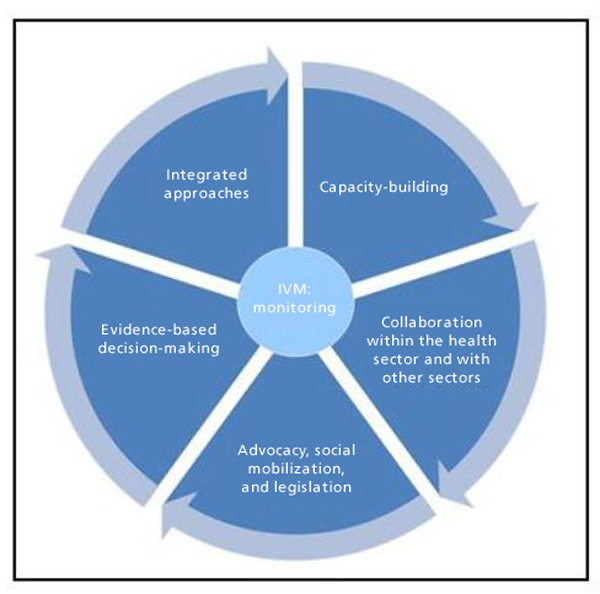
Integrated vector management (IVM) is defined as "a rational decision-making process for the optimal use of resources for vector control" and includes five key elements: 1) evidence-based decision-making, 2) integrated approaches 3), collaboration within the health sector and with other sectors, 4) advocacy, social mobilization, and legislation, and 5) capacity-building. In 2004, the WHO adopted IVM globally for the control of all vector-borne diseases. Important recent progress has been made in developing and promoting IVM for national malaria control programmes in Africa at a time when successful malaria control programmes are scaling-up with insecticide-treated nets (ITN) and/or indoor residual spraying (IRS) coverage. While interventions using only ITNs and/or IRS successfully reduce transmission intensity and the burden of malaria in many situations, it is not clear if these interventions alone will achieve those critical low levels that result in malaria elimination. Despite the successful employment of comprehensive integrated malaria control programmes, further strengthening of vector control components through IVM is relevant, especially during the "end-game" where control is successful and further efforts are required to go from low transmission situations to sustained local and country-wide malaria elimination. To meet this need and to ensure sustainability of control efforts, malaria control programmes should strengthen their capacity to use data for decision-making with respect to evaluation of current vector control programmes, employment of additional vector control tools in conjunction with ITN/IRS tactics, case-detection and treatment strategies, and determine how much and what types of vector control and interdisciplinary input are required to achieve malaria elimination. Similarly, on a global scale, there is a need for continued research to identify and evaluate new tools for vector control that can be integrated with existing biomedical strategies within national malaria control programmes. This review provides an overview of how IVM programmes are being implemented, and provides recommendations for further development of IVM to meet the goals of national malaria control programmes in Africa.
Overview
The claims and statistics of this paper haven’t been checked yet.
Free: it reads the open-access text and checks the first 5 claims that cite a source we can check. Create a free account to check every claim.
Integrity signals
Registry
Cites
Statistics
Figures
Verification
Claims the paper makes
The claims and statistics of this paper haven’t been checked yet.
Free: it reads the open-access text and checks the first 5 claims that cite a source we can check. Create a free account to check every claim.
Claims other papers make about this one
Each is checked against this paper’s own text: does it say what the citing paper says it does?
The cited source says what the claim attributes to it.
In the citing paper
“An IVM approach is important to sustain achievements and reduce transmission to critical low levels needed to eliminate malaria (Beier et al. 2009).”
From Global Status of DDT and Its Alternatives for Use in Vector Control to Prevent Disease (2009) · cites this paper as Beier et al. 2009
Self-check
Percentages, sums and reported differences re-computed from the paper’s own numbers.
The self-check needs the paper’s full text.
Citations
Cites
Disease control priorities in developing countries
(2006) · Choice Reviews Online · doi:10.5860/choice.44-0343 · Cited by 3,628
Macroeconomics and health: investing in health for economic development
Sachs, J. D. (2002) · Revista Panamericana de Salud Pública · doi:10.1590/s1020-49892002000800017 · Cited by 1,830
Disease control priorities in developing countries
Frenk, J. (2006) · Salud Pública de México · doi:10.1590/s0036-36342006000600011 · Cited by 1,599
Disease Control Priorities in Developing Countries
Mosley, W. H. (1993) · World Bank, Washington, DC eBooks · doi:10.1596/0-1952-0990-7 · Cited by 1,400
Handbook of Pesticide Toxicology
(2001) · Elsevier eBooks · doi:10.1016/b978-0-12-426260-7.x5000-9 · Cited by 1,322
Ross, R. (2010) · Cited by 940
Introduction to insect pest management
(1994) · Choice Reviews Online · doi:10.5860/choice.32-2128 · Cited by 539
Measuring the Burden of Neglected Tropical Diseases: The Global Burden of Disease Framework
Mathers, C. D., Ezzati, M., & Lopez, A. D. (2007) · PLoS Neglected Tropical Diseases · doi:10.1371/journal.pntd.0000114 · Cited by 510
WALKER, K., & LYNCH, M. (2007) · Medical and Veterinary Entomology · doi:10.1111/j.1365-2915.2007.00674.x · Cited by 279 · cited 2×
“Recent reviews of environmental management [37,39] and larval control [26] contain additional examples.”
BackgroundEradication of Anopheles gambiae from Brazil: lessons for malaria control in Africa?
Killeen, G. F., Fillinger, U., Kiche, I., Gouagna, L. C., & Knols, B. G. (2002) · The Lancet Infectious Diseases · doi:10.1016/s1473-3099(02)00397-3 · Cited by 272
Research works printed but not linked: 7
- Hatch CL, Williams JW, Jarinko PA: Guidelines for measuring proficiency as an aid in mosquito abatement program assessment. Mosq News. 1973, 33: 228-233.
- WHO: Global strategic framework for integrated vector management. World Health Organization. 2004, 10: 1-12.WHO/CDS/CPE/PVC/2004,
- WHO: Report of the global partners' meeting on neglected tropical diseases: 2007 – a turning point: Geneva, Swizerland, 17–18 April 2007. 2007, Geneva: World Health Organization
- Rafatjah HA: Prospects and Progress on IPM in World-wide Malaria control. Mosq News. 1982, 42: 491-498.
- Hinman EH: The management of water for malaria control. Symposium on Human Malaria: 1941; Philadelphia. 1941, 324-332.
- Berg van den H, Das PK, von Hildebrand A, Ragunathan V: Evaluation of the Integrated Pest and Vector Management (IPVM) project in Sri Lanka. 2006, New Dehli: World Health Organization, South East Asia Regional Office, 1-46.
- Manga L, Toure A, Shililu J: Implementation of Integrated Vector Management in the WHO-African Region: Progress Report 2000–2003. 2004, Washington, DC: Environmental Health Project, U.S. Agency for International Development, 1-26.
Cited by
White, N. J., Pukrittayakamee, S., Hien, T. T., Faiz, M. A., Mokuolu, O. A., & Dondorp, A. M. (2014) · The Lancet · doi:10.1016/s0140-6736(13)60024-0 · Cited by 1,123
Operational strategies to achieve and maintain malaria elimination
Moonen, B., Cohen, J. M., Snow, R. W., Slutsker, L., Drakeley, C., Smith, D. L., Abeyasinghe, R. R., Rodriguez, M. H., Maharaj, R., Tanner, M., et al. (2010) · The Lancet · doi:10.1016/s0140-6736(10)61269-x · Cited by 381
Global Status of DDT and Its Alternatives for Use in Vector Control to Prevent Disease
van den Berg, H. (2009) · Environmental Health Perspectives · doi:10.1289/ehp.0900785 · Cited by 376
“An IVM approach is important to sustain achievements and reduce transmission to criti cal low levels needed to eliminate malaria (Beier et al. 2009).”
BackgroundAlternative strategies for mosquito-borne arbovirus control
Achee, N. L., Grieco, J. P., Vatandoost, H., Seixas, G., Pinto, J., Ching-NG, L., Martins, A. J., Juntarajumnong, W., Corbel, V., Gouagna, C., et al. (2019) · PLOS Neglected Tropical Diseases · doi:10.1371/journal.pntd.0006822 · Cited by 353
Current vector control challenges in the fight against malaria
Benelli, G., & Beier, J. C. (2017) · Acta Tropica · doi:10.1016/j.actatropica.2017.06.028 · Cited by 313
Self-citation
Metadata
- Authors
- Beier, J. C., Keating, J., Githure, J. I., Macdonald, M. B., Impoinvil, D. E., & Novak, R. J.
- Affiliations
- University of Miami (US)
- Tulane University (US)
- International Centre of Insect Physiology and Ecology (KE)
- United States Agency for International Development (US)
- University of Liverpool (GB)
- University of Alabama at Birmingham (US)
- Corresponding author
- Beier, John C
- Venue
- Malaria Journal
- Published
- 2008-12
- Volume
- 7
- Issue
- S1
- Pages
- S4-S4
- ISSN
- 1475-2875 (ISSN-L)
- PMC
- PMC2604879
- OpenAlex
- W2024349624
- Cited by
- 355
- References
- 64
- Citations by year
- 2026: 12 · 2025: 25 · 2024: 26 · 2023: 18 · 2022: 14 · 2021: 24 · 2020: 23 · 2019: 25 · 2018: 16 · 2017: 21 · 2016: 19 · 2015: 20 · 2014: 21 · 2013: 26 · 2012: 21
- FWCI
- 2.21
- Type
- journal article
- Language
- en
- Open access
- gold
- doi.org
- Licence
- cc-by
- creativecommons.org/licenses/by/2.0 (tdm)
- Locations
- Malaria Journal (publishedVersion, cc-by)
- PubMed Central (publishedVersion, cc-by)
- PubMed (publishedVersion)
- DOAJ (DOAJ: Directory of Open Access Journals) (submittedVersion, cc-by-sa)
- Funders
- Foundation for the National Institutes of Health
- University of Miami
- Wellcome Trust
- National Institutes of Health
- U.S. Public Health Service (U01 A1054889)
- National Center for Research Resources (P20RR020770)
- Topics
- Health Sciences › Medicine › Public Health, Environmental and Occupational Health › Malaria Research and Control
- Health Sciences › Medicine › Public Health, Environmental and Occupational Health › Mosquito-borne diseases and control
- Health Sciences › Medicine › Public Health, Environmental and Occupational Health › Dengue and Mosquito Control Research
- Keywords
- integrated vector management, malaria control, malaria elimination, insecticide-treated nets, indoor residual spraying, vector control, evidence-based decision making, capacity building, social mobilization, advocacy, interdisciplinary collaboration, Africa
- MeSH terms
- Africa, Animals, Community Participation, Decision Making, Health Plan Implementation, Humans, Insect Vectors, Malaria, Mosquito Control, World Health Organization, Health Care Sector
About these checks
Registry, retraction, Cites and statistics results are computed, not judged, with one exception: a printed reference that no index lists is read once by a model before it counts as a citation error. Claims are extracted by a model and kept only when their quote appears verbatim in the text; each cited source is then checked, with a model’s help, for whether it says what the claim relies on. Those verdicts can be wrong — read the claim’s quote and the cited source before relying on one.
Statistics and arithmetic are recomputed, not judged.
Confidence bands are shown only for fields calibrated on our annotated test set. None is calibrated yet, so no band is shown.
What counts as a claim ›How we measure confidence ›How we check this ›
Are you an author, or do you see a problem with this page? Request a review
How to cite
Cite CoChat for the checks on this page, and the paper for its own findings.
- This page
- CoChat. (2026). Citation check: Integrated vector management for malaria control. https://app.cochat.ai/papers/10.1186/1475-2875-7-s1-s4
- The paper
- Beier, J. C., Keating, J., Githure, J. I., Macdonald, M. B., Impoinvil, D. E., & Novak, R. J. (2008). Integrated vector management for malaria control. Malaria Journal. https://doi.org/10.1186/1475-2875-7-s1-s4
Data sources
Bibliographic data: Semantic Scholar, OpenAlex, Crossref.
Contains information from the Semantic Scholar Academic Graph Datasets, made available under the ODC Attribution License (ODC-BY 1.0).
Semantic Scholar’s data is described in: Kinney, R., et al. (2023). The Semantic Scholar Open Data Platform. arXiv:2301.10140.
