

Optimization of AAV expression cassettes to improve packaging capacity and transgene expression in neurons
Open accessThe DOI matches its Crossref record, with a small difference in title or year; 27 of the 27 references it cites were found in a registry or an index; 11 of the 21 sources its claims cite were checked for support.
Abstract
Adeno-associated virus (AAV) vectors can deliver transgenes to diverse cell types and are therefore useful for basic research and gene therapy. Although AAV has many advantages over other viral vectors, its relatively small packaging capacity limits its use for delivering large genes. The available transgene size is further limited by the existence of additional elements in the expression cassette without which the gene expression level becomes much lower. By using alternative combinations of shorter elements, we generated a series of AAV expression cassettes and systematically evaluated their expression efficiency in neurons to maximize the transgene size available within the AAV packaging capacity while not compromising the transgene expression. We found that the newly developed smaller expression cassette shows comparable expression efficiency with an efficient vector generally used for strong gene expression. This new expression cassette will allow us to package larger transgenes without compromising expression efficiency.
Overview
CoChat Summary
TL;DR
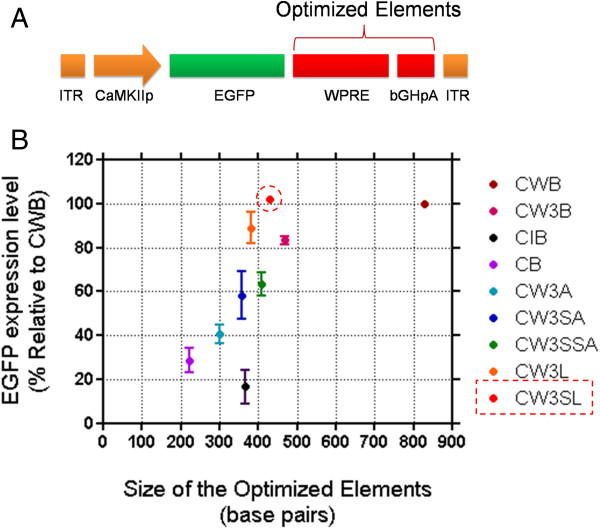
This study systematically shortened AAV expression-cassette elements and identified CW3SL, a cassette ~399 bp smaller than the prototype CWB that drives comparable transgene expression. CW3SL increased AAV packaging capacity, allowing expression of a 5.2 kb p110γ-EGFP cassette that exceeded the conventional AAV packaging limit in the CWB context.
Key findings
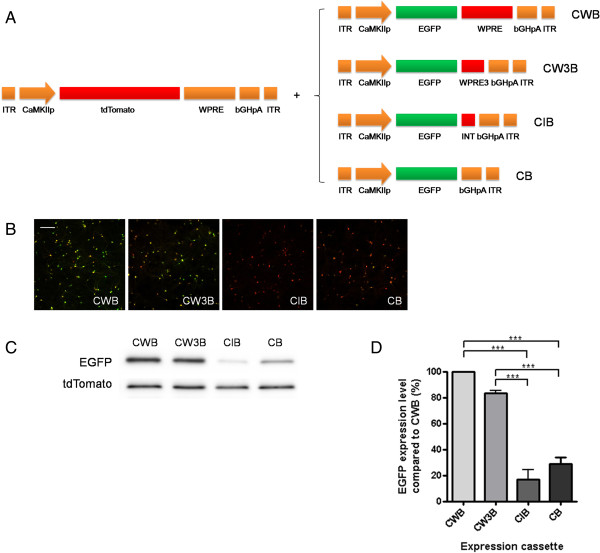
- Replacing 600 bp WPRE with 247 bp WPRE3 (CW3B) gave EGFP expression at 83.4% of CWB, not statistically different from CWB; removing WPRE (CB) reduced expression to 28.6%, and a chimeric intron (CIB) gave 16.6%.
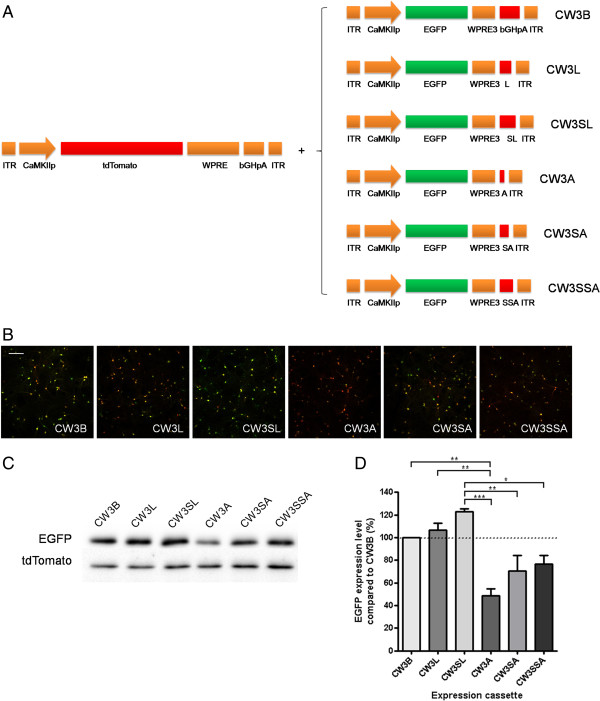
- Among polyadenylation variants, CW3SL (WPRE3 plus SV40 late polyadenylation signal upstream element and SV40 late polyadenylation signal) produced 122.7% of CW3B expression in vitro and 103.4% of parental CWB, while CW3A (synthetic polyadenylation signal alone) was only 49.7% of CW3B and 40.4% of CWB.
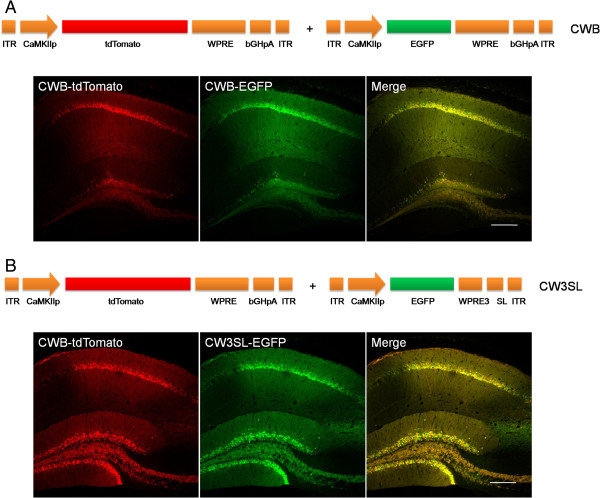
- In mouse hippocampal CA1, CW3SL-EGFP expression was 86.2% of CWB-EGFP.
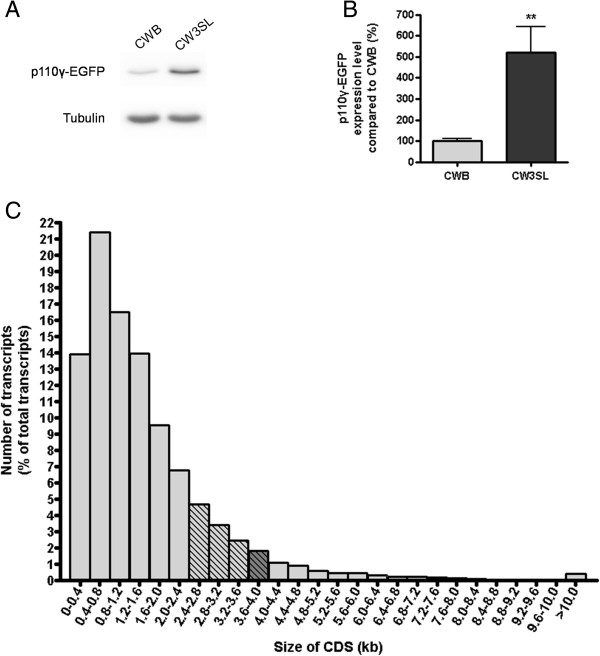
- For p110γ-EGFP, CWB produced a 5.6 kb packaged genome exceeding the 5.2 kb AAV limit, whereas CW3SL produced a 5.2 kb genome; viral titers were comparable (6.61 × 10^12 GC/ml for CWB vs. 7.01 × 10^12 GC/ml for CW3SL), but CW3SL drove five times more p110γ-EGFP expression than CWB.
Methods
- A series of AAV expression cassettes was generated by replacing WPRE and bGHpA with shorter elements, cloned between ITRs, and used to produce AAV serotype 1 in HEK293T cells; vectors were purified by iodixanol gradients and titered by quantitative RT-PCR.
- Cultured hippocampal neurons from E18 rat embryos were co-infected with EGFP and tdTomato AAVs; EGFP expression was quantified by western blot and normalized to tdTomato. In vivo, AAVs were stereotactically injected into mouse hippocampal CA1, and EGFP fluorescence was normalized to tdTomato by confocal imaging.
- Statistical comparisons used ANOVA with Bonferroni post-hoc tests; mouse hippocampal transcript length distributions were analyzed from RNA sequencing data.
Limitations
- The paper does not include a formal limitations section; it notes that cassettes shorter than CW3SL would allow packaging even longer transgenes but with lower expression levels.
- Evident from the text: in vivo CW3SL expression was slightly weaker than CWB (86.2%) in mouse CA1.
- Evident from the text: neuronal expression tests used the CaMKIIα promoter and hippocampal neurons; the authors suggest substituting other promoters or cell-type-specific promoters but do not test these alternatives.
Model-written summary. Check it against the paper before relying on it.
Integrity signals
Registry
Cites
Statistics
Figures
Verification
Claims the paper makes
5 Valid · 2 Not valid · 4 Not checked · 27 Own results and interpretations
At least one cited source doesn’t support this claim or points to a different paper, and none confirmed it — see the verdicts below.
In the paper
“Efforts have been made to expand the available AAV transgene size by trans-splicing and/or recombination to split the AAV expression cassette to two viral vectors [9]. However, the expression efficiency is still much lower than that of a single viral vector.”
- Also stated in: § Discussion · plain
“Techniques to divide a gene into two AAV vectors and then combining each segment to reconstitute the full-length sequence after transduction by trans-splicing and recombination have been developed, but this technique is still in its infancy showing much lower expression efficiency compared to a non-divided single vector [9].”
§ Optimization of AAV expression cassettes to improve packaging capacity and transgene expression in neurons > Background
What the sources say
- Disputedcites [9] Ghosh A Yue Y Duan D Efficient transgene reconstitution with hybrid dual AAV vectors carrying the minimized bridging sequences Hum Gene Ther 2011 22 77 83 10.1089/hum.2010.122 20662564 PMC3025179 sourceExperimental — accuracy not yet measured
The Discussion says trans-splicing and overlapping dual vectors have achieved expression comparable to a single AAV for certain genes, contrary to the claim that their expression is much lower. It cautions that success depends on the target gene, but does not make the claimed general comparison. (LLM, conf=0.88)
Checked by a reasoning model — may be wrong.
plainstates a cause- Asserted: passes — The authors put it forward as true.
- Checkable: passes — It can be checked against evidence.
- Load-bearing: passes — The paper’s conclusions depend on it.
- Based: passes — The paper gives a reason why it holds.
- Also stated in: § Discussion · plain
The cited sources support only part of this claim — read each source’s verdict below.
In the paper
“other studies [6-8] indicated that intact genomes were not, in fact, packaged in that case [3], and further suggested a strict size cutoff of 5.2 kb.”
- Also stated in: § CW3SL significantly increases AAV packaging limit of transgene · plain
“which exceeds the 5.2 kb packaging limit for AAV.”
§ Optimization of AAV expression cassettes to improve packaging capacity and transgene expression in neurons > Background
What the sources say
- Partly supportedcites [6] Dong B Nakai H Xiao W Characterization of genome integrity for oversized recombinant AAV vector Mol Ther J Am Soc Gene Ther 2010 18 87 92 10.1038/mt.2009.258 PMC2803017 19904236 sourceExperimental — accuracy not yet measured
The Discussion supports a physical limit on AAV genome packaging, but gives the limit as less than 5 kb and concludes that a capsid cannot accommodate more than 5,000 nucleotides. It does not support the claimed strict cutoff of 5.2 kb. (LLM, conf=0.88)
- Supportedcites [7] Wu Z Yang H Colosi P Effect of genome size on AAV vector packaging Mol Ther J Am Soc Gene Ther 2010 18 80 86 10.1038/mt.2009.255 PMC2839202 19904234 source
The Results report that genomes from vectors larger than 5.2 kb were truncated and that the upper packaging limit for the AAV2 and AAV5 capsids tested appeared to be approximately 5.2 kb. The Discussion reports the same maximum for the AAV2, AAV5, and AAV8 vectors tested, supporting the citing sentence’s suggestion of a cutoff rather than an absolute claim about every AAV vector. (LLM, conf=0.90)
- Not checked yetcites [8] Lai Y Yue Y Duan D Evidence for the failure of adeno-associated virus serotype 5 to package a viral genome > or = 8.2 kb. Mol Ther J Am Soc Gene Ther 2010 18 75 79 10.1038/mt.2009.256 PMC2839223 19904238 source
Checked before — its earlier verdict is held back until a new check runs.
- Not checked — no full text of the sourcecites [3] Dong JY Fan PD Frizzell RA Quantitative analysis of the packaging capacity of recombinant adeno-associated virus Hum Gene Ther 1996 7 2101 2112 10.1089/hum.1996.7.17-2101 8934224 source
plain- Asserted: passes — The authors put it forward as true.
- Checkable: passes — It can be checked against evidence.
- Load-bearing: passes — The paper’s conclusions depend on it.
- Based: passes — The paper gives a reason why it holds.
- Also stated in: § CW3SL significantly increases AAV packaging limit of transgene · plain
The cited sources support only part of this claim — read each source’s verdict below.
In the paper
“Conventionally used AAV backbones which include a commonly used neuronal expression cassette composed of 1.3 kb CaMKIIα promoter (which shows comparable expression efficiency with 0.4 kb CaMKIIα promoter [10] used in CWB), WPRE, and human growth hormone polyadenylation signal [23-25] has a capacity of 2.4 kb.”
§ Optimization of AAV expression cassettes to improve packaging capacity and transgene expression in neurons > Discussion
What the sources say
- Partly supportedcites [10] Dittgen T Nimmerjahn A Komai S Licznerski P Waters J Margrie TW Helmchen F Denk W Brecht M Osten P Lentivirus-based genetic manipulations of cortical neurons and their optical and electrophysiological monitoring in vivo Proc Natl Acad Sci 2004 101 18206 18211 10.1073/pnas.0407976101 15608064 PMC539748 sourceExperimental — accuracy not yet measured
Table 1 (Methods, p. 2) identifies a 1.3-kb α-CaMKII promoter used in this paper’s lentiviral vectors. The Discussion (p. 6) gives an approximately 10-kb limit for a lentiviral promoter-and-gene cassette, not a 2.4-kb capacity for an AAV backbone. The cited passages do not establish the claimed AAV cassette with WPRE and a human growth hormone polyadenylation signal. (LLM, conf=0.89)
- Partly supportedcites [23] Tye KM Prakash R Kim S-Y Fenno LE Grosenick L Zarabi H Thompson KR Gradinaru V Ramakrishnan C Deisseroth K Amygdala circuitry mediating reversible and bidirectional control of anxiety Nature 2011 471 358 362 10.1038/nature09820 21389985 PMC3154022 sourceExperimental — accuracy not yet measured
The Methods Summary (Virus-mediated opsin gene expression; page not provided) describes AAV5-packaged plasmids using a CaMKIIα promoter. It does not specify a 1.3 kb promoter, WPRE, a human growth hormone polyadenylation signal, or a 2.4 kb capacity; searches for those cassette components and capacity found no supporting passage. (LLM, conf=0.82)
- Partly supportedcites [24] Yizhar O Fenno LE Prigge M Schneider F Davidson TJ O’Shea DJ Sohal VS Goshen I Finkelstein J Paz JT Stehfest K Fudim R Ramakrishnan C Huguenard JR Hegemann P Deisseroth K Neocortical excitation/inhibition balance in information processing and social dysfunction Nature 2011 477 171 178 10.1038/nature10360 21796121 PMC4155501 sourceExperimental — accuracy not yet measured
The Consequences of altered E/I balance section describes an AAV expressing SSFO–EYFP under a CaMKIIα promoter, supporting the use of that promoter in an AAV construct. The passages do not specify a 1.3 kb promoter, WPRE, a human growth hormone polyadenylation signal, or a 2.4 kb capacity; searches for those terms found no supporting passage. Page numbers were unavailable in our copy. (LLM, conf=0.83)
- Partly supportedcites [25] Mattis J Tye KM Ferenczi EA Ramakrishnan C O’Shea DJ Prakash R Gunaydin LA Hyun M Fenno LE Gradinaru V Yizhar O Deisseroth K Principles for applying optogenetic tools derived from direct comparative analysis of microbial opsins Nat Methods 2012 9 159 172 22179551 PMC4165888 sourceExperimental — accuracy not yet measured
The Results section (‘Inhibiting spikes in pyramidal cells in acute slice’; page not provided) describes an AAV construct controlled by a CaMKIIα promoter. Online Methods (‘Molecular cloning’; page not provided) mentions WPRE, but for lentiviral constructs. Our copy does not give a 1.3 kb promoter length, identify a human growth hormone polyadenylation signal in that AAV backbone, or state a 2.4 kb capacity. (LLM, conf=0.84)
plain- Asserted: passes — The authors put it forward as true.
- Checkable: passes — It can be checked against evidence.
- Load-bearing: passes — The paper’s conclusions depend on it.
- Based: passes — The paper gives a reason why it holds.
- Partly supported
Every source the paper cites for this claim was checked and supports it.
In the paper
“which shows comparable expression efficiency with 0.4 kb CaMKIIα promoter [10] used in CWB”
§ Optimization of AAV expression cassettes to improve packaging capacity and transgene expression in neurons > Discussion
What the sources say
- Supportedcites [10] Dittgen T Nimmerjahn A Komai S Licznerski P Waters J Margrie TW Helmchen F Denk W Brecht M Osten P Lentivirus-based genetic manipulations of cortical neurons and their optical and electrophysiological monitoring in vivo Proc Natl Acad Sci 2004 101 18206 18211 10.1073/pnas.0407976101 15608064 PMC539748 source
The Results (p. 3) identify the 0.4-kb and 1.3-kb α-CaMKII vectors as producing the strongest EGFP expression. Figure 1 on the same page reports similar normalized expression values for them—155.1 ± 7.9 and 165.7 ± 13.5, respectively—in the tested cortical neurons. (LLM, conf=0.94)
plain- Asserted: passes — The authors put it forward as true.
- Checkable: passes — It can be checked against evidence.
- Load-bearing: passes — The paper’s conclusions depend on it.
- Based: passes — The paper gives a reason why it holds.
- Supported
A result the paper reports from its own data — it cites no other source for it, so there is none to check. The quote shows it is in the paper.
In the paper
“Although CWB-p110γ-EGFP did produce comparable amount of virus (6.61 × 10¹² GC/ml for CWB-p110γ-EGFP, 7.01 × 10¹² GC/ml for CW3SL-p110γ-EGFP; GC: genome copy)”
§ Optimization of AAV expression cassettes to improve packaging capacity and transgene expression in neurons > Results > CW3SL significantly increases AAV packaging limit of transgene
plain- Asserted: passes — The authors put it forward as true.
- Checkable: passes — It can be checked against evidence.
- Load-bearing: unclear — It is unclear whether the paper’s conclusions depend on it.
- Based: passes — The paper gives a reason why it holds.
23 more claims
Create a free account to see all 38 claims and to verify the 1 reference still open.
- Probably not a substantial claim. 4
- It may state two separate claims as one. 7
Claims other papers make about this one
Each is checked against this paper’s own text: does it say what the citing paper says it does?
The source backs part of the claim, not all of it — or backs it for a different population, condition or comparison.
In the citing paper
“A shorter version of the WPRE (WPRE3; 247 bp) showed only a 15% drop in expression in hippocampal neuron cultures or GFP expression in rAAV infected hippocampal CA1 region in the mouse brain [139].”
From Recombinant Adeno-Associated Viral Vectors (rAAV)-Vector Elements in Ocular Gene Therapy Clinical Trials and Transgene Expression and Bioactivity Assays (2020) · cites this paper as [139]
Experimental — accuracy not yet measuredThe source backs part of the claim, not all of it — or backs it for a different population, condition or comparison.
In the citing paper
“The SV40 late polyadenylation signal upstream element and the SV40 late polyadenylation signal combined with the WPRE3 (420 bp), decrease the length to less than half compared to the commonly used WPRE-bGHpolyA gene cassette (919 bp), and maintain a similar expression profile [139].”
From Recombinant Adeno-Associated Viral Vectors (rAAV)-Vector Elements in Ocular Gene Therapy Clinical Trials and Transgene Expression and Bioactivity Assays (2020) · cites this paper as [139]
Experimental — accuracy not yet measuredThe source backs part of the claim, not all of it — or backs it for a different population, condition or comparison.
In the citing paper
“Woodchuck Hepatitis Virus PRE (WPRE) | 600 | +++, 6-10× increase | [139,150]”
From Recombinant Adeno-Associated Viral Vectors (rAAV)-Vector Elements in Ocular Gene Therapy Clinical Trials and Transgene Expression and Bioactivity Assays (2020) · cites this paper as [139]
Experimental — accuracy not yet measuredThe source backs part of the claim, not all of it — or backs it for a different population, condition or comparison.
In the citing paper
“SV40 late | 135 | +++ | [139]”
From Recombinant Adeno-Associated Viral Vectors (rAAV)-Vector Elements in Ocular Gene Therapy Clinical Trials and Transgene Expression and Bioactivity Assays (2020) · cites this paper as [139]
Experimental — accuracy not yet measured
Citations
Cites
Neocortical excitation/inhibition balance in information processing and social dysfunction
Yizhar, O., Fenno, L. E., Prigge, M., Schneider, F., Davidson, T. J., O’Shea, D. J., Sohal, V. S., Goshen, I., Finkelstein, J., Paz, J. T., et al. (2011) · Nature · doi:10.1038/nature10360 · Cited by 2,454 · cited 1×
“4 kb CaMKIIα promoter [10] used in CWB), WPRE, and human growth hormone polyadenylation signal [23-25] has a capacity of 2.”
MethodAmygdala circuitry mediating reversible and bidirectional control of anxiety
Tye, K. M., Prakash, R., Kim, S.-Y., Fenno, L. E., Grosenick, L., Zarabi, H., Thompson, K. R., Gradinaru, V., Ramakrishnan, C., & Deisseroth, K. (2011) · Nature · doi:10.1038/nature09820 · Cited by 1,289 · cited 1×
“4 kb CaMKIIα promoter [10] used in CWB), WPRE, and human growth hormone polyadenylation signal [23-25] has a capacity of 2.”
MethodEffect of genome size on AAV vector packaging
Wu, Z., Yang, H., & Colosi, P. (2010) · Molecular Therapy · doi:10.1038/mt.2009.255 · Cited by 1,029 · cited 1×
“Although there is a report describing specific serotypes with much larger packaging capacity [5], other studies [6-8] indicated that intact genomes were not, in fact, packaged in that case [3], and further suggested a strict size cutoff of 5.”
BackgroundMattis, J., Tye, K. M., Ferenczi, E. A., Ramakrishnan, C., O'Shea, D. J., Prakash, R., Gunaydin, L. A., Hyun, M., Fenno, L. E., Gradinaru, V., et al. (2012) · Nature Methods · doi:10.1038/nmeth.1808 · Cited by 780 · cited 1×
“4 kb CaMKIIα promoter [10] used in CWB), WPRE, and human growth hormone polyadenylation signal [23-25] has a capacity of 2.”
MethodQuantitative analysis of the packaging capacity of recombinant adeno-associated virus
Dong, J.-Y., Fan, P.-D., & Frizzell, R. A. (1996) · Human Gene Therapy · doi:10.1089/hum.1996.7.17-2101 · Cited by 583 · cited 2×
“Although there is a report describing specific serotypes with much larger packaging capacity [5], other studies [6-8] indicated that intact genomes were not, in fact, packaged in that case [3], and further suggested a strict size cutoff of 5.”
BackgroundDittgen, T., Nimmerjahn, A., Komai, S., Licznerski, P., Waters, J., Margrie, T. W., Helmchen, F., Denk, W., Brecht, M., & Osten, P. (2004) · Proceedings of the National Academy of Sciences · doi:10.1073/pnas.0407976101 · Cited by 485 · cited 2×
“To generate a series of AAV expression cassettes, we used a strong expression cassette which contains neuronspecific promoter [10], transgene encoding enhanced green fluorescent protein (EGFP), woodchuck hepatitis posttranscriptional regulatory element (WPRE) [11-13], and bovine growth hormone polyadenylation signal (…”
MethodWoodchuck hepatitis virus contains a tripartite posttranscriptional regulatory element
Donello, J. E., Loeb, J. E., & Hope, T. J. (1998) · Journal of Virology · doi:10.1128/jvi.72.6.5085-5092.1998 · Cited by 350 · cited 2×
“1, and WPRE3 was produced by using recombinant PCR, in which the minimal sequences of γ and α elements were fused [16].”
BackgroundMethod(2013) · PubMed · Cited by 308
Intervening sequences increase efficiency of RNA 3' processing and accumulation of cytoplasmic RNA
Huang, M. T. F., & Gorman, C. M. (1990) · Nucleic Acids Research · doi:10.1093/nar/18.4.937 · Cited by 303 · cited 1×
“Introns are known to possess a posttranscriptional regulatory element that efficiently induces transport of mRNA out of the nucleus and enhances mRNA stability [18].”
BackgroundAllocca, M., Doria, M., Petrillo, M., Colella, P., Garcia-Hoyos, M., Gibbs, D., Kim, S. R., Maguire, A., Rex, T. S., Di Vicino, U., et al. (2008) · Journal of Clinical Investigation · doi:10.1172/jci34316 · Cited by 292
Cited by
Adeno-associated virus as a delivery vector for gene therapy of human diseases
Wang, J.-H., Gessler, D. J., Zhan, W., Gallagher, T. L., & Gao, G. (2024) · Signal Transduction and Targeted Therapy · doi:10.1038/s41392-024-01780-w · Cited by 904
Emerging issues in AAV-mediated in vivo gene therapy
Colella, P., Ronzitti, G., & Mingozzi, F. (2018) · Molecular Therapy - Methods & Clinical Development · doi:10.1016/j.omtm.2017.11.007 · Cited by 881
A viral strategy for targeting and manipulating interneurons across vertebrate species
Dimidschstein, J., Chen, Q., Tremblay, R., Rogers, S. L., Saldi, G.-A., Guo, L., Xu, Q., Liu, R., Lu, C., Chu, J., et al. (2016) · Nature Neuroscience · doi:10.1038/nn.4430 · Cited by 541
Levy, J. M., Yeh, W.-H., Pendse, N., Davis, J. R., Hennessey, E., Butcher, R., Koblan, L. W., Comander, J., Liu, Q., & Liu, D. R. (2020) · Nature Biomedical Engineering · doi:10.1038/s41551-019-0501-5 · Cited by 477
Systemic AAV vectors for widespread and targeted gene delivery in rodents
Challis, R. C., Ravindra Kumar, S., Chan, K. Y., Challis, C., Beadle, K., Jang, M. J., Kim, H. M., Rajendran, P. S., Tompkins, J. D., Shivkumar, K., et al. (2019) · Nature Protocols · doi:10.1038/s41596-018-0097-3 · Cited by 409
Astrocytes phagocytose adult hippocampal synapses for circuit homeostasis
Lee, J.-H., Kim, J.-Y., Noh, S., Lee, H., Lee, S. Y., Mun, J. Y., Park, H., & Chung, W.-S. (2021) · Nature · doi:10.1038/s41586-020-03060-3 · Cited by 385
Interregional synaptic maps among engram cells underlie memory formation
Choi, J.-H., Sim, S.-E., Kim, J.-I., Choi, D. I., Oh, J., Ye, S., Lee, J., Kim, T., Ko, H.-G., Lim, C.-S., et al. (2018) · Science · doi:10.1126/science.aas9204 · Cited by 382
Self-citationAAV vectors: The Rubik’s cube of human gene therapy
Pupo, A., Fernández, A., Low, S. H., François, A., Suárez-Amarán, L., & Samulski, R. J. (2022) · Molecular Therapy · doi:10.1016/j.ymthe.2022.09.015 · Cited by 360
Gene therapy for neurological disorders: progress and prospects
Deverman, B. E., Ravina, B. M., Bankiewicz, K. S., Paul, S. M., & Sah, D. W. Y. (2018) · Nature Reviews Drug Discovery · doi:10.1038/nrd.2018.110 · Cited by 306
Erratum: Gene therapy for neurological disorders: progress and prospects
Deverman, B. E., Ravina, B. M., Bankiewicz, K. S., Paul, S. M., & Sah, D. W. Y. (2018) · Nature Reviews Drug Discovery · doi:10.1038/nrd.2018.158 · Cited by 248
Precise correction of Duchenne muscular dystrophy exon deletion mutations by base and prime editing
Chemello, F., Chai, A. C., Li, H., Rodriguez-Caycedo, C., Sanchez-Ortiz, E., Atmanli, A., Mireault, A. A., Liu, N., Bassel-Duby, R., & Olson, E. N. (2021) · Science Advances · doi:10.1126/sciadv.abg4910 · Cited by 244
Efficient prime editing in mouse brain, liver and heart with dual AAVs
Davis, J. R., Banskota, S., Levy, J. M., Newby, G. A., Wang, X., Anzalone, A. V., Nelson, A. T., Chen, P. J., Hennes, A. D., An, M., et al. (2024) · Nature Biotechnology · doi:10.1038/s41587-023-01758-z · Cited by 227
“…mRNA transcript-stabilizing cis -elements on the AAV genome would increase PE efficiency, we tested the effect of including W3, the minimized gamma portion of the woodchuck hepatitis virus post-transcriptional regulatory element (WPRE), to the 3′ untranslated region (UTR) of the PE gene 40 .”
Progresses towards safe and efficient gene therapy vectors
Chira, S., Jackson, C. S., Oprea, I., Ozturk, F., Pepper, M. S., Diaconu, I., Braicu, C., Raduly, L.-Z., Calin, G. A., & Berindan-Neagoe, I. (2015) · Oncotarget · doi:10.18632/oncotarget.5169 · Cited by 219
“Other strategies have used minimal expression elements in the expression cassette to favor the size limit of the therapeutic gene in a single vector system, bypassing in this way the relatively low expression efficiency commonly seen with dual vector systems [102].”
MethodDrug delivery systems for CRISPR-based genome editors
Madigan, V., Zhang, F., & Dahlman, J. E. (2023) · Nature Reviews Drug Discovery · doi:10.1038/s41573-023-00762-x · Cited by 172
“Engineering regulatory elements, including the promoter, enhancer and polyadenylation signal, can both reduce the size of these elements and restrict transgene expression to desired tissue or cell types 58,59 .”
BackgroundAdeno-Associated Virus Toolkit to Target Diverse Brain Cells
Challis, R. C., Ravindra Kumar, S., Chen, X., Goertsen, D., Coughlin, G. M., Hori, A. M., Chuapoco, M. R., Otis, T. S., Miles, T. F., & Gradinaru, V. (2022) · Annual Review of Neuroscience · doi:10.1146/annurev-neuro-111020-100834 · Cited by 148
Multiple repressive mechanisms in the hippocampus during memory formation
Cho, J., Yu, N.-K., Choi, J.-H., Sim, S.-E., Kang, S. J., Kwak, C., Lee, S.-W., Kim, J.-I., Choi, D. I., Kim, V. N., et al. (2015) · Science · doi:10.1126/science.aac7368 · Cited by 139
Self-citationViral and Non-Viral Systems to Deliver Gene Therapeutics to Clinical Targets
Taghdiri, M., & Mussolino, C. (2024) · International Journal of Molecular Sciences · doi:10.3390/ijms25137333 · Cited by 145
The Brain-Enriched MicroRNA miR-9-3p Regulates Synaptic Plasticity and Memory
Sim, S.-E., Lim, C.-S., Kim, J.-I., Seo, D., Chun, H., Yu, N.-K., Lee, J., Kang, S. J., Ko, H.-G., Choi, J.-H., et al. (2016) · The Journal of Neuroscience · doi:10.1523/jneurosci.0630-16.2016 · Cited by 116
“AAVs expressing each sponge were produced as described previously (Choi et al., 2014).”
MethodSelf-citationNeumann, E. N., Bertozzi, T. M., Wu, E., Serack, F. E., Harvey, J. W., Brauer, P. P., Pirtle, C. P., Coffey, A. A., Howard, M., Kamath, N., et al. (2024) · Science · doi:10.1126/science.ado7082 · Cited by 137
Synaptic correlates of associative fear memory in the lateral amygdala
Choi, D. I., Kim, J., Lee, H., Kim, J., Sung, Y., Choi, J. E., Venkat, S. J., Park, P., Jung, H., & Kaang, B. (2021) · Neuron · doi:10.1016/j.neuron.2021.07.003 · Cited by 116
Self-citationCAR-T cell potency: from structural elements to vector backbone components
Mazinani, M., & Rahbarizadeh, F. (2022) · Biomarker Research · doi:10.1186/s40364-022-00417-w · Cited by 118
Buck, T., & Wijnholds, J. (2020) · International Journal of Molecular Sciences · doi:10.3390/ijms21124197 · Cited by 92
“A shorter version of the WPRE (WPRE3; 247 bp) showed only a 15% drop in expression in hippocampal neuron cultures or GFP expression in rAAV infected hippocampal CA1 region in the mouse brain [139].”
BackgroundInfluentialCRISPR-Cas9 gene editing of hepatitis B virus in chronically infected humanized mice
Stone, D., Long, K. R., Loprieno, M. A., Feelixge, H. S. D. S., Kenkel, E. J., Liley, R. M., Rapp, S., Roychoudhury, P., Nguyen, T., Stensland, L., et al. (2020) · Molecular Therapy — Methods & Clinical Development · doi:10.1016/j.omtm.2020.11.014 · Cited by 101
Understanding Capsid Assembly and Genome Packaging for Adeno-Associated Viruses
Bennett, A., Mietzsch, M., & Agbandje-McKenna, M. (2017) · Future Virology · doi:10.2217/fvl-2017-0011 · Cited by 82
Potassium channel-based optogenetic silencing
Sierra, Y. A. B., Rost, B. R., Pofahl, M., Fernandes, A. M., Kopton, R. A., Moser, S., Holtkamp, D., Masala, N., Beed, P. S., Tukker, J. J., et al. (2018) · Nature Communications · doi:10.1038/s41467-018-07038-8 · Cited by 85
A suite of enhancer AAVs and transgenic mouse lines for genetic access to cortical cell types
Ben‐Simon, Y., Hooper, M. J., Narayan, S., Daigle, T. L., Dwivedi, D., Way, S. W., Oster, A., Stafford, D. A., Mich, J. K., Taormina, M. J., et al. (2025) · Cell · doi:10.1016/j.cell.2025.05.002 · Cited by 98
Tbr1 instructs laminar patterning of retinal ganglion cell dendrites
Liu, J., Reggiani, J. D. S., Laboulaye, M. A., Pandey, S., Chen, B., Rubenstein, J. L. R., Krishnaswamy, A., & Sanes, J. R. (2018) · Nature Neuroscience · doi:10.1038/s41593-018-0127-z · Cited by 79
Layer 6b Is Driven by Intracortical Long-Range Projection Neurons
Zolnik, T. A., Ledderose, J., Toumazou, M., Trimbuch, T., Oram, T., Rosenmund, C., Eickholt, B. J., Sachdev, R. N. S., & Larkum, M. E. (2020) · Cell Reports · doi:10.1016/j.celrep.2020.02.044 · Cited by 77
Distinct roles of neuronal and microglial CB2 cannabinoid receptors in the mouse hippocampus
Li, Y., & Kim, J. (2017) · Neuroscience · doi:10.1016/j.neuroscience.2017.08.053 · Cited by 86
Adeno-Associated Viral Vectors as a Tool for Large Gene Delivery to the Retina
Trapani, I. (2019) · Genes · doi:10.3390/genes10040287 · Cited by 73
Li, S.-J., Vaughan, A., Sturgill, J. F., & Kepecs, Á. (2018) · Neuron · doi:10.1016/j.neuron.2018.05.028 · Cited by 79
In utero adenine base editing corrects multi-organ pathology in a lethal lysosomal storage disease
Bose, S. K., White, B. M., Kashyap, M. V., Dave, A., De Bie, F. R., Li, H., Singh, K., Menon, P., Wang, T., Teerdhala, S., et al. (2021) · Nature Communications · doi:10.1038/s41467-021-24443-8 · Cited by 67
Is Viral Vector Gene Delivery More Effective Using Biomaterials?
Wang, Y., Bruggeman, K. F., Franks, S. J., Gautam, V., Hodgetts, S. I., Harvey, A. R., Williams, R. J., & Nisbet, D. R. (2020) · Advanced Healthcare Materials · doi:10.1002/adhm.202001238 · Cited by 79
Duan, Y., Tao, Y., Qu, Z., Chen, Y., Miranda, A., Zhou, X., Lok, K.-C., Chen, Y., Fu, A. K. Y., Gradinaru, V., et al. (2021) · Nature Biomedical Engineering · doi:10.1038/s41551-021-00759-0 · Cited by 69
Rational engineering of a functional CpG-free ITR for AAV gene therapy
Pan, X., Yue, Y., Boftsi, M., Wasala, L. P., Tran, N. T., Zhang, K., Pintel, D. J., Tai, P. W. L., & Duan, D. (2022) · Gene Therapy · doi:10.1038/s41434-021-00296-0 · Cited by 53
Spatial transcriptomics for profiling the tropism of viral vectors in tissues
Jang, M. J., Coughlin, G. M., Jackson, C. R., Chen, X., Chuapoco, M. R., Vendemiatti, J., Wang, A. Z., & Gradinaru, V. (2023) · Nature Biotechnology · doi:10.1038/s41587-022-01648-w · Cited by 71
A bistable inhibitory optoGPCR for multiplexed optogenetic control of neural circuits
Wietek, J., Nozownik, A., Pulin, M., Saraf‐Sinik, I., Matosevich, N., Gowrishankar, R., Gat, A., Malan, D., Brown, B. J., Dine, J., et al. (2024) · Nature Methods · doi:10.1038/s41592-024-02285-8 · Cited by 63
Kolesnik, V. V., Nurtdinov, R. F., Oloruntimehin, E. S., Karabelsky, A. V., & Malogolovkin, A. S. (2024) · Clinical and Translational Medicine · doi:10.1002/ctm2.1607 · Cited by 59
“A variety of shortened AAV expression cassettes were generated by Choi et al. 72 Focusing on the Woodchuck hepatitis virus PREs and poly(A) elements, the authors declared 399 bp reduction in the CW3SL AAV vector without losing EGFP expression level in AAV transduced DIV9 cultured hippocampal neurons relative to the fu…”
BackgroundMethodInfluentialNon-viral therapeutic approaches to ocular diseases: An overview and future directions
Zulliger, R., Conley, S. M., & Naash, M. I. (2015) · Journal of Controlled Release · doi:10.1016/j.jconrel.2015.10.007 · Cited by 50
O’Geen, H., Beitnere, U., Garcia, M. S., Adhikari, A., Cameron, D. L., Fenton, T. A., Copping, N. A., Deng, P., Lock, S., Halmai, J. A. N. M., et al. (2023) · Molecular Therapy · doi:10.1016/j.ymthe.2023.01.013 · Cited by 53
LMO7 deficiency reveals the significance of the cuticular plate for hearing function
Du, T., Dewey, J. B., Wagner, E. L., Cui, R., Heo, J., Park, J.-J., Francis, S. P., Perez‐Reyes, E., Guillot, S. J., Sherman, N. E., et al. (2019) · Nature Communications · doi:10.1038/s41467-019-09074-4 · Cited by 53
Mahata, B., Cabrera, A., Brenner, D. A., Guerra-Resendez, R. S., Li, J., Goell, J., Wang, K., Guo, Y., Escobar, M., Parthasarathy, A. K., et al. (2023) · Nature Methods · doi:10.1038/s41592-023-02036-1 · Cited by 55
Excitatory neuron–specific SHP2-ERK signaling network regulates synaptic plasticity and memory
Ryu, H.-H., Kim, T., Kim, J.-W., Kang, M., Park, P., Kim, Y. G., Kim, H., Ha, J., Choi, J. E., Lee, J., et al. (2019) · Science Signaling · doi:10.1126/scisignal.aau5755 · Cited by 48
Self-citationOsborne, A., Wang, A. X. Z., Tassoni, A., Widdowson, P. S., & Martin, K. R. (2018) · Human Gene Therapy · doi:10.1089/hum.2017.069 · Cited by 43
Wang, T., & Guo, X. H. (2020) · Applied Microbiology and Biotechnology · doi:10.1007/s00253-020-10640-w · Cited by 45
Toward Development of Neuron Specific Transduction After Systemic Delivery of Viral Vectors
Finneran, D. J., Njoku, I. P., Flores-Pazarin, D., Ranabothu, M., Nash, K. R., Morgan, D., & Gordon, M. N. (2021) · Frontiers in Neurology · doi:10.3389/fneur.2021.685802 · Cited by 49
Rational design of a compact CRISPR-Cas9 activator for AAV-mediated delivery
Vora, S., Cheng, J., Xiao, R., VanDusen, N. J., Quintino, L., Pu, W. T., Vandenberghe, L. H., Chavez, A., & Church, G. (2018) · doi:10.1101/298620 · Cited by 42
Recombinant Viral Vectors as Neuroscience Tools
Chen, S., Haam, J., Walker, M., Scappini, E., Naughton, J., & Martin, N. P. (2019) · Current Protocols in Neuroscience · doi:10.1002/cpns.67 · Cited by 49
Greer, C. B., Wright, J., Weiss, J. D., Lazarenko, R. M., Moran, S. P., Zhu, J., Chronister, K. S., Jin, A., Kennedy, A. J., Sweatt, J. D., et al. (2020) · Journal of Neuroscience · doi:10.1523/jneurosci.1821-20.2020 · Cited by 51
Tickner, Z. J., & Farzan, M. (2021) · Pharmaceuticals · doi:10.3390/ph14060554 · Cited by 45
Multiplex Neural Circuit Tracing With G-Deleted Rabies Viral Vectors
Suzuki, T., Morimoto, N., Akaike, A., & Osakada, F. (2020) · Frontiers in Neural Circuits · doi:10.3389/fncir.2019.00077 · Cited by 41
Cost-Effectiveness of Newborn Screening for Spinal Muscular Atrophy in The Netherlands
Velikanova, R., van der Schans, S., Bischof, M., van Olden, R. W., Postma, M. J., & Boersma, C. (2022) · Value in Health · doi:10.1016/j.jval.2022.06.010 · Cited by 45
Zhang, W., Hou, Y., Yin, S., Miao, Q., Lee, K., Zhou, X., & Wang, Y. (2024) · Journal of Nanobiotechnology · doi:10.1186/s12951-024-02580-8 · Cited by 47
Treatment of a metabolic liver disease in mice with a transient prime editing approach
Rothgangl, T., Tálas, A., Ioannidi, E. I., Weber, Y., Böck, D., Matsushita, M., Villiger, E. A., Schmidheini, L., Moon, W. J., Lin, P. J. C., et al. (2025) · Nature Biomedical Engineering · doi:10.1038/s41551-025-01399-4 · Cited by 52
Production, Purification, and Quality Control for Adeno-associated Virus-based Vectors
Fripont, S., Marneffe, C., Marino, M., Rincón, M. Y., & Holt, M. G. (2019) · Journal of Visualized Experiments · doi:10.3791/58960 · Cited by 44
Inducible CRISPR genome-editing tool: classifications and future trends
Dai, X., Chen, X., Fang, Q., Li, J., & Bai, Z. (2017) · Critical Reviews in Biotechnology · doi:10.1080/07388551.2017.1378999 · Cited by 37
Current RNA strategies in treating cardiovascular diseases
Chia, S. P. S., Pang, J. K. S., & Soh, B.-S. (2024) · Molecular Therapy · doi:10.1016/j.ymthe.2024.01.028 · Cited by 35
Strategies to improve safety profile of AAV vectors
Suoranta, T., Laham-Karam, N., & Ylä‐Herttuala, S. (2022) · Frontiers in Molecular Medicine · doi:10.3389/fmmed.2022.1054069 · Cited by 33
A single-vector intersectional AAV strategy for interrogating cellular diversity and brain function
Hughes, A. C., Pittman, B. G., Xu, B., Gammons, J. W., Webb, C. M., Nolen, H. G., Chapman, P., Bikoff, J. B., & Schwarz, L. A. (2024) · Nature Neuroscience · doi:10.1038/s41593-024-01659-7 · Cited by 33
Lee, L. R., Peacock, L., Lisowski, L., Little, D. G., Munns, C. F., & Schindeler, A. (2019) · Molecular Therapy — Methods & Clinical Development · doi:10.1016/j.omtm.2019.08.010 · Cited by 30
Cappelli, J., Khacho, P., Wang, B., Sokolovski, A., Bakkar, W., Raymond, S., Ahlskog, N., Pitney, J., Wu, J., Chudalayandi, P., et al. (2021) · iScience · doi:10.1016/j.isci.2021.103539 · Cited by 31
Eickelbeck, D., Karapinar, R., Jäck, A., Süß, S. T., Barzan, R., Azimi, Z., Surdin, T., Grömmke, M., Mark, M. D., Gerwert, K. B., et al. (2019) · Communications Biology · doi:10.1038/s42003-019-0292-y · Cited by 30
Holehonnur, R., Lella, S. K., Ho, A., Luong, J. A., & Ploski, J. E. (2015) · Molecular Brain · doi:10.1186/s13041-015-0100-7 · Cited by 25
Calcium-permeable AMPA receptors govern PV neuron feature selectivity
Hong, I., Kim, J., Hainmueller, T., Kim, D. W., Keijser, J., Johnson, R. C., Park, S. H., Limjunyawong, N., Yang, Z., Cheon, D., et al. (2024) · Nature · doi:10.1038/s41586-024-08027-2 · Cited by 32
Redchuk, T. A., Karasev, M. M., Omelina, E. S., & Verkhusha, V. V. (2018) · ChemBioChem · doi:10.1002/cbic.201700642 · Cited by 26
Use of Adeno‐Associated and Herpes Simplex Viral Vectors for In Vivo Neuronal Expression in Mice
Penrod, R. D., Wells, A. M., Carlezon, W. A., & Cowan, C. W. (2015) · Current Protocols in Neuroscience · doi:10.1002/0471142301.ns0437s73 · Cited by 23
A neurodegeneration checkpoint mediated by REST protects against the onset of Alzheimer’s disease
Aron, L., Qiu, C., Ngian, Z., Liang, M., Drake, D., Choi, J., Fernandez, M. A., Roche, P., Bunting, E. L., Lacey, E. K., et al. (2023) · Nature Communications · doi:10.1038/s41467-023-42704-6 · Cited by 26
Self-citationRecombinant AAV Vectors for Enhanced Expression of Authentic IgG
Fuchs, S. P., Martinez-Navío, J. M., Gao, G., & Desrosiers, R. C. (2016) · PLoS ONE · doi:10.1371/journal.pone.0158009 · Cited by 23
Genetic Constructs for the Control of Astrocytes’ Activity
Borodinova, A. A., Balaban, P. M., Борисович, Б. И., Salmina, A. B., & Власова, О. Л. (2021) · Cells · doi:10.3390/cells10071600 · Cited by 24
Revolution of AAV in Drug Discovery: From Delivery System to Clinical Application
Yin, L., He, H., Zhang, H., Shang, Y., Fu, C., Wu, S., & Jin, T. (2025) · Journal of Medical Virology · doi:10.1002/jmv.70447 · Cited by 27
In vivo three- and four-photon fluorescence microscopy using a 1.8 µm femtosecond fiber laser system
Murakoshi, H., Ueda, H. H., Goto, R., Hamada, K., Nagasawa, Y., & Fuji, T. (2022) · Biomedical Optics Express · doi:10.1364/boe.477322 · Cited by 21
Regulation of PV interneuron plasticity by neuropeptide-encoding genes
Selten, M. M., Bernard, C., Mukherjee, D., Hamid, F., Hanusz-Godoy, A., Oozeer, F., Zimmer, C., & Marín, Ó. (2025) · Nature · doi:10.1038/s41586-025-08933-z · Cited by 24
The role of nuclear PKMζ in memory maintenance
Ko, H., Kim, J., Sim, S.-E., Kim, T., Yoo, J., Choi, S.-L., Baek, S. H., Yu, W.-J., Yoon, J., Sacktor, T. C., et al. (2016) · Neurobiology of Learning and Memory · doi:10.1016/j.nlm.2016.06.010 · Cited by 22
Self-citationMaturana, C. J., Verpeut, J. L., Pisano, T. J., Dhanerawala, Z. M., Esteves, A. D., Enquist, L. W., & Engel, E. A. (2020) · Molecular Therapy — Methods & Clinical Development · doi:10.1016/j.omtm.2020.04.004 · Cited by 21
Coordination chemogenetics for activation of GPCR-type glutamate receptors in brain tissue
Ojima, K., Kakegawa, W., Yamasaki, T., Miura, Y., Itoh, M., Michibata, Y., Kubota, R., Doura, T., Miura, E., Nonaka, H., et al. (2022) · Nature Communications · doi:10.1038/s41467-022-30828-0 · Cited by 20
Mich, J. K., Sunil, S., Johansen, N., Martinez, R. A., Liu, J., Gore, B. B., Mahoney, J. T., Leytze, M., Ben‐Simon, Y., Bertagnolli, D., et al. (2023) · bioRxiv (Cold Spring Harbor Laboratory) · doi:10.1101/2023.09.20.558718 · Cited by 22
Ross, P. D., Gadalla, K. K. E., Thomson, S. R., Selfridge, J., Bahey, N. G., Benito, J., Burstein, S. R., McMinn, R., Bolon, B. N., Hector, R. D., et al. (2025) · Science Translational Medicine · doi:10.1126/scitranslmed.adq3614 · Cited by 27
Understanding the Potential of Genome Editing in Parkinson’s Disease
Arango, D., Bittar, A., Esmeral, N. P., Ocasión, C., Muñoz-Camargo, C., Cruz, J. C., Reyes, L. H., & Bloch, N. I. (2021) · International Journal of Molecular Sciences · doi:10.3390/ijms22179241 · Cited by 26
Hippocampal overexpression of NOS1AP promotes endophenotypes related to mental disorders
Freudenberg, F., Candemir, E., Chen, X., Li, L., Esen-Sehir, D., Schenk, N., Kinoshita, M., Grünewald, L., Frerichs, V., Fattakhov, N. S., et al. (2021) · EBioMedicine · doi:10.1016/j.ebiom.2021.103565 · Cited by 20
Karapinar, R., Schwitalla, J., Eickelbeck, D., Pakusch, J., Mücher, B., Grömmke, M., Surdin, T., Knöpfel, T., Mark, M., Siveke, I., et al. (2021) · Nature Communications · doi:10.1038/s41467-021-24718-0 · Cited by 15
Amphetamine-induced reverse transport of dopamine does not require cytosolic Ca2+
Støier, J. F., Konomi-Pilkati, A., Apuschkin, M., Herborg, F., & Gether, U. (2023) · Journal of Biological Chemistry · doi:10.1016/j.jbc.2023.105063 · Cited by 20
Targeted sensors for glutamatergic neurotransmission
Hao, Y., Toulmé, E., König, B., Rosenmund, C., & Plested, A. J. R. (2023) · eLife · doi:10.7554/elife.84029 · Cited by 17
Kawabata, H., Konno, A., Matsuzaki, Y., Sato, Y., Kawachi, M., Aoki, R., Tsutsumi, S., Togai, S., Kobayashi, R., Horii, T., et al. (2024) · Molecular Therapy — Methods & Clinical Development · doi:10.1016/j.omtm.2024.101185 · Cited by 20
Yu, N., Kim, H. F., Shim, J.-H., Kim, S., Kim, D. W., Kwak, C., Sim, S.-E., Choi, J.-H., Ahn, S.-H., Yoo, J., et al. (2016) · Scientific Reports · doi:10.1038/srep22892 · Cited by 20
Self-citationViral Cre-LoxP tools aid genome engineering in mammalian cells
Sengupta, R., Mendenhall, A., Sarkar, N., Mukherjee, C., Afshari, A., Huang, J. S., & Lü, B. (2017) · Journal of Biological Engineering · doi:10.1186/s13036-017-0087-y · Cited by 20
Pironet, A., Syam, N., Vandewiele, F., den Haute, C. V., Kerselaers, S., Pinto, S., Velde, G. V., Gijsbers, R., & Vennekens, R. (2019) · Frontiers in Physiology · doi:10.3389/fphys.2019.00802 · Cited by 17
Effects of Thermally Induced Configuration Changes on rAAV Genome’s Enzymatic Accessibility
Xu, Y., Guo, P., Zhang, J., Chrzanowski, M., Chew, H., Firrman, J., Sang, N., Diao, Y., & Xiao, W. (2020) · Molecular Therapy — Methods & Clinical Development · doi:10.1016/j.omtm.2020.06.005 · Cited by 19
Challis, R. C., Kumar, S. R., Chan, K. Y., Challis, C., Jang, M. J., Rajendran, P. S., Tompkins, J. D., Shivkumar, K., Deverman, B. E., & Gradinaru, V. (2018) · bioRxiv (Cold Spring Harbor Laboratory) · doi:10.1101/246405 · Cited by 17
Chen, H., Durinck, S., Patel, H., Foreman, O., Mesh, K., Eastham, J., Caothien, R. H., Newman, R. J., Roose‐Girma, M., Darmanis, S., et al. (2022) · Molecular Therapy — Methods & Clinical Development · doi:10.1016/j.omtm.2022.10.016 · Cited by 15
Lemmens, M., Dorsheimer, L., Zeller, A., & Dietz, Y. (2024) · Mutation Research/Genetic Toxicology and Environmental Mutagenesis · doi:10.1016/j.mrgentox.2024.503767 · Cited by 16
Develop an efficient and specific AAV-based labeling system for Muller glia in mice
Gao, Y., Fang, K., Yan, Z., Zhang, H., Geng, G., Wu, W., Ding, X., Zhang, H., Zhong, N., Wang, Q., et al. (2022) · Scientific Reports · doi:10.1038/s41598-022-27013-0 · Cited by 13
Quinlan, M. A., Guo, R., Clark, A. G., Luber, E. M., Christian, R. J., Martinez, R. A., Groce, E. L., Liu, J., Bishaw, Y. M., Bhowmik, R., et al. (2025) · Molecular Therapy · doi:10.1016/j.ymthe.2025.09.040 · Cited by 15
Friedreich Ataxia: Treatment with Genetic Approach
Nelwan, M. (2017) · Journal of Advances in Biology & Biotechnology · doi:10.2139/ssrn.2986633 · Cited by 12
AAV vectors for specific and efficient gene expression in microglia
Aoki, R., Konno, A., Hosoi, N., Kawabata, H., & Hirai, H. (2025) · Cell Reports Methods · doi:10.1016/j.crmeth.2025.101116 · Cited by 12
“29 Our unpublished data using a CaMKII promoter-driven AAV-PHP.”
Current trends in gene therapy to treat inherited disorders of the brain
Matuszek, Ż., Brown, B. L., Yrigollen, C. M., Keiser, M. S., & Davidson, B. L. (2025) · Molecular Therapy · doi:10.1016/j.ymthe.2025.03.057 · Cited by 14
Egr1 is a sex-dependent regulator of neuronal chromatin, structural plasticity, and behaviour
Rocks, D., Demarchi, L., Ouldibbat, L., Purisic, E., Cham, H., Gallo, E. F., Greally, J. M., Suzuki, M., & Kundaković, M. (2025) · Nature Communications · doi:10.1038/s41467-025-66217-6 · Cited by 16
Optogenetic activation of mGluR1 signaling in the cerebellum induces synaptic plasticity
Surdin, T., Preissing, B., Rohr, L., Grömmke, M., Böke, H., Barcik, M., Azimi, Z., Jancke, D., Herlitze, S., Mark, M. D., et al. (2022) · iScience · doi:10.1016/j.isci.2022.105828 · Cited by 13
A light-controlled phospholipase C for imaging of lipid dynamics and controlling neural plasticity
Kim, Y., Tohyama, S., Nagashima, T., Nagase, M., Hida, Y., Hamada, S., Watabe, A. M., & Ohtsuka, T. (2024) · Cell chemical biology · doi:10.1016/j.chembiol.2024.03.001 · Cited by 10
E2F4-Based Gene Therapy Mitigates the Phenotype of the Alzheimer's Disease Mouse Model 5xFAD
López‐Sánchez, N., Garrido‐García, A., Ramón‐Landreau, M., Cano‐Daganzo, V., & Frade, J. M. (2021) · Neurotherapeutics · doi:10.1007/s13311-021-01151-1 · Cited by 13
Production, Purification, and Quality Control for Adeno-associated Virus-based Vectors
Fripont, S., Marneffe, C., Marino, M., Rincón, M. Y., & Holt, M. G. (2019) · Journal of Visualized Experiments · doi:10.3791/58960-v · Cited by 10
Metadata
- Authors
- Choi, J.-H., Yu, N.-K., Baek, G.-C., Bakes, J., Seo, D., Nam, H. J., Baek, S. H., Lim, C.-S., Lee, Y.-S., & Kaang, B.-K.
- Affiliations
- Seoul National University (KR)
- Chung-Ang University (KR)
- Corresponding author
- Kaang, Bong-Kiun
- ORCID
- Venue
- Molecular Brain
- Published
- 2014-03-11
- Volume
- 7
- Issue
- 1
- Pages
- 17-17
- ISSN
- 1756-6606 (ISSN-L)
- PMC
- PMC3975461
- OpenAlex
- W2144605372
- Cited by
- 188
- References
- 27
- Citations by year
- 2026: 26 · 2025: 24 · 2024: 23 · 2023: 19 · 2022: 16 · 2021: 15 · 2020: 17 · 2019: 11 · 2018: 11 · 2017: 13 · 2016: 6 · 2015: 6
- FWCI
- 4.21
- Type
- journal article
- Language
- en
- Open access
- gold
- doi.org
- Licence
- cc-by
- Locations
- Molecular Brain (publishedVersion, cc-by)
- Europe PMC (PubMed Central) (publishedVersion, cc-by)
- PubMed Central (publishedVersion, cc-by)
- PubMed (publishedVersion)
- Seoul National University Open Repository (Seoul National University) (submittedVersion)
- Topics
- Life Sciences › Biochemistry, Genetics and Molecular Biology › Genetics › Virus-based gene therapy research
- Life Sciences › Biochemistry, Genetics and Molecular Biology › Molecular Biology › RNA Interference and Gene Delivery
- Life Sciences › Neuroscience › Neurology › Barrier Structure and Function Studies
- Keywords
- adeno-associated virus vectors, packaging capacity, transgene expression efficiency, neurons, gene therapy vectors, multi-objective optimization
- MeSH terms
- Dependovirus, Animals, Brain, Genetic Techniques, Genetic Vectors, Humans, Male, Mice, Inbred C57BL, Neurons, Regulatory Sequences, Nucleic Acid, Gene Expression, Sequence Deletion, Virus Assembly, Transgenes, Polyadenylation, Mice, Rats, HEK293 Cells
About these checks
Registry, retraction, Cites and statistics results are computed, not judged, with one exception: a printed reference that no index lists is read once by a model before it counts as a citation error. Claims are extracted by a model and kept only when their quote appears verbatim in the text; each cited source is then checked, with a model’s help, for whether it says what the claim relies on. Those verdicts can be wrong — read the claim’s quote and the cited source before relying on one.
The claim verdicts this report counts are experimental: their accuracy is not yet measured.
A language model drew the claims from the paper on 2026-10-28, under version 3 of the claim definition (model deepseek-v4.1-flash, prompt extract-v3).
A second model labelled each claim on 2026-10-28 (model jev-1.13-20260917, definition revision gold-guideline-v0.2).
Cited sources are checked with a language model’s help (gpt-6-sol).
Statistics and arithmetic are recomputed, not judged.
Confidence bands are shown only for fields calibrated on our annotated test set. None is calibrated yet, so no band is shown.
What counts as a claim ›How we measure confidence ›How we check this ›
Are you an author, or do you see a problem with this page? Request a review
Data sources
Bibliographic data: Semantic Scholar, OpenAlex, Crossref.
Contains information from the Semantic Scholar Academic Graph Datasets, made available under the ODC Attribution License (ODC-BY 1.0).
Semantic Scholar’s data is described in: Kinney, R., et al. (2023). The Semantic Scholar Open Data Platform. arXiv:2301.10140.
