

Optimization of AAV expression cassettes to improve packaging capacity and transgene expression in neurons
Open accessThe DOI matches its Crossref record, with a small difference in title or year; 27 of the 27 references it cites were found in a registry or an index; 11 of the 21 sources its claims cite were checked for support.
Abstract
Adeno-associated virus (AAV) vectors can deliver transgenes to diverse cell types and are therefore useful for basic research and gene therapy. Although AAV has many advantages over other viral vectors, its relatively small packaging capacity limits its use for delivering large genes. The available transgene size is further limited by the existence of additional elements in the expression cassette without which the gene expression level becomes much lower. By using alternative combinations of shorter elements, we generated a series of AAV expression cassettes and systematically evaluated their expression efficiency in neurons to maximize the transgene size available within the AAV packaging capacity while not compromising the transgene expression. We found that the newly developed smaller expression cassette shows comparable expression efficiency with an efficient vector generally used for strong gene expression. This new expression cassette will allow us to package larger transgenes without compromising expression efficiency.
Overview
CoChat Summary
TL;DR
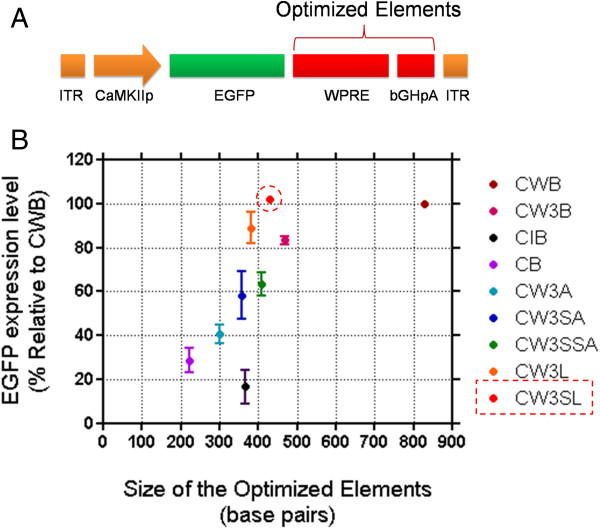
This study systematically shortened AAV expression-cassette elements and identified CW3SL, a cassette ~399 bp smaller than the prototype CWB that drives comparable transgene expression. CW3SL increased AAV packaging capacity, allowing expression of a 5.2 kb p110γ-EGFP cassette that exceeded the conventional AAV packaging limit in the CWB context.
Key findings
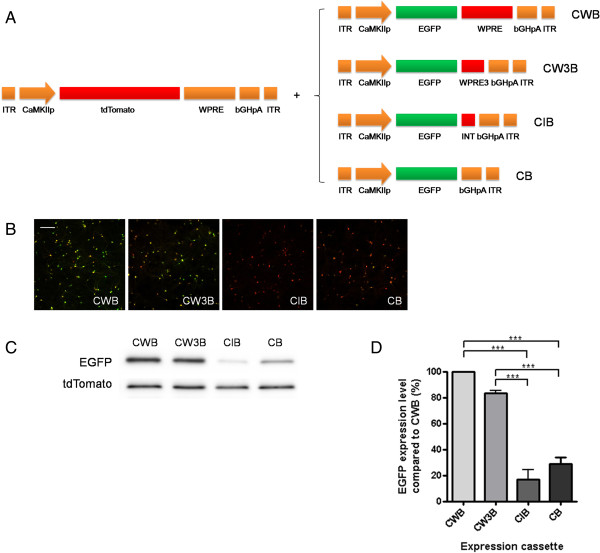
- Replacing 600 bp WPRE with 247 bp WPRE3 (CW3B) gave EGFP expression at 83.4% of CWB, not statistically different from CWB; removing WPRE (CB) reduced expression to 28.6%, and a chimeric intron (CIB) gave 16.6%.
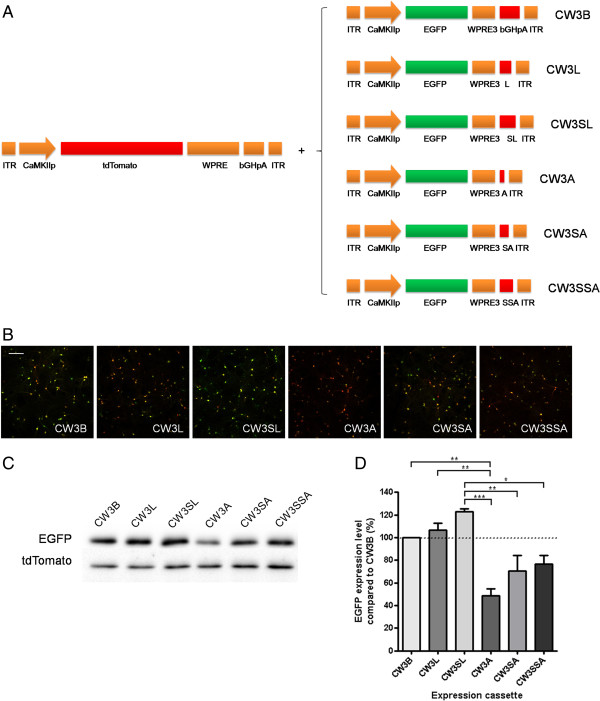
- Among polyadenylation variants, CW3SL (WPRE3 plus SV40 late polyadenylation signal upstream element and SV40 late polyadenylation signal) produced 122.7% of CW3B expression in vitro and 103.4% of parental CWB, while CW3A (synthetic polyadenylation signal alone) was only 49.7% of CW3B and 40.4% of CWB.
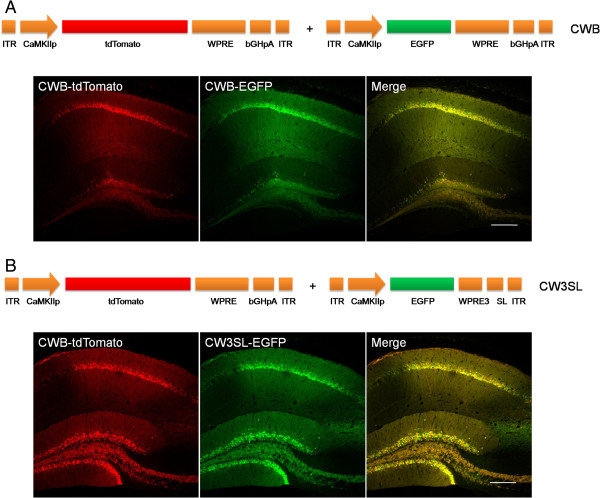
- In mouse hippocampal CA1, CW3SL-EGFP expression was 86.2% of CWB-EGFP.
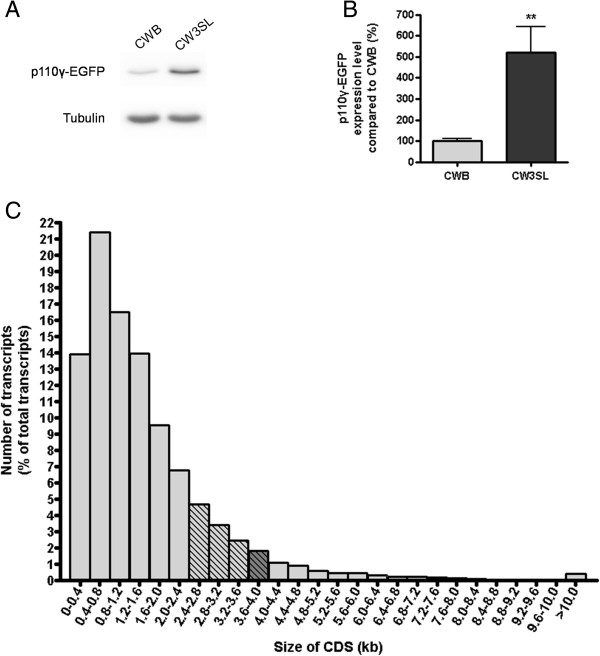
- For p110γ-EGFP, CWB produced a 5.6 kb packaged genome exceeding the 5.2 kb AAV limit, whereas CW3SL produced a 5.2 kb genome; viral titers were comparable (6.61 × 10^12 GC/ml for CWB vs. 7.01 × 10^12 GC/ml for CW3SL), but CW3SL drove five times more p110γ-EGFP expression than CWB.
Methods
- A series of AAV expression cassettes was generated by replacing WPRE and bGHpA with shorter elements, cloned between ITRs, and used to produce AAV serotype 1 in HEK293T cells; vectors were purified by iodixanol gradients and titered by quantitative RT-PCR.
- Cultured hippocampal neurons from E18 rat embryos were co-infected with EGFP and tdTomato AAVs; EGFP expression was quantified by western blot and normalized to tdTomato. In vivo, AAVs were stereotactically injected into mouse hippocampal CA1, and EGFP fluorescence was normalized to tdTomato by confocal imaging.
- Statistical comparisons used ANOVA with Bonferroni post-hoc tests; mouse hippocampal transcript length distributions were analyzed from RNA sequencing data.
Limitations
- The paper does not include a formal limitations section; it notes that cassettes shorter than CW3SL would allow packaging even longer transgenes but with lower expression levels.
- Evident from the text: in vivo CW3SL expression was slightly weaker than CWB (86.2%) in mouse CA1.
- Evident from the text: neuronal expression tests used the CaMKIIα promoter and hippocampal neurons; the authors suggest substituting other promoters or cell-type-specific promoters but do not test these alternatives.
Model-written summary. Check it against the paper before relying on it.
Integrity signals
Registry
Cites
Statistics
Figures
Verification
Claims the paper makes
5 Valid · 2 Not valid · 4 Not checked · 27 Own results and interpretations
At least one cited source doesn’t support this claim or points to a different paper, and none confirmed it — see the verdicts below.
In the paper
“Efforts have been made to expand the available AAV transgene size by trans-splicing and/or recombination to split the AAV expression cassette to two viral vectors [9]. However, the expression efficiency is still much lower than that of a single viral vector.”
- Also stated in: § Discussion · plain
“Techniques to divide a gene into two AAV vectors and then combining each segment to reconstitute the full-length sequence after transduction by trans-splicing and recombination have been developed, but this technique is still in its infancy showing much lower expression efficiency compared to a non-divided single vector [9].”
§ Optimization of AAV expression cassettes to improve packaging capacity and transgene expression in neurons > Background
What the sources say
- Disputedcites [9] Ghosh A Yue Y Duan D Efficient transgene reconstitution with hybrid dual AAV vectors carrying the minimized bridging sequences Hum Gene Ther 2011 22 77 83 10.1089/hum.2010.122 20662564 PMC3025179 sourceExperimental — accuracy not yet measured
The Discussion says trans-splicing and overlapping dual vectors have achieved expression comparable to a single AAV for certain genes, contrary to the claim that their expression is much lower. It cautions that success depends on the target gene, but does not make the claimed general comparison. (LLM, conf=0.88)
Checked by a reasoning model — may be wrong.
plainstates a cause- Asserted: passes — The authors put it forward as true.
- Checkable: passes — It can be checked against evidence.
- Load-bearing: passes — The paper’s conclusions depend on it.
- Based: passes — The paper gives a reason why it holds.
- Also stated in: § Discussion · plain
The cited sources support only part of this claim — read each source’s verdict below.
In the paper
“other studies [6-8] indicated that intact genomes were not, in fact, packaged in that case [3], and further suggested a strict size cutoff of 5.2 kb.”
- Also stated in: § CW3SL significantly increases AAV packaging limit of transgene · plain
“which exceeds the 5.2 kb packaging limit for AAV.”
§ Optimization of AAV expression cassettes to improve packaging capacity and transgene expression in neurons > Background
What the sources say
- Partly supportedcites [6] Dong B Nakai H Xiao W Characterization of genome integrity for oversized recombinant AAV vector Mol Ther J Am Soc Gene Ther 2010 18 87 92 10.1038/mt.2009.258 PMC2803017 19904236 sourceExperimental — accuracy not yet measured
The Discussion supports a physical limit on AAV genome packaging, but gives the limit as less than 5 kb and concludes that a capsid cannot accommodate more than 5,000 nucleotides. It does not support the claimed strict cutoff of 5.2 kb. (LLM, conf=0.88)
- Supportedcites [7] Wu Z Yang H Colosi P Effect of genome size on AAV vector packaging Mol Ther J Am Soc Gene Ther 2010 18 80 86 10.1038/mt.2009.255 PMC2839202 19904234 source
The Results report that genomes from vectors larger than 5.2 kb were truncated and that the upper packaging limit for the AAV2 and AAV5 capsids tested appeared to be approximately 5.2 kb. The Discussion reports the same maximum for the AAV2, AAV5, and AAV8 vectors tested, supporting the citing sentence’s suggestion of a cutoff rather than an absolute claim about every AAV vector. (LLM, conf=0.90)
- Not checked yetcites [8] Lai Y Yue Y Duan D Evidence for the failure of adeno-associated virus serotype 5 to package a viral genome > or = 8.2 kb. Mol Ther J Am Soc Gene Ther 2010 18 75 79 10.1038/mt.2009.256 PMC2839223 19904238 source
Checked before — its earlier verdict is held back until a new check runs.
- Not checked — no full text of the sourcecites [3] Dong JY Fan PD Frizzell RA Quantitative analysis of the packaging capacity of recombinant adeno-associated virus Hum Gene Ther 1996 7 2101 2112 10.1089/hum.1996.7.17-2101 8934224 source
plain- Asserted: passes — The authors put it forward as true.
- Checkable: passes — It can be checked against evidence.
- Load-bearing: passes — The paper’s conclusions depend on it.
- Based: passes — The paper gives a reason why it holds.
- Also stated in: § CW3SL significantly increases AAV packaging limit of transgene · plain
The cited sources support only part of this claim — read each source’s verdict below.
In the paper
“Conventionally used AAV backbones which include a commonly used neuronal expression cassette composed of 1.3 kb CaMKIIα promoter (which shows comparable expression efficiency with 0.4 kb CaMKIIα promoter [10] used in CWB), WPRE, and human growth hormone polyadenylation signal [23-25] has a capacity of 2.4 kb.”
§ Optimization of AAV expression cassettes to improve packaging capacity and transgene expression in neurons > Discussion
What the sources say
- Partly supportedcites [10] Dittgen T Nimmerjahn A Komai S Licznerski P Waters J Margrie TW Helmchen F Denk W Brecht M Osten P Lentivirus-based genetic manipulations of cortical neurons and their optical and electrophysiological monitoring in vivo Proc Natl Acad Sci 2004 101 18206 18211 10.1073/pnas.0407976101 15608064 PMC539748 sourceExperimental — accuracy not yet measured
Table 1 (Methods, p. 2) identifies a 1.3-kb α-CaMKII promoter used in this paper’s lentiviral vectors. The Discussion (p. 6) gives an approximately 10-kb limit for a lentiviral promoter-and-gene cassette, not a 2.4-kb capacity for an AAV backbone. The cited passages do not establish the claimed AAV cassette with WPRE and a human growth hormone polyadenylation signal. (LLM, conf=0.89)
- Partly supportedcites [23] Tye KM Prakash R Kim S-Y Fenno LE Grosenick L Zarabi H Thompson KR Gradinaru V Ramakrishnan C Deisseroth K Amygdala circuitry mediating reversible and bidirectional control of anxiety Nature 2011 471 358 362 10.1038/nature09820 21389985 PMC3154022 sourceExperimental — accuracy not yet measured
The Methods Summary (Virus-mediated opsin gene expression; page not provided) describes AAV5-packaged plasmids using a CaMKIIα promoter. It does not specify a 1.3 kb promoter, WPRE, a human growth hormone polyadenylation signal, or a 2.4 kb capacity; searches for those cassette components and capacity found no supporting passage. (LLM, conf=0.82)
- Partly supportedcites [24] Yizhar O Fenno LE Prigge M Schneider F Davidson TJ O’Shea DJ Sohal VS Goshen I Finkelstein J Paz JT Stehfest K Fudim R Ramakrishnan C Huguenard JR Hegemann P Deisseroth K Neocortical excitation/inhibition balance in information processing and social dysfunction Nature 2011 477 171 178 10.1038/nature10360 21796121 PMC4155501 sourceExperimental — accuracy not yet measured
The Consequences of altered E/I balance section describes an AAV expressing SSFO–EYFP under a CaMKIIα promoter, supporting the use of that promoter in an AAV construct. The passages do not specify a 1.3 kb promoter, WPRE, a human growth hormone polyadenylation signal, or a 2.4 kb capacity; searches for those terms found no supporting passage. Page numbers were unavailable in our copy. (LLM, conf=0.83)
- Partly supportedcites [25] Mattis J Tye KM Ferenczi EA Ramakrishnan C O’Shea DJ Prakash R Gunaydin LA Hyun M Fenno LE Gradinaru V Yizhar O Deisseroth K Principles for applying optogenetic tools derived from direct comparative analysis of microbial opsins Nat Methods 2012 9 159 172 22179551 PMC4165888 sourceExperimental — accuracy not yet measured
The Results section (‘Inhibiting spikes in pyramidal cells in acute slice’; page not provided) describes an AAV construct controlled by a CaMKIIα promoter. Online Methods (‘Molecular cloning’; page not provided) mentions WPRE, but for lentiviral constructs. Our copy does not give a 1.3 kb promoter length, identify a human growth hormone polyadenylation signal in that AAV backbone, or state a 2.4 kb capacity. (LLM, conf=0.84)
plain- Asserted: passes — The authors put it forward as true.
- Checkable: passes — It can be checked against evidence.
- Load-bearing: passes — The paper’s conclusions depend on it.
- Based: passes — The paper gives a reason why it holds.
- Partly supported
Every source the paper cites for this claim was checked and supports it.
In the paper
“which shows comparable expression efficiency with 0.4 kb CaMKIIα promoter [10] used in CWB”
§ Optimization of AAV expression cassettes to improve packaging capacity and transgene expression in neurons > Discussion
What the sources say
- Supportedcites [10] Dittgen T Nimmerjahn A Komai S Licznerski P Waters J Margrie TW Helmchen F Denk W Brecht M Osten P Lentivirus-based genetic manipulations of cortical neurons and their optical and electrophysiological monitoring in vivo Proc Natl Acad Sci 2004 101 18206 18211 10.1073/pnas.0407976101 15608064 PMC539748 source
The Results (p. 3) identify the 0.4-kb and 1.3-kb α-CaMKII vectors as producing the strongest EGFP expression. Figure 1 on the same page reports similar normalized expression values for them—155.1 ± 7.9 and 165.7 ± 13.5, respectively—in the tested cortical neurons. (LLM, conf=0.94)
plain- Asserted: passes — The authors put it forward as true.
- Checkable: passes — It can be checked against evidence.
- Load-bearing: passes — The paper’s conclusions depend on it.
- Based: passes — The paper gives a reason why it holds.
- Supported
A result the paper reports from its own data — it cites no other source for it, so there is none to check. The quote shows it is in the paper.
In the paper
“Although CWB-p110γ-EGFP did produce comparable amount of virus (6.61 × 10¹² GC/ml for CWB-p110γ-EGFP, 7.01 × 10¹² GC/ml for CW3SL-p110γ-EGFP; GC: genome copy)”
§ Optimization of AAV expression cassettes to improve packaging capacity and transgene expression in neurons > Results > CW3SL significantly increases AAV packaging limit of transgene
plain- Asserted: passes — The authors put it forward as true.
- Checkable: passes — It can be checked against evidence.
- Load-bearing: unclear — It is unclear whether the paper’s conclusions depend on it.
- Based: passes — The paper gives a reason why it holds.
23 more claims
Create a free account to see all 38 claims and to verify the 1 reference still open.
- Probably not a substantial claim. 4
- It may state two separate claims as one. 7
Claims other papers make about this one
Each is checked against this paper’s own text: does it say what the citing paper says it does?
The source backs part of the claim, not all of it — or backs it for a different population, condition or comparison.
In the citing paper
“A shorter version of the WPRE (WPRE3; 247 bp) showed only a 15% drop in expression in hippocampal neuron cultures or GFP expression in rAAV infected hippocampal CA1 region in the mouse brain [139].”
From Recombinant Adeno-Associated Viral Vectors (rAAV)-Vector Elements in Ocular Gene Therapy Clinical Trials and Transgene Expression and Bioactivity Assays (2020) · cites this paper as [139]
Experimental — accuracy not yet measuredThe source backs part of the claim, not all of it — or backs it for a different population, condition or comparison.
In the citing paper
“The SV40 late polyadenylation signal upstream element and the SV40 late polyadenylation signal combined with the WPRE3 (420 bp), decrease the length to less than half compared to the commonly used WPRE-bGHpolyA gene cassette (919 bp), and maintain a similar expression profile [139].”
From Recombinant Adeno-Associated Viral Vectors (rAAV)-Vector Elements in Ocular Gene Therapy Clinical Trials and Transgene Expression and Bioactivity Assays (2020) · cites this paper as [139]
Experimental — accuracy not yet measuredThe source backs part of the claim, not all of it — or backs it for a different population, condition or comparison.
In the citing paper
“Woodchuck Hepatitis Virus PRE (WPRE) | 600 | +++, 6-10× increase | [139,150]”
From Recombinant Adeno-Associated Viral Vectors (rAAV)-Vector Elements in Ocular Gene Therapy Clinical Trials and Transgene Expression and Bioactivity Assays (2020) · cites this paper as [139]
Experimental — accuracy not yet measuredThe source backs part of the claim, not all of it — or backs it for a different population, condition or comparison.
In the citing paper
“SV40 late | 135 | +++ | [139]”
From Recombinant Adeno-Associated Viral Vectors (rAAV)-Vector Elements in Ocular Gene Therapy Clinical Trials and Transgene Expression and Bioactivity Assays (2020) · cites this paper as [139]
Experimental — accuracy not yet measured
Citations
Cites
Neocortical excitation/inhibition balance in information processing and social dysfunction
Yizhar, O., Fenno, L. E., Prigge, M., Schneider, F., Davidson, T. J., O’Shea, D. J., Sohal, V. S., Goshen, I., Finkelstein, J., Paz, J. T., et al. (2011) · Nature · doi:10.1038/nature10360 · Cited by 2,454 · cited 1×
“4 kb CaMKIIα promoter [10] used in CWB), WPRE, and human growth hormone polyadenylation signal [23-25] has a capacity of 2.”
MethodAmygdala circuitry mediating reversible and bidirectional control of anxiety
Tye, K. M., Prakash, R., Kim, S.-Y., Fenno, L. E., Grosenick, L., Zarabi, H., Thompson, K. R., Gradinaru, V., Ramakrishnan, C., & Deisseroth, K. (2011) · Nature · doi:10.1038/nature09820 · Cited by 1,289 · cited 1×
“4 kb CaMKIIα promoter [10] used in CWB), WPRE, and human growth hormone polyadenylation signal [23-25] has a capacity of 2.”
MethodEffect of genome size on AAV vector packaging
Wu, Z., Yang, H., & Colosi, P. (2010) · Molecular Therapy · doi:10.1038/mt.2009.255 · Cited by 1,029 · cited 1×
“Although there is a report describing specific serotypes with much larger packaging capacity [5], other studies [6-8] indicated that intact genomes were not, in fact, packaged in that case [3], and further suggested a strict size cutoff of 5.”
BackgroundMattis, J., Tye, K. M., Ferenczi, E. A., Ramakrishnan, C., O'Shea, D. J., Prakash, R., Gunaydin, L. A., Hyun, M., Fenno, L. E., Gradinaru, V., et al. (2012) · Nature Methods · doi:10.1038/nmeth.1808 · Cited by 780 · cited 1×
“4 kb CaMKIIα promoter [10] used in CWB), WPRE, and human growth hormone polyadenylation signal [23-25] has a capacity of 2.”
MethodQuantitative analysis of the packaging capacity of recombinant adeno-associated virus
Dong, J.-Y., Fan, P.-D., & Frizzell, R. A. (1996) · Human Gene Therapy · doi:10.1089/hum.1996.7.17-2101 · Cited by 583 · cited 2×
“Although there is a report describing specific serotypes with much larger packaging capacity [5], other studies [6-8] indicated that intact genomes were not, in fact, packaged in that case [3], and further suggested a strict size cutoff of 5.”
BackgroundDittgen, T., Nimmerjahn, A., Komai, S., Licznerski, P., Waters, J., Margrie, T. W., Helmchen, F., Denk, W., Brecht, M., & Osten, P. (2004) · Proceedings of the National Academy of Sciences · doi:10.1073/pnas.0407976101 · Cited by 485 · cited 2×
“To generate a series of AAV expression cassettes, we used a strong expression cassette which contains neuronspecific promoter [10], transgene encoding enhanced green fluorescent protein (EGFP), woodchuck hepatitis posttranscriptional regulatory element (WPRE) [11-13], and bovine growth hormone polyadenylation signal (…”
MethodWoodchuck hepatitis virus contains a tripartite posttranscriptional regulatory element
Donello, J. E., Loeb, J. E., & Hope, T. J. (1998) · Journal of Virology · doi:10.1128/jvi.72.6.5085-5092.1998 · Cited by 350 · cited 2×
“1, and WPRE3 was produced by using recombinant PCR, in which the minimal sequences of γ and α elements were fused [16].”
BackgroundMethod(2013) · PubMed · Cited by 308
Intervening sequences increase efficiency of RNA 3' processing and accumulation of cytoplasmic RNA
Huang, M. T. F., & Gorman, C. M. (1990) · Nucleic Acids Research · doi:10.1093/nar/18.4.937 · Cited by 303 · cited 1×
“Introns are known to possess a posttranscriptional regulatory element that efficiently induces transport of mRNA out of the nucleus and enhances mRNA stability [18].”
BackgroundAllocca, M., Doria, M., Petrillo, M., Colella, P., Garcia-Hoyos, M., Gibbs, D., Kim, S. R., Maguire, A., Rex, T. S., Di Vicino, U., et al. (2008) · Journal of Clinical Investigation · doi:10.1172/jci34316 · Cited by 292
Cited by
Items 101–186 of 186
Becker, J., Domenger, C., Choksi, P. K., Krämer, C., Baumgartl, C., Maiakovska, O., Kim, J.-J., Weinmann, J., Huber, G., Schmidt, F., et al. (2025) · Molecular Therapy · doi:10.1016/j.ymthe.2025.04.027 · Cited by 13
Optimized in vivo base editing restores auditory function in a DFNA15 mouse model
Wang, M., Zhang, Z., Wang, X., Zhang, L., Chen, X., Li, N., Sun, Q., Lu, Y., He, Z., Yang, H., et al. (2025) · Nature Communications · doi:10.1038/s41467-025-63613-w · Cited by 12
Nuclear Localization Signals for Optimization of Genetically Encoded Tools in Neurons
Karasev, M. M., Baloban, M., Verkhusha, V. V., & Shcherbakova, D. M. (2022) · Frontiers in Cell and Developmental Biology · doi:10.3389/fcell.2022.931237 · Cited by 10
“For pAAV vectors designed in this work, we used short woodchuck hepatitis posttranscriptional regulatory element (WPRE3) and bovine growth hormone polyadenylation signal (bGHpA) (Choi et al., 2014).”
Muller, A., Sullivan, J., Schwarzer, W., Wang, M., Park‐Windhol, C., Klingler, B., Matsell, J., Hostettler, S. M., Galliker, P., Duman, M., et al. (2023) · bioRxiv (Cold Spring Harbor Laboratory) · doi:10.1101/2023.04.17.535579 · Cited by 11
Lopes, J. A., Garnier, N. E., Pei, Y., Yates, J. G. E., Campbell, E. S. B., Goens, M. M., Hughes, M. E., Rghei, A. D., Stevens, B. A. Y., Guilleman, M. M., et al. (2024) · Gene Therapy · doi:10.1038/s41434-024-00453-1 · Cited by 9
Cognitive rejuvenation through partial reprogramming of engram cells
Berdugo‐Vega, G., Sierra, C., Astori, S., Calati, V., Orsat, J., Scoglio, M. J., Sandi, C., & Gräff, J. (2026) · Neuron · doi:10.1016/j.neuron.2025.11.028 · Cited by 12
AAV-compatible optogenetic tools for activating endogenous calcium channels in vivo
Kook, Y. H., Lee, H., Lee, J., Jeong, Y., Rho, J., Heo, W. D., & Lee, S. (2023) · Molecular Brain · doi:10.1186/s13041-023-01061-7 · Cited by 10
SPIN90 Modulates Long-Term Depression and Behavioral Flexibility in the Hippocampus
Kim, D. H., Kang, M., Kim, C., Huh, Y. H., Cho, I. H., Ryu, H.-H., Chung, K. H., Park, C., Rhee, S., Lee, Y., et al. (2017) · Frontiers in Molecular Neuroscience · doi:10.3389/fnmol.2017.00295 · Cited by 8
Self-citationOptogenetic Approaches for Controlling Neuronal Activity and Plasticity
Eickelbeck, D., Karapinar, R., Herlitze, S., & Spoida, K. (2018) · Handbook of behavioral neuroscience · doi:10.1016/b978-0-12-812028-6.00016-1 · Cited by 8
Matsushita, N., Kato, S., Nishizawa, K., Sugawara, M., Takeuchi, K., Miyasaka, Y., Mashimo, T., & Kobayashi, K. (2022) · Cell Reports Methods · doi:10.1016/j.crmeth.2022.100393 · Cited by 10
Progrès de la thérapie génique: Espoirs pour le syndrome d’Usher
Calvet, C., Lahlou, G., & Safieddine, S. (2018) · médecine/sciences · doi:10.1051/medsci/2018210 · Cited by 10
Zelena, D., Demeter, K., Haller, J., & Balázsfi, D. (2017) · Behavioural Pharmacology · doi:10.1097/fbp.0000000000000361 · Cited by 9
Kushinsky, D., Tsivourakis, E., Apelblat, D., Roethler, O., Breger-Mikulincer, M., Malina, K. C.-K., & Spiegel, I. (2024) · Cell Reports · doi:10.1016/j.celrep.2024.114701 · Cited by 7
Chemogenetic Silencing of Differentiating Cortical Neurons Impairs Dendritic and Axonal Growth
Köhler, I., Schröder, M., Cronin, L., Kusch, J., Rennau, L.-M., Mücher, B., Herlitze, S., Jäck, A., & Wahle, P. (2022) · Frontiers in Cellular Neuroscience · doi:10.3389/fncel.2022.941620 · Cited by 9
Optogenetics in primate cortical networks
Merlin, S., & Vidyasagar, T. R. (2023) · Frontiers in Neuroanatomy · doi:10.3389/fnana.2023.1193949 · Cited by 7
Sullivan, K. A., Vitko, I., Blair, K., Gaykema, R. P. A., Failor, M. J., Pietro, J. M. S., Dey, D., Williamson, J. M., Stornetta, R. L., Kapur, J., et al. (2023) · International Journal of Molecular Sciences · doi:10.3390/ijms241411347 · Cited by 7
Singh, S., Pugliano, C. M., Honaker, Y., Laird, A., DeGottardi, M. Q., Lopez, E., Lachkar, S., Stoffers, C. M., Sommer, K., Khan, I., et al. (2023) · Molecular Therapy — Methods & Clinical Development · doi:10.1016/j.omtm.2023.101183 · Cited by 8
Preferential superficial cortical layer activation during seizure propagation
Brodovskaya, A., Shiono, S., Sun, C., Perez‐Reyes, E., & Kapur, J. (2024) · Epilepsia · doi:10.1111/epi.18239 · Cited by 10
Palchaudhuri, S., Lin, B.-X., Osypenko, D., Wu, J., Kochubey, O., & Schneggenburger, R. (2025) · Cell Reports · doi:10.1016/j.celrep.2025.115320 · Cited by 7
Transient cAMP elevation during systems consolidation enhances remote contextual fear memory
Lee, J., Lee, H., Kim, J., Baek, J., Jang, E., Lee, J., Kim, M., Lee, R. U., Kim, S., Park, P., et al. (2020) · Neurobiology of Learning and Memory · doi:10.1016/j.nlm.2020.107171 · Cited by 6
Self-citationLee, H. H. C., Latzer, I. T., Bertoldi, M., Gao, G., Pearl, P. L., Şahin, M., & Rotenberg, A. (2024) · Journal of Inherited Metabolic Disease · doi:10.1002/jimd.12735 · Cited by 8
Wykes, A. D., Ma, S., Bathgate, R. A. D., & Gundlach, A. L. (2019) · IBRO Reports · doi:10.1016/j.ibror.2019.11.006 · Cited by 6
Ziraldo, M., Bidart, J. E., Prato, C. A., Tribulatti, M. V., Zamorano, P. I., Mattion, N., & D’Antuono, A. L. (2020) · Frontiers in Microbiology · doi:10.3389/fmicb.2020.591019 · Cited by 7
Masri, S., Mowery, T. M., Fair, R., & Sanes, D. H. (2024) · Proceedings of the National Academy of Sciences · doi:10.1073/pnas.2311570121 · Cited by 9
AAV Vector-Based Gene Therapy, Progress and Current Challenges
Kuranda, K., & Mingozzi, F. (2017) · Springer eBooks · doi:10.1007/978-3-319-53457-2_5 · Cited by 5
Building Blocks of Artificial CRISPR-Based Systems beyond Nucleases
Kuzmin, A. A., & Tomilin, A. N. (2022) · International Journal of Molecular Sciences · doi:10.3390/ijms24010397 · Cited by 6
Transcriptional Regulation of Cortical Interneuron Development
Pai, E. L.-L., Vogt, D. L., Hu, J. S., & Rubenstein, J. L. R. (2024) · Oxford University Press eBooks · doi:10.1093/med/9780197549469.003.0047 · Cited by 6
Hughes, A. C., Pollard, B. G., Xu, B., Gammons, J. W., Chapman, P., Bikoff, J. B., & Schwarz, L. A. (2023) · bioRxiv (Cold Spring Harbor Laboratory) · doi:10.1101/2023.02.07.527312 · Cited by 5
Treatment of a genetic liver disease in mice through transient prime editor expressionPreprint
Rothgangl, T., Ioannidi, E. I., Weber, Y., Tálas, A., Böck, D., Matsushita, M., Villiger, E. A., Schmidheini, L., Moon, J., Lin, P. J. C., et al. (2024) · bioRxiv (Cold Spring Harbor Laboratory) · doi:10.1101/2024.01.22.575834 · Cited by 5
The Potential of RNA Therapeutics in Treating Cardiovascular Disease
Mainkar, G., Ghiringhelli, M., & Zangi, L. (2025) · Drugs · doi:10.1007/s40265-025-02173-1 · Cited by 7
Intravitreal Injection of AAV for the Transduction of Mouse Retinal Ganglion Cells
Nieuwenhuis, B., & Osborne, A. (2023) · Methods in molecular biology · doi:10.1007/978-1-0716-3409-7_17 · Cited by 7
Da, X., Xuhong, J., Li, L., et al. (2023) · Neuroscience Bulletin · doi:10.1007/s12264-023-01116-8 · Cited by 4
Merberg, D., Moreland, R. J., Su, Z., Ли, Б., Crooker, B., Palmieri, K. J., Moore, S. W., Melber, A., Boyanapalli, R., Carey, G. J., et al. (2024) · Annals of Medicine · doi:10.1080/07853890.2024.2402503 · Cited by 5
Jackson, R. E., Compans, B., & Burrone, J. (2022) · Frontiers in Synaptic Neuroscience · doi:10.3389/fnsyn.2022.830583 · Cited by 5
Pushing the Right Buttons: Improving Efficacy of Therapeutic DNA Vectors
Hacobian, A., & Hercher, D. (2017) · Tissue Engineering Part B Reviews · doi:10.1089/ten.teb.2017.0353 · Cited by 6
Advances in endothelial cell targeting by AAV vectors
Cichoń, M., Jozkowicz, A., & Grochot‐Przeczek, A. (2026) · Acta Biochimica Polonica · doi:10.3389/abp.2026.15740 · Cited by 5
Chami, A. A., Gravel, C., Weng, Y. C., Križ, J., & Julien, J. (2025) · Experimental Neurology · doi:10.1016/j.expneurol.2025.115138 · Cited by 4
Expression Cassette Design and Regulation of Transgene Expression
Keravala, A., & Gasmi, M. (2021) · International Ophthalmology Clinics · doi:10.1097/iio.0000000000000363 · Cited by 5
Perseverative stereotypic behavior of Epac2 KO mice in a reward-based decision making task
Roh, M., Lee, H., Seo, H., Lim, C., Park, P., Choi, J. E., Kwak, J., Lee, J., Kaang, B., McHugh, T. J., et al. (2020) · Neuroscience Research · doi:10.1016/j.neures.2020.08.010 · Cited by 3
Self-citationDesign of Muscle Gene Therapy Expression Cassette
Lai, Y., & Duan, D. (2019) · Springer eBooks · doi:10.1007/978-3-030-03095-7_8 · Cited by 3
Ultrasound imaging of in situ transcriptional activity in opaque tissuePreprint
Shivaei, S., Cheung, K. Y. M., Yadav, A., Hurvitz, I. U., Lee, S., Revilla, J., Rabut, C., Criado-Hidalgo, E., Zhang, R. J., & Shapiro, M. G. (2025) · bioRxiv (Cold Spring Harbor Laboratory) · doi:10.1101/2025.07.06.663365 · Cited by 4
Shafer, A. M., Kenna, E., Golden, L.-A. F., Elhossiny, A. M., Perry, K. D., Wilkowski, J. M., Yan, W., Kaczkofsky, B., McGue, J. J., Bresler, S. C., et al. (2025) · Clinical Cancer Research · doi:10.1158/1078-0432.ccr-25-1628 · Cited by 4
Gene modification: Exploring the potential in treating kidney diseases
Ekperikpe, U. S., Zhao, S., & Daehn, I. S. (2026) · Pharmacological Research · doi:10.1016/j.phrs.2026.108104 · Cited by 5
Prospects of Gene Therapy for Skeletal Diseases
Grol, M. W., Stone, A., Ruan, M. Z. C., Guse, K., & Lee, B. (2017) · Elsevier eBooks · doi:10.1016/b978-0-12-804182-6.00008-3 · Cited by 2
Therapeutic Window for the Treatment of Lafora Disease
Varea, O., Guinovart, J. J., & Durán, J. (2024) · Oxford University Press eBooks · doi:10.1093/med/9780197549469.003.0053 · Cited by 2
Regulatory Elements for Gene Therapy of Epilepsy
Chesnokova, E., Bal, N. V., Alhalabi, G., & Balaban, P. M. (2025) · Cells · doi:10.3390/cells14030236 · Cited by 2
Masri, S., Fair, R., Mowery, T. M., & Sanes, D. H. (2023) · bioRxiv (Cold Spring Harbor Laboratory) · doi:10.1101/2023.01.10.523440 · Cited by 2
“We therefore minimized cassette length by using TurboRFP as the fluorescent reporter, WPRE3 as a posttranscriptional regulatory element, and P2A to cleave the fluorescent reporter (Merzlyak et al., 2007; Choi et al., 2014, Zufferey et al., 1999; Szymczak et al., 2005).”
Guiding G protein signaling by target enhancement of GPCRsPreprint
Mücher, B., Garrido‐Charles, A., Cyganek, L., Bruegmann, T., Dalkara, D., Siveke, I., & Herlitze, S. (2025) · bioRxiv (Cold Spring Harbor Laboratory) · doi:10.1101/2025.02.06.636923 · Cited by 2
enOsCas12f1-mediated exon skipping for Duchenne muscular dystrophy therapy in humanized mouse model
Jin, M., Lin, J., Zhang, Y., Xiao, Q., Kong, X., Zhang, X., Shao, Z., Wang, Y., Yu, Y., Li, J.-J., et al. (2023) · Journal of genetics and genomics/Journal of Genetics and Genomics · doi:10.1016/j.jgg.2023.12.003 · Cited by 2
Grömmke, M., Schulte, H., Theis, C. D. C., Nonnweiler, L., & Mark, M. D. (2025) · Neurobiology of Disease · doi:10.1016/j.nbd.2025.107109 · Cited by 3
Lee, M., & Park, J. E. (2026) · Biotechnology Advances · doi:10.1016/j.biotechadv.2026.108906 · Cited by 1
O’Donohue, A. K., Chu, J., Norris, N., Kao, H.-Y., Yu, J., Lee, L. R., Grimm, D., Gunton, J. E., & Schindeler, A. (2026) · Gene Therapy · doi:10.1038/s41434-026-00636-y · Cited by 1
The future of adenoassociated viral vectors for optogenetic peripheral nerve interfaces
Anderson, H., & Weir, R. F. F. (2020) · Neural Regeneration Research · doi:10.4103/1673-5374.301017 · Cited by 1
Ammonia abatement by means of ozone in a system containing bicarbonates and bromides
Ruffino, B., & Zanetti, M. (2008) · PORTO@Iris · Cited by 1
Retro-Orbital Delivery of AAVs for CNS Wide Astrocyte Targeting
Natale, D., & Holt, M. G. (2025) · Methods in molecular biology · doi:10.1007/978-1-0716-4366-2_2 · Cited by 1
Cell-Based Delivery Approaches for DNA-Binding Domains to the Central Nervous System
Deng, P., Halmai, J. A. N. M., Waldo, J. J., & Fink, K. D. (2021) · Current Neuropharmacology · doi:10.2174/1570159x19666210517144044 · Cited by 2
Mich, J. K., Sunil, S., Johansen, N., Martinez, R. A., Liu, J., Gore, B. B., Mahoney, J. T., Leytze, M., Ben‐Simon, Y., Bertagnolli, D., et al. (2025) · eLife · doi:10.7554/elife.108640.1 · Cited by 2
Mich, J. K., Sunil, S., Johansen, N., Martinez, R. A., Liu, J., Gore, B. B., Mahoney, J. T., Leytze, M., Ben‐Simon, Y., Bertagnolli, D., et al. (2026) · eLife · doi:10.7554/elife.108640 · Cited by 1
Lentiviral vectors for gene therapy of Gaucher disease
Aitchison, K. (2015) · UCL Discovery (University College London)
Developing novel therapeutic strategies for Rett syndrome
Ross, P. D. (2016) · Enlighten: Theses (The University of Glasgow) · Cited by 1
The influence of epigenetic alterations on synaptic function and memory
Schroeder, H. (2022) · eDiss (Georg-August-Universität Göttingen) · doi:10.53846/goediss-9417
Grömmke, M., Schulte, H., Theis, C. D. C., et al. (2023) · bioRxiv (Cold Spring Harbor Laboratory) · doi:10.1101/2023.09.12.557443
Chakrabarty, A., Newey, S. E., Promi, M. M., Agbetiameh, B. K., Munro, D., Brodersen, P. J. N., Gothard, G., Mahfooz, K., Prius-Mengual, J., Vyazovskiy, V. V., et al. (2024) · Scientific Reports · doi:10.1038/s41598-024-65611-2
Tam, L. C. S., Joel, J., Stampoulis, D., Little, A., Walton, A., Atkinson-Dell, R., Devine, M., Hill, J., Esteve-Rudd, J., & Ellis, S. (2024) · Research Square · doi:10.21203/rs.3.rs-4636180/v1
Castonguay, A.-M., Morin, B., Parent, M., Durcan, T. M., Luo, W., Shlaifer, I., Julien, J., Gravel, C., & Lévesque, M. (2024) · bioRxiv (Cold Spring Harbor Laboratory) · doi:10.1101/2024.09.09.612044
Reithofer, M., Huber, S., & Grabherr, R. M. (2025) · Journal of Biotechnology · doi:10.1016/j.jbiotec.2024.12.011
Sinha, V., Ayoub, P. G., Juett, C. J., Lathrop, L. E., Foley, R. A., Sims, R. A., Long, J. D., Duggan, E. C., Fernandes, N., Illek, B., et al. (2025) · bioRxiv (Cold Spring Harbor Laboratory) · doi:10.1101/2025.09.21.677613
Chao, Y., McAndrew, D. J., Revuelta, D., Yadav, R., Hong, W., Hu, J., Folkmanaite, M., Valli, E., Olmedilla, M. G., Koschinski, A., et al. (2025) · bioRxiv (Cold Spring Harbor Laboratory) · doi:10.1101/2025.11.18.689162 · Cited by 2
Kook, Y. H., Lee, H., Lee, J., Jeong, Y., Rho, J., Heo, W. D., & Lee, S. (2023) · Figshare · doi:10.6084/m9.figshare.24329830
Long-Term Expression and Safety of AAV1-Mediated PI3Kδ Overexpression in the Adult Rat CortexPreprint
Knight, L. W., Zuzana, P., Mareková, D., Urdzíková, L. M., Jirák, D., Ziółkowska, N., Makovicky, P., de Winter, F., Kwok, J. C. F., Jendelová, P., et al. (2026) · bioRxiv (Cold Spring Harbor Laboratory) · doi:10.64898/2026.01.22.700520
Lim, H., & Cooper, G. P. (2026) · PLoS ONE · doi:10.64898/2026.02.03.703574
Dual AAV amelioration of Lama2-null muscular dystrophy and neuropathyPreprint
McKee, K. K., & Yurchenco, P. D. (2026) · bioRxiv (Cold Spring Harbor Laboratory) · doi:10.64898/2026.02.09.704845 · Cited by 1
Prospects of gene therapy for skeletal diseases
Grol, M. W., Dou, Z., Yan, J., & Lee, B. (2026) · Elsevier eBooks · doi:10.1016/b978-0-443-13683-2.00035-9
2P-NucTag: On-demand phototagging for molecular analysis of functionally identified cortical neurons
Shi, J., Nutkovich, B., Kushinsky, D., Rao, B. Y., Herrlinger, S. A., Tsivourakis, E., Mihaila, T. S., Paredes, M. E. C., Malina, K. C.-K., O’Toole, C. K., et al. (2026) · Neuron · doi:10.1016/j.neuron.2026.03.016 · Cited by 2
Synaptopathies auditives et vestibulaires : de la physiologie moléculaire à la thérapie génique
Calvet, C. (2020) · theses.fr (ABES) · doi:10.70675/8920e327zd8ffz457ez9711zcfc53af428dc
de Jong, L. A., Willems, J., de Wilde, A. H., Schrama, M., Sanders, B. P., Martens, D. E., van Oers, M. M., & Pijlman, G. P. (2026) · Trends in biotechnology · doi:10.1016/j.tibtech.2026.05.010
Li, N., Li, Z., Zhang, Z., Xiahou, Z., Xiao, H., Wu, S., Xu, F., Liu, Q., Wu, Y., & Song, Y. (2026) · Journal of Translational Medicine · doi:10.1186/s12967-026-08483-6
Yin, L. (2026) · IntechOpen eBooks · doi:10.5772/intechopen.1016169
Oraskovich, S. V., Lewis, K. K., van Haasteren, J., Lee, H., Chu, E., & Schaffer, D. V. (2026) · bioRxiv (Cold Spring Harbor Laboratory) · doi:10.64898/2026.06.25.734611
Sinha, V., Ayoub, P. G., Juett, C., Lathrop, L. E., Foley, R. A., Sims, R. A., Long, J. D., Duggan, E. C., Fernandes, N. R., Illek, B., et al. (2026) · Molecular Therapy — Nucleic Acids · doi:10.1016/j.omtn.2026.103049 · Cited by 1
Tang, Z., Liu, W., Xu, B., Feng, D., Liu, S., Fan, W., Song, S., & Yan, L. (2026) · Veterinary Research · doi:10.1186/s13567-026-01820-z
Hu, S., Chen, Y., Wu, C., Reuter, W. H., Deng, J., Jia, N., Walsh, N., Bastille, A., Edwards, T. M. E., Hebben, M., et al. (2026) · Microorganisms · doi:10.3390/microorganisms14081857
Lin, R., Ke, Z., Wang, J., Wei, T., Zhang, L., Fang, Y., & Tian, R. (2026) · Neuron · doi:10.1016/j.neuron.2026.08.006
Ayon, A., Jalil, A., Egan, C., Ducos, B., Mailhes‐Hamon, C., Tangara, A., Mathieu, B., Bemelmans, A., Llano, I., Bourdieu, L., et al. (2026) · bioRxiv (Cold Spring Harbor Laboratory) · doi:10.64898/2026.09.22.752944
“SV40pA), in which minimized versions of these post-transcripJonal elements — WPRE3 in place of WPRE, and SV40 late-pA in place of bGH-pA (Choi et al., 2014; Li et al., 2018) — reduce the combined regulatory element footprint to 356 bp, freeing approximately 500 bp of addiJonal packaging space for…”
Mücher, B., Garrido‐Charles, A., Wietek, J., Köhler, I., Grömmke, M., Frischmuth, T., Cyganek, L., Rost, B. R., Bruegmann, T., Schmitz, D., et al. (2026) · Science Signaling · doi:10.1126/scisignal.adw4374
Mich, J. K., Sunil, S., Johansen, N., Martinez, R. A., Liu, J., Gore, B. B., Mahoney, J. T., Leytze, M., Ben‐Simon, Y., Bertagnolli, D., et al. (2026) · eLife · doi:10.7554/elife.108640.2 · Cited by 2
Metadata
- Authors
- Choi, J.-H., Yu, N.-K., Baek, G.-C., Bakes, J., Seo, D., Nam, H. J., Baek, S. H., Lim, C.-S., Lee, Y.-S., & Kaang, B.-K.
- Affiliations
- Seoul National University (KR)
- Chung-Ang University (KR)
- Corresponding author
- Kaang, Bong-Kiun
- ORCID
- Venue
- Molecular Brain
- Published
- 2014-03-11
- Volume
- 7
- Issue
- 1
- Pages
- 17-17
- ISSN
- 1756-6606 (ISSN-L)
- PMC
- PMC3975461
- OpenAlex
- W2144605372
- Cited by
- 188
- References
- 27
- Citations by year
- 2026: 26 · 2025: 24 · 2024: 23 · 2023: 19 · 2022: 16 · 2021: 15 · 2020: 17 · 2019: 11 · 2018: 11 · 2017: 13 · 2016: 6 · 2015: 6
- FWCI
- 4.21
- Type
- journal article
- Language
- en
- Open access
- gold
- doi.org
- Licence
- cc-by
- Locations
- Molecular Brain (publishedVersion, cc-by)
- Europe PMC (PubMed Central) (publishedVersion, cc-by)
- PubMed Central (publishedVersion, cc-by)
- PubMed (publishedVersion)
- Seoul National University Open Repository (Seoul National University) (submittedVersion)
- Topics
- Life Sciences › Biochemistry, Genetics and Molecular Biology › Genetics › Virus-based gene therapy research
- Life Sciences › Biochemistry, Genetics and Molecular Biology › Molecular Biology › RNA Interference and Gene Delivery
- Life Sciences › Neuroscience › Neurology › Barrier Structure and Function Studies
- Keywords
- adeno-associated virus vectors, packaging capacity, transgene expression efficiency, neurons, gene therapy vectors, multi-objective optimization
- MeSH terms
- Dependovirus, Animals, Brain, Genetic Techniques, Genetic Vectors, Humans, Male, Mice, Inbred C57BL, Neurons, Regulatory Sequences, Nucleic Acid, Gene Expression, Sequence Deletion, Virus Assembly, Transgenes, Polyadenylation, Mice, Rats, HEK293 Cells
About these checks
Registry, retraction, Cites and statistics results are computed, not judged, with one exception: a printed reference that no index lists is read once by a model before it counts as a citation error. Claims are extracted by a model and kept only when their quote appears verbatim in the text; each cited source is then checked, with a model’s help, for whether it says what the claim relies on. Those verdicts can be wrong — read the claim’s quote and the cited source before relying on one.
The claim verdicts this report counts are experimental: their accuracy is not yet measured.
A language model drew the claims from the paper on 2026-10-28, under version 3 of the claim definition (model deepseek-v4.1-flash, prompt extract-v3).
A second model labelled each claim on 2026-10-28 (model jev-1.13-20260917, definition revision gold-guideline-v0.2).
Cited sources are checked with a language model’s help (gpt-6-sol).
Statistics and arithmetic are recomputed, not judged.
Confidence bands are shown only for fields calibrated on our annotated test set. None is calibrated yet, so no band is shown.
What counts as a claim ›How we measure confidence ›How we check this ›
Are you an author, or do you see a problem with this page? Request a review
Data sources
Bibliographic data: Semantic Scholar, OpenAlex, Crossref.
Contains information from the Semantic Scholar Academic Graph Datasets, made available under the ODC Attribution License (ODC-BY 1.0).
Semantic Scholar’s data is described in: Kinney, R., et al. (2023). The Semantic Scholar Open Data Platform. arXiv:2301.10140.
