

The DOI matches its Crossref record; 39 of the 40 references it cites were found in a registry or an index.
Is exercise a therapeutic tool for improvement of cardiovascular risk factors in adolescents with type 1 diabetes mellitus? A randomised controlled trial
Open accessAbstract
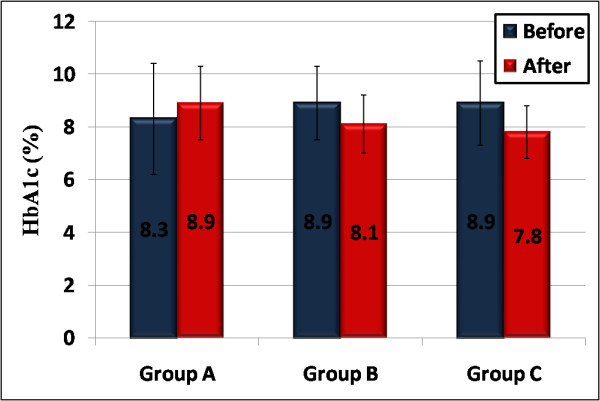
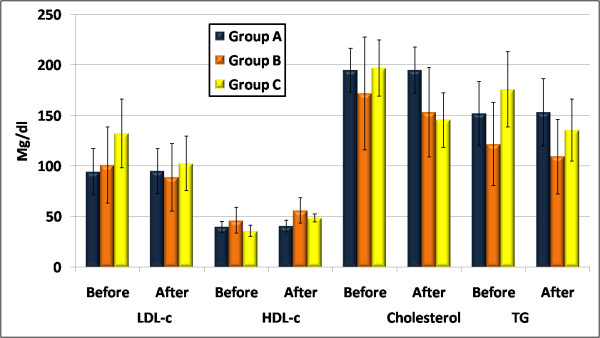
BACKGROUND: Type 1 diabetes mellitus (T1DM) is associated with a high risk for early atherosclerotic complications especially risk of coronary heart disease. OBJECTIVE: To evaluate the impact of six months exercise prgram on glycemic control, plasma lipids values, blood pressure, severity and frequency of hypoglycemia, anthropometric measurements and insulin dose in a sample of adolescents with T1DM. RESEARCH DESIGN AND METHODS: A total of 196 type 1 diabetic patients participated in the study. They were classified into three groups: Group (A) did not join the exercise program(n = 48), group (B) attended the exercise sessions once/week (n = 75), group (C) attended the exercise sessions three times/week (n = 73). Studied parameters were evaluated before and six months after exercise programe. RESULTS: Exercise improved glycemic control by reducing HbA1c values in exercise groups (P = 0.03, P = 0.01 respectively) and no change in those who were not physically active (P = 0.2). Higher levels of HbA1c were associated with higher levels of cholesterol, LDL-c, and triglycerides (P = 0.000 each). In both groups, B and C, frequent exercise improved dyslipidemia and reduced insulin requirements significantly (P = 0.00 both), as well as a reduction in BMI (P = 0.05, P = 0.00 respectively) and waist circumference(P = 0.02, P = 0.00 respectively). The frequency of hypoglycemic attacks were not statistically different between the control group and both intervention groups (4.7 +/- 3.56 and 4.82 +/- 4.23, P = 0.888 respectively). Reduction of blood pressure was statistically insignificant apart from the diastolic blood presure in group C (P = 0.04). CONCLUSION: Exercise is an indispensable component in the medical treatment of patients with T1DM as it improves glycemic control and decreases cardiovascular risk factors among them.
Overview
The claims and statistics of this paper haven’t been checked yet.
Run the check — free, no account needed. It reads the open-access text and checks the sources it cites.
Integrity signals
Registry
Cites
Statistics
Figures
Verification
Claims the paper makes
The claims and statistics of this paper haven’t been checked yet.
Run the check — free, no account needed. It reads the open-access text and checks the sources it cites.
Claims other papers make about this one
Each is checked against this paper’s own text: does it say what the citing paper says it does?
The cited source says what the claim attributes to it.
In the citing paper
“Physical activity, a known determinant of insulin requirements 25 , 26 , was not assessed.”
Self-check
Percentages, sums and reported differences re-computed from the paper’s own numbers.
The self-check needs the paper’s full text.
Citations
Cites
Friedewald, W. T., Levy, R. I., & Fredrickson, D. S. (1972) · Clinical Chemistry · doi:10.1093/clinchem/18.6.499 · Cited by 32,423
(1993) · New England Journal of Medicine · doi:10.1056/nejm199309303291401 · Cited by 24,667
Jeffcoate, W. J., & Harding, K. G. (2003) · The Lancet · doi:10.1016/s0140-6736(03)13169-8 · Cited by 1,089
Maiorana, A., O’Driscoll, G., Cheetham, C., Dembo, L. G., Stanton, K. G., Goodman, C., Taylor, R. R., & GREEN, D. J. (2001) · Journal of the American College of Cardiology · doi:10.1016/s0735-1097(01)01439-5 · Cited by 485
Management of dyslipidemia in children and adolescents with diabetes
American Diabetes Association (2003) · Diabetes Care · doi:10.2337/diacare.26.7.2194 · Cited by 438
Meyer, A. A., Kundt, G., Lenschow, U., Schuff‐Werner, P., & Kienast, W. (2006) · Journal of the American College of Cardiology · doi:10.1016/j.jacc.2006.07.035 · Cited by 430
Cauza, E., Hanusch-Enserer, U., Strasser, B., Ludvik, B., Metz-Schimmerl, S., Pacini, G., Wagner, O., Georg, P., Prager, R., Kostner, K., et al. (2005) · Archives of Physical Medicine and Rehabilitation · doi:10.1016/j.apmr.2005.01.007 · Cited by 392 · cited 3×
“Other studies [23-25] also revealed that the more frequent exercise performed the lower HbA1c level.”
BackgroundResultPhysical Activity/Exercise and Diabetes
American Diabetes Association (2004) · Diabetes Care · doi:10.2337/diacare.27.2007.s58 · Cited by 359
Carotid Artery Intima-Media Thickness in Children With Type 1 Diabetes
Järvisalo, M. J., Putto‐Laurila, A., Jartti, L., Lehtimäki, T. J., Solakivi, T., Rönnemaa, T., & Raitakari, O. T. (2002) · Diabetes · doi:10.2337/diabetes.51.2.493 · Cited by 316
Gordon, L. A., Morrison, E. Y., McGrowder, D. A., Young, R., Fraser, Y. T. P., Zamora, E. M., Alexander-Lindo, R. L., & Irving, R. R. (2008) · BMC Complementary and Alternative Medicine · doi:10.1186/1472-6882-8-21 · Cited by 275
Research works printed but not linked: 2
- Hornsby WG, Albright AL: Diabetes. ACSM's Exercise Management for Persons with Chronic Diseases & Disabilities/American College of sports Medicine. Edited by: Robertson L, Bihler DK, Davis JL, Bernard K. 2003, Human Kinetics, USA, 133-141. 2
- Kelley G, Kelley K: Effects of aerobic exercise on non HDL-c in children & adolescents. prog Cardiovasc Nors. 2008, 23 (3): 128-132. 10.1111/j.1751-7117.2008.00002.x. · DOI
Cited by
Sorted by citations
Update of pathophysiology and management of diabetic kidney disease
Lin, Y., Chang, Y.-H., Yang, S., Wu, K., & Chu, T. (2018) · Journal of the Formosan Medical Association · doi:10.1016/j.jfma.2018.02.007 · Cited by 583
Huynh, K., Bernardo, B. C., McMullen, J. R., & Ritchie, R. H. (2014) · Pharmacology & Therapeutics · doi:10.1016/j.pharmthera.2014.01.003 · Cited by 556
Type 1 Diabetes Mellitus and Cardiovascular Disease
de Ferranti, S. D., de Boer, I. H., Fonseca, V. A., Fox, C. S., Golden, S. H., Lavie, C. J., Magge, S. N., Marx, N., McGuire, D. K., Orchard, T. J., et al. (2014) · Circulation · doi:10.1161/cir.0000000000000034 · Cited by 516
What are the health benefits of physical activity in type 1 diabetes mellitus? A literature review
Chimen, M., Kennedy, A., Nirantharakumar, K., Pang, T. T., Andrews, R., & Narendran, P. (2012) · Diabetologia · doi:10.1007/s00125-011-2403-2 · Cited by 438
de Ferranti, S. D., de Boer, I. H., Fonseca, V. A., Fox, C. S., Golden, S. H., Lavie, C. J., Magge, S. N., Marx, N., McGuire, D. K., Orchard, T. J., et al. (2014) · Diabetes Care · doi:10.2337/dc14-1720 · Cited by 444
Metadata
- Authors
- Salem, M. A., AboElAsrar, M. A., Elbarbary, N. S., ElHilaly, R. A., & Refaat, Y. M.
- Affiliations
- Ain Shams University (EG)
- Corresponding author
- Salem, Mona A
- ORCID
- Elbarbary, Nancy S
- Venue
- Diabetology & Metabolic Syndrome
- Published
- 2010-07-11
- Volume
- 2
- Issue
- 1
- Pages
- 47-47
- ISSN
- 1758-5996 (ISSN-L)
- PMC
- PMC3238209
- OpenAlex
- W2142357242
- Cited by
- 140
- References
- 40
- Citations by year
- 2026: 5 · 2025: 11 · 2024: 7 · 2023: 4 · 2022: 11 · 2021: 15 · 2020: 7 · 2019: 11 · 2018: 13 · 2017: 7 · 2016: 11 · 2015: 8 · 2014: 8 · 2013: 11 · 2012: 6
- FWCI
- 5.08
- Type
- journal article
- Language
- en
- Open access
- gold
- doi.org
- Licence
- Locations
- Diabetology & Metabolic Syndrome (publishedVersion, cc-by)
- Europe PMC (PubMed Central) (publishedVersion, cc-by)
- PubMed Central (publishedVersion, cc-by)
- PubMed (publishedVersion)
- DOAJ (DOAJ: Directory of Open Access Journals) (submittedVersion)
- Greater South Information System
- Funders
- Ain Shams University
- Topics
- Health Sciences › Medicine › Endocrinology, Diabetes and Metabolism › Diabetes Management and Research
- Health Sciences › Medicine › Public Health, Environmental and Occupational Health › Physical Activity and Health
- Health Sciences › Medicine › Endocrinology, Diabetes and Metabolism › Diabetes, Cardiovascular Risks, and Lipoproteins
- Keywords
- type 1 diabetes, adolescents, exercise therapy, glycemic control, HbA1c, dyslipidemia, cardiovascular risk factors, insulin dose, hypoglycemia, body mass index, waist circumference, blood pressure
About these checks
Registry, retraction, Cites and statistics results are computed, not judged, with one exception: a printed reference that no index lists is read once by a model before it counts as a citation error. Claims are extracted by a model and kept only when their quote appears verbatim in the text; each cited source is then checked, with a model’s help, for whether it says what the claim relies on. Those verdicts can be wrong — read the claim’s quote and the cited source before relying on one.
Statistics and arithmetic are recomputed, not judged.
Confidence bands are shown only for fields calibrated on our annotated test set. None is calibrated yet, so no band is shown.
What counts as a claim ›How we measure confidence ›How we check this ›
Are you an author, or do you see a problem with this page? Request a review
