

Direct cardiovascular effects of glucagon like peptide-1
Open accessThe DOI matches its Crossref record; 145 of the 145 references it cites were found in a registry or an index.
Abstract
Current gold standard therapeutic strategies for T2DM target insulin resistance or β cell dysfunction as their core mechanisms of action. However, the use of traditional anti-diabetic drugs, in most cases, does not significantly reduce macrovascular morbidity and mortality. Among emerging anti-diabetic candidates, glucagon like peptide-1 (GLP-1) based therapies carry special cardiovascular implications, exerting both direct as well as indirect effects. The direct cardiovascular effects of GLP-1 and its analogs remain the focus of this review.
Overview
The claims and statistics of this paper haven’t been checked yet.
Free: it reads the open-access text and checks the first 5 claims that cite a source we can check. Create a free account to check every claim.
Integrity signals
Registry
Cites
Statistics
Figures
Verification
Claims the paper makes
The claims and statistics of this paper haven’t been checked yet.
Free: it reads the open-access text and checks the first 5 claims that cite a source we can check. Create a free account to check every claim.
Claims other papers make about this one
Each is checked against this paper’s own text: does it say what the citing paper says it does?
The cited source says what the claim attributes to it.
In the citing paper
“GLP-1R is expressed in the cardiovascular system, and its knockout has implications for cardiovascular function.43,44”
From Glucagon-like peptide-1 receptor: mechanisms and advances in therapy (2024) · cites this paper as [44]
Self-check
Percentages, sums and reported differences re-computed from the paper’s own numbers.
The self-check needs the paper’s full text.
Citations
Cites
Effects of Intensive Glucose Lowering in Type 2 Diabetes
(2008) · New England Journal of Medicine · doi:10.1056/nejmoa0802743 · Cited by 7,888
Intensive blood glucose control and vascular outcomes in patients with type 2 diabetes
(2008) · New England Journal of Medicine · doi:10.1056/nejmoa0802987 · Cited by 7,397 · cited 1×
“The robust relationship between these two entities has been largely attributed to oxidative stress caused by hyperglycemia, although a few studies have failed to demonstrate a significant reduction in cardiovascular risk as a result of intense glycemic control [84-86].”
BackgroundInternational Union of Pharmacology: Approaches to the Nomenclature of Voltage-Gated Ion Channels
Catterall, W. A., Chandy, K. G., Clapham, D. E., Gutman, G. A., Hofmann, F., Harmar, A. J., Abernethy, D. R., & Spedding, M. (2003) · Pharmacological Reviews · doi:10.1124/pr.55.4.5 · Cited by 7,126
The American Journal of Physiology
(1899) · The American Naturalist · doi:10.1086/277182 · Cited by 5,654
Glucose control and vascular complications in veterans with type 2 diabetes
Duckworth, W., Abraira, C., Moritz, T., Reda, D., Emanuele, N., Reaven, P. D., Zieve, F. J., Marks, J., Davis, S. N., Hayward, R., et al. (2009) · New England Journal of Medicine · doi:10.1056/nejmoa0808431 · Cited by 4,762 · cited 1×
“The robust relationship between these two entities has been largely attributed to oxidative stress caused by hyperglycemia, although a few studies have failed to demonstrate a significant reduction in cardiovascular risk as a result of intense glycemic control [84-86].”
BackgroundIndian Journal of Experimental Biology
(2022) · Indian Journal of Experimental Biology · doi:10.56042/ijeb · Cited by 3,392
Heidenreich, P. A., Trogdon, J. G., Khavjou, O. A., Butler, J., Dracup, K., Ezekowitz, M. D., Finkelstein, E. A., Hong, Y., Johnston, S. C., Khera, A., et al. (2011) · Circulation · doi:10.1161/cir.0b013e31820a55f5 · Cited by 3,208
Grundy, S. M., Benjamin, I. J., Burke, G. L., Chait, A., Eckel, R. H., Howard, B. V., Mitch, W., Smith, S. C., & Sowers, J. R. (1999) · Circulation · doi:10.1161/01.cir.100.10.1134 · Cited by 2,698 · cited 1×
“Most of these risk factors overlap with those of type 2 diabetes mellitus (T2DM) and past studies have demonstrated such a strong relationship between these two entities that AHA has declared “diabetes is a cardiovascular disease” [3].”
BackgroundRole of Endothelial Dysfunction in Atherosclerosis
Davignon, J., & Ganz, P. (2004) · Circulation · doi:10.1161/01.cir.0000131515.03336.f8 · Cited by 2,513 · cited 1×
“Since reduced anti-coagulant properties and increased pro-inflammatory mediators and reactive oxygen species play important roles in the development of both endothelial dysfunction and atherosclerosis, the association between the two is almost ubiquitous [88].”
BackgroundGlucagon-like peptide-1 7–36: a physiological incretin in man
Kreymann, B., Ghatei, M. A., Williams, G., & Bloom, S. R. (1987) · The Lancet · doi:10.1016/s0140-6736(87)91194-9 · Cited by 1,928 · cited 1×
“However, removal of the first 6 amino acids yields shorter compounds (7–37 and 7–36) that have enhanced biological activity [14].”
Background
Cited by
Glucagon-like peptide-1 receptor: mechanisms and advances in therapy
Zheng, Z., Zong, Y., Ma, Y., Tian, Y., Pang, Y., Zhang, C., & Gao, J. (2024) · Signal Transduction and Targeted Therapy · doi:10.1038/s41392-024-01931-z · Cited by 1,036
“43,44 GLP-1R is present in the CNS, and its absence might contribute to alterations in behavior, mood, or cognitive function.”
BackgroundThe Role of the Autonomic Nervous System in the Pathophysiology of Obesity
Guarino, D., Nannipieri, M., Iervasi, G., Taddei, S., & Bruno, R. M. (2017) · Frontiers in Physiology · doi:10.3389/fphys.2017.00665 · Cited by 242
“Furthermore, it inhibits gastric acid secretion and gastric emptying (Imeryuz et al., 1997; Edvell and Lindstrom, 1999; Sheikh, 2013).”
BackgroundKhan, M. S., Fonarow, G. C., McGuire, D. K., Hernandez, A. F., Vaduganathan, M., Rosenstock, J., Handelsman, Y., Verma, S., Anker, S. D., McMurray, J. J. V., et al. (2020) · Circulation · doi:10.1161/circulationaha.120.045888 · Cited by 139
Kanie, T., Mizuno, A., Takaoka, Y., Suzuki, T., Yoneoka, D., Nishikawa, Y., Tam, W., Morze, J., Rynkiewicz, A., Xin, Y., et al. (2021) · UCL Discovery (University College London) · Cited by 71
Ishii, M., Shibata, R., Kondo, K., Kambara, T., Shimizu, Y., Tanigawa, T., Bando, Y. K., Nishimura, M., Ouchi, N., & Murohara, T. (2014) · Journal of Biological Chemistry · doi:10.1074/jbc.m114.557835 · Cited by 61
“A number of studies have shown that GLP-1 attenuates ischemia-induced myocardial damage and atherosclerotic lesion formation (3) and promotes angiogenesis in endothelial cells through the Akt, PKC, and Src pathways (29).”
BackgroundSmits, M. M., Muskiet, M. H. A., Tonneijck, L., Hoekstra, T., Kramer, M. H. H., Diamant, M., & van Raalte, D. H. (2016) · British Journal of Clinical Pharmacology · doi:10.1111/bcp.12843 · Cited by 60
Determinants of body weight regulation in humans
Moehlecke, M., Canani, L. H., Silva, L. O. J. E., Trindade, M. R. M., Friedman, R., & Leitão, C. B. (2016) · Archives of Endocrinology and Metabolism · doi:10.1590/2359-3997000000129 · Cited by 59
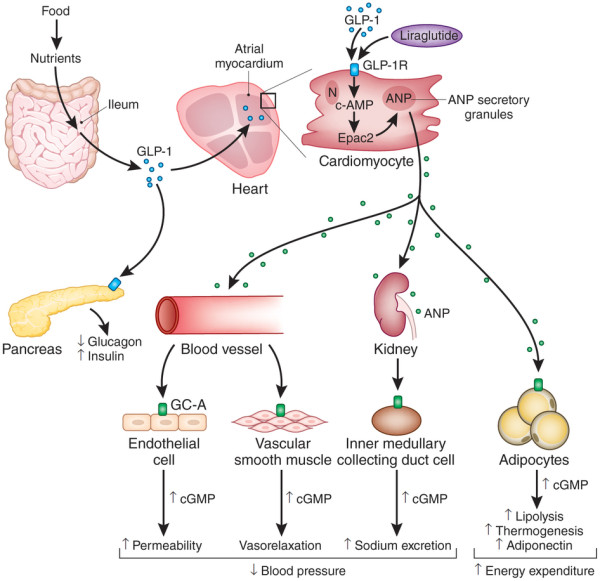
“Peripherally, GLP-1 stimulates lipolysis, adiponectin expression and increases thermogenesis with increased energy expenditure (30).”
BackgroundKanie, T., Mizuno, A., Takaoka, Y., Suzuki, T., Yoneoka, D., Nishikawa, Y., Tam, W. W. S., Morze, J., Rynkiewicz, A., Xin, Y., et al. (2021) · Cochrane Database of Systematic Reviews · doi:10.1002/14651858.cd013650.pub2 · Cited by 127
Enhanced-autophagy by exenatide mitigates doxorubicin-induced cardiotoxicity
Lee, K. H., Cho, H., Lee, S., Woo, J. S., Cho, B. H., Kang, J. H., Jeong, Y., Cheng, X. W., & Kim, W. (2017) · International Journal of Cardiology · doi:10.1016/j.ijcard.2017.01.123 · Cited by 51
Xin, M., Jin, X., Cui, X.-D., Jin, C., Piao, L., Wan, Y., Xu, S., Zhang, S., Yue, X., Wang, H., et al. (2019) · Chemico-Biological Interactions · doi:10.1016/j.cbi.2019.108842 · Cited by 50
Ikonomidis, I., Pavlidis, G., Lambadiari, V., Kousathana, F., Varoudi, M., Spanoudi, F., Maratou, E., Parissis, J., Triantafyllidi, H., Dimitriadis, G., et al. (2017) · International Journal of Cardiology · doi:10.1016/j.ijcard.2017.01.056 · Cited by 44
The emerging role of metformin in gestational diabetes mellitus
Gray, S. G., McGuire, T. M., Cohen, N., & Little, P. J. (2017) · Diabetes Obesity and Metabolism · doi:10.1111/dom.12893 · Cited by 40
do Nascimento, T. S., Pereira, R. O. L., Maia, E., Ohnuma, T., da Costa, M. G., Slawka, E., Galhardo, C., & Krishnamoorthy, V. K. (2024) · Perioperative Medicine · doi:10.1186/s13741-024-00439-y · Cited by 49
“…of myocardial glucose utilization, decreased systemic and pulmonary vascular resistance, activation of ischemic preconditioning pathways, chronotropism, improvement of systolic and diastolic function, among others (Aravindhan et al. 2015; Kim et al. 2013; Ravassa et al. 2012; Sheikh 2013).”
BackgroundHuang, J.-H., Chen, Y.-C., Lee, T.-I., Kao, Y.-H., Chazo, T.-F., Chen, S.-A., & Chen, Y.-J. (2016) · Peptides · doi:10.1016/j.peptides.2016.02.007 · Cited by 36
Extra-pancreatic effects of incretin-based therapies
Gallwitz, B. (2014) · Endocrine · doi:10.1007/s12020-014-0223-0 · Cited by 35
Le, T. D., Nguyen, N. P. T., Tran, T. T. H., Cong, T. L., Nguyen, L. H. T., Nhu, B. D., Nguyen, S. T., Ngo, M. V., Dinh, T. H., Nguyen, H. T., et al. (2022) · Diabetes Metabolic Syndrome and Obesity · doi:10.2147/dmso.s344532 · Cited by 41
“These effects caused hyperglycemia, oxidative stress, enhancing the synthesis of inflammatory cytokines, tumor necrosis factor (TNF)-α and MCP-1, and microvascular complications.(21,51,52) GLP-1 influenced DPN via the indirect mechanisms of microvascular damage in type 2 diabetes.”
BackgroundKanie, T., Mizuno, A., Yoneoka, D., Tam, W., Morze, J., Rynkiewicz, A., Xin, Y., Wu, O., & Kwong, J. S. (2020) · Cochrane Database of Systematic Reviews · doi:10.1002/14651858.cd013650 · Cited by 34
Tawfik, M. K., & Mohamed, M. I. (2016) · Biomedicine & Pharmacotherapy · doi:10.1016/j.biopha.2016.05.005 · Cited by 28
King, N. E., & Brittain, E. L. (2022) · Pulmonary Circulation · doi:10.1002/pul2.12028 · Cited by 30
Pharmacological Actions of Glucagon-Like Peptide-1, Gastric Inhibitory Polypeptide, and Glucagon
Sekar, R., Singh, K., Arokiaraj, A. W. R., & Chow, B. (2016) · International review of cytology · doi:10.1016/bs.ircmb.2016.05.002 · Cited by 28
Development of novel ligands for peptide GPCRs
Moran, B. M., McKillop, A. M., & O'Harte, F. P. M. (2016) · Current Opinion in Pharmacology · doi:10.1016/j.coph.2016.08.009 · Cited by 26
The cardiovascular effects of insulin
Younk, L. M., Lamos, E. M., & Davis, S. N. (2014) · Expert Opinion on Drug Safety · doi:10.1517/14740338.2014.919256 · Cited by 23
“These include leptin, adiponectin, ghrelin, glucagon-like peptide 1, resistin, and angiotensin-(1-7) [56-58].”
Metabolomics Provides Insights into Renoprotective Effects of Semaglutide in Obese Mice
Chen, X., Chen, S., Ren, Q., Niu, S., Pan, X., Yue, L., Li, Z., Zhu, R., Jia, Z., Chen, X., et al. (2022) · Drug Design Development and Therapy · doi:10.2147/dddt.s383537 · Cited by 18
Karakasis, P., Patoulias, D., Giannakoulas, G. A., Sagris, Μ., Theofilis, P., Fragakis, N., & Biondi‐Zoccai, G. (2024) · Journal of Clinical Medicine · doi:10.3390/jcm13216411 · Cited by 13
“Moreover, GLP-1R is expressed in the cardiovascular system and central nervous system (CNS), where its absence can result in cardiovascular dysfunction and altered cognitive, behavioral, or mood states [20,21].”
BackgroundKowalska, M. K., El‐Mallul, A., Hudecka, W., Lubojańska, J. E., Lubojański, P. J., Orłowska, S. M., & Bednarczyk, Ł. (2026) · International Journal of Molecular Sciences · doi:10.3390/ijms27041886 · Cited by 10
Bervanlou, R. N., Bijeh, N., Rad, M. M., & Hosseini, S. R. A. (2021) · International Journal of Diabetes in Developing Countries · doi:10.1007/s13410-021-00950-8 · Cited by 11
“It has been observed that the other receptors can act like insulin receptors and change the blood glucose levels [6].”
BackgroundLe, T. D., Nguyen, N. P. T., Nguyen, S. T., Nguyen, H. T. T., Tran, T. T. H., Nguyen, T. H. L., Nguyen, D. C., Nguyen, G. T., Nguyễn, X. T., Nguyen, B. D., et al. (2020) · Diabetes Metabolic Syndrome and Obesity · doi:10.2147/dmso.s264876 · Cited by 11
Yoon, H., Sung, J. H., & Song, M. J. (2020) · Biomolecules & Therapeutics · doi:10.4062/biomolther.2020.150 · Cited by 7
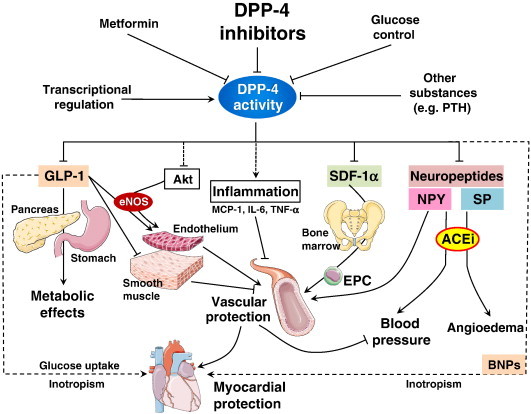
“In particular, soluble DPP4 (sDPP4), originating from the cell surface, cleaves incretin peptides such as gastric inhibitory polypeptide and glucagon-like peptide-1, thereby regulating insulin-mediated glucose metabolism (Ussher and Drucker, 2012; Sheikh, 2013; Mulvihill and Drucker, 2014).”
DPP-4 inhibitors and heart failure: a potential role for pharmacogenomics
Krittanawong, C., Xanthopoulos, A. V., Kitai, T., Branis, N. M., Zhang, H., & Kukin, M. L. (2017) · Heart Failure Reviews · doi:10.1007/s10741-017-9655-y · Cited by 6
Nanomedicine’s transformative impact on anti-diabetic drug discovery: an appraisal
Saini, K., & Sharma, S. (2023) · Journal of Nanoparticle Research · doi:10.1007/s11051-023-05870-8 · Cited by 7
“Apart from this, these therapies have limited tolerability, gastric irritation, diarrhea, intense protein binding, unsolvability in water-limited efficacy, and significant mechanism-based adverse effects including episodes of weight gain and hypoglycemia [25].”
BackgroundPotential role of glucagon like peptide 1 in taste receptors
Doval-Caballero, J. L. E., Ferreira‐Hermosillo, A., Eugenio-Ponce, G. D., García-Sáenz, M. R., Ibarra‐Salce, R., Tenorio-Rojo, A. P., Luna-Ávila, E. S., Palacios, P. C. G., Pérez-Hernández, F., Rojas-Milán, E., et al. (2026) · Frontiers in Endocrinology · doi:10.3389/fendo.2025.1683419 · Cited by 10
“Its presence in the cardiovascular system has implications in cardiac and vascular function (142), while its expression in the central nervous system might regulate behavior, mood, and cognition (143, 144).”
Advances in Diabetes Pharmacotherapy: An Update for the Emergency Provider
Mazer-Amirshahi, M. E., & Pourmand, A. (2017) · Journal of Emergency Medicine · doi:10.1016/j.jemermed.2017.08.024 · Cited by 7
Role of endogenous incretin hormones, GLP-1 and GIP, in cardiovascular physiology
Trivedi, K., & Dolinsky, V. W. (2026) · Canadian Journal of Physiology and Pharmacology · doi:10.1139/cjpp-2025-0163 · Cited by 7
Functional Relationship Between the Gut and Other Tissues/Organs of the Body
Welcome, M. O. (2018) · Springer eBooks · doi:10.1007/978-3-319-91056-7_15 · Cited by 6
Williams, J. A. (2014) · doi:10.3998/panc.2014.7 · Cited by 4
Kumar, S., Lau, R. G., Palaia, T. A., Hall, C. E., Lee, J., Hall, K. N., BRATHWAITE, C. E. M., & Ragolia, L. (2016) · Annals of Medicine and Surgery · doi:10.1016/j.amsu.2016.11.007 · Cited by 2
“The direct effect of GLP-1 on the cardiovascular system remains controversial due to inconsistent in-vitro and in-vivo results [20].”
BackgroundPeptides from Animal Venoms: A Promising Frontier in Diabetes Therapy via Multi-Target Mechanisms
de Almeida, J. O. C. S., Comerma-Steffensen, S., Leite, J. R. S. A., Simonsen, U., & Arcanjo, D. D. R. (2025) · Pharmaceuticals · doi:10.3390/ph18101438 · Cited by 2
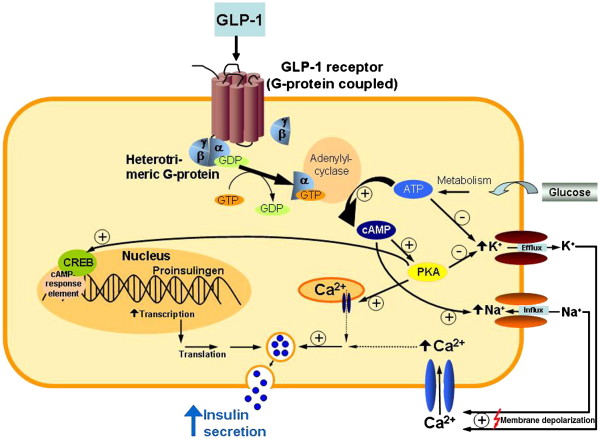
“PKA, in turn, facilitates membrane depolarization by opening sodium and calcium channels, thereby promoting insulin secretion [5].”
Semaglutide’s Impact on Kidney Health in Obese Mice: A Metabolomics Study
Eriksson, J., & Lindgren, M. (2025) · Pharmaceutical Sciences and Drug Design · doi:10.51847/5whbt71l9k · Cited by 1
Gut-Derived Hormones—Cardiac Effects of Ghrelin and Glucagon-Like Peptide-1
Ruozi, G., Bortolotti, F., & Recchia, F. A. (2017) · Elsevier eBooks · doi:10.1016/b978-0-12-803111-7.00006-3 · Cited by 6
Grajower, M. M. (2015) · Endocrine Practice · doi:10.4158/ep14393.co
Le 3 en 1 : agoniste triple du GLP-1, du GIP et du glucagon
Dubois‐Laforgue, D. (2016) · Médecine des Maladies Métaboliques · doi:10.1016/s1957-2557(16)30104-3
Optimization and validation of a fluorogenic dipeptidyl peptidase 4 enzymatic assay in human plasma
Yoon, H., Cho, S. H., Seo, Y. R., Yu, K., Park, S. S., & Song, M. J. (2020) · Analytical Biochemistry · doi:10.1016/j.ab.2020.113952
Kiaei, N., & Aghdam, R. M. (2020) · Research Square · doi:10.21203/rs.3.rs-102352/v1
“GLP-1 infusion has been shown to reduce infarct size and lead to myocardial recovery post-infarction through the mechanism of increasing glucose uptake, enhancement of resistance to ischemia and increasing contractile strength of the heart muscle [58-61].”
BackgroundWilliams, J. A. (2021) · doi:10.3998/panc.2021.06
do Nascimento, T. S., Pereira, R. O. L., Maia, E. R., Ohnuma, T., da Costa, M. G., Slawka, E., Galhardo, C., & Krishnamoorthy, V. (2024) · Figshare · doi:10.6084/m9.figshare.26752558
do Nascimento, T. S., Pereira, R. O. L., Maia, E. R., Ohnuma, T., da Costa, M. G., Slawka, E., Galhardo, C., & Krishnamoorthy, V. (2024) · Figshare · doi:10.6084/m9.figshare.26752561
Metabolic and Digestive Functions of Glucagon-Like Peptide-1 in Pigs
Čulka, Ľ., Krepelková, Z., Bárdová, K., & Novotny, J. F. (2026) · Folia veterinaria · doi:10.2478/fv-2026-0018
“patients with type 2 diabetes, several beneficial actions beyond glycaemic control have been documented [32, 33, 34].”
Metadata
- Authors
- Sheikh, A.
- Affiliations
- Dow University of Health Sciences (PK)
- Corresponding author
- Sheikh, Asfandyar
- ORCID
- Sheikh, Asfandyar
- Venue
- Diabetology & Metabolic Syndrome
- Published
- 2013-08-29
- Volume
- 5
- Issue
- 1
- Pages
- 47-47
- ISSN
- 1758-5996 (ISSN-L)
- PMC
- PMC3765965
- OpenAlex
- W2120864714
- Cited by
- 45
- References
- 145
- Citations by year
- 2026: 4 · 2025: 2 · 2024: 5 · 2023: 1 · 2022: 3 · 2021: 3 · 2020: 6 · 2019: 1 · 2018: 1 · 2017: 7 · 2016: 7 · 2015: 2 · 2014: 3
- FWCI
- 3.42
- Type
- journal article
- Language
- en
- Open access
- gold
- doi.org
- Licence
- cc-by
- creativecommons.org/licenses/by/2.0 (tdm)
- Locations
- Diabetology & Metabolic Syndrome (publishedVersion, cc-by)
- Europe PMC (PubMed Central) (publishedVersion, cc-by)
- PubMed Central (publishedVersion, cc-by)
- PubMed (publishedVersion)
- Greater South Information System
- Topics
- Health Sciences › Medicine › Endocrinology, Diabetes and Metabolism › Diabetes Treatment and Management
- Health Sciences › Medicine › Cardiology and Cardiovascular Medicine › Cardiovascular Function and Risk Factors
- Health Sciences › Medicine › Endocrinology, Diabetes and Metabolism › Diabetes, Cardiovascular Risks, and Lipoproteins
- Keywords
- glucagon-like peptide-1, GLP-1 receptor agonists, cardiovascular effects, type 2 diabetes, macrovascular complications, insulin resistance, beta-cell dysfunction, antidiabetic drugs
About these checks
Registry, retraction, Cites and statistics results are computed, not judged, with one exception: a printed reference that no index lists is read once by a model before it counts as a citation error. Claims are extracted by a model and kept only when their quote appears verbatim in the text; each cited source is then checked, with a model’s help, for whether it says what the claim relies on. Those verdicts can be wrong — read the claim’s quote and the cited source before relying on one.
Statistics and arithmetic are recomputed, not judged.
Confidence bands are shown only for fields calibrated on our annotated test set. None is calibrated yet, so no band is shown.
What counts as a claim ›How we measure confidence ›How we check this ›
Are you an author, or do you see a problem with this page? Request a review
Data sources
Bibliographic data: Semantic Scholar, OpenAlex, Crossref.
Contains information from the Semantic Scholar Academic Graph Datasets, made available under the ODC Attribution License (ODC-BY 1.0).
Semantic Scholar’s data is described in: Kinney, R., et al. (2023). The Semantic Scholar Open Data Platform. arXiv:2301.10140.
