

Intake of green tea inhibited increase of salivary chromogranin A after mental task stress loads
Open accessThe DOI matches its Crossref record; 32 of the 32 references it cites were found in a registry or an index.
Abstract
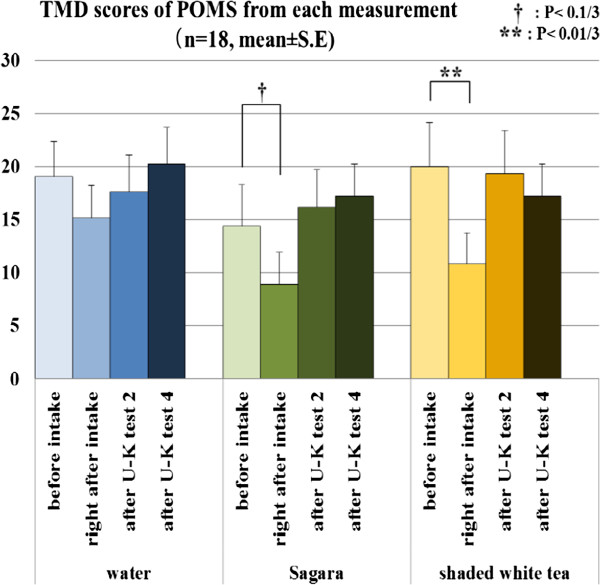
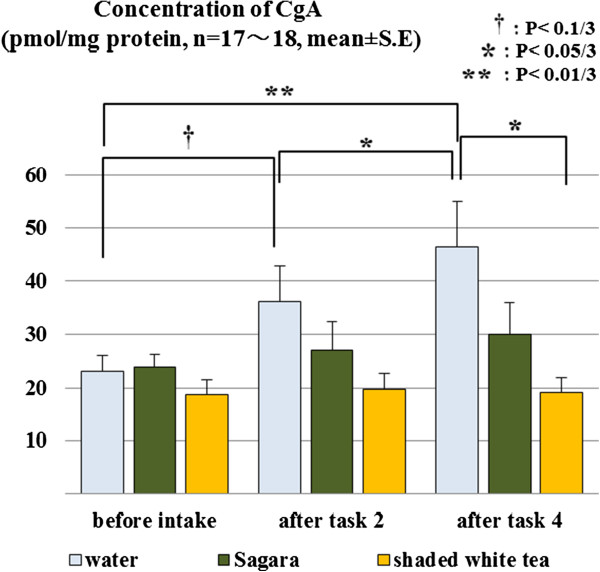
BACKGROUND: Green tea has become renowned for its health benefits. In this study, we investigated the anti-stress effect of two kinds of green tea against a mental stress task load. METHODS: Warm water, ordinary green tea (Sagara), and shaded white tea, which contains more amino acid components than Sagara, were used as test samples in a randomized cross-over design study. Eighteen students (nine male and nine female) participated in three experimental trials on different days at intervals of seven days. Saliva was collected before beverage intake and after performing the mental stress load tasks. Concentration of chromogranin A (CgA) in the saliva was used as an index of autonomic nervous system activity. RESULTS: CgA level increased after the mental tasks, but intake of green tea inhibited this increase; the anti-stress effect was even greater after consumption of shaded white tea. Intake of shaded white tea also lowered Total Mood Disturbance (TMD) score on the Profile of Mood States (POMS); subjects in this condition tended to perform more calculations in the arithmetic task than those in the warm water treatment condition. CONCLUSIONS: Salivary CgA concentration levels increased after mental stress load tasks, but ingestion of green tea inhibited this increase. This anti-stress effect was larger after the consumption of shaded white tea than after Sagara. Shaded white tea intake also lowered TMD score (POMS) and tended to improve performance on an arithmetic task compared to warm water, suggesting that shaded white tea might also improve mood during and after mental stress load.
Overview
The claims and statistics of this paper haven’t been checked yet.
Free: it reads the open-access text and checks the first 5 claims that cite a source we can check. Create a free account to check every claim.
Integrity signals
Registry
Cites
Statistics
Figures
Verification
Claims the paper makes
The claims and statistics of this paper haven’t been checked yet.
Free: it reads the open-access text and checks the first 5 claims that cite a source we can check. Create a free account to check every claim.
Claims other papers make about this one
Each is checked against this paper’s own text: does it say what the citing paper says it does?
The cited source says what the claim attributes to it.
In the citing paper
“However, we found only three studies [28,30,37] that have investigated the effects of green tea intake on parameters of anxiety and stress.”
From Psychotropic effects of L-theanine and its clinical properties: from the management of anxiety and stress to a potential use in schizophrenia (2019) · cites this paper as [30]
Self-check
Percentages, sums and reported differences re-computed from the paper’s own numbers.
The self-check needs the paper’s full text.
Citations
Cites
EEG alpha and theta oscillations reflect cognitive and memory performance: a review and analysis
Klimesch, W. (1999) · Brain Research Reviews · doi:10.1016/s0165-0173(98)00056-3 · Cited by 6,889 · cited 1×
“Alpha activity is indicative of a state of wakeful relaxation, and is associated with decreased anxiety and improved performance under stress [26,27].”
Über das Elektrenkephalogramm des Menschen
Berger, H. (1929) · Archiv für Psychiatrie und Nervenkrankheiten · doi:10.1007/bf01797193 · Cited by 4,235
Relaxation and immunity enhancement effects of γ‐Aminobutyric acid (GABA) administration in humans
Abdou, A. M., Higashiguchi, S., Horie, K., Kim, M., Hatta, H., & Yokogoshi, H. (2006) · BioFactors · doi:10.1002/biof.5520260305 · Cited by 407 · cited 6×
“Theanine, a popular functional food ingredient, has received attention for its multiple roles in the central nervous system (CNS) and autonomic nervous system (ANS).”
InfluentialSelf-citationL-Theanine—a unique amino acid of green tea and its relaxation effect in humans
Juneja, L. (1999) · Trends in Food Science & Technology · doi:10.1016/s0924-2244(99)00044-8 · Cited by 363 · cited 2×
“caffeine and catechins, amino acid components such as theanine have also been reported to have positive effects on brain activity such as memory and learning ability [3,29].”
l-theanine reduces psychological and physiological stress responses
Kimura, K., Ozeki, M., Juneja, L. R., & Ohira, H. (2007) · Biological Psychology · doi:10.1016/j.biopsycho.2006.06.006 · Cited by 349 · cited 1×
“it could reduce stress by inhibiting cortical neuron excitation [5].”
The Effects of L-Theanine, Caffeine and Their Combination on Cognition and Mood
Haskell, C. F., Kennedy, D. O., Milne, A. L., Wesnes, K. A., & Scholey, A. B. (2008) · Biological Psychology · doi:10.1016/j.biopsycho.2007.09.008 · Cited by 280 · cited 1×
“At the same time, previous studies have indicated that theanine interacted with caffeine, and the combination promoted better effects than either alone [28].”
Zhao, Y., Chen, P., Lin, L., Harnly, J. M., Yu, L. (., & Li, Z. (2011) · Food Chemistry · doi:10.1016/j.foodchem.2010.11.055 · Cited by 212 · cited 1×
“7 μm particle size [15].”
Yokogoshi, H., Kato, Y., Sagesaka, Y. M., Takihara-Matsuura, T., Kakuda, T., & Takeuchi, N. (1995) · Bioscience, Biotechnology, and Biochemistry · doi:10.1271/bbb.59.615 · Cited by 192
Self-citationThe Acute Physiological and Mood Effects of Tea and Coffee
Quinlan, P. T., Lane, J., Moore, K. L., Aspen, J., Rycroft, J. A., & O'Brien, D. C. (2000) · Pharmacology Biochemistry and Behavior · doi:10.1016/s0091-3057(00)00192-1 · Cited by 181 · cited 1×
“reported that tea and coffee produced mild autonomic stimulation and an elevation in mood but there were no effects of caffeine dose [22].”
(2008) · PubMed · Cited by 154
Quinlan, P., Lane, J., & Aspinall, L. (1997) · Psychopharmacology · doi:10.1007/s002130050438 · Cited by 153 · cited 1×
“Caffeine and catechins also have been reported to improve mood and reduce anxiety or self-rated stress [20,21].”
Acute neurocognitive effects of epigallocatechin gallate (EGCG)
Scholey, A., Downey, L. A., Ciorciari, J., Pipingas, A., Nolidin, K., Finn, M., Wines, M., Catchlove, S., Terrens, A., Barlow, E., et al. (2012) · Appetite · doi:10.1016/j.appet.2011.11.016 · Cited by 150 · cited 1×
“Caffeine and catechins also have been reported to improve mood and reduce anxiety or self-rated stress [20,21].”
Yoto, A., Murao, S., Motoki, M., Yokoyama, Y., Horie, N., Takeshima, K., Masuda, K., Kim, M., & Yokogoshi, H. (2011) · Amino Acids · doi:10.1007/s00726-011-1206-6 · Cited by 122 · cited 6×
“Theanine, a popular functional food ingredient, has received attention for its multiple roles in the central nervous system (CNS) and autonomic nervous system (ANS).”
InfluentialSelf-citationNakamura, H., Takishima, T., Kometani, T., & Yokogoshi, H. (2009) · International Journal of Food Sciences and Nutrition · doi:10.1080/09637480802558508 · Cited by 116 · cited 1×
“also reported the psychological stressreducing effect of chocolate enriched with GABA (28 mg) on stress induced by an arithmetic task [10].”
Self-citationFoxe, J. J., Morie, K. P., Laud, P. J., Rowson, M. J., de Bruin, E. A., & Kelly, S. P. (2012) · Neuropharmacology · doi:10.1016/j.neuropharm.2012.01.020 · Cited by 106 · cited 1×
“caffeine and catechins, amino acid components such as theanine have also been reported to have positive effects on brain activity such as memory and learning ability [3,29].”
Gomez-Ramirez, M., Higgins, B. A., Rycroft, J. A., Owen, G. N., Mahoney, J., Shpaner, M., & Foxe, J. J. (2007) · Clinical Neuropharmacology · doi:10.1097/01.wnf.0000240940.13876.17 · Cited by 96 · cited 1×
“Intake of theanine was also found to increase alpha brain wave activity in humans, which might lead to a relaxed but alert state [3,4].”
Gomez-Ramirez, M., Kelly, S. P., Montesi, J. L., & Foxe, J. J. (2009) · Brain Topography · doi:10.1007/s10548-008-0068-z · Cited by 90 · cited 1×
“[24]), the low dose of 52 mg in shaded white tea in this study might have been insufficient.”
Relieving Occupational Fatigue by Consumption of a Beverage Containing γ-Amino Butyric Acid
KANEHIRA, T., NAKAMURA, Y., NAKAMURA, K., HORIE, K., HORIE, N., FURUGORI, K., SAUCHI, Y., & YOKOGOSHI, H. (2011) · Journal of Nutritional Science and Vitaminology · doi:10.3177/jnsv.57.9 · Cited by 75 · cited 1×
“demonstrated an anti-fatigue effect from GABA ingestion on salivary secretion levels of chromogranin A (CgA) and cortisol following an arithmetic task used as a fatigue load [9].”
Self-citationYamada, T., Terashima, T., Okubo, T., Juneja, L. R., & Yokogoshi, H. (2005) · Nutritional Neuroscience · doi:10.1080/10284150500170799 · Cited by 72 · cited 1×
“It has been found to affect dopamine and serotonin concentrations in the brain, thus producing an anxiolytic effect [1,2].”
Self-citationReduced baroreflex cardiac sensitivity predicts increased cognitive performance
Yasumasu, T., Reyes del Paso, G. A., Takahara, K., & Nakashima, Y. (2006) · Psychophysiology · doi:10.1111/j.1469-8986.2006.00377.x · Cited by 59 · cited 1×
“The test, a questionnaire modified from Kraepelin’s arithmetic test and developed by Uchida [16], is widely used as a mental stressor [17-19].”
Hypotensive effect of γ-glutamylmethylamide in spontaneously hypertensive rats
Yokogoshi, H., & Kobayashi, M. (1998) · Life Sciences · doi:10.1016/s0024-3205(98)00029-0 · Cited by 57
Self-citationConcentration Effects of Green Odor on Event-related Potential (P300) and Pleasantness
Sano, K. (2002) · Chemical Senses · doi:10.1093/chemse/27.3.225 · Cited by 51 · cited 1×
“The mechanism might be that one of the main odor components of green tea stimulated the release of dopamine, which regulates brain functions, mood and attention in rats, and induced changes of event-related potential P-300 and perceived pleasure in human studies [32,33].”
Effects of l-theanine on attention and reaction time response
Higashiyama, A., Htay, H. H., Ozeki, M., Juneja, L. R., & Kapoor, M. P. (2011) · Journal of Functional Foods · doi:10.1016/j.jff.2011.03.009 · Cited by 50 · cited 1×
“[23]; and 250 mg in GomezRamirez et al.”
Kako, H., Fukumoto, S., Kobayashi, Y., & Yokogoshi, H. (2008) · Brain Research Bulletin · doi:10.1016/j.brainresbull.2007.11.016 · Cited by 50 · cited 1×
“The mechanism might be that one of the main odor components of green tea stimulated the release of dopamine, which regulates brain functions, mood and attention in rats, and induced changes of event-related potential P-300 and perceived pleasure in human studies [32,33].”
Self-citationEffect of Smelling Green Tea on Mental Status and EEG Activity
Murao, S., Yoto, A., & Yokogoshi, H. (2013) · International Journal of Affective Engineering · doi:10.5057/ijae.12.37 · Cited by 47 · cited 1×
“Our previous study showed that smelling shaded white tea increased the band power of alpha and beta in the frontal and occipital regions and suppressed the decrease of Vigor-Activity in POMS after mental tasks [31].”
Self-citationActivation of Autonomic Nervous System Activity by the Oral Ingestion of GABA
Fujibayashi, M., Kamiya, T., Takagaki, K., & Moritani, T. (2008) · Nippon Eiyo Shokuryo Gakkaishi · doi:10.4327/jsnfs.61.129 · Cited by 36 · cited 6×
“Theanine, a popular functional food ingredient, has received attention for its multiple roles in the central nervous system (CNS) and autonomic nervous system (ANS).”
InfluentialCOMPARISON OF PEROXIDASE RESPONSE TO MENTAL ARITHMETIC STRESS IN SALIVA OF SMOKERS AND NON-SMOKERS
GOI, N., HIRAI, Y., HARADA, H., IKARI, A., ONO, T., KINAE, N., HIRAMATSU, M., NAKAMURA, K., & TAKAGI, K. (2007) · The Journal of Toxicological Sciences · doi:10.2131/jts.32.121 · Cited by 32 · cited 1×
“The test, a questionnaire modified from Kraepelin’s arithmetic test and developed by Uchida [16], is widely used as a mental stressor [17-19].”
Vb, S., Garakh, Z., & Novototskiĭ-Vlasov, V. I. (2006) · PubMed · Cited by 27
Kashiwagi, S., Yanai, H., Aoki, T., Tamai, H., Tanaka, Y., & Hokugoh, K. (1985) · The Japanese journal of psychology · doi:10.4992/jjpsy.56.179 · Cited by 22 · cited 4×
“Kashiwagi S, Yanai H, Aoki T, Tamai H, Tanaka Y, Hokugoh K: A factor analytic study of the items for the personality description based on the principle of the three traits theory for the work curve of addition of the Uchida-Kraepelin psychodiagnostic test.”
InfluentialDimpfel, W., Kler, A., Kriesl, E., & Lehnfeld, R. (2007) · Journal of Pharmacy and Pharmacology · doi:10.1211/jpp.59.8.0011 · Cited by 18 · cited 1×
“Additionally, an in vitro study reported that glutamic acid in green tea increased electrical hippocampal activity in rats; such activity is commonly taken as representative for enhancement of spatial and time-dependent memory [30].”
Characteristics of Salivary Chromogranin A as a Short-term Mental Stress Biomarker
Nomura, S., Mizuno, T., Nozawa, A., Asano, H., & Ide, H. (2010) · BME · Cited by 14
Concentration Effects of Green Odor on Event-related Potential (P300) and
Sano, K., Tsuda, Y., Sugano, H., et al. (2002) · Cited by 1
Research works printed but not linked: 2
- Nakane H Salivary chromogranin A as index of psychosomatic stress response R&D Review of Toyota CRDL 1999 34 17 22 (in Japanese)
- Fuchinoue Y Fuchinoue H A Compendium of Japanese Tea 1999 Tokyo, Japan: Rural Culture Association (in Japanese)
Cited by
Kubala, E., Strzelecka, P., Grzegocka, M., Lietz–Kijak, D., Gronwald, H., Skomro, P., & Kijak, E. (2018) · BioMed Research International · doi:10.1155/2018/6572381 · Cited by 194
“Their studies showed that concentration of CgA in saliva increased after mental stress, but drinking green tea can inhibit the growth [107].”
BackgroundMechanisms Underlying the Anti-Depressive Effects of Regular Tea Consumption
Rothenberg, D. O., & Zhang, L. (2019) · Nutrients · doi:10.3390/nu11061361 · Cited by 149
“Green Tea, Shade-Grown White Tea Lowered CgA levels following stress load task for both tea types, more effect for Shade-Grown White Tea [42]”
BackgroundMethodSurgeons' and surgical trainees' acute stress in real operations or simulation: A systematic review
Georgiou, K., Larentzakis, A., & Papavassiliou, A. G. (2017) · The Surgeon · doi:10.1016/j.surge.2017.06.003 · Cited by 69
“It has been shown that salivary chromogranin A (sCgA) changes rapidly in response to various psychological stressors.(44,54,55) In contrast, other studies suggest that sCgA levels may not be an accurate index for evaluating ANS activity.”
BackgroundLopes Sakamoto, F., Metzker Pereira Ribeiro, R., Amador Bueno, A., & Oliveira Santos, H. (2019) · Pharmacological Research · doi:10.1016/j.phrs.2019.104395 · Cited by 49
“However, we found only three studies [28,30,37] that have investigated the effects of green tea intake on parameters of anxiety and stress.”
BackgroundFeng, M., Zheng, X., Wan, J., Pan, W., Xie, X., Hu, B., Wang, Y., Wen, H., & Cai, S. (2021) · Food & Function · doi:10.1039/d0fo02921a · Cited by 30
Metadata
- Authors
- Yoto, A., Murao, S., Nakamura, Y., & Yokogoshi, H.
- Affiliations
- Shizuoka University (JP)
- Chubu University (JP)
- Corresponding author
- Yoto, Ai
- ORCID
- Yoto, Ai
- Venue
- Journal of Physiological Anthropology
- Published
- 2014-07-17
- Volume
- 33
- Issue
- 1
- Pages
- 20-20
- ISSN
- 1880-6791 (ISSN-L)
- 1880-6805
- PMC
- PMC4118660
- OpenAlex
- W2105882430
- Cited by
- 31
- References
- 32
- Citations by year
- 2026: 1 · 2025: 4 · 2024: 3 · 2023: 6 · 2022: 3 · 2021: 2 · 2020: 1 · 2019: 2 · 2018: 4 · 2017: 2 · 2016: 3
- FWCI
- 1.24
- Type
- journal article
- Language
- en
- Open access
- gold
- doi.org
- Locations
- Journal of PHYSIOLOGICAL ANTHROPOLOGY (publishedVersion)
- Europe PMC (PubMed Central) (publishedVersion, cc-by)
- PubMed Central (publishedVersion, cc-by)
- PubMed (publishedVersion)
- Topics
- Life Sciences › Agricultural and Biological Sciences › Food Science › Tea Polyphenols and Effects
- Health Sciences › Medicine › Complementary and alternative medicine › Medicinal Plants and Bioactive Compounds
- Health Sciences › Medicine › Pharmacology (medical) › Coffee research and impacts
- Keywords
- green tea, chromogranin A, salivary biomarkers, psychological stress, stress response, autonomic nervous system, mood disturbance, total mood disturbance, arithmetic performance
- MeSH terms
- Adult, Affect, Female, Humans, Male, Saliva, Stress, Psychological, Tea, Cross-Over Studies, Plant Preparations, Chromogranin A, Young Adult
About these checks
Registry, retraction, Cites and statistics results are computed, not judged, with one exception: a printed reference that no index lists is read once by a model before it counts as a citation error. Claims are extracted by a model and kept only when their quote appears verbatim in the text; each cited source is then checked, with a model’s help, for whether it says what the claim relies on. Those verdicts can be wrong — read the claim’s quote and the cited source before relying on one.
Statistics and arithmetic are recomputed, not judged.
Confidence bands are shown only for fields calibrated on our annotated test set. None is calibrated yet, so no band is shown.
What counts as a claim ›How we measure confidence ›How we check this ›
Are you an author, or do you see a problem with this page? Request a review
Data sources
Bibliographic data: Semantic Scholar, OpenAlex, Crossref.
Contains information from the Semantic Scholar Academic Graph Datasets, made available under the ODC Attribution License (ODC-BY 1.0).
Semantic Scholar’s data is described in: Kinney, R., et al. (2023). The Semantic Scholar Open Data Platform. arXiv:2301.10140.
