

Randomized clinical trial of the effects of screening and brief intervention for illicit drug use: the life shift/shift gears study
Open accessThe DOI matches its Crossref record; 43 of the 44 references it cites were found in a registry or an index, and 1 are not checked yet.
Abstract
BACKGROUND: Although screening, brief intervention, and referral to treatment (SBIRT) has shown promise for alcohol use, relatively little is known about its effectiveness for adult illicit drug use. This randomized controlled trial assessed the effectiveness of the SBIRT approach for outcomes related to drug use among patients visiting trauma and emergency departments (EDs) at two large, urban hospitals. METHODS: A total of 700 ED patients who admitted using illegal drugs in the past 30 days were recruited, consented, provided baseline measures of substance use and related problems measured with the Addiction Severity Index-Lite (ASI-Lite), and then randomized to the Life Shift SBIRT intervention or to an attention-placebo control group focusing on driving and traffic safety (Shift Gears). Both groups received a level of motivational intervention matched to their condition and risk level by trained paraprofessional health educators. Separate measurement technicians conducted face-to-face follow-ups at 6 months post-intervention and collected hair samples to confirm reports of abstinence from drug use. The primary outcome measure of the study was past 30-day drug abstinence at 6 months post-intervention, as self-reported on the ASI-Lite. RESULTS: Of 700 participants, 292 (42%) completed follow-up. There were no significant differences in self-reported abstinence (12.5% vs. 12.0% , p = 0.88) for Life Shift and Shift Gears groups, respectively. When results of hair analyses were applied, the abstinence rate was 7 percent for Life Shift and 2 percent for Shift Gears (p = .074). In an analysis in which results were imputed (n = 694), there was no significant difference in the ASI-Lite drug use composite scores (Life Shift +0.005 vs. Shift Gears +0.017, p = 0.12). CONCLUSIONS: In this randomized controlled trial, there was no evidence of effectiveness of SBIRT on the primary drug use outcome. TRIAL REGISTRATION: ClinicalTrials.gov NCT01683227.
Overview
The claims and statistics of this paper haven’t been checked yet.
Free: it reads the open-access text and checks the first 5 claims that cite a source we can check. Create a free account to check every claim.
Integrity signals
Registry
Cites
Statistics
Figures
Verification
Claims the paper makes
The claims and statistics of this paper haven’t been checked yet.
Free: it reads the open-access text and checks the first 5 claims that cite a source we can check. Create a free account to check every claim.
Claims other papers make about this one
Each is checked against this paper’s own text: does it say what the citing paper says it does?
The cited source says what the claim attributes to it.
In the citing paper
“Severity demonstrated extremely high heterogeneity across studies, which appears to be due the highly divergent findings from Woodruff. 46”
From Efficacy of Brief Intervention for Unhealthy Drug Use in Outpatient Medical Care: a Systematic Review and Meta-analysis (2022) · cites this paper as [46]
Self-check
Percentages, sums and reported differences re-computed from the paper’s own numbers.
The self-check needs the paper’s full text.
Citations
Cites
Multiple Imputation for Nonresponse in Surveys
Rubin, D. B. (1987) · Wiley Series in Probability and Statistics · doi:10.1002/9780470316696 · Cited by 20,701
In search of how people change: Applications to addictive behaviors.
Prochaska, J. O., DiClemente, C. C., & Norcross, J. C. (1992) · American Psychologist · doi:10.1037/0003-066x.47.9.1102 · Cited by 8,596
Motivational interviewing: preparing people for change.
Miller, W. R., & Rollnick, S. (2002) · Guilford Press eBooks · Cited by 7,896
(2001) · Cited by 5,455
Moher, D., Schulz, K. F., & Altman, D. G. (2001) · The Lancet · doi:10.1016/s0140-6736(00)04337-3 · Cited by 5,373
McLELLAN, A. T., LUBORSKY, L., WOODY, G. E., & O??BRIEN, C. P. (1980) · The Journal of Nervous and Mental Disease · doi:10.1097/00005053-198001000-00006 · Cited by 3,188 · cited 12×
“As mentioned above, the ASI-Lite gathers quantitative information (i.e., number of days in the past 30 days) about the participant’s recent use of several broad types of illicit drugs.”
MethodInfluentialSkinner, H. A. (1982) · Addictive Behaviors · doi:10.1016/0306-4603(82)90005-3 · Cited by 3,134 · cited 6×
“Life Shift drug use intervention Based on DAST-10 categories resulting from standard scoring procedures [20] and the MI process, participants in the Life Shift group received one of three tracks tailored to their specific risk category: 1.”
MethodInfluentialMoher, D., Schulz, K. F., & Altman, D. G. (2001) · BMC Medical Research Methodology · doi:10.1186/1471-2288-1-2 · Cited by 2,755 · cited 1×
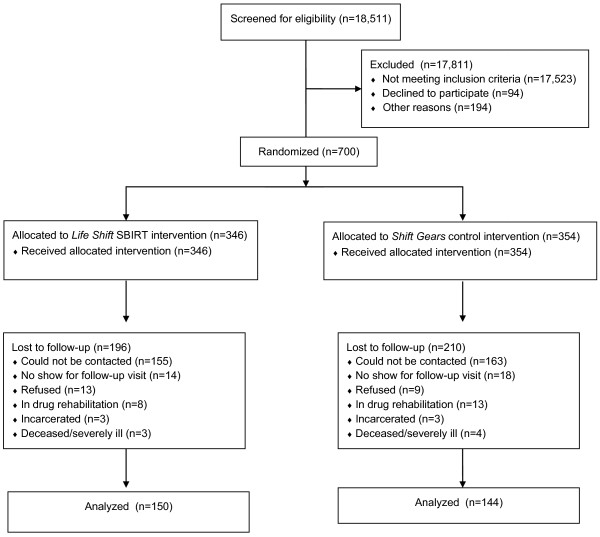
“Figure 1 presents a CONSORT diagram of the flow of patients through the trial [15,21].”
BackgroundMotivational Interviewing: Preparing People for Change, 2nd ed.
Miller, W., & Rollnick, S. (2003) · Journal For Healthcare Quality · doi:10.1097/01445442-200305000-00013 · Cited by 2,634 · cited 1×
“interviewing (MI), a non-confrontational style of behavior change counseling [25,26].”
BackgroundErrors and violations on the roads: a real distinction?
REASON, J., MANSTEAD, A., STRADLING, S., BAXTER, J., & CAMPBELL, K. (1990) · Ergonomics · doi:10.1080/00140139008925335 · Cited by 1,940 · cited 5×
“The DBQ is an assessment tool designed to identify and classify driving behaviors into specific categories.”
MethodInfluential
Research works printed but not linked: 2
- Substance Abuse and Mental Health Services Administration (SAMHSA)/Center for Substance Abuse Treatment (CSAT) A guide to substance abuse services for primary care clinicians Treatment Improvement Protocol (TIP) Series 24 1997 Rockville: U.S: Department of Health and Human Services, Substance Abuse and Mental Health Services Administration DHHS Publication No. (SMA) 97–3139 22514830
- McGahan PL Griffith JA Parente R McLellan AT: Composite scores for the addiction severity index 1986 Philadelphia, PA: Department of Veterans Affairs Medical Center Retrieved from http://www.tresearch.org/wp-content/uploads/2012/09/
Cited by
Screening and Brief Intervention for Drug Use in Primary Care: The ASPIRE Randomized Clinical Trial
Saitz, R., Palfai, T. P. A., Cheng, D. M., Alford, D. P., Bernstein, J. A., Lloyd-Travaglini, C. A., Meli, S. M., Chaisson, C. E., & Samet, J. H. (2014) · JAMA · doi:10.1001/jama.2014.7862 · Cited by 280
Blow, F. C., Walton, M. A., Bohnert, A. S. B., Ignacio, R. V., Chermack, S., Cunningham, R. M., Booth, B. M., Ilgen, M., & Barry, K. L. (2017) · Addiction · doi:10.1111/add.13773 · Cited by 72
“have used ordinal measures and/or quantity/frequency questions [18,21,66] or brief assessment windows (e.”
BackgroundMethodScreening and Brief Intervention for Unhealthy Drug Use: Little or No Efficacy
Saitz, R. (2014) · Frontiers in Psychiatry · doi:10.3389/fpsyt.2014.00121 · Cited by 78
“One had 58% loss to follow-up and found no benefit of SBI (40).”
BackgroundWamsley, M. A., Satterfield, J. M., Curtis, A. C., Lundgren, L. M., & Satre, D. D. (2018) · Journal of Addiction Medicine · doi:10.1097/adm.0000000000000410 · Cited by 76
“SBI and SBIRT in emergency department and primary care settings have not been shown to be efficacious in reducing drug use (Roy-Byrne et al., 2014; Saitz et al., 2014; Woodruff et al., 2014).”
BackgroundMyers, B., van der Westhuizen, C., Naledi, T., Stein, D. J., & Sorsdahl, K. (2016) · BMC Psychiatry · doi:10.1186/s12888-016-0742-8 · Cited by 34
Prendergast, M. L., McCollister, K., & Warda, U. (2017) · Journal of Substance Abuse Treatment · doi:10.1016/j.jsat.2016.12.011 · Cited by 42
“, 2009), although some studies found no difference in outcomes (Marsden et al., 2006; Stein, Herman & Anderson, 2009; Woodruff et al., 2014).”
ResultWoodruff, S. I., & Shillington, A. M. (2016) · American Journal on Addictions · doi:10.1111/ajad.12401 · Cited by 41
Self-citationCordovilla‐Guardia, S., Fernández‐Mondejar, E., Vilar‐López, R., Navas, J. F., Portillo‐Santamaría, M., Rico‐Martín, S., & Lardelli‐Claret, P. (2017) · PLoS ONE · doi:10.1371/journal.pone.0182441 · Cited by 41
“Admission to trauma centers offers a potential “teachable moment” because patients may have perceptions of vulnerability about their health and therefore may be particularly receptive to screening and counseling [16].”
BackgroundWalton, M. A., Epstein-Ngo, Q. M., Carter, P. M., Zimmerman, M. A., Blow, F. C., Buu, A., Goldstick, J. E., & Cunningham, R. M. (2017) · Drug and Alcohol Dependence · doi:10.1016/j.drugalcdep.2016.11.040 · Cited by 39
“, 2013), whereas adult studies show null findings (Blow et al., under review; Bogenschutz et al., 2014; Roy-Byrne et al., 2014; Saitz et al., 2014; Woodruff et al., 2014).”
ResultPoblete, F., Barticevic, N. A., Zuzulich, M. S., Portilla, R., Castillo‐Carniglia, A., Sapag, J. C., Villarroel, L., Sena, B. F., & Galarce, M. (2017) · Addiction · doi:10.1111/add.13808 · Cited by 33
“[17] in the emergency department setting.”
Olmstead, T. A., Yonkers, K. A., Ondersma, S. J., Forray, A., Gilstad‐Hayden, K., & Martino, S. (2019) · Addiction · doi:10.1111/add.14668 · Cited by 28
New Drugs of Abuse and Withdrawal Syndromes
Andrabi, S., Greene, S. C., Moukaddam, N. J., & Li, B. (2015) · Emergency Medicine Clinics of North America · doi:10.1016/j.emc.2015.07.006 · Cited by 24
“Although studies on the outcomes on alcohol use seem promising, the effect on illicit drug use is less studied; further studies are needed to determine any consistent benefits of SBIRT in illicit drug use.(80,81)”
BackgroundHealth-Related Material Needs and Substance Use among Emergency Department Patients
Gerber, E., Gelberg, L., Rotrosen, J., Castelblanco, D. G., Mijanovich, T., & Doran, K. M. (2019) · Substance Abuse · doi:10.1080/08897077.2019.1635960 · Cited by 22
Merchant, R. C., Baird, J. R., & Liu, T. (2015) · Academic Emergency Medicine · doi:10.1111/acem.12767 · Cited by 19
A Research Agenda for Gender and Substance Use Disorders in the Emergency Department
Choo, E. K., Beauchamp, G. A., Beaudoin, F. L., Bernstein, E., Bernstein, J., Bernstein, S. L., Broderick, K. B., Cannon, R. D., D’Onofrio, G., Greenberg, M. R., et al. (2014) · Academic Emergency Medicine · doi:10.1111/acem.12534 · Cited by 18
O’Grady, M. A., Kapoor, S., Kwon, N. S., Morley, J., Auerbach, M., Neighbors, C. J., Conigliaro, J. C., & Morgenstern, J. (2018) · Journal of Evaluation in Clinical Practice · doi:10.1111/jep.13060 · Cited by 18
Covington, K., Johnson, J. A., Henry, D., Chalmers, S., Payne, F., Tuck, L., & Seale, J. P. (2017) · Applied Nursing Research · doi:10.1016/j.apnr.2017.11.015 · Cited by 16
Guan, W., Liu, T., Baird, J. R., & Merchant, R. C. (2015) · Drug and Alcohol Dependence · doi:10.1016/j.drugalcdep.2015.10.007 · Cited by 15
Alcohol Counseling in Hospital Trauma: Examining Two Brief Interventions
Veach, L. J., Moro, R. R., Miller, P. R., Reboussin, B. A., Ivers, N. N., Rogers, J. L., & O’Brien, M. C. (2018) · Journal of Counseling & Development · doi:10.1002/jcad.12199 · Cited by 13
Morse, A. K., Sercombe, J., Askovic, M., Fisher, A., Marel, C., Chatterton, M.-L., Kay-Lambkin, F., Barrett, E., Sunderland, M., Harvey, L., et al. (2023) · Journal of Substance Abuse Treatment · doi:10.1016/j.jsat.2022.108928 · Cited by 12
Mavoglurant reduces cocaine use in patients with cocaine use disorder in a phase 2 clinical trial
Gomez‐Mancilla, B., Dürsteler, K. M., Vogel, M., Herdener, M., Torrens, M., Gálvez, B. P., Gual, A., Corral, R. M., Kuper, E., Mosca, D., et al. (2025) · Science Translational Medicine · doi:10.1126/scitranslmed.adi4505 · Cited by 11
Eisenberg, K., & Woodruff, S. I. (2013) · Addiction Science & Clinical Practice · doi:10.1186/1940-0640-8-8 · Cited by 11
Self-citationDrislane, L. E., Waller, R. E., Martz, M. E., Bonar, E. E., Walton, M. A., Chermack, S. T., & Blow, F. C. (2019) · Addiction · doi:10.1111/add.14781 · Cited by 11
Sahker, E., Luo, Y., Sakata, M., Toyomoto, R., Hwang, C., Yoshida, K., Watanabe, N., & Furukawa, T. A. (2022) · Journal of General Internal Medicine · doi:10.1007/s11606-022-07543-z · Cited by 10
“Severity demonstrated extremely high heterogeneity across studies, which appears to be due the highly divergent findings fromWoodruff.(46) The certainty of evidence was rated low and downgraded by two levels due to very serious inconsistency of effects between studies.”
BackgroundMethodGhasemi, A., Chehregosha, M., Dastoorpoor, M., kolsoumTomaj, O., Farizi, M., Aghababaeian, H., Jamshidi, E., Khanjani, N., & Kouhpayeh, S. A. (2018) · Mental Health & Prevention · doi:10.1016/j.mhp.2018.07.002 · Cited by 10
Scialli, A. C., & Terplan, M. (2019) · Journal of Addiction Medicine · doi:10.1097/adm.0000000000000537 · Cited by 8
Bonar, E. E., Walton, M. A., Barry, K. L., Bohnert, A. M., Chermack, S. T., Cunningham, R. M., Massey, L. S., Ignacio, R. V., & Blow, F. C. (2017) · Drug and Alcohol Dependence · doi:10.1016/j.drugalcdep.2017.10.036 · Cited by 8
“studies have reported no significant effects of BIs for drugs (Guan et al., 2015; Humeniuk et al., 2012; Saitz, 2014; Saitz et al., 2014; Woodruff et al., 2014), including BIs followed by boosters (Bogenschutz et al.”
BackgroundCharacteristics of Cannabis-Only and Other Drug Users Who Visit the Emergency Department
Woodruff, S. I., McCabe, C. T., Hohman, M. M., Clapp, J. D., Shillington, A. M., Eisenberg, K., Sise, C. B., Castillo, E. M., Chan, T. C., & Sise, M. J. (2016) · Cannabis and Cannabinoid Research · doi:10.1089/can.2016.0012 · Cited by 8
“Overall participant sociodemographic characteristics were reported in a previous article.(14) Three-fourths of the 686 participants were male.”
Self-citationMerchant, R. C., Zhang, Z., Zhang, Z., Liu, T., & Baird, J. R. (2018) · Emergency Medicine Journal · doi:10.1136/emermed-2016-206540 · Cited by 8
Merchant, R. C., Romanoff, J., Zhang, Z., Liu, T., & Baird, J. R. (2017) · Alcohol · doi:10.1016/j.alcohol.2017.07.003 · Cited by 7
“(Merchant, Baird, & Liu, 2015) Other limitations of previous ED-based BI studies are that BIs are focused either primarily or exclusively on alcohol or drug use, the populations studied were predominately alcohol or drug users, and the outcomes measured were restricted to either alcohol or drug use (as opposed to alco…”
BackgroundResultInfluentialMerchant, R. C., Liu, T., & Baird, J. R. (2016) · Western Journal of Emergency Medicine · doi:10.5811/westjem.2016.3.29723 · Cited by 5
“…drug use or increasing uptake of drug treatment services; 43 (2) no differences in past 30-day drug use abstinence six months post-enrollment 44 ; and no advantage to a BI with telephone boosters as compared with screening, assessment and referral to treatment or minimal screening only in…”
Ajzoon, M. S. B. (2017) · ODU Digital Commons (Old Dominion University) · doi:10.25777/w61p-gw72 · Cited by 5
“These three established instruments are currently used in the published literature (Haider et al., 2015; Woodruff et al., 2014; Torabi, Seo & Jeng, 2004).”
MethodHodgins, F. (2017) · Enlighten: Theses (The University of Glasgow) · Cited by 4
McCormack, R. P. (2017) · Addiction · doi:10.1111/add.13872 · Cited by 4
Patston, L. L. M., Travers, K. A., & Newcombe, D. A. L. (2017) · Addictive Disorders & Their Treatment · doi:10.1097/adt.0000000000000108 · Cited by 3
Clingan, S. E., & Woodruff, S. I. (2017) · Substance Use & Misuse · doi:10.1080/10826084.2017.1305412 · Cited by 2
“Details of the participants’ demographics have been reported previously (Woodruff et al., 2014).”
BackgroundMethodSelf-citationGareri, J. (2015) · TSpace (University of Toronto) · Cited by 2
Self-citationDo Motivational Incentives Facilitate Drug Addiction Therapy?
Mobasher, M. W., Enaba, D. A., & Khalil, M. A. E. F. (2016) · Addictive Disorders & Their Treatment · doi:10.1097/adt.0000000000000096
Guardia, C., & Alejandro, S. (2017) · Institutional Repository of the University of Granada (University of Granada)
Cowdin, L. Z., Frost, C. J., Cambron, C., Castillo, J., Parada, M. L., & Gren, L. H. (2023) · Journal of Social Work Practice in the Addictions · doi:10.1080/1533256x.2023.2280957
“…their examined workers ‘paraprofessionals’ (Barlow et al., 2015; Paltzer et al., 2017; Woodruff et al., 2014), two studies (Paltzer et al., 2017; Woodruff et al., 2014) stated that their examined ‘paraprofessional’ workers received a college education, while the other study (Barlow et al.,…”
InfluentialTuschick, E., Ferguson, J., Coulton, S., Eberhardt, J., Reneesha, A., Osindeinde, I., Deluca, P., Sumnall, H. R., Stevens, A., Bray, J. W., et al. (2025) · NIHR Open Research · doi:10.3310/nihropenres.13633.1
Uimastite koostarvitamise häire nõustamine: tervisetehnoloogia hindamise raport TTH77
Põld, M., Müürsepp, M., Redlich, K., & Jürisson, M. (2025) · DSpace repository (University of Tartu)
Reduced Recidivism in Drug Offenders by Treatment Involving Motivational Interviewing
Clary, M. (2021) · ScholarWorks (Walden University)
Metadata
- Authors
- Woodruff, S. I., Clapp, J. D., Eisenberg, K., McCabe, C., Hohman, M., Shillington, A. M., Sise, C. B., Castillo, E. M., Chan, T. C., Sise, M. J., & Gareri, J.
- Affiliations
- San Diego State University (US)
- The Ohio State University (US)
- Colorado State University (US)
- Scripps Mercy Hospital (US)
- University of California San Diego (US)
- University of Toronto (CA)
- Corresponding author
- Woodruff, Susan I
- ORCID
- Venue
- Addiction Science & Clinical Practice
- Published
- 2014-05-22
- Volume
- 9
- Issue
- 1
- Pages
- 8-8
- ISSN
- 1940-0632 (ISSN-L)
- 1940-0640
- PMC
- PMC4046000
- OpenAlex
- W2170231464
- Cited by
- 37
- References
- 43
- Citations by year
- 2025: 2 · 2023: 1 · 2022: 2 · 2019: 4 · 2018: 5 · 2017: 10 · 2016: 6 · 2015: 3 · 2014: 3
- FWCI
- 5.54
- Type
- journal article
- Language
- en
- Open access
- gold
- doi.org
- Licence
- cc-by
- creativecommons.org/licenses/by/2.0 (tdm)
- Locations
- Addiction Science & Clinical Practice (publishedVersion, cc-by)
- PubMed Central (publishedVersion, cc-by)
- PubMed (publishedVersion)
- TSpace (University of Toronto) (submittedVersion)
- eScholarship (California Digital Library) (submittedVersion)
- eScholarship (California Digital Library) (submittedVersion, cc-by)
- Funders
- National Institutes of Health (5rc1da028031-02)
- National Institute on Drug Abuse (1RC1DA028031-01)
- Topics
- Health Sciences › Medicine › Epidemiology › Substance Abuse Treatment and Outcomes
- Health Sciences › Medicine › Public Health, Environmental and Occupational Health › Opioid Use Disorder Treatment
- Health Sciences › Medicine › Epidemiology › HIV, Drug Use, Sexual Risk
- Keywords
- SBIRT, illicit drug use, drug abstinence, emergency department patients, trauma patients, hair analysis, substance use disorders, motivational interventions, treatment effectiveness
- MeSH terms
- Adolescent, Adult, Alcoholism, California, Cross-Sectional Studies, Emergency Service, Hospital, Female, Follow-Up Studies, Hospitals, Urban, Humans, Male, Mass Screening, Middle Aged, Referral and Consultation, Illicit Drugs, Substance Abuse Detection, Comorbidity, Substance-Related Disorders, Young Adult, Motivational Interviewing
About these checks
Registry, retraction, Cites and statistics results are computed, not judged, with one exception: a printed reference that no index lists is read once by a model before it counts as a citation error. Claims are extracted by a model and kept only when their quote appears verbatim in the text; each cited source is then checked, with a model’s help, for whether it says what the claim relies on. Those verdicts can be wrong — read the claim’s quote and the cited source before relying on one.
Statistics and arithmetic are recomputed, not judged.
Confidence bands are shown only for fields calibrated on our annotated test set. None is calibrated yet, so no band is shown.
What counts as a claim ›How we measure confidence ›How we check this ›
Are you an author, or do you see a problem with this page? Request a review
Data sources
Bibliographic data: Semantic Scholar, OpenAlex, Crossref.
Contains information from the Semantic Scholar Academic Graph Datasets, made available under the ODC Attribution License (ODC-BY 1.0).
Semantic Scholar’s data is described in: Kinney, R., et al. (2023). The Semantic Scholar Open Data Platform. arXiv:2301.10140.
