

The DOI matches its Crossref record; 9 of the 9 references it cites were found in a registry or an index; none of the 8 sources its claims cite is checked for support yet.
SFARI Gene 2.0: a community-driven knowledgebase for the autism spectrum disorders (ASDs)
Open accessAbstract
New technologies enabling genome-wide interrogation have led to a large and rapidly growing number of autism spectrum disorder (ASD) candidate genes. Although encouraging, the volume and complexity of these data make it challenging for scientists, particularly non-geneticists, to comprehensively evaluate available evidence for individual genes. Described here is the Gene Scoring module within SFARI Gene 2.0 ( https://gene.sfari.org/autdb/GS_Home.do ), a platform developed to enable systematic community driven assessment of genetic evidence for individual genes with regard to ASD.
Overview
AI snapshot
Written from the paper’s full text.
TL;DR
SFARI Gene 2.0 introduces a community-driven Gene Scoring module that systematically scores human genetic evidence for ASD candidate genes. In an initial 196-gene set, 58% fell into “Minimal Evidence,” and publication attention was only weakly related to evidence category.
Key findings
- Of 196 scored genes, 114 (58.2%) were assigned “Minimal Evidence” (category 4); no genes were placed in “High confidence” (category 1), while 5 (2.6%) were “Strong candidate” and 17 (8.7%) “Suggestive.”
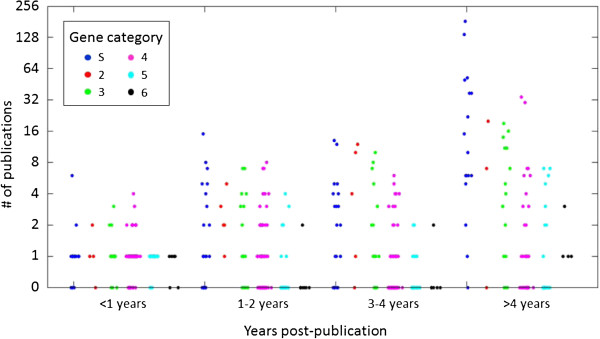
- Publication attention was skewed: among syndromic genes discovered more than four years earlier (n = 17), two genes accounted for almost 50% of ASD-associated publications, while the eight least attended genes in that group collectively accounted for 8.4%.
- Almost half of genes with no or modest support (categories 4/5/6) had more ASD-associated publications than genes with more evidence (categories S/2/3); Table 1 shows syndromic genes had 714 observed versus 160 expected papers (4.4x), while minimal evidence genes had 360 observed versus 834 expected (0.4x).
- The resource includes explicitly defined scoring criteria, downloadable data, community score additions/proposals, and staff/advisory board oversight with versioning.
Methods
- Criteria were developed from a human genetics perspective to quantify evidence for ASD involvement, guided by three principles: use genetic variation in human cohorts, start with no assumptions about individual genes, and make active community involvement central.
- An initial set of 196 genes was scored and annotated in a gene-centric web interface; users with a SFARI login can add scores alongside curated calls, propose new genes, and suggest modifications to scoring criteria, with oversight by staff curators and the SFARI Gene Advisory Board.
- Attention analysis used manually curated publication counts containing “(autism OR autistic)” in the title or abstract; Figure 1 used the PubMed query “(autism OR autistic) AND (‘Gene symbol’)” in the title or abstract, and Table 1 compared observed papers to expected papers based on total observed papers across all categories (n = 1,434).
Limitations
- Stated: the scoring system is “not entirely immune to bias”; scores are not static and will change in the face of new data.
- Evident: the analysis covers only an initial set of 196 genes, and publication counts are used as a proxy for scientific attention; the paper does not report external validation of the scoring categories.
Model-written summary. Check it against the paper before relying on it.
Integrity signals
Registry
Cites
Statistics
Figures
Verification
Claims the paper makes
7 Own interpretation · 6 Own result · 3 Own method · 2 No basis given · 1 Not checked yet
A result the paper reports from its own data — it cites no other source for it, so there is none to check. The quote shows it is in the paper.
In the paper
“Within syndromic genes discovered more than four years ago (n = 17), for example, two genes accounted for almost 50% of the ASD-associated publications.”
§ SFARI Gene 2.0: a community-driven knowledgebase for the autism spectrum disorders (ASDs) > Letter to the Editor
plaincorrelationaln = 17- Asserted: passes — The authors put it forward as true.
- Checkable: passes — It can be checked against evidence.
- Load-bearing: passes — The paper’s conclusions depend on it.
- Based: passes — The paper gives a reason why it holds.
A result the paper reports from its own data — it cites no other source for it, so there is none to check. The quote shows it is in the paper.
In the paper
“A total of 58% of the scored genes, many having been highlighted elsewhere as top candidates, were assigned to the “Minimal Evidence” category.”
§ SFARI Gene 2.0: a community-driven knowledgebase for the autism spectrum disorders (ASDs) > Letter to the Editor
plain- Asserted: passes — The authors put it forward as true.
- Checkable: passes — It can be checked against evidence.
- Load-bearing: passes — The paper’s conclusions depend on it.
- Based: passes — The paper gives a reason why it holds.
The paper states this without a source or data behind it here, so there is nothing to check it against. The quote shows it is in the paper.
In the paper
“Application of these criteria resulted in the identification of genes which despite substantial support had received little or no attention from the field.”
§ SFARI Gene 2.0: a community-driven knowledgebase for the autism spectrum disorders (ASDs) > Letter to the Editor
plaindirect- Asserted: passes — The authors put it forward as true.
- Checkable: passes — It can be checked against evidence.
- Load-bearing: passes — The paper’s conclusions depend on it.
- Based: passes — The paper gives a reason why it holds.
- Rests on an assumption: The scoring categories accurately reflect the strength of genetic evidence for ASD involvement.
A result the paper reports from its own data — it cites no other source for it, so there is none to check. The quote shows it is in the paper.
In the paper
“At the other extreme, the eight least attended to from this group collectively accounted for only 8.4% of the publications.”
§ SFARI Gene 2.0: a community-driven knowledgebase for the autism spectrum disorders (ASDs) > Letter to the Editor
plainn = 17- Asserted: passes — The authors put it forward as true.
- Checkable: passes — It can be checked against evidence.
- Load-bearing: passes — The paper’s conclusions depend on it.
- Based: passes — The paper gives a reason why it holds.
A result the paper reports from its own data — it cites no other source for it, so there is none to check. The quote shows it is in the paper.
In the paper
“Finally, almost half of the genes with no or relatively modest support (categories 4/5/6) have a greater number of ASD-associated publications than those with more evidence for involvement in disease (categories S/2/3).”
§ SFARI Gene 2.0: a community-driven knowledgebase for the autism spectrum disorders (ASDs) > Letter to the Editor
plaincorrelational- Asserted: passes — The authors put it forward as true.
- Checkable: passes — It can be checked against evidence.
- Load-bearing: passes — The paper’s conclusions depend on it.
- Based: passes — The paper gives a reason why it holds.
What the paper did — it cites no source for this, so there is none to check. The quote shows it is in the paper.
In the paper
“To minimize bias, we did not begin with any discussion or review of the literature, but rather the establishment of formalized criteria to quantify available support.”
§ SFARI Gene 2.0: a community-driven knowledgebase for the autism spectrum disorders (ASDs) > Letter to the Editor
plaindirect- Asserted: passes — The authors put it forward as true.
- Checkable: passes — It can be checked against evidence.
- Load-bearing: passes — The paper’s conclusions depend on it.
- Based: passes — The paper gives a reason why it holds.
A conclusion the paper draws from its own results — it cites no other source for it, so there is none to check. The quote shows it is in the paper.
In the paper
“This “winner takes most” effect, where two genes attracted almost 50% of the community’s attention, is in direct conflict with a comprehensive understanding of autism genetics.”
§ SFARI Gene 2.0: a community-driven knowledgebase for the autism spectrum disorders (ASDs) > Letter to the Editor
plainn = 17- Asserted: passes — The authors put it forward as true.
- Checkable: passes — It can be checked against evidence.
- Load-bearing: passes — The paper’s conclusions depend on it.
- Based: passes — The paper gives a reason why it holds.
- Rests on an assumption: The number of manually curated publications containing “(autism OR autistic)” in the title or abstract is a valid measure of attention from the scientific community.
A conclusion the paper draws from its own results — it cites no other source for it, so there is none to check. The quote shows it is in the paper.
In the paper
“Although scores are not static and will change in the face of new data, these data suggest that there exists only modest support for the majority of autism-candidate genes proposed to date.”
§ SFARI Gene 2.0: a community-driven knowledgebase for the autism spectrum disorders (ASDs) > Letter to the Editor
hedged- Asserted: passes — The authors put it forward as true.
- Checkable: passes — It can be checked against evidence.
- Load-bearing: passes — The paper’s conclusions depend on it.
- Based: passes — The paper gives a reason why it holds.
- Rests on an assumption: The initial set of 196 scored genes is representative of autism-candidate genes proposed to date.
A conclusion the paper draws from its own results — it cites no other source for it, so there is none to check. The quote shows it is in the paper.
In the paper
“These data highlight a relatively poor relationship between genetic evidence and attention from the scientific community.”
- Also stated in: § Letter to the Editor · plain
“Consistent with a disconnect between attention from the research community and evidence in support of individual genes, the number of publications for individual genes is highly variable and only weakly related to gene category.”
§ SFARI Gene 2.0: a community-driven knowledgebase for the autism spectrum disorders (ASDs) > Letter to the Editor
plaincorrelational- Asserted: passes — The authors put it forward as true.
- Checkable: passes — It can be checked against evidence.
- Load-bearing: passes — The paper’s conclusions depend on it.
- Based: passes — The paper gives a reason why it holds.
- Rests on an assumption: The number of manually curated publications containing “(autism OR autistic)” in the title or abstract is a valid measure of attention from the scientific community.
- Rests on an assumption: The scoring categories accurately reflect the strength of genetic evidence for ASD involvement.
- Also stated in: § Letter to the Editor · plain
- It may state two separate claims as one. 8
- Probably not a substantial claim. 4
A result the paper reports from its own data — it cites no other source for it, so there is none to check. The quote shows it is in the paper.
In the paper
“Consistent with a disconnect between attention from the research community and evidence in support of individual genes, the number of publications for individual genes is highly variable and only weakly related to gene category.”
§ SFARI Gene 2.0: a community-driven knowledgebase for the autism spectrum disorders (ASDs) > Letter to the Editor
plaincorrelational- Asserted: passes — The authors put it forward as true.
- Checkable: passes — It can be checked against evidence.
- Load-bearing: passes — The paper’s conclusions depend on it.
- Based: passes — The paper gives a reason why it holds.
It may state two separate claims as one.
- Rests on an assumption: The number of manually curated publications containing “(autism OR autistic)” in the title or abstract is a valid measure of attention from the scientific community.
A result the paper reports from its own data — it cites no other source for it, so there is none to check. The quote shows it is in the paper.
In the paper
“Enormous variability was observed both within and between categories, along with marked skewing towards specific genes within a given category (Figure 1).”
§ SFARI Gene 2.0: a community-driven knowledgebase for the autism spectrum disorders (ASDs) > Letter to the Editor
plaincorrelational- Asserted: passes — The authors put it forward as true.
- Checkable: passes — It can be checked against evidence.
- Load-bearing: passes — The paper’s conclusions depend on it.
- Based: passes — The paper gives a reason why it holds.
It may state two separate claims as one.
What the paper did — it cites no source for this, so there is none to check. The quote shows it is in the paper.
In the paper
“Although the scoring system we have developed is itself not entirely immune to bias, evidence is examined and applied in a systemic fashion and is sensitive to community feedback.”
§ SFARI Gene 2.0: a community-driven knowledgebase for the autism spectrum disorders (ASDs) > Letter to the Editor
plain- Asserted: passes — The authors put it forward as true.
- Checkable: passes — It can be checked against evidence.
- Load-bearing: passes — The paper’s conclusions depend on it.
- Based: passes — The paper gives a reason why it holds.
Probably not a substantial claim. It may state two separate claims as one.
A conclusion the paper draws from its own results — it cites no other source for it, so there is none to check. The quote shows it is in the paper.
In the paper
“For genes already included in the portal, users with a SFARI login are able to add their own scores alongside curated calls (https://gene.sfari.org/autdb/search); these are viewable by the entire community in the form of “counts”.”
- Also stated in: § Letter to the Editor · plain
“Registered individuals are also able to propose scores for genes not yet included in the database (https://gene.sfari.org/autdb/user/AddAGene.do), and also suggest modifications to the scoring criteria.”
§ SFARI Gene 2.0: a community-driven knowledgebase for the autism spectrum disorders (ASDs) > Letter to the Editor
plain- Asserted: passes — The authors put it forward as true.
- Checkable: passes — It can be checked against evidence.
- Load-bearing: passes — The paper’s conclusions depend on it.
- Based: passes — The paper gives a reason why it holds.
It may state two separate claims as one.
- Also stated in: § Letter to the Editor · plain
What the paper did — it cites no source for this, so there is none to check. The quote shows it is in the paper.
In the paper
“Extensive safeguards - including staff and advisory board oversight - are in place to ensure the quality and utility of the resource.”
§ SFARI Gene 2.0: a community-driven knowledgebase for the autism spectrum disorders (ASDs) > Letter to the Editor
plaindirect- Asserted: passes — The authors put it forward as true.
- Checkable: passes — It can be checked against evidence.
- Load-bearing: fails — The paper’s conclusions may not depend on it.
- Based: fails — The paper may give no reason why it holds.
Probably not a substantial claim. The paper’s conclusions may not depend on it. The paper may give no reason why it holds.
The paper states this without a source or data behind it here, so there is nothing to check it against. The quote shows it is in the paper.
In the paper
“Further, this process requires the integration of diverse lines of support that are unequal.”
§ SFARI Gene 2.0: a community-driven knowledgebase for the autism spectrum disorders (ASDs) > Letter to the Editor
plain- Asserted: passes — The authors put it forward as true.
- Checkable: fails — It may be too vague to check against evidence.
- Load-bearing: passes — The paper’s conclusions depend on it.
- Based: passes — The paper gives a reason why it holds.
Probably not a substantial claim. It may be too vague to check against evidence.
A conclusion the paper draws from its own results — it cites no other source for it, so there is none to check. The quote shows it is in the paper.
In the paper
“Also new and unique to SFARI Gene 2.0 is a mechanism that enables researchers to provide reasoned arguments for the introduction of new genes, offer alternate scores that sit alongside existing ones, and provide suggestions for the modification of the scoring criteria.”
§ SFARI Gene 2.0: a community-driven knowledgebase for the autism spectrum disorders (ASDs) > Letter to the Editor
plain- Asserted: passes — The authors put it forward as true.
- Checkable: passes — It can be checked against evidence.
- Load-bearing: passes — The paper’s conclusions depend on it.
- Based: passes — The paper gives a reason why it holds.
It may state two separate claims as one.
None of the sources cited for this claim have been checked yet.
In the paper
“Previous work has crafted curated lists of genes implicated in autism spectrum disorders (ASDs) [1-5], and in some cases developed loosely defined “evidence scores” for entries [6-8]. Such efforts are incomplete, non-systematic and static.”
§ SFARI Gene 2.0: a community-driven knowledgebase for the autism spectrum disorders (ASDs) > Letter to the Editor
What the sources say
- Not checked yetcites [1] Basu SN, Kollu R, Banerjee-Basu S: AutDB: a gene reference resource for autism research. Nucleic Acids Res. 2009, 37: 832-836. 10.1093/nar/gkn941. source
- Not checked yetcites [2] Matuszek G, Talebizadeh Z: Autism Genetic Database (AGD): a comprehensive database including autism susceptibility gene-CNVs integrated with known noncoding RNAs and fragile sites. BMC Med Genet. 2009, 10: 102-10.1186/1471-2350-10-102. Epub 2009/09/26 source
- Not checked yetcites [3] Pinto D, Pagnamenta AT, Klei L, Anney R, Merico D, Regan R, Conroy J, Magalhaes TR, Correia C, Abrahams BS, Almeida J, Bacchelli E, Bader GD, Bailey AJ, Baird G, Battaglia A, Berney T, Bolshakova N, Bölte S, Bolton PF, Bourgeron T, Brennan S, Brian J, Bryson SE, Carson AR, Casallo G, Casey J, Chung BH, Cochrane L, Corsello C: Functional impact of global rare copy number variation in autism spectrum disorders. Nature. 2010, 466: 368-372. 10.1038/nature09146. source
- Not checked yetcites [4] Betancur C: Etiological heterogeneity in autism spectrum disorders: more than 100 genetic and genomic disorders and still counting. Brain Res. 2011, 1380: 42-77. source
- Not checked yetcites [5] Weiss LA, Arking DE, Daly MJ, Chakravarti A, Gene Discovery Project of Johns Hopkins & the Autism Consortium: A genome-wide linkage and association scan reveals novel loci for autism. Chakravarti A. Nature. 2009, 461 (7265): 802-808. source
- Not checked yetcites [6] Abrahams BS, Geschwind DH: Advances in autism genetics: on the threshold of a new neurobiology. Nat Rev Genet. 2008, 9 (5): 341-355. 10.1038/nrg2346. source
- Not checked yetcites [7] Abrahams BS, Geschwind DH: Genetics of autism. Vogel and Motulsky's Human Genetics: Problems & Approaches. Edited by: Speicher MR, Antonarakis SE, Motulsky AG. 2009, Berlin: Springer-Verlag, 699-714. 4
- Not checked yetcites [8] Xu LM, Li JR, Huang Y, Zhao M, Tang X, Wei L: AutismKB: an evidence-based knowledgebase of autism genetics. Nucleic Acids Res. 2012, 40: D1016-D1022. 10.1093/nar/gkr1145. source
plain- Asserted: passes — The authors put it forward as true.
- Checkable: passes — It can be checked against evidence.
- Load-bearing: passes — The paper’s conclusions depend on it.
- Based: passes — The paper gives a reason why it holds.
It may state two separate claims as one.
A conclusion the paper draws from its own results — it cites no other source for it, so there is none to check. The quote shows it is in the paper.
In the paper
“In summary, key strengths of SFARI Gene 2.0 include explicitly defined scoring criteria, continuous updates and infrastructure to permit community based involvement.”
§ SFARI Gene 2.0: a community-driven knowledgebase for the autism spectrum disorders (ASDs) > Letter to the Editor
plain- Asserted: passes — The authors put it forward as true.
- Checkable: passes — It can be checked against evidence.
- Load-bearing: passes — The paper’s conclusions depend on it.
- Based: passes — The paper gives a reason why it holds.
Probably not a substantial claim. It may state two separate claims as one.
A conclusion the paper draws from its own results — it cites no other source for it, so there is none to check. The quote shows it is in the paper.
In the paper
“Although similar in concept to other efforts, SFARI Gene 2.0 differs in terms of philosophy, methodology and output.”
§ SFARI Gene 2.0: a community-driven knowledgebase for the autism spectrum disorders (ASDs) > Letter to the Editor
plain- Asserted: passes — The authors put it forward as true.
- Checkable: passes — It can be checked against evidence.
- Load-bearing: passes — The paper’s conclusions depend on it.
- Based: passes — The paper gives a reason why it holds.
It may state two separate claims as one.
The paper relies on this without support.
Downstream work involves considerable resources.
“Given that downstream work involves considerable resources, a portal and framework enabling systematic assessments of all available evidence holds great value.”
The paper relies on this without support.
The initial set of 196 scored genes is representative of autism-candidate genes proposed to date.
“Using these newly developed criteria, we scored an initial set of 196 genes.”
“these data suggest that there exists only modest support for the majority of autism-candidate genes proposed to date.”
The paper relies on this without support.
The number of manually curated publications containing “(autism OR autistic)” in the title or abstract is a valid measure of attention from the scientific community.
“We then looked at the relationship between category placement and attention from the field, as defined by the number of manually curated publications containing “(autism OR autistic)” in the title or abstract.”
The paper relies on this without support.
The scoring categories accurately reflect the strength of genetic evidence for ASD involvement.
“Using a human genetics perspective, we developed a set of criteria to quantify evidence for involvement in the ASDs.”
Claims other papers make about this one
Each is checked against this paper’s own text: does it say what the citing paper says it does?
In the citing paper
“(ii) 235 genes (ASD SFARI 2014) from the SFARI AutDB database22 (accessed on July 2014).”
From Transcriptome analysis reveals dysregulation of innate immune response genes and neuronal activity-dependent genes in autism (2014) · cites this paper as [22]
Citations
Cites
Functional impact of global rare copy number variation in autism spectrum disorders
Pinto, D., Pagnamenta, A. T., Klei, L., Anney, R., Merico, D., Regan, R., Conroy, J., Magalhaes, T. R., Correia, C., Abrahams, B. S., et al. (2010) · Nature · doi:10.1038/nature09146 · Cited by 2,013 · cited 1×
“Letter to the Editor Previous work has crafted curated lists of genes implicated in autism spectrum disorders (ASDs) [1-5], and in some cases developed loosely defined “evidence scores” for entries [6-8].”
Self-citationAdvances in autism genetics: on the threshold of a new neurobiology
Abrahams, B. S., & Geschwind, D. H. (2008) · Nature Reviews Genetics · doi:10.1038/nrg2346 · Cited by 1,866 · cited 1×
“Letter to the Editor Previous work has crafted curated lists of genes implicated in autism spectrum disorders (ASDs) [1-5], and in some cases developed loosely defined “evidence scores” for entries [6-8].”
Self-citationBetancur, C. (2011) · Brain Research · doi:10.1016/j.brainres.2010.11.078 · Cited by 954 · cited 1×
“Letter to the Editor Previous work has crafted curated lists of genes implicated in autism spectrum disorders (ASDs) [1-5], and in some cases developed loosely defined “evidence scores” for entries [6-8].”
A genome-wide linkage and association scan reveals novel loci for autism
The Gene Discovery Project of Johns Hopkins & the Autism Consortium, Weiss, L. A., & Arking, D. E. (2009) · Nature · doi:10.1038/nature08490 · Cited by 619 · cited 1×
“Letter to the Editor Previous work has crafted curated lists of genes implicated in autism spectrum disorders (ASDs) [1-5], and in some cases developed loosely defined “evidence scores” for entries [6-8].”
Self-citationAutDB: a gene reference resource for autism research
Basu, S. N., Kollu, R., & Banerjee-Basu, S. (2009) · Nucleic Acids Research · doi:10.1093/nar/gkn835 · Cited by 394 · cited 1×
“Letter to the Editor Previous work has crafted curated lists of genes implicated in autism spectrum disorders (ASDs) [1-5], and in some cases developed loosely defined “evidence scores” for entries [6-8].”
Self-citationAutismKB: an evidence-based knowledgebase of autism genetics
Xu, L.-M., Li, J.-R., Huang, Y., Zhao, M., Tang, X., & Wei, L. (2012) · Nucleic Acids Research · doi:10.1093/nar/gkr1145 · Cited by 179 · cited 1×
“Letter to the Editor Previous work has crafted curated lists of genes implicated in autism spectrum disorders (ASDs) [1-5], and in some cases developed loosely defined “evidence scores” for entries [6-8].”
Matuszek, G., & Talebizadeh, Z. (2009) · BMC Medical Genetics · doi:10.1186/1471-2350-10-102 · Cited by 48 · cited 1×
“Letter to the Editor Previous work has crafted curated lists of genes implicated in autism spectrum disorders (ASDs) [1-5], and in some cases developed loosely defined “evidence scores” for entries [6-8].”
Vogel and Motulsky's Human Genetics: Problems and Approaches
Vogel, F., Motulsky, A. G., Speicher, M. R., Motulsky, A. G., & Antonarakis, S. E. (1982) · Medical Entomology and Zoology · Cited by 33
Abrahams, B. S., & Geschwind, D. H. (2009) · Springer eBooks · doi:10.1007/978-3-540-37654-5_29 · Cited by 15
Self-citation
Cited by
Sorted by citations
Items 901–943 of 943
The Etiology of Autism Spectrum Disorder and Gender Dysphoria
Nelson, A., Somerville, P., Patel, S., & Matta, J. (2024) · Annual International Conference of the IEEE Engineering in Medicine and Biology Society (EMBC) · doi:10.1109/embc53108.2024.10781615
Gene Expression Associated with Human Brain Activations in Facial Expression RecognitionPreprint
Wang, Z., Ji, Y., Fu, Y., et al. (2021) · Research Square · doi:10.21203/rs.3.rs-990296/v1
Han, S., Sun, X., Sloofman, L. G., Satterstrom, F. K., Wang, G., Liang, L., Knoblauch, N., Zhao, S., Liu, Y., Sheng, W., et al. (2024) · bioRxiv (Cold Spring Harbor Laboratory) · doi:10.1101/2024.10.24.620131
Systematic Reconstruction of Autism Biology with Multi-Level Whole Exome AnalysisPreprint
Luo, W., Zhang, C., & Brouwer, C. (2016) · bioRxiv (Cold Spring Harbor Laboratory) · doi:10.1101/052878
Multi-modification crosstalk-aware graph learning for ASD risk gene identification
Cui, Z., Wei, L., Deng, X., Li, Z., & Li, G. (2026) · Expert Systems with Applications · doi:10.1016/j.eswa.2026.134550
Huang, M., Ye, X., & Sakurai, T. (2025) · Current Bioinformatics · doi:10.2174/0115748936361195250410044441
3-1 ワイブル分布の形状母数推定に関する一考察(REAJ第10回研究発表会)
長塚, 豪., & 鎌倉, 稔. (2002) · 日本信頼性学会誌 : 信頼性
Hidden causal inference delineates dynamic lncRNA regulation in autism spectrum disorder
Zhang, J., Wei, X., Zhao, C., Hu, Z., & Fan, S. (2026) · Briefings in Bioinformatics · doi:10.1093/bib/bbag541
Behavior and Depression Gene Networks Reconstruction and Analysis
Ivanov, R. A., Zamyatin, V., Klimenko, A. I., Астахова, Т. Н., Matushkin, Y. G., Savostyanov, A. N., & Lashin, S. A. (2019) · International Multi-Conference on Engineering, Computer and Information Sciences (SIBIRCON) · doi:10.1109/sibircon48586.2019.8958072
McEwan, F., Santo, J. D., Kambara, C., Tarrat-Castells, M., Woods, R. M., Harte, M., Glazier, J. D., & Hager, R. (2026) · Brain Behavior and Immunity · doi:10.1016/j.bbi.2026.106895
Alaiz-Noya, M., Miozzo, F., Fuentes-Ramos, M., Machnicka, M. A., Kurowska, M., Herrera, M. L., del Blanco, B., Niñerola, S., Bustos-Martínez, I., Wilczyński, B., et al. (2025) · bioRxiv (Cold Spring Harbor Laboratory) · doi:10.1101/2025.02.11.637399
Liu, H., Barnes, J., Pedrosa, E., Herman, N. S., Salas, F., Wang, P., Zheng, D., & Lachman, H. M. (2020) · Figshare · doi:10.6084/m9.figshare.12285440
Diaz, L., Kong, A. X., Zhang, P., Jinhua, C. H. I., Pham, K. T., Johnson, M., Eno, A. F., Douglas, I., Mao, Y., MacDonald, J. K., et al. (2026) · eLife · doi:10.7554/elife.110280
Marino, V., Phromkrasae, W., Bertacchi, M., Cassini, P., Chakrabandhu, K., Dell’Orco, D., & Studer, M. (2023) · bioRxiv (Cold Spring Harbor Laboratory) · doi:10.1101/2023.07.24.550340
Robles, N. D. J., Tosatto, S. C. E., & Aspromonte, M. C. (2026) · Genes · doi:10.3390/genes17020219
Utami, K. H., Han, V. X., Yusof, N. A. B. M., et al. (2026) · Neurology Genetics · doi:10.1212/nxg.0000000000200351
Vu, T.-D., Iwasaki, Y., Oshima, K., et al. (2020) · bioRxiv (Cold Spring Harbor Laboratory) · doi:10.1101/2020.08.05.237586
Liu, Z., & Huang, Y.-F. (2023) · bioRxiv (Cold Spring Harbor Laboratory) · doi:10.1101/2023.08.29.555384 · Cited by 1
An analysis of genetic variants associated with autism spectrum disorder
Callaghan, D. B. (2018) · cIRcle (University of British Columbia) · doi:10.14288/1.0362156
Rôle du zinc dans la transmission synaptique normale et pathologique
Serraz, B. (2019) · theses.fr (ABES) · doi:10.70675/c9307d17zdbe8z495dz8561z8136a8c5dbb7
Huang, J., Liao, J., Chen, X., Lin, G., De, Y., Shangguan, H., & Tao, W. (2025) · International Journal of Molecular Sciences · doi:10.3390/ijms27010067
Zhang, Y., Wang, T., Wang, Y., et al. (2021) · Research Square · doi:10.21203/rs.3.rs-191713/v1
De novo variants in population constrained fetal brain enhancers and intellectual disabilityPreprint
Vas, M. G. D., Garstang, M. G., Joshi, S. S., Khan, T. N., Atla, G., Parry, D., Moore, D., Cebola, I., Zhang, S., Cui, W., et al. (2019) · bioRxiv (Cold Spring Harbor Laboratory) · doi:10.1101/621029
In silico reconstruction of the gene network for cytokine regulation of ASD-associated
Levanova, N. M., Vergunov, E. G., Savostyanov, A. N., Yatsyk, I. V., & Иванисенко, В. А. (2025) · Vavilov Journal of Genetics and Breeding · doi:10.18699/vjgb-25-105
Fu, S., Bury, L. A. D., Eum, J., et al. (2022) · bioRxiv (Cold Spring Harbor Laboratory) · doi:10.1101/2022.11.15.516317
Contino, S., Bertolazzi, G., Calı̀, F., Cantone, M., Vera, J., & Romano, V. (2020) · Elsevier eBooks · doi:10.1016/b978-0-12-801238-3.11518-1
Uncovering the complexity of structural variants in four individuals with autism spectrum disorder
Dada, S., Dixon, K., Akbari, V., et al. (2024) · Genome · doi:10.1139/gen-2024-0121
Sex-dependent prediction of autism
O'Sullivan, J. M., Miller, C., Portlock, T., & Nyaga, D. (2026) · Frontiers in Genetics · doi:10.3389/fgene.2026.1799530
Genetic and Cortical Cell-Type Liability Architecture of AutismPreprint
Renne, T., Bénitière, F., Poulain, C., Dubuc, A., Bourque, V.-R., Huguet, G., Nowakowski, T. J., & Jacquemont, S. (2025) · Research Square · doi:10.64898/2025.12.10.693473
Liu, F., Yang, H., & Wu, X. (2026) · International Journal of Molecular Sciences · doi:10.3390/ijms27062849
Exome Sequencing of 963 Chinese Families Identifies Novel Epilepsy Candidate GenesPreprint
Ma, Y., Su, K., Zhou, M., Liu, Y., Lu, G., Wang, J., Li, C., Wang, T., Li, Y., Zhang, Q., et al. (2024) · medRxiv · doi:10.1101/2024.06.11.24308522
Diaz, L., Kong, A. X., Zhang, P., Jinhua, C. H. I., Pham, K. T., Johnson, M., Eno, A. F., Douglas, I., Mao, Y., MacDonald, J. K., et al. (2026) · eLife · doi:10.7554/elife.110280.1
Integration of single cell gene expression data in Bayesian association analysis of rare variantsPreprint
Zhong, G., Choi, Y. A., & Shen, Y. (2022) · bioRxiv (Cold Spring Harbor Laboratory) · doi:10.1101/2022.05.13.491893
Costa, C. I. S. (2024) · Digital Library of Theses and Dissertations (Universidade de São Paulo) · doi:10.11606/t.41.2024.tde-22082024-180122
Transcriptomic divergence of network hubs in the prenatal human brainPreprint
Oldham, S., & Ball, G. (2025) · bioRxiv (Cold Spring Harbor Laboratory) · doi:10.1101/2025.05.26.656237
O’Shea, H., Hutchinson, M. L. C., Lee, J. W., & Lee, S.-K. (2026) · Developmental Biology · doi:10.1016/j.ydbio.2026.04.005
Smolen, C., Jensen, M., & Girirajan, S. (2026) · STAR Protocols · doi:10.1016/j.xpro.2026.104546
Zhu, Y., Mordaunt, C. E., Durbin-Johnson, B. P., et al. (2020) · bioRxiv (Cold Spring Harbor Laboratory) · doi:10.1101/2020.05.14.096586
Singh, K., Mogha, K., & Moctar, S. M. S. (2026) · Neurological Sciences · doi:10.1007/s10072-026-09334-4
Chaudhary, R., & Steinson, E. (2023) · Springer eBooks · doi:10.1007/978-3-031-42383-3_18 · Cited by 2
Integration of polygenic risk with single cell methylation data using met-scDRS
Li, X., Shi, Z., Hou, K., Eyring, K. W., Liu, C., Heffel, M. G., Luo, C., Geschwind, D. H., & Pasaniuc, B. (2026) · Bioinformatics · doi:10.1093/bioinformatics/btag751
Metadata
- Authors
- Abrahams, B. S., Arking, D. E., Campbell, D. B., Mefford, H. C., Morrow, E. M., Weiss, L. A., Menashe, I., Wadkins, T., Banerjee-Basu, S., & Packer, A.
- Affiliations
- Albert Einstein College of Medicine (US)
- Johns Hopkins University (US)
- University of Southern California (US)
- University of Washington (US)
- Brown University (US)
- University of California, San Francisco (US)
- Ben-Gurion University of the Negev (IL)
- MindSpec (US)
- Simons Foundation (US)
- Corresponding author
- Packer, Alan
- Venue
- Molecular Autism
- Published
- 2013-10-03
- Volume
- 4
- Issue
- 1
- Pages
- 36-36
- ISSN
- 2040-2392 (ISSN-L)
- PMC
- PMC3851189
- OpenAlex
- W2168950294
- Cited by
- 873
- References
- 9
- Citations by year
- 2026: 103 · 2025: 115 · 2024: 79 · 2023: 94 · 2022: 110 · 2021: 95 · 2020: 89 · 2019: 60 · 2018: 46 · 2017: 31 · 2016: 26 · 2015: 12 · 2014: 10 · 2013: 1
- FWCI
- 8.92
- Type
- journal article
- Language
- en
- Open access
- gold
- doi.org
- Licence
- cc-by
- Locations
- Molecular Autism (publishedVersion, cc-by)
- Europe PMC (PubMed Central) (publishedVersion, cc-by)
- PubMed Central (publishedVersion, cc-by)
- PubMed (publishedVersion)
- eScholarship (California Digital Library) (submittedVersion)
- Funders
- Simons Foundation
- Simons Foundation Autism Research Initiative
- National Institute of Mental Health (R01MH100027)
- Topics
- Life Sciences › Neuroscience › Cognitive Neuroscience › Autism Spectrum Disorder Research
- Life Sciences › Biochemistry, Genetics and Molecular Biology › Genetics › Genetics and Neurodevelopmental Disorders
- Life Sciences › Biochemistry, Genetics and Molecular Biology › Genetics › Genomics and Rare Diseases
- Keywords
- autism spectrum disorder, candidate genes, autism genetics, evidence evaluation
About these checks
Registry, retraction, Cites and statistics results are computed, not judged, with one exception: a printed reference that no index lists is read once by a model before it counts as a citation error. Claims are extracted by a model and kept only when their quote appears verbatim in the text; each cited source is then checked, with a model’s help, for whether it says what the claim relies on. Those verdicts can be wrong — read the claim’s quote and the cited source before relying on one.
A language model drew the claims from the paper on 2026-10-06, under version 3 of the claim definition (model deepseek-v4.1-flash, prompt extract-v3).
A second model labelled each claim on 2026-10-06 (model jev-1.13-20260917, definition revision gold-guideline-v0.2).
Statistics and arithmetic are recomputed, not judged.
Confidence bands are shown only for fields calibrated on our annotated test set. None is calibrated yet, so no band is shown.
What counts as a claim ›How we measure confidence ›How we check this ›
Are you an author, or do you see a problem with this page? Request a review
