

The DOI matches its Crossref record; 46 of the 47 references it cites were found in a registry or an index.
A systematic review of the role of school-based healthcare in adolescent sexual, reproductive, and mental health
Open accessAbstract
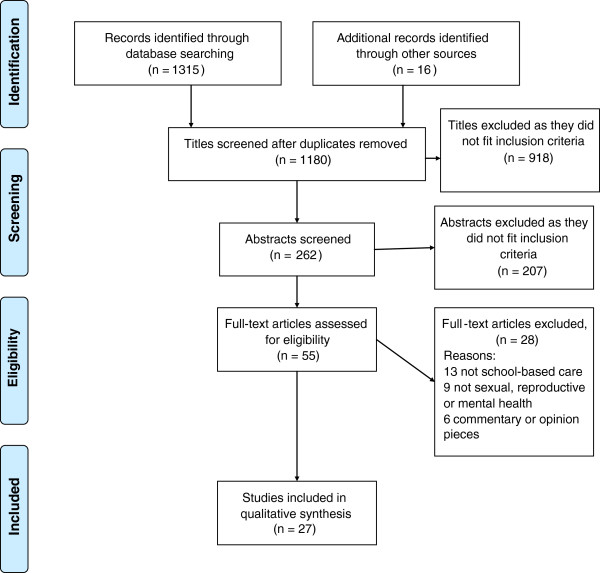
BACKGROUND: Accessible sexual, reproductive, and mental healthcare services are crucial for adolescent health and wellbeing. It has been reported that school-based healthcare (SBHC) has the potential to improve the availability of services particularly for young people who are normally underserved. Locating health services in schools has the potential to reduce transport costs, increase accessibility and provide links between schools and communities. METHODS: A systematic review of the literature was undertaken. Pubmed, Psychinfo, Psychnet, Cochrane CENTRAL, and Web of Science were searched for English language papers published between January 1990 and March 2012 RESULTS: Twenty-seven studies were found which fitted the criteria, of which, all but one were from North America. Only three measured adolescent sexual, reproductive, or mental health outcomes related to SBHC and none of the studies were randomized controlled trials. The remaining studies explored accessibility of services and clinic utilization or described pertinent contextual factors. CONCLUSIONS: There is a paucity of high quality research which evaluates SBHC and its effects on adolescent sexual, reproductive, and mental health. However, there is evidence that SBHC is popular with young people, and provides important mental and reproductive health services. Services also appear to have cost benefits in terms of adolescent health and society as a whole by reducing health disparities and attendance at secondary care facilities. However, clearer definitions of what constitutes SBHC and more high quality research is urgently needed.
Overview
The claims and statistics of this paper haven’t been checked yet.
Run the check — free, no account needed. It reads the open-access text and checks the sources it cites.
Integrity signals
Registry
Cites
Statistics
Figures
Verification
Claims the paper makes
The claims and statistics of this paper haven’t been checked yet.
Run the check — free, no account needed. It reads the open-access text and checks the sources it cites.
Claims other papers make about this one
Each is checked against this paper’s own text: does it say what the citing paper says it does?
The cited source says what the claim attributes to it.
In the citing paper
“Previous reviews have found limited evidence of SBHC effectiveness in improving healthcare utilization and academic outcomes.19,37–41”
From School-Based Health Centers to Advance Health Equity (2016) · cites this paper as [37]
In the citing paper
“Evidence from community-based mental health delivery programs specifically targeting mental health promotion of young people in LMICs suggests positive impacts on mental health outcomes; however, pooled analysis could not be conducted [19].”
From Interventions for Adolescent Mental Health: An Overview of Systematic Reviews (2016) · cites this paper as [19]
In the citing paper
“However, meta-analysis was not done due to study quality.”
From Interventions for Adolescent Mental Health: An Overview of Systematic Reviews (2016) · cites this paper as [19]
In the citing paper
“Another review reported from 27 studies that school-based preventive health care is popular with young people and provides important mental health services [19].”
From Interventions for Adolescent Mental Health: An Overview of Systematic Reviews (2016) · cites this paper as [19]
In the citing paper
“However, there were mixed results, including differential effects for gender and age groups [19], and effect estimates could not be pooled.”
From Interventions for Adolescent Mental Health: An Overview of Systematic Reviews (2016) · cites this paper as [19]
In the citing paper
“School-based mental health interventions specifically focusing on low- and middle-income countries (LMICs) suggest that the majority of the school-based life skills and resilience programs indicated positive effects on students' self-esteem, motivation, and self-efficacy.”
From Interventions for Adolescent Mental Health: An Overview of Systematic Reviews (2016) · cites this paper as [19]
Self-check
Percentages, sums and reported differences re-computed from the paper’s own numbers.
The self-check needs the paper’s full text.
Citations
Cites
Merikangas, K. R., He, J.-P., Burstein, M., Swanson, S. A., Avenevoli, S., Cui, L., Benjet, C., Georgiades, K., & Swendsen, J. (2010) · Journal of the American Academy of Child & Adolescent Psychiatry · doi:10.1016/j.jaac.2010.05.017 · Cited by 6,278
Child and adolescent mental health worldwide: evidence for action
Kieling, C., Baker-Henningham, H., Belfer, M., Conti, G., Ertem, I., Omigbodun, O., Rohde, L. A., Srinath, S., Ulkuer, N., & Rahman, A. (2011) · The Lancet · doi:10.1016/s0140-6736(11)60827-1 · Cited by 2,449
Reframing school dropout as a public health issue.
(2007) · PubMed Central · Cited by 476
Full-service schools: a revolution in health and social services for children, youth, and families
(1995) · Choice Reviews Online · doi:10.5860/choice.32-4621 · Cited by 436
Sindre, G. M. (2017) · PCD Journal · doi:10.22146/pcd.25766 · Cited by 261
Race, ethnicity, and access to ambulatory care among US adolescents.
Lieu, T. A., Newacheck, P. W., & McManus, M. A. (1993) · American Journal of Public Health · doi:10.2105/ajph.83.7.960 · Cited by 246
Use of health and mental health services by adolescents across multiple delivery sites
Juszczak, L. J., Melinkovich, P., & Kaplan, D. (2003) · Journal of Adolescent Health · doi:10.1016/s1054-139x(03)00073-9 · Cited by 193
Campbell, M. K., Skea, Z., Sutherland, A. G., Cuthbertson, B. H., Entwistle, V. A., McDonald, A., Norrie, J. D., Carlson, R., & Bridgman, S. (2010) · PubMed · doi:10.3310/hta14040 · Cited by 192
School-Based Health Centers: Improving Access and Quality of Care for Low-Income Adolescents
Allison, M. A., Crane, L. A., Beaty, B. L., Davidson, A. J., Melinkovich, P., & Kempe, A. (2007) · PEDIATRICS · doi:10.1542/peds.2006-2314 · Cited by 164
Anglin, T. M., Naylor, K. E., & Kaplan, D. W. (1996) · PEDIATRICS · doi:10.1542/peds.97.3.318 · Cited by 151
Six School-Based Clinics: Their Reproductive Health Services and Impact on Sexual Behavior
Kirby, D., Waszak, C., & Ziegler, J. (1991) · Family Planning Perspectives · doi:10.2307/2135395 · Cited by 149 · cited 7×
“These evaluations included sexual and reproductive health outcomes such as use of contraceptives, pregnancy prevention, and screening for sexually transmitted infections [22,27,28].”
BackgroundResultInfluentialKisker, E. E., & Brown, R. (1996) · Journal of Adolescent Health · doi:10.1016/1054-139x(95)00236-l · Cited by 122
The Role of School Health Centers in Health Care Access and Client Outcomes
Soleimanpour, S., Geierstanger, S. P., Kaller, S., McCarter, V., & Brindis, C. D. (2010) · American Journal of Public Health · doi:10.2105/ajph.2009.186833 · Cited by 104
Owen, J., Carroll, C., Cooke, J., Formby, E., Hayter, M., Hirst, J., Jones, M. L., Stapleton, H., Stevenson, M., & Sutton, A. (2010) · Health Technology Assessment · doi:10.3310/hta14300 · Cited by 97
School-based health centers: accessibility and accountability
Brindis, C. D., Klein, J. D., Schlitt, J. J., Santelli, J. S., Juszczak, L. J., & Nystrom, R. J. (2003) · Journal of Adolescent Health · doi:10.1016/s1054-139x(03)00069-7 · Cited by 96
Full Service Schools: Revolution or Fad?
Dryfoos, J. G. (1995) · Journal of Research on Adolescence · doi:10.1207/s15327795jra0502_1 · Cited by 87
Ethier, K. A., Dittus, P. J., DeRosa, C. J., Chung, E. Q., Martinez, E., & Kerndt, P. R. (2011) · Journal of Adolescent Health · doi:10.1016/j.jadohealth.2011.01.018 · Cited by 87
School-Based Health Centers: Cost–Benefit Analysis and Impact on Health Care Disparities
Guo, J. J., Wade, T. J., Pan, W., & Keller, K. N. (2010) · American Journal of Public Health · doi:10.2105/ajph.2009.185181 · Cited by 85
Amaral, G., Geierstanger, S. P., Soleimanpour, S., & Brindis, C. D. (2011) · Journal of School Health · doi:10.1111/j.1746-1561.2010.00572.x · Cited by 71
Langille, D. B., Asbridge, M., Kisely, S. R., Leblanc, M. B., Schaller, E., Lynk, A., & Allen, M. (2008) · Paediatrics & Child Health · doi:10.1093/pch/13.7.605 · Cited by 66
Adolescent use of school-based health centers and high school dropout.
Kerns, S., Pullmann, M. D., Walker, S., Lyon, A. R., Cosgrove, T., & Bruns, E. J. (2011) · Archives of Pediatrics & Adolescent Medicine · doi:10.1001/archpediatrics.2011.10 · Cited by 66
Impact of School-Based Health Centers on Students with Mental Health Problems
Guo, J. J., Wade, T. J., & Keller, K. N. (2008) · Public Health Reports · doi:10.1177/003335490812300613 · Cited by 63
A Study of a School-Based Clinic: Who Uses It and Who Doesn't?
Adelman, H. S., Barker, L. A., & Nelson, P. (1993) · Journal of Clinical Child Psychology · doi:10.1207/s15374424jccp2201_5 · Cited by 63
Ralph, L. J., & Brindis, C. D. (2010) · Current Opinion in Obstetrics & Gynecology · doi:10.1097/gco.0b013e32833d9661 · Cited by 63
Cura, M. V. (2010) · Journal of School Health · doi:10.1111/j.1746-1561.2010.00516.x · Cited by 56
Clayton, S., Chin, T., Blackburn, S., & Echeverría, C. (2010) · American Journal of Public Health · doi:10.2105/ajph.2009.186668 · Cited by 53
Characteristics of users and nonusers of health clinics in inner-city junior high schools
Walter, H. J., VAUGHAN, R. D., Armstrong, B. J., Krakoff, R. Y., Tiezzi, L., & McCarthy, J. F. (1996) · Journal of Adolescent Health · doi:10.1016/1054-139x(95)00171-n · Cited by 50
A comparison of users and nonusers of a school-based health and mental health clinic
Balassone, M. L., Bell, M. A., & Peterfreund, N. (1991) · Journal of Adolescent Health · doi:10.1016/0197-0070(91)90017-g · Cited by 48
Impact of a school-based intervention on access to healthcare for underserved youth
Britto, M. T., Klostermann, B. K., Bonny, A. E., Altum, S., & Hornung, R. (2001) · Journal of Adolescent Health · doi:10.1016/s1054-139x(01)00196-3 · Cited by 46
Santelli, J. S., Nystrom, R. J., Brindis, C. D., Juszczak, L. J., Klein, J. D., Bearss, N., Kaplan, D. W., Hudson, M. L., & Schlitt, J. J. (2003) · Journal of Adolescent Health · doi:10.1016/s1054-139x(03)00063-6 · Cited by 40
The school-linked health center: a promising model of community-based care for adolescents
Fothergill, K. E., & Ballard, E. (1998) · Journal of Adolescent Health · doi:10.1016/s1054-139x(98)00012-3 · Cited by 36
Wolk, L. I., & Rosenbaum, R. (1995) · Journal of Adolescent Health · doi:10.1016/1054-139x(95)00031-m · Cited by 34
Managed Care and School-Based Health Centers
Kaplan, D. W., Calonge, B. N., Guernsey, B. P., & Hanrahan, M. B. (1998) · Archives of Pediatrics and Adolescent Medicine · doi:10.1001/archpedi.152.1.25 · Cited by 33
Mental health care in a high school based health service.
Jepson, L., Juszczak, L. J., & Fisher, M. (1998) · PubMed · Cited by 26
Contextual influences on school provision of health services
Billy, J. O. G., Grady, W. R., Wenzlow, A. T., Brener, N. D., Collins, J. L., & Kann, L. K. (2000) · Journal of Adolescent Health · doi:10.1016/s1054-139x(99)00123-8 · Cited by 24
Use of School-Based Health Centres for Mental Health Support in Cape Breton, Nova Scotia
Szumilas, M., Kutcher, S., LeBlanc, J. C., & Langille, D. B. (2010) · The Canadian Journal of Psychiatry · doi:10.1177/070674371005500508 · Cited by 23
Building Bridges Between School‐Based Health Clinics and Schools
Richardson, J. W. (2007) · Journal of School Health · doi:10.1111/j.1746-1561.2007.00217.x · Cited by 23
Peak, G. L., & McKinney, D. L. H. (1996) · Journal of Adolescent Health · doi:10.1016/s1054-139x(96)00039-0 · Cited by 23
Weist, M. D., Proescher, E. L., Freedman, A. H., Paskewitz, D. A., & Flaherty, L. T. (1995) · Journal of Youth and Adolescence · doi:10.1007/bf01537152 · Cited by 21
Ingram, J. C., & Salmon, D. (2010) · Health Education Journal · doi:10.1177/0017896910364566 · Cited by 19
School-Based Clinics: A Response to the Physical and Mental Health Needs of Adolescents
Harold, R. D., & Harold, N. B. (1993) · Health & Social Work · doi:10.1093/hsw/18.1.65 · Cited by 16
Integrating Services: The Case for Better Links to Schools
Bruininks, R. H., Frenzel, M., & Kelly, A. (1994) · Journal of School Health · doi:10.1111/j.1746-1561.1994.tb06195.x · Cited by 14
Adolescent school-based health care: a description of two sites in their 20th year of service.
Pastore, D. R., & Techow, B. (2004) · PubMed · Cited by 11
School‐Based Care: Clinical Challenges and Research Opportunities
Walker, P. H., Bowllan, N. M., Chevalier, N., Gullo, S., & Lawrence, L. (1996) · Journal for Specialists in Pediatric Nursing · doi:10.1111/j.1744-6155.1996.tb00003.x · Cited by 4
School-Based Health Care: Advancing Educational Success and Public Health
(2012) · American Public Health Association eBooks · doi:10.2105/9780875530062 · Cited by 4
Research works printed but not linked: 5
- World Health Organization: Caring for children and adolescents with mental disorders: Setting WHO directions. In Caring for children and adolescents with mental disorders: Setting WHO directions. 2003, Geneva: WHO
- UNAIDS: Securing the future today: Synthesis of strategic information on HIV and Young People. In Securing the future today: Synthesis of strategic information on HIV and Young People. 2011, Geneva: UNAIDS
- World Health Organization: Young people: health risks and solutions WHO Fact sheet N°345. In Young people: health risks and solutions WHO Fact sheet N°345. 2011, Geneva: WHO
- Motsoaledi A: Health Budget Vote Policy Speech presented at the National Assembly by Minister of Health, Dr A Motsoaledi. In Health Budget Vote Policy Speech presented at the National Assembly by Minister of Health, Dr A Motsoaledi. Edited by: Cape T. 2011, Cape Town: Parliamentary Monitoring Group
- Alexander E: School-based clinics: questions to be answered in planning stages. High Sch J. 1989, 73: 133-138.
Cited by
Sorted by citations
Our future: a Lancet commission on adolescent health and wellbeing
Patton, G. C., Sawyer, S. M., Santelli, J. S., Ross, D. A., Afifi, R., Allen, N. B., Arora, M., Azzopardi, P., Baldwin, W., Bonell, C., et al. (2016) · The Lancet · doi:10.1016/s0140-6736(16)00579-1 · Cited by 3,785
Mental health interventions in schools in high-income countries
Fazel, M., Hoagwood, K., Stephan, S., & Ford, T. (2014) · The Lancet Psychiatry · doi:10.1016/s2215-0366(14)70312-8 · Cited by 730
International technical guidance on sexuality education: an evidence-informed approach
UNESCO, Joint United Nations Programme on HIV/AIDS, Fund, U. N. C., & Women, U. N. E. F. G. E. A. T. E. O. (2018) · UNESCO eBooks · doi:10.54675/uqrm6395 · Cited by 580
Interventions for Adolescent Mental Health: An Overview of Systematic Reviews
Das, J. K., Salam, R. A., Lassi, Z. S., Khan, M. N., Mahmood, W., Patel, V., & Bhutta, Z. A. (2016) · Journal of Adolescent Health · doi:10.1016/j.jadohealth.2016.06.020 · Cited by 528
Improving Adolescent Sexual and Reproductive Health: A Systematic Review of Potential Interventions
Salam, R. A., Faqqah, A., Sajjad, N., Lassi, Z. S., Das, J. K., Kaufman, M. E., & Bhutta, Z. A. (2016) · Journal of Adolescent Health · doi:10.1016/j.jadohealth.2016.05.022 · Cited by 368
Metadata
- Authors
- Mason-Jones, A. J., Crisp, C., Momberg, M., Koech, J., De Koker, P., & Mathews, C.
- Affiliations
- Brown University (US)
- University of Cape Town (ZA)
- ORCID
- Crisp, Carolyn
- Venue
- Systematic Reviews
- Published
- 2012-10-26
- Volume
- 1
- Issue
- 1
- Pages
- 49-49
- ISSN
- 2046-4053 (ISSN-L)
- PMC
- PMC3621403
- OpenAlex
- W2151176650
- Cited by
- 145
- References
- 47
- Citations by year
- 2026: 6 · 2025: 5 · 2024: 8 · 2023: 9 · 2022: 14 · 2021: 17 · 2020: 11 · 2019: 11 · 2018: 12 · 2017: 14 · 2016: 15 · 2015: 13 · 2014: 8 · 2013: 2
- FWCI
- 1.12
- Type
- journal article
- Language
- en
- Open access
- gold
- doi.org
- Licence
- Locations
- Systematic Reviews (publishedVersion, cc-by)
- Europe PMC (PubMed Central) (publishedVersion, cc-by)
- PubMed Central (publishedVersion, cc-by)
- PubMed (publishedVersion)
- Open University of Cape Town (University of Cape Town) (submittedVersion, cc-by)
- Funders
- Brown University
- University of Exeter
- Universiteit Maastricht
- Universitetet i Bergen
- Universitetet i Oslo
- University of Cape Town
- Medical Research Council
- Topics
- Health Sciences › Medicine › Public Health, Environmental and Occupational Health › Adolescent Sexual and Reproductive Health
- Health Sciences › Medicine › Public Health, Environmental and Occupational Health › School Health and Nursing Education
- Health Sciences › Medicine › Pediatrics, Perinatology and Child Health › Adolescent and Pediatric Healthcare
- Keywords
- adolescent sexual health, adolescent reproductive health, adolescent mental health, health care access, clinic utilization, health disparities, cost-benefit analysis
- MeSH terms
- Adolescent, Cost-Benefit Analysis, Health Services Accessibility, Humans, Mental Health, Mental Health Services, North America, School Health Services, Patient Satisfaction, Outcome Assessment, Health Care, Reproductive Health Services, Reproductive Health
About these checks
Registry, retraction, Cites and statistics results are computed, not judged, with one exception: a printed reference that no index lists is read once by a model before it counts as a citation error. Claims are extracted by a model and kept only when their quote appears verbatim in the text; each cited source is then checked, with a model’s help, for whether it says what the claim relies on. Those verdicts can be wrong — read the claim’s quote and the cited source before relying on one.
Statistics and arithmetic are recomputed, not judged.
Confidence bands are shown only for fields calibrated on our annotated test set. None is calibrated yet, so no band is shown.
What counts as a claim ›How we measure confidence ›How we check this ›
Are you an author, or do you see a problem with this page? Request a review
