

Reporting participation rates in studies of non-pharmacological interventions for patients with chronic obstructive pulmonary disease: a systematic review
Open accessThe DOI matches its Crossref record; 100 of the 104 references it cites were found in a registry or an index.
Abstract
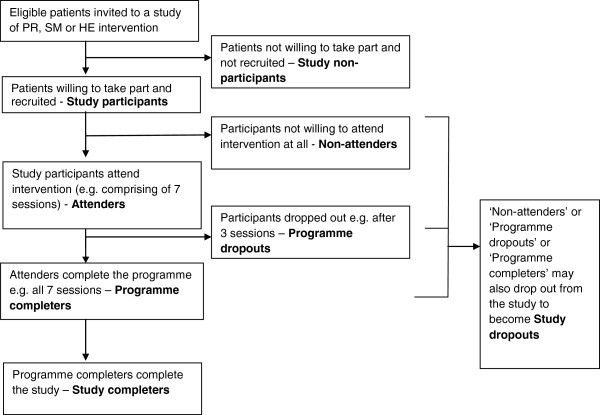
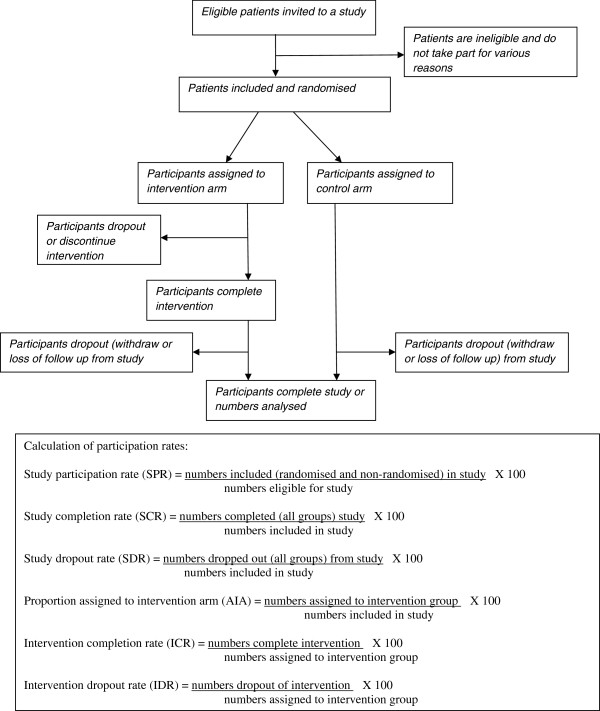
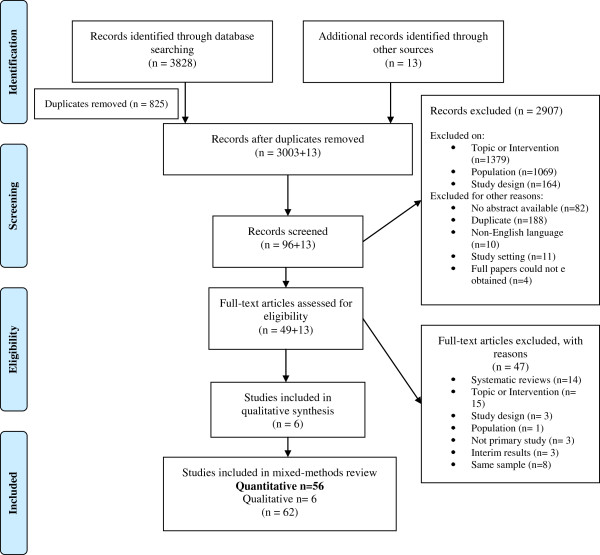
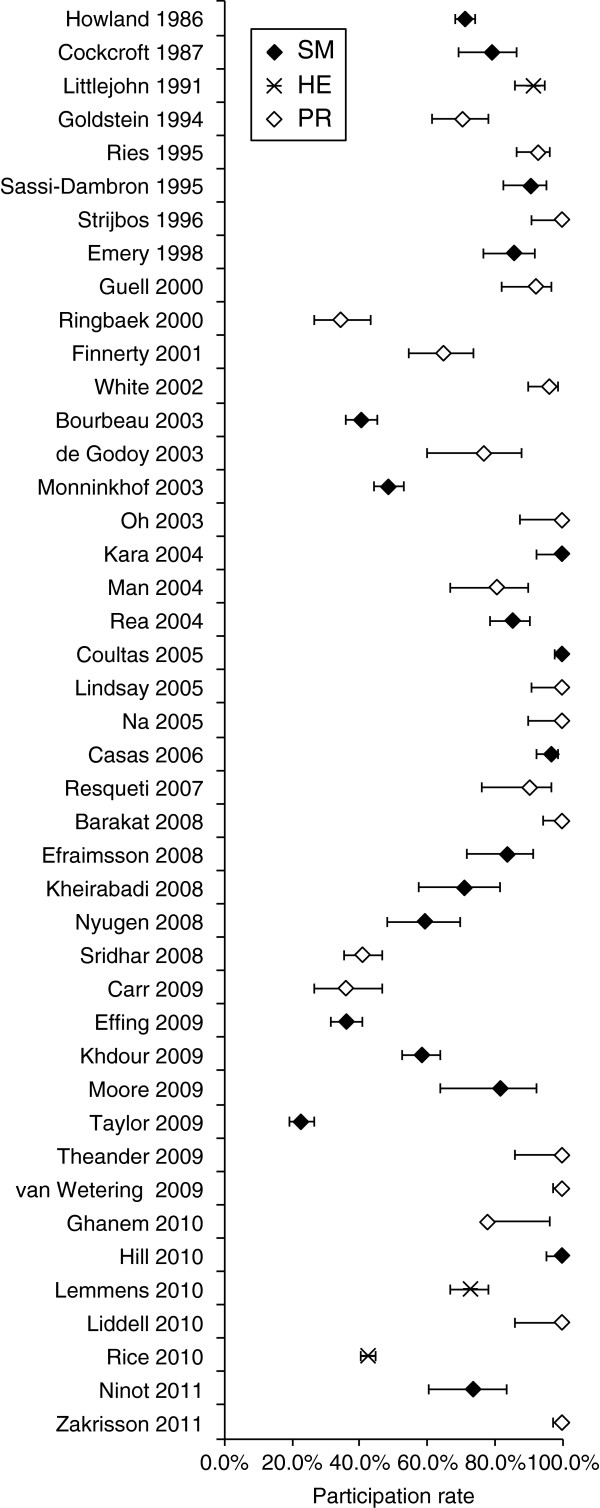
BACKGROUND: Pulmonary rehabilitation (PR) and self-management (SM) support programmes are effective in the management of patients with chronic obstructive pulmonary disease (COPD), but these interventions are not widely implemented in routine care. One reason may be poor patient participation and retention. We conducted a systematic review to determine a true estimate of participation and dropout rates in research studies of these interventions. METHODS: Studies were identified from eight electronic databases including MEDLINE, UK Clinical Trial Register, Cochrane library, and reference lists of identified studies. Controlled clinical trial studies of structured SM, PR and health education (HE) programmes for COPD were included. Data extraction included 'participant flow' data using the Consolidated Standards of Reporting Trials (CONSORT) statement and its extension to pragmatic trials. Patient 'participation rates' (study participation rate (SPR), study dropout rate (SDR) and intervention dropout rate (IDR)) were calculated using prior participation definitions consistent with CONSORT. Random effects logistic regression analysis was conducted to examine effects of four key study characteristics (group vs. individual treatment, year of publication, study quality and exercise vs. non-exercise) on participation rates. RESULTS: Fifty-six quantitative studies (51 randomised controlled trials, three quasi-experimental and two before-after studies) evaluated PR (n = 31), SM (n = 21) and HE (n = 4). Reports of participant flow were generally incomplete; 'numbers of potential participants identified' were only available for 16%, and 'numbers assessed for eligibility' for only 39% of studies. Although 'numbers eligible' were better reported (77%), we were unable to calculate SPR for 23% of studies. Overall we found 'participation rates' for studies (n = 43) were higher than previous reports; only 19% of studies had less than 50% SPR and just over one-third (34%) had a SPR of 100%; SDR and IDR were less than or equal to 30% for around 93% of studies. There was no evidence of effects of study characteristics on participation rates. CONCLUSION: Unlike previous reports, we found high participation and low dropout rates in studies of PR or SM support for COPD. Previous studies adopted different participation definitions; some reported proportions without stating definitions clearly, obscuring whether proportions referred to the study or the intervention. Clear, uniform definitions of patient participation in studies are needed to better inform the wider implementation of effective interventions.
Overview
The claims and statistics of this paper haven’t been checked yet.
Free: it reads the open-access text and checks the first 5 claims that cite a source we can check. Create a free account to check every claim.
Integrity signals
Registry
Cites
Statistics
Figures
Verification
Claims the paper makes
The claims and statistics of this paper haven’t been checked yet.
Free: it reads the open-access text and checks the first 5 claims that cite a source we can check. Create a free account to check every claim.
Claims other papers make about this one
Each is checked against this paper’s own text: does it say what the citing paper says it does?
The source backs part of the claim, not all of it — or backs it for a different population, condition or comparison.
In the citing paper
“This uptake rate is better than expected but falls within reported participation rates (range of 35-100%) for previous studies of non-pharmacologic interventions for subjects with COPD.28”
From Cognitive behavioral therapy for management of dyspnea: A pilot study (2015) · cites this paper as [28]
Experimental — accuracy not yet measured
Self-check
Percentages, sums and reported differences re-computed from the paper’s own numbers.
The self-check needs the paper’s full text.
Citations
Cites
CONSORT 2010 Statement: updated guidelines for reporting parallel group randomised trials
the CONSORT Group, Schulz, K. F., Altman, D. G., & Moher, D. (2010) · BMC Medicine · doi:10.1186/1741-7015-8-18 · Cited by 13,371
Moher, D., Hopewell, S., Schulz, K. F., Montori, V., Gotzsche, P. C., Devereaux, P. J., Elbourne, D., Egger, M., & Altman, D. G. (2010) · BMJ · doi:10.1136/bmj.c869 · Cited by 8,883 · cited 2×
“A distinction needs to be made between these two types of attrition [40] to inform on implementation of interventions.”
BackgroundDowns, S. H., & Black, N. (1998) · Journal of Epidemiology and Community Health · doi:10.1136/jech.52.6.377 · Cited by 8,252
Systematic reviews: CRD's guidance for undertaking reviews in health care
Tacconelli, E. (2010) · The Lancet Infectious Diseases · doi:10.1016/s1473-3099(10)70065-7 · Cited by 3,245
Evaluating non-randomised intervention studies
Deeks, J., Dinnes, J., D'Amico, R., Sowden, A., Sakarovitch, C., Song, F., Petticrew, M., & Altman, D. (2003) · Health Technology Assessment · doi:10.3310/hta7270 · Cited by 2,907
Self-management approaches for people with chronic conditions: a review
Barlow, J., Wright, C., Sheasby, J., Turner, A., & Hainsworth, J. (2002) · Patient Education and Counseling · doi:10.1016/s0738-3991(02)00032-0 · Cited by 2,800 · cited 1×
“Efficacious self-management encompasses ability to monitor one’s condition and to effect the cognitive, behavioural and emotional responses necessary to maintain a satisfactory quality of life’ [9].”
BackgroundPulmonary rehabilitation for chronic obstructive pulmonary disease
McCarthy, B., Casey, D., Devane, D., Murphy, K., Murphy, E., & Lacasse, Y. (2015) · Cochrane Database of Systematic Reviews · doi:10.1002/14651858.cd003793.pub3 · Cited by 2,643
CONSORT 2010 statement: updated guidelines for reporting parallel group randomised trials
Schulz, K. F., Altman, D. G., Moher, D., & for the CONSORT Group (2010) · PLoS Medicine · doi:10.1371/journal.pmed.1000251 · Cited by 2,296
Improving the reporting of pragmatic trials: An extension of the CONSORT statement
Zwarenstein, M., Treweek, S., Gagnier, J. J., Altman, D. G., Tunis, S., Haynes, B., Oxman, A. D., Moher, D., & groups, F. T. C. A. P. T. I. H. (. (2008) · BMJ · doi:10.1136/bmj.a2390 · Cited by 1,813 · cited 3×
“The patient participation data (before and after recruitment) was extracted from studies by referring to the Consolidated Standards of Reporting Trials (CONSORT) participant flow diagram [32] and the checklist suggested by extension of the CONSORT statement for reporting of pragmatic trials [33].”
BackgroundMethodInfluentialA pragmatic–explanatory continuum indicator summary (PRECIS): a tool to help trial designers
Thorpe, K. E., Zwarenstein, M., Oxman, A. D., Treweek, S., Furberg, C. D., Altman, D. G., Tunis, S., Bergel, E., Harvey, I., Magid, D. J., et al. (2009) · Journal of Clinical Epidemiology · doi:10.1016/j.jclinepi.2008.12.011 · Cited by 1,389
Research works printed but not linked: 4
- European Respiratory Society European Lung White Book 2003 Huddersfield: European Respiratory Society Journals Ltd
- Goldstein R Gort E Stubbing D Avendano M Guyatt G Randomised controlled trial of respiratory rehabilitation Lancet 1994 344 1394 1397 10.1016/S0140-6736(94)90568-1 7968075 · DOI · Paper page
- Sewell L Singh S Williams J Collier M How long should outpatient pulmonary rehabilitation be? A randomised controlled trial of 4 weeks versus 7 weeks Thorax 2006 61 767 771 10.1136/thx.2005.048173 16449270 PMC2117104 · DOI · Paper page
- Taylor SJC Sohanpal R Bremner S Devine A McDaid D Fernandez JL Griffiths CJ Self management support for moderate to severe COPD: a pilot randomised controlled trial Br J Gen Pract 2012 in press PMC3459776 23265228
Cited by
Digital interventions to improve adherence to maintenance medication in asthma
Chan, A., De Simoni, A., Wileman, V., Holliday, L., Newby, C. J., Chisari, C., Ali, S., Zhu, N., Padakanti, P., Pinprachanan, V., et al. (2022) · Cochrane Database of Systematic Reviews · doi:10.1002/14651858.cd013030.pub2 · Cited by 105
Sanduzzi, A., Balbo, P. E., Candoli, P., Catapano, G. A., Contini, P., Mattei, A., Puglisi, G., Santoiemma, L., & Stanziola, A. A. (2014) · Multidisciplinary Respiratory Medicine · doi:10.1186/2049-6958-9-60 · Cited by 108
“Poor patient participation and adherence are the lowest to referring patients with a forced expiratory volume in one second (FEV1) < 80% predicted to pulmonary rehabilitation (5%) [18].”
BackgroundHague, B., Hall, J., & Kellett, S. (2016) · Journal of Behavioral Addictions · doi:10.1556/2006.5.2016.064 · Cited by 103
Long-term exercise maintenance in COPD via telerehabilitation: a two-year pilot study
Zanaboni, P., Hoaas, H., Lien, L. A., Hjalmarsen, A., & Wootton, R. (2016) · Journal of Telemedicine and Telecare · doi:10.1177/1357633x15625545 · Cited by 95
“Completers were defined as those participants actively undertaking the study procedures until the end of the intervention, while dropouts where those who ceased participation before the end of the intervention.(21) Frequency of training sessions was calculated to measure how active patients were in maintaining exercis…”
BackgroundSohanpal, R., Steed, L., Mars, T. S., & Taylor, S. J. (2015) · npj Primary Care Respiratory Medicine · doi:10.1038/npjpcrm.2015.54 · Cited by 81
Self-citationHeras, J. C. D. L., Balbino, F., Løkke, A., Catalán-Matamoros, D., Hilberg, O., & Bendstrup, E. M. (2021) · Journal of Clinical Medicine · doi:10.3390/jcm11010011 · Cited by 68
“The patient drop-out rate in tele-rehabilitation with VAPA was lower than in the standard rehabilitation group but similar to the dropout rate that Sohanpal et al. found in their review on self-management support programs for COPD patients [3].”
ResultRecruitment rates and strategies in exercise trials in cancer survivorship: a systematic review
Reynolds, S. A., O’Connor, L., McGee, A., Kilcoyne, A. Q., Connolly, A., Mockler, D., Guinan, E. M., & O’Neill, L. M. (2023) · Journal of Cancer Survivorship · doi:10.1007/s11764-023-01363-8 · Cited by 65
“…variability in recruitment rates is observed in exercise trials in non-cancer chronic diseases, including chronic obstructive pulmonary disease [65] and cardiovascular disease [66–68], with recruitment to pulmonary and cardiac rehabilitation varying from 35 to 100% and 4 to 100%, respectively.”
BackgroundWright, D. J., Twigg, M. J., Barton, G., Thornley, T., & Kerr, C. (2014) · International Journal of Pharmacy Practice · doi:10.1111/ijpp.12165 · Cited by 51
EQUIP Emergency: Study protocol for an organizational intervention to promote equity in health care.
Varcoe, C., Bungay, V., Browne, A. J., Wilson, E., Wathen, C. N., Kolar, K., Perrin, N., Comber, S., Blanchet Garneau, A., Byres, D., et al. (2019) · BMC Health Services Research · doi:10.1186/s12913-019-4494-2 · Cited by 47
Billington, J., Coster, S., Murrells, T., & Norman, I. J. (2014) · COPD Journal of Chronic Obstructive Pulmonary Disease · doi:10.3109/15412555.2014.974735 · Cited by 51
“Uptake of programs when off ered across Europe is cited as low as 33% to 39% (11), and attrition from self-management programs for COPD are typically around 30% (12).”
BackgroundThe role of collaboration in the cognitive development of young children: a systematic review
Sills, J., Rowse, G., & Emerson, L. (2016) · Child Care Health and Development · doi:10.1111/cch.12330 · Cited by 54
“In line with previous reviews (MacLehose et al. 2000; Sohanpal et al. 2012), the checklist was modified to fit the aims of the current review.”
ResultA systematic review of the role of parents in the development of anxious cognitions in children
Emerson, L., Ogielda, C., & Rowse, G. (2018) · Journal of Anxiety Disorders · doi:10.1016/j.janxdis.2018.11.002 · Cited by 44
Neto, E. A. P., Lewthwaite, H., Boyle, T., Johnston, K., Bennett, H., & Williams, M. (2021) · PeerJ · doi:10.7717/peerj.11554 · Cited by 38
Digital interventions to improve adherence to maintenance medication in asthma
Chan, A. H. Y., Simoni, A. D., Wileman, V., Holliday, L., Chisari, C., Newby, C., Taylor, S. J., Fleming, L., Griffiths, C., & Horne, R. (2018) · Cochrane Database of Systematic Reviews · doi:10.1002/14651858.cd013030 · Cited by 30
Self-citationRusso, R., Coultas, D., Ashmore, J., Peoples, J., Sloan, J., Jackson, B. E., Uhm, M., Singh, K. P., Blair, S., & Bae, S. (2015) · Contemporary Clinical Trials · doi:10.1016/j.cct.2015.01.018 · Cited by 19
“While the study participation rate is an important component for assessment of external validity of clinical trials it is infrequently reported and there is often uncertainty about what constitutes the eligible population [23].”
BackgroundMethodXie, B., He, J., Liu, Y., Liu, T., & Liu, C. (2021) · Lipids in Health and Disease · doi:10.1186/s12944-021-01444-6 · Cited by 24
An, Q., Sandlund, M., Agnello, D. M., McCaffrey, L., CHASTIN, S. F. M., Helleday, R., & Wadell, K. (2023) · Respiratory Medicine · doi:10.1016/j.rmed.2023.107193 · Cited by 21
Armstrong, J., Paskal, K., Elliott, C. M., Wray, J. A., Davidson, E., Mizen, J., & Girdler, S. J. (2018) · Scandinavian Journal of Occupational Therapy · doi:10.1080/11038128.2018.1498919 · Cited by 19
“Scoring on the Down and Black’s measure [36] was adapted to account for lower level studies by changing the statistical power calculation question from a 1 to 5 rating to a yes/no response as was done by Sohanpal and colleagues [38].”
MethodCognitive behavioral therapy for management of dyspnea: A pilot study
Williams, M. T., Cafarella, P., Paquet, C., & Frith, P. (2015) · Respiratory Care · doi:10.4187/respcare.03764 · Cited by 15
“28 This positive responder bias may have been a result of recruitment by the comprehensive pulmonary rehabilitation program director, novelty of the intervention, or scheduling the intervention within the standard program (no additional travel or appointments were required) or due to the previous…”
Rosenbloom, B. N., Frederiksen, S. D., Wang, V., Park, C., Gordon, G., Brar, G., Rasic, N. F., Stinson, J., Birnie, K. A., & Rabbitts, J. A. (2025) · Regional Anesthesia & Pain Medicine · doi:10.1136/rapm-2024-105696 · Cited by 19
“A participation rate of less than 20% was considered low, 13 and attrition of more than 30% was considered high.”
Participation in research bronchoscopy: a literature review
Martinsen, E. M. H., Leiten, E. O., Bakke, P. S., Eagan, T., & Grønseth, R. (2016) · European Clinical Respiratory Journal · doi:10.3402/ecrj.v3.29511 · Cited by 14
“An earlier review conducted on participation in COPD studies without an invasive procedure also examined response rates (18).”
BackgroundStanić, J., Barth, J., Danon‐Hersch, N., Bondolfi, G., Jermann, F., & Eicher, M. (2021) · Journal of Psychosocial Oncology Research and Practice · doi:10.1097/or9.0000000000000048 · Cited by 15
“Where possible we calculated the ICR (as the proportion of women who completed all classes)([17]) applying the following formula (higher rates indicate a higher proportion of participants who completed all the 8 classes):”
MethodA Pilot Randomized Controlled Trial of Smoking Cessation in an Outpatient Respirology Clinic
Pakhale, S. S., Baron, J., Armstrong, M. A., Garde, A., Reid, R. D., Alvarez, G. G., Aitken, D., Mullen, K., Wells, G., & Pipe, A. (2015) · Canadian Respiratory Journal · doi:10.1155/2015/871204 · Cited by 10
Condon, C., Moloney, E. D., Lane, S. J., & Stokes, E. (2015) · Physiotherapy Practice and Research · doi:10.3233/ppr-150058 · Cited by 9
“This proportion was calculated using data from Sohanpal and others [13–16].”
Chan, S. C., Sekhon, J. K., Engkasan, J. P., Nathan, J. J., Mirza, F. T., Liew, S. M., Hussein, N. B., Suhaimi, A., Hanafi, N. S., Pang, Y. K., et al. (2021) · Journal of Global Health · doi:10.7189/jogh.11.02003 · Cited by 10
Programas educativos en pacientes con Enfermedad Pulmonar Obstructiva Crónica. Revisión integradora
Ayora, A. F., Orts‐Cortés, M. I., Carcereny, C. H., Seijas, N., & Maciá-Soler, M. L. (2016) · Enfermería Global · doi:10.6018/eglobal.16.1.249621 · Cited by 9
“Another review prepared in 2012 in the UK (88) coincides with our research in the sense that the methodological quality of the studies is changing and that the best results are found in the concealment technique.”
BackgroundBarbosa, M., de Melo, C. A., & Torres, R. (2024) · Canadian Journal of Respiratory Therapy · doi:10.29390/001c.117966 · Cited by 4
Home-based ‘No Cost’ Pulmonary Rehabilitation in Chronic Obstructive Pulmonary Disease
Gothi, D., Saxena, M., Kumar, N., Sood, K., & BabuSah, R. (2022) · The Indian Journal of Chest Diseases and Allied Sciences · doi:10.5005/ijcdas-60-1-19 · Cited by 1
Li, Z., Liu, X., Cheng, J., Yuan, Y., & Yue, M. (2023) · Advances in Computer and Engineering Technology Research · doi:10.61935/acetr.1.1.2023.p174
Xie, B., He, J., Liu, Y., Liu, T., & Liu, C. (2020) · Research Square · doi:10.21203/rs.3.rs-61508/v1 · Cited by 1
van der Wulp, N. Y. (2016) · Research Publications (Maastricht University) · doi:10.26481/dis.20160303nw
La educación terapéutica en los pacientes con EPOC
Ayora, A. F. (2016) · Tesis Doctorals en Xarxa (Consorci de Serveis Universitaris de Catalunya) · doi:10.6035/14103.2016.442846
Investigating the cost implications of including all respiratory medicines in PCRS schemes
O’Dwyer, J., & Murphy, A. (2018) · Irish Journal of Medical Science (1971 -) · doi:10.1007/s11845-017-1734-5
Xie, B., He, J., Liu, Y., Liu, T., & Liu, C. (2020) · Research Square · doi:10.21203/rs.3.rs-61508/v2
Lameris, M., & Atkins, C. (2014) · InnovAiT Education and inspiration for general practice · doi:10.1177/1755738013519784 · Cited by 2
Santos, A. M. N. N. D., & Rosa, S. D. A. (2025) · Revista Multidisciplinar do Nordeste Mineiro · doi:10.61164/6z6gs146
Xie, B., He, J., Liu, Y., Liu, T., & Liu, C. (2021) · Figshare · doi:10.6084/m9.figshare.14072308
Xie, B., He, J., Liu, Y., Liu, T., & Liu, C. (2021) · Figshare · doi:10.6084/m9.figshare.14072302
Xie, B., He, J., Liu, Y., Liu, T., & Liu, C. (2021) · Figshare · doi:10.6084/m9.figshare.14072317
Xie, B., He, J., Liu, Y., Liu, T., & Liu, C. (2021) · Figshare · doi:10.6084/m9.figshare.14072290
Xie, B., He, J., Liu, Y., Liu, T., & Liu, C. (2021) · Figshare · doi:10.6084/m9.figshare.14072305
Xie, B., He, J., Liu, Y., Liu, T., & Liu, C. (2021) · Figshare · doi:10.6084/m9.figshare.14072296
Xie, B., He, J., Liu, Y., Liu, T., & Liu, C. (2021) · Figshare · doi:10.6084/m9.figshare.14072311
Xie, B., He, J., Liu, Y., Liu, T., & Liu, C. (2021) · Figshare · doi:10.6084/m9.figshare.14072293
Xie, B., He, J., Liu, Y., Liu, T., & Liu, C. (2021) · Figshare · doi:10.6084/m9.figshare.14072299
Xie, B., He, J., Liu, Y., Liu, T., & Liu, C. (2021) · Figshare · doi:10.6084/m9.figshare.14072314
Walsh, J. A., Dale, M., McKeough, Z. J., Alison, J. A., & Dennis, S. M. (2026) · BMC Family Practice · doi:10.1186/s12875-026-03237-1
“Most of the measurement of participation or engagement in PR focuses on attendance and participation in exercise [40], aligning with the biomedical approach to exercise therapy.”
Metadata
- Authors
- Sohanpal, R., Hooper, R., Hames, R., Priebe, S., & Taylor, S.
- Affiliations
- Queen Mary University of London (GB)
- Corresponding author
- Sohanpal, Ratna
- Venue
- Systematic Reviews
- Published
- 2012-12
- Volume
- 1
- Issue
- 1
- Pages
- 66-66
- ISSN
- 2046-4053 (ISSN-L)
- PMC
- PMC3563605
- OpenAlex
- W2145059722
- Cited by
- 51
- References
- 104
- Citations by year
- 2026: 1 · 2025: 2 · 2024: 1 · 2023: 3 · 2022: 2 · 2021: 18 · 2020: 2 · 2019: 1 · 2018: 4 · 2016: 7 · 2015: 5 · 2014: 5
- FWCI
- 0.54
- Type
- journal article
- Language
- en
- Open access
- gold
- doi.org
- Licence
- cc-by
- creativecommons.org/licenses/by/2.0 (tdm)
- Locations
- Systematic Reviews (publishedVersion, cc-by)
- Europe PMC (PubMed Central) (publishedVersion, cc-by)
- PubMed Central (publishedVersion, cc-by)
- PubMed (publishedVersion)
- DOAJ (DOAJ: Directory of Open Access Journals) (submittedVersion)
- Queen Mary Research Online (Queen Mary University of London) (submittedVersion, cc-by)
- Funders
- National Institute for Health and Care Research (DRF-2010-03-130)
- Barts and The London School of Medicine and Dentistry
- Topics
- Health Sciences › Medicine › Pulmonary and Respiratory Medicine › Chronic Obstructive Pulmonary Disease (COPD) Research
- Social Sciences › Decision Sciences › Statistics, Probability and Uncertainty › Meta-analysis and systematic reviews
- Physical Sciences › Mathematics › Statistics and Probability › Statistical Methods in Epidemiology
- Keywords
- chronic obstructive pulmonary disease, pulmonary rehabilitation, self-management support, health education intervention, participant retention, dropout rates, study participation rates, CONSORT, reporting quality
- MeSH terms
- Exercise Therapy, Humans, Patient Dropouts, Patient Participation, Self Care, Logistic Models, Pulmonary Disease, Chronic Obstructive
About these checks
Registry, retraction, Cites and statistics results are computed, not judged, with one exception: a printed reference that no index lists is read once by a model before it counts as a citation error. Claims are extracted by a model and kept only when their quote appears verbatim in the text; each cited source is then checked, with a model’s help, for whether it says what the claim relies on. Those verdicts can be wrong — read the claim’s quote and the cited source before relying on one.
Statistics and arithmetic are recomputed, not judged.
Confidence bands are shown only for fields calibrated on our annotated test set. None is calibrated yet, so no band is shown.
What counts as a claim ›How we measure confidence ›How we check this ›
Are you an author, or do you see a problem with this page? Request a review
Data sources
Bibliographic data: Semantic Scholar, OpenAlex, Crossref.
Contains information from the Semantic Scholar Academic Graph Datasets, made available under the ODC Attribution License (ODC-BY 1.0).
Semantic Scholar’s data is described in: Kinney, R., et al. (2023). The Semantic Scholar Open Data Platform. arXiv:2301.10140.
