

Risk of bias: a simulation study of power to detect study-level moderator effects in meta-analysis
Open accessThe DOI matches its Crossref record; 32 of the 34 references it cites were found in a registry or an index.
Abstract
BACKGROUND: There are both theoretical and empirical reasons to believe that design and execution factors are associated with bias in controlled trials. Statistically significant moderator effects, such as the effect of trial quality on treatment effect sizes, are rarely detected in individual meta-analyses, and evidence from meta-epidemiological datasets is inconsistent. The reasons for the disconnect between theory and empirical observation are unclear. The study objective was to explore the power to detect study level moderator effects in meta-analyses. METHODS: We generated meta-analyses using Monte-Carlo simulations and investigated the effect of number of trials, trial sample size, moderator effect size, heterogeneity, and moderator distribution on power to detect moderator effects. The simulations provide a reference guide for investigators to estimate power when planning meta-regressions. RESULTS: The power to detect moderator effects in meta-analyses, for example, effects of study quality on effect sizes, is largely determined by the degree of residual heterogeneity present in the dataset (noise not explained by the moderator). Larger trial sample sizes increase power only when residual heterogeneity is low. A large number of trials or low residual heterogeneity are necessary to detect effects. When the proportion of the moderator is not equal (for example, 25% 'high quality', 75% 'low quality' trials), power of 80% was rarely achieved in investigated scenarios. Application to an empirical meta-epidemiological dataset with substantial heterogeneity (I(2) = 92%, τ(2) = 0.285) estimated >200 trials are needed for a power of 80% to show a statistically significant result, even for a substantial moderator effect (0.2), and the number of trials with the less common feature (for example, few 'high quality' studies) affects power extensively. CONCLUSIONS: Although study characteristics, such as trial quality, may explain some proportion of heterogeneity across study results in meta-analyses, residual heterogeneity is a crucial factor in determining when associations between moderator variables and effect sizes can be statistically detected. Detecting moderator effects requires more powerful analyses than are employed in most published investigations; hence negative findings should not be considered evidence of a lack of effect, and investigations are not hypothesis-proving unless power calculations show sufficient ability to detect effects.
Overview
The claims and statistics of this paper haven’t been checked yet.
Free: it reads the open-access text and checks the first 5 claims that cite a source we can check. Create a free account to check every claim.
Integrity signals
Registry
Cites
Statistics
Figures
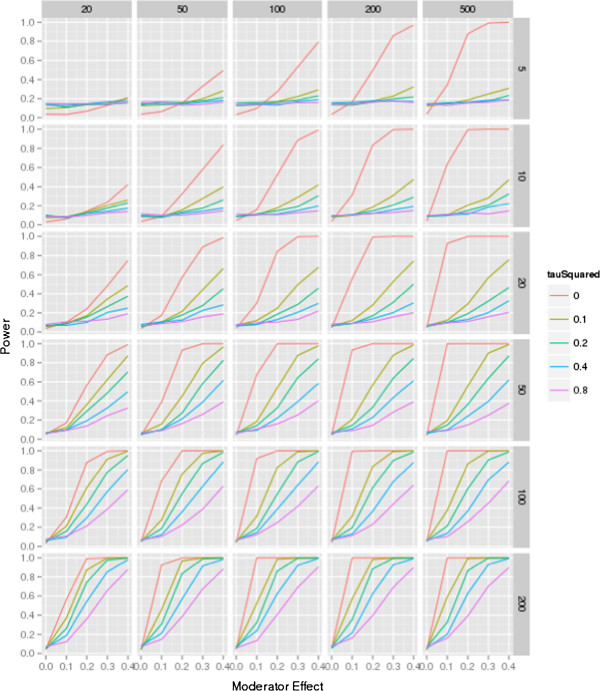
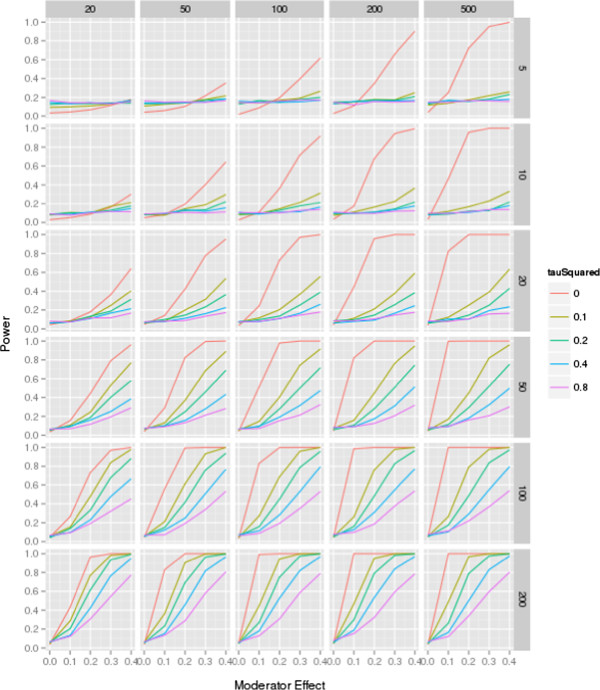
Verification
Claims the paper makes
The claims and statistics of this paper haven’t been checked yet.
Free: it reads the open-access text and checks the first 5 claims that cite a source we can check. Create a free account to check every claim.
Claims other papers make about this one
Each is checked against this paper’s own text: does it say what the citing paper says it does?
The cited source says what the claim attributes to it.
In the citing paper
“However, subgroup and moderator analyses usually lack power (54).”
From Efficacy of mindfulness- and acceptance-based cognitive-behavioral therapies for bodily distress in adults: a meta-analysis (2023) · cites this paper as [54]
In the citing paper
“It could therefore be that this moderator analysis was rendered insensitive due to the imbalance in number of effect sizes between condition being compared”
From A systematic and meta-analytic review of the impact of sleep restriction on memory formation. (2024) · cites this paper as Hempel et al., 2013
In the citing paper
“moderator analyses are highly sensitive to statistical power because they depend on smaller subsets of data and are impacted by number of effect sizes, number of participants per effect size, residual heterogeneity, and imbalance in the number of effect sizes between moderator levels (Hempel et al., 2013).”
From A systematic and meta-analytic review of the impact of sleep restriction on memory formation. (2024) · cites this paper as Hempel et al., 2013
In the citing paper
“the current sleep restriction meta-analysis and the total sleep deprivation after encoding meta-analysis in Newbury et al. (2021) are comparable across a number of factors known to affect statistical power of moderating effects including number of effect sizes and balance in the number of effect sizes between moderator levels”
From A systematic and meta-analytic review of the impact of sleep restriction on memory formation. (2024) · cites this paper as Hempel et al., 2013
In the citing paper
“It is possible that this moderating effect could change with a more balanced set of studies”
From A systematic and meta-analytic review of the impact of sleep restriction on memory formation. (2024) · cites this paper as Hempel et al., 2013
1 more claim about this paper
Create a free account to see every claim other papers make about this one.
Self-check
Percentages, sums and reported differences re-computed from the paper’s own numbers.
The self-check needs the paper’s full text.
Citations
Cites
Statistical Power Analysis for the Behavioral Sciences
Muller, K. (1989) · Technometrics · doi:10.1080/00401706.1989.10488618 · Cited by 99,167
Statistical power analysis for the behavioral sciences
(1990) · Computers, Environment and Urban Systems · doi:10.1016/0198-9715(90)90050-4 · Cited by 65,269
Measuring inconsistency in meta-analyses
Higgins, J. P. T., Thompson, S. G., Deeks, J. J., & Altman, D. G. (2003) · BMJ · doi:10.1136/bmj.327.7414.557 · Cited by 63,139 · cited 1×
“Of note, the heterogeneity measure I(2), represents 1 minus the proportion of the total variation that is due to chance, thus equal amounts of heterogeneity (τ(2)) give rise to different proportions of variation that is not due to chance (I(2)) [28].”
BackgroundConducting Meta-Analyses in R with the metafor Package
Viechtbauer, W. (2010) · Journal of Statistical Software · doi:10.18637/jss.v036.i03 · Cited by 20,464 · cited 1×
“Data analysis was carried out using the Metafor package [30].”
MethodSchulz (1995) · doi:10.1001/jama.1995.03520290060030 · Cited by 5,634 · cited 3×
“Some analyses have demonstrated that low quality trials exaggerate treatment effects [9,10]; for example, low quality trials and those with inadequate treatment allocation concealment showed an increased effect size in a large dataset reported by Moher et al.”
BackgroundMethodRequired sample size to detect the mediated effect
Fritz, M. S., & MacKinnon, D. P. (2007) · Psychological Science · doi:10.1111/j.1467-9280.2007.01882.x · Cited by 4,810
Moher, D., Pham, B., Jones, A., Cook, D. J., Jadad, A. R., Moher, M., Tugwell, P., & Klassen, T. P. (1998) · The Lancet · doi:10.1016/s0140-6736(98)01085-x · Cited by 3,560
Assessing the quality of controlled clinical trials
Jüni, P., Altman, D. G., & Egger, M. (2001) · BMJ · doi:10.1136/bmj.323.7303.42 · Cited by 3,309 · cited 1×
“[17] reported associations of effect sizes with allocation concealment and double blinding, whereas the generation of treatment allocation did not show a statistically significant effect across datasets.”
BackgroundWood, L., Egger, M., Gluud, L. L., Schulz, K. F., Jüni, P., Altman, D. G., Gluud, C., Martin, R. M., Wood, A. J. G., & Sterne, J. A. C. (2008) · BMJ · doi:10.1136/bmj.39465.451748.ad · Cited by 2,538 · cited 2×
“Only a few characteristics, such as the type of outcome measure, seem to be reliably related to the detection of quality effects [19].”
BackgroundMethodEgger, M., Jüni, P., Bartlett, C., Holenstein, F., & Sterne, J. (2003) · Health Technology Assessment · doi:10.3310/hta7010 · Cited by 1,181 · cited 1×
“[19] used three meta-epidemiological datasets to explore the associations of quality features and effect sizes [10,15,20] and investigated whether the nature of the intervention and the type of outcome measure influence the effect of allocation concealment and blinding.”
MethodSystems to rate the strength of scientific evidence.
West, S. L., King, V., Carey, T. S., Lohr, K. N., Mckoy, N. A., Sutton, S. F., & Lux, L. J. (2002) · PubMed Central · Cited by 929
Field, A. P. (2001) · Psychological Methods · doi:10.1037/1082-989x.6.2.161 · Cited by 725 · cited 1×
“Furthermore, simulation has rarely been applied to meta-analytic questions (meta-analyses and meta-regressions pose a complex model with withintrial as well as across-trial variables to consider) but it can be a powerful tool in systematically assessing the effects of hypothesized factors [24-26].”
MethodHow study design affects outcomes in comparisons of therapy. I: Medical
Colditz, G. A., Miller, J. N., & Mosteller, F. (1989) · Statistics in Medicine · doi:10.1002/sim.4780080408 · Cited by 520 · cited 1×
“Some analyses have demonstrated that low quality trials exaggerate treatment effects [9,10]; for example, low quality trials and those with inadequate treatment allocation concealment showed an increased effect size in a large dataset reported by Moher et al.”
BackgroundHopewell, S., Dutton, S., Yu, L.-M., Chan, A.-W., & Altman, D. G. (2010) · BMJ · doi:10.1136/bmj.c723 · Cited by 504 · cited 2×
“We sampled the described RCT collection [31] to demonstrate the application of the power considerations in an empirical meta-analysis with large heterogeneity (I(2) = 92%, τ(2) = 0.”
MethodStandard Errors and Sample Sizes for Two-Level Research
Snijders, T. A. B., & Bosker, R. J. (1993) · Journal of Educational Statistics · doi:10.3102/10769986018003237 · Cited by 487 · cited 1×
“This finding is equivalent to the result found in cluster randomized studies, where the number of individuals is less important than the number of clusters [32,33].”
ResultBalk, E. M. (2002) · JAMA · doi:10.1001/jama.287.22.2973 · Cited by 478 · cited 2×
“Dataset 4 is a replication of parts of another published meta-epidemiological dataset [14] using trials from eight cardiovascular disease and five pediatric treatment metaanalyses; this dataset includes 149 trials.”
BackgroundMethodBerlin, J. A., Santanna, J., Schmid, C. H., Szczech, L. A., & Feldman, H. I. (2002) · Statistics in Medicine · doi:10.1002/sim.1023 · Cited by 468
Sterne, J. A. C., Jüni, P., Schulz, K. F., Altman, D. G., Bartlett, C., & Egger, M. (2002) · Statistics in Medicine · doi:10.1002/sim.1184 · Cited by 382 · cited 1×
“[6,7] outline the methodology further, and also apply a similar approach for dichotomous outcomes.”
MethodDesigning Randomised Trials in Health, Education and the Social Sciences
Torgerson, D. J., & Torgerson, C. J. (2008) · doi:10.1057/9780230583993 · Cited by 366
Is the Meta-Analysis of Correlation Coefficients Accurate When Population Correlations Vary?
Field, A. P. (2005) · Psychological Methods · doi:10.1037/1082-989x.10.4.444 · Cited by 328 · cited 1×
“Furthermore, simulation has rarely been applied to meta-analytic questions (meta-analyses and meta-regressions pose a complex model with withintrial as well as across-trial variables to consider) but it can be a powerful tool in systematically assessing the effects of hypothesized factors [24-26].”
MethodMeta‐analysis of continuous outcome data from individual patients
Higgins, J. P. T., Whitehead, A., Turner, R. M., Omar, R. Z., & Thompson, S. G. (2001) · Statistics in Medicine · doi:10.1002/sim.918 · Cited by 265 · cited 1×
“Specifically, these papers focus on the decision regarding the appropriateness of metaregression or individual patient data [21-23].”
BackgroundThe art of quality assessment of RCTs included in systematic reviews
Verhagen, A. P., de Vet, H. C. W., de Bie, R. A., Boers, M., & A van den Brandt, P. (2001) · Journal of Clinical Epidemiology · doi:10.1016/s0895-4356(00)00360-7 · Cited by 245 · cited 1×
“Methodological characteristics of studies included in a systematic review can have a substantial impact on treatment effect estimates [3].”
BackgroundEmerson, J. D., Burdick, E., Hoaglin, D. C., Mosteller, F., & Chalmers, T. C. (1990) · Controlled Clinical Trials · doi:10.1016/0197-2456(90)90175-2 · Cited by 241 · cited 1×
“Other researchers [13,14] applying quality measures to a number of meta-analyses concluded that individual quality measures were not reliably associated with the strength of treatment effect across studies and clinical areas.”
BackgroundMoja, L. P., Telaro, E., D'Amico, R., Moschetti, I., Coe, L., & Liberati, A. (2005) · BMJ · doi:10.1136/bmj.38414.515938.8f · Cited by 239 · cited 1×
“We routinely assess the quality of studies we include in meta-analyses as a potential source of heterogeneity, and a large number of individual quality criteria and quality checklists or scales are available for this purpose [4,5].”
BackgroundSimmonds, M. C., & Higgins, J. P. T. (2007) · Statistics in Medicine · doi:10.1002/sim.2768 · Cited by 194 · cited 1×
“Specifically, these papers focus on the decision regarding the appropriateness of metaregression or individual patient data [21-23].”
BackgroundHartling, L., Hamm, M. P., Milne, A., Vandermeer, B., Santaguida, P. L., Ansari, M., Tsertsvadze, A., Hempel, S., Shekelle, P., & Dryden, D. M. (2013) · Journal of Clinical Epidemiology · doi:10.1016/j.jclinepi.2012.07.005 · Cited by 173 · cited 1×
“Where possible, criteria should be selected accordingly, particularly for critical appraisal instruments with very strict criteria, such as the Cochrane Risk of Bias tool [34,35], that routinely result in very imbalanced distributions - given that the number of studies with the rare expression of the moderator has pro…”
BackgroundSelf-citationDesigning Randomised Trials in Health, Education and the Social Sciences: An Introduction
Torgerson, D. J., & Torgerson, C. J. (2008) · Cited by 134
van Tulder, M. W., Suttorp, M., Morton, S., Bouter, L. M., & Shekelle, P. (2009) · Spine · doi:10.1097/brs.0b013e3181ab6a78 · Cited by 132
Meta-regression Approaches: What, Why, When, and How?
Morton, S. C., Jl, A., Suttorp, M.-J., & Shekelle, P. (2004) · Cited by 59
Empirical Evidence of Associations Between Trial Quality and Effect Size
Hempel, S., Suttorp, M. J., Miles, J. N. V., Wang, Z., Maglione, M., Morton, S. C., Johnsen, B., Valentine, D., & Shekelle, P. (2011) · Europe PMC (PubMed Central) · Cited by 51
Sample size in guideline trials
Bland, J. M. (2000) · Family Practice · doi:10.1093/fampra/17.suppl_1.s17 · Cited by 41
Detection of Associations Between Trial Quality and Effect Sizes
Hempel, S., Miles, J. N. V., Suttorp, M. J., Wang, Z., Johnsen, B., Morton, S. C., Perry, T., Valentine, D., & Shekelle, P. (2012) · Cited by 17
Research works printed but not linked: 5
- Holmes R The Age of Wonder: The Romantic Generation and the Discovery of the Beauty and Terror of Science 2009 London: Random House Digital, Inc
- Kjaergard LL Villumsen J Gluud C Quality of randomised clinical trials affects estimates of intervention efficacy Proceedings of the 7th Cochrane colloquium Universita STommaso D’Aquino 1999 Rome: Centro Cochrane Italiano 57 poster B10
- Juni P Tallon D Egger M Garbage in - garbage out? Assessment of the quality of controlled trials in meta-analyses published in leading journals Proceedings of the 3rd symposium on systematic reviews: beyond the basics. St Catherine’s College 2000 Oxford: Centre for Statistics in Medicine
- Development Core Team Manual R: A Language and Environment for Statistical Computing 2011 Vienna: R Foundation for Statistical Computing
- Higgins J Green S Cochrane handbook for systematic reviews of interventions version 5.1.0. [updated March 2011] 2011 Oxford: The Cochrane Collaboration
Cited by
Effects of flipping the classroom on learning outcomes and satisfaction: A meta-analysis
van Alten, D. C. D., Phielix, C., Janssen, J., & Kester, L. (2019) · Educational Research Review · doi:10.1016/j.edurev.2019.05.003 · Cited by 546
“Moderator analyses in a meta-analysis have certain statistical limitations (Hempel et al., 2013).”
BackgroundMethodInfluentialEmotion regulation and posttraumatic stress symptoms: a meta-analysis
Seligowski, A. V., Lee, D. J., Bardeen, J. R., & Orcutt, H. K. (2015) · Cognitive Behaviour Therapy · doi:10.1080/16506073.2014.980753 · Cited by 408
Kaner, E. F., Beyer, F. R., Garnett, C., Crane, D., Brown, J., Muirhead, C., Redmore, J., O'Donnell, A., Newham, J. J., de Vocht, F., et al. (2017) · Cochrane Database of Systematic Reviews · doi:10.1002/14651858.cd011479.pub2 · Cited by 308
Wittgens, C., Fischer, M. M., Buspavanich, P., Theobald, S., Schweizer, K., & Trautmann, S. (2022) · Acta Psychiatrica Scandinavica · doi:10.1111/acps.13405 · Cited by 284
Virtual reality exposure therapy for posttraumatic stress disorder (PTSD): a meta-analysis
Kothgassner, O. D., Goreis, A., Kafka, J. X., Van Eickels, R. L., Plener, P. L., & Felnhofer, A. (2019) · European Journal of Psychotraumatology · doi:10.1080/20008198.2019.1654782 · Cited by 246
“We were unable to analyse potential confounders (e.g. via meta-regression) due to the small sample of eligible studies and the resulting low power (Hempel et al., 2013).”
Background
Metadata
- Authors
- Hempel, S., Miles, J. N., Booth, M. J., Wang, Z., Morton, S. C., & Shekelle, P. G.
- Affiliations
- RAND Corporation (US)
- Mayo Clinic (US)
- University of Pittsburgh (US)
- Corresponding author
- Hempel, Susanne
- Venue
- Systematic Reviews
- Published
- 2013-11-28
- Volume
- 2
- Issue
- 1
- Pages
- 107-107
- ISSN
- 2046-4053 (ISSN-L)
- PMC
- PMC4219184
- OpenAlex
- W2152530611
- Cited by
- 137
- References
- 34
- Citations by year
- 2026: 9 · 2025: 7 · 2024: 7 · 2023: 14 · 2022: 14 · 2021: 19 · 2020: 16 · 2019: 20 · 2018: 13 · 2017: 2 · 2016: 5 · 2015: 5 · 2014: 6
- FWCI
- 5.81
- Type
- journal article
- Language
- en
- Open access
- gold
- doi.org
- Licence
- cc-by
- creativecommons.org/licenses/by/2.0 (tdm)
- Locations
- Systematic Reviews (publishedVersion, cc-by)
- PubMed Central (publishedVersion, cc-by)
- PubMed (publishedVersion)
- D-Scholarship@Pitt (University of Pittsburgh) (acceptedVersion)
- eScholarship (California Digital Library) (submittedVersion)
- eScholarship (California Digital Library) (submittedVersion, cc-by)
- Funders
- U.S. Department of Veterans Affairs
- RAND Corporation
- Agency for Healthcare Research and Quality
- U.S. Public Health Service (290-2007-10062-I)
- Topics
- Social Sciences › Decision Sciences › Statistics, Probability and Uncertainty › Meta-analysis and systematic reviews
- Physical Sciences › Mathematics › Statistics and Probability › Statistical Methods in Clinical Trials
- Physical Sciences › Mathematics › Statistics and Probability › Statistical Methods in Epidemiology
- Keywords
- statistical power, meta-regression, residual heterogeneity, trial quality, meta-epidemiology, sample size determination, number of trials, trial size, negative results, risk of bias
- MeSH terms
- Computer Simulation, Humans, Monte Carlo Method, Research Design, Risk Factors, Meta-Analysis as Topic, Bias, Effect Modifier, Epidemiologic, Randomized Controlled Trials as Topic
About these checks
Registry, retraction, Cites and statistics results are computed, not judged, with one exception: a printed reference that no index lists is read once by a model before it counts as a citation error. Claims are extracted by a model and kept only when their quote appears verbatim in the text; each cited source is then checked, with a model’s help, for whether it says what the claim relies on. Those verdicts can be wrong — read the claim’s quote and the cited source before relying on one.
Statistics and arithmetic are recomputed, not judged.
Confidence bands are shown only for fields calibrated on our annotated test set. None is calibrated yet, so no band is shown.
What counts as a claim ›How we measure confidence ›How we check this ›
Are you an author, or do you see a problem with this page? Request a review
Data sources
Bibliographic data: Semantic Scholar, OpenAlex, Crossref.
Contains information from the Semantic Scholar Academic Graph Datasets, made available under the ODC Attribution License (ODC-BY 1.0).
Semantic Scholar’s data is described in: Kinney, R., et al. (2023). The Semantic Scholar Open Data Platform. arXiv:2301.10140.
