

Using text mining for study identification in systematic reviews: a systematic review of current approaches
Open accessThe DOI matches its Crossref record; 85 of the 85 references it cites were found in a registry or an index.
Abstract
BACKGROUND: The large and growing number of published studies, and their increasing rate of publication, makes the task of identifying relevant studies in an unbiased way for inclusion in systematic reviews both complex and time consuming. Text mining has been offered as a potential solution: through automating some of the screening process, reviewer time can be saved. The evidence base around the use of text mining for screening has not yet been pulled together systematically; this systematic review fills that research gap. Focusing mainly on non-technical issues, the review aims to increase awareness of the potential of these technologies and promote further collaborative research between the computer science and systematic review communities. METHODS: Five research questions led our review: what is the state of the evidence base; how has workload reduction been evaluated; what are the purposes of semi-automation and how effective are they; how have key contextual problems of applying text mining to the systematic review field been addressed; and what challenges to implementation have emerged? We answered these questions using standard systematic review methods: systematic and exhaustive searching, quality-assured data extraction and a narrative synthesis to synthesise findings. RESULTS: The evidence base is active and diverse; there is almost no replication between studies or collaboration between research teams and, whilst it is difficult to establish any overall conclusions about best approaches, it is clear that efficiencies and reductions in workload are potentially achievable. On the whole, most suggested that a saving in workload of between 30% and 70% might be possible, though sometimes the saving in workload is accompanied by the loss of 5% of relevant studies (i.e. a 95% recall). CONCLUSIONS: Using text mining to prioritise the order in which items are screened should be considered safe and ready for use in 'live' reviews. The use of text mining as a 'second screener' may also be used cautiously. The use of text mining to eliminate studies automatically should be considered promising, but not yet fully proven. In highly technical/clinical areas, it may be used with a high degree of confidence; but more developmental and evaluative work is needed in other disciplines.
Overview
The claims and statistics of this paper haven’t been checked yet.
Free: it reads the open-access text and checks the first 5 claims that cite a source we can check. Create a free account to check every claim.
Integrity signals
Registry
Cites
Statistics
Figures
Verification
Claims the paper makes
The claims and statistics of this paper haven’t been checked yet.
Free: it reads the open-access text and checks the first 5 claims that cite a source we can check. Create a free account to check every claim.
Claims other papers make about this one
Each is checked against this paper’s own text: does it say what the citing paper says it does?
The source backs part of the claim, not all of it — or backs it for a different population, condition or comparison.
In the citing paper
“They can be calibrated to achieve a given level of recall, thus enabling reviewers to implement screening rules, such as eliminating records or replacing double with single screening.”
From PRISMA 2020 explanation and elaboration: updated guidance and exemplars for reporting systematic reviews (2021) · cites this paper as [53]
Experimental — accuracy not yet measuredThe source backs part of the claim, not all of it — or backs it for a different population, condition or comparison.
In the citing paper
“However, there is a risk of erroneously excluding relevant studies because of uncertainty about when it is safe to stop screening; the balance between efficiency gains and risk tolerance will be review-specific52 53”
From PRISMA 2020 explanation and elaboration: updated guidance and exemplars for reporting systematic reviews (2021) · cites this paper as [53]
Experimental — accuracy not yet measuredThe source backs part of the claim, not all of it — or backs it for a different population, condition or comparison.
In the citing paper
“Because there are fewer examples of relevant than irrelevant publications to train on, the class imbalance causes the classifier to miss relevant publications [32].”
From Performance of active learning models for screening prioritization in systematic reviews: a simulation study into the Average Time to Discover relevant records (2023) · cites this paper as [32]
Experimental — accuracy not yet measuredThe source backs part of the claim, not all of it — or backs it for a different population, condition or comparison.
In the citing paper
“As mentioned above, these algorithms/software are more and more used for article screening in systematic reviews [53, 55, 56]”
From Machine learning computational tools to assist the performance of systematic reviews: A mapping review. (2022) · cites this paper as [53]
Experimental — accuracy not yet measuredThe source backs part of the claim, not all of it — or backs it for a different population, condition or comparison.
In the citing paper
“Recent advances in natural language processing, text mining and machine learning have produced new algorithms that can accurately mimic human endeavour in systematic review activity, faster and more cheaply [5–8].”
From Making progress with the automation of systematic reviews: principles of the International Collaboration for the Automation of Systematic Reviews (ICASR) (2018) · cites this paper as [6]
Experimental — accuracy not yet measured
34 more claims about this paper
Create a free account to see every claim other papers make about this one.
Self-check
Percentages, sums and reported differences re-computed from the paper’s own numbers.
The self-check needs the paper’s full text.
Citations
Cites
Proceedings of the 24th international conference on Machine learning
(2007) · doi:10.1145/1273496 · Cited by 11,630
The relationship between Precision-Recall and ROC curves
Davis, J., & Goadrich, M. (2006) · Proceedings of the 23rd international conference on Machine learning - ICML '06 · doi:10.1145/1143844.1143874 · Cited by 6,559 · cited 1×
“For example, if you care about both the TPs and the TNs, you’d use ROC-AUC, but if you only care about the TPs, you might prefer PR_AUC [78].”
BackgroundProceedings of the 19th International Joint Conference on Artificial Intelligence
Pujol, J. M., Delgado, J., Ramon Sangüesa, A., & Flache, A. (2005) · International Joint Conference on Artificial Intelligence · Cited by 5,771
A survey on concept drift adaptation
Gama, J., Žliobaitė, I., Bifet, A., Pechenizkiy, M., & Bouchachia, A. (2014) · ACM Computing Surveys · doi:10.1145/2523813 · Cited by 3,735 · cited 1×
“Some online learning algorithms adapt their models quickly to new coming data and can be adapted to deal with slight concept drift [76].”
Background2009 International Joint Conference on Artificial Intelligence
(2009) · doi:10.1109/jcai15434.2009 · Cited by 2,800
Systematic Reviews: Rationale for systematic reviews
Mulrow, C. D. (1994) · BMJ · doi:10.1136/bmj.309.6954.597 · Cited by 1,677
An Introduction to Systematic Reviews
Gough, D., Oliver, S., & Thomas, J. (2017) · doi:10.4135/9781036234942 · Cited by 1,239
Self-citationSeventy-five trials and eleven systematic reviews a day: how will we ever keep up?
Bastian, H., Glasziou, P., & Chalmers, I. (2010) · PLoS Medicine · doi:10.1371/journal.pmed.1000326 · Cited by 1,188
(1976) · IEEE Transactions on Systems, Man, and Cybernetics · doi:10.1109/tsmc.1976.4309452 · Cited by 1,078
Clarifying differences between review designs and methods
Gough, D., Thomas, J., & Oliver, S. (2012) · Systematic Reviews · doi:10.1186/2046-4053-1-28 · Cited by 1,063 · cited 1×
“Whilst they are often associated with medical research and randomised controlled trials, they can be used to address any research question using any relevant type of research [3].”
BackgroundSelf-citation
Research works printed but not linked: 12
- Lefebvre C Manheimer E Glanville J Higgins J Green S Searching for studies (chapter 6) Cochrane Handbook for Systematic Reviews of Interventions Version 510 [updated March 2011] 2011 Oxford The Cochrane Collaboration
- Gomersall A Cooper C Database selection bias and its affect on systematic reviews: a United Kingdom perspective Joint Colloquium of the Cochrane and Campbell Collaborations 2010 Keystone, Colorado The Campbell Collaboration
- Malheiros V Hohn E Pinho R Mendonca M A visual text mining approach for systematic reviews Empirical Software Engineering and Measurement, 2007 ESEM 2007 First International Symposium on: 2007 2007 2007 Piscataway IEEE 245 54
- Hearst M Untangling Text Data Mining Proceedings of the 37th Annual Meeting of the Association for Computational Linguistics (ACL 1999): 1999 1999 3 10
- Thomas J Brunton J Graziosi S EPPI-Reviewer 4.0: Software for Research Synthesis 2010 London EPPI-Centre Software, Social Science Research Unit, Institute of Education
- Sun Y Yang Y Zhang H Zhang W Wang Q Towards evidence-based ontology for supporting Systematic Literature Review Proceedings of the EASE Conference 2012: 2012 2012 2012 Ciudad Real Spain IET
- Martinez D Karimi S Cavedon L Baldwin T Facilitating biomedical systematic reviews using ranked text retrieval and classification Proceedings of the 13th Australasian Document Computing Symposium: 2008; Hobart Australia 2008 53
- Thomas J O’Mara A How can we find relevant research more quickly? NCRM MethodsNews 2011 UK NCRM 3
- Felizardo K, Maldonado J, Minghim R, MacDonell S, Mendes E: An extension of the systematic literature review process with visual text mining: a case study on software engineering. 16. Unpublished. Downloadable from: (p.164) http://www.teses.usp.br/teses/disponiveis/55/55134/tde-18072012–102032/publico/Thesis.pdf
- Sasaki Y Automatic text classification University of Manchester: presentation 2008
- Brinker K Incorporating diversity in active learning with support vector machines Proceedings of the 20th International Conference on Machine Learning: 2003 2003 Palo Alto AAAI Press 59 66
- Settles B Active Learning Literature Survey. Computer Sciences Technical Report 1648 2009 Wisconsin University of Wisconsin–Madison
Cited by
Items 201–300 of 685
Felizardo, K. R., Lima, M. H. T. D. F., Deizepe, A., Conte, T. U., & Steinmacher, I. (2024) · Proceedings of the ... ACM-IEEE International Symposium on Empirical Software Engineering and Measurement/International Symposium on Empirical Software Engineering and Measurement · doi:10.1145/3674805.3686666 · Cited by 53
Harnessing AI for enhanced evidence-based laboratory medicine (EBLM)
Pillay, T. S., Topçu, D. İ., & Yenice, S. (2025) · Clinica Chimica Acta · doi:10.1016/j.cca.2025.120181 · Cited by 38
Créquit, P., Trinquart, L., & Ravaud, P. (2016) · BMJ Open · doi:10.1136/bmjopen-2016-011841 · Cited by 30
Lerner, I., Créquit, P., Ravaud, P., & Atal, I. (2019) · Journal of Clinical Epidemiology · doi:10.1016/j.jclinepi.2018.12.001 · Cited by 28
Complementary approaches to searching MEDLINE may be sufficient for updating systematic reviews
Sampson, M., de Bruijn, B., Urquhart, C. J., & Shojania, K. G. (2016) · Journal of Clinical Epidemiology · doi:10.1016/j.jclinepi.2016.03.004 · Cited by 28
Abogunrin, S., Muir, J. M., Zerbini, C., & Sarri, G. (2025) · Frontiers in Pharmacology · doi:10.3389/fphar.2025.1454245 · Cited by 27
Waddington, H. S., Stevenson, J., Sonnenfeld, A., & Gaarder, M. M. (2018) · Campbell Systematic Reviews · doi:10.1002/cl2.205 · Cited by 32
“27 The Campbell Collaboration | www.campbellcollaboration.org At the title and abstract stage, we intend to use innovative text mining technologies to reduce the initial screening workload (O’Mara-Eves et al., 2015).”
MethodShemilt, I., Noel-Storr, A. H., Thomas, J., Featherstone, R. M., & Mavergames, C. (2022) · Systematic Reviews · doi:10.1186/s13643-021-01880-6 · Cited by 27
“…of COVID-19 publishing shows little sign of slowing, introducing machine learning (ML) into COVID-19 study identification workflows could offer important gains in terms of workload reduction [10] so long as the corollary risk of ‘missing’ (or ‘losing’) relevant research studies is acceptably low.”
BackgroundSelf-citationCodepori: Large-Scale System for Autonomous Software Development Using Multi-Agent Technology
Rasheed, Z., Malik, S., Kemell, K.-K., Muhammad, W., Saari, M., Systä, K., & Abrahamsson, P. (2024) · doi:10.2139/ssrn.4979510 · Cited by 27
ASReview LAB v.2: Open-source text screening with multiple agents and a crowd of experts
de Bruin, J., Lombaers, P., Kaandorp, C., Teijema, J., van der Kuil, T., Yazan, B., Dong, A., & van de Schoot, R. (2025) · Patterns · doi:10.1016/j.patter.2025.101318 · Cited by 27
“Many of the metrics used in ASReview derive from the literature on active learning and systematic reviews 54 ).”
Discriminating between empirical studies and nonempirical works using automated text classification
Langlois, A., Nie, J., Thomas, J., Hong, Q. N., & Pluye, P. (2018) · Research Synthesis Methods · doi:10.1002/jrsm.1317 · Cited by 26
“15 19 Extant research mainly focusses on topic-specific algorithm training where algorithms are conditioned to measure the relationship between a research question and a study.”
BackgroundSelf-citationPeceny, U. S., & Ilijaš, T. (2021) · doi:10.18690/978-961-286-515-3.1 · Cited by 29
Carey, N., Harte, M., & McCullagh, L. (2022) · Journal of Clinical Epidemiology · doi:10.1016/j.jclinepi.2022.05.017 · Cited by 28
Data extraction methods for systematic review (semi)automation: Update of a living systematic review
Schmidt, L., Finnerty Mutlu, A. N., Elmore, R., Olorisade, B. K., Thomas, J., & Higgins, J. P. T. (2025) · F1000Research · doi:10.12688/f1000research.51117.3 · Cited by 27
Self-citationA Study of an Automatic Stopping Strategy for Technologically Assisted Medical Reviews
Nunzio, G. M. D. (2018) · Lecture notes in computer science · doi:10.1007/978-3-319-76941-7_61 · Cited by 35
Kő, A., & Gillani, S. A. (2020) · International Journal of Information Technology & Decision Making · doi:10.1142/s0219622019300076 · Cited by 32
Evolution of project management studies in the XXI century
Wawak, S., & Woźniak, K. (2020) · International Journal of Managing Projects in Business · doi:10.1108/ijmpb-01-2020-0002 · Cited by 39
Antwi, E. K., Owusu-Banahene, W., Boakye-Danquah, J., Bernard, A., & Boateng, F. A. F. (2022) · MethodsX · doi:10.1016/j.mex.2022.101935 · Cited by 30
“Research on ifferent approaches for automating systematic reviews via technologies such as machine learning, ext mining, and natural language processing exists [12] .”
BackgroundMethodCampbell, F., Sutton, A., Pollock, D., Garritty, C., Tricco, A. C., Schmidt, L., & Khalil, H. (2025) · BMJ Evidence-Based Medicine · doi:10.1136/bmjebm-2023-112389 · Cited by 43
Martin, P. B., Surian, D., Bashir, R., Bourgeois, F. T., & Dunn, A. G. (2019) · JAMIA Open · doi:10.1093/jamiaopen/ooy062 · Cited by 27
Rosemblat, G., Fiszman, M., Shin, D., & Kilicoglu, H. (2019) · Journal of Biomedical Informatics · doi:10.1016/j.jbi.2019.103275 · Cited by 34
“The significant manual effort and time involved in such studies have led researchers to automated and semi-automated text mining methods for some aspects of the systematic review process, such as study screening [6, 7].”
Cornford, R., Deinet, S., Palma, A. D., Hill, S. L. L., McRae, L., Pettit, B., Marconi, V., Purvis, A., & Freeman, R. (2020) · Global Ecology and Biogeography · doi:10.1111/geb.13219 · Cited by 28
“Estimates from other fields, such as medical systematic reviews, suggest that an experienced reviewer may take between 30 s and several minutes to assess an abstract (O’Mara-Eves et al., 2015).”
BackgroundGates, A., Gates, M., Sim, S., Elliott, S. A., Pillay, J., & Hartling, L. (2021) · BMC Medical Research Methodology · doi:10.1186/s12874-021-01354-2 · Cited by 28
Rapid reviews as an emerging approach to evidence synthesis in education
Wollscheid, S., & Tripney, J. (2021) · London Review of Education · doi:10.14324/lre.19.1.32 · Cited by 37
Cheng, S. H., Costedoat, S., Sterling, E. J., Chamberlain, C. J., Jagadish, A., Lichtenthal, P., Nowakowski, A. J., Taylor, A., Tinsman, J. C., Canty, S. W. J., et al. (2022) · Environmental Evidence · doi:10.1186/s13750-022-00268-w · Cited by 34
“Based on other reviews that have employed machine learning functions to identify a stopping point [55], we will stop screening when we reach a 5% inclusion rate for every 300 citations screened (in order of ranked relevance).”
BackgroundTercero-Hidalgo, J. R., Khan, K. S., Bueno‐Cavanillas, A., López, R. F., Huete, J. F., Amezcua‐Prieto, C., Zamora, J., & Fernández-Luna, J. M. (2022) · Journal of Clinical Epidemiology · doi:10.1016/j.jclinepi.2022.04.027 · Cited by 24
Crichton, M., Yates, P. M., Agbejule, O. A., Spooner, A. J., Chan, R. J., & Hart, N. H. (2022) · Nutrients · doi:10.3390/nu14122403 · Cited by 34
“Automated de-duplication of articles and manual text-mining [25] was conducted by one investigator (MC) using Endnote software (EndNote 20, Clarivate, Version 20.”
MethodSystematic Literature Review Langchain Proposed
Asyrofi, R., Dewi, M. R., Luthfi, M. I., & Wibowo, P. A. (2023) · International Electronics Symposium (IES) · doi:10.1109/ies59143.2023.10242497 · Cited by 28
“[6], can improve the efficiency and accuracy of”
BackgroundOrel, E., Ciglenečki, I., Thiabaud, A., Temerev, A., Calmy, A., Keiser, O., & Merzouki, A. (2023) · Journal of Medical Internet Research · doi:10.2196/39736 · Cited by 44
Data Sampling and Supervised Learning for HIV Literature Screening
Almeida, H., Meurs, M., Kosseim, L., & Tsang, A. (2016) · IEEE Transactions on NanoBioscience · doi:10.1109/tnb.2016.2565481 · Cited by 26
Paynter, R. A., Featherstone, R. M., Stoeger, E., Fiordalisi, C. V., Voisin, C. E., & Adam, G. P. (2021) · Journal of Clinical Epidemiology · doi:10.1016/j.jclinepi.2021.03.013 · Cited by 27
Marshall, I. J., Trikalinos, T. A., Soboczenski, F., Yun, H. S., Kell, G., Marshall, R., & Wallace, B. C. (2023) · Journal of Clinical Epidemiology · doi:10.1016/j.jclinepi.2022.08.013 · Cited by 23
“…of machine learning (ML) to prioritise studies for screening, which has found to be accurate and efficient in a number of methodological studies,[12–14] and is available at the time of writing in several systematic review authoring tools. u a [15,16] Here, we describe a hybrid system that…”
BackgroundAnaliza podatkov o prometnih tokovih in mobilnosti
Žagar, A. P., Hočevar, T., & Curk, T. (2021) · doi:10.18690/978-961-286-515-3.8 · Cited by 23
Huang, D. F., Tay, D., & Cheung, A. K. F. (2025) · IEEE Access · doi:10.1109/access.2025.3563148 · Cited by 23
“It can process large volumes of textual data efficiently and without bias [41], [42].”
O’Connor, S., Hanlon, P., O’Donnell, C. A., Gonzalez-Moral, S. G., Glanville, J., & Mair, F. S. (2016) · BMJ Open · doi:10.1136/bmjopen-2015-010895 · Cited by 29
Xie, J., Zhang, B., Ma, J., Zeng, D. D., & Lo-Ciganic, J. (2021) · ACM Transactions on Management Information Systems · doi:10.1145/3468780 · Cited by 29
Burns, J. K., Etherington, C., Cheng‐Boivin, O., & Boet, S. (2021) · Health Information & Libraries Journal · doi:10.1111/hir.12413 · Cited by 35
Callaghan, M., Müller-Hansen, F., Bond, M., Hamel, C., Devane, D., Kusa, W., O’Mara-Eves, A., Spijker, R., Stevenson, M., Stansfield, C., et al. (2024) · Systematic Reviews · doi:10.1186/s13643-024-02699-7 · Cited by 27
Self-citationYamada, T., Yoneoka, D., Hiraike, Y., Hino, K., Toyoshiba, H., Shishido, A., Noma, H., Shojima, N., & Yamauchi, T. (2020) · Journal of Medical Internet Research · doi:10.2196/22422 · Cited by 22
“A review of systematic reviews [41] noted that current use of text mining in systematic reviews could reduce workload from 30% to 70%, at 95% recall.”
BackgroundUsing ChatGPT to perform a systematic review: a tutorial
Teperikidis, E., Boulmpou, A., Papadopoulos, C. E., & Biondi‐Zoccai, G. (2024) · Minerva Cardiology and Angiology · doi:10.23736/s2724-5683.24.06568-2 · Cited by 29
Dunn, A. G., Coiera, E. W., & Bourgeois, F. T. (2017) · Journal of Clinical Epidemiology · doi:10.1016/j.jclinepi.2017.12.007 · Cited by 24
“liographic databases to support the screening of articles for inclusion in a systematic review [22].”
Backgroundrevtools: An R package to support article screening for evidence synthesisPreprint
Westgate, M. J. (2018) · bioRxiv (Cold Spring Harbor Laboratory) · doi:10.1101/262881 · Cited by 24
Machine learning to optimize literature screening in medical guideline development
Harmsen, W., de Groot, J., Harkema, A., van Dusseldorp, I., de Bruin, J., van den Brand, S., & van de Schoot, R. (2024) · Systematic Reviews · doi:10.1186/s13643-024-02590-5 · Cited by 21
Regulating religion in a time of COVID-19 pandemic in Indonesia: context, dynamics, and implication
Regus, M. (2021) · International Journal of Sociology and Social Policy · doi:10.1108/ijssp-07-2020-0321 · Cited by 33
Woody, C., Baxter, A. J., Wright, E., Gossip, K., Leitch, E., Whiteford, H., & Scott, J. G. (2019) · Clinical Child Psychology and Psychiatry · doi:10.1177/1359104519827631 · Cited by 23
Montalvo‐Mancheno, C. S., Ondei, S., Brook, B. W., & Buettel, J. C. (2019) · Biodiversity and Conservation · doi:10.1007/s10531-019-01913-6 · Cited by 25
Kusa, W., Lipani, A., Knoth, P., & Hanbury, A. (2023) · Intelligent Systems with Applications · doi:10.1016/j.iswa.2023.200193 · Cited by 21
“An older systematic review from 2014 found in total 44 studies dealing implicitly or explicitly with the problem of citation screening (O’Mara-Eves et al., 2015).”
Zou, J., Li, D., & Kanoulas, E. (2018) · International ACM SIGIR Conference on Research and Development in Information Retrieval (SIGIR) · doi:10.1145/3209978.3210102 · Cited by 18
“TAR has been successfully applied in a variety of high-recall tasks such as conducting systematic reviews in evidence-based medicine [8], electronic discovery in the legal”
Neural Rankers for Effective Screening Prioritisation in Medical Systematic Review Literature Search
Wang, S., Scells, H., Koopman, B., & Zuccon, G. (2022) · Australasian Document Computing Symposium · doi:10.1145/3572960.3572980 · Cited by 31
On the Use of Generative AI for Literature Reviews: An Exploration of Tools and Techniques
Mozelius, P., & Humble, N. (2024) · European Conference on Research Methodology for Business and Management Studies · doi:10.34190/ecrm.23.1.2528 · Cited by 39
Big Text advantages and challenges: classification perspective
Sokolova, M. (2017) · International Journal of Data Science and Analytics · doi:10.1007/s41060-017-0087-5 · Cited by 20
“Text analytics of bio- and medical information exemplifies those challenges, from text mining of the rigorous texts of systematic reviews [46] to extracting scientist’s position related to advances of medicine [66] to search for medical information in classification of online posts [30].”
BackgroundMetzendorf, M., & Featherstone, R. M. (2018) · Cochrane Database of Systematic Reviews · doi:10.1002/14651858.ed000125 · Cited by 25
“[19][20][21] These activities enhance the e7iciency of systematic review production and are increasingly needed to realize new models of living evidence, such as living systematic reviews (LSRs).”
BackgroundCawley, M. A., Beardslee, R., Beverly, B., Hotchkiss, A. K., Kirrane, E. F., Sams, R. L., Varghese, A., Wignall, J., & Cowden, J. (2019) · Environment International · doi:10.1016/j.envint.2019.105228 · Cited by 23
Liu, J., Lai, H., Zhao, W., Huang, J., Xia, D., Liu, H., Luo, X., Wang, B., Pan, B., Hou, L., et al. (2025) · International Journal of Surgery · doi:10.1097/js9.0000000000002215 · Cited by 19
Residential energy efficiency interventions: A meta-analysis of effectiveness studies
Berretta, M., Furgeson, J. R., Wu, N., Zamawe, C. O. F., Hamilton, I., & Eyers, J. E. (2021) · Campbell Systematic Reviews · doi:10.1002/cl2.1206 · Cited by 30
“While undertaking title/abstract screening, we took advantage of the text‐mining capabilities of EPPI‐Reviewer 4, to reduce the initial screening workload (O'Mara‐Eves et al., 2015).”
MethodScoping Review (SR) via Text Data Mining on Water Scarcity and Climate Change
Aversa, D., Adamashvili, N., Fiore, M., & Spada, A. (2022) · Sustainability · doi:10.3390/su15010070 · Cited by 25
Villar, P. F., Kozakiewicz, T., Bachina, V., Young, S., & Shisler, S. (2023) · Campbell Systematic Reviews · doi:10.1002/cl2.1348 · Cited by 34
Using machine learning for continuous updating of meta-analysis in educational context
Chernikova, O., Stadler, M. J., Melev, I., & Fischer, F. (2024) · Computers in Human Behavior · doi:10.1016/j.chb.2024.108215 · Cited by 22
Semi-automated Tools for Systematic Searches
Adam, G. P., Wallace, B. C., & Trikalinos, T. A. (2022) · Methods in Molecular Biology · doi:10.1007/978-1-0716-1566-9_2 · Cited by 19
Bannach‐Brown, A., Przybyła, P., Thomas, J., Rice, A. S. C., Ananiadou, S., Liao, J., & Macleod, M. R. (2018) · bioRxiv (Cold Spring Harbor Laboratory) · doi:10.1101/255760 · Cited by 24
Self-citationIdrissi, F. E., Gressier, B., Devos, D., & Bélarbi, K. (2021) · Frontiers in Pharmacology · doi:10.3389/fphar.2021.630003 · Cited by 22
“Text-mining has been recommended for large-scale screening (O ’ Mara-Eves et al., 2015) and can be used to identify key pathways and candidate genes for drug-discovery and Human health (Singhal et al., 2016; Lever et al., 2019; Pan et al., 2019).”
BackgroundJain, M., Shisler, S., Lane, C. E., Bagai, A., Brown, E. E., Engelbert, M., Vardy, Y., Eyers, J. E., Anda, D., & Parsekar, S. S. (2022) · Campbell Systematic Reviews · doi:10.1002/cl2.1253 · Cited by 31
Muller, A. E., Berg, R. C., Meneses-Echavez, J. F., Ames, H. M. R., Borge, T. C., Jardim, P. S. J., Cooper, C., & Rose, C. J. (2023) · Systematic Reviews · doi:10.1186/s13643-023-02171-y · Cited by 18
“O’Mara-Eves and colleagues’ review in 2015 found time savings of 40–70% in the screening phase when using various text mining software [24]; we reported similar or perhaps more (60–90”
MethodSynthesizing connectivity information from migratory marine species for area-based management
Kot, C. Y., DeLand, S. E., Harrison, A., Alberini, A., Blondin, H. E., Chory, M., Cleary, J., Curtice, C., Donnelly, B., Fujioka, E., et al. (2023) · Biological Conservation · doi:10.1016/j.biocon.2023.110142 · Cited by 25
Machine learning for accelerating screening in evidence reviews
Chappell, M., Edwards, M., Watkins, D., Marshall, C., & Graziadio, S. (2023) · Cochrane Evidence Synthesis and Methods · doi:10.1002/cesm.12021 · Cited by 20
“The function and usability of machine learning tools has been assessed in a number of reviews [6, 9 – 12] and some of the tools have been identified as having good usability and acceptability or being rated highly by users.”
Smith, L. C. (2023) · Journal of the Association for Information Science and Technology · doi:10.1002/asi.24851 · Cited by 22
Reproducibility and Data Storage for Active Learning-Aided Systematic Reviews
Lombaers, P., de Bruin, J., & van de Schoot, R. (2024) · Applied Sciences · doi:10.3390/app14093842 · Cited by 20
Adam, G. P., DeYoung, J., Paul, A., Saldanha, I. J., Balk, E. M., Trikalinos, T. A., & Wallace, B. (2024) · JAMIA Open · doi:10.1093/jamiaopen/ooae098 · Cited by 33
Text Mining of Journal Articles for Sleep Disorder Terminologies
Lam, C., Lai, F., Wang, C., Lai, M.-H., Hsu, N., & Chung, M. (2016) · PLoS ONE · doi:10.1371/journal.pone.0156031 · Cited by 22
“To specify the direction of text mining, the necessary and unnecessary categories of studies can be assigned to automatically categorize unstructured data during the text mining process [3, 5].”
BackgroundSurian, D., Dunn, A. G., Orenstein, L., Bashir, R., Coiera, E. W., & Bourgeois, F. T. (2018) · Journal of Biomedical Informatics · doi:10.1016/j.jbi.2018.01.008 · Cited by 17
“A number of semi-automated methods have been proposed to identify relevant trials for inclusion in systematic reviews and improve the efficiency of the searching and screening processes [15,20,21].”
BackgroundMethodAdjutant: an R-based tool to support topic discovery for systematic and literature reviews
Crisan, A., Munzner, T., & Gardy, J. L. (2018) · Bioinformatics · doi:10.1093/bioinformatics/bty722 · Cited by 24
“Depending upon the subject, these reviews can involve hundreds or thousands of documents, which can easily become overwhelming, leading to significant culling of a document dataset to facilitate analysis [8].”
BackgroundA Computational Approach for Objectively Derived Systematic Review Search Strategies
Scells, H., Zuccon, G., Koopman, B., & Clark, J. M. (2020) · Lecture notes in computer science · doi:10.1007/978-3-030-45439-5_26 · Cited by 18
“5 , 1 , 3 (standard values used to evaluate automatic systematic review methods [15]).”
BackgroundCurrent trends in cancer immunotherapy: a literature-mining analysis
Pouliliou, S., Nikolaidis, C., & Drosatos, G. (2020) · Cancer Immunology Immunotherapy · doi:10.1007/s00262-020-02630-8 · Cited by 18
Lwamba, E., Ridlehoover, W., Kupfer, M., Shisler, S., Sonnenfeld, A., Langer, L., Eyers, J. E., Grant, S., & Barooah, B. (2021) · Campbell Systematic Reviews · doi:10.1002/cl2.1180 · Cited by 28
A text mining based overview of inventory research in the ISIR special issues 1994–2016
Demeter, K., Szász, L., & Kő, A. (2018) · International Journal of Production Economics · doi:10.1016/j.ijpe.2018.06.006 · Cited by 31
Evaluation(3ie), I. I. F. I., Snilsveit, B., Stevenson, J., Evaluation(3ie), I. I. F. I., Langer, L., da Silva, N., Rabath, Z., Nduku, P. M., Polanin, J. R., Shemilt, I., et al. (2019) · doi:10.23846/sr00044 · Cited by 26
Simulation-based Active Learning for Systematic Reviews: A Scoping Review of Literature
Teijema, J. J., Ribeiro, G., Seuren, S., Anadria, D., Bagheri, A., & van de Schoot, R. (2023) · doi:10.31234/osf.io/67zmt · Cited by 10
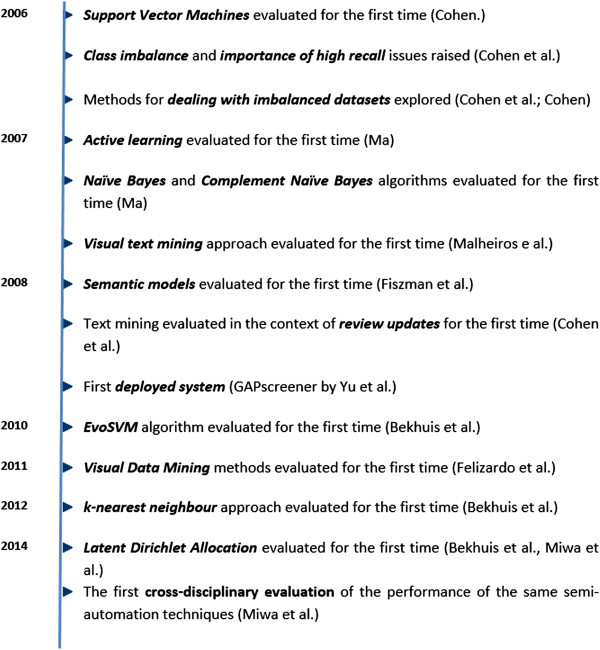
“The timeframe of ”after 2005” was selected as the starting point for the analysis, as per a review by O’Mara-Eves [23], which identified the first documented application of techniques used for title and abstract screening in literature as occurring in 2006.”
Commentary on EPC methods: an exploration of the use of text-mining software in systematic reviews
Paynter, R., Bañez, L. L., Erinoff, E., Lege-Matsuura, J., & Potter, S. (2017) · Journal of Clinical Epidemiology · doi:10.1016/j.jclinepi.2016.11.019 · Cited by 17
López‐Pineda, A., Nouni-García, R., Carbonell-Soliva, Á., Gil-Guillén, V. F., Carratalá‐Munuera, C., & Borrás, F. (2025) · Research Synthesis Methods · doi:10.1017/rsm.2025.15 · Cited by 26
Scotti, K. L., Young, S. M. N., Gainey, M. A., & Lan, H. (2025) · Cochrane Evidence Synthesis and Methods · doi:10.1002/cesm.70046 · Cited by 37
“Similarly, basic text ‐ mining techniques that filter results based on word frequency or other simple heuristics use deterministic meth-ods to improve efficiency in study selection [43].”
Oami, T., Okada, Y., Sakuraya, M., Fukuda, T., Shime, N., & Nakada, T. (2023) · Journal of Epidemiology · doi:10.2188/jea.je20230227 · Cited by 19
Developing timely insights into comparative effectiveness research with a text-mining pipeline
Chang, M., Chang, M., Reed, J. Z., Milward, D., Xu, J. J., & Cornell, W. D. (2016) · Drug Discovery Today · doi:10.1016/j.drudis.2016.01.012 · Cited by 18
Osseointegration Pharmacology: A Systematic Mapping Using Artificial Intelligence
Mahri, M., Shen, N., Berrizbeitia, F., Rodan, R., Daer, A., Faigan, M., Taqi, D., Wu, K. Y., Ahmadi, M., Ducret, M., et al. (2020) · Acta Biomaterialia · doi:10.1016/j.actbio.2020.11.011 · Cited by 18
Constructing and evaluating automated literature review systems
Portenoy, J., & West, J. D. (2020) · Scientometrics · doi:10.1007/s11192-020-03490-w · Cited by 31
“This need for efficient literature review, and especially systematic review, is strongly felt in medicine, but it is also a need for all areas of science (Bastian et al. 2010; O’Mara-Eves et al. 2015; Tsafnat et al. 2013).”
BackgroundSercombe, J., Bryant, Z., & Wilson, J. (2025) · JMIR Formative Research · doi:10.2196/68666 · Cited by 16
“Machine learning classifiers, such as support vector machines or complement naive Bayes have been trained to replicate human inclusion/exclusion decisions based on label training data [10,11].”
Using artificial intelligence tools to automate data extraction for living evidence syntheses
Mitchell, E., Are, E. B., Colijn, C., & Earn, D. J. D. (2025) · PLoS ONE · doi:10.1371/journal.pone.0320151 · Cited by 23
Optimal large language models to screen citations for systematic reviews
Oami, T., Okada, Y., & Nakada, T. (2025) · Research Synthesis Methods · doi:10.1017/rsm.2025.10014 · Cited by 29
Interoperable, Smart, and Sustainable Urban Energy Systems
Pastor, R., Fraga, A., & López-Cózar, L. (2023) · Sustainability · doi:10.3390/su151813491 · Cited by 16
A Reproducibility and Generalizability Study of Large Language Models for Query Generation
Staudinger, M., Kusa, W., Piroi, F., Lipani, A., & Hanbury, A. (2024) · Annual International ACM SIGIR Conference on Research and Development in Information Retrieval in the Asia Pacific Region (SIGIR-AP) · doi:10.1145/3673791.3698432 · Cited by 40
“Consequently, the development of Boolean queries represents a significant bottleneck in the SLR process, contributing to its overall time-consuming nature [35, 51].”
Water conflicts under climate change: Research gaps and priorities
Kåresdotter, E., Destouni, G., Lammers, R. B., Keskinen, M., Pan, H., & Kalantari, Z. (2025) · AMBIO · doi:10.1007/s13280-024-02111-7 · Cited by 21
“Despite the potential and reliability of more automated text analysis (O’Mara-Eves et al. 2015), this has rarely been used to review previous research.”
Marshall, Z., Welch, V. A., Thomas, J., Brunger, F., Swab, M., Shemilt, I., & Kaposy, C. (2017) · Systematic Reviews · doi:10.1186/s13643-017-0427-5 · Cited by 28
“The use of new technologies—text mining and machine learning—have been advanced as potential ways in which screening workload might be reduced [32].”
BackgroundSelf-citationIs it time for computable evidence synthesis?
Dunn, A. G., & Bourgeois, F. T. (2020) · Journal of the American Medical Informatics Association · doi:10.1093/jamia/ocaa035 · Cited by 16
Higgins, S., Katsipataki, M., Aguilera, A. B. V., Dobson, E., Gascoine, L., Rajab, T., Kalambouka, A., Reardon, J., Stafford, J., & Uwimpuhwe, G. (2022) · Review of Education · doi:10.1002/rev3.3327 · Cited by 27
Kusa, W., Hanbury, A., & Knoth, P. (2022) · Lecture notes in computer science · doi:10.1007/978-3-030-99736-6_39 · Cited by 19
Deep learning in automated text classification: a case study using toxicological abstracts
Varghese, A., Agyeman-Badu, G., & Cawley, M. A. (2020) · Environment Systems & Decisions · doi:10.1007/s10669-020-09763-2 · Cited by 20
Artificial Intelligence Software to Accelerate Screening for Living Systematic Reviews
Fuller‐Tyszkiewicz, M., Jones, A., Vasa, R., Vasa, R., Grbin, L., Macdonald, J. A., Deane, C., Samuel, D., Evans-Whipp, T., & Olsson, C. A. (2025) · Clinical Child and Family Psychology Review · doi:10.1007/s10567-025-00519-5 · Cited by 22
“These performance statistics suggest that AI-based analysis of textual data from article abstracts has the potential to yield considerable time savings in human contribution and accurate prediction of article relevance (e.g. O’Mara-Eves et al., 2015).”
Lange, T., Schwarzer, G., Datzmann, T., & Binder, H. (2021) · Research Synthesis Methods · doi:10.1002/jrsm.1486 · Cited by 39
“kknn k [3, 6, 9, 12, 15, 18]”
O’Keefe, H., Rankin, J. M., Wallace, S. A., & Beyer, F. R. (2022) · Research Synthesis Methods · doi:10.1002/jrsm.1593 · Cited by 15
“Semi-automation, the combination of human and machine efforts to perform tasks, has the potential to aid search strategy design by providing a rapid assessment of a subset of the literature.(2,7,8) Semi-automation is not routinely used for developing search strategies in systematic reviews despite the volume and compl…”
BackgroundAutomatic recognition of self-acknowledged limitations in clinical research literature
Kilicoglu, H., Rosemblat, G., Malički, M., & ter Riet, G. (2018) · Journal of the American Medical Informatics Association · doi:10.1093/jamia/ocy038 · Cited by 15
Bashir, R., Surian, D., & Dunn, A. G. (2019) · Journal of Clinical Epidemiology · doi:10.1016/j.jclinepi.2019.02.015 · Cited by 18
Metadata
- Authors
- O’Mara-Eves, A., Thomas, J., McNaught, J., Miwa, M., & Ananiadou, S.
- Affiliations
- University of London (GB)
- University of Manchester (GB)
- Toyota Technological Institute (JP)
- Corresponding author
- Thomas, James
- Venue
- Systematic Reviews
- Published
- 2015-01-14
- Volume
- 4
- Issue
- 1
- Pages
- 5-5
- ISSN
- 2046-4053 (ISSN-L)
- PMC
- PMC4320539
- OpenAlex
- W4313371821
- Cited by
- 681
- References
- 82
- Citations by year
- 2026: 60 · 2025: 72 · 2024: 87 · 2023: 80 · 2022: 56 · 2021: 102 · 2020: 64 · 2019: 54 · 2018: 44 · 2017: 27 · 2016: 23 · 2015: 9
- FWCI
- 5.65
- Type
- journal article
- Language
- en
- Update notices
- erratum (2015-04-28)
- Open access
- gold
- doi.org
- Licence
- Locations
- Systematic Reviews (publishedVersion, cc-by)
- Europe PMC (PubMed Central) (publishedVersion, cc-by)
- PubMed Central (publishedVersion, cc-by)
- PubMed (publishedVersion)
- Research Explorer (The University of Manchester) (publishedVersion, other-oa)
- UCL Discovery (University College London) (submittedVersion)
- Funders
- Medical Research Council (MR/J005037/1, MR/L01078X/1)
- Topics
- Social Sciences › Decision Sciences › Statistics, Probability and Uncertainty › Meta-analysis and systematic reviews
- Social Sciences › General Social Sciences › Computational and Text Analysis Methods
- Social Sciences › Library and Information Sciences › scientometrics and bibliometrics research
- Keywords
- text mining, systematic review screening, study identification, automated screening, memory retrieval, interdisciplinary collaboration
- MeSH terms
- Humans, Publications, Databases, Factual, Information Storage and Retrieval, Computational Biology, Evidence-Based Medicine, Data Mining
About these checks
Registry, retraction, Cites and statistics results are computed, not judged, with one exception: a printed reference that no index lists is read once by a model before it counts as a citation error. Claims are extracted by a model and kept only when their quote appears verbatim in the text; each cited source is then checked, with a model’s help, for whether it says what the claim relies on. Those verdicts can be wrong — read the claim’s quote and the cited source before relying on one.
Statistics and arithmetic are recomputed, not judged.
Confidence bands are shown only for fields calibrated on our annotated test set. None is calibrated yet, so no band is shown.
What counts as a claim ›How we measure confidence ›How we check this ›
Are you an author, or do you see a problem with this page? Request a review
Data sources
Bibliographic data: Semantic Scholar, OpenAlex, Crossref.
Contains information from the Semantic Scholar Academic Graph Datasets, made available under the ODC Attribution License (ODC-BY 1.0).
Semantic Scholar’s data is described in: Kinney, R., et al. (2023). The Semantic Scholar Open Data Platform. arXiv:2301.10140.
