

The DOI matches its Crossref record; 40 of the 40 references it cites were found in a registry or an index.
Meta-analyses on prevalence of selected Parkinson's nonmotor symptoms before and after diagnosis
Open accessAbstract
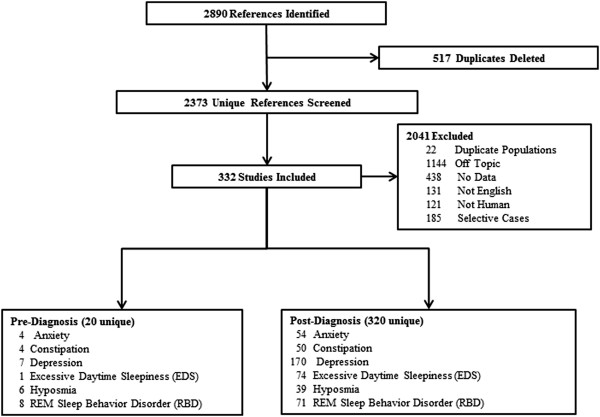
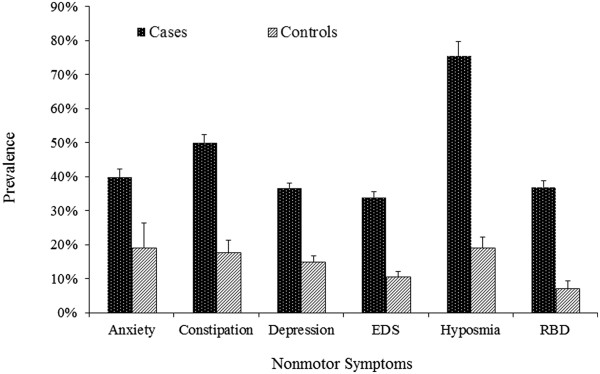
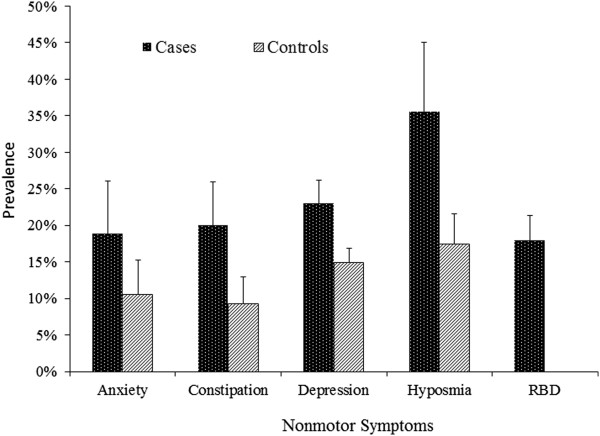
BACKGROUND: Nonmotor symptoms are common among patients with Parkinson's disease (PD) and some may precede disease diagnosis. METHODS: We conducted a meta-analysis on the prevalence of selected nonmotor symptoms before and after PD diagnosis, using random-effect models. We searched PubMed (1965 through October/November 2012) for the following symptoms: hyposmia, constipation, rapid eye movement sleep behavior disorder, excessive daytime sleepiness, depression, and anxiety. Eligible studies were publications in English with original data on one or more of these symptoms. RESULTS: The search generated 2,373 non-duplicated publications and 332 met the inclusion criteria, mostly (n = 320) on symptoms after PD diagnosis. For all symptoms, the prevalence was substantially higher in PD cases than in controls, each affecting over a third of the patients. Hyposmia was the most prevalent (75.5% in cases vs. 19.1% in controls), followed by constipation (50% vs. 17.7%), anxiety (39.9% vs. 19.1%), rapid eye movement sleep behavior disorder (37.0% vs. 7.0%), depression (36.6% vs. 14.9%), and excessive daytime sleepiness (33.9% vs. 10.5%). We observed substantial heterogeneities across studies and meta-regression analyses suggested that several factors might have contributed to this. However, the prevalence estimates were fairly robust in several sensitivity analyses. Only 20 studies had data on any symptoms prior to PD diagnosis, but still the analyses revealed higher prevalence in future PD cases than in controls. CONCLUSION: These symptoms are common among PD patients both before and after diagnosis. Further studies are needed to understand the natural history of nonmotor symptoms in PD and their etiological and clinical implications.
Overview
The claims and statistics of this paper haven’t been checked yet.
Run the check — free, no account needed. It reads the open-access text and checks the sources it cites.
Integrity signals
Registry
Cites
Statistics
Figures
Verification
Claims the paper makes
The claims and statistics of this paper haven’t been checked yet.
Run the check — free, no account needed. It reads the open-access text and checks the sources it cites.
Claims other papers make about this one
Each is checked against this paper’s own text: does it say what the citing paper says it does?
In the citing paper
“Some of these symptoms may precede the classical motor symptoms by several years (Abbott et al., 2001;Chen et al., 2015;Gao et al., 2011)”
From The Gut-Brain Axis in Parkinson’s Disease: Possibilities for Food-Based Therapies (2017) · cites this paper as Chen et al., 2015
Self-check
Percentages, sums and reported differences re-computed from the paper’s own numbers.
The self-check needs the paper’s full text.
Citations
Cites
Bias in meta-analysis detected by a simple, graphical test
Egger, M., Smith, G. D., Schneider, M., & Minder, C. (1997) · BMJ · doi:10.1136/bmj.315.7109.629 · Cited by 56,722
Quantifying heterogeneity in a meta‐analysis
Higgins, J. P. T., & Thompson, S. G. (2002) · Statistics in Medicine · doi:10.1002/sim.1186 · Cited by 36,763
(2000) · Cited by 9,198
Barone, P., Antonini, A., Colosimo, C., Marconi, R., Morgante, L., Avarello, T. P., Bottacchi, E., Cannas, A., Ceravolo, G., Ceravolo, R., et al. (2009) · Movement Disorders · doi:10.1002/mds.22643 · Cited by 1,445
Prevalence of olfactory impairment in older adults.
Murphy, C. (2002) · JAMA · doi:10.1001/jama.288.18.2307 · Cited by 953
Suares, N. C., & Ford, A. C. (2011) · The American Journal of Gastroenterology · doi:10.1038/ajg.2011.164 · Cited by 919
Meta‐analysis of early nonmotor features and risk factors for Parkinson disease
Noyce, A. J., Bestwick, J. P., Silveira‐Moriyama, L., Hawkes, C. H., Giovannoni, G., Lees, A. J., & Schrag, A. E. (2012) · Annals of Neurology · doi:10.1002/ana.23687 · Cited by 834
Quantifying the risk of neurodegenerative disease in idiopathic REM sleep behavior disorder
Postuma, R. B., Gagnon, J., Vendette, M., Fantini, M. L., Massicotte-Marquez, J., & Montplaisir, J. Y. (2008) · Neurology · doi:10.1212/01.wnl.0000340980.19702.6e · Cited by 779
Association of olfactory dysfunction with risk for future Parkinson's disease
Ross, G. W., Petrovitch, H., Abbott, R. D., Tanner, C. M., Popper, J. S., Masaki, K., Launer, L. J., & White, L. R. (2007) · Annals of Neurology · doi:10.1002/ana.21291 · Cited by 739
Development of the 12‐Item Cross‐Cultural Smell Identification Test(CC‐SIT)
Doty, R. L., Marcus, A., & Lee, W. W. (1996) · The Laryngoscope · doi:10.1097/00005537-199603000-00021 · Cited by 734
Cited by
Sorted by citations
The gut microbiota–brain axis in behaviour and brain disorders
Morais, L. H., Schreiber, H. L., & Mazmanian, S. K. (2021) · Nature Reviews Microbiology · doi:10.1038/s41579-020-00460-0 · Cited by 2,149
The gut-brain axis: is intestinal inflammation a silent driver of Parkinson’s disease pathogenesis?
Houser, M. C., & Tansey, M. G. (2017) · npj Parkinson's Disease · doi:10.1038/s41531-016-0002-0 · Cited by 588
Vagotomy and Parkinson disease: A Swedish register–based matched-cohort study
Liu, B., Fang, F., Pedersen, N. L., Tillander, A., Ludvigsson, J. F., Ekbom, A., Svenningsson, P., Chen, H., & Wirdefeldt, K. (2017) · Neurology · doi:10.1212/wnl.0000000000003961 · Cited by 447
Self-citationPeter, I., Dubinsky, M., Bressman, S., Park, A., Lu, C., Chen, N., & Wang, A. (2018) · JAMA Neurology · doi:10.1001/jamaneurol.2018.0605 · Cited by 386
The gut microbiota–brain axis in neurological disorder
Ullah, H., Arbab, S., Tian, Y., Liu, C., Chen, Y., Li, Q., Khan, M. I. U., Hassan, I. U., & Li, K. (2023) · Frontiers in Neuroscience · doi:10.3389/fnins.2023.1225875 · Cited by 292
Metadata
- Authors
- Chen, H., Zhao, E. J., Zhang, W., Lu, Y., Liu, R., Huang, X., Ciesielski-Jones, A. J., Justice, M. A., Cousins, D. S., & Peddada, S.
- Affiliations
- National Institutes of Health (US)
- Social and Scientific Systems (United States) (US)
- Pennsylvania State University (US)
- National Institute of Environmental Health Sciences (US)
- Corresponding author
- Chen, Honglei
- ORCID
- Venue
- Translational Neurodegeneration
- Published
- 2015-01-08
- Volume
- 4
- Issue
- 1
- Pages
- 1-1
- ISSN
- 2047-9158 (ISSN-L)
- PMC
- PMC4322463
- OpenAlex
- W2126909058
- Cited by
- 212
- References
- 40
- Citations by year
- 2026: 11 · 2025: 22 · 2024: 16 · 2023: 21 · 2022: 20 · 2021: 26 · 2020: 20 · 2019: 16 · 2018: 21 · 2017: 28 · 2016: 7 · 2015: 4
- FWCI
- 14.10
- Type
- journal article
- Language
- en
- Open access
- gold
- doi.org
- Licence
- cc-by
- Locations
- Translational Neurodegeneration (publishedVersion, cc-by)
- Europe PMC (PubMed Central) (publishedVersion, cc-by)
- PubMed Central (publishedVersion, cc-by)
- PubMed (publishedVersion)
- Funders
- National Institutes of Health (1z01es101986-03, Z01-ES101986)
- National Institute of Neurological Disorders and Stroke (U01NS082151)
- National Institute of Environmental Health Sciences
- Topics
- Health Sciences › Medicine › Clinical Neurology › Parkinson's Disease Mechanisms and Treatments
- Health Sciences › Medicine › Psychiatry and Mental health › Dementia and Cognitive Impairment Research
- Health Sciences › Medicine › Clinical Neurology › Deep Brain Stimulation and Movement Disorders
- Keywords
- Parkinson's disease, non-motor symptoms, hyposmia, constipation, REM sleep behavior disorder, excessive daytime sleepiness, depression, anxiety, symptom prevalence, preclinical Parkinson's disease
About these checks
Registry, retraction, Cites and statistics results are computed, not judged, with one exception: a printed reference that no index lists is read once by a model before it counts as a citation error. Claims are extracted by a model and kept only when their quote appears verbatim in the text; each cited source is then checked, with a model’s help, for whether it says what the claim relies on. Those verdicts can be wrong — read the claim’s quote and the cited source before relying on one.
Statistics and arithmetic are recomputed, not judged.
Confidence bands are shown only for fields calibrated on our annotated test set. None is calibrated yet, so no band is shown.
What counts as a claim ›How we measure confidence ›How we check this ›
Are you an author, or do you see a problem with this page? Request a review
