

Structure of the gut microbiome following colonization with human feces determines colonic tumor burden
Open accessThe DOI matches its Crossref record; 46 of the 47 references it cites were found in a registry or an index.
Abstract
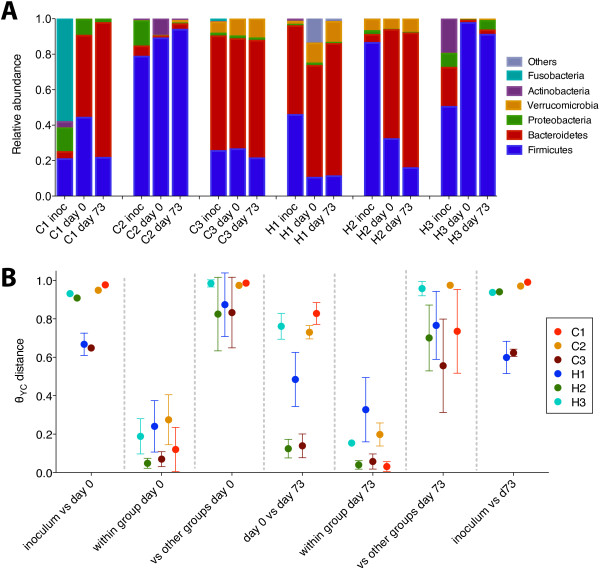
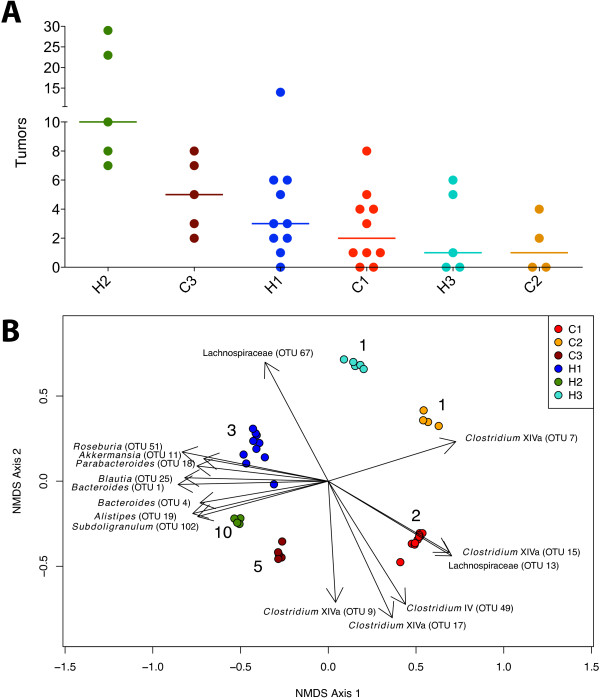
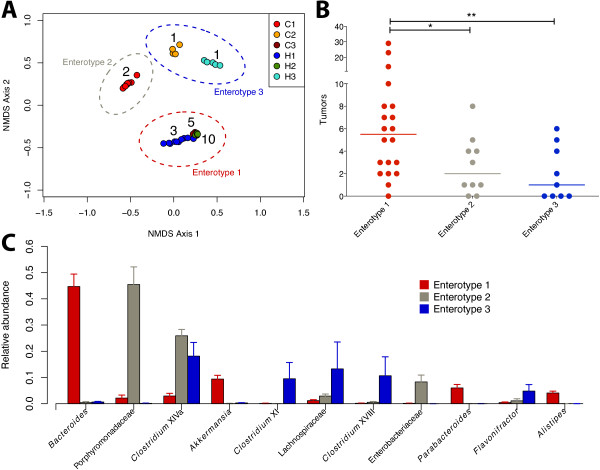
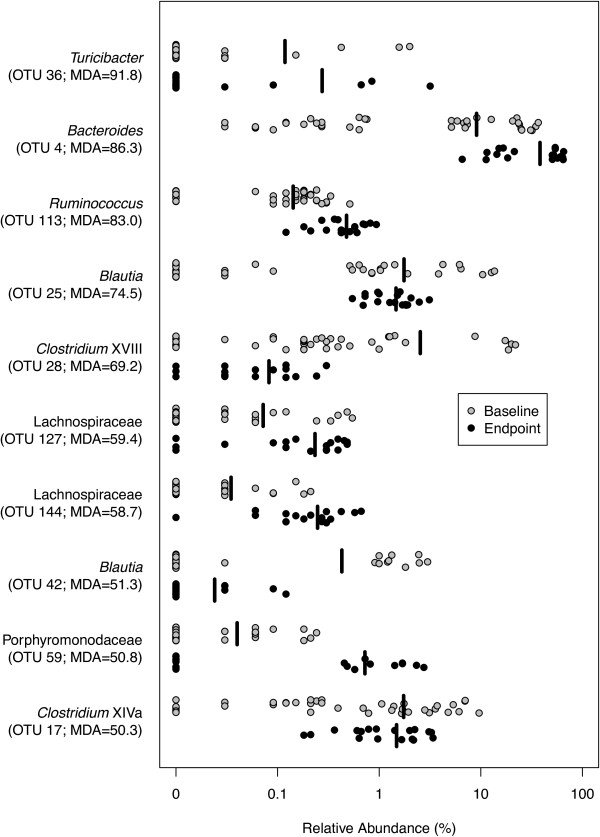
BACKGROUND: A growing body of evidence indicates that the gut microbiome plays a role in the development of colorectal cancer (CRC). Patients with CRC harbor gut microbiomes that are structurally distinct from those of healthy individuals; however, without the ability to track individuals during disease progression, it has not been possible to observe changes in the microbiome over the course of tumorigenesis. Mouse models have demonstrated that these changes can further promote colonic tumorigenesis. However, these models have relied upon mouse-adapted bacterial populations and so it remains unclear which human-adapted bacterial populations are responsible for modulating tumorigenesis. RESULTS: We transplanted fecal microbiota from three CRC patients and three healthy individuals into germ-free mice, resulting in six structurally distinct microbial communities. Subjecting these mice to a chemically induced model of CRC resulted in different levels of tumorigenesis between mice. Differences in the number of tumors were strongly associated with the baseline microbiome structure in mice, but not with the cancer status of the human donors. Partitioning of baseline communities into enterotypes by Dirichlet multinomial mixture modeling resulted in three enterotypes that corresponded with tumor burden. The taxa most strongly positively correlated with increased tumor burden were members of the Bacteroides, Parabacteroides, Alistipes, and Akkermansia, all of which are Gram-negative. Members of the Gram-positive Clostridiales, including multiple members of Clostridium Group XIVa, were strongly negatively correlated with tumors. Analysis of the inferred metagenome of each community revealed a negative correlation between tumor count and the potential for butyrate production, and a positive correlation between tumor count and the capacity for host glycan degradation. Despite harboring distinct gut communities, all mice underwent conserved structural changes over the course of the model. The extent of these changes was also correlated with tumor incidence. CONCLUSION: Our results suggest that the initial structure of the microbiome determines susceptibility to colonic tumorigenesis. There appear to be opposing roles for certain Gram-negative (Bacteroidales and Verrucomicrobia) and Gram-positive (Clostridiales) bacteria in tumor susceptibility. Thus, the impact of community structure is potentially mediated by the balance between protective, butyrate-producing populations and inflammatory, mucin-degrading populations.
Overview
The claims and statistics of this paper haven’t been checked yet.
Free: it reads the open-access text and checks the first 5 claims that cite a source we can check. Create a free account to check every claim.
Integrity signals
Registry
Cites
Statistics
Figures

Verification
Claims the paper makes
The claims and statistics of this paper haven’t been checked yet.
Free: it reads the open-access text and checks the first 5 claims that cite a source we can check. Create a free account to check every claim.
Claims other papers make about this one
Each is checked against this paper’s own text: does it say what the citing paper says it does?
In the citing paper
“Nevertheless, A. muciniphila has previously been linked to an increased burden of CRC in human and mice,25–27”
Self-check
Percentages, sums and reported differences re-computed from the paper’s own numbers.
The self-check needs the paper’s full text.
Citations
Cites
Breiman, L. (2001) · Machine Learning · doi:10.1023/a:1010933404324 · Cited by 133,538
Naïve Bayesian Classifier for Rapid Assignment of rRNA Sequences into the New Bacterial Taxonomy
Wang, Q., Garrity, G. M., Tiedje, J. M., & Cole, J. R. (2007) · Applied and Environmental Microbiology · doi:10.1128/aem.00062-07 · Cited by 19,885 · cited 1×
“Each sequence was classified using a naive Bayesian classifier trained against a 16S rRNA gene training set provided by the Ribosomal Database Project [30,31].”
MethodSchloss, P. D., Westcott, S. L., Ryabin, T., Hall, J. R., Hartmann, M., Hollister, E. B., Lesniewski, R. A., Oakley, B. B., Parks, D. H., Robinson, C. J., et al. (2009) · Applied and Environmental Microbiology · doi:10.1128/aem.01541-09 · Cited by 19,549
Self-citationClassification and Regression by randomForest
Liaw, A. I., & Wiener, M. C. (2007) · Cited by 18,594
UCHIME improves sensitivity and speed of chimera detection
Edgar, R. C., Haas, B. J., Clemente, J. C., Quince, C., & Knight, R. (2011) · Bioinformatics · doi:10.1093/bioinformatics/btr381 · Cited by 15,114
Excoffier, L., Smouse, P. E., & Quattro, J. M. (1992) · Genetics · doi:10.1093/genetics/131.2.479 · Cited by 13,929
An obesity-associated gut microbiome with increased capacity for energy harvest
Turnbaugh, P. J., Ley, R. E., Mahowald, M. A., Magrini, V., Mardis, E. R., & Gordon, J. I. (2006) · Nature · doi:10.1038/nature05414 · Cited by 12,444 · cited 1×
“In studies of diabetes, obesity, and malnutrition, colonization with human feces has been reported to recapitulate the phenotype of the human donors in the recipient mice [18-21].”
BackgroundPredictive functional profiling of microbial communities using 16S rRNA marker gene sequences
Langille, M. G. I., Zaneveld, J., Caporaso, J. G., McDonald, D., Knights, D., Reyes, J. A., Clemente, J. C., Burkepile, D. E., Vega Thurber, R. L., Knight, R., et al. (2013) · Nature Biotechnology · doi:10.1038/nbt.2676 · Cited by 9,116
Kozich, J. J., Westcott, S. L., Baxter, N. T., Highlander, S. K., & Schloss, P. D. (2013) · Applied and Environmental Microbiology · doi:10.1128/aem.01043-13 · Cited by 7,112
Self-citationPruesse, E., Quast, C., Knittel, K., Fuchs, B. M., Ludwig, W., Peplies, J., & Glockner, F. O. (2007) · Nucleic Acids Research · doi:10.1093/nar/gkm864 · Cited by 6,668 · cited 1×
“Briefly, paired end reads were assembled into contigs and aligned to the SILVA 16S rRNA sequence database [28].”
Method
Research works printed but not linked: 2
- American Cancer Society Colorectal Cancer Facts & Figures 2011-2013 2013 Atlanta
- Schloss P Data File Repository for the Manuscript, ‘Structure of the Gut Microbiome Following Colonization with Human Feces Determines Colonic Tumor Burden’ by Niel Baxter, Joseph Zackular and Colleagues http://www.mothur.org/human_mouse_aomdss PMC4070349 24967088
Cited by
Items 101–200 of 298
Zhang, Y., Ma, C., Zhao, J., Xu, H., Hou, Q., & Zhang, H. (2017) · Oncotarget · doi:10.18632/oncotarget.15791 · Cited by 60
MASI: microbiota—active substance interactions database
Zeng, X. L., Yang, X., Fan, J., Tan, Y. C., Ju, L., Shen, W. X., Wang, Y., Wang, X., Chen, W., Ju, D., et al. (2020) · Nucleic Acids Research · doi:10.1093/nar/gkaa924 · Cited by 54
Akkermansia muciniphila: A potential target and pending issues for oncotherapy
Zhao, X., Zhao, J., Li, D., Yang, H., Chen, C., Qin, M., Wen, Z., He, Z., & Xu, L. (2023) · Pharmacological Research · doi:10.1016/j.phrs.2023.106916 · Cited by 53
Pfalzer, A. C., Nesbeth, P.-D. C., Parnell, L. D., Iyer, L. K., Liu, Z., Kane, A. V., Chen, C. O., Tai, A., Bowman, T. A., Obin, M. S., et al. (2015) · PLoS ONE · doi:10.1371/journal.pone.0135758 · Cited by 59
Rokhsefat, S., Lin, A., & Comelli, E. M. (2016) · Digestive Diseases and Sciences · doi:10.1007/s10620-016-4032-6 · Cited by 58
“Characteristics of these conditions include an inflammatory component, such as mucositis [4], inflammatory bowel disease [5–7], intestinal infections [8], colorectal cancer [9], and the metabolic syndrome [10].”
BackgroundFaghfuri, E., & Gholizadeh, P. (2024) · Biomedicine & Pharmacotherapy · doi:10.1016/j.biopha.2024.116416 · Cited by 57
Effects of Walnut Consumption on Colon Carcinogenesis and Microbial Community Structure
Nakanishi, M., Chen, Y., Qendro, V., Miyamoto, S., Weinstock, E., Weinstock, G. M., & Rosenberg, D. W. (2016) · Cancer Prevention Research · doi:10.1158/1940-6207.capr-16-0026 · Cited by 55
Hannigan, G. D., Duhaime, M. B., Koutra, D., & Schloss, P. D. (2018) · PLoS Computational Biology · doi:10.1371/journal.pcbi.1006099 · Cited by 48
Self-citationTingler, A. M., & Engevik, M. A. (2025) · Infection and Immunity · doi:10.1128/iai.00503-24 · Cited by 68
“Moreover, Baxter et al. reported that co-colonization of Akkermansia and Bacteroides in germ-free C57BL/6 mice treated with FMTs from human samples and subsequently exposed to AOM/DSS resulted in increased tumor formation (295).”
Lee, S. M., Kim, N., Yoon, H., Nam, R. H., & Lee, D. H. (2018) · Frontiers in Microbiology · doi:10.3389/fmicb.2018.02236 · Cited by 60
“However, in a previous study, the caecal abundance of Akkermansia was higher in rats fed with HFD compared with in low-fat diet-fed rats, suggesting the need for caution in proclaiming the probiotic effect of A. muciniphila (Zhong et al., 2015).”
BackgroundInfluentialMarongiu, L., & Allgayer, H. (2021) · Molecular Oncology · doi:10.1002/1878-0261.13100 · Cited by 52
Paik, J., Pershutkina, O., Meeker, S., Yi, J. J., Dowling, S., Hsu, C., Hajjar, A. M., Maggio-Price, L., & Beck, D. A. C. (2015) · Gut Microbes · doi:10.1080/19490976.2015.1064576 · Cited by 45
Microbial Interactions and Interventions in Colorectal Cancer
Raay, T. J. V., & Allen‐Vercoe, E. (2017) · Microbiology Spectrum · doi:10.1128/microbiolspec.bad-0004-2016 · Cited by 51
Interaction between microbiota and immunity and its implication in colorectal cancer
Xing, C., Du, Y., Duan, T., Nim, K., Chu, J., Wang, H. Y., & Wang, R. (2022) · Frontiers in Immunology · doi:10.3389/fimmu.2022.963819 · Cited by 52
Zhang, Y., Song, F., Yang, M., Chen, C., Cui, J., Xing, M., Dai, Y., Li, M., Cao, Y., Lu, L., et al. (2024) · Advanced Science · doi:10.1002/advs.202306297 · Cited by 50
The Pivotal Role of the Gut Microbiome in Colorectal Cancer
Siddiqui, R., Boghossian, A., Alharbi, A. M., Alfahemi, H. H., & Khan, N. A. (2022) · Biology · doi:10.3390/biology11111642 · Cited by 47
“In contrast, Gram negative bacteria such as Alistipes, Akkermansia, Parabacteroid s, and Bacteroides are associa ed ositively with tumor generation [16,25,29].”
Backgroundγδ T Cells: Crosstalk Between Microbiota, Chronic Inflammation, and Colorectal Cancer
Yang, Y., Xu, C., Wu, D., Wang, Z., Wu, P., Li, L., Huang, J., & Qiu, F. (2018) · Frontiers in Immunology · doi:10.3389/fimmu.2018.01483 · Cited by 48
Escherichia coli and Colorectal Cancer: Unfolding the Enigmatic Relationship
Rezaee, M. A., Nouri, R., Hasani, A., Shirazi, K. M., Alivand, M. R., Sepehri, B., Sotoodeh, S., & Hemmati, F. (2021) · Current Pharmaceutical Biotechnology · doi:10.2174/1389201022666210910094827 · Cited by 48
Leung, H. K. M., Lo, E. K. K., & El-Nezami, H. S. (2022) · Antioxidants · doi:10.3390/antiox11091716 · Cited by 43
“Previous studies reported that Bacteroidceae family and Bacteroides genus are associated with colorectal cancer and worsened tumor multiplicity and burden in AOM/DSS tumor bearing mice [49,50].”
Resultvan Liere, E. L. S. A., van Dijk, L. J., Bosch, S., Vermeulen, L., Heymans, M. W., Burchell, G. L., de Meij, T. G. J., Ramsoekh, D., & de Boer, N. K. H. (2023) · European Journal of Cancer · doi:10.1016/j.ejca.2023.03.002 · Cited by 45
Intestinal Microbiota in Animal Models of Inflammatory Diseases
Hörmannsperger, G., Schaubeck, M., & Haller, D. (2015) · ILAR Journal · doi:10.1093/ilar/ilv019 · Cited by 45
Alam, M. B. E., Sims, T. T., Kouzy, R., Biegert, G. W. G., Jaoude, J. A., Karpinets, T. V., Yoshida-Court, K., Wu, X., Medrano, A. Y. D., Mezzari, M. P., et al. (2021) · PLoS ONE · doi:10.1371/journal.pone.0247905 · Cited by 43
Prevention of antibiotic‐associated metabolic syndrome in mice by intestinal alkaline phosphatase
Economopoulos, K. P., Ward, N. L., Phillips, C. D., Teshager, A., Patel, P. Y., Mohamed, M. M., Hakimian, S., Cox, S. B., Ahmed, R., Moaven, O., et al. (2016) · Diabetes Obesity and Metabolism · doi:10.1111/dom.12645 · Cited by 41
“The abundance of Parabacteroides has been associated with HFD-induced obesity [30], as well as with other inflammatory disorders such as nonalcoholic steatohepatitis [31] and colonic tumors [32].”
Fecal volatile organic compounds for early detection of colorectal cancer: where are we now?
Bosch, S., Berkhout, D. J. C., Larbi, I. B., de Meij, T. G. J., & de Boer, N. K. H. (2018) · Journal of Cancer Research and Clinical Oncology · doi:10.1007/s00432-018-2821-3 · Cited by 44
Wei, X., Cheng, F., Liu, J., Cheng, Y., Yun, S., Meng, J., Chang, M., Geng, X., Xu, L., Cao, J., et al. (2023) · International Journal of Biological Macromolecules · doi:10.1016/j.ijbiomac.2023.123299 · Cited by 44
Russo, E., Gloria, L. D., Nannini, G., Meoni, G., Niccolai, E., Ringressi, M. N., Baldi, S., Fani, R., Tenori, L., Taddei, A., et al. (2023) · Neoplasia · doi:10.1016/j.neo.2023.100901 · Cited by 47
Tomkovich, S., Gharaibeh, R. Z., Dejea, C. M., Pope, J. L., Jiang, J., Winglee, K., Gauthier, J., Newsome, R. C., Yang, Y., Fodor, A. A., et al. (2020) · mSystems · doi:10.1128/msystems.00451-19 · Cited by 42
“One group demonstrated stool communities from either individual CRC or healthy patients promoted polyp formation depending on the composition of the microbiota that established in mice (9).”
BackgroundResultInfluentialZhou, T., Wu, J., Khan, A., Hu, T., Wang, Y., Salama, E., Su, S., Han, H., Jin, W., & Li, X. (2024) · npj Science of Food · doi:10.1038/s41538-024-00307-5 · Cited by 43
Butera, A., Paola, M. D., Pavarini, L., Strati, F., Pindo, M., Sanchez, M., Cavalieri, D., Boirivant, M., & Filippo, C. D. (2018) · Scientific Reports · doi:10.1038/s41598-018-32583-z · Cited by 40
Harusato, A., Viennois, É., Etienne‐Mesmin, L., Matsuyama, S., Abo, H., Osuka, S., Lukacs, N. W., Naito, Y., Itoh, Y., Li, J., et al. (2019) · Cancer Immunology Research · doi:10.1158/2326-6066.cir-18-0444 · Cited by 37
“These results are consistent with reports that Akkermansia, Bacteroidales, and Erysipelotrichaceae correlate with increased CAC (22, 23).”
ResultLuo, J., Li, T., Xie, J., Guo, H., Liu, L., Zhang, G., & Peng, X. (2020) · Food & Function · doi:10.1039/c9fo02786f · Cited by 40
Han, B., Jiang, P., Jiang, L., Li, X., & Ye, X. (2021) · Food Research International · doi:10.1016/j.foodres.2021.110147 · Cited by 36
Abbasi, A., Bazzaz, S., da Cruz, A. G., Khorshidian, N., Saadat, Y. R., Sabahi, S., Ozma, M. A., Lahouty, M., Aslani, R., & Mortazavian, A. M. (2023) · Probiotics and Antimicrobial Proteins · doi:10.1007/s12602-023-10118-x · Cited by 40
Gut microbiota in patients after surgical treatment for colorectal cancer
Jin, Y., Liu, Y., Zhao, L., Zhao, F., Feng, J., Li, S., Chen, H., Sun, J., Zhu, B., Geng, R., et al. (2018) · Environmental Microbiology · doi:10.1111/1462-2920.14498 · Cited by 40
Huang, Q., Wei, X., Li, W., Ma, Y., Chen, G., Zhao, L., Jiang, Y., Xie, S., Chen, Q., & Chen, T. (2022) · Cancers · doi:10.3390/cancers14215178 · Cited by 38
“Similarly, pks + E. coli , Clostridium spp ., and Bacteroides fragilis in the tumour can also contribute to tumour formation and development [34,35].”
BackgroundSelf-citationNovel cancer therapy targeting microbiome
Nagano, T., Otoshi, T., Hazama, D., Kiriu, T., Umezawa, K., Katsurada, N., & Nishimura, Y. (2019) · OncoTargets and Therapy · doi:10.2147/ott.s207546 · Cited by 39
Parker, K. D., Maurya, A. K., Ibrahim, H., Rao, S., Hove, P. R., Kumar, D., Kant, R., Raina, B., Agarwal, R., Kuhn, K. A., et al. (2021) · Biomedicines · doi:10.3390/biomedicines9020144 · Cited by 39
Context-Dependent Regulation of Type17 Immunity by Microbiota at the Intestinal Barrier
Akuzum, B., & Lee, J. (2022) · Immune Network · doi:10.4110/in.2022.22.e46 · Cited by 37
Chou, Y.-C., Ho, P.-Y., Chen, W.-J., Wu, S.-H., & Pan, M. (2020) · PubMed · Cited by 39
Wang, Y., Wang, X., Chen, Z., Zheng, J., Liu, X., Zheng, Y., Zheng, Z., Xu, Z., Zhang, Y., Chen, K., et al. (2025) · The ISME Journal · doi:10.1093/ismejo/wraf084 · Cited by 45
“Moreover, in colorectal cancer (CRC) mouse models receiving fecal microbiota transplants from patients with colorectal cancer, the abundance of AKK has been positively associated with increased tumor burden [27].”
The intestinal microbiome and surgical disease
Krezalek, M. A., Skowron, K. B., Guyton, K. L., Shakhsheer, B. A., Hyoju, S. K., & Alverdy, J. C. (2016) · Current Problems in Surgery · doi:10.1067/j.cpsurg.2016.06.001 · Cited by 39
Zhang, Y., Kang, C., Wang, X., Zhou, M., Chen, M., Zhu, X., Liu, K., Wang, B., Zhang, Q., Zhu, J., et al. (2018) · Molecular Nutrition & Food Research · doi:10.1002/mnfr.201700554 · Cited by 33
Natural agents inhibit colon cancer cell proliferation and alter microbial diversity in mice
Farhana, L., Sarkar, S. H., Nangia‐Makker, P., Yu, Y., Khosla, P., Levi, E., Azmi, A. S., & Majumdar, A. P. N. (2020) · PLoS ONE · doi:10.1371/journal.pone.0229823 · Cited by 35
Ji, J., Sundquist, J., & Sundquist, K. (2017) · Gastroenterology · doi:10.1053/j.gastro.2017.09.009 · Cited by 35
Study Insights into Gastrointestinal Cancer through the Gut Microbiota
Kong, F., & Cai, Y. (2019) · BioMed Research International · doi:10.1155/2019/8721503 · Cited by 36
Wang, M., Ma, Y., Yu, G., Bao, Z., Yang, W., Huang, C., Dong, Y., Tang, B.-Q., & Wu, Z. (2024) · Biomedicine & Pharmacotherapy · doi:10.1016/j.biopha.2024.117292 · Cited by 36
Randomized Lasso Links Microbial Taxa with Aquatic Functional Groups Inferred from Flow Cytometry
Rubbens, P., Schmidt, M. L., Props, R., Biddanda, B. A., Boon, N., Waegeman, W., & Denef, V. J. (2019) · mSystems · doi:10.1128/msystems.00093-19 · Cited by 33
Living Therapeutics: The Next Frontier of Precision Medicine
Kelly, V. W., Liang, B. K., & Sirk, S. J. (2020) · ACS Synthetic Biology · doi:10.1021/acssynbio.0c00444 · Cited by 31
Arnesen, H., Hitch, T. C. A., Steppeler, C., Müller, M. H. B., Knutsen, L. E., Gunnes, G., Angell, I. L., Ormaasen, I., Rudi, K., Paulsen, J. E., et al. (2021) · Gut Microbes · doi:10.1080/19490976.2021.1993581 · Cited by 33
“Generally, large microbial shifts are observed in mice subjected to AOM and/or DSS treatment,(37,38,49) and tumor burden has been associated with the magnitude of changes in gut microbiota community structure.(54) We found major changes in the microbiota profile of lab mice, but only minor in feralized mice, following…”
BackgroundThe Oncobiome in Gastroenteric and Genitourinary Cancers
D’Antonio, D. L., Marchetti, S., Pignatelli, P., Piattelli, A., & Curia, M. C. (2022) · International Journal of Molecular Sciences · doi:10.3390/ijms23179664 · Cited by 36
“The microbiota that characterized the CRC is richer in some bacterial pro-inflammatory species (Streptococcus gallolyticus, Fusobacterium nucleatum, Escherichia coli, Bacteroides fragilis and Enterococcus faecalis) and more depleted in butyrate-producing bacterial species (Roseburia, Clostridium, Faecalibacterium and…”
BackgroundInfluentialTherapeutic implications of bioactive sphingolipids: A focus on colorectal cancer
Camp, E. R., Patterson, L., KESTER, M. A., & Voelkel‐Johnson, C. (2017) · Cancer Biology & Therapy · doi:10.1080/15384047.2017.1345396 · Cited by 37
“to increased tumorigenesis.(34,35) While sphingolipids have been”
Wu, J.-C., Tsai, M., Lai, C., Lo, C., Ho, C., Wang, Y., & Pan, M. (2017) · International Journal of Cancer · doi:10.1002/ijc.31190 · Cited by 33
Rastogi, Y. R., Saini, A. K., Thakur, V. K., & Saini, R. V. (2020) · International Journal of Molecular Sciences · doi:10.3390/ijms21093212 · Cited by 36
Haskey, N., Ye, J., Estaki, M., Verdugo‐Meza, A., Barnett, J. A., Yousefi, M., Birnie, B. W., Gruenheid, S., Ghosh, S., & Gibson, D. L. (2022) · Gut Microbes · doi:10.1080/19490976.2022.2055441 · Cited by 34
“In contrast, the top ranked ASVs in the CO, MF and OO diets were B. massiliensis, with the CO diet also containing A. muciniphila both of which have been associated with colitis and colorectal cancer in humans and animal models (Berry et al., 2012; Baxter et al., 2014; Feng et al., 2015).”
BackgroundLi, H., Liu, Y., Zhou, J., Liu, S., Liu, Y., Yang, Y., Wang, W. “., Che, Y., Inam, M., & Guan, L. (2022) · International Journal of Biological Macromolecules · doi:10.1016/j.ijbiomac.2022.11.256 · Cited by 32
Cong, W., Jin, X., Feng, Y., Wang, J., Fu, R., Yue, B., He, Z., Lin, L., Yang, W., Cheng, J., et al. (2018) · BMC Microbiology · doi:10.1186/s12866-018-1226-4 · Cited by 31
Xu, L., Li, W., Chen, S., Deng, X.-W., Deng, W.-F., Liu, G., Chen, Y., & Cao, Y. (2022) · Frontiers in Nutrition · doi:10.3389/fnut.2022.1053718 · Cited by 32
“A previous investigation found elevated abundance of Lachnospiraceae in humans with alcohol liver injury (57).”
BackgroundThe Urinary Microbiome in Health and Disease: Relevance for Bladder Cancer
Kuštrimović, N. Z., Bilato, G., Mortara, L., & Baci, D. (2024) · International Journal of Molecular Sciences · doi:10.3390/ijms25031732 · Cited by 33
“Bacteroides and Akkermansia are strongly positively correlated with an increased tumor burden in colorectal cancer [90] since they are known mucin degraders, undermining the integrity of the mucosal barrier and leading to increased inflammation [91,92]. spp. may constitute a clinically important…”
BackgroundGonzalez-Mercado, V. J., Henderson, W. A., Sarkar, A., Lim, S. J., Saligan, L. N., Berk, L. B., Dishaw, L. J., McMillan, S. C., Groer, M. E., Sepehri, F., et al. (2020) · Biological Research For Nursing · doi:10.1177/1099800420942830 · Cited by 29
“Blautia has also being found to be associated to colorectal cancer (Baxter et al., 2014) and with most severe clinical stage and histoprognostic grade in breast cancer patients (Luu et al., 2017).”
BackgroundPrediction of Postoperative Ileus in Patients With Colorectal Cancer by Preoperative Gut Microbiota
Jin, Y., Geng, R., Liu, Y., Liu, L., Jin, X., Zhao, F., Feng, J., & Wei, Y. (2020) · Frontiers in Oncology · doi:10.3389/fonc.2020.526009 · Cited by 34
“For example, in animal model studies, germ-free mice and colon tumor-bearing mice received feces transplants from CRC patients, revealing that the gut microbiota plays a crucial role in the development of CRC (18, 19).”
ResultCheng, K.-W., Tseng, C.-H., Chen, I., Huang, B.-C., Liu, H.-J., Ho, K., Lin, W., Chuang, C.-H., Huang, M., Leu, Y.-L., et al. (2022) · Pharmacological Research · doi:10.1016/j.phrs.2022.106115 · Cited by 28
Lv, X., Wu, Q., Yuan, Y., Li, L., Guo, W., Lin, X.-B., Huang, Z.-R., Rao, P., Ai, L., & Ni, L. (2022) · International Journal of Biological Macromolecules · doi:10.1016/j.ijbiomac.2022.07.211 · Cited by 29
Elahi, Z., Shariati, A., Bostanghadiri, N., Dadgar-Zankbar, L., Razavi, S., Norzaee, S., Arasi, S. V., & Darban‐Sarokhalil, D. (2023) · Heliyon · doi:10.1016/j.heliyon.2023.e22602 · Cited by 29
“Our study has shown that Clostridium has a negative correlation with colorectal neoplasms, like other epidemiological studies [46,47].”
ResultEffect of gut microbiota in the colorectal cancer and potential target therapy
Li, J., Zhu, Y., Yang, L., & Wang, Z. (2022) · Discover Oncology · doi:10.1007/s12672-022-00517-x · Cited by 29
“However, from colon cancer mice or CRC patients to sterile mice, FMT experiments revealed that intestinal microflora played a key role in the development of CRC [125, 126].”
BackgroundChou, Y.-C., Suh, J. H., Wang, Y., Pahwa, M., Badmaev, V., Ho, C., & Pan, M. (2017) · Molecular Nutrition & Food Research · doi:10.1002/mnfr.201600984 · Cited by 32
Pedrogo, D. A. M., Sears, C. L., & Melia, J. (2024) · Journal of Crohn s and Colitis · doi:10.1093/ecco-jcc/jjae061 · Cited by 32
Zhang, Z., Shi, X., Ji, J., Guo, Y., Peng, Q., Hao, L., Xue, Y., Liu, Y.-W., Li, C., Lu, J., et al. (2023) · Frontiers of Medicine · doi:10.1007/s11684-022-0978-2 · Cited by 28
“muciniphila promoted the development in esophageal adenocarcinoma [35], colonic [36], and colorectal tumors [37,38].”
BackgroundCrossland, N. A., Beck, S., Tan, W. Y., Lo, M., Mason, J. B., Zhang, C., Guo, W., & Crott, J. W. (2023) · Gut Microbes · doi:10.1080/19490976.2023.2288187 · Cited by 28
“A causal role of gut microbiota in CRC is supported by reports that stool from tumor-bearing mice 15 or specific communities from human donors 11 can promote tumor formation in recipient mice.”
BackgroundResultThe Interaction Between the Microbiome and Tumors
Zong, Y., Zhou, Y., Liao, B., Liao, M., Shi, Y., Yu, W., Huang, Y., Zhou, X., Cheng, L., & Ren, B. (2021) · Frontiers in Cellular and Infection Microbiology · doi:10.3389/fcimb.2021.673724 · Cited by 25
Bolsega, S., Bleich, A., & Basic, M. (2021) · Nutrients · doi:10.3390/nu13114173 · Cited by 29
Yan, J., Duan, W., Gao, Q., Mao, T., Wang, M., Duan, J., & Li, J. (2023) · Pharmacological Research · doi:10.1016/j.phrs.2023.106877 · Cited by 28
The Microbiome in Inflammatory Bowel Disease
Jauregui-Amezaga, A., & Smet, A. (2024) · Journal of Clinical Medicine · doi:10.3390/jcm13164622 · Cited by 30
“However, the pasteurisation of A. muciniphila and its approval as a postbiotic has opened a new research line in managing metabolic diseases and other inflammatory disorders [87].”
BackgroundElechi, J. O. G., Sirianni, R., Conforti, F. L., Cione, E., & PELLEGRINO, M. A. (2023) · Foods · doi:10.3390/foods12122286 · Cited by 34
“Dysbiosis, a change in the comp sition of t e intestinal microbiota, has been link d to a variety of chr ic disea es, such as metabolic disorders (such as obesity and obesity-associated metabolic diseases such as type 2 diabetes mellitus (T2DM) and non-alcoholic fatty liver disease (NAFLD) [10,20,21], immune-mediated…”
BackgroundThe impact of gut microbiota manipulation with antibiotics on colon tumorigenesis in a murine model
Lee, J. G., Eun, C. S., Jo, S. V., Lee, A.-R., Park, C. H., & Han, D. S. (2019) · PLoS ONE · doi:10.1371/journal.pone.0226907 · Cited by 27
Emerging Complexity in CD4+T Lineage Programming and Its Implications in Colorectal Cancer
Ditoro, D. F., & Basu, R. (2021) · Frontiers in Immunology · doi:10.3389/fimmu.2021.694833 · Cited by 25
Modeling microbiota-associated human diseases: from minimal models to complex systems
Aguanno, D., Metwaly, A., Coleman, O. I., & Haller, D. (2022) · Microbiome Research Reports · doi:10.20517/mrr.2022.01 · Cited by 25
Yang, C., Qiao, Z., Xu, Z., Wang, X., Deng, Q., Chen, W., & Huang, F. (2021) · Journal of Agricultural and Food Chemistry · doi:10.1021/acs.jafc.0c07323 · Cited by 25
Ma, X., LvjunYan, Yu, X., Guo, H., He, Y., Wen, S., Yu, T., & Wang, W. (2024) · Journal of Functional Foods · doi:10.1016/j.jff.2024.106091 · Cited by 24
Human Intestinal Microbiota and Colorectal Cancer: Moving Beyond Associative Studies
Jobin, C. (2017) · Gastroenterology · doi:10.1053/j.gastro.2017.10.030 · Cited by 24
“Interestingly, a previous report using wild-type germ-free mice exposed to AOM and the inflammatory agent dextran sodium sulfate (DSS) showed that tumor burden was higher in mice colonized with feces obtained from healthy subjects compared with CRC fecal materials.(16) Moreover, intestinal tumor burden is higher in ge…”
Protein tyrosine phosphatase non-receptor type 22 modulates colitis in a microbiota-dependent manner
Spalinger, M. R., Schmidt, T., Schwarzfischer, M., Hering, L., Atrott, K., Lang, S., Gottier, C., Geirnaert, A., Lacroix, C., Dai, X., et al. (2019) · Journal of Clinical Investigation · doi:10.1172/jci123263 · Cited by 23
“Another important group of bacteria involved in intestinal health are butyrate producers, which are drastically reduced in IBD patients (35, 36).”
BackgroundGut microbiota in patients with newly diagnosed acromegaly: a pilot cross-sectional study
Hacıoğlu, A., Gündoğdu, A., Nalbantoglu, U., Karaca, Z., Urhan, M. E., Şahin, S., Dökmetaş, H. S., Kadıoğlu, P., Keleştimur, F., & Pituitary Microbiom Study Group (PITMIT-SG) (2021) · Pituitary · doi:10.1007/s11102-021-01137-4 · Cited by 21
Ruszkowski, J., Kachlik, Z., Walaszek, M., Storman, D., Podkowa, K., Garbarczuk, P., Jemioło, P., Łyzińska, W., Nowakowska, K., Grych, K., et al. (2025) · Journal of Translational Medicine · doi:10.1186/s12967-025-06645-6 · Cited by 28
“Notably, not all studies confirmed the uptake of the donor micro-biome (e.g [37–39]).”
The Role of Gut Microbiota in Gastrointestinal Tract Cancers
Grochowska, M., Perlejewski, K., Laskus, T., & Radkowski, M. (2022) · Archivum Immunologiae et Therapiae Experimentalis · doi:10.1007/s00005-021-00641-6 · Cited by 23
Leveraging Fecal Bacterial Survey Data to Predict Colorectal Tumors
Zhang, B., Xu, S., Xu, W., Chen, Q., Chen, Z., Yan, C., Fan, Y., Zhang, H., Liu, Q., Yang, J., et al. (2019) · Frontiers in Genetics · doi:10.3389/fgene.2019.00447 · Cited by 21
“, 2016) and the overall community (Baxter et al., 2014; Zackular et al., 2016) in disease progression of CRA and CRC.”
BackgroundGut microbiota in cancer initiation, development and therapy
Zhang, R., Zhang, X., Lau, H. C.-H., & Yu, J. Q. (2024) · Science China Life Sciences · doi:10.1007/s11427-024-2831-x · Cited by 19
“Similarly, transferring microbiota from patients with CRC (Baxter et al., 2014; Wong et al., 2017) or GC (Kwon et al., 2022) to germ-free mice encouraged the development of premalignant lesions in the respective organs.”
Interaction between gut microbiota and T cell immunity in colorectal cancer
Jing, Z., Wu, Y., Chu, J., Zhanbo, Q., Wu, X., & Han, S. (2025) · Autoimmunity Reviews · doi:10.1016/j.autrev.2025.103807 · Cited by 20
Evaluation of Birth by Cesarean Delivery and Development of Early-Onset Colorectal Cancer
Cao, Y., Nguyen, L. H., Tica, S., Otegbeye, E. E., Zong, X., Roelstraete, B., Chan, A. T., Warner, B. B., Stephansson, O., & Ludvigsson, J. F. (2023) · JAMA Network Open · doi:10.1001/jamanetworkopen.2023.10316 · Cited by 24
Geier, D. A., & Geier, M. R. (2023) · Journal of Clinical Medicine Research · doi:10.14740/jocmr4919 · Cited by 19
“Colon cancer is associated with fecal and mucosal dysbiosis [5-7], and gavage with fecal/colonic mucosal slurries from colon cancer patients induced colonic tumors in susceptible mouse model systems [8-10].”
BackgroundDiet, Microbes, and Cancer Across the Tree of Life: a Systematic Review
Kapsetaki, S. E., Alcaraz, G. M., Maley, C. C., Whisner, C. M., & Aktipis, A. (2022) · Current Nutrition Reports · doi:10.1007/s13668-022-00420-5 · Cited by 20
Liu, J., Zhang, Y., Xu, L., Li, H., Dai, T., Zhang, Z., Zheng, Z., Wu, H., Yang, H., Gu, G.-L., et al. (2025) · Journal of Translational Medicine · doi:10.1186/s12967-025-06675-0 · Cited by 19
DeWeerdt, S. (2015) · Nature · doi:10.1038/521s10a · Cited by 18
Brim, H., Yooseph, S., Lee, E. W., Sherif, Z. A., Abbas, M. M., Laiyemo, A. O., Varma, S., Torralba, M., Dowd, S. E., Nelson, K., et al. (2017) · Genes · doi:10.3390/genes8110314 · Cited by 17
Pratt, M., Forbes, J. D., Knox, N., Domselaar, G. V., & Bernstein, C. N. (2022) · Gastroenterology · doi:10.1053/j.gastro.2021.12.287 · Cited by 20
Effects of Gabexate Mesylate on the Gut Microbiota and Metabolomics in Rats with Sepsis
Sun, W., Cui, Y., Zhang, X., Wang, Y., Zhang, Z., Ding, X., Liang, H., Wang, D., Sun, Y., Liu, S., et al. (2022) · Journal of Inflammation Research · doi:10.2147/jir.s392060 · Cited by 17
Beneficial microbiome and diet interplay in early-onset colorectal cancer
Zhou, Z., Kleis, L., Depetris-Chauvin, A., Jaskulski, S., Damerell, V., Michels, K. B., Gigic, B., Nöthlings, U., & Panagiotou, G. (2024) · EMBO Molecular Medicine · doi:10.1038/s44321-024-00177-0 · Cited by 24
Wu, Z., & Wang, H. X. (2018) · SN Comprehensive Clinical Medicine · doi:10.1007/s42399-018-0033-4 · Cited by 22
The animal's microbiome and cancer: A translational perspective
Aluai‐Cunha, C., Pinto, C. A., Correia, A., Serra, C. R., & Santos, A. A. F. (2023) · Veterinary and Comparative Oncology · doi:10.1111/vco.12892 · Cited by 17
Gut Fecal Microbiota Transplant in a Mouse Model of Orthotopic Rectal Cancer
Chen, Y., Miao, Z., Yip, K., Cheng, Y., Liu, C., Li, L., Lin, C., Wang, J., Wu, D., Cheng, T., et al. (2020) · Frontiers in Oncology · doi:10.3389/fonc.2020.568012 · Cited by 15
“After the gavage of fecal samples from healthy individuals and patients with cancer, those from patients with cancer induced more polyps and mucosal dysplasia (49, 50).”
BackgroundInfluentialOral and Fecal Microbiota in Lynch Syndrome
Ferrarese, R., Zuppardo, R. A., Puzzono, M., Mannucci, A., Amato, V., Ditonno, I., Patricelli, M. G., Raucci, A. R., Clementi, M., Elmore, U., et al. (2020) · Journal of Clinical Medicine · doi:10.3390/jcm9092735 · Cited by 16
“Experimental evidence from mouse models suggests that different community compositions can result in a diverse tumor burden [20,21].”
BackgroundConnecting the Dots: Dietary Fat, Microbiota Dysbiosis, Altered Metabolome, and Colon Cancer
Viennois, É., Gewirtz, A. T., & Chassaing, B. (2021) · Gastroenterology · doi:10.1053/j.gastro.2021.10.018 · Cited by 15
Metadata
- Authors
- Baxter, N. T., Zackular, J. P., Chen, G. Y., & Schloss, P. D.
- Affiliations
- University of Michigan (US)
- Corresponding author
- Schloss, Patrick D
- Venue
- Microbiome
- Published
- 2014-06-17
- Volume
- 2
- Issue
- 1
- Pages
- 20-20
- ISSN
- 2049-2618 (ISSN-L)
- PMC
- PMC4070349
- OpenAlex
- W2125932918
- Cited by
- 299
- References
- 47
- Citations by year
- 2026: 9 · 2025: 26 · 2024: 25 · 2023: 28 · 2022: 30 · 2021: 28 · 2020: 32 · 2019: 25 · 2018: 30 · 2017: 31 · 2016: 17 · 2015: 16 · 2014: 2
- FWCI
- 9.03
- Type
- journal article
- Language
- en
- Open access
- gold
- doi.org
- Licence
- cc-by
- Locations
- Microbiome (publishedVersion, cc-by)
- PubMed Central (publishedVersion, cc-by)
- PubMed (publishedVersion)
- Deep Blue (University of Michigan) (submittedVersion)
- Funders
- National Cancer Institute (R01CA166879, P50CA130810)
- National Institute of General Medical Sciences (R01GM099514)
- Topics
- Life Sciences › Biochemistry, Genetics and Molecular Biology › Molecular Biology › Gut microbiota and health
- Health Sciences › Medicine › Infectious Diseases › Clostridium difficile and Clostridium perfringens research
- Health Sciences › Dentistry › Periodontics › Oral microbiology and periodontitis research
- Keywords
- gut microbiota, colorectal cancer, colon carcinogenesis, fecal microbiota transplantation, germ-free mice, enterotypes, tumor burden, Bacteroides, Parabacteroides, Alistipes, Akkermansia, butyrate production, Verrucomicrobia, Gram-negative bacteria, Gram-positive bacteria
About these checks
Registry, retraction, Cites and statistics results are computed, not judged, with one exception: a printed reference that no index lists is read once by a model before it counts as a citation error. Claims are extracted by a model and kept only when their quote appears verbatim in the text; each cited source is then checked, with a model’s help, for whether it says what the claim relies on. Those verdicts can be wrong — read the claim’s quote and the cited source before relying on one.
Statistics and arithmetic are recomputed, not judged.
Confidence bands are shown only for fields calibrated on our annotated test set. None is calibrated yet, so no band is shown.
What counts as a claim ›How we measure confidence ›How we check this ›
Are you an author, or do you see a problem with this page? Request a review
Data sources
Bibliographic data: Semantic Scholar, OpenAlex, Crossref.
Contains information from the Semantic Scholar Academic Graph Datasets, made available under the ODC Attribution License (ODC-BY 1.0).
Semantic Scholar’s data is described in: Kinney, R., et al. (2023). The Semantic Scholar Open Data Platform. arXiv:2301.10140.
