

The DOI matches its Crossref record; 87 of the 88 references it cites were found in a registry or an index.
The cognitive-interpersonal maintenance model of anorexia nervosa revisited: a summary of the evidence for cognitive, socio-emotional and interpersonal predisposing and perpetuating factors
Open accessAbstract
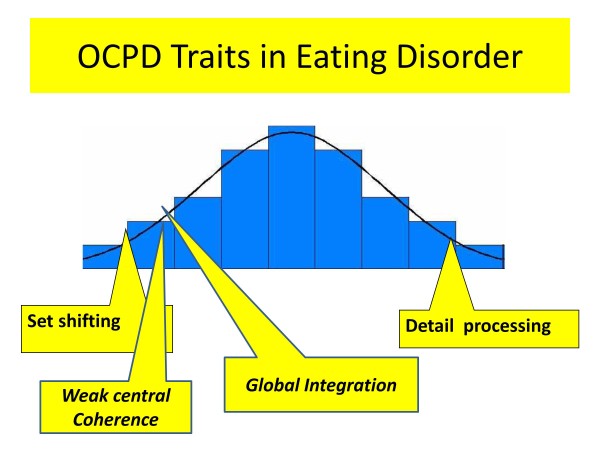
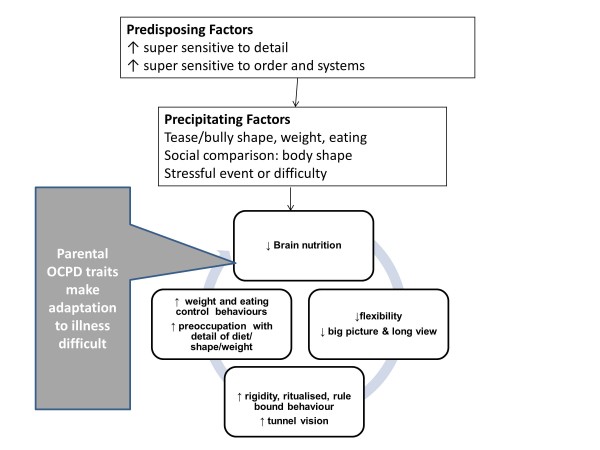
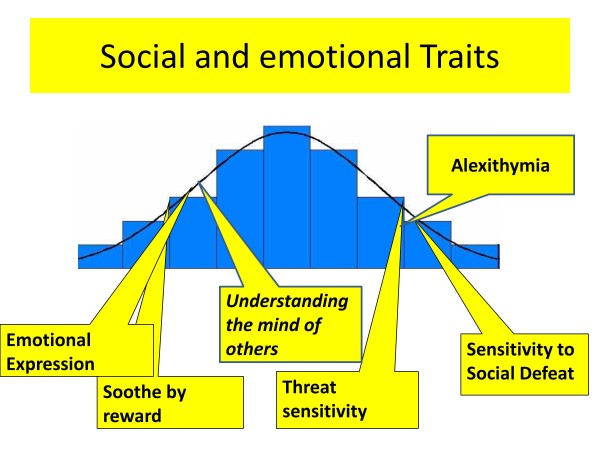
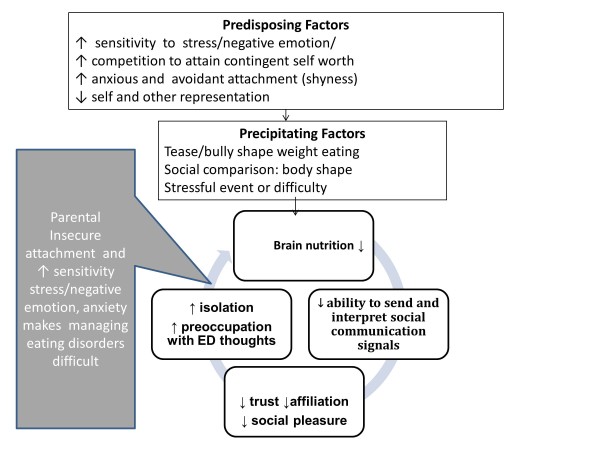
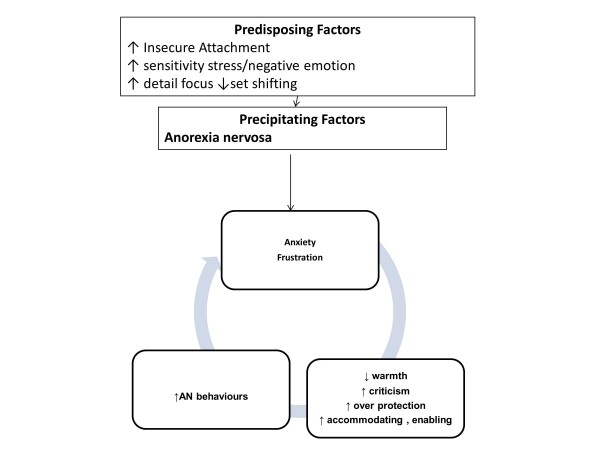
AIM: To describe the evidence base relating to the Cognitive-Interpersonal Maintenance Model for anorexia nervosa (AN). BACKGROUND: A Cognitive-Interpersonal Maintenance Model maintenance model for anorexia nervosa was described in 2006. This model proposed that cognitive, socio-emotional and interpersonal elements acted together to both cause and maintain eating disorders. METHOD: A review of the empirical literature relating to the key constructs of the model (cognitive, socio-emotional, interpersonal) risk and maintaining factors for anorexia nervosa was conducted. RESULTS: Set shifting and weak central coherence (associated with obsessive compulsive traits) have been widely studied. There is some evidence to suggest that a strong eye for detail and weak set shifting are inherited vulnerabilities to AN. Set shifting and global integration are impaired in the ill state and contribute to weak central coherence. In addition, there are wide-ranging impairments in socio-emotional processing including: an automatic bias in attention towards critical and domineering faces and away from compassionate faces; impaired signalling of, interpretation and regulation of emotions. Difficulties in social cognition may in part be a consequence of starvation but inherited vulnerabilities may also contribute to these traits. The shared familial traits may accentuate family members' tendency to react to the frustrating and frightening symptoms of AN with high expressed emotion (criticism, hostility, overprotection), and inadvertently perpetuate the problem. CONCLUSION: The cognitive interpersonal model is supported by accumulating evidence. The model is complex in that cognitive and socio-emotional factors both predispose to the illness and are exaggerated in the ill state. Furthermore, some of the traits are inherited vulnerabilities and are present in family members. The clinical formulations from the model are described as are new possibilities for targeted treatment.
Overview
The claims and statistics of this paper haven’t been checked yet.
Run the check — free, no account needed. It reads the open-access text and checks the sources it cites.
Integrity signals
Registry
Cites
Statistics
Figures
Verification
Claims the paper makes
The claims and statistics of this paper haven’t been checked yet.
Run the check — free, no account needed. It reads the open-access text and checks the sources it cites.
Claims other papers make about this one
Each is checked against this paper’s own text: does it say what the citing paper says it does?
The cited source says what the claim attributes to it.
In the citing paper
“These interpersonal difficulties may contribute to the high levels of social withdrawal and isolation that patients with AN often report.”
From Do anxiety, depression, and intolerance of uncertainty contribute to social problem solving in adult women with anorexia nervosa? (2020) · cites this paper as Treasure & Schmidt, 2013
The cited source says what the claim attributes to it.
In the citing paper
“In conclusion, this study has shown that one of the factors underlying the interpersonal maintaining factors of AN (Fairburn, 2008; Treasure & Schmidt, 2013) might be suboptimal social problem solving skills and these inefficient skills may be due to anxiety and high IU, which could be ameliorated in treatment as a means of better supporting the social and cognitive skills of people with AN.”
From Do anxiety, depression, and intolerance of uncertainty contribute to social problem solving in adult women with anorexia nervosa? (2020) · cites this paper as Treasure & Schmidt, 2013
Self-check
Percentages, sums and reported differences re-computed from the paper’s own numbers.
The self-check needs the paper’s full text.
Citations
Cites
Developing and evaluating complex interventions: the new Medical Research Council guidance
Craig, P., Dieppe, P., Macintyre, S., Michie, S., Nazareth, I., & Petticrew, M. (2008) · BMJ · doi:10.1136/bmj.a1655 · Cited by 10,995 · cited 1×
“The Medical Research Council (MRC) has developed guidelines on the development of complex interventions as it is acknowledged that they entail unique challenges [7].”
Gómez, J. G., & Dally, P. (1979) · Cited by 1,965
Oxytocin and vasopressin in the human brain: social neuropeptides for translational medicine
Meyer-Lindenberg, A., Domes, G., Kirsch, P., & Heinrichs, M. (2011) · Nature Reviews Neuroscience · doi:10.1038/nrn3044 · Cited by 1,688
Jacobi, C., Hayward, C., de Zwaan, M., KRAEMER, H. C., & Agras, W. S. (2004) · Psychological Bulletin · doi:10.1037/0033-2909.130.1.19 · Cited by 1,514
Lock, J., Le Grange, D., Agras, W. S., Moye, A., Bryson, S. W., & Jo, B. (2010) · Archives of General Psychiatry · doi:10.1001/archgenpsychiatry.2010.128 · Cited by 866
Cognitive Bias Modification Approaches to Anxiety
MacLeod, C., & Mathews, A. (2012) · Annual Review of Clinical Psychology · doi:10.1146/annurev-clinpsy-032511-143052 · Cited by 664
Risk Factors for Anorexia Nervosa
Fairburn, C. G., Cooper, Z., Doll, H., & Welch, S. L. (1999) · Archives of General Psychiatry · doi:10.1001/archpsyc.56.5.468 · Cited by 642
Social complexity as a proximate and ultimate factor in communicative complexity
Freeberg, T. M., Dunbar, R., & Ord, T. J. (2012) · Philosophical Transactions of the Royal Society B Biological Sciences · doi:10.1098/rstb.2011.0213 · Cited by 587
Harrison, A., Sullivan, S. A., Tchanturia, K., & Treasure, J. L. (2010) · Psychological Medicine · doi:10.1017/s0033291710000036 · Cited by 535
Self-citationAppearance-related teasing, body dissatisfaction, and disordered eating: A meta-analysis
Menzel, J. E., Schaefer, L. M., Burke, N. L., Mayhew, L. L., Brannick, M. Τ., & Thompson, J. K. (2010) · Body Image · doi:10.1016/j.bodyim.2010.05.004 · Cited by 453
Cited by
Sorted by citations
Items 101–200 of 645
Why Study Positive Emotions in the Context of Eating Disorders?
Tchanturia, K., Dapelo, M. M., Harrison, A., & Hambrook, D. G. (2014) · Current Psychiatry Reports · doi:10.1007/s11920-014-0537-x · Cited by 54
Social cognition in female adults with Anorexia Nervosa: A systematic review
Tauro, J. L., Wearne, T. A., Belevski, B., Filipčíková, M., & Francis, H. (2021) · Neuroscience & Biobehavioral Reviews · doi:10.1016/j.neubiorev.2021.11.035 · Cited by 50
Bentz, M., Jepsen, J. R. M., Telléus, G. K., Moslet, U., Pedersen, T., Bulik, C. M., & Plessen, K. J. (2017) · Journal of Eating Disorders · doi:10.1186/s40337-017-0137-3 · Cited by 46
Impact of Cognitive Remediation Therapy on Neurocognitive Processing in Anorexia Nervosa
Leppänen, J., Adamson, J., & Tchanturia, K. (2018) · Frontiers in Psychiatry · doi:10.3389/fpsyt.2018.00096 · Cited by 50
Orthorexic tendencies are linked with difficulties with emotion identification and regulation
Vuillier, L., Robertson, S., & Greville-Harris, M. (2020) · Journal of Eating Disorders · doi:10.1186/s40337-020-00291-7 · Cited by 46
Empirical examination of the interpersonal maintenance model of anorexia nervosa
Goddard, E., Salerno, L., Hibbs, R., Raenker, S., Naumann, U., Arcelus, J., Ayton, A. K., Boughton, D. N., Connan, F., Goss, D. K., et al. (2013) · International Journal of Eating Disorders · doi:10.1002/eat.22172 · Cited by 45
Self-citationBrooks, S. J. (2016) · BMC Psychiatry · doi:10.1186/s12888-016-0714-z · Cited by 48
Neural differences in self-perception during illness and after weight-recovery in anorexia nervosa
McAdams, C. J., Jeon-Slaughter, H., Evans, S., Lohrenz, T., Montague, P. R., & Krawczyk, D. C. (2016) · Social Cognitive and Affective Neuroscience · doi:10.1093/scan/nsw092 · Cited by 40
Emotion Recognition Abilities in Adults with Anorexia Nervosa are Associated with Autistic Traits
Kerr‐Gaffney, J., Mason, L., Jones, E. J. H., Hayward, H., Ahmad, J., Harrison, A., Loth, E., Murphy, D., & Tchanturia, K. (2020) · Journal of Clinical Medicine · doi:10.3390/jcm9041057 · Cited by 45
Truttmann, S., Philipp, J., Zeiler, M. D., Franta, C., Wittek, T., Merl, E., Schöfbeck, G., Koubek, D., Laczkovics, C., Imgart, H., et al. (2020) · Journal of Clinical Medicine · doi:10.3390/jcm9061912 · Cited by 45
Self-citationHarrison, A., Al-Khairulla, H., & Kikoler, M. (2016) · The Journal of Positive Psychology · doi:10.1080/17439760.2015.1117125 · Cited by 12
Simon, J. J., Stopyra, M. A., & Friederich, H. (2019) · Journal of Clinical Medicine · doi:10.3390/jcm8071047 · Cited by 46
Cassioli, E., Rossi, E., D’Anna, G., Martelli, M., Hazzard, V. M., Crosby, R. D., Wonderlich, S. A., Ricca, V., & Castellini, G. (2021) · International Journal of Eating Disorders · doi:10.1002/eat.23647 · Cited by 44
de Paoli, T., Fuller-Tyszkiewicz, M., Halliwell, E., Puccio, F., & Krug, I. (2017) · European eating disorders review · doi:10.1002/erv.2537 · Cited by 35
Oldershaw, A., Lavender, T., & Schmidt, U. H. (2018) · European Eating Disorders Review · doi:10.1002/erv.2602 · Cited by 42
Self-citationLooking at the Figures: Visual Adaptation as a Mechanism for Body-Size and -Shape Misperception
Brooks, K. R., Mond, J., Mitchison, D., Stevenson, R. J., Challinor, K. L., & Stephen, I. D. (2019) · Perspectives on Psychological Science · doi:10.1177/1745691619869331 · Cited by 50
Wonderlich, J. A., Bershad, M., & STEINGLASS, J. E. (2021) · Neuropsychiatric Disease and Treatment · doi:10.2147/ndt.s282554 · Cited by 47
Cardi, V., Esposito, M., Clarke, A., Schifano, S., & Treasure, J. L. (2014) · Appetite · doi:10.1016/j.appet.2014.12.224 · Cited by 46
Self-citationPerception of Peripersonal and Interpersonal Space in Patients with Restrictive‐type Anorexia
Nandrino, J., Ducro, C., Iachini, T., & Coello, Y. (2017) · European Eating Disorders Review · doi:10.1002/erv.2506 · Cited by 41
Treasure, J. L., & Cardi, V. (2017) · European Eating Disorders Review · doi:10.1002/erv.2511 · Cited by 46
Self-citationWang, S. B., Pisetsky, E. M., Skutch, J. M., Fruzzetti, A. E., & Haynos, A. F. (2018) · Comprehensive Psychiatry · doi:10.1016/j.comppsych.2018.02.005 · Cited by 41
van Passel, B., Danner, U. N., Dingemans, A. E., Aarts, E., Sternheim, L. C., Becker, E. S., Elburg, A. A. V., van Furth, E. F., Hendriks, G., & Cath, D. C. (2020) · Psychotherapy and Psychosomatics · doi:10.1159/000505733 · Cited by 45
Looking beneath the surface: Distinguishing between common features in autism and anorexia nervosa
Kinnaird, E., & Tchanturia, K. (2020) · Journal of Behavioral and Cognitive Therapy · doi:10.1016/j.jbct.2020.09.001 · Cited by 41
Lang, K., Dapelo, M. M., Khondoker, M. R., Morris, R. G., Surguladze, S., Treasure, J. L., & Tchanturia, K. (2015) · European Eating Disorders Review · doi:10.1002/erv.2358 · Cited by 43
Self-citationEmotional development in eating disorders: A qualitative metasynthesis
Henderson, Z. B., Fox, J. R. E., Trayner, P., & Wittkowski, A. (2019) · Clinical Psychology & Psychotherapy · doi:10.1002/cpp.2365 · Cited by 39
An updated transdiagnostic review of social cognition and eating disorder psychopathology.
Mason, T. B., Lesser, E. L., Dolgon-Krutolow, A., Wonderlich, S., & Smith, K. E. (2020) · Journal of Psychiatric Research · doi:10.1016/j.jpsychires.2020.11.019 · Cited by 31
Cultural shifts in the symptoms of Anorexia Nervosa: The case of Orthorexia Nervosa
Bhattacharya, A., Cooper, M., McAdams, C. J., Peebles, R., & Timko, C. A. (2021) · Appetite · doi:10.1016/j.appet.2021.105869 · Cited by 46
Lang, K., Treasure, J. L., & Tchanturia, K. (2015) · The World Journal of Biological Psychiatry · doi:10.3109/15622975.2015.1112035 · Cited by 39
Self-citationAdamson, J., Leppanen, J., Murin, M., & Tchanturia, K. (2018) · European Eating Disorders Review · doi:10.1002/erv.2594 · Cited by 38
The Neuropsychology of Starvation: Set-Shifting and Central Coherence in a Fasted Nonclinical Sample
Pender, S., Gilbert, S. J., & Serpell, L. (2014) · PLoS ONE · doi:10.1371/journal.pone.0110743 · Cited by 39
Diminished facial emotion expression and associated clinical characteristics in Anorexia Nervosa
Lang, K., Larsson, E. E. C., Mavromara, L., Simic, M., Treasure, J. L., & Tchanturia, K. (2015) · Psychiatry Research · doi:10.1016/j.psychres.2015.12.004 · Cited by 38
Self-citationPerfectionism and Eating Disorders
Wade, T. D., O’Shea, A. E., & Shafran, R. (2015) · Springer eBooks · doi:10.1007/978-3-319-18582-8_9 · Cited by 49
Effects of Intranasal Oxytocin on the Interpretation and Expression of Emotions in Anorexia Nervosa
Leppänen, J., Cardi, V., Ng, K. W., Paloyelis, Y., Stein, D. J., Tchanturia, K., & Treasure, J. L. (2017) · Journal of Neuroendocrinology · doi:10.1111/jne.12458 · Cited by 42
Self-citationAdamson, J., Cardi, V., Kan, C., Harrison, A., Macdonald, P., & Treasure, J. L. (2019) · International Review of Psychiatry · doi:10.1080/09540261.2019.1573721 · Cited by 38
Self-citationLose, A., Davies, C., Renwick, B., Kenyon, M., Treasure, J. L., Schmidt, U. H., & on behalf of the MOSAIC trial group (2014) · European Eating Disorders Review · doi:10.1002/erv.2279 · Cited by 36
Self-citationLang, K., Treasure, J. L., & Tchanturia, K. (2014) · Psychiatry Research · doi:10.1016/j.psychres.2014.12.008 · Cited by 36
Self-citationCognitive performance in children with acute early-onset anorexia nervosa
van Noort, B. M., Pfeiffer, E. F., Ehrlich, S., Lehmkuhl, U., & Kappel, V. (2016) · European Child & Adolescent Psychiatry · doi:10.1007/s00787-016-0847-0 · Cited by 36
Interoception and Autonomic Correlates during Social Interactions. Implications for Anorexia
Ambrosecchia, M., Ardizzi, M., Russo, E. C., Ditaranto, F., Speciale, M., Vinai, P., Todisco, P., Maestro, S., & Gallese, V. (2017) · Frontiers in Human Neuroscience · doi:10.3389/fnhum.2017.00219 · Cited by 43
Kästner, D., Löwe, B., Weigel, A., Osen, B., Voderholzer, U., & Gumz, A. (2018) · BMC Health Services Research · doi:10.1186/s12913-017-2800-4 · Cited by 37
Living with someone with an eating disorder: factors affecting the caregivers’ burden
Stefanini, M. C., Troiani, M. R., Caselli, M., Dirindelli, P., Lucarelli, S., Caini, S., & Martinetti, M. G. (2018) · Eating and Weight Disorders - Studies on Anorexia Bulimia and Obesity · doi:10.1007/s40519-018-0480-7 · Cited by 36
Kerr‐Gaffney, J., Harrison, A., & Tchanturia, K. (2020) · European Eating Disorders Review · doi:10.1002/erv.2736 · Cited by 40
Hannah, L. A., Cross, M., Baily, H., Grimwade, K., Clarke, T., & Allan, S. M. (2021) · Eating and Weight Disorders - Studies on Anorexia Bulimia and Obesity · doi:10.1007/s40519-021-01338-7 · Cited by 36
Turton, R., Cardi, V., Treasure, J. L., & Hirsch, C. R. (2017) · Journal of Affective Disorders · doi:10.1016/j.jad.2017.11.089 · Cited by 34
Self-citationHippocampal volume, function, and related molecular activity in anorexia nervosa: A scoping review
Keeler, J. L., Patsalos, O., Thuret, S., Ehrlich, S., Tchanturia, K., Himmerich, H., & Treasure, J. L. (2020) · Expert Review of Clinical Pharmacology · doi:10.1080/17512433.2020.1850256 · Cited by 35
Self-citationDuriez, P., Lefèvre, H., Lodovico, L. D., Viltart, O., & Gorwood, P. A. P. M. (2021) · European Eating Disorders Review · doi:10.1002/erv.2829 · Cited by 44
Brochu, J. P., Meilleur, D., Meglio, G. D., Taddeo, D., Lavoie, É., Erdstein, J., Pauzé, R., Pesant, C., Thibault, I., & Frappier, J. (2018) · Eating Disorders · doi:10.1080/10640266.2018.1454806 · Cited by 35
Anorexia Nervosa, Autism, and the ADOS: How Appropriate Is the New Algorithm in Identifying Cases?
Sedgewick, F., Kerr-Gaffney, J., Leppanen, J., & Tchanturia, K. (2019) · Frontiers in Psychiatry · doi:10.3389/fpsyt.2019.00507 · Cited by 34
Enduring Changes in Decision Making in Patients with Full Remission from Anorexia Nervosa
Steward, T., Mestre‐Bach, G., Agüera, Z., Granero, R., Martín‐Romera, V., Sánchez, I., Riesco, N., Tolosa‐Sola, I., Fernández‐Formoso, J. A., Fernández‐García, J. C., et al. (2016) · European Eating Disorders Review · doi:10.1002/erv.2472 · Cited by 34
Griffiths, S., Mitchison, D., Murray, S. B., Mond, J. M., & Bastian, B. B. (2018) · International Journal of Eating Disorders · doi:10.1002/eat.22932 · Cited by 33
Robinson, I., Stoyel, H., & Robinson, P. H. (2020) · European Eating Disorders Review · doi:10.1002/erv.2780 · Cited by 40
Grey matter correlates of autistic traits in women with anorexia nervosa
Björnsdotter, M., Davidovic, M., Karjalainen, L., Starck, G., Olausson, H., & Wentz, E. (2018) · Journal of Psychiatry and Neuroscience · doi:10.1503/jpn.170072 · Cited by 32
Harrison, A., Stavri, P., Ormond, L., McEnemy, F., Akyol, D., Qureshi, A., & Al‐Khairulla, H. (2018) · European Eating Disorders Review · doi:10.1002/erv.2584 · Cited by 33
Steding, J., Boehm, I., King, J. A., Geisler, D., Ritschel, F., Seidel, M., Doose, A., Jaite, C., Roessner, V., Smolka, M. N., et al. (2019) · Scientific Reports · doi:10.1038/s41598-019-49884-6 · Cited by 37
Monteleone, A. M., Cascino, G., Barone, E., Carfagno, M., & Monteleone, P. (2021) · Current Psychiatry Reports · doi:10.1007/s11920-021-01294-0 · Cited by 31
Trail Making Task Performance in Inpatients with Anorexia Nervosa and Bulimia Nervosa
Vall, E., & Wade, T. D. (2015) · European Eating Disorders Review · doi:10.1002/erv.2364 · Cited by 35
Benefits of group cognitive remediation therapy in anorexia nervosa: case series
Tchanturia, K., Larsson, E. E. C., & Brown, A. (2016) · Neuropsychiatrie · doi:10.1007/s40211-016-0177-y · Cited by 32
Field, S. L., Fox, J. R. E., Jones, C. R. G., & Williams, M. O. (2023) · Journal of Eating Disorders · doi:10.1186/s40337-023-00740-z · Cited by 34
The Early Cognitive Development of Children at High Risk of Developing an Eating Disorder
Kothari, R., Rosińska, M., Treasure, J. L., & Micali, N. (2013) · European Eating Disorders Review · doi:10.1002/erv.2274 · Cited by 31
Self-citationGiombini, L., Moynihan, J., Turco, M., & Nesbitt, S. (2016) · Eating and Weight Disorders - Studies on Anorexia Bulimia and Obesity · doi:10.1007/s40519-016-0322-4 · Cited by 33
The Role of Self-Compassion in Recovery from Substance Use Disorders
Chen, G. (2019) · OBM Integrative and Complementary Medicine · doi:10.21926/obm.icm.1902026 · Cited by 32
Sproch, L. E., Anderson, K. P., Sherman, M. F., Crawford, S. F., & Brandt, H. (2019) · International Journal of Eating Disorders · doi:10.1002/eat.23143 · Cited by 31
Philipp, J., Franta, C., Zeiler, M. D., Truttmann, S., Wittek, T., Imgart, H., Zanko, A., Auer‐Welsbach, E., Mairhofer, D., Mitterer, M., et al. (2021) · International Journal of Environmental Research and Public Health · doi:10.3390/ijerph18094656 · Cited by 30
Self-citationLevinson, C. A., Brosof, L. C., Vanzhula, I. A., Bumberry, L., Zerwas, S. C., & Bulik, C. M. (2017) · European Eating Disorders Review · doi:10.1002/erv.2557 · Cited by 32
Elzakkers, I. F. F. M., Danner, U. N., Grisso, T., Hoek, H. W., & van Elburg, A. A. (2018) · International Journal of Law and Psychiatry · doi:10.1016/j.ijlp.2018.02.001 · Cited by 30
Treating the individual: moving towards personalised eating disorder care
Bryant, E., Marks, P., Griffiths, K. R., Boulet, S., Pehlivan, M., Barakat, S., Touyz, S. W., & Maguire, S. (2025) · Journal of Eating Disorders · doi:10.1186/s40337-025-01246-6 · Cited by 38
Schmidt, U. H., Sharpe, H., Bartholdy, S., Bonin, E., Davies, H. A., Easter, A., Goddard, E., Hibbs, R., House, J., Keyes, A., et al. (2017) · Programme Grants for Applied Research · doi:10.3310/pgfar05160 · Cited by 34
Self-citationAnorexia nervosa and autism: a prospective twin cohort study
Dinkler, L., Taylor, M. J., Råstam, M., Hadjikhani, N. K., Bulik, C. M., Lichtenstein, P., Gillberg, C., & Lundström, S. (2020) · Journal of Child Psychology and Psychiatry · doi:10.1111/jcpp.13265 · Cited by 33
Philipp, J., Truttmann, S., Zeiler, M. D., Franta, C., Wittek, T., Schöfbeck, G., Mitterer, M., Mairhofer, D., Zanko, A., Imgart, H., et al. (2020) · Journal of Clinical Medicine · doi:10.3390/jcm9072021 · Cited by 30
Self-citationLockertsen, V., Holm, L. A. W., Nilsen, L., Rø, Ø., Burger, L. M., & Røssberg, J. I. (2021) · Journal of Eating Disorders · doi:10.1186/s40337-021-00404-w · Cited by 30
Riquin, É., Raynal-Tacquet, A., Mattar, L., Lalanne, C., Hirot, F., Huas, C., Duclos, J., Berthoz, S., Godart, N. T., & EVHAN group (2021) · Frontiers in Psychiatry · doi:10.3389/fpsyt.2021.658416 · Cited by 30
Predicting intolerance of uncertainty in individuals with eating disorder symptoms
Sternheim, L. C., Fisher, M., Harrison, A., & Watling, R. (2017) · Journal of Eating Disorders · doi:10.1186/s40337-017-0152-4 · Cited by 30
An exploratory study of evoked facial affect in adolescent females with anorexia nervosa
Rhind, C., Mandy, W., Treasure, J. L., & Tchanturia, K. (2014) · Psychiatry Research · doi:10.1016/j.psychres.2014.07.057 · Cited by 32
Self-citationMcEvoy, P. M., Targowski, K., McGrath, D., Carter, O., Fursland, A., Fitzgerald, M., & Raykos, B. C. (2019) · International Journal of Eating Disorders · doi:10.1002/eat.23121 · Cited by 28
Chami, R., Cardi, V., Lautarescu, A., Mallorquí‐Bagué, N., & McLoughlin, G. (2019) · International Review of Psychiatry · doi:10.1080/09540261.2019.1622515 · Cited by 29
Anorexia nervosa, zinc deficiency and the glutamate system: The ketamine option
Hermens, D. F., Simcock, G. P., Dutton, M., Bouças, A. P., Can, A., Lilley, C. J., & Lagopoulos, J. (2020) · Progress in Neuro-Psychopharmacology and Biological Psychiatry · doi:10.1016/j.pnpbp.2020.109921 · Cited by 30
Wittek, T., Truttmann, S., Zeiler, M. D., Philipp, J., Auer‐Welsbach, E., Koubek, D., Ohmann, S., Werneck‐Rohrer, S., Sackl‐Pammer, P., Schöfbeck, G., et al. (2021) · Journal of Eating Disorders · doi:10.1186/s40337-021-00387-8 · Cited by 29
Self-citationDuarte, C., Ferreira, C., Trindade, I. A., & Pinto‐Gouveia, J. (2015) · Eating and Weight Disorders - Studies on Anorexia Bulimia and Obesity · doi:10.1007/s40519-015-0212-1 · Cited by 37
Rhind, C., Hibbs, R., Goddard, E., Schmidt, U. H., Micali, N., Gowers, S., Beecham, J. K., Macdonald, P., Todd, G., Tchanturia, K., et al. (2014) · European Eating Disorders Review · doi:10.1002/erv.2298 · Cited by 29
Self-citationCardi, V., Ambwani, S., Crosby, R. D., Macdonald, P., Todd, G., Park, S. J., Moss, S. A., Schmidt, U. H., & Treasure, J. L. (2015) · Trials · doi:10.1186/s13063-015-0701-6 · Cited by 31
Self-citationMartinez, M. A., & Craighead, L. W. (2015) · Clinical Psychology Science and Practice · doi:10.1111/cpsp.12111 · Cited by 29
Facial Emotion Recognition Abilities in Women Experiencing Eating Disorders
Wyssen, A., Lao, J., Rodger, H., Humbel, N., Lennertz, J., Schuck, K., Isenschmid, B., Milos, G. F., Trier, S. N., Whinyates, K., et al. (2019) · Psychosomatic Medicine · doi:10.1097/psy.0000000000000664 · Cited by 29
Sedgewick, F., Leppänen, J., Goh, F., Hayward, H., Happe, F. G. E., & Tchanturia, K. (2019) · Frontiers in Psychiatry · doi:10.3389/fpsyt.2019.00318 · Cited by 28
Kerr‐Gaffney, J., Harrison, A., & Tchanturia, K. (2020) · Journal of Affective Disorders · doi:10.1016/j.jad.2020.01.169 · Cited by 31
Dimitropoulos, G., Landers, A. L., Freeman, V., Novick, J., Schmidt, U. H., & Olmsted, M. P. (2019) · European Eating Disorders Review · doi:10.1002/erv.2678 · Cited by 28
Self-citationConceptualisation of severe and enduring anorexia nervosa: a qualitative meta-synthesis
Kiely, L., Conti, J., & Hay, P. (2023) · BMC Psychiatry · doi:10.1186/s12888-023-05098-9 · Cited by 27
“The therapist sees the person: A recent treatment innovation Maudsley Model for Anorexia Nervosa Treatment for adults (MANTRA) has been founded on a comprehensive theoretical basis of a cognitive-interpersonal model of maintenance [95].”
BackgroundMacdonald, P., Rhind, C., Hibbs, R., Goddard, E., Raenker, S., Todd, G., Schmidt, U. H., & Treasure, J. L. (2014) · European Eating Disorders Review · doi:10.1002/erv.2320 · Cited by 27
Self-citationSevere and Enduring Anorexia Nervosa: Enduring Wrong Assumptions?
Gutiérrez, E., & Carrera, O. (2021) · Frontiers in Psychiatry · doi:10.3389/fpsyt.2020.538997 · Cited by 27
Cognitive flexibility, central coherence, and quality of life in anorexia nervosa
Brockmeyer, T., Febry, H., Leiteritz-Rausch, A., Wünsch‐Leiteritz, W., Leiteritz, A., & Friederich, H. (2022) · Journal of Eating Disorders · doi:10.1186/s40337-022-00547-4 · Cited by 31
Shame, Guilt, and Self-Consciousness in Anorexia Nervosa
Panero, M., Longo, P., Bacco, C. D., Daga, G. A., & Martini, M. (2022) · Journal of Clinical Medicine · doi:10.3390/jcm11226683 · Cited by 29
Foye, U., Hazlett, D. E., & Irving, P. (2018) · Eating Disorders · doi:10.1080/10640266.2018.1517520 · Cited by 26
Exploring the Experiences of Women Who Develop Restrictive Eating Behaviours After Bariatric Surgery
Watson, C., Riazi, A., & Ratcliffe, D. (2020) · Obesity Surgery · doi:10.1007/s11695-020-04424-4 · Cited by 26
Sternheim, L. C., van Passel, B., Dingemans, A. E., Cath, D. C., & Danner, U. N. (2022) · Frontiers in Psychiatry · doi:10.3389/fpsyt.2022.868921 · Cited by 24
Increased Set Shifting Costs in Fasted Healthy Volunteers
Bolton, H., Burgess, P. W., Gilbert, S. J., & Serpell, L. (2014) · PLoS ONE · doi:10.1371/journal.pone.0101946 · Cited by 29
van Passel, B., Danner, U. N., Dingemans, A. E., van Furth, E. F., Sternheim, L. C., Elburg, A. A. V., van Minnen, A., van den Hout, M., Hendriks, G., & Cath, D. C. (2016) · BMC Psychiatry · doi:10.1186/s12888-016-1109-x · Cited by 29
Sternheim, L., Danner, U., van Elburg, A., & Harrison, A. (2020) · Brain and Behavior · doi:10.1002/brb3.1588 · Cited by 24
“This social avoidance has been hypothesized to function as a way to reduce the negative emotions that are triggered by social interactions and interpersonal relationships (Treasure & Schmidt, 2013).”
BackgroundMicali, N., Kothari, R., Nam, K. W., Gioroukou, E., Walshe, M., Allin, M. P. G., Rifkin, L., Murray, R. M., & Nosarti, C. (2015) · European Eating Disorders Review · doi:10.1002/erv.2346 · Cited by 25
Harrison, A., Watterson, S. V., & Bennett, S. D. (2018) · International Journal of Eating Disorders · doi:10.1002/eat.22993 · Cited by 25
Rowlands, K., Beaty, T., Simic, M., Grafton, B., Hirsch, C. R., Treasure, J. L., & Cardi, V. (2022) · International Journal of Eating Disorders · doi:10.1002/eat.23809 · Cited by 25
Self-citationMiles, S., Nedeljkovic, M., & Phillipou, A. (2023) · Eating Disorders · doi:10.1080/10640266.2023.2206751 · Cited by 34
Waterman‐Collins, D., Renwick, B., Lose, A., Kenyon, M., Serpell, L., Richards, L. M., Boughton, N., Treasure, J. L., Schmidt, U. H., & on behalf of the MOSAIC trial group (2014) · European Eating Disorders Review · doi:10.1002/erv.2278 · Cited by 25
Self-citation
Metadata
- Authors
- Treasure, J., & Schmidt, U.
- Affiliations
- King's College London (GB)
- Corresponding author
- Treasure, Janet
- Venue
- Journal of Eating Disorders
- Published
- 2013-04-15
- Volume
- 1
- Issue
- 1
- Pages
- 13-13
- ISSN
- 2050-2974 (ISSN-L)
- PMC
- PMC4081714
- OpenAlex
- W2128692360
- Cited by
- 646
- References
- 88
- Citations by year
- 2026: 30 · 2025: 53 · 2024: 51 · 2023: 48 · 2022: 58 · 2021: 66 · 2020: 71 · 2019: 46 · 2018: 43 · 2017: 47 · 2016: 45 · 2015: 46 · 2014: 31 · 2013: 9
- FWCI
- 6.45
- Type
- journal article
- Language
- en
- Open access
- gold
- doi.org
- Licence
- Locations
- Journal of Eating Disorders (publishedVersion, cc-by)
- Europe PMC (PubMed Central) (publishedVersion, cc-by)
- PubMed Central (publishedVersion, cc-by)
- PubMed (publishedVersion)
- Research Portal (King's College London) (publishedVersion, other-oa)
- Funders
- National Institute for Health and Care Research (RP-PG-0606-1043)
- Topics
- Social Sciences › Psychology › Clinical Psychology › Eating Disorders and Behaviors
- Social Sciences › Psychology › Experimental and Cognitive Psychology › Anxiety, Depression, Psychometrics, Treatment, Cognitive Processes
- Health Sciences › Nursing › Nutrition and Dietetics › Nutrition, Health and Food Behavior
- Keywords
- anorexia nervosa, risk factors, maintaining factors, set-shifting, weak central coherence, obsessive-compulsive traits, socio-emotional processing, emotion regulation, social cognition, expressed emotion, family vulnerability
About these checks
Registry, retraction, Cites and statistics results are computed, not judged, with one exception: a printed reference that no index lists is read once by a model before it counts as a citation error. Claims are extracted by a model and kept only when their quote appears verbatim in the text; each cited source is then checked, with a model’s help, for whether it says what the claim relies on. Those verdicts can be wrong — read the claim’s quote and the cited source before relying on one.
Statistics and arithmetic are recomputed, not judged.
Confidence bands are shown only for fields calibrated on our annotated test set. None is calibrated yet, so no band is shown.
What counts as a claim ›How we measure confidence ›How we check this ›
Are you an author, or do you see a problem with this page? Request a review
