

The DOI matches its Crossref record; 87 of the 88 references it cites were found in a registry or an index.
The cognitive-interpersonal maintenance model of anorexia nervosa revisited: a summary of the evidence for cognitive, socio-emotional and interpersonal predisposing and perpetuating factors
Open accessAbstract
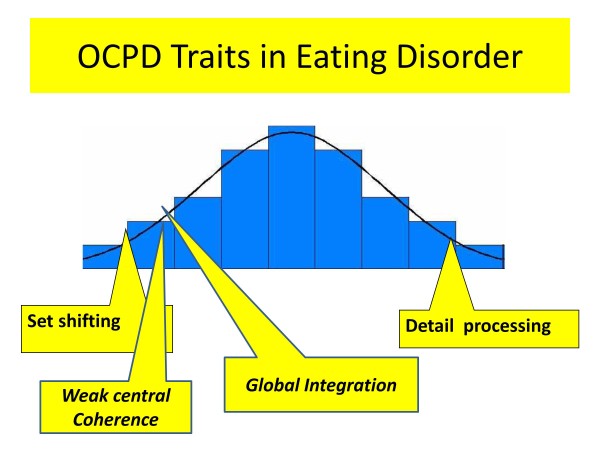
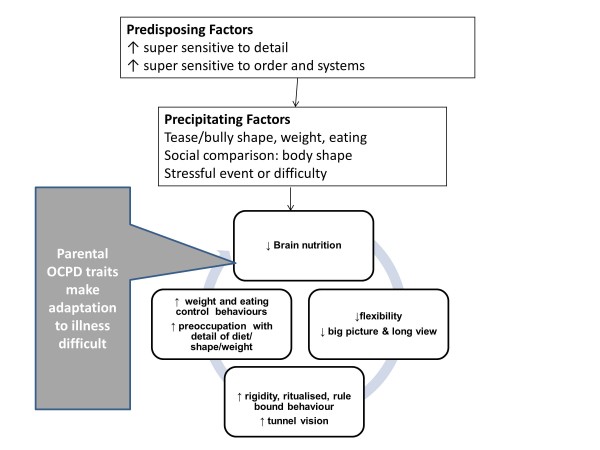
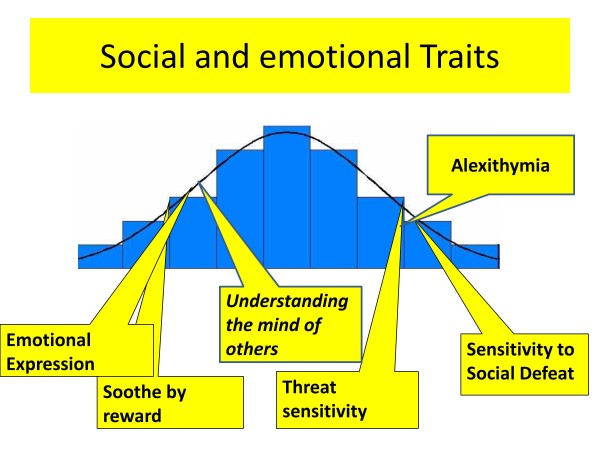
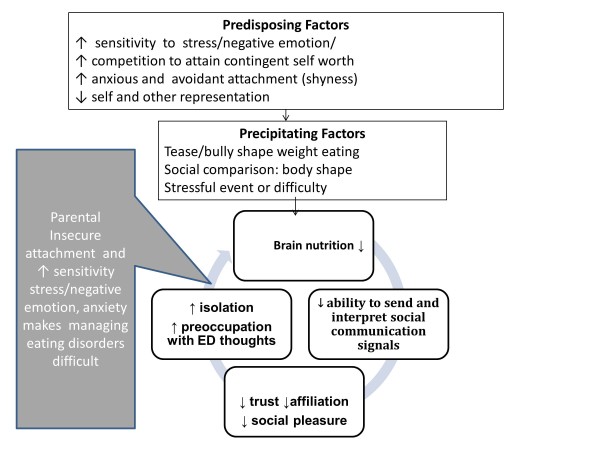
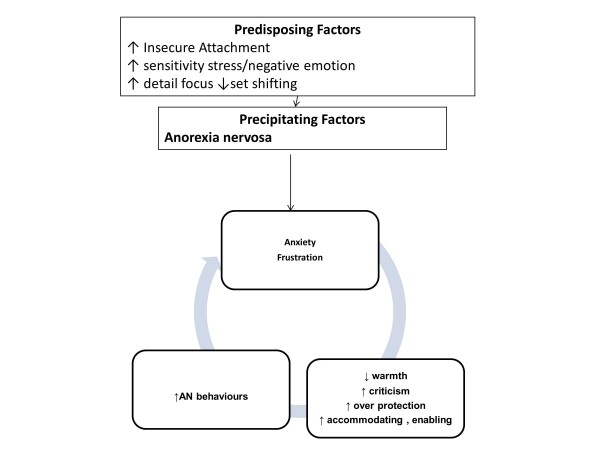
AIM: To describe the evidence base relating to the Cognitive-Interpersonal Maintenance Model for anorexia nervosa (AN). BACKGROUND: A Cognitive-Interpersonal Maintenance Model maintenance model for anorexia nervosa was described in 2006. This model proposed that cognitive, socio-emotional and interpersonal elements acted together to both cause and maintain eating disorders. METHOD: A review of the empirical literature relating to the key constructs of the model (cognitive, socio-emotional, interpersonal) risk and maintaining factors for anorexia nervosa was conducted. RESULTS: Set shifting and weak central coherence (associated with obsessive compulsive traits) have been widely studied. There is some evidence to suggest that a strong eye for detail and weak set shifting are inherited vulnerabilities to AN. Set shifting and global integration are impaired in the ill state and contribute to weak central coherence. In addition, there are wide-ranging impairments in socio-emotional processing including: an automatic bias in attention towards critical and domineering faces and away from compassionate faces; impaired signalling of, interpretation and regulation of emotions. Difficulties in social cognition may in part be a consequence of starvation but inherited vulnerabilities may also contribute to these traits. The shared familial traits may accentuate family members' tendency to react to the frustrating and frightening symptoms of AN with high expressed emotion (criticism, hostility, overprotection), and inadvertently perpetuate the problem. CONCLUSION: The cognitive interpersonal model is supported by accumulating evidence. The model is complex in that cognitive and socio-emotional factors both predispose to the illness and are exaggerated in the ill state. Furthermore, some of the traits are inherited vulnerabilities and are present in family members. The clinical formulations from the model are described as are new possibilities for targeted treatment.
Overview
The claims and statistics of this paper haven’t been checked yet.
Run the check — free, no account needed. It reads the open-access text and checks the sources it cites.
Integrity signals
Registry
Cites
Statistics
Figures
Verification
Claims the paper makes
The claims and statistics of this paper haven’t been checked yet.
Run the check — free, no account needed. It reads the open-access text and checks the sources it cites.
Claims other papers make about this one
Each is checked against this paper’s own text: does it say what the citing paper says it does?
The cited source says what the claim attributes to it.
In the citing paper
“These interpersonal difficulties may contribute to the high levels of social withdrawal and isolation that patients with AN often report.”
From Do anxiety, depression, and intolerance of uncertainty contribute to social problem solving in adult women with anorexia nervosa? (2020) · cites this paper as Treasure & Schmidt, 2013
The cited source says what the claim attributes to it.
In the citing paper
“In conclusion, this study has shown that one of the factors underlying the interpersonal maintaining factors of AN (Fairburn, 2008; Treasure & Schmidt, 2013) might be suboptimal social problem solving skills and these inefficient skills may be due to anxiety and high IU, which could be ameliorated in treatment as a means of better supporting the social and cognitive skills of people with AN.”
From Do anxiety, depression, and intolerance of uncertainty contribute to social problem solving in adult women with anorexia nervosa? (2020) · cites this paper as Treasure & Schmidt, 2013
Self-check
Percentages, sums and reported differences re-computed from the paper’s own numbers.
The self-check needs the paper’s full text.
Citations
Cites
Developing and evaluating complex interventions: the new Medical Research Council guidance
Craig, P., Dieppe, P., Macintyre, S., Michie, S., Nazareth, I., & Petticrew, M. (2008) · BMJ · doi:10.1136/bmj.a1655 · Cited by 10,995 · cited 1×
“The Medical Research Council (MRC) has developed guidelines on the development of complex interventions as it is acknowledged that they entail unique challenges [7].”
Gómez, J. G., & Dally, P. (1979) · Cited by 1,965
Oxytocin and vasopressin in the human brain: social neuropeptides for translational medicine
Meyer-Lindenberg, A., Domes, G., Kirsch, P., & Heinrichs, M. (2011) · Nature Reviews Neuroscience · doi:10.1038/nrn3044 · Cited by 1,688
Jacobi, C., Hayward, C., de Zwaan, M., KRAEMER, H. C., & Agras, W. S. (2004) · Psychological Bulletin · doi:10.1037/0033-2909.130.1.19 · Cited by 1,514
Lock, J., Le Grange, D., Agras, W. S., Moye, A., Bryson, S. W., & Jo, B. (2010) · Archives of General Psychiatry · doi:10.1001/archgenpsychiatry.2010.128 · Cited by 866
Cognitive Bias Modification Approaches to Anxiety
MacLeod, C., & Mathews, A. (2012) · Annual Review of Clinical Psychology · doi:10.1146/annurev-clinpsy-032511-143052 · Cited by 664
Risk Factors for Anorexia Nervosa
Fairburn, C. G., Cooper, Z., Doll, H., & Welch, S. L. (1999) · Archives of General Psychiatry · doi:10.1001/archpsyc.56.5.468 · Cited by 642
Social complexity as a proximate and ultimate factor in communicative complexity
Freeberg, T. M., Dunbar, R., & Ord, T. J. (2012) · Philosophical Transactions of the Royal Society B Biological Sciences · doi:10.1098/rstb.2011.0213 · Cited by 587
Harrison, A., Sullivan, S. A., Tchanturia, K., & Treasure, J. L. (2010) · Psychological Medicine · doi:10.1017/s0033291710000036 · Cited by 535
Self-citationAppearance-related teasing, body dissatisfaction, and disordered eating: A meta-analysis
Menzel, J. E., Schaefer, L. M., Burke, N. L., Mayhew, L. L., Brannick, M. Τ., & Thompson, J. K. (2010) · Body Image · doi:10.1016/j.bodyim.2010.05.004 · Cited by 453
Cited by
Sorted by citations
Items 501–600 of 645
Nader, L. A., Chammas, G., Chammas, M., Fekih‐Romdhane, F., Hallit, S. R., & Obeïd, S. (2026) · PLoS ONE · doi:10.1371/journal.pone.0340095 · Cited by 1
Leppänen, J., Bailey, O., Halls, D., Allen, K. L., Tchanturia, K., & Williams, S. (2026) · Translational Psychiatry · doi:10.1038/s41398-026-03819-8 · Cited by 3
Controversies and considerations in treating OCD in individuals with an eating disorder
Veale, D. M. (2026) · Journal of Obsessive-Compulsive and Related Disorders · doi:10.1016/j.jocrd.2026.101014 · Cited by 1
Lazzer, S., Mari, L., D’Alleva, M., Stafuzza, J., Zaccaron, S., Campigotto, N., Rejc, E., Tringali, G., Grimoldi, I., Micheli, R. D., et al. (2026) · Journal of Clinical Medicine · doi:10.3390/jcm15145738 · Cited by 1
Treasure, J. L. (2013) · Epidemiology and Psychiatric Sciences · doi:10.1017/s2045796013000528 · Cited by 1
Self-citationMitchell, S., Newton, R., Harrison, P., Castle, D. J., & Brennan, L. (2015) · Contemporary Clinical Trials · doi:10.1016/j.cct.2015.12.011 · Cited by 1
Eating Disorder Risk and Personality Factors in Adolescent Girls
Sălceanu, C. (2020) · Postmodern Openings · doi:10.18662/po/11.1sup1/128 · Cited by 1
Coleman, M., Jones, E. J., Hoiles, K. J., & McEvoy, P. M. (2022) · Eating Behaviors · doi:10.1016/j.eatbeh.2022.101628 · Cited by 1
Positive communication workshops: are they useful for treatment programmes for anorexia nervosa?
Tchanturia, K., Croft, P., Holetic, V., Webb, J., & Dapelo, M. M. (2023) · Frontiers in Psychology · doi:10.3389/fpsyg.2023.1234928 · Cited by 1
Clinical identification of a specific psychic envelope in families with anorexic symptoms
Naimi, M., & Sanahuja, A. (2024) · Family Process · doi:10.1111/famp.12963 · Cited by 1
Mansour, L., Rothschild‐Yakar, L., & Kurman, J. (2024) · Transcultural Psychiatry · doi:10.1177/13634615241227342 · Cited by 1
Kwan, M. Y., & Dodd, D. R. (2024) · European Eating Disorders Review · doi:10.1002/erv.3120 · Cited by 1
Carer Outcomes From a Residential Treatment Service for Eating Disorders
Day, S., Mitchison, D., Gill, K. H., Rankin, R. M., Tannous, K., & Hay, P. (2024) · European Eating Disorders Review · doi:10.1002/erv.3165 · Cited by 3
The Complex Interplay of Type 1 Diabetes and Eating Disorders
Partridge, H., Figueiredo, C., & Chapman, S. (2024) · Springer eBooks · doi:10.1007/978-3-031-46096-8_36 · Cited by 1
Thorsrud, T., Hjemdal, O., Thorsen, L., Micali, N., Dahlgren, C. L., & Weider, S. (2025) · Nutrients · doi:10.3390/nu17091460 · Cited by 1
Ruiz-Guerrero, F., del Barrio, A. G., de la Torre‐Luque, A., MacDowell, K. S., Beato‐Fernández, L., Fuentes, L. C., Ayad‐Ahmed, W., Mola-Cardenes, P., Carrasco-Díaz, Á., López‐Villatoro, J. M., et al. (2025) · Revista de Psiquiatría y Salud Mental · doi:10.1016/j.sjpmh.2025.04.002 · Cited by 1
Enduring changes in decision making in patients with full remission from anorexia nervosa
Steward, T., Mestre‐Bach, G., Agüera, Z., Granero, R., Martín‐Romera, V., Sánchez, I., Riesco, N., Jiménez‐Múrcia, S., & Fernández‐Aranda, F. (2017) · European Neuropsychopharmacology · doi:10.1016/s0924-977x(17)30135-9 · Cited by 1
Numata, N., Hirano, Y., Sutoh, C., Matsuzawa, D., Takeda, K., Setsu, R., Shimizu, E., & Nakazato, M. (2018) · Eating and Weight Disorders - Studies on Anorexia Bulimia and Obesity · doi:10.1007/s40519-018-0500-7 · Cited by 2
Neurological and Mental Disorders
Bernstam, V. A. (2019) · CRC Press eBooks · doi:10.1201/9780429187421-25 · Cited by 1
Ralph‐Nearman, C., Hooper, M. A., & Filik, R. (2021) · Cognition & Emotion · doi:10.1080/02699931.2021.1987862 · Cited by 1
Trastornos de la conducta alimentaria en niños y adolescentes
Hirot, F., Doyen, C., & Godart, N. T. (2022) · EMC - Tratado de Medicina · doi:10.1016/s1636-5410(22)46844-9 · Cited by 1
The Effects of Anorexia on Adolescents
(2023) · DHR Proceedings · doi:10.47488/dhrp.v3is2.92
Individual case formulation for post-traumatic stress disorder : a single case series
Griffiths, A. (2017) · Cited by 1
Evaluation of film stimuli for the assessment of social-emotional processingPreprint
Leppänen, J., Patsalos, O., Surguladze, S., Kerr‐Gaffney, J., Williams, S., & Tchanturia, K. (2021) · doi:10.31234/osf.io/625rd · Cited by 1
Berchio, C., Annen, L. C., Bouamoud, Y., & Micali, N. (2022) · bioRxiv (Cold Spring Harbor Laboratory) · doi:10.1101/2022.03.24.485666 · Cited by 1
Vuillier, L., Joseph, J., Greville-Harris, M., May, L., Sommerville, M., Harrison, A., & Rachel, L. M. (2022) · Research Square · doi:10.21203/rs.3.rs-1905788/v1 · Cited by 1
Touyz, S. W., & Hay, P. (2025) · Journal of Eating Disorders · doi:10.1186/s40337-025-01499-1 · Cited by 1
Exploring the Metacognitive Profile and Role of Memory in Adolescents with Anorexia Nervosa
Liveley, K. (2014) · UEA Digital Repository (University of East Anglia) · Cited by 1
Anastasiadou, D. T. (2014) · Biblos-e Archivo (Universidad Autónoma de Madrid)
Motivational Interviewing and Readiness for Change
Macdonald, P., & Treasure, J. L. (2015) · Wiley eBooks · doi:10.1002/9781118574089.ch63
Self-citationEat your heart out : a narrative approach to understanding anorexia nervosa in nine adult women.
Rees, A. (2016) · ResearchSpace (University of KwaZulu-Natal)
Neuropsychological Predictors of Risk for Disordered Eating Behaviour in Preschool-Aged Children
Grummitt, J. (2016) · TSpace (University of Toronto)
Norris, M. L., & Couturier, J. L. (2017) · Evidence-Based Mental Health · doi:10.1136/eb-2017-102654
Blunted neural response to implicit negative facial affect in anorexia nervosa
Leppänen, J., Cardi, V., Paloyelis, Y., Simmons, A., Tchanturia, K., & Treasure, J. L. (2017) · European Neuropsychopharmacology · doi:10.1016/s0924-977x(17)31326-3
Self-citationAnorexia nervosa: die neuen Herausforderungen
Gebhard, S., Dorogi, Y., & Holzer, L. (2016) · Swiss Medical Forum ‒ Schweizerisches Medizin-Forum · doi:10.4414/smf.2016.02717
Common Factors Across the Eating Disorder Models
Pennesi, J., & Wade, T. D. (2017) · Springer eBooks · doi:10.1007/978-981-287-104-6_97
Wang, J. (2018) · St Andrews Research Repository (St Andrews Research Repository)
Carrà, G., Brambilla, G., Caslini, M., Parma, F., Chinello, A., Bartoli, F., Crocamo, C., Zappa, L. E., & Papagno, C. (2018) · GLOBAL PSYCHIATRY ARCHIVES · doi:10.2478/gp-2018-0008
Body distress in eating disorders: A comprehensive review of treatment techniques
Marogna, C., Nobile, F., & Giacomuzzi, F. (2018) · Padua Research Archive (University of Padova) · doi:10.4473/tpm25.4.8
Neurological and mental disorders
Ramachandran, T. S. (2013) · Oxford University Press eBooks · doi:10.1093/acprof:oso/9780199655786.003.0036
Milios, A. (2019) · Dalhousie Medical Journal · doi:10.15273/dmj.vol46no1.9833
Trastorno del Espectro Autista en Anorexia Nerviosa: Invisibles frente al espejo
Marco, G. G. (2020) · Revista de Psicoterapia · doi:10.33898/rdp.v31i115.356
Treatment for eating disorders in a post‐COVID world: The case of TRIANGLE
Cardi, V., Willmott, D., Ambwani, S., Rowlands, K., Bryan, D. C., & Treasure, J. L. (2020) · European Eating Disorders Review · doi:10.1002/erv.2761
Self-citationNeurological and Mental Disorders
Fatima-Shad, K., & Doğan, K. H. (2019) · IntechOpen eBooks · doi:10.5772/intechopen.87273
Kanakam, N. (2020) · UEL Research Repository (University of East London) · doi:10.15123/uel.88829
Enduring anorexia: A multi-storied counter document of living and coping with anorexia over time
Lainson, K. (2020) · Minerva Access (University of Melbourne)
Maria, A., Ringuenet, D., & Berthoz, S. (2018) · Dunod eBooks · doi:10.3917/dunod.besce.2018.01.0279
Gestion de l'eau dans les micropiles à combustible
Karst, N. (2009) · HAL
Interactions of obesity associated behaviours, BMI, age, sex, and FTO genotype
Abdella, H. M. (2019) · Sheffield Hallam University · doi:10.7190/shu-thesis-00357
Reduction of emitter-collector leakages by ion implantation
Das, G., & Yeh, T. H. (1976)
Keeler, J. L., Keeler-Schäffeler, R., Himmerich, H., & Treasure, J. L. (2021) · doi:10.31219/osf.io/d6ucx
Self-citationSchmidt, U. H., Oldershaw, A., Sternheim, L. C., Tchanturia, K., Treasure, J. L., Jichi, F., Landau, S., Startup, H. M., Wolff, G., Rooney, M., et al. (2013) · The British Journal of Psychiatry · doi:10.1192/bjp.202.5.384a
Self-citationDéficits neuropsicológicos en mujeres con trastornos de la conducta alimentaria
Bracho, M. J., Grasso‐Cladera, A., & Salas, C. (2022) · Revista chilena de neuro-psiquiatría · doi:10.4067/s0717-92272022000100040 · Cited by 1
Berchio, C., Annen, L. C., Bouamoud, Y., & Micali, N. (2022) · SSRN Electronic Journal · doi:10.2139/ssrn.4072588
Scutt, E., Langdon-Daly, J., & Smithson, J. (2022) · Research Square · doi:10.21203/rs.3.rs-1497405/v1
Frank, G. (2019) · Faculty Opinions – Post-Publication Peer Review of the Biomedical Literature · doi:10.3410/f.727307530.793558787
Hay, P. (2021) · Elsevier eBooks · doi:10.1016/b978-0-12-818697-8.00234-x
Schmidt, U. H. (2017) · Springer eBooks · doi:10.1007/978-981-287-104-6_95
Self-citationGhaderi, A. (2019) · Faculty Opinions – Post-Publication Peer Review of the Biomedical Literature · doi:10.3410/f.727216561.793565939
Pareja, B. P., Marcos, Y. Q., Sebastián, M. J. Q., & Pamies-Aubalat, L. (2018) · INFORMACIO PSICOLOGICA · doi:10.14635/ipsic.2019.116.3
Versterking van de Gezonde volwassene bij eetstoornissen
Oldershaw, A., & Startup, H. M. (2022) · Bohn Stafleu van Loghum eBooks · doi:10.1007/978-90-368-2791-1_18
Carrà, G., Brambilla, G., Caslini, M., Parma, F., Chinello, A., Bartoli, F., Crocamo, C., Zappa, L. E., & Papagno, C. (2020) · GLOBAL PSYCHIATRY ARCHIVES · doi:10.52095/gpa.2020.1383
Lopes, A. C. D. S. (2022) · Digital Library of Theses and Dissertations (Universidade de São Paulo) · doi:10.11606/t.47.2022.tde-06092022-080115
Common Factors Across the Eating Disorder Models
Pennesi, J., & Wade, T. D. (2015) · Springer eBooks · doi:10.1007/978-981-287-087-2_97-1
Maudsley Model of Anorexia Nervosa Treatment for Adults (MANTRA)
Schmidt, U. H. (2015) · Springer eBooks · doi:10.1007/978-981-287-087-2_83-1
Self-citationClerc, E., Mesquida, L., Raynaud, J., & Revet, A. (2022) · Annales Médico-psychologiques revue psychiatrique · doi:10.1016/j.amp.2022.09.011
Anorexia Nervosa and Comorbidities
Parmeggiani, A., & Pruccoli, J. (2022) · Springer eBooks · doi:10.1007/978-3-030-67929-3_36-1
Anorexia Nervosa and Comorbidities
Parmeggiani, A., & Pruccoli, J. (2023) · Springer eBooks · doi:10.1007/978-3-031-16691-4_36
Managing Hypoglycaemia in Young People with Type 1 Diabetes with an Eating Disorder (T1DE)
Team DFTB (2023) · Don't Forget The Bubbles · doi:10.31440/dftb.54560
Approche de l’anorexie mentale et de l’anorexie mentale atypique chez l’adolescent
Parpia, R., Spettigue, W. J., & Norris, M. L. (2023) · Canadian Family Physician · doi:10.46747/cfp.6906393
Khan, A. S., Zulfiqar, N., Tariq, I., Nazir, F., & Bashir, T. (2023) · International Neuropsychiatric Disease Journal · doi:10.9734/indj/2023/v20i4406
“I cannot see your fear!” Altered recognition of fearful facial expressions in anorexia nervosa
Vaioli, G., Bastoni, I., Villa, V., Mendolicchio, L., Castelnuovo, G., Mauro, A., & Scarpina, F. (2023) · Frontiers in Psychology · doi:10.3389/fpsyg.2023.1280719
Fox, P. A., Burgess, G. H., & Irons, C. (2024) · OBM Integrative and Complementary Medicine · doi:10.21926/obm.icm.2401004
Autism Spectrum Conditions and Eating Disorders
Bentz, M. (2023) · Springer eBooks · doi:10.1007/978-3-030-97416-9_39-1
New Perspectives in Eating Disorders
Monteleone, A. M., Sala, L., Gorwood, P. A. P. M., Treasure, J. L., & Monteleone, P. (2024) · Cambridge University Press eBooks · doi:10.1017/9781009067287.006
Self-citationFarkas, L. S., Ashurova, M., Hochman, A., Dave, S., & Shimshoni, Y. (2024) · Springer eBooks · doi:10.1007/978-3-031-58141-0_6
Kocsis-Bogár, K., Ossege, M. A., Aigner, M., Wancata, J., & Friedrich, F. (2024) · International Journal of Social Psychiatry · doi:10.1177/00207640241280159
The Complex Interplay of Type 1 Diabetes and Eating Disorders
Partridge, H., Figueiredo, C., & Chapman, S. (2024) · Springer eBooks · doi:10.1007/978-3-030-97416-9_36-1
Relationships with Peers and Eating Disorders
Rowlands, K., Treasure, J. L., & Cardi, V. (2023) · Springer eBooks · doi:10.1007/978-3-030-97416-9_81-1
Self-citationAutism Spectrum Conditions and Eating Disorders
Bentz, M. (2024) · Springer eBooks · doi:10.1007/978-3-031-46096-8_39
The Maudsley Model of Anorexia Nervosa Treatment for Adults (MANTRA)
Schmidt, U. H., Treasure, J. L., & Allen, K. L. (2024) · Springer eBooks · doi:10.1007/978-3-031-46096-8_61
Self-citationPhilipp, J., Karwautz, A. F. K., & Treasure, J. L. (2024) · Springer eBooks · doi:10.1007/978-3-031-46096-8_85
Self-citationTenconi, E., Meregalli, V., Meneguzzo, P., Collantoni, E., & Favaro, A. (2024) · Springer eBooks · doi:10.1007/978-3-031-32046-0_73-1
Applications of Evidence-Based Practice in Pediatric Settings
Bennett, A., Kruger, H., Hamdan, S. Z., & Glatts, C. (2025) · Springer eBooks · doi:10.1007/978-3-031-78143-8_17
Okumuşoğlu, S. (2025) · Akademik Hassasiyetler · doi:10.58884/akademik-hassasiyetler.1526635
Halls, D., Leppänen, J., Williams, S., & Tchanturia, K. (2025) · Frontiers in Psychology · doi:10.3389/fpsyg.2025.1583417
Thorsrud, T., Thorsen, L., Hjemdal, O., Dahlgren, C. L., Micali, N., & Weider, S. (2025) · European Eating Disorders Review · doi:10.1002/erv.70019
Heal‐Cohen, N., Nabirinde, R., & Burgess, A. (2025) · European Eating Disorders Review · doi:10.1002/erv.70015
Renzi, A., Bytyqi, B., & Mariani, R. (2025) · European Archives of Psychiatry and Clinical Neuroscience · doi:10.1007/s00406-025-02083-z
Social function in adolescent eating disorders: lived experience framework for clinical practice
Nicholls, D., Boules, D., Julius, N., Sheridan, E., & Burmester, V. (2025) · BJPsych Open · doi:10.1192/bjo.2025.10816
Shaw, H., Ranceva, N., & Langdon, D. W. (2025) · Journal of Eating Disorders · doi:10.1186/s40337-025-01278-y
Tenconi, E., Meregalli, V., Meneguzzo, P., Collantoni, E., & Favaro, A. (2025) · Springer eBooks · doi:10.1007/978-3-031-73363-5_73
Metadata
- Authors
- Treasure, J., & Schmidt, U.
- Affiliations
- King's College London (GB)
- Corresponding author
- Treasure, Janet
- Venue
- Journal of Eating Disorders
- Published
- 2013-04-15
- Volume
- 1
- Issue
- 1
- Pages
- 13-13
- ISSN
- 2050-2974 (ISSN-L)
- PMC
- PMC4081714
- OpenAlex
- W2128692360
- Cited by
- 646
- References
- 88
- Citations by year
- 2026: 30 · 2025: 53 · 2024: 51 · 2023: 48 · 2022: 58 · 2021: 66 · 2020: 71 · 2019: 46 · 2018: 43 · 2017: 47 · 2016: 45 · 2015: 46 · 2014: 31 · 2013: 9
- FWCI
- 6.45
- Type
- journal article
- Language
- en
- Open access
- gold
- doi.org
- Licence
- Locations
- Journal of Eating Disorders (publishedVersion, cc-by)
- Europe PMC (PubMed Central) (publishedVersion, cc-by)
- PubMed Central (publishedVersion, cc-by)
- PubMed (publishedVersion)
- Research Portal (King's College London) (publishedVersion, other-oa)
- Funders
- National Institute for Health and Care Research (RP-PG-0606-1043)
- Topics
- Social Sciences › Psychology › Clinical Psychology › Eating Disorders and Behaviors
- Social Sciences › Psychology › Experimental and Cognitive Psychology › Anxiety, Depression, Psychometrics, Treatment, Cognitive Processes
- Health Sciences › Nursing › Nutrition and Dietetics › Nutrition, Health and Food Behavior
- Keywords
- anorexia nervosa, risk factors, maintaining factors, set-shifting, weak central coherence, obsessive-compulsive traits, socio-emotional processing, emotion regulation, social cognition, expressed emotion, family vulnerability
About these checks
Registry, retraction, Cites and statistics results are computed, not judged, with one exception: a printed reference that no index lists is read once by a model before it counts as a citation error. Claims are extracted by a model and kept only when their quote appears verbatim in the text; each cited source is then checked, with a model’s help, for whether it says what the claim relies on. Those verdicts can be wrong — read the claim’s quote and the cited source before relying on one.
Statistics and arithmetic are recomputed, not judged.
Confidence bands are shown only for fields calibrated on our annotated test set. None is calibrated yet, so no band is shown.
What counts as a claim ›How we measure confidence ›How we check this ›
Are you an author, or do you see a problem with this page? Request a review
