

Assessing motivation to change in eating disorders: a systematic review
Open accessThe DOI matches its Crossref record; 69 of the 69 references it cites were found in a registry or an index.
Abstract
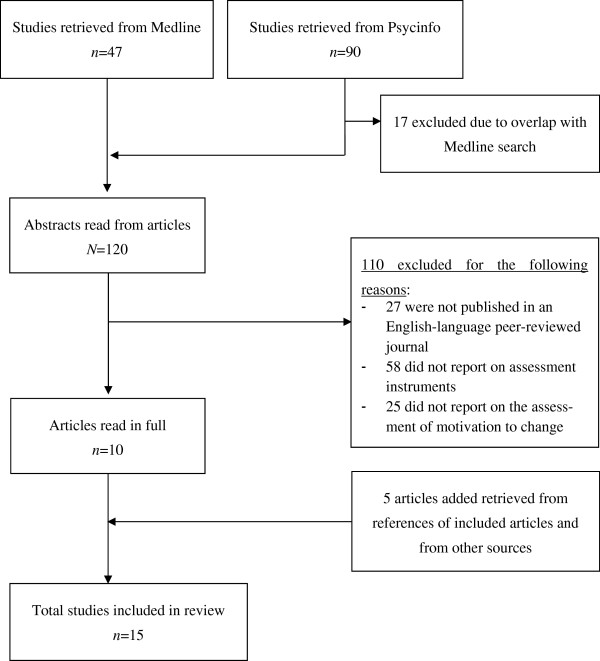
Background: Patients with anorexia and bulimia nervosa are often ambivalent about their eating disorder symptoms. Therefore, a lack of motivation to change is a frequent problem in the treatment of eating disorders. This is of high relevance, as a low motivation to change is a predictor of an unfavourable treatment outcome and high treatment dropout rates. In order to quantify the degree of motivation to change, valid and reliable instruments are required in research and practice. The transtheoretical model of behaviour change (TTM) offers a framework for these measurements. Objective: This paper reviews existing instruments assessing motivation to change in eating disorders. Method: We screened N = 119 studies from the databases Medline and Psycinfo found by combinations of the search keywords ‘eating disorder’, ‘anorexia nervosa’, ‘bulimia nervosa’, ‘motivation’, ‘readiness to change’, ‘assessment’, ‘measurement’, and ‘questionnaire’. Results: Ultimately,n = 15 studies investigating psychometric properties of different assessment tools of motivation to change in eating disorders were identified. Reviewed instruments can be divided into those assessing the stages of change according to the TTM (6 instruments) and those capturing decisional balance (3 instruments). Overall, the psychometric properties of these instruments are satisfactory to good. Discussion: Advantages, disadvantages, and limitations of the reviewed assessment tools are discussed. So far, the TTM provides the only framework to assess motivation to change in eating disorders.
Overview
The claims and statistics of this paper haven’t been checked yet.
Free: it reads the open-access text and checks the first 5 claims that cite a source we can check. Create a free account to check every claim.
Integrity signals
Registry
Cites
Statistics
Figures
Verification
Claims the paper makes
The claims and statistics of this paper haven’t been checked yet.
Free: it reads the open-access text and checks the first 5 claims that cite a source we can check. Create a free account to check every claim.
Self-check
Percentages, sums and reported differences re-computed from the paper’s own numbers.
The self-check needs the paper’s full text.
Citations
Cites
Stages and processes of self-change of smoking: Toward an integrative model of change.
Prochaska, J. O., & DiClemente, C. C. (1983) · Journal of Consulting and Clinical Psychology · doi:10.1037/0022-006x.51.3.390 · Cited by 9,098
Motivational interviewing: preparing people for change.
Miller, W. R., & Rollnick, S. (2002) · Guilford Press eBooks · Cited by 7,896
Lippa, N. C., & Sanderson, S. C. (2013) · Human Heredity · doi:10.1159/000353712 · Cited by 6,078
Comparison of Beck Depression Inventories -IA and -II in psychiatric outpatients
Beck, A. T., Steer, R. A., Ball, R., & Ranieri, W. F. (1996) · Journal of Personality Assessment · doi:10.1207/s15327752jpa6703_13 · Cited by 5,965
Decision making: A psychological analysis of conflict, choice, and commitment
(1978) · Evaluation and Program Planning · doi:10.1016/0149-7189(78)90042-3 · Cited by 3,946
Cognitive behaviour therapy for eating disorders: a “transdiagnostic” theory and treatment
Fairburn, C. G., Cooper, Z., & Shafran, R. (2003) · Behaviour Research and Therapy · doi:10.1016/s0005-7967(02)00088-8 · Cited by 3,374
The development and validation of the body shape questionnaire
Cooper, P. J., Taylor, M. J., Cooper, Z., & Fairbum, C. G. (1987) · International Journal of Eating Disorders · doi:10.1002/1098-108x(198707)6:4<485::aid-eat2260060405>3.0.co;2-o · Cited by 2,200
Decision Making--A Psychological Analysis of Conflict, Choice, and Commitment.
Elowitz, L., Janis, I. L., & Mann, L. (1978) · Military Affairs · doi:10.2307/1987412 · Cited by 1,432
(1992) · PubMed · Cited by 1,429
Eating Disorder Inventory-2 ; Pro-fessional Manual
Garner, D. (1991) · Medical Entomology and Zoology · Cited by 1,276
Research works printed but not linked: 5
- 18. Fisseni HJ: Lehrbuch der psychologischen Diagnostik: Mit Hinweisen zur Intervention. Göttingen: Hogrefe; 1997.
- 36. Kovacs M: Children' s depression inventory manual. North Tonawanda, NY: Multi-Health Systems, Inc; 1991.
- 37. Vitousek K, de Viva J, Slay J, Manke F: Concerns about change in the eating and anxiety disorders. New York: Paper presented at the annual meeting of the American Psychological Association; 1995.
- 40. Garner DM: Eating Disorder Inventory-2: Professional manual. Odessa, Florida: Psychological Assessment Resources; 1991.
- 42. Paulhus DL: Reference manual for BIDR Version 6. Vancouver, Canada: University of British Columbia; 1994.
Cited by
Oldershaw, A., Lavender, T., Sallis, H., Stahl, D., & Schmidt, U. (2015) · Clinical Psychology Review · doi:10.1016/j.cpr.2015.04.005 · Cited by 222
Wells, K. R., Jeacocke, N. A., Appaneal, R., Smith, H. D., Vlahovich, N., Burke, L. M., & Hughes, D. (2020) · British Journal of Sports Medicine · doi:10.1136/bjsports-2019-101813 · Cited by 209
“56 The complexity of DE requires a biopsychosocial approach, and it is important to know the type and nature of support within the athletes’ social network.”
Virtues, ecological momentary assessment/intervention and smartphone technology
Runyan, J. D., & Steinke, E. G. (2015) · Frontiers in Psychology · doi:10.3389/fpsyg.2015.00481 · Cited by 88
Sansfaçon, J., Booij, L., Gauvin, L. I., Fletcher, É., Islam, F., Israël, M., & Steiger, H. (2020) · International Journal of Eating Disorders · doi:10.1002/eat.23376 · Cited by 54
Adamson, J., Leppanen, J., Murin, M., & Tchanturia, K. (2018) · European Eating Disorders Review · doi:10.1002/erv.2594 · Cited by 38
von Brachel, R., Hötzel, K., Hirschfeld, G., Rieger, E., Schmidt, U., Kosfelder, J., Hechler, T., Schulte, D., & Vocks, S. (2014) · Journal of Medical Internet Research · doi:10.2196/jmir.3104 · Cited by 37
Self-citationPauli, D., Aebi, M., Metzke, C. W., & Steinhausen, H. (2017) · Journal of Eating Disorders · doi:10.1186/s40337-016-0125-z · Cited by 32
Shingleton, R. M., Pratt, E. M., Gorman, B. S., Barlow, D. H., Palfai, T. P., & Thompson‐Brenner, H. (2016) · Behavior Therapy · doi:10.1016/j.beth.2016.01.005 · Cited by 32
Using the theory of planned behaviour to measure motivation for recovery in anorexia nervosa
Dawson, L., Mullan, B. A., & Sainsbury, K. (2014) · Appetite · doi:10.1016/j.appet.2014.10.028 · Cited by 30
Day program for young people with anorexia nervosa
Green, J. E., Melvin, G. A., Newman, L. K., Jones, M., Taffe, J. R., & Gordon, M. (2015) · Australasian Psychiatry · doi:10.1177/1039856215584513 · Cited by 21
Robinson, L., Flynn, M., & Cooper, M. J. (2024) · International Journal of Eating Disorders · doi:10.1002/eat.24178 · Cited by 26
Anastasiadou, D., Lupiañez-Villanueva, F., Faulí, C., Arcal Cunillera, J., & Serrano-Troncoso, E. (2018) · BMC Psychiatry · doi:10.1186/s12888-018-1664-4 · Cited by 16
“to their growing incidence, the severity of the associated physical and psychiatric comorbidities [1], the high suicide and mortality rates [2] and the resistance of patients to treatment [3], among other reasons.”
BackgroundQuality of friendships and motivation to change in adolescents with Anorexia Nervosa
Malmendier-Muehlschlegel, A., Rosewall, J. K., Smith, J. G., Hugo, P., & Lask, B. D. (2016) · Eating Behaviors · doi:10.1016/j.eatbeh.2016.06.010 · Cited by 15
Williams-Ridgway, A.-M., McGowan, R., McNeil, S., & Tuomainen, H. (2025) · Journal of Eating Disorders · doi:10.1186/s40337-024-01173-y · Cited by 18
Green, J. E., Phillipou, A., Castle, D. J., Cistullo, L. L., & Newton, R. (2017) · Journal of Eating Disorders · doi:10.1186/s40337-017-0180-0 · Cited by 14
Olsson, A., & Landgren, K. (2020) · Issues in Mental Health Nursing · doi:10.1080/01612840.2019.1663567 · Cited by 22
Psychological Trauma as a Risk Factor for Eating Disorders
Burdo, J., Trottier, K., MacDonald, D. E., & Liebman, R. E. (2023) · Springer eBooks · doi:10.1007/978-3-030-97416-9_30-1 · Cited by 11
Sansfaçon, J., Steiger, H., Gauvin, L. I., Fletcher, É., & Israël, M. (2017) · Journal of Eating Disorders · doi:10.1186/s40337-017-0147-1 · Cited by 9
Arthur-Cameselle, J. N., & Curcio, M. (2018) · Journal of Clinical Sport Psychology · doi:10.1123/jcsp.2018-0030 · Cited by 7
Die therapeutische Beziehung zu Patientinnen mit der Diagnose einer Essstörung
Herpertz, S., Tuschen‐Caffier, B., & Vocks, S. (2019) · Springer eBooks · doi:10.1007/978-3-662-59606-7_3 · Cited by 6
Self-citationRawahi, S. H. A., Asimakopoulou, K. G., Masood, M., Bulushi, N. M. A., Yaqoobi, K. H. A., & Newton, T. (2020) · Oman Medical Journal · doi:10.5001/omj.2020.32 · Cited by 8
Vocks, S., Schweiger, U., Hilbert, A., Hagenah, U., & Tuschen‐Caffier, B. (2019) · Springer eBooks · doi:10.1007/978-3-662-59606-7_2 · Cited by 6
Self-citationApplying Stages of Change Model to Examine Online Peer Communication on Binge Eating
Chu, T. H., & Xiao, F. (2022) · Health Communication · doi:10.1080/10410236.2022.2129640 · Cited by 4
Hudson, C. C., & Neil, B. A. M. (2018) · Behavior Modification · doi:10.1177/0145445518807129 · Cited by 4
Runge, E., Jensen, E. S., Mathiasen, K., Larsen, P. V., Hertz, S. P. T., Holmberg, T. T., Tarp, K., Linnet, J., & Lichtenstein, M. B. (2022) · Frontiers in Psychiatry · doi:10.3389/fpsyt.2022.969338 · Cited by 4
Chung, A. (2015) · Australian & New Zealand Journal of Psychiatry · doi:10.1177/0004867415609425 · Cited by 4
Gilmartin, T. L., Spiel, E. C., Watson, J., & Roberton, M. (2025) · Journal of Eating Disorders · doi:10.1186/s40337-025-01426-4 · Cited by 4
Validation d’une version francophone de l’Anorexia Nervosa Stages of Change Questionnaire
Morin, G., & Meilleur, D. (2021) · Neuropsychiatrie de l Enfance et de l Adolescence · doi:10.1016/j.neurenf.2021.05.001 · Cited by 2
Bergner, L., Himmerich, H., & Steinberg, H. (2022) · Fortschritte der Neurologie · Psychiatrie · doi:10.1055/a-1897-2330 · Cited by 3
Spivak‐Lavi, Z., & Gewirtz‐Meydan, A. (2022) · Archives of Sexual Behavior · doi:10.1007/s10508-022-02463-9 · Cited by 7
Martini, M., Longo, P., Toppino, F., Bacco, C. D., Preti, A., Daga, G. A., & Panero, M. (2024) · European Eating Disorders Review · doi:10.1002/erv.3133 · Cited by 4
Patino, L. D., Yudchak, C. G., Barbieri, D. P., Stramesi, J. M., Champagne, V., & Ramundo, M. P. (2018) · Archives of Medicine · doi:10.21767/1989-5216.1000258 · Cited by 4
Hambleton, A. L., Hanstock, T. L., Simeone, R., & Sperling, M. (2019) · Clinical Case Studies · doi:10.1177/1534650119886653 · Cited by 5
Neu, L., Maunz, L. A., Vedova, S., Schurr, T., Mangweth‐Matzek, B., Sperner‐Unterweger, B., Holzner, B., & Hüfner, K. (2025) · Neuropsychiatrie · doi:10.1007/s40211-025-00540-8 · Cited by 1
Anorexia nervosa und Bulimia nervosa
Trunk, J., Bauer, A., & Vocks, S. (2018) · Springer eBooks · doi:10.1007/978-3-662-45995-9_43-1 · Cited by 1
Self-citationChinnery, L. J. (2015) · ANU Open Research (Australian National University) · doi:10.25911/5d627396c246a · Cited by 1
Was passiert nach dem letzten Klick?
von Brachel, R., Windgassen, A., Hötzel, K., Hirschfeld, G. H. F., & Vocks, S. (2016) · Zeitschrift für Klinische Psychologie und Psychotherapie · doi:10.1026/1616-3443/a000349
Self-citationTransteorijski model u ispitivanju procesa promjene kod anoreksije nervoze
Atlaga, M., & Šimić, N. (2022) · Medica Jadertina · doi:10.57140/mj.52.2.4
Psychological Trauma as a Risk Factor for Eating Disorders
Burdo, J., Trottier, K., MacDonald, D. E., & Liebman, R. E. (2024) · Springer eBooks · doi:10.1007/978-3-031-46096-8_30 · Cited by 2
Pushing Past the Extinction Burst: Extreme Dysregulation in Inpatient Treatment of ARFID
Ward, K., Adler, L., Escalera, A., Maginot, T. R., & Frank, G. (2025) · Clinical Case Studies · doi:10.1177/15346501251339233
Validity of nutrition-related outcome measures in eating disorder treatment: a scoping review
Pearson, L., Kirkegaard, A., Crowley, J., Matthews-Rensch, K. L., & Ball, L. (2026) · Eating Disorders · doi:10.1080/10640266.2026.2669112
Meléndez, J. A. B., Valdez-Aguilar, M., Bustinzar, A. R. P., García, C. G., Chávez-Peón, P. B., Portugal, A. V., Moncada, C. E. M. D. O., & Miranda, N. J. (2026) · Frontiers in Psychology · doi:10.3389/fpsyg.2026.1890098
Metadata
- Authors
- Hoetzel, K., von Brachel, R., Schlossmacher, L., & Vocks, S.
- Affiliations
- Ruhr University Bochum (DE)
- Osnabrück University (DE)
- ORCID
- Vocks, Silja
- Venue
- Journal of Eating Disorders
- Published
- 2013-10-10
- Volume
- 1
- Issue
- 1
- Pages
- 38-38
- ISSN
- 2050-2974 (ISSN-L)
- PMC
- PMC4081820
- OpenAlex
- W2157713700
- Cited by
- 42
- References
- 68
- Citations by year
- 2026: 2 · 2025: 4 · 2024: 3 · 2023: 1 · 2022: 5 · 2021: 1 · 2020: 4 · 2019: 3 · 2018: 6 · 2017: 3 · 2016: 3 · 2015: 5 · 2014: 2
- FWCI
- 0.49
- Type
- journal article
- Language
- en
- Open access
- gold
- doi.org
- Licence
- cc-by
- Locations
- Journal of Eating Disorders (publishedVersion, cc-by)
- Europe PMC (PubMed Central) (publishedVersion, cc-by)
- PubMed Central (publishedVersion, cc-by)
- PubMed (publishedVersion)
- Funders
- Deutsche Forschungsgemeinschaft
- Topics
- Social Sciences › Psychology › Clinical Psychology › Eating Disorders and Behaviors
- Health Sciences › Nursing › Nutrition and Dietetics › Nutrition, Health and Food Behavior
- Social Sciences › Psychology › Experimental and Cognitive Psychology › Anxiety, Depression, Psychometrics, Treatment, Cognitive Processes
- Keywords
- motivation for change, eating disorders, anorexia nervosa, bulimia nervosa, readiness to change, decisional balance, stages of change, psychometric properties, assessment instruments, treatment discontinuation
About these checks
Registry, retraction, Cites and statistics results are computed, not judged, with one exception: a printed reference that no index lists is read once by a model before it counts as a citation error. Claims are extracted by a model and kept only when their quote appears verbatim in the text; each cited source is then checked, with a model’s help, for whether it says what the claim relies on. Those verdicts can be wrong — read the claim’s quote and the cited source before relying on one.
Statistics and arithmetic are recomputed, not judged.
Confidence bands are shown only for fields calibrated on our annotated test set. None is calibrated yet, so no band is shown.
What counts as a claim ›How we measure confidence ›How we check this ›
Are you an author, or do you see a problem with this page? Request a review
Data sources
Bibliographic data: Semantic Scholar, OpenAlex, Crossref.
Contains information from the Semantic Scholar Academic Graph Datasets, made available under the ODC Attribution License (ODC-BY 1.0).
Semantic Scholar’s data is described in: Kinney, R., et al. (2023). The Semantic Scholar Open Data Platform. arXiv:2301.10140.
