

Listen protect connect for traumatized schoolchildren: a pilot study of psychological first aid
Open accessThe DOI matches its Crossref record; 39 of the 41 references it cites were found in a registry or an index.
Abstract
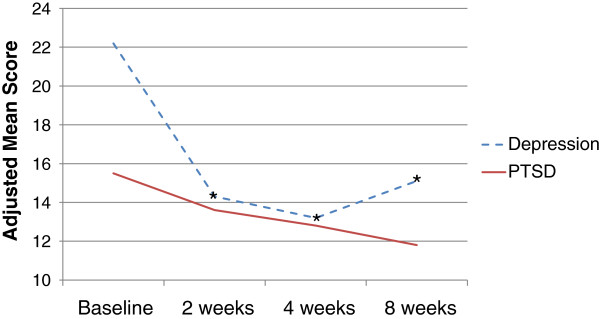
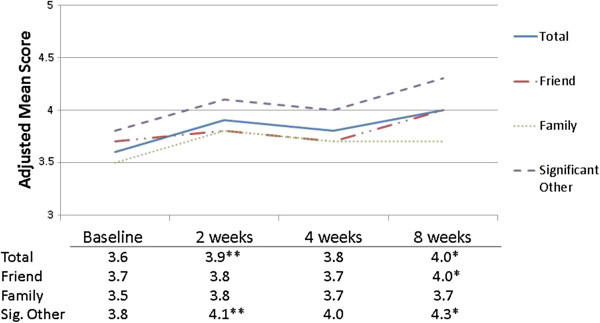
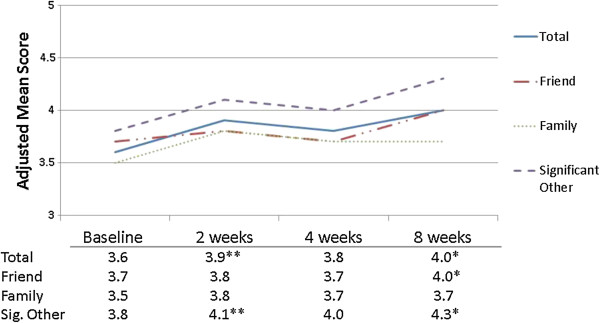
BACKGROUND: Listen Protect Connect (LPC), a school-based program of Psychological First Aid delivered by non-mental health professionals, is intended to support trauma-exposed children. Our objective was to implement LPC in a school setting and assess the effectiveness of LPC on improving psychosocial outcomes associated with trauma. METHODS: A pilot quasi-experiment was conducted with middle school children self-identified or referred to the school nurse as potentially exposed to stressful life experiences. LPC was provided to students by the school nurse, and questionnaires were administered at baseline, 2-, 4- and 8-weeks to assess life stressors, symptoms of post-traumatic stress disorder and depression, social support, and school connectedness. A total of 71 measurements were collected from 20 children in all. Although a small sample size, multiple measurements allowed for multivariable mixed effects models to analyze changes in the repeated outcomes over time. RESULTS: Students who received the intervention had reduced depressive and posttraumatic stress symptoms from baseline throughout follow-up period. Total social support also increased significantly from baseline through 8-weeks, and school connectedness increased up to 4-weeks post-intervention. CONCLUSIONS: This study demonstrates the potential of LPC as a school-based intervention of Psychological First Aid. Future randomized trials of LPC are needed, however.
Overview
The claims and statistics of this paper haven’t been checked yet.
Free: it reads the open-access text and checks the first 5 claims that cite a source we can check. Create a free account to check every claim.
Integrity signals
Registry
Cites
Statistics
Figures
Verification
Claims the paper makes
The claims and statistics of this paper haven’t been checked yet.
Free: it reads the open-access text and checks the first 5 claims that cite a source we can check. Create a free account to check every claim.
Claims other papers make about this one
Each is checked against this paper’s own text: does it say what the citing paper says it does?
The source backs part of the claim, not all of it — or backs it for a different population, condition or comparison.
In the citing paper
“An uncontrolled pre–post study [43] showed that the psychosocial support intervention LPC [42] for children after experiencing traumatic events, such as community disaster, emergency, or personal trauma, was successful in reducing PTSD and depressive symptoms at post-intervention.”
From Promoting Recovery from Disasters, Pandemics, and Trauma: A Systematic Review of Brief Psychological Interventions to Reduce Distress in Adults, Children, and Adolescents (2023) · cites this paper as [43]
Experimental — accuracy not yet measuredThe source backs part of the claim, not all of it — or backs it for a different population, condition or comparison.
In the citing paper
“Depressive symptoms and felt connectedness to their school improved at 4 weeks post-intervention.”
From Promoting Recovery from Disasters, Pandemics, and Trauma: A Systematic Review of Brief Psychological Interventions to Reduce Distress in Adults, Children, and Adolescents (2023) · cites this paper as [43]
Experimental — accuracy not yet measuredThe cited source says what the claim attributes to it.
In the citing paper
“PTSD symptoms (i.e., re-experiencing, avoidance, and arousal) did not significantly decrease at 8 weeks post-intervention.”
Self-check
Percentages, sums and reported differences re-computed from the paper’s own numbers.
The self-check needs the paper’s full text.
Citations
Cites
Diagnostic and Statistical Manual of Mental Disorders
Williams, J. B. W., & First, M. (2013) · Encyclopedia of Social Work · doi:10.1093/acrefore/9780199975839.013.104 · Cited by 109,519
The CES-D Scale: A Self-Report Depression Scale for Research in the General Population
Radloff, L. S. (1977) · Applied Psychological Measurement · doi:10.1177/014662167700100306 · Cited by 53,267
Psychometric Characteristics of the Multidimensional Scale of Perceived Social Support
Zimet, G. D., Powell, S. S., Farley, G. K., Werkman, S., & Berkoff, K. A. (1990) · Journal of Personality Assessment · doi:10.1080/00223891.1990.9674095 · Cited by 4,855 · cited 2×
“93) (Zimet et al. 1990; Canty-Mitchell and Zimet 2000; Bruwer et al. 2008).”
InfluentialPsychometric Characteristics of the Multidimensional Scale of Perceived Social Support
Zimet, G., Powell, S., Farley, G., Werkman, S., & Berkoff, K. (1990) · Journal of Personality Assessment · doi:10.1207/s15327752jpa5503&4_17 · Cited by 4,854
Traumatic Events and Posttraumatic Stress Disorder in an Urban Population of Young Adults
Breslau, N. (1991) · Archives of General Psychiatry · doi:10.1001/archpsyc.1991.01810270028003 · Cited by 2,506 · cited 2×
“In an urban population of 1,007 youths exposed to violence, 23.6% developed PTSD and among those, 36.6% had major depression (Breslau et al. 1991).”
BackgroundInfluentialTrauma and Posttraumatic Stress Disorder in the Community: The 1996 Detroit Area Survey of Trauma
Breslau, N., Kessler, R. C., Chilcoat, H. D., Schultz, L. R., Davis, G. C., & Andreski, P. (1998) · Archives of General Psychiatry · doi:10.1001/archpsyc.55.7.626 · Cited by 2,407 · cited 2×
“(Breslau et al. 1998).”
Psychometric Properties of the Life Events Checklist
Gray, M. J., Litz, B. T., Hsu, J. L., & Lombardo, T. W. (2004) · Assessment · doi:10.1177/1073191104269954 · Cited by 1,889 · cited 1×
“Respondents reported their traumatic experiences on a 5-point scale (1 = happened to me, 2 = witnessed it, 3 = learned about it, 4 = not sure, and 5 = does not apply) (Gray et al. 2004).”
BackgroundFURUKAWA, T. A., KESSLER, R. C., SLADE, T., & ANDREWS, G. (2003) · Psychological Medicine · doi:10.1017/s0033291702006700 · Cited by 1,570 · cited 1×
“The interventionist conducts a brief screener of nonspecific distress using the six-item K6 screener (Furukawa et al. 2003).”
MethodTraumatic Events and Posttraumatic Stress in Childhood
Copeland, W. E., Keeler, G., Angold, A., & Costello, E. J. (2007) · Archives of General Psychiatry · doi:10.1001/archpsyc.64.5.577 · Cited by 1,544 · cited 2×
“In a US-based longitudinal study, 68.8% of children were exposed to one or more traumatic events by their 16th birthday (Copeland et al. 2007).”
BackgroundInfluentialGueorguieva, R., & Krystal, J. H. (2004) · Archives of General Psychiatry · doi:10.1001/archpsyc.61.3.310 · Cited by 1,529 · cited 1×
“Compared with standard repeated measures ANOVA, the hierarchical mixed effects model is a more flexible approach to account for irregular time measurement points, missing observations and time-dependency (Gueorguieva and Krystal 2004).”
Method
Research works printed but not linked: 2
- 8. Cash, RE, & Nealis, LK. (2004). Mental health in the schools: It' s a matter of public policy. Washington, DC: Paper presented at the National Association of School Psychologists Public Policy Institute.
- 9. Constantine, NA, Benard, B, & Diaz, M. (1999). Measuring Protective Factors and Resilience Traits in Youth: The Healthy Kids Resilience Assessment. New Orleans, LA: Paper presented at the Seventh Annual Meeting of the Society for Prevention Research.
Cited by
Adverse childhood experiences and trauma informed care: the future of health care
Oral, R., Ramirez, M., Coohey, C., Nakada, S., Walz, A., Kuntz, A., Benoit, J., & Peek-Asa, C. (2016) · Pediatric Research · doi:10.1038/pr.2015.197 · Cited by 511
“One study also reported PFA being effective in improving connectedness and stress among youth traumatized by a disaster, bullying, death or illness of a family member, or injury (59).”
BackgroundSelf-citationCrandall, A., Broadbent, E., Stanfill, M., Magnusson, B. M., Novilla, M. L. B., Hanson, C. L., & Barnes, M. (2020) · Child Abuse & Neglect · doi:10.1016/j.chiabu.2020.104644 · Cited by 164
Bayageldi, N. K., & Şimşek, N. (2019) · Nurse Education Today · doi:10.1016/j.nedt.2019.104203 · Cited by 151
Fondren, K., Lawson, M., Speidel, R., McDonnell, C. G., & Valentino, K. (2020) · Children and Youth Services Review · doi:10.1016/j.childyouth.2019.104691 · Cited by 101
Hermosilla, S., Forthal, S., Sadowska, K., Magill, E. B., Watson, P., & Pike, K. M. (2022) · Journal of Traumatic Stress · doi:10.1002/jts.22888 · Cited by 159
The Role of Psychological First Aid to Support Public Mental Health in the COVID-19 Pandemic
Shah, K., Bedi, S., Onyeaka, H., Singh, R., & Chaudhari, G. (2020) · Cureus · doi:10.7759/cureus.8821 · Cited by 79
“Similarly, the administration of PFA in students enhances their safety due to various distress symptoms that can prevail in school settings [11].”
BackgroundWang, L., Norman, I. J., Edleston, V., Oyo, C., & Leamy, M. C. (2024) · Trauma Violence & Abuse · doi:10.1177/15248380231221492 · Cited by 122
“Techniques emphasized by most protocols included “rapport building” (Despeaux et al., 2019; Everly et al., 2016), “active listening” (Ramirez et al., 2013, 2021), “contact and engagement” (McCart et al., 2020), “safety and com-fort” (Meir et al., 2012), and “cognitive communication” (Farchi et al.,…”
BackgroundMethodInfluentialPierce, H., & Jones, M. S. (2021) · Journal of Research in Crime and Delinquency · doi:10.1177/00224278211003227 · Cited by 70
“For example, a recent study identified PFA being effective in improving connectedness and stress among youth traumatized by a disaster, bullying, death of a family member, or serious injury (Ramirez et al. 2013).”
BackgroundJackson, D. B., Jones, M. S., Semenza, D. C., & Testa, A. M. (2023) · International Journal of Environmental Research and Public Health · doi:10.3390/ijerph20043202 · Cited by 79
Pawils, S., Heumann-Schoop, S., Schneider, S. A., Metzner, F., & Mays, D. (2023) · PLoS ONE · doi:10.1371/journal.pone.0275724 · Cited by 73
Grolnick, W. S., Schonfeld, D. J., Schreiber, M. D., Cohen, J. A., Cole, V. L., Jaycox, L. H., Lochman, J. E., Pfefferbaum, B. J., Ruggiero, K. J., Wells, K. B., et al. (2018) · American Psychologist · doi:10.1037/amp0000181 · Cited by 52
Self-citationGender, adverse childhood experiences, and the development of self-control
Chapple, C. L., Pierce, H., & Jones, M. S. (2021) · Journal of Criminal Justice · doi:10.1016/j.jcrimjus.2021.101811 · Cited by 47
Contextualization of Psychological First Aid: An Integrative Literature Review
Sim, T., & Wang, A. (2021) · Journal of Nursing Scholarship · doi:10.1111/jnu.12613 · Cited by 48
“…as a seven-step psychological support plan (Bancken, 2014), a psychosocial intervention continuum (Macy et al., 2004), “listen protect connect” (Ramirez et al., 2013), mental health and psychosocial support with five actions (Atwoli, 2010), and the brief A^B^C^D^E (Assess, Be, Comfort, Do,…”
BackgroundMethodInfluentialYohannan, J., & Carlson, J. S. (2018) · Psychology in the Schools · doi:10.1002/pits.22202 · Cited by 59
Lotzin, A., Franc de Pommereau, A., & Laskowsky, I. (2023) · International Journal of Environmental Research and Public Health · doi:10.3390/ijerph20075339 · Cited by 36
“(2013) [43] Listen Protect Connect (LPC) [42] Uncontrolled pre–post study N = 20 Flood Provision of psychological support Reduction in distress Face-to-face Children A total of 1 for 25 min on average LPC marginally reduced PTSD symptoms at 8 weeks post-intervention and significantly reduced depressive symptoms at 4 w…”
BackgroundMethodInfluentialCohen, K. A., Ito, S., Ahuvia, I. L., Yang, Y., Zhang, Y., Renshaw, T. L., Larson, M. F., Cook, C. R., Hill, S., Liao, J., et al. (2024) · Clinical Child and Family Psychology Review · doi:10.1007/s10567-024-00487-2 · Cited by 67
Azzollini, S., Depaula, P. D., Cosentino, A. C., & Pupko, V. B. (2018) · Athens Journal of Social Sciences · doi:10.30958/ajss.5-2-5 · Cited by 36
The Use of Psychological First Aid in Children Exposed to Mass Trauma
Gilbert, R. M., Abel, M. R., Vernberg, E. M., & Jacobs, A. K. (2021) · Current Psychiatry Reports · doi:10.1007/s11920-021-01270-8 · Cited by 36
Khan, Y. S., Khan, A. W., & Alabdulla, M. (2023) · European Journal of Psychotraumatology · doi:10.1080/20008066.2023.2249788 · Cited by 29
Evidence-Based Treatments for Children and Adolescents
Landolt, M. A., & Kenardy, J. A. (2022) · Springer eBooks · doi:10.1007/978-3-030-97802-0_20 · Cited by 22
Development study of psychological first aid application self‐efficacy scale
Bayageldi, N. K., & Şimşek, N. (2021) · Perspectives In Psychiatric Care · doi:10.1111/ppc.12975 · Cited by 20
Early exposure to adverse childhood experiences and delinquent peer association among youth
Jones, M. S., Pierce, H., & Shoaf, H. (2023) · Family Relations · doi:10.1111/fare.12856 · Cited by 25
Early child disaster mental health interventions: A review of the empirical evidence
Pfefferbaum, B., Nitiéma, P., Tucker, P., & Newman, E. (2017) · Child & Youth Care Forum · doi:10.1007/s10566-017-9397-y · Cited by 17
“Of note, a non-controlled pilot study using the Listen Protect Connect model of psychological first aid in youth exposed to a flood found a decrease in PTSD and depressive symptoms 10 months after the disaster (Ramirez et al. 2013).”
BackgroundSchools must include faculty and staff in sexual violence prevention efforts
Sales, J. M., & Krause, K. H. (2017) · Journal of American College Health · doi:10.1080/07448481.2017.1349133 · Cited by 16
“Becoming a trauma-informed campus requires a layered approach to create an environment with clear behavior expectations for everyone, open communication, and sensitivity to the feelings and emotions of others.(11) Trauma-informed approaches are designed to avoid re-traumatizing individuals who have experienced a traum…”
BackgroundEvaluation of an organization-based psychological first aid intervention
Hechanova, M. R. M., Manaois, J. O., & Masuda, H. V. (2019) · Disaster Prevention and Management An International Journal · doi:10.1108/dpm-10-2018-0330 · Cited by 21
A Skill Set for Supporting Displaced Children in Psychological Recovery After Disasters
Pfefferbaum, B. J., Jacobs, A. K., Jones, R. T., Reyes, G., & Wyche, K. F. (2017) · Current Psychiatry Reports · doi:10.1007/s11920-017-0814-6 · Cited by 22
Kottenstette, S., Segal, R., Roeder, V., Rochford, H. I., Schnieders, E. M., Bayman, L., McKissic, D. A., Dahlberg, G. J., Krewer, R., Chambliss, J. E., et al. (2019) · Child Abuse & Neglect · doi:10.1016/j.chiabu.2019.104327 · Cited by 16
Simonds, E. A., Gobenciong, K. A. P., Wilson, J. E., Jiroutek, M. R., Nugent, N. R., & van Tilburg, M. A. L. (2022) · Children · doi:10.3390/children9070951 · Cited by 17
“For example, in a small non-controlled trial among twenty children undergoing stressful life experiences, Psychological First Aid was implemented by a school nurse [19].”
BackgroundAdverse childhood experiences and adolescent handgun carrying
Jones, M. S., Boccio, C. M., Semenza, D. C., & Jackson, D. B. (2023) · Journal of Criminal Justice · doi:10.1016/j.jcrimjus.2023.102118 · Cited by 14
Jones, M. S., & Worthen, M. G. F. (2023) · Child Abuse & Neglect · doi:10.1016/j.chiabu.2023.106560 · Cited by 38
Supporting Children’s Mental Health Needs in Disasters
Hoffmann, J. A., Pergjika, A., Burkhart, K. M., Gable, C. J., Foster, A. A., Saidinejad, M., Covington, T., Edemba, D., Mullins, S., Schreiber, M. D., et al. (2024) · PEDIATRICS · doi:10.1542/peds.2024-068076 · Cited by 14
Madani, S. M. S., Bahramnejad, A., Farsi, Z., Alizadeh, A., Rajai, N., & Azizi, M. (2023) · Disaster Medicine and Public Health Preparedness · doi:10.1017/dmp.2023.81 · Cited by 15
Link for Injured Kids: A Patient-Centered Program of Psychological First Aid After Trauma
Ramirez, M. R., Toussaint, M., Woods-Jaeger, B. A., Harland, K. K., Wetjen, K. M., Wilgenbusch, T. L. V., Pitcher, G., & Jennissen, C. A. (2015) · Pediatric Emergency Care · doi:10.1097/pec.0000000000000535 · Cited by 13
“The 2 steps, links 1 and 2, were created based on a parentbased intervention in the area of teen driving(13,14) and our pilot study on LPC.(12) According to our pilot work, when parents and nurses reported 2 key skills—communication and screening— were valued most in their interactions with traumatized children.”
BackgroundMethodInfluentialSelf-citationAdverse Childhood Experiences and Truancy in High School: An Analysis of Florida Adolescents
Boccio, C. M., Cardwell, S. M., & Jackson, D. B. (2024) · Deviant Behavior · doi:10.1080/01639625.2024.2336194 · Cited by 12
“Research has revealed that PFA can enhance connectedness and reduce stress among youth who have experienced traumatic life events, such death of a family member, disaster, and serious harm or injury (Ramirez et al. 2013).”
Jones, M. S., Everett, H. D., & Hoffmann, J. P. (2024) · Child Abuse & Neglect · doi:10.1016/j.chiabu.2024.106913 · Cited by 11
Andersson, H., Nieminen, K., Malmquist, A., & Grundström, H. (2024) · Sexual & Reproductive Healthcare · doi:10.1016/j.srhc.2024.101002 · Cited by 9
“Nonetheless, programmes based on PFA have been tested in other populations with positive stress-reducing results [23,24].”
Approaches to the Assessment of Children in the Context of Disasters
Lai, B. S., Alisic, E., Lewis, R., & Ronan, K. R. (2016) · Current Psychiatry Reports · doi:10.1007/s11920-016-0683-4 · Cited by 10
Tanner, A., Miller, W. R., von Gaudecker, J. R., & Buelow, J. M. (2019) · The Journal of School Nursing · doi:10.1177/1059840519854796 · Cited by 9
“Interestingly, of the four studies that reported interventions delivered at the individual level, three were one-time interventions rather than extended multisession interventions (Bannink et al., 2014; Kim et al., 2015; Ramirez et al., 2013).”
BackgroundInfluentialPastrana, F. A., Moreland, A. D., Milman, E. J., Williams, J. L., delMas, S., & Rheingold, A. A. (2020) · Death Studies · doi:10.1080/07481187.2020.1805819 · Cited by 10
“Pilot work suggests PFA may reduce depressive and posttraumatic symptoms and enhance social support in youth (n1⁄4 20) post disaster (Ramirez et al., 2013); contribute to positive coping in youth (n1⁄4 11) in conflict zones (Schafer et al.”
BackgroundRamirez, M. R., Ryan, A. M., Harding, A. B., Renfro, T. L., Church, T. R., Rosebush, C. E., Trotter, A. G., Xiong, B. N., Gonzalez, J., & Woods-Jaeger, B. A. (2023) · Contemporary Clinical Trials · doi:10.1016/j.cct.2023.107090 · Cited by 8
Self-citationComparative Effectiveness of Parent-Based Interventions to Support Injured Children
Ramirez, M. R., Flores, J. E., Woods-Jaeger, B. A., Cavanaugh, J. E., Peek-Asa, C. L., Branch, C. A., Bolenbaugh, M., Chande, V. T., Pitcher, G., Ortega, H. W., et al. (2021) · PEDIATRICS · doi:10.1542/peds.2020-046920 · Cited by 8
Self-citationLink for Schools: A System to Prevent Trauma and Its Adverse Impacts
Immerfall, S. J., & Ramirez, M. R. (2018) · NASN School Nurse · doi:10.1177/1942602x18785010 · Cited by 9
Self-citationWoods-Jaeger, B. A., Sexton, C. C., Branch, C. A., Bolenbaugh, M., Roth, L. G., Stelson, E., Braaten, N., & Ramirez, M. R. (2019) · Journal of Comparative Effectiveness Research · doi:10.2217/cer-2018-0126 · Cited by 5
Self-citationPrimeiros Socorros Psicológicos: Intervenção psicológica na catástrofe
Beja, M. J., Portugal, A. P. M., Câmara, J., Berenguer, C., Rebolo, A. P., Crawford, C. M. F., & Gonçalves, D. (2018) · Psychologica · doi:10.14195/1647-8606_61-1_7 · Cited by 13
Evidence-Based Treatment for Mental Health Care Post-Disaster
Lucas, E., & Brown, L. M. (2020) · Springer eBooks · doi:10.1007/978-3-030-51525-6_11 · Cited by 6
Psychological First Aid and Practice Principles in the Coronavirus (COVID-19) Outbreak Process
Bayageldi, N. K. (2021) · Bezmialem Science · doi:10.14235/bas.galenos.2020.4472 · Cited by 7
Psychological First Aid: Application and Adaptation in Southeast Asia
Manaois, J. O., Tabo-Corpuz, C. E. S., & Heise, A. G. (2020) · Community, environment and disaster risk management · doi:10.1108/s2040-726220200000021005 · Cited by 7
Adverse Childhood Experiences, Race/Ethnicity, and Suicidality Among Florida High School Students
Jensen, L. C. X., Jones, M. S., Gibbs, B. G., & Jarvis, J. A. (2025) · Youth & Society · doi:10.1177/0044118x241312248 · Cited by 4
Current Evidence for Selecting Disaster Interventions for Children and Adolescents
Pfefferbaum, B. J., Newman, E., & Nitiéma, P. (2016) · Current Treatment Options in Psychiatry · doi:10.1007/s40501-016-0079-4 · Cited by 3
Legerski, J., & King, A. R. (2015) · Journal of Contemporary Psychotherapy · doi:10.1007/s10879-015-9299-y · Cited by 5
“Ramirez et al. (2013) adapted a school-based group format of psychological first aid for middle school children, titled Listen Protect Connect.”
BackgroundThe Psychosocial Effects of Radiation Disasters on Young Children
Murray, J. S. (2017) · Springer eBooks · doi:10.1007/978-3-319-62887-5_7 · Cited by 1
Psychological First Aid in Suicide Crises
Hernández-Cervantes, Q. (2022) · Springer eBooks · doi:10.1007/978-3-030-42003-1_58 · Cited by 2
Psychological First Aid in Suicide Crises
Hernández-Cervantes, Q. (2021) · Springer eBooks · doi:10.1007/978-3-030-41319-4_58-1 · Cited by 2
Ramirez, M. R., Harland, K. K., Frederick, M., Shepherd, R., Wong, M., & Cavanaugh, J. E. (2014) · BMC Psychology · doi:10.1186/s40359-014-0045-0 · Cited by 1
“Erratum Due to an error in the publication process, this article (Ramirez et al. 2013) was published with an incorrect figure for Figure three (Figure 1 here).”
BackgroundSelf-citationThe role of parental factors in the mental health problems experienced by refugee children
Eruyar, Ş. (2018) · Figshare · Cited by 1
Childhood Trauma-Related Interventions: Treatment at Different Stages Across the Life Span
Gomez, M. A., & Brown, L. M. (2020) · Springer eBooks · doi:10.1007/978-3-030-49414-8_21 · Cited by 3
Fay, C. M. (2018) · UA Campus Repository (The University of Arizona)
Partitions pour l’exil : la musique comme espace habitable
Bourgeois-Guérin, É., Rousseau, C., & Lyke, C. (2021) · Éditions de la Maison des sciences de l’homme eBooks · doi:10.4000/books.editionsmsh.29385
Tanner, A. (2021) · IUScholarWorks (Indiana University) · doi:10.7912/c2/1320
tajari, T. (2021) · Journal of Rescue and Relief · doi:10.32592/jorar.2021.13.3.6
“It can improve quality of life and increase life expectancy (21).”
BackgroundCorreia, C. H. (2022) · REVISTA CIENTÍFICA ACERTTE · doi:10.47820/acertte.v2i10.95
Brief School-Based Interventions Targeting Student Mental Health or Wellbeing: A Systematic ReviewPreprint
Cohen, K. A., Ito, S., Ahuvia, I. L., Yang, Y., Zhang, Y., Renshaw, T. L., Larson, M. F., Cook, C. R., Hill, S., Liao, J., et al. (2023) · doi:10.31234/osf.io/xemjn
The importance of psychological first aid intervention and nurses after earthquake
Tanrıverdi, Ö. (2024) · Sağlık akademisyenleri dergisi/Sağlık akademisyenler dergisi · doi:10.52880/sagakaderg.1340638
Richardson, M., Black, T., de Wit, K., Bain, B., Trolley, E., & Cramm, H. A. (2026) · Journal of Military Veteran and Family Health · doi:10.3138/jmvfh-2025-0080
Psychological Triage and First Aid for Children, Families, and Disaster Responders
Burkhart, K. M., Agarwal, N., & Ievers‐Landis, C. E. (2026) · Springer eBooks · doi:10.1007/978-3-032-27013-9_13
Kocabıyık, O. O. (2026) · Journal of Health Psychology · doi:10.1177/13591053261495646
Metadata
- Authors
- Ramirez, M., Harland, K., Frederick, M., Shepherd, R., Wong, M., & Cavanaugh, J. E.
- Affiliations
- University of Southern California (US)
- University of Iowa (US)
- Corresponding author
- Ramirez, Marizen
- Venue
- BMC Psychology
- Published
- 2013-11-27
- Volume
- 1
- Issue
- 1
- Pages
- 26-26
- ISSN
- 2050-7283 (ISSN-L)
- PMC
- PMC4269971
- OpenAlex
- W1966121847
- Cited by
- 66
- References
- 41
- Citations by year
- 2026: 3 · 2025: 1 · 2024: 7 · 2023: 10 · 2022: 5 · 2021: 11 · 2020: 6 · 2019: 6 · 2018: 7 · 2017: 4 · 2016: 2 · 2015: 3 · 2014: 1
- FWCI
- 2.23
- Type
- journal article
- Language
- en
- Update notices
- correction (2014-10-25)
- Open access
- gold
- doi.org
- Licence
- Locations
- BMC Psychology (publishedVersion, cc-by)
- Europe PMC (PubMed Central) (publishedVersion, cc-by)
- PubMed Central (publishedVersion, cc-by)
- PubMed (publishedVersion)
- Iowa Research Online (The University of Iowa) (submittedVersion)
- Iowa Research Online (The University of Iowa) (submittedVersion, cc-by)
- eScholarship (California Digital Library) (submittedVersion, cc-by)
- Funders
- Injury Prevention Research Center
- Topics
- Social Sciences › Psychology › Clinical Psychology › Posttraumatic Stress Disorder Research
- Social Sciences › Psychology › Clinical Psychology › Child Abuse and Trauma
- Health Sciences › Medicine › Public Health, Environmental and Occupational Health › School Health and Nursing Education
- Keywords
- psychological first aid, school-based intervention, trauma-exposed children, post-traumatic stress disorder, depression, social support, school connectedness, school nurses, non-mental health professionals, life events, junior high school students
About these checks
Registry, retraction, Cites and statistics results are computed, not judged, with one exception: a printed reference that no index lists is read once by a model before it counts as a citation error. Claims are extracted by a model and kept only when their quote appears verbatim in the text; each cited source is then checked, with a model’s help, for whether it says what the claim relies on. Those verdicts can be wrong — read the claim’s quote and the cited source before relying on one.
Statistics and arithmetic are recomputed, not judged.
Confidence bands are shown only for fields calibrated on our annotated test set. None is calibrated yet, so no band is shown.
What counts as a claim ›How we measure confidence ›How we check this ›
Are you an author, or do you see a problem with this page? Request a review
Data sources
Bibliographic data: Semantic Scholar, OpenAlex, Crossref.
Contains information from the Semantic Scholar Academic Graph Datasets, made available under the ODC Attribution License (ODC-BY 1.0).
Semantic Scholar’s data is described in: Kinney, R., et al. (2023). The Semantic Scholar Open Data Platform. arXiv:2301.10140.
