

Listen protect connect for traumatized schoolchildren: a pilot study of psychological first aid
Open accessThe DOI matches its Crossref record; 39 of the 41 references it cites were found in a registry or an index.
Abstract
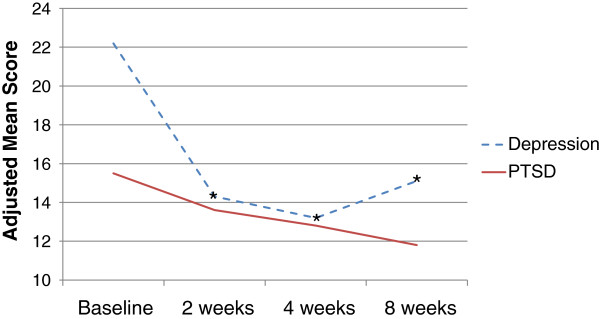
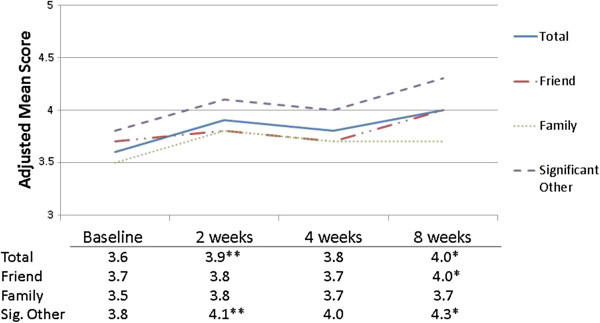
BACKGROUND: Listen Protect Connect (LPC), a school-based program of Psychological First Aid delivered by non-mental health professionals, is intended to support trauma-exposed children. Our objective was to implement LPC in a school setting and assess the effectiveness of LPC on improving psychosocial outcomes associated with trauma. METHODS: A pilot quasi-experiment was conducted with middle school children self-identified or referred to the school nurse as potentially exposed to stressful life experiences. LPC was provided to students by the school nurse, and questionnaires were administered at baseline, 2-, 4- and 8-weeks to assess life stressors, symptoms of post-traumatic stress disorder and depression, social support, and school connectedness. A total of 71 measurements were collected from 20 children in all. Although a small sample size, multiple measurements allowed for multivariable mixed effects models to analyze changes in the repeated outcomes over time. RESULTS: Students who received the intervention had reduced depressive and posttraumatic stress symptoms from baseline throughout follow-up period. Total social support also increased significantly from baseline through 8-weeks, and school connectedness increased up to 4-weeks post-intervention. CONCLUSIONS: This study demonstrates the potential of LPC as a school-based intervention of Psychological First Aid. Future randomized trials of LPC are needed, however.
Overview
The claims and statistics of this paper haven’t been checked yet.
Free: it reads the open-access text and checks the first 5 claims that cite a source we can check. Create a free account to check every claim.
Integrity signals
Registry
Cites
Statistics
Figures
Verification
Claims the paper makes
The claims and statistics of this paper haven’t been checked yet.
Free: it reads the open-access text and checks the first 5 claims that cite a source we can check. Create a free account to check every claim.
Claims other papers make about this one
Each is checked against this paper’s own text: does it say what the citing paper says it does?
The source backs part of the claim, not all of it — or backs it for a different population, condition or comparison.
In the citing paper
“An uncontrolled pre–post study [43] showed that the psychosocial support intervention LPC [42] for children after experiencing traumatic events, such as community disaster, emergency, or personal trauma, was successful in reducing PTSD and depressive symptoms at post-intervention.”
From Promoting Recovery from Disasters, Pandemics, and Trauma: A Systematic Review of Brief Psychological Interventions to Reduce Distress in Adults, Children, and Adolescents (2023) · cites this paper as [43]
Experimental — accuracy not yet measuredThe source backs part of the claim, not all of it — or backs it for a different population, condition or comparison.
In the citing paper
“Depressive symptoms and felt connectedness to their school improved at 4 weeks post-intervention.”
From Promoting Recovery from Disasters, Pandemics, and Trauma: A Systematic Review of Brief Psychological Interventions to Reduce Distress in Adults, Children, and Adolescents (2023) · cites this paper as [43]
Experimental — accuracy not yet measuredThe cited source says what the claim attributes to it.
In the citing paper
“PTSD symptoms (i.e., re-experiencing, avoidance, and arousal) did not significantly decrease at 8 weeks post-intervention.”
Self-check
Percentages, sums and reported differences re-computed from the paper’s own numbers.
The self-check needs the paper’s full text.
Citations
Cites
Diagnostic and Statistical Manual of Mental Disorders
Williams, J. B. W., & First, M. (2013) · Encyclopedia of Social Work · doi:10.1093/acrefore/9780199975839.013.104 · Cited by 109,519
The CES-D Scale: A Self-Report Depression Scale for Research in the General Population
Radloff, L. S. (1977) · Applied Psychological Measurement · doi:10.1177/014662167700100306 · Cited by 53,267
Psychometric Characteristics of the Multidimensional Scale of Perceived Social Support
Zimet, G. D., Powell, S. S., Farley, G. K., Werkman, S., & Berkoff, K. A. (1990) · Journal of Personality Assessment · doi:10.1080/00223891.1990.9674095 · Cited by 4,855 · cited 2×
“93) (Zimet et al. 1990; Canty-Mitchell and Zimet 2000; Bruwer et al. 2008).”
InfluentialPsychometric Characteristics of the Multidimensional Scale of Perceived Social Support
Zimet, G., Powell, S., Farley, G., Werkman, S., & Berkoff, K. (1990) · Journal of Personality Assessment · doi:10.1207/s15327752jpa5503&4_17 · Cited by 4,854
Traumatic Events and Posttraumatic Stress Disorder in an Urban Population of Young Adults
Breslau, N. (1991) · Archives of General Psychiatry · doi:10.1001/archpsyc.1991.01810270028003 · Cited by 2,506 · cited 2×
“In an urban population of 1,007 youths exposed to violence, 23.6% developed PTSD and among those, 36.6% had major depression (Breslau et al. 1991).”
BackgroundInfluentialTrauma and Posttraumatic Stress Disorder in the Community: The 1996 Detroit Area Survey of Trauma
Breslau, N., Kessler, R. C., Chilcoat, H. D., Schultz, L. R., Davis, G. C., & Andreski, P. (1998) · Archives of General Psychiatry · doi:10.1001/archpsyc.55.7.626 · Cited by 2,407 · cited 2×
“(Breslau et al. 1998).”
Psychometric Properties of the Life Events Checklist
Gray, M. J., Litz, B. T., Hsu, J. L., & Lombardo, T. W. (2004) · Assessment · doi:10.1177/1073191104269954 · Cited by 1,889 · cited 1×
“Respondents reported their traumatic experiences on a 5-point scale (1 = happened to me, 2 = witnessed it, 3 = learned about it, 4 = not sure, and 5 = does not apply) (Gray et al. 2004).”
BackgroundFURUKAWA, T. A., KESSLER, R. C., SLADE, T., & ANDREWS, G. (2003) · Psychological Medicine · doi:10.1017/s0033291702006700 · Cited by 1,570 · cited 1×
“The interventionist conducts a brief screener of nonspecific distress using the six-item K6 screener (Furukawa et al. 2003).”
MethodTraumatic Events and Posttraumatic Stress in Childhood
Copeland, W. E., Keeler, G., Angold, A., & Costello, E. J. (2007) · Archives of General Psychiatry · doi:10.1001/archpsyc.64.5.577 · Cited by 1,544 · cited 2×
“In a US-based longitudinal study, 68.8% of children were exposed to one or more traumatic events by their 16th birthday (Copeland et al. 2007).”
BackgroundInfluentialGueorguieva, R., & Krystal, J. H. (2004) · Archives of General Psychiatry · doi:10.1001/archpsyc.61.3.310 · Cited by 1,529 · cited 1×
“Compared with standard repeated measures ANOVA, the hierarchical mixed effects model is a more flexible approach to account for irregular time measurement points, missing observations and time-dependency (Gueorguieva and Krystal 2004).”
MethodThe Child PTSD Symptom Scale: A Preliminary Examination of its Psychometric Properties
Foa, E. B., Johnson, K. M., Feeny, N. C., & Treadwell, K. R. H. (2001) · Journal of Clinical Child & Adolescent Psychology · doi:10.1207/s15374424jccp3003_9 · Cited by 1,096 · cited 2×
“We collected the following measures from students in baseline and follow-up questionnaires: The modified Child PTSD Symptom Scale is the 17-item child version of the adult posttraumatic diagnostic scale with scores ranging from 0 to 51 (Chronbach α = 0.89) (Foa et al. 2001).”
BackgroundMethodInfluentialCanty-Mitchell, J., & Zimet, G. D. (2000) · American Journal of Community Psychology · doi:10.1023/a:1005109522457 · Cited by 844 · cited 2×
“School nurses also reported use of the program materials (worksheets, manual, screener, pocket card) and how helpful these materials were during the delivery of the session (1 = not at all to 5 = very helpful).”
BackgroundInfluentialA Mental Health Intervention for Schoolchildren Exposed to Violence: A Randomized Controlled Trial
Stein, B. D., Jaycox, L. H., Kataoka, S. H., Wong, M., Tu, W., Elliott, M. N., & Fink, A. (2003) · JAMA · doi:10.1001/jama.290.5.603 · Cited by 751 · cited 4×
“These findings are noteworthy, given that more complex school-based interventions report similar reductions in PTSD among children traumatized by violence, war or an earthquake (Goenjian et al. 2005; Stein et al. 2003; Layne 2001).”
MethodResultInfluentialSelf-citationPost-traumatic Stress Reactions in Children After the 1988 Armenian Earthquake
Pynoos, R. S., Goenjian, A., Tashjian, M., Karakashian, M., Manjikian, R., Manoukian, G., Steinberg, A. M., & Fairbanks, L. A. (1993) · British Journal of Psychiatry · doi:10.1192/bjp.163.2.239 · Cited by 551 · cited 1×
“Keywords: Post-traumatic stress disorders, Intervention studies, Schools, Child”
Psychopathology Among New York City Public School Children 6 Months After September 11
Hoven, C. W., Duarte, C. S., Lucas, C. P., Wu, P., Mandell, D. J., Goodwin, R. D., Cohen, M., Balaban, V., Woodruff, B. A., Bin, F., et al. (2005) · Archives of General Psychiatry · doi:10.1001/archpsyc.62.5.545 · Cited by 447 · cited 1×
“Keywords: Post-traumatic stress disorders, Intervention studies, Schools, Child”
Prediction of posttraumatic stress symptoms in children after Hurricane Andrew.
Vernberg, E. M., La Greca, A. M., Silverman, W. K., & Prinstein, M. J. (1996) · Journal of Abnormal Psychology · doi:10.1037/0021-843x.105.2.237 · Cited by 415 · cited 2×
“Keywords: Post-traumatic stress disorders, Intervention studies, Schools, Child”
BackgroundChildren's PTSD reactions one year after a sniper attack at their school
(1990) · American Journal of Psychiatry · doi:10.1176/ajp.147.11.1526 · Cited by 408 · cited 2×
“Keywords: Post-traumatic stress disorders, Intervention studies, Schools, Child”
Achieving the Promise: Transforming Mental Health Care in America: (645522010-001)
(2003) · PsycEXTRA Dataset · doi:10.1037/e645522010-001 · Cited by 362
Psychometric properties of the Multidimensional Scale of Perceived Social Support in youth
Bruwer, B., Emsley, R., Kidd, M., Lochner, C., & Seedat, S. (2008) · Comprehensive Psychiatry · doi:10.1016/j.comppsych.2007.09.002 · Cited by 355 · cited 2×
“School nurses also reported use of the program materials (worksheets, manual, screener, pocket card) and how helpful these materials were during the delivery of the session (1 = not at all to 5 = very helpful).”
BackgroundInfluentialGoenjian, A. K., Walling, D., Steinberg, A. M., Karayan, I., Najarian, L. M., & Pynoos, R. (2005) · American Journal of Psychiatry · doi:10.1176/appi.ajp.162.12.2302 · Cited by 319 · cited 4×
“These findings are noteworthy, given that more complex school-based interventions report similar reductions in PTSD among children traumatized by violence, war or an earthquake (Goenjian et al. 2005; Stein et al. 2003; Layne 2001).”
MethodResultInfluentialRuzek, J. I., Brymer, M. J., Jacobs, A. K., Layne, C. M., Vernberg, E. M., & Watson, P. J. (2007) · Journal of Mental Health Counseling · doi:10.17744/mehc.29.1.5racqxjueafabgwp · Cited by 318
Layne, C. M., Pynoos, R. S., Saltzman, W. R., Arslanagić, B., Black, M., Savjak, N., Popović, T., Duraković, E., Mušić, M., Ćampara, N., et al. (2001) · Group Dynamics: Theory, Research, and Practice · doi:10.1037/1089-2699.5.4.277 · Cited by 278 · cited 1×
“Keywords: Post-traumatic stress disorders, Intervention studies, Schools, Child”
Hobbs, M., Mayou, R., Harrison, B., & Worlock, P. (1996) · BMJ · doi:10.1136/bmj.313.7070.1438 · Cited by 251 · cited 1×
“Goenjian et al. 2005; Nader et al. 1990; Hoven 2005; Ahmad et al. 2000).”
Dowdy, E., Ritchey, K., & Kamphaus, R. W. (2010) · School Mental Health · doi:10.1007/s12310-010-9036-3 · Cited by 245 · cited 1×
“Currently, the state of school mental health practice focuses on referring students who are at high risk for developing mental health disorders to a school psychologist for individual care (Dowdy et al. 2010; Cash & Nealis 2004).”
BackgroundPosttraumatic Stress Disorder in Children and Adolescents: A Review and Analysis
Davis, L., & Siegel, L. J. (2000) · Clinical Child and Family Psychology Review · doi:10.1023/a:1009564724720 · Cited by 215 · cited 1×
“Age, gender and ethnicity, potential confounders identified from prior research, were also collected from students at baseline (Davis and Siegel 2000).”
BackgroundWethington, H. R., Hahn, R. A., Fuqua-Whitley, D. S., Sipe, T. A., Crosby, A. E., Johnson, R. L., Liberman, A. M., Mościcki, E., Price, L. N., Tuma, F. K., et al. (2008) · American Journal of Preventive Medicine · doi:10.1016/j.amepre.2008.06.024 · Cited by 215 · cited 3×
“In two randomized trials, debriefing did not improve post-trauma stress (Stallard et al. 2006; Hobbs et al. 1996), and it has been hypothesized that the deep probing involved in debriefing may lead to retraumatization (Wethington et al. 2008).”
Neuner, F., Schauer, E., Catani, C., Ruf, M., & Elbert, T. (2006) · Journal of Traumatic Stress · doi:10.1002/jts.20121 · Cited by 196 · cited 2×
“Between 23-70% of children exposed to natural disasters and 10-80% of children witnessing violence display symptoms of PTSD (McDermott et al. 2005; Neuner et al. 2006; Vernberg et al. 1996; Pynoos 1993; * Correspondence: marizen-ramirez@uiowa.edu 1Department of Occupational and Environmental…”
BackgroundMcDermott, B. M., Lee, E. M., Judd, M., & Gibbon, P. (2005) · The Canadian Journal of Psychiatry · doi:10.1177/070674370505000302 · Cited by 181 · cited 2×
“Between 23-70% of children exposed to natural disasters and 10-80% of children witnessing violence display symptoms of PTSD (McDermott et al. 2005; Neuner et al. 2006; Vernberg et al. 1996; Pynoos 1993; * Correspondence: marizen-ramirez@uiowa.edu 1Department of Occupational and Environmental…”
BackgroundPsychological aspects of traumatic injury in children and adolescents
Caffo, E., & Belaise, C. (2003) · Child and Adolescent Psychiatric Clinics of North America · doi:10.1016/s1056-4993(03)00004-x · Cited by 172 · cited 1×
“A number of indicators were used to identify these students, based on prior research on factors associated with trauma (Caffo and Belaise 2003).”
MethodScreening for Posttraumatic Stress Disorder in Children After Accidental Injury
Kenardy, J. A., Spence, S. H., & Macleod, A. C. (2006) · Pediatrics · doi:10.1542/peds.2006-0406 · Cited by 172 · cited 2×
“Exposure to trauma may trigger adverse psychological responses, of which post-traumatic stress disorder (PTSD) and depression are most prominent (Kenardy et al. 2006).”
BackgroundDeahl, M., Srinivasan, M., Jones, N., Thomas, J., Neblett, C., & Jolly, A. (2000) · British Journal of Medical Psychology · doi:10.1348/000711200160318 · Cited by 162 · cited 1×
“In contrast, other studies found that Psychological Debriefing significantly reduced PTSD symptoms among firefighters and alcohol use among soldiers (Mitchell et al. 1999; Deahl et al. 2000).”
ResultPosttraumatic stress disorder in children after the military operation "Anfal" in Iraqi Kurdistan
Ahmad, A., Sofi, M. A., Sundelin‐Wahlsten, V., & von Knorring, A. ‐. (2000) · European Child & Adolescent Psychiatry · doi:10.1007/s007870070026 · Cited by 127 · cited 1×
“Goenjian et al. 2005; Nader et al. 1990; Hoven 2005; Ahmad et al. 2000).”
Stallard, P., Velleman, R., Salter, E., Howse, I., Yule, W., & Taylor, G. (2006) · Journal of Child Psychology and Psychiatry · doi:10.1111/j.1469-7610.2005.01459.x · Cited by 119 · cited 3×
“In two randomized trials, debriefing did not improve post-trauma stress (Stallard et al. 2006; Hobbs et al. 1996), and it has been hypothesized that the deep probing involved in debriefing may lead to retraumatization (Wethington et al. 2008).”
BackgroundMueser, K. T., & Taub, J. (2008) · Psychiatric Services · doi:10.1176/appi.ps.59.6.627 · Cited by 104
Responding to Students with Posttraumatic Stress Disorder in Schools
Kataoka, S., Langley, A. K., Wong, M., Baweja, S., & Stein, B. D. (2012) · Child and Adolescent Psychiatric Clinics of North America · doi:10.1016/j.chc.2011.08.009 · Cited by 73 · cited 3×
“The LPC program teaches children to “re-establish social connectedness with family, teachers and peers”, and through improved social support, adopt positive coping and increase resilience (Kataoka et al. 2012; Wong 2008).”
Self-citationCritical Incident Stress Management (CISM): updated review of findings, 1998–2002
Flannery, R. B., & Everly, G. S. (2003) · Aggression and Violent Behavior · doi:10.1016/s1359-1789(03)00030-2 · Cited by 33
Interventions to Reduce Psychological Harm from Traumatic Events Among Children and Adolescents
Wong, M. (2008) · American Journal of Preventive Medicine · doi:10.1016/j.amepre.2008.07.002 · Cited by 29 · cited 3×
“The LPC program teaches children to “re-establish social connectedness with family, teachers and peers”, and through improved social support, adopt positive coping and increase resilience (Kataoka et al. 2012; Wong 2008).”
BackgroundMethodSelf-citationPediatric Posttraumatic Stress Disorder
Sharma-Patel, K., Filton, B., Brown, E. J., Zlotnik, D. M., Campbell, C., & Yedlin, J. (2011) · Springer eBooks · doi:10.1007/978-1-4419-7784-7_21 · Cited by 24 · cited 1×
“Trauma is common in youth, impacting as many as 80% of children worldwide (Sharma-Patel et al. 2011).”
BackgroundCommunity crisis intervention: the Coldenham tragedy revisited.
Mitchell, J. T., Schiller, G., Va, E., & Gs, E. (1999) · PubMed · Cited by 17
Research works printed but not linked: 2
- 8. Cash, RE, & Nealis, LK. (2004). Mental health in the schools: It' s a matter of public policy. Washington, DC: Paper presented at the National Association of School Psychologists Public Policy Institute.
- 9. Constantine, NA, Benard, B, & Diaz, M. (1999). Measuring Protective Factors and Resilience Traits in Youth: The Healthy Kids Resilience Assessment. New Orleans, LA: Paper presented at the Seventh Annual Meeting of the Society for Prevention Research.
Cited by
Adverse childhood experiences and trauma informed care: the future of health care
Oral, R., Ramirez, M., Coohey, C., Nakada, S., Walz, A., Kuntz, A., Benoit, J., & Peek-Asa, C. (2016) · Pediatric Research · doi:10.1038/pr.2015.197 · Cited by 511
“One study also reported PFA being effective in improving connectedness and stress among youth traumatized by a disaster, bullying, death or illness of a family member, or injury (59).”
BackgroundSelf-citationCrandall, A., Broadbent, E., Stanfill, M., Magnusson, B. M., Novilla, M. L. B., Hanson, C. L., & Barnes, M. (2020) · Child Abuse & Neglect · doi:10.1016/j.chiabu.2020.104644 · Cited by 164
Bayageldi, N. K., & Şimşek, N. (2019) · Nurse Education Today · doi:10.1016/j.nedt.2019.104203 · Cited by 151
Fondren, K., Lawson, M., Speidel, R., McDonnell, C. G., & Valentino, K. (2020) · Children and Youth Services Review · doi:10.1016/j.childyouth.2019.104691 · Cited by 101
Hermosilla, S., Forthal, S., Sadowska, K., Magill, E. B., Watson, P., & Pike, K. M. (2022) · Journal of Traumatic Stress · doi:10.1002/jts.22888 · Cited by 159
Metadata
- Authors
- Ramirez, M., Harland, K., Frederick, M., Shepherd, R., Wong, M., & Cavanaugh, J. E.
- Affiliations
- University of Southern California (US)
- University of Iowa (US)
- Corresponding author
- Ramirez, Marizen
- Venue
- BMC Psychology
- Published
- 2013-11-27
- Volume
- 1
- Issue
- 1
- Pages
- 26-26
- ISSN
- 2050-7283 (ISSN-L)
- PMC
- PMC4269971
- OpenAlex
- W1966121847
- Cited by
- 66
- References
- 41
- Citations by year
- 2026: 3 · 2025: 1 · 2024: 7 · 2023: 10 · 2022: 5 · 2021: 11 · 2020: 6 · 2019: 6 · 2018: 7 · 2017: 4 · 2016: 2 · 2015: 3 · 2014: 1
- FWCI
- 2.23
- Type
- journal article
- Language
- en
- Update notices
- correction (2014-10-25)
- Open access
- gold
- doi.org
- Licence
- Locations
- BMC Psychology (publishedVersion, cc-by)
- Europe PMC (PubMed Central) (publishedVersion, cc-by)
- PubMed Central (publishedVersion, cc-by)
- PubMed (publishedVersion)
- Iowa Research Online (The University of Iowa) (submittedVersion)
- Iowa Research Online (The University of Iowa) (submittedVersion, cc-by)
- eScholarship (California Digital Library) (submittedVersion, cc-by)
- Funders
- Injury Prevention Research Center
- Topics
- Social Sciences › Psychology › Clinical Psychology › Posttraumatic Stress Disorder Research
- Social Sciences › Psychology › Clinical Psychology › Child Abuse and Trauma
- Health Sciences › Medicine › Public Health, Environmental and Occupational Health › School Health and Nursing Education
- Keywords
- psychological first aid, school-based intervention, trauma-exposed children, post-traumatic stress disorder, depression, social support, school connectedness, school nurses, non-mental health professionals, life events, junior high school students
About these checks
Registry, retraction, Cites and statistics results are computed, not judged, with one exception: a printed reference that no index lists is read once by a model before it counts as a citation error. Claims are extracted by a model and kept only when their quote appears verbatim in the text; each cited source is then checked, with a model’s help, for whether it says what the claim relies on. Those verdicts can be wrong — read the claim’s quote and the cited source before relying on one.
Statistics and arithmetic are recomputed, not judged.
Confidence bands are shown only for fields calibrated on our annotated test set. None is calibrated yet, so no band is shown.
What counts as a claim ›How we measure confidence ›How we check this ›
Are you an author, or do you see a problem with this page? Request a review
Data sources
Bibliographic data: Semantic Scholar, OpenAlex, Crossref.
Contains information from the Semantic Scholar Academic Graph Datasets, made available under the ODC Attribution License (ODC-BY 1.0).
Semantic Scholar’s data is described in: Kinney, R., et al. (2023). The Semantic Scholar Open Data Platform. arXiv:2301.10140.
