

The DOI matches its Crossref record; 209 of the 212 references it cites were found in a registry or an index, and 1 are not checked yet.
Mechanisms of disturbed emotion processing and social interaction in borderline personality disorder: state of knowledge and research agenda of the German Clinical Research Unit
Open accessAbstract
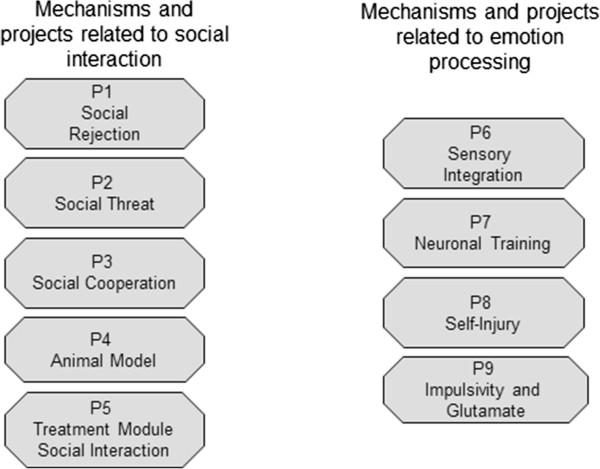
The last two decades have seen a strong rise in empirical research in the mechanisms of emotion dysregulation in borderline personality disorder. Major findings comprise structural as well as functional alterations of brain regions involved in emotion processing, such as amygdala, insula, and prefrontal regions. In addition, more specific mechanisms of disturbed emotion regulation, e.g. related to pain and dissociation, have been identified. Most recently, social interaction problems and their underlying neurobiological mechanisms, e.g. disturbed trust or hypersensitivity to social rejection, have become a major focus of BPD research. This article covers the current state of knowledge and related relevant research goals. The first part presents a review of the literature. The second part delineates important open questions to be addressed in future studies. The third part describes the research agenda for a large German center grant focusing on mechanisms of emotion dysregulation in BPD.
Overview
The claims and statistics of this paper haven’t been checked yet.
Run the check — free, no account needed. It reads the open-access text and checks the sources it cites.
Integrity signals
Registry
Cites
Statistics
Figures
Verification
Claims the paper makes
The claims and statistics of this paper haven’t been checked yet.
Run the check — free, no account needed. It reads the open-access text and checks the sources it cites.
Claims other papers make about this one
Each is checked against this paper’s own text: does it say what the citing paper says it does?
The source backs part of the claim, not all of it — or backs it for a different population, condition or comparison.
In the citing paper
“increased pain threshold, reduced pain perception (related to self-harm behaviours) (Bekrater-Bodmann et al., 2015;Ludascher et al., 2007;Schmahl et al., 2014)”
From A review of the relation between dissociation, memory, executive functioning and social cognition in military members and civilians with neuropsychiatric conditions (2016) · cites this paper as Schmahl et al., 2014
Experimental — accuracy not yet measured
Self-check
Percentages, sums and reported differences re-computed from the paper’s own numbers.
The self-check needs the paper’s full text.
Citations
Cites
Lazarus, R. S. (1991) · doi:10.1093/oso/9780195069945.001.0001 · Cited by 12,691
The Endophenotype Concept in Psychiatry: Etymology and Strategic Intentions
Gottesman, I. I., & Gould, T. D. (2003) · American Journal of Psychiatry · doi:10.1176/appi.ajp.160.4.636 · Cited by 5,615
The adolescent brain and age-related behavioral manifestations
Spear, L. P. (2000) · Neuroscience & Biobehavioral Reviews · doi:10.1016/s0149-7634(00)00014-2 · Cited by 5,433
Emotion regulation: affective, cognitive, and social consequences.
Gross, J. J. (2002) · Psychophysiology · doi:10.1017/s0048577201393198 · Cited by 4,890 · cited 11×
“Ochsner KN, Gross JJ: The Neural Bases of Emotion and Emotion Regulation: A valuation Perspective.”
BackgroundMethodInfluentialThe cognitive control of emotion
OCHSNER, K., & GROSS, J. (2005) · Trends in Cognitive Sciences · doi:10.1016/j.tics.2005.03.010 · Cited by 4,495
Hayes, S. C., Wilson, K. G., Gifford, E. V., Follette, V. M., & Strosahl, K. (1996) · Journal of Consulting and Clinical Psychology · doi:10.1037//0022-006x.64.6.1152 · Cited by 3,595
Handbook of emotion regulation
Gross, J. (2014) · Choice Reviews Online · doi:10.5860/choice.52-1127 · Cited by 3,283
Pezawas, L., Meyer-Lindenberg, A., Drabant, E. M., Verchinski, B. A., Munoz, K. E., Kolachana, B. S., Egan, M. F., Mattay, V. S., Hariri, A. R., & Weinberger, D. R. (2005) · Nature Neuroscience · doi:10.1038/nn1463 · Cited by 1,980
Self-citationThe functions of deliberate self-injury: a review of the evidence
Klonsky, E. D. (2007) · Clinical Psychology Review · doi:10.1016/j.cpr.2006.08.002 · Cited by 1,979
The social brain in adolescence
Blakemore, S.-J. (2008) · Nature Reviews Neuroscience · doi:10.1038/nrn2353 · Cited by 1,896
Research works printed but not linked: 1
- [40]Frijda N The Emotions 1986 Cambridge Cambridge University Press
Cited by
Sorted by citations
Schulze, L., Schmahl, C., & Niedtfeld, I. (2016) · Biological Psychiatry · doi:10.1016/j.biopsych.2015.03.027 · Cited by 48
Self-citationFonagy, P., Speranza, M., Luyten, P., Kaess, M., Hessels, C. J., & Bohus, M. (2015) · European Child & Adolescent Psychiatry · doi:10.1007/s00787-015-0751-z · Cited by 165
Self-citationMüller, L. E., Schulz, A., Andermann, M., Gäbel, A., Gescher, D. M., Spohn, A., Herpertz, S. C., & Bertsch, K. (2015) · JAMA Psychiatry · doi:10.1001/jamapsychiatry.2015.1252 · Cited by 141
Self-citationAlterations of amygdala-prefrontal connectivity with real-time fMRI neurofeedback in BPD patients.
Paret, C., Kluetsch, R., Zaehringer, J., Ruf, M., Demirakca, T., Bohus, M., Ende, G., & Schmahl, C. (2016) · Social Cognitive and Affective Neuroscience · doi:10.1093/scan/nsw016 · Cited by 114
Self-citationvan Steenwyk, G., Roszkowski, M., Manuella, F., Franklin, T. B., & Mansuy, I. M. (2018) · Environmental Epigenetics · doi:10.1093/eep/dvy023 · Cited by 116
Metadata
- Authors
- Schmahl, C., Herpertz, S. C., Bertsch, K., Ende, G., Flor, H., Kirsch, P., Lis, S., Meyer-Lindenberg, A., Rietschel, M., Schneider, M., Spanagel, R., Treede, R.-D., & Bohus, M.
- Affiliations
- Heidelberg University (DE)
- Corresponding author
- Schmahl, Christian
- ORCID
- Venue
- Borderline Personality Disorder and Emotion Dysregulation
- Published
- 2014
- Volume
- 1
- Issue
- 1
- Pages
- 12
- ISSN
- 2051-6673 (ISSN-L)
- PMC
- PMC4579501
- OpenAlex
- W2108334765
- Cited by
- 168
- References
- 212
- Citations by year
- 2026: 12 · 2025: 15 · 2024: 3 · 2023: 11 · 2022: 13 · 2021: 23 · 2020: 19 · 2019: 13 · 2018: 14 · 2017: 12 · 2016: 18 · 2015: 14 · 2014: 1
- FWCI
- 2.27
- Type
- journal article
- Language
- en
- Open access
- gold
- doi.org
- Licence
- cc-by
- Locations
- Borderline Personality Disorder and Emotion Dysregulation (publishedVersion, cc-by)
- PubMed Central (publishedVersion, cc-by)
- PubMed (publishedVersion)
- heiDOK (Heidelberg University) (acceptedVersion, other-oa)
- Funders
- Deutsche Forschungsgemeinschaft
- Topics
- Social Sciences › Psychology › Clinical Psychology › Personality Disorders and Psychopathology
- Life Sciences › Neuroscience › Cognitive Neuroscience › Neural and Behavioral Psychology Studies
- Social Sciences › Psychology › Clinical Psychology › Personality Traits and Psychology
- Keywords
- borderline personality disorder, emotional dysregulation, emotional processing, social interaction, amygdala, insula, prefrontal cortex, pain, dissociation, trust, rejection sensitivity, neurobiological mechanisms, research agenda
About these checks
Registry, retraction, Cites and statistics results are computed, not judged, with one exception: a printed reference that no index lists is read once by a model before it counts as a citation error. Claims are extracted by a model and kept only when their quote appears verbatim in the text; each cited source is then checked, with a model’s help, for whether it says what the claim relies on. Those verdicts can be wrong — read the claim’s quote and the cited source before relying on one.
Statistics and arithmetic are recomputed, not judged.
Confidence bands are shown only for fields calibrated on our annotated test set. None is calibrated yet, so no band is shown.
What counts as a claim ›How we measure confidence ›How we check this ›
Are you an author, or do you see a problem with this page? Request a review
