

A Comparative Study on Open Circuit Voltage Models for Lithium-ion Batteries
Open accessThe DOI matches its Crossref record; 47 of the 48 references it cites were found in a registry or an index.
Abstract
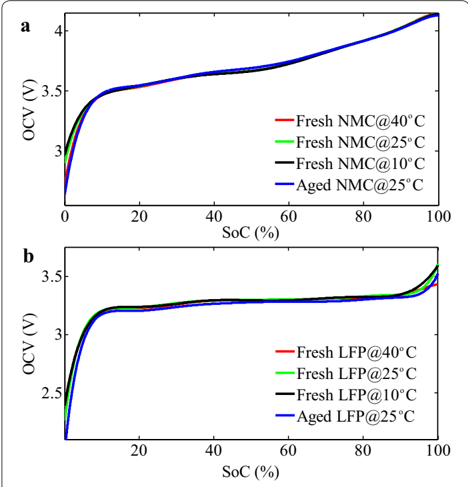
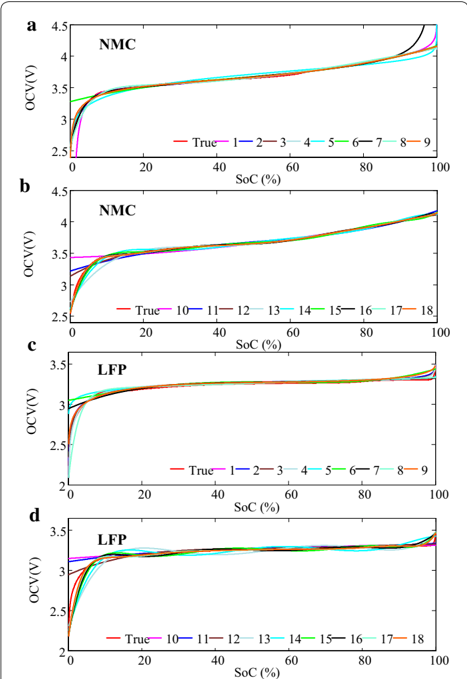
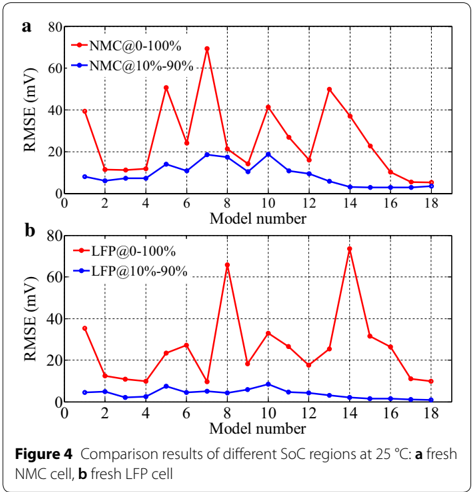
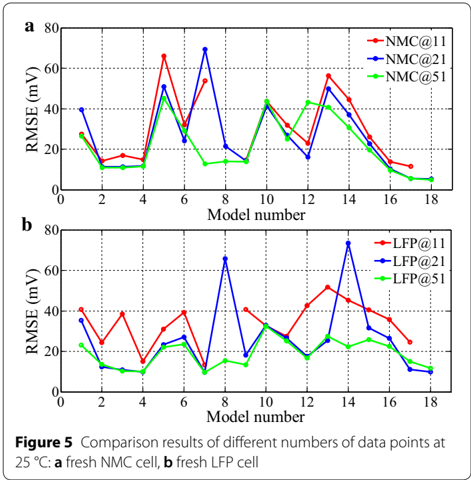
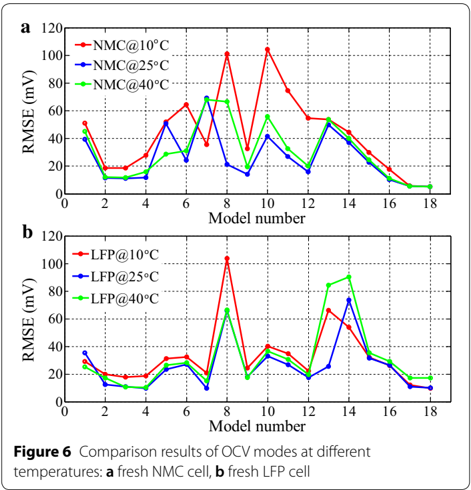
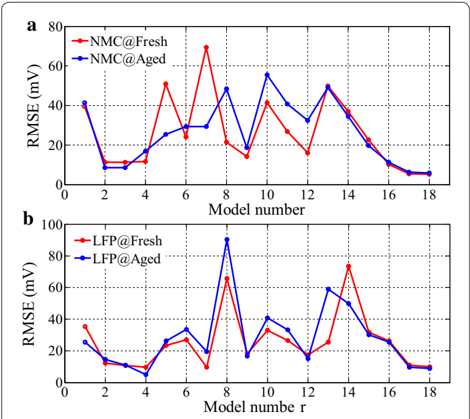
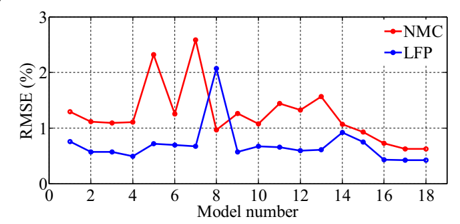
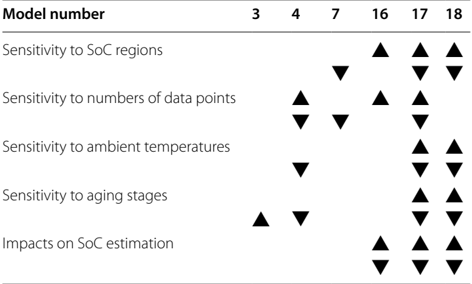
The current research of state of charge (SoC) online estimation of lithium-ion battery (LiB) in electric vehicles (EVs) mainly focuses on adopting or improving of battery models and estimation filters. However, little attention has been paid to the accuracy of various open circuit voltage (OCV) models for correcting the SoC with aid of the ampere-hour counting method. This paper presents a comprehensive comparison study on eighteen OCV models which cover the majority of models used in literature. The low-current OCV tests are conducted on the typical commercial LiFePO 4 /graphite (LFP) and LiNiMnCoO 2 /graphite (NMC) cells to obtain the experimental OCV-SoC curves at different ambient temperature and aging stages. With selected OCV and SoC points from experimental OCV-SoC curves, the parameters of each OCV model are determined by curve fitting toolbox of MATLAB 2013. Then the fitting OCV-SoC curves based on diversified OCV models are also obtained. The indicator of root-mean-square error (RMSE) between the experimental data and fitted data is selected to evaluate the adaptabilities of these OCV models for their main features, advantages, and limitations. The sensitivities of OCV models to ambient temperatures, aging stages, numbers of data points, and SoC regions are studied for both NMC and LFP cells. Furthermore, the influences of these models on SoC estimation are discussed. Through a comprehensive comparison and analysis on OCV models, some recommendations in selecting OCV models for both NMC and LFP cells are given.
Overview
The claims and statistics of this paper haven’t been checked yet.
Free: it reads the open-access text and checks the first 5 claims that cite a source we can check. Create a free account to check every claim.
Integrity signals
Registry
Cites
Statistics
Figures
Verification
Claims the paper makes
The claims and statistics of this paper haven’t been checked yet.
Free: it reads the open-access text and checks the first 5 claims that cite a source we can check. Create a free account to check every claim.
Claims other papers make about this one
Each is checked against this paper’s own text: does it say what the citing paper says it does?
The source backs part of the claim, not all of it — or backs it for a different population, condition or comparison.
In the citing paper
“The flat section of the mid-SOC zone curve contributes to OCV ' s inaccuracy [45].”
From Recent developments and challenges in state-of-charge estimation techniques for electric vehicle batteries: A review (2024) · cites this paper as [45]
Experimental — accuracy not yet measured
Self-check
Percentages, sums and reported differences re-computed from the paper’s own numbers.
The self-check needs the paper’s full text.
Citations
Cites
Accurate electrical battery model capable of predicting runtime and I-V performance
Chen, M., & Rincon-Mora, G. A. (2006) · IEEE Transactions on Energy Conversion · doi:10.1109/tec.2006.874229 · Cited by 2,427
Extended Kalman filtering for battery management systems of LiPB-based HEV battery packs
Plett, G. L. (2004) · Journal of Power Sources · doi:10.1016/j.jpowsour.2004.02.032 · Cited by 1,923
Critical Review on the Battery State of Charge Estimation Methods for Electric Vehicles
Xiong, R., Cao, J., Yu, Q., He, H., & Sun, F. (2018) · IEEE Access · doi:10.1109/access.2017.2780258 · Cited by 1,004
Self-citationHe, H., Xiong, R., Zhang, X., Sun, F., & Fan, J. (2011) · IEEE Transactions on Vehicular Technology · doi:10.1109/tvt.2011.2132812 · Cited by 825
Self-citationZou, Y., Hu, X., Ma, H., & Li, S. E. (2015) · Journal of Power Sources · doi:10.1016/j.jpowsour.2014.09.146 · Cited by 723
Battery-Management System (BMS) and SOC Development for Electrical Vehicles
Cheng, K. W. E., Divakar, B. P., Wu, H., Ding, K., & Ho, H. F. (2011) · IEEE Transactions on Vehicular Technology · doi:10.1109/tvt.2010.2089647 · Cited by 692
Nejad, S., Gladwin, D. T., & Stone, D. A. (2016) · Journal of Power Sources · doi:10.1016/j.jpowsour.2016.03.042 · Cited by 565
Xiong, R., Sun, F., Chen, Z., & He, H. (2014) · Applied Energy · doi:10.1016/j.apenergy.2013.07.061 · Cited by 529 · cited 1×
“3 [11, 12] Uoc = K0 + K1s+ K2s(2) + K3s(3) + K4/s+ K5 ln (s)”
Self-citationXiong, R., He, H., Sun, F., & Zhao, K. (2013) · IEEE Transactions on Vehicular Technology · doi:10.1109/tvt.2012.2222684 · Cited by 447 · cited 1×
“12 [20] Uoc = K0 + K1s+ K2s(2) + K3s(3) + K4s(4)”
Self-citationChen, Z., Fu, Y., & Mi, C. C. (2013) · IEEE Transactions on Vehicular Technology · doi:10.1109/tvt.2012.2235474 · Cited by 442
Cited by
Items 101–157 of 157
Pattnaik, M., Badoni, M., & Tatte, Y. N. (2022) · Journal of Energy Storage · doi:10.1016/j.est.2022.105244 · Cited by 5
Modeling of Lithium-ion battery open-circuit voltage using incremental and low current test
Abbas, D., Boulebtateche, B., & Lafifi, M. M. (2022) · International Multi-Conference on Systems, Signals & Devices (SSD) · doi:10.1109/ssd54932.2022.9955959 · Cited by 5
“INTRODUCTION In recent years, the global energy problem and the deterioration of the environment have provided an opportunity for Electric vehicle (EVs) development [1].”
BackgroundMethodInfluentialState of Charge Estimation Using an Adaptive Luenberger Observer and Artificial Neural Networks
Margal, A., Daoudi, S. E., Abdallaoui, A. E., Khallouq, A., & Karama, A. (2025) · Mediterranean Conference on Control and Automation (MED) · doi:10.1109/med64031.2025.11073263 · Cited by 4
“Direct measurement methods, such as open-circuit voltage (OCV) measurement, which offers high accuracy but requires extended balancing time, and it is dependent on external factors including temperature and hysteresis, thus limiting its use in real-time [5].”
Yuan, Z., Huang, K., Xu, C.-H., Zou, J.-C., & Yan, J. (2025) · Batteries · doi:10.3390/batteries11070243 · Cited by 4
Tabular Open Circuit Voltage Modelling of Li-ion Batteries for Robust SOC Estimation
Sundaresan, S., Devabattini, B., Balasingam, B., & Pattipati, K. R. (2022) · IEEE Industrial Electronics Society Annual On-Line Conference (ONCON) · doi:10.1109/oncon56984.2022.10126732 · Cited by 4
“Polynomial [19] p1+p2s+p3s (2)+p4s 3+ p5 s + p6 s2 p1 = −3.”
Hugenholtz, D. (2020) · Research Repository (Delft University of Technology) · Cited by 4
Figgener, J., Bors, J., Kuipers, M., Hildenbrand, F., Junker, M. D., Koltermann, L., Woerner, P., Mennekes, M., Haberschusz, D., Kairies, K.-P., et al. (2024) · arXiv (Cornell University) · doi:10.48550/arxiv.2411.08025 · Cited by 4
Nguyen, N., Sunil, S., Pillai, P., & Balasingam, B. (2025) · IEEE International Symposium on Industrial Electronics (ISIE) · doi:10.1109/isie62713.2025.11124624 · Cited by 4
“Some examples are [1], [8], [9], where the low-rate OCV test is conducted at multiple temperautres.”
Estimation of Battery SoC using Reinforcement Learning
Mortabit, I., Rachid, A., Errifai, N., & Boudmane, B. (2025) · EPJ Web of Conferences · doi:10.1051/epjconf/202533006006 · Cited by 3
de Bessa, I. V., Besançon, G., Bratcu, A. I., Coutinho, D., & Munteanu, I. (2026) · Control Engineering Practice · doi:10.1016/j.conengprac.2026.107021 · Cited by 3
Statistical Modeling Procedures for Rapid Battery Pack Characterization
Beslow, L., Landore, S., & Park, J. W. (2023) · Batteries · doi:10.3390/batteries9090437 · Cited by 3
Experimental Testing and Modeling of Li-Ion Battery Performance Based on IEC 62660-1 Standard
Voltsi, Z., & Elmasides, C. (2025) · Batteries · doi:10.3390/batteries11080314 · Cited by 3
Relax, Estimate, and Track: A Simple Battery State-of-Charge and State-of-Health Estimation MethodPreprint
Jiang, S., Shi, J., & Moura, S. J. (2025) · SSRN Electronic Journal · doi:10.2139/ssrn.5295539 · Cited by 3
Diagnostic de la batterie et gestion de l’énergie pour applications embarquées
Meng, J. (2020) · theses.fr (ABES) · doi:10.70675/08ef3fa0za60az4544zb1d8z0fbab43c100b · Cited by 3
Physics-Informed Data-Driven Approaches to State of Health Prediction of Maritime Battery Systems
Bakdi, A., Bruch, M., Liang, Q., & Vanem, E. (2024) · Annual Conference of the PHM Society · doi:10.36001/phmconf.2024.v16i1.4135 · Cited by 2
“…models based on open circuit voltage (OCV) for state of health prediction are presented in e.g. Weng et al. (2014); Bian et al. (2020, 2022); Noh et al. (2023), see also Yu et al. (2018); Meng et al. (2020); Wang et al. (2023); Zhou et al. (2024) for related work on estimating the OCV curve.”
BackgroundArabacı, H., Uçar, K., & Çimen, H. (2025) · International Youth Conference on Energy · doi:10.1109/iyce66046.2025.11155025 · Cited by 2
“…can be obtained using different methods: I-By using current, voltage, and SoC data obtained from full charge and full discharge experiments conducted at low current levels (such as one-twentieth or one-thirtieth of the nominal current), either directly [14-16] or through optimization methods [17].”
Moser, J., Rom, W., Aichinger, G., Kron, V., Tuljapure, P. A., Ratz, F., & Michelini, E. (2026) · World Electric Vehicle Journal · doi:10.3390/wevj17020066 · Cited by 2
Bossi, G., & Damiano, A. (2024) · IEEE Energy Conversion Congress and Exposition (ECCE) · doi:10.1109/ecce55643.2024.10860951 · Cited by 2
“The ninth-order polynomial mathematical model of (16) is considered the best choice for estimating v OC [15] v OC ( x ) = p 1 x 8 + p 2 x 7 + p 3 x 6 + p 4 x 5 + + p 5 x 4 + p 6 x 3 + p 7 x 2 + p 8 x + p 9 (16) Fig.”
Optimal Power Management for Seismic Nodes
Duncan, D., Zungeru, A. M., Mangwala, M., Diarra, B., Chuma, J., & Mtengi, B. (2021) · International journal of engineering research in Africa · doi:10.4028/www.scientific.net/jera.56.162 · Cited by 1
“It is important to note that the difference between the VOC and the terminal voltage of the lead-acid battery is polarization effects and voltage drop [36].”
BackgroundOnline determination of state of charge in lithium-ion batteries: influence of the state of health
Armenta-Déu, C. (2025) · Frontiers in Energy Research · doi:10.3389/fenrg.2025.1573972 · Cited by 1
“…et al., 2016), and the discharge path (Petzl and Danzer, 2013); therefore, the determination of the OCV requires a modeling process that considers all the factors mentioned above (Zhang et al., 2016; Birkl et al., 2015; Yu et al., 2018; Weng et al., 2014; Weng et al., 2013; Yu et al., 2021).”
Tang, P. C., Pan, J., Yao, Z., Qiu, Z., Cheng, D., & Gu, X. (2025) · Journal of The Electrochemical Society · doi:10.1149/1945-7111/adfd17 · Cited by 1
Online Implementable Open Circuit Voltage Prediction for Battery-Powered Internet of Things Devices
Liu, W., Wang, L., Dong, H., Pan, C., Xia, Y., & Hu, S. (2025) · IEEE Internet of Things Journal · doi:10.1109/jiot.2025.3602129 · Cited by 1
“More complex fitting methods can be used [31], although this inevitably increases the computational overhead.”
Self-citationExperimental Comparison of Different Techniques for Estimating Li-Ion Open-Circuit Voltage
Pakjoo, M., & Piegari, L. (2026) · Batteries · doi:10.3390/batteries12010032 · Cited by 1
“The OCV is equal to the battery terminal voltage when there is no polarization effect or voltage drop due to internal impedance [20].”
Intelligent Learning Methods for Battery State of Charge Estimation for Electric Vehicles: a Review
Parmar, R., & Sakravdia, D. K. (2025) · International Conference on Advanced Computing and Emerging Technologies (ACET) · doi:10.1109/acet67282.2025.11430296 · Cited by 1
Çelik, M., Gözüküçük, M. A., Akdoğan, T., & Uğurdağ, H. F. (2019) · National Conference on Electrical and Electronics Engineering (ELECO) · doi:10.23919/eleco47770.2019.8990538 · Cited by 1
Liu, W., Wan, B., Ma, S., Ma, S., Li, Y., Guo, R., Pei, H., & Xie, J. (2024) · ECS Advances · doi:10.1149/2754-2734/ad58f7 · Cited by 1
“…capacities and discharge voltages at 1 C. 17 Various methods are commonly used to estimate the capacity of lithium-ion batteries, including open circuit voltage (OCV), 18 internal resistance acquisition, 19 extended Kalman fi lter (EKF)- based estimation, 20 – 22 and statistical learning methods.”
BackgroundMethodReisz, P. A., Eschelmüller, B., Stahleder, D., & Ledinger, S. (2024) · Annual Conference of the IEEE Industrial Electronics Society (IECON) · doi:10.1109/iecon55916.2024.10905638 · Cited by 1
“An exception is V oc , for which several non-linear equations are proposed [14], [16].”
OPTIMAL PROBING OF BATTERY CYCLES FOR MACHINE LEARNING-BASED MODEL DEVELOPMENT
Nozarijouybari, Z. (2024) · University Libraries (University of Maryland) · doi:10.13016/hqe6-c5w3 · Cited by 1
Tiozzo, A. (n.d.) · Institutional Research Information System University of Turin (University of Turin) · Cited by 1
Yang, J. L., Zhang, T., Hong, J., Zhang, H., Zhao, Q., & Meng, Z. (2021) · Research Square · doi:10.21203/rs.3.rs-793390/v1
Non-Linear Bipolar Pulse Characterisation of Lithium-ion Batteries
Li, A. G., & Preindl, M. (2023) · IEEE Energy Conversion Congress and Exposition (ECCE) · doi:10.1109/ecce53617.2023.10362892
State of Charge Balancing Control for Multiple Output Dynamically Adjustable Capacity System
Kang, J.-M., & Rich, D. (2024) · SAE International Journal of Electrified Vehicles · doi:10.4271/14-13-02-0014
Lin, C., Zhang, G., Zhao, C., & Liu, L. (2025) · Lecture notes in electrical engineering · doi:10.1007/978-981-96-4067-6_21
Self-citationSimultaneous Series-Parallel High-Speed and Accurate Active Cell Balancing for Improved Battery Life
Sarkar, A., Dutt, R., & Acharyya, A. (2025) · IEEE International Symposium on Circuits and Systems proceedings · doi:10.1109/iscas56072.2025.11044073
Αλγόριθμοι υπολογισμού της κατάστασης φόρτισης και της κατάστασης υγείας σε μπαταρίες ιόντων λιθίου
Lolis, I. (2022) · DSpace - NTUA (National Technical University of Athens) · doi:10.26240/heal.ntua.23842
Characterization of Lithium-Ion Batteries in Electric Vehicles over their Lifetime
Wildfeuer, L., Lienkamp, M., & München, T. U. (2025) · mediaTUM (Technical University of Munich)
García-Méndez, A. D. J., Sánchez-Hernández, J. D. J., & García-Guzmàn, J. (2025) · Mexican International Conference on Computer Science · doi:10.1109/enc68268.2025.11311882
“Initial cost [15] Low Hight Energy density [15] 30-50 Wh/kg 150-250 Wh/kg Charge-discharge efficiency [16] 70-85 % 90-95 % Cycle life [16] 500-1,000 3,000-5,000 Maintenance [17] Required (distilled water) Practically none Environment impact [17] Hight (toxic lead) Medium (complex recycling) The…”
Nasri, E., Jarou, T., & Jenkal, W. (2026) · SSRN Electronic Journal · doi:10.2139/ssrn.6024655
State of Health Estimation in Lithium-Ion Batteries: Methods, Comparisons, and Future Directions
Patel, P., & Bhagat, A. (2026) · SAE technical papers on CD-ROM/SAE technical paper series · doi:10.4271/2026-26-0208
Litovski, V. B. (2026) · Lecture notes in electrical engineering · doi:10.1007/978-981-95-0070-3_5
Sim, J.-U., Kim, S.-W., & Cho, I. (2026) · Journal of Electrical Engineering and Technology · doi:10.1007/s42835-026-02637-8
Elsisi, M., Tsao, S.-H., Huang, Y.-Z., Hu, C.-H., & Su, C. (2025) · IEEE International Conference on Energy Technologies for Future Grids (ETFG) · doi:10.1109/etfg61999.2025.11401246
“Model-based improvements, such as high-order polynomial OCV models [14], further enhance accuracy.”
Severin, C. (2026) · eTransportation · doi:10.1016/j.etran.2026.100581
Modeling and monitoring of the aging of Li-ion accumulators by coupling with a dual-tank model
Koné, J.-L. (2021) · theses.fr (ABES) · doi:10.70675/99542509z25bfz4d9az8dd3zc7fb71be3c24
Wang, W., Chen, D., Cheng, C., Tong, C., Wang, X., Jian, J., & Zou, J. (2026) · Engineering Research Express · doi:10.1088/2631-8695/ae68da
“This may be attributed to the more complex electrochemical behavior and stronger dynamic disturbances at extreme SOC ranges that increase prediction difficulty, while the feature-SOC relationship is more stable in the mid-SOC range [39, 40].”
Chen, L., Hu, Y., Yuan, B., Li, M., Liu, T., Wang, Z., Yang, R., Shi, M., & Zhao, Y. (2026) · Ionics · doi:10.1007/s11581-026-07175-x
Research on the enhancement of LFP battery SOC prediction performance by ultrasonic technology
Wang, W., Zou, J., & Jian, J. (2026) · Journal of Physics Conference Series · doi:10.1088/1742-6596/3269/1/012019
Yang, C., Liu, J., Gao, Z., Zeng, X., Wang, H., & Tan, S. (2026) · IEEE Transactions on Instrumentation and Measurement · doi:10.1109/tim.2026.3716475
“…, t and The relationship between OCV and SOE is modeled using a fifth-order polynomial function, following a similar approach to that used for OCV-SOC characterization in the following equation [36]: where b j ( j = 0 , 1 , . . . , 5) denotes fitting coe ffi cients updated online by the first-stage KF.”
Khoshharf, A. (2026) · SSRN Electronic Journal · doi:10.2139/ssrn.7235135
Buchaniec, S., Kishimoto, M., & Iwai, H. (2026) · SSRN Electronic Journal · doi:10.2139/ssrn.7519527
State‐of‐Charge Estimation of Second‐Life Batteries Using the Federated Learning
Gotz, J. D., Galvão, J. R., Corrêa, F. C., Borsato, M., Britto, A. D. S., Viana, E. R., Mendes, N., & Badin, A. A. (2026) · Energy Storage · doi:10.1002/est2.70532
“This technique requires a relaxation time for the battery to establish a correlation between Voltage, SOC, and temperature [44, 45].”
Energy recovery and storage from aircraft taxiing operations
Lukic, M. (2022) · Nottingham ePrints (University of Nottingham)
Shanaq, A. A., Shannag, M., Ganesan, S., Debnath, D., & Zohdy, M. A. (2026) · International Conference on Intelligent Computing and Sustainable Innovations in Technology (IC-SIT) · doi:10.1109/ic-sit69723.2026.11735934
“Lithium iron phosphate (LiFePO4, LFP) batteries have become a popular choice in various applications, including electric vehicles (EVs) and energy storage systems, because of their inherent advantages, such as safety, long cycle life, and excellent thermal stability [1].”
Chen, T., Zhang, H., Wang, S., Li, J., Shang, S., Du, J., Yan, Y., Yang, F., & Xu, Y. (2026) · Journal of The Electrochemical Society · doi:10.1149/1945-7111/aeba1e
Ferahtia, S., Bekrar, A., & Mesbahi, T. (2026) · Energy and AI · doi:10.1016/j.egyai.2026.100958
Nassef, A. M., Balaha, H. M., & Elhosseini, M. A. (2026) · Batteries · doi:10.3390/batteries12110451
Initial SOC Error Recovery with a CC-RLS-PI Hybrid Estimator
Budiarto, T., Akbar, M. N., Haq, I. N., Pradipta, J., Leksono, E., & Rasyidnianto, M. F. (2027) · Jurnal Otomasi Kontrol dan Instrumentasi · doi:10.5614/joki.2027.19.1.2
Metadata
- Authors
- Yu, Q.-Q., Xiong, R., Wang, L.-Y., & Lin, C.
- Affiliations
- Beijing Institute of Technology (CN)
- Wayne State University (US)
- Corresponding author
- Xiong, Rui
- Venue
- Chinese Journal of Mechanical Engineering
- Publisher
- Elsevier BV
- Published
- 2018-08-17
- Volume
- 31
- Issue
- 1
- ISSN
- 1000-9345 (ISSN-L)
- 2192-8258
- OpenAlex
- W2886761387
- Cited by
- 137
- References
- 48
- Citations by year
- 2026: 13 · 2025: 24 · 2024: 13 · 2023: 24 · 2022: 24 · 2021: 19 · 2020: 10 · 2019: 10
- FWCI
- 5.18
- Type
- journal article
- Language
- en
- Open access
- diamond
- doi.org
- Licence
- cc-by
- creativecommons.org/licenses/by/4.0 (tdm)
- Locations
- Chinese Journal of Mechanical Engineering (publishedVersion, cc-by)
- Funders
- National Natural Science Foundation of China (51507012)
- Beijing Nova Program (Z171100001117063)
- National Key Research and Development Program of China (2017YFB0103802)
- Topics
- Physical Sciences › Engineering › Automotive Engineering › Battery Modeling and Management
- Physical Sciences › Engineering › Electrical and Electronic Engineering › Advancements in Battery Materials
- Physical Sciences › Engineering › Control and Systems Engineering › Control Systems and Identification
- Keywords
- lithium-ion batteries, state of charge estimation, LiFePO4/graphite cells, NMC/graphite cells, battery degradation, ambient temperature effects, electric vehicles, model sensitivity analysis
About these checks
Registry, retraction, Cites and statistics results are computed, not judged, with one exception: a printed reference that no index lists is read once by a model before it counts as a citation error. Claims are extracted by a model and kept only when their quote appears verbatim in the text; each cited source is then checked, with a model’s help, for whether it says what the claim relies on. Those verdicts can be wrong — read the claim’s quote and the cited source before relying on one.
Statistics and arithmetic are recomputed, not judged.
Confidence bands are shown only for fields calibrated on our annotated test set. None is calibrated yet, so no band is shown.
What counts as a claim ›How we measure confidence ›How we check this ›
Are you an author, or do you see a problem with this page? Request a review
Data sources
Bibliographic data: Semantic Scholar, OpenAlex, Crossref.
Contains information from the Semantic Scholar Academic Graph Datasets, made available under the ODC Attribution License (ODC-BY 1.0).
Semantic Scholar’s data is described in: Kinney, R., et al. (2023). The Semantic Scholar Open Data Platform. arXiv:2301.10140.
