

Halloysite Nanotubes Supported Ag and ZnO Nanoparticles with Synergistically Enhanced Antibacterial Activity
Open accessThe DOI matches its Crossref record; 34 of the 34 references it cites were found in a registry or an index; none of the 32 sources its claims cite is checked for support yet.
Abstract
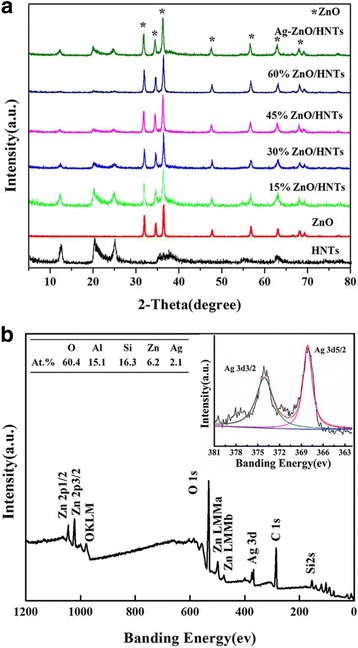
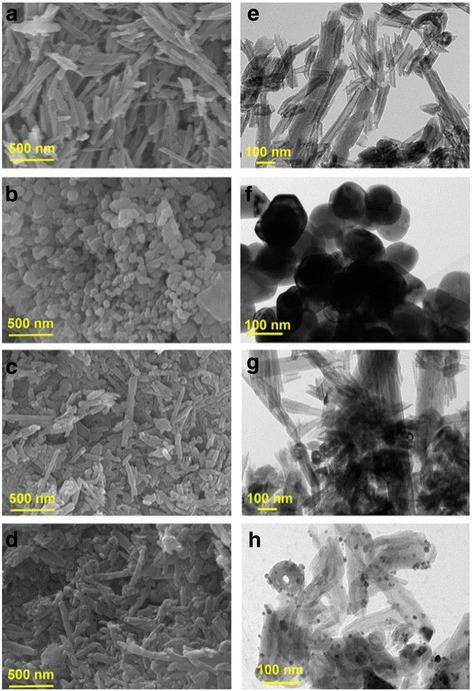
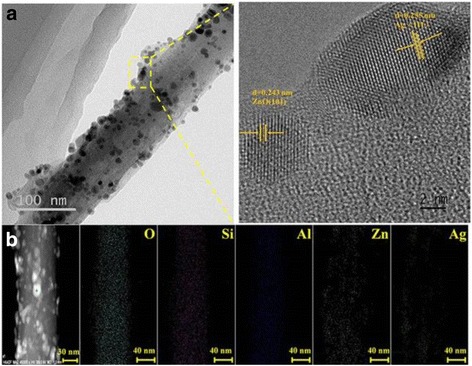
Novel antimicrobial nanocomposite incorporating halloysite nanotubes (HNTs) and silver (Ag) into zinc oxide (ZnO) nanoparticles is prepared by integrating HNTs and decorating Ag nanoparticles. ZnO nanoparticles (ZnO NPs) and Ag nanoparticles (Ag NPs) with a size of about 100 and 8 nm, respectively, are dispersively anchored onto HNTs. The synergistic effects of ZnO NPs, Ag NPs, and HNTs led to the superior antibacterial activity of the Ag-ZnO/HNTs antibacterial nanocomposites. HNTs facilitated the dispersion and stability of ZnO NPs and brought them in close contact with bacteria, while Ag NPs could promote the separation of photogenerated electron-hole pairs and enhanced the antibacterial activity of ZnO NPs. The close contact with cell membrane enabled the nanoparticles to produce the increased concentration of reactive oxygen species and the metal ions to permeate into the cytoplasm, thus induced quick death of bacteria, indicating that Ag-ZnO/HNTs antibacterial nanocomposite is a promising candidate in the antibacterial fields.
Overview
CoChat Summary
TL;DR
Ag-ZnO/HNTs antibacterial nanocomposites were prepared by anchoring Ag and ZnO nanoparticles onto halloysite nanotubes, and they showed the highest antibacterial activity and stability against *E. coli* compared with ZnO and ZnO/HNTs. The proposed synergy is that HNTs disperse/stabilize ZnO and bring it into close contact with bacteria, while Ag promotes photogenerated electron-hole separation and membrane damage.
Key findings
- ZnO nanoparticles of about 100 nm and Ag nanoparticles of about 8 nm were dispersively anchored onto HNTs; Ag loading was 1.31 wt/%. HNTs had an average length of 0.7–1.5 μm, external diameter of 50–75 nm, and internal diameter of 10–30 nm.
- Among ZnO/HNTs with 15, 30, 45, and 60% ZnO loading, 30% ZnO loading exhibited the best antibacterial efficacy; excessive loading (45 and 60%) caused ZnO agglomeration, while 15% provided insufficient ZnO.
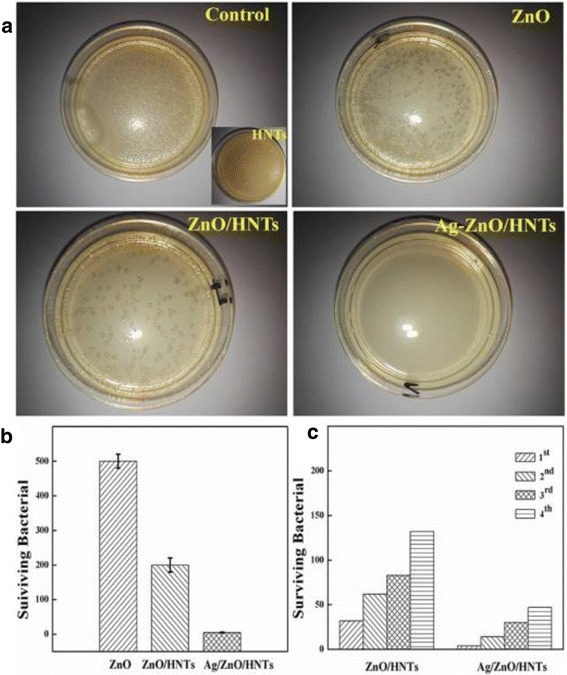
- Pristine HNTs showed no antibacterial activity. ZnO/HNTs inhibited bacterial growth more obviously than equivalent doses of pure ZnO, and Ag-ZnO/HNTs exerted the highest antibacterial activity and stability.
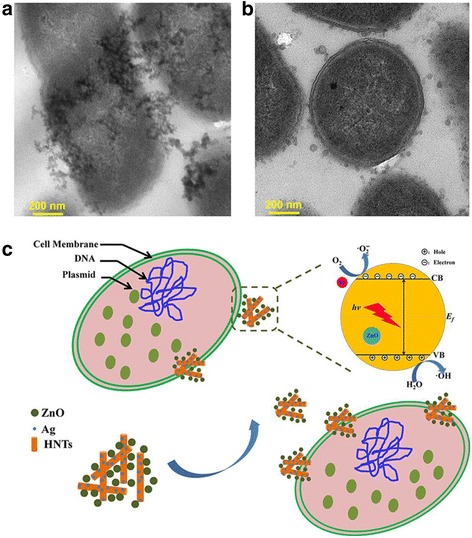
- TEM showed Ag-ZnO/HNTs adsorbed onto the bacterial surface and localized in the periplasmic compartment; the proposed mechanism involves increased ROS production, Ag-promoted separation of photogenerated electron-hole pairs, and direct damage to the bacterial cell membrane.
Methods
- Synthesis: HNTs from Chenxi, Hunan, China were purified; ZnO/HNTs were prepared using HNTs, CO(NH₂)₂, and Zn(NO₃)₂·6H₂O, then calcined at 400 °C for 4 h. Ag-ZnO/HNTs were prepared by dispersing ZnO/HNTs with AgNO₃ and PVP, adding NaBH₄ dropwise, stirring 30 min, washing, and vacuum drying.
- Characterization: XRD, SEM, TEM, HRTEM, XPS, and EDX elemental mapping were used to analyze structure, morphology, and elemental distribution.
- Antibacterial assay: Gram-negative *Escherichia coli* was cultured in LB broth at 37 °C; 10 mg nanomaterial was added to 10 mL LB plus 2 mL *E. coli* for 4 h, then 100 μL samples were plated on LB nutrient agar and colonies were quantified after 18–20 h incubation. TEM was also performed on bacteria exposed to Ag-ZnO/HNTs for 4 h.
Limitations
- The paper does not state limitations.
- Evident from the text: antibacterial testing used only one Gram-negative bacterium, *E. coli*, so activity against other bacteria or Gram-positive strains is not shown.
- Evident from the text: the ROS-mediated mechanism and metal-ion permeation are proposed from TEM and prior literature, but ROS levels and ion concentrations were not directly quantified; Ag XRD peaks were not observed because of the relatively small Ag amount.
Model-written summary. Check it against the paper before relying on it.
Integrity signals
Registry
Cites
Statistics
Figures
Verification
Claims the paper makes
0 Valid · 1 Not valid · 9 Not checked · 19 Own results and interpretations
A result the paper states — it cites no source for it, so there is none to check. The quote shows it is in the paper.
In the paper
“Most significantly, Ag-ZnO/HNTs nanocomposites exerted the highest antibacterial activity and stability than that of the equivalent doses of ZnO/HNTs and pure ZnO, which could attribute to the Ag introduced.”
- Also stated in: § Conclusions · plain
“Ag-ZnO/HNTs nanocomposites showed the highest antibacterial activity and stability.”
§ Halloysite Nanotubes Supported Ag and ZnO Nanoparticles with Synergistically Enhanced Antibacterial Activity > Results and Discussion
plainstates a cause- Asserted: passes — The authors put it forward as true.
- Checkable: passes — It can be checked against evidence.
- Load-bearing: passes — The paper’s conclusions depend on it.
- Based: passes — The paper gives a reason why it holds.
- Also stated in: § Conclusions · plain
A result the paper states — it cites no source for it, so there is none to check. The quote shows it is in the paper.
In the paper
“Thirty percent ZnO loading amount exhibited the best efficacy, which could be explained by the agglomeration of ZnO NPs with excessive ZnO loading (45 and 60%) and the insufficient amount of ZnO antibacterial agents with only 15% ZnO loading.”
§ Halloysite Nanotubes Supported Ag and ZnO Nanoparticles with Synergistically Enhanced Antibacterial Activity > Results and Discussion
plainstates an association- Asserted: passes — The authors put it forward as true.
- Checkable: passes — It can be checked against evidence.
- Load-bearing: passes — The paper’s conclusions depend on it.
- Based: passes — The paper gives a reason why it holds.
A result the paper states — it cites no source for it, so there is none to check. The quote shows it is in the paper.
In the paper
“The outstanding results demonstrated excellent antibacterial properties of Ag-ZnO/HNTs antibacterial nanocomposites.”
§ Halloysite Nanotubes Supported Ag and ZnO Nanoparticles with Synergistically Enhanced Antibacterial Activity > Conclusions
boosted- Asserted: passes — The authors put it forward as true.
- Checkable: passes — It can be checked against evidence.
- Load-bearing: passes — The paper’s conclusions depend on it.
- Based: passes — The paper gives a reason why it holds.
A result the paper states — it cites no source for it, so there is none to check. The quote shows it is in the paper.
In the paper
“The above design revealed that the Ag-ZnO/HNTs antibacterial nanocomposites exert an obvious inhibition to E. coli.”
§ Halloysite Nanotubes Supported Ag and ZnO Nanoparticles with Synergistically Enhanced Antibacterial Activity > Results and Discussion
boostedstates a cause- Asserted: passes — The authors put it forward as true.
- Checkable: passes — It can be checked against evidence.
- Load-bearing: passes — The paper’s conclusions depend on it.
- Based: passes — The paper gives a reason why it holds.
A result the paper reports from its own data — it cites no other source for it, so there is none to check. The quote shows it is in the paper.
In the paper
“The colony forming units (CFU) of both HNTs and the control sample showed normal growth on the agar plates, and the CFU cannot be counted accurately, indicating that pristine HNTs showed no antibacterial activity.”
§ Halloysite Nanotubes Supported Ag and ZnO Nanoparticles with Synergistically Enhanced Antibacterial Activity > Results and Discussion
hedged- Asserted: passes — The authors put it forward as true.
- Checkable: passes — It can be checked against evidence.
- Load-bearing: passes — The paper’s conclusions depend on it.
- Based: passes — The paper gives a reason why it holds.
9 more claims
Create a free account to see all 29 claims and to verify the 32 references still open.
- Probably not a substantial claim. 6
- It may state two separate claims as one. 9
Self-check
Percentages, sums and reported differences re-computed from the paper’s own numbers.
Each contradiction between two passages listed here was confirmed by an independent check.
Rated minor: it would not touch a result — a value no result rests on, a p-value that stays on the same side of the significance level, or a conflict that is clerical, resolved elsewhere in the paper, or outside its own findings.
In the paper
§ Halloysite Nanotubes Supported Ag and ZnO Nanoparticles with Synergistically Enhanced Antibacterial Activity > Background
“given to their natural nanostructures, unique ion exchange capacities, superior hydrophily, and excellent mechanical properties.”
§ Halloysite Nanotubes Supported Ag and ZnO Nanoparticles with Synergistically Enhanced Antibacterial Activity > Background
“Such interest can be hugely attributed to their physicochemical properties: tubular structures, high-specific surface area, length-to-diameter (L/D) ratio [31, 32], and hydrophobicity.”
Citations
Cites
Raghupathi, K. R., Koodali, R. T., & Manna, A. C. (2011) · Langmuir · doi:10.1021/la104825u · Cited by 2,037
Li, Y., Zhang, W., Niu, J., & Chen, Y. (2012) · ACS Nano · doi:10.1021/nn300934k · Cited by 1,660
Halloysite clay minerals — a review
Joussein, E., Petit, S., Churchman, J., Theng, B., Righi, D., & Delvaux, B. (2005) · Clay Minerals · doi:10.1180/0009855054040180 · Cited by 1,412
Enhanced Antibacterial Activity of Nanocrystalline ZnO Due to Increased ROS‐Mediated Cell Injury
Applerot, G., Lipovsky, A., Dror, R., Perkas, N., Nitzan, Y., Lubart, R., & Gedanken, A. (2009) · Advanced Functional Materials · doi:10.1002/adfm.200801081 · Cited by 1,031
Rizzello, L., & Pompa, P. P. (2014) · Chem. Soc. Rev. · doi:10.1039/c3cs60218d · Cited by 822
Antibacterial nano-structured titania coating incorporated with silver nanoparticles
Zhao, L., Wang, H., Huo, K., Cui, L., Zhang, W., Ni, H., Zhang, Y., Wu, Z., & Chu, P. K. (2011) · Biomaterials · doi:10.1016/j.biomaterials.2011.04.040 · Cited by 772
Self-citationZhao, Y., Tian, Y., Cui, Y., Liu, W., Ma, W., & Jiang, X. (2010) · Journal of the American Chemical Society · doi:10.1021/ja1028843 · Cited by 592
Wang, Y.-W., Cao, A., Jiang, Y., Zhang, X., Liu, J.-H., Liu, Y., & Wang, H. (2014) · ACS Applied Materials & Interfaces · doi:10.1021/am4053317 · Cited by 503
Clay: New Opportunities for Tissue Regeneration and Biomaterial Design
Dawson, J. I., & Oreffo, R. O. C. (2013) · Advanced Materials · doi:10.1002/adma.201301034 · Cited by 351
Applications and interfaces of halloysite nanocomposites
Zhang, Y., Tang, A., Yang, H., & Ouyang, J. (2016) · Applied Clay Science · doi:10.1016/j.clay.2015.06.034 · Cited by 263
Self-citation
Cited by
Surface Design for Antibacterial Materials: From Fundamentals to Advanced Strategies
Li, W., Thian, E. S., Wang, M., Wang, Z., & Ren, L. (2021) · Advanced Science · doi:10.1002/advs.202100368 · Cited by 429
Yan, Z., Fu, L., Zuo, X., & Yang, H. (2017) · Applied Catalysis B: Environmental · doi:10.1016/j.apcatb.2017.12.040 · Cited by 305
Self-citationSingh, T. A., Sharma, A., Tejwan, N., Ghosh, N., Das, J., & Sil, P. C. (2021) · Advances in Colloid and Interface Science · doi:10.1016/j.cis.2021.102495 · Cited by 283
Bimetallic Nanoparticles for Antimicrobial Applications
Arora, N., Thangavelu, K., & Karanikolos, G. N. (2020) · Frontiers in Chemistry · doi:10.3389/fchem.2020.00412 · Cited by 268
Tharmavaram, M., Pandey, G., & Rawtani, D. (2018) · Advances in Colloid and Interface Science · doi:10.1016/j.cis.2018.09.001 · Cited by 220
Metadata
- Authors
- Shu, Z., Zhang, Y., Yang, Q., & Yang, H.
- Affiliations
- Central South University (CN)
- University College London (GB)
- Corresponding author
- Yang, Huaming
- Venue
- Nanoscale Research Letters
- Published
- 2017-02-20
- Volume
- 12
- Issue
- 1
- Pages
- 135-135
- ISSN
- 1556-276X (ISSN-L)
- 1931-7573
- PMC
- PMC5318317
- OpenAlex
- W2590540748
- Semantic Scholar
- 087dee7be4edf3e84021dd9c0dbc4f8bf3c1576e
- Cited by
- 156
- References
- 34
- Citations by year
- 2026: 5 · 2025: 8 · 2024: 14 · 2023: 15 · 2022: 16 · 2021: 20 · 2020: 19 · 2019: 27 · 2018: 20 · 2017: 12
- FWCI
- 6.82
- Type
- journal article
- Language
- en
- Open access
- gold
- doi.org
- Locations
- Nanoscale Research Letters (publishedVersion, cc-by)
- PubMed Central (publishedVersion, cc-by)
- PubMed (publishedVersion)
- DOAJ (DOAJ: Directory of Open Access Journals) (submittedVersion)
- Funders
- National Natural Science Foundation of China (51225403, 41572036)
- Central South University
- China Postdoctoral Science Foundation
- State Key Laboratory of Powder Metallurgy (2015-19)
- Postdoctoral Science Foundation of Central South University (155219)
- National Science Fund for Distinguished Young Scholars (51225403)
- Topics
- Physical Sciences › Materials Science › Materials Chemistry › Nanoparticles: synthesis and applications
- Physical Sciences › Earth and Planetary Sciences › Geochemistry and Petrology › Clay minerals and soil interactions
- Physical Sciences › Energy › Renewable Energy, Sustainability and the Environment › Advanced Photocatalysis Techniques
- Keywords
- halloysite nanotubes, silver nanoparticles, zinc oxide nanoparticles, antibacterial nanocomposites, synergistic antibacterial activity, photogenerated electron-hole separation, reactive oxygen species, metal ion uptake, bacterial membranes
About these checks
Registry, retraction, Cites and statistics results are computed, not judged, with one exception: a printed reference that no index lists is read once by a model before it counts as a citation error. Claims are extracted by a model and kept only when their quote appears verbatim in the text; each cited source is then checked, with a model’s help, for whether it says what the claim relies on. Those verdicts can be wrong — read the claim’s quote and the cited source before relying on one.
A language model drew the claims from the paper on 2026-11-27, under version 3 of the claim definition (model deepseek-v4.1-flash, prompt extract-v3).
A second model labelled each claim on 2026-11-27 (model jev-1.13-20260917, definition revision gold-guideline-v0.2).
Statistics and arithmetic are recomputed, not judged.
Confidence bands are shown only for fields calibrated on our annotated test set. None is calibrated yet, so no band is shown.
What counts as a claim ›How we measure confidence ›How we check this ›
Are you an author, or do you see a problem with this page? Request a review
How to cite
Cite CoChat for the checks on this page, and the paper for its own findings.
- This page
- CoChat. (2026). Citation check: Halloysite Nanotubes Supported Ag and ZnO Nanoparticles with Synergistically Enhanced Antibacterial Activity. https://app.cochat.ai/papers/10.1186/s11671-017-1859-5
- The paper
- Shu, Z., Zhang, Y., Yang, Q., & Yang, H. (2017). Halloysite Nanotubes Supported Ag and ZnO Nanoparticles with Synergistically Enhanced Antibacterial Activity. Nanoscale Research Letters. https://doi.org/10.1186/s11671-017-1859-5
Data sources
Bibliographic data: Semantic Scholar, OpenAlex, Crossref.
Contains information from the Semantic Scholar Academic Graph Datasets, made available under the ODC Attribution License (ODC-BY 1.0).
Semantic Scholar’s data is described in: Kinney, R., et al. (2023). The Semantic Scholar Open Data Platform. arXiv:2301.10140.
