

Postural orientation and equilibrium processes associated with increased postural sway in autism spectrum disorder (ASD)
Open accessThe DOI matches its Crossref record; 47 of the 47 references it cites were found in a registry or an index.
Abstract
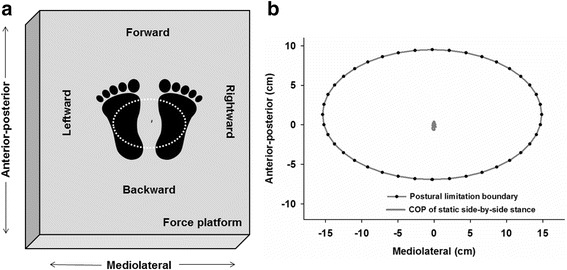
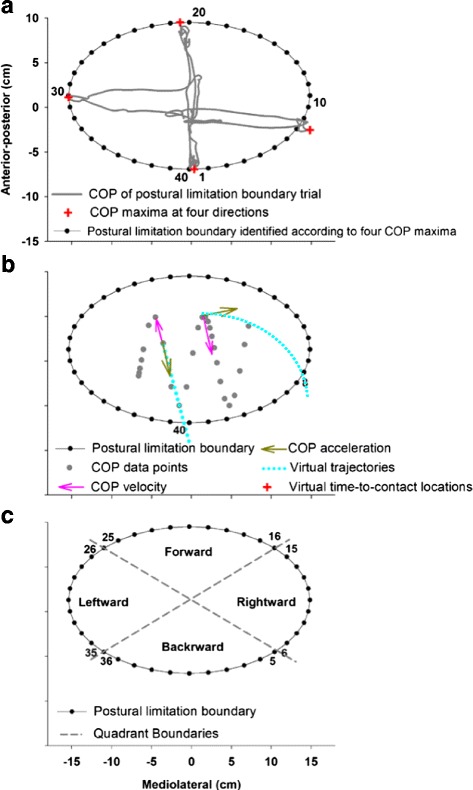
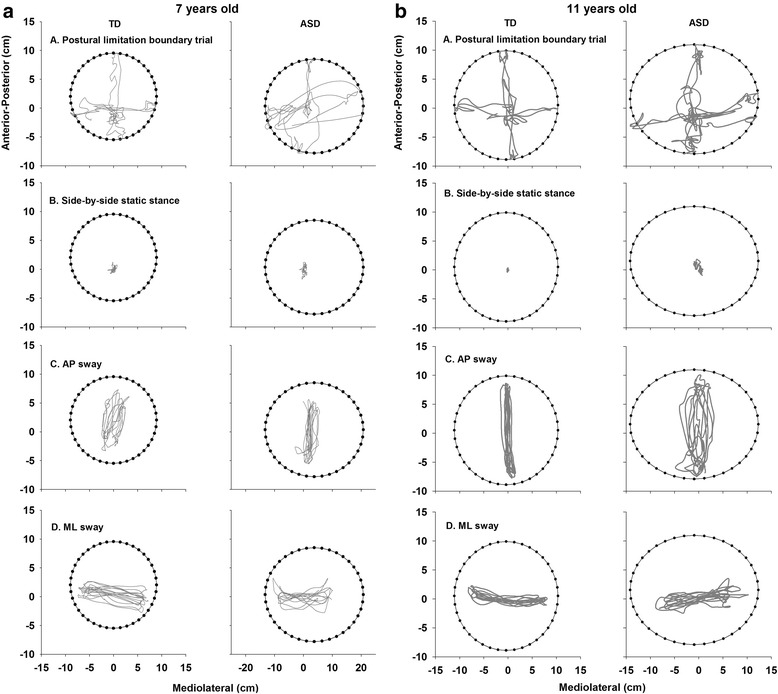
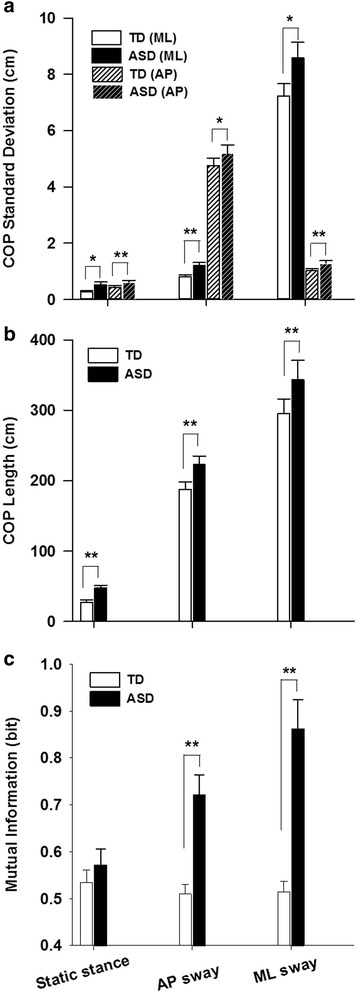
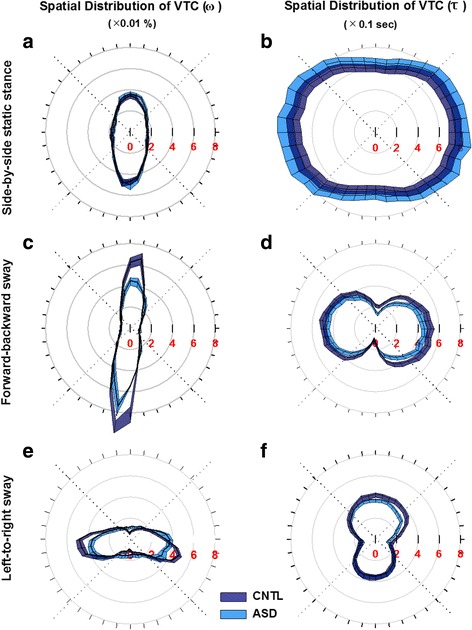
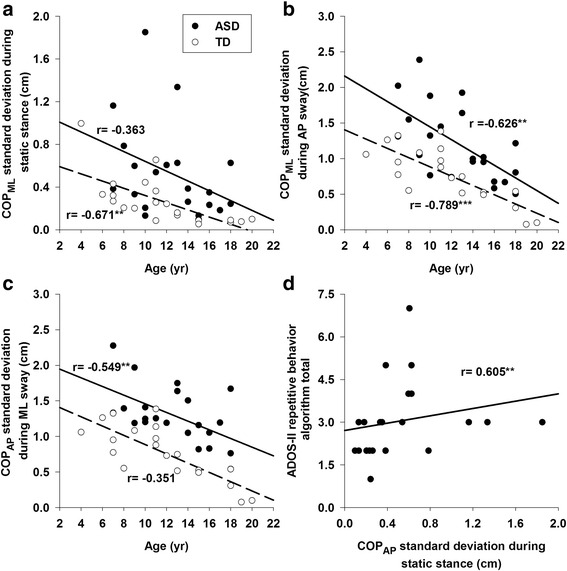
BACKGROUND: Increased postural sway has been repeatedly documented in children with autism spectrum disorder (ASD). Characterizing the control processes underlying this deficit, including postural orientation and equilibrium, may provide key insights into neurophysiological mechanisms associated with ASD. Postural orientation refers to children's ability to actively align their trunk and head with respect to their base of support, while postural equilibrium is an active process whereby children coordinate ankle dorsi-/plantar-flexion and hip abduction/adduction movements to stabilize their upper body. Dynamic engagement of each of these control processes is important for maintaining postural stability, though neither postural orientation nor equilibrium has been studied in ASD. METHODS: Twenty-two children with ASD and 21 age and performance IQ-matched typically developing (TD) controls completed three standing tests. During static stance, participants were instructed to stand as still as possible. During dynamic stances, participants swayed at a comfortable speed and magnitude in either anterior-posterior (AP) or mediolateral (ML) directions. The center of pressure (COP) standard deviation and trajectory length were examined to determine if children with ASD showed increased postural sway. Postural orientation was assessed using a novel virtual time-to-contact (VTC) approach that characterized spatiotemporal dimensions of children's postural sway (i.e., body alignment) relative to their postural limitation boundary, defined as the maximum extent to which each child could sway in each direction. Postural equilibrium was quantified by evaluating the amount of shared or mutual information of COP time series measured along the AP and ML directions. RESULTS: Consistent with prior studies, children with ASD showed increased postural sway during both static and dynamic stances relative to TD children. In regard to postural orientation processes, children with ASD demonstrated reduced spatial perception of their postural limitation boundary towards target directions and reduced time to correct this error during dynamic postural sways but not during static stance. Regarding postural equilibrium, they showed a compromised ability to decouple ankle dorsi-/plantar-flexion and hip abduction/adduction processes during dynamic stances. CONCLUSIONS: These results suggest that deficits in both postural orientation and equilibrium processes contribute to reduced postural stability in ASD. Specifically, increased postural sway in ASD appears to reflect patients' impaired perception of their body movement relative to their own postural limitation boundary as well as a reduced ability to decouple distinct ankle and hip movements to align their body during standing. Our findings that deficits in postural orientation and equilibrium are more pronounced during dynamic compared to static stances suggests that the increased demands of everyday activities in which children must dynamically shift their COP involve more severe postural control deficits in ASD relative to static stance conditions that often are studied. Systematic assessment of dynamic postural control processes in ASD may provide important insights into new treatment targets and neurodevelopmental mechanisms.
Overview
The claims and statistics of this paper haven’t been checked yet.
Free: it reads the open-access text and checks the first 5 claims that cite a source we can check. Create a free account to check every claim.
Integrity signals
Registry
Cites
Statistics
Figures
Verification
Claims the paper makes
The claims and statistics of this paper haven’t been checked yet.
Free: it reads the open-access text and checks the first 5 claims that cite a source we can check. Create a free account to check every claim.
Claims other papers make about this one
Each is checked against this paper’s own text: does it say what the citing paper says it does?
The source backs part of the claim, not all of it — or backs it for a different population, condition or comparison.
In the citing paper
“Other studies [44, 47] associated instability, higher COP variability, reduced motor independence, and anticipatory adjustments with repetitive behaviours.”
From Static and dynamic balance in children and adolescents with autism spectrum disorder compared with typically developing peers: a systematic review and meta-analysis (2026) · cites this paper as [44]
Experimental — accuracy not yet measuredThe cited source says what the claim attributes to it.
In the citing paper
“Twenty-nine studies used instrumental tools, [11, 12, 14, 24–48] while 11 employed observational assessments. [14, 26, 28, 32, 34, 38, 44, 49, 51–53]”
The check wasn’t confident either way, so it gives no verdict — never disputed.
In the citing paper
“Highest-quality studies were Surgent et al. [44], (13/14) and Abdel-Ghafar et al. [29] and Ghanouni et al. [25] (11/13).”
From Static and dynamic balance in children and adolescents with autism spectrum disorder compared with typically developing peers: a systematic review and meta-analysis (2026) · cites this paper as [44]
Experimental — accuracy not yet measured
Self-check
Percentages, sums and reported differences re-computed from the paper’s own numbers.
The self-check needs the paper’s full text.
Citations
Cites
Lord, C., Rutter, M., & Le Couteur, A. (1994) · Journal of Autism and Developmental Disorders · doi:10.1007/bf02172145 · Cited by 9,065 · cited 8×
“We examined scores from the social, communication, and restricted-repetitive behavior algorithms of the ADI-R and the social-affective and restrictedrepetitive behavior algorithms of the ADOS-II.”
BackgroundMethodInfluentialHorak, F. B. (2006) · Age and Ageing · doi:10.1093/ageing/afl077 · Cited by 2,758
Measures of postural steadiness: differences between healthy young and elderly adults
Prieto, T. E., Myklebust, J. B., Hoffmann, R. G., Lovett, E. G., & Myklebust, B. M. (1996) · IEEE Transactions on Biomedical Engineering · doi:10.1109/10.532130 · Cited by 1,863
Autism Diagnostic Observation Schedule
Lord, C., Rutter, M., Goode, S., Heemsbergen, J., Jordan, H., Mawhood, L., & Schopler, E. (2016) · PsycTESTS Dataset · doi:10.1037/t54175-000 · Cited by 1,678
Autism screening questionnaire: diagnostic validity
Berument, S. K., Rutter, M., Lord, C., Pickles, A., & Bailey, A. (1999) · British Journal of Psychiatry · doi:10.1192/bjp.175.5.444 · Cited by 1,464 · cited 2×
“TD participants were recruited from the community and were required to have a score of 8 or lower on the Social Communication Questionnaire (SCQ) [35].”
Unified theory regarding A/P and M/L balance in quiet stance
Winter, D. A., Prince, F., Frank, J. S., Powell, C., & Zabjek, K. F. (1996) · Journal of Neurophysiology · doi:10.1152/jn.1996.75.6.2334 · Cited by 1,163
Why Do Autistic Individuals Show Superior Performance on the Block Design Task?
Shah, A., & Frith, U. (1993) · Journal of Child Psychology and Psychiatry · doi:10.1111/j.1469-7610.1993.tb02095.x · Cited by 935
Center of mass velocity-position predictions for balance control
Pai, Y.-C., & Patton, J. (1997) · Journal of Biomechanics · doi:10.1016/s0021-9290(96)00165-0 · Cited by 757
Massion, J. (1994) · Current Opinion in Neurobiology · doi:10.1016/0959-4388(94)90137-6 · Cited by 747
Prevalence of motor impairment in autism spectrum disorders
Ming, X., Brimacombe, M., & Wagner, G. C. (2007) · Brain and Development · doi:10.1016/j.braindev.2007.03.002 · Cited by 613
Mathematical psychology : an elementary introduction
Coombs, C. H., Dawes, R. M., & Tversky, A. D. (1970) · Prentice Hall eBooks · Cited by 549
Underdevelopment of the postural control system in autism
Minshew, N. J., Sung, K., Jones, B. L., & Furman, J. M. (2004) · Neurology · doi:10.1212/01.wnl.0000145771.98657.62 · Cited by 440 · cited 1×
“[4] who showed that postural stability in children with ASD failed to reach adult levels during development.”
BackgroundControl and Estimation of Posture During Quiet Stance Depends on Multijoint Coordination
Hsu, W.-L., Scholz, J. P., Schöner, G., Jeka, J. J., & Kiemel, T. (2007) · Journal of Neurophysiology · doi:10.1152/jn.01142.2006 · Cited by 322
Deficits in time-to-boundary measures of postural control with chronic ankle instability
Hertel, J., & Olmsted-Kramer, L. C. (2007) · Gait & Posture · doi:10.1016/j.gaitpost.2005.12.009 · Cited by 279
Postural Stability in Children with Autism Spectrum Disorder
Molloy, C. A., Dietrich, K. N., & Bhattacharya, A. (2003) · Journal of Autism and Developmental Disorders · doi:10.1023/b:jadd.0000006001.00667.4c · Cited by 265
Atypical basic movement kinematics in autism spectrum conditions
Cook, J. L., Blakemore, S.-J., & Press, C. (2013) · Brain · doi:10.1093/brain/awt208 · Cited by 252
Pharmacological treatment effects on eye movement control
Reilly, J. L., Lencer, R., Bishop, J. R., Keedy, S., & Sweeney, J. A. (2008) · Brain and Cognition · doi:10.1016/j.bandc.2008.08.026 · Cited by 248 · cited 1×
“No participants were taking medications known to affect motor performance at the time of testing, including antipsychotics, stimulants, or anticonvulsants [36].”
BackgroundSelf-citationDiagnostic Overshadowing Reviewed and Reconsidered
Jopp, D. A., & Keys, C. B. (2001) · American Journal on Mental Retardation · doi:10.1352/0895-8017(2001)106<0416:dorar>2.0.co;2 · Cited by 219
Motor impairment in sibling pairs concordant and discordant for autism spectrum disorders
Hilton, C. L., Zhang, Y., Whilte, M. R., Klohr, C. L., & Constantino, J. (2012) · Autism · doi:10.1177/1362361311423018 · Cited by 210
Postural control in children with autism
Kohen-Raz, R., Volkman, F. R., & Cohen, D. J. (1992) · Journal of Autism and Developmental Disorders · doi:10.1007/bf01048244 · Cited by 202
Information in movement variability about the qualitative dynamics of posture and orientation
Riccio, G. E. (1993) · Medical Entomology and Zoology · Cited by 195
Decreased static and dynamic postural control in children with autism spectrum disorders
Fournier, K. A., Kimberg, C. I., Radonovich, K. J., Tillman, M. D., Chow, J. W., Lewis, M. H., Bodfish, J. W., & Hass, C. J. (2010) · Gait & Posture · doi:10.1016/j.gaitpost.2010.02.007 · Cited by 182 · cited 1×
“[28] observed reduced COP shifts to the side in children with ASD suggesting that postural control deficits contributing to reduced postural stability in ASD may be different during more dynamic stance conditions compared to static stances.”
BackgroundLoh, A., Soman, T., Brian, J., Bryson, S. E., Roberts, W., Szatmari, P., Smith, I. M., & Zwaigenbaum, L. (2007) · Journal of Autism and Developmental Disorders · doi:10.1007/s10803-006-0333-5 · Cited by 174
Motor Difficulties in Autism Spectrum Disorder: Linking Symptom Severity and Postural Stability
Travers, B. G., Powell, P. S., Klinger, L. G., & Klinger, M. R. (2013) · Journal of Autism and Developmental Disorders · doi:10.1007/s10803-012-1702-x · Cited by 173
Gepner, B., & Mestre, D. (2002) · Journal of Autism and Developmental Disorders · doi:10.1023/a:1015410015859 · Cited by 168
Schmitt, L. M., Cook, E. H., Sweeney, J. A., & Mosconi, M. W. (2014) · Molecular Autism · doi:10.1186/2040-2392-5-47 · Cited by 155
Self-citationEffects of Parkinson’s disease and levodopa on functional limits of stability
Mancini, M., Rocchi, L., Horak, F. B., & Chiari, L. (2007) · Clinical Biomechanics · doi:10.1016/j.clinbiomech.2007.11.007 · Cited by 150
Mosconi, M. W., Mohanty, S., Greene, R. K., Cook, E. H., Vaillancourt, D. E., & Sweeney, J. A. (2015) · The Journal of Neuroscience · doi:10.1523/jneurosci.2731-14.2015 · Cited by 145
Self-citationFrom movement kinematics to social cognition: the case of autism
Cook, J. (2016) · Philosophical Transactions of the Royal Society B: Biological Sciences · doi:10.1098/rstb.2015.0372 · Cited by 145
Postural Control Deficits in Autism Spectrum Disorder: The Role of Sensory Integration
Doumas, M., McKenna, R., & Murphy, B. (2015) · Journal of Autism and Developmental Disorders · doi:10.1007/s10803-015-2621-4 · Cited by 142
Neural basis of postural instability identified by VTC and EEG
Slobounov, S., Cao, C., Jaiswal, N., & Newell, K. M. (2009) · Experimental Brain Research · doi:10.1007/s00221-009-1956-5 · Cited by 138
Two functionally different synergies during arm reaching movements involving the trunk
Ma, S., & Feldman, A. G. (1995) · Journal of Neurophysiology · doi:10.1152/jn.1995.73.5.2120 · Cited by 118
Velocity of centre of pressure excursions as an indicator of postural control systems in children
Riach, C. L., & Starkes, J. (1994) · Gait & Posture · doi:10.1016/0966-6362(94)90004-3 · Cited by 117
The role of cerebellar circuitry alterations in the pathophysiology of autism spectrum disorders
Mosconi, M. W., Wang, Z., Schmitt, L. M., Tsai, P., & Sweeney, J. A. (2015) · Frontiers in Neuroscience · doi:10.3389/fnins.2015.00296 · Cited by 112 · cited 1×
“Sensorimotor deficits are common in children with autism spectrum disorder (ASD) [1, 2].”
BackgroundSelf-citationSlobounov, S., Cao, C., Sebastianelli, W. J., Slobounov, E., & Newell, K. M. (2008) · Clinical Neurophysiology · doi:10.1016/j.clinph.2007.10.006 · Cited by 110
Travers, B. G., Bigler, E. D., Duffield, T. C., Prigge, M. D. B., Froehlich, A. L., Lange, N., Alexander, A. L., & Lainhart, J. E. (2017) · Developmental Science · doi:10.1111/desc.12401 · Cited by 108
The Role of Sensorimotor Difficulties in Autism Spectrum Conditions
Hannant, P., Tavassoli, T., & Cassidy, S. (2016) · Frontiers in Neurology · doi:10.3389/fneur.2016.00124 · Cited by 103
Differences in the use of vision and proprioception for postural control in autism spectrum disorder
Morris, S. L., Foster, C. J., Parsons, R. W., Falkmer, M., Falkmer, T., & Rosalie, S. M. (2015) · Neuroscience · doi:10.1016/j.neuroscience.2015.08.040 · Cited by 96
Radonovich, K. J., Fournier, K. A., & Hass, C. J. (2013) · Frontiers in Integrative Neuroscience · doi:10.3389/fnint.2013.00028 · Cited by 94
Visual tasks and postural sway in children with and without autism spectrum disorders
Chang, C.-H., Wade, M. G., Stoffregen, T. A., Hsu, C.-Y., & Pan, C. (2010) · Research in Developmental Disabilities · doi:10.1016/j.ridd.2010.06.003 · Cited by 84
Wang, Z., Magnon, G. C., White, S. P., Greene, R. K., Vaillancourt, D. E., & Mosconi, M. W. (2015) · Journal of Neurophysiology · doi:10.1152/jn.00661.2014 · Cited by 81
Self-citationThe Influence of Task Difficulty and Participant Age on Balance Control in ASD
Graham, S. A., Abbott, A. E., Nair, A., Lincoln, A. J., Müller, R.-A., & Goble, D. J. (2015) · Journal of Autism and Developmental Disorders · doi:10.1007/s10803-014-2303-7 · Cited by 49
Kilby, M. C., Slobounov, S., & Newell, K. M. (2014) · PLoS ONE · doi:10.1371/journal.pone.0108905 · Cited by 38
Inter-foot coordination dynamics of quiet standing postures
Wang, Z., & Newell, K. M. (2014) · Neuroscience & Biobehavioral Reviews · doi:10.1016/j.neubiorev.2014.08.007 · Cited by 37
Self-citationMotor Memory Deficits Contribute to Motor Impairments in Autism Spectrum Disorder
Neely, K. A., Mohanty, S., Schmitt, L., Wang, Z., Sweeney, J. A., & Mosconi, M. W. (2016) · Journal of Autism and Developmental Disorders · doi:10.1007/s10803-016-2806-5 · Cited by 35
Self-citationHuman Postural Control: Force Plate Experiments and Modelling
Rosenblum, M., Игоревич, Ф. Г., Кууз, Р. А., & Pompe, B. (1998) · Springer eBooks · doi:10.1007/978-3-642-71949-3_17 · Cited by 31
Coordination Patterns of Foot Dynamics in the Control of Upright Standing
Wang, Z., Jordan, K., & Newell, K. M. (2012) · Motor Control · doi:10.1123/mcj.16.3.425 · Cited by 27
Self-citation
Research works printed but not linked: 2
- Wechsler D Wechsler Abbreviated Scale of Intelligence: Psychological Corporation 1999
- Wechsler D Wechsler Abbreviated Scale of Intelligence—second edition—(WASI-II) 2011 San Antonio, TX Pearson Education
Cited by
Wang, L. A. L., Petrulla, V., Zampella, C., Waller, R. E., & Schultz, R. T. (2022) · Psychological Bulletin · doi:10.1037/bul0000358 · Cited by 179
Postural control processes during standing and step initiation in autism spectrum disorder
Bojanek, E. K., Wang, Z., White, S. P., & Mosconi, M. W. (2020) · Journal of Neurodevelopmental Disorders · doi:10.1186/s11689-019-9305-x · Cited by 57
Self-citationOdeh, C. E., Gladfelter, A. L., Stoesser, C., & Roth, S. (2022) · International Journal of Developmental Disabilities · doi:10.1080/20473869.2020.1764241 · Cited by 51
“Even in children with ASD between the ages of 7 and 18 impairments in both static and dynamic stance are evident on force platform measures of postural orientation and sway (Wang et al. 2016).”
BackgroundMotor skills predict adaptive behavior in autistic children and adolescents
Fears, N. E., Palmer, S. A., & Miller, H. L. (2022) · Autism Research · doi:10.1002/aur.2708 · Cited by 45
Lepping, R. J., McKinney, W. S., Magnon, G. C., Keedy, S., Wang, Z., Coombes, S. A., Vaillancourt, D. E., Sweeney, J. A., & Mosconi, M. W. (2021) · Human Brain Mapping · doi:10.1002/hbm.25692 · Cited by 46
Self-citation
Metadata
- Authors
- Wang, Z., Hallac, R. R., Conroy, K. C., White, S. P., Kane, A. A., Collinsworth, A. L., Sweeney, J. A., & Mosconi, M. W.
- Affiliations
- University of Kansas (US)
- Children's Medical Center (US)
- The University of Texas Southwestern Medical Center (US)
- University of Cincinnati (US)
- Corresponding author
- Wang, Zheng
- ORCID
- Venue
- Journal of Neurodevelopmental Disorders
- Published
- 2016-11-25
- Volume
- 8
- Issue
- 1
- Pages
- 43-43
- ISSN
- 1866-1947 (ISSN-L)
- 1866-1955
- PMC
- PMC5124312
- OpenAlex
- W2549845568
- Cited by
- 53
- References
- 47
- Citations by year
- 2026: 3 · 2025: 8 · 2024: 4 · 2023: 7 · 2022: 5 · 2021: 11 · 2020: 6 · 2019: 5 · 2018: 1 · 2017: 3
- FWCI
- 1.91
- Type
- journal article
- Language
- en
- Open access
- gold
- doi.org
- Licence
- cc-by
- creativecommons.org/licenses/by/4.0/ (tdm)
- creativecommons.org/licenses/by/4.0/ (vor)
- Locations
- Journal of Neurodevelopmental Disorders (publishedVersion, cc-by)
- PubMed Central (publishedVersion, cc-by)
- PubMed (publishedVersion)
- KU ScholarWorks (University of Kansas) (submittedVersion, cc-by)
- Funders
- University of Kansas (Kansas Center for Autism Research and Training Research Investment Council Strategic Initiative Grant)
- National Institute of Mental Health (MH092696)
- Topics
- Life Sciences › Neuroscience › Cognitive Neuroscience › Autism Spectrum Disorder Research
- Health Sciences › Health Professions › Physical Therapy, Sports Therapy and Rehabilitation › Balance, Gait, and Falls Prevention
- Social Sciences › Psychology › Developmental and Educational Psychology › Children's Physical and Motor Development
- Keywords
- autism spectrum disorder, postural sway, postural orientation, postural stability, center of pressure, static posture, children, postural control
About these checks
Registry, retraction, Cites and statistics results are computed, not judged, with one exception: a printed reference that no index lists is read once by a model before it counts as a citation error. Claims are extracted by a model and kept only when their quote appears verbatim in the text; each cited source is then checked, with a model’s help, for whether it says what the claim relies on. Those verdicts can be wrong — read the claim’s quote and the cited source before relying on one.
Statistics and arithmetic are recomputed, not judged.
Confidence bands are shown only for fields calibrated on our annotated test set. None is calibrated yet, so no band is shown.
What counts as a claim ›How we measure confidence ›How we check this ›
Are you an author, or do you see a problem with this page? Request a review
Data sources
Bibliographic data: Semantic Scholar, OpenAlex, Crossref.
Contains information from the Semantic Scholar Academic Graph Datasets, made available under the ODC Attribution License (ODC-BY 1.0).
Semantic Scholar’s data is described in: Kinney, R., et al. (2023). The Semantic Scholar Open Data Platform. arXiv:2301.10140.
