

The DOI matches its Crossref record; 53 of the 56 references it cites were found in a registry or an index.
Trends in glyphosate herbicide use in the United States and globally
Open accessAbstract
BACKGROUND: Accurate pesticide use data are essential when studying the environmental and public health impacts of pesticide use. Since the mid-1990s, significant changes have occurred in when and how glyphosate herbicides are applied, and there has been a dramatic increase in the total volume applied. METHODS: Data on glyphosate applications were collected from multiple sources and integrated into a dataset spanning agricultural, non-agricultural, and total glyphosate use from 1974-2014 in the United States, and from 1994-2014 globally. RESULTS: Since 1974 in the U.S., over 1.6 billion kilograms of glyphosate active ingredient have been applied, or 19 % of estimated global use of glyphosate (8.6 billion kilograms). Globally, glyphosate use has risen almost 15-fold since so-called "Roundup Ready," genetically engineered glyphosate-tolerant crops were introduced in 1996. Two-thirds of the total volume of glyphosate applied in the U.S. from 1974 to 2014 has been sprayed in just the last 10 years. The corresponding share globally is 72 %. In 2014, farmers sprayed enough glyphosate to apply ~1.0 kg/ha (0.8 pound/acre) on every hectare of U.S.-cultivated cropland and nearly 0.53 kg/ha (0.47 pounds/acre) on all cropland worldwide. CONCLUSIONS: Genetically engineered herbicide-tolerant crops now account for about 56 % of global glyphosate use. In the U.S., no pesticide has come remotely close to such intensive and widespread use. This is likely the case globally, but published global pesticide use data are sparse. Glyphosate will likely remain the most widely applied pesticide worldwide for years to come, and interest will grow in quantifying ecological and human health impacts. Accurate, accessible time-series data on glyphosate use will accelerate research progress.
Overview
The claims and statistics of this paper haven’t been checked yet.
Run the check — free, no account needed. It reads the open-access text and checks the sources it cites.
Integrity signals
Registry
Cites
Statistics
Figures
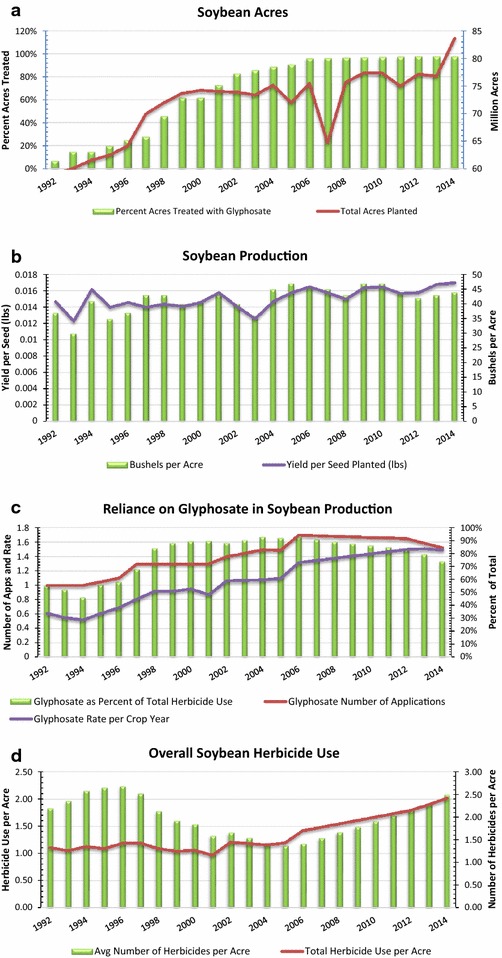
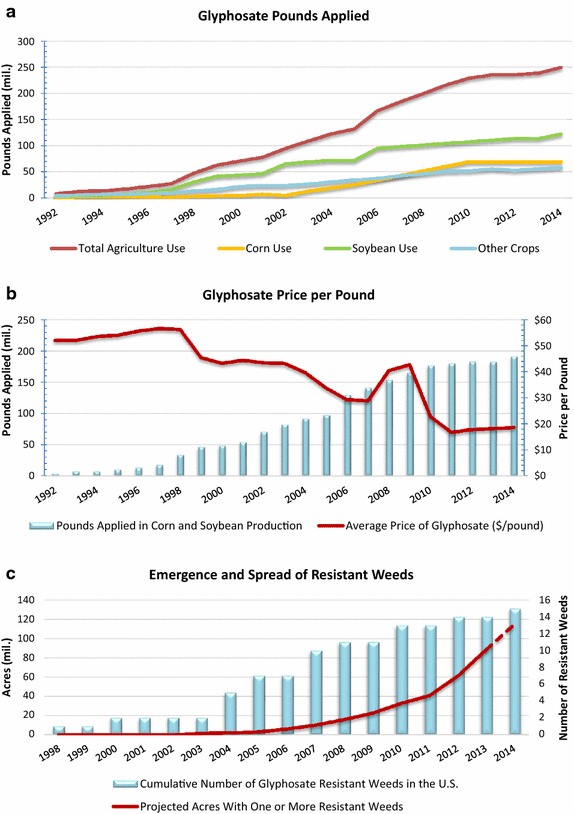
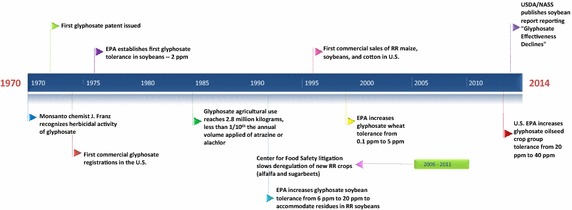
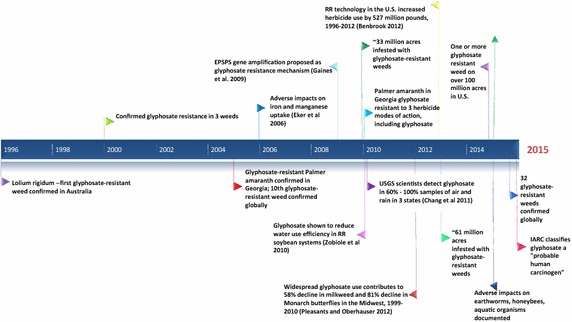
Verification
Claims the paper makes
The claims and statistics of this paper haven’t been checked yet.
Run the check — free, no account needed. It reads the open-access text and checks the sources it cites.
Self-check
Percentages, sums and reported differences re-computed from the paper’s own numbers.
The self-check needs the paper’s full text.
Citations
Cites
International Agency for Research on Cancer
National Cancer Institute (2020) · Definitions · doi:10.32388/pfg7jq · Cited by 9,394
The United States Department of Agriculture
True, A. C. (1912) · The Annals of the American Academy of Political and Social Science · doi:10.1177/000271621204000113 · Cited by 5,104
Glyphosate: a once‐in‐a‐century herbicide
Duke, S. O., & Powles, S. B. (2008) · Pest Management Science · doi:10.1002/ps.1518 · Cited by 1,821 · cited 1×
“John Franz, identified the herbicidal activity of glyphosate in 1970, and a formulated end-use product called Roundup was first sold commercially by Monsanto in 1974 [2].”
BackgroundMyers, J. P., Antoniou, M. N., Blumberg, B., Carroll, L., Colborn, T., Everett, L. G., Hansen, M., Landrigan, P. J., Lanphear, B. P., Mesnage, R., et al. (2016) · Environmental Health · doi:10.1186/s12940-016-0117-0 · Cited by 907
Self-citationFate of glyphosate in soil and the possibility of leaching to ground and surface waters: a review.
Borggaard, O., & Gimsing, A. (2008) · Pest Management Science · doi:10.1002/ps.1512 · Cited by 734 · cited 1×
“Rising use triggers new concerns Driven by the growing diversity of uses and dramatic increases in volumes applied, levels of glyphosate and its primary metabolite aminomethylphosphonic acid (AMPA) have been detected in the air [51], soil [52], and water [49, 53].”
BackgroundGlobal perspective of herbicide‐resistant weeds
Heap, I. (2013) · Pest Management Science · doi:10.1002/ps.3696 · Cited by 666
Glyphosate-based herbicides are toxic and endocrine disruptors in human cell lines
Gasnier, C., Dumont, C., Benachour, N., Clair, E., Chagnon, M.-C., & Séralini, G.-E. (2009) · Toxicology · doi:10.1016/j.tox.2009.06.006 · Cited by 658
Battaglin, W. A., Meyer, M. T., Kuivila, K. M., & Dietze, J. E. (2014) · JAWRA Journal of the American Water Resources Association · doi:10.1111/jawr.12159 · Cited by 597 · cited 1×
“Rising use triggers new concerns Driven by the growing diversity of uses and dramatic increases in volumes applied, levels of glyphosate and its primary metabolite aminomethylphosphonic acid (AMPA) have been detected in the air [51], soil [52], and water [49, 53].”
BackgroundEvolved glyphosate‐resistant weeds around the world: lessons to be learnt
Powles, S. B. (2008) · Pest Management Science · doi:10.1002/ps.1525 · Cited by 500 · cited 1×
“Shifts in weed communities favoring species less susceptible to glyphosate, coupled with the emergence of first, less sensitive, and eventually glyphosate-resistant weeds drove the incremental rise in the intensity of glyphosate applications on GE-HT crops [13, 10].”
BackgroundPaganelli, A. R., Gnazzo, V., Acosta, H., López, S. L., & Carrasco, A. E. (2010) · Chemical Research in Toxicology · doi:10.1021/tx1001749 · Cited by 460
Pleasants, J. M., & Oberhauser, K. S. (2012) · Insect Conservation and Diversity · doi:10.1111/j.1752-4598.2012.00196.x · Cited by 437 · cited 1×
“Environmental studies encompass possible glyphosate impacts on soil microbial communities and earthworms [56–58], monarch butterflies [59], crustaceans [60], and honeybees [61].”
BackgroundGlyphosate induces human breast cancer cells growth via estrogen receptors
Thongprakaisang, S., Thiantanawat, A., Rangkadilok, N., Suriyo, T., & Satayavivad, J. (2013) · Food and Chemical Toxicology · doi:10.1016/j.fct.2013.05.057 · Cited by 424 · cited 1×
“changes through endocrine-mediated mechanisms [54, 73, 75, 76, 79, 81, 83].”
Impacts of genetically engineered crops on pesticide use in the U.S. -- the first sixteen years
Benbrook, C. M. (2012) · Environmental Sciences Europe · doi:10.1186/2190-4715-24-24 · Cited by 416 · cited 2×
“In response, farmers increased both the rate of glyphosate application as well as the number of applications [5, 6, 9, 88, 13].”
BackgroundSelf-citationJayasumana, C., Gunatilake, S., & Senanayake, P. (2014) · International Journal of Environmental Research and Public Health · doi:10.3390/ijerph110202125 · Cited by 360 · cited 2×
“The apparent tendency of glyphosate to concentrate in the kidneys, coupled with glyphosate’s action as a chelating agent, has led some scientists to hypothesize that glyphosate can bind to metals in hard drinking water, creating metallic-glyphosate complexes that may not pass normally through kidneys [71, 72].”
BackgroundNavigating a Critical Juncture for Sustainable Weed Management
Mortensen, D. A., Egan, J. F., Maxwell, B. D., Ryan, M. R., & Smith, R. G. (2012) · BioScience · doi:10.1525/bio.2012.62.1.12 · Cited by 357 · cited 1×
“In response, farmers increased both the rate of glyphosate application as well as the number of applications [5, 6, 9, 88, 13].”
BackgroundCoupe, R. H., Kalkhoff, S. J., Capel, P. D., & Grégoire, C. (2011) · Pest Management Science · doi:10.1002/ps.2212 · Cited by 310
Bøhn, T., Cuhra, M., Traavik, T., Sanden, M., Fagan, J., & Primicerio, R. (2013) · Food Chemistry · doi:10.1016/j.foodchem.2013.12.054 · Cited by 300
Séralini, G.-E., Clair, E., Mesnage, R., Gress, S., Defarge, N., Malatesta, M., Hennequin, D., & de Vendômois, J. S. (2014) · Environmental Sciences Europe · doi:10.1186/s12302-014-0014-5 · Cited by 299 · cited 1×
“Evidence from multiple studies suggests that the kidney, and secondarily the liver, is at risk of glyphosatetriggered, or glyphosate-enhanced chronic degeneration [55, 71, 72, 84, 85].”
BackgroundCattani, D., Cavalli, V. L. D. L. O., Rieg, C. E. H., Domingues, J. T., Dal-Cim, T. A., Tasca, C. I., Silva, F. R. M. B., & Zamoner, A. (2014) · Toxicology · doi:10.1016/j.tox.2014.03.001 · Cited by 275 · cited 1×
“Studies assessing possible risks to vertebrates and humans include evidence of rising residue levels in soybeans [62, 63], cancer risk [64], and risk of a variety of other potential adverse impacts on development, the liver or kidney, or metabolic processes [54, 55, 65–80].”
BackgroundEffects of sublethal doses of glyphosate on honeybee navigation
Balbuena, M. S., Tison, L., Hahn, M.-L., Greggers, U., Menzel, R., & Farina, W. M. (2015) · Journal of Experimental Biology · doi:10.1242/jeb.117291 · Cited by 275 · cited 1×
“Environmental studies encompass possible glyphosate impacts on soil microbial communities and earthworms [56–58], monarch butterflies [59], crustaceans [60], and honeybees [61].”
BackgroundSchinasi, L. H., & Leon, M. E. (2014) · International Journal of Environmental Research and Public Health · doi:10.3390/ijerph110404449 · Cited by 261 · cited 1×
“Studies assessing possible risks to vertebrates and humans include evidence of rising residue levels in soybeans [62, 63], cancer risk [64], and risk of a variety of other potential adverse impacts on development, the liver or kidney, or metabolic processes [54, 55, 65–80].”
BackgroundJayasumana, C., Paranagama, P. A., Agampodi, S. B., Wijewardane, C., Gunatilake, S., & Siribaddana, S. (2015) · Environmental Health · doi:10.1186/1476-069x-14-6 · Cited by 233
A first report of glyphosate-resistant goosegrass (Eleusine indica (L) Gaertn) in Malaysia
Lee, L. J., & Ngim, J. (2000) · Pest Management Science · doi:10.1002/(sici)1526-4998(200004)56:4 · Cited by 213
Glyphosate: Discovery, Development, Applications, and Properties
Dill, G. M., Sammons, R. D., Feng, P. C. C., Kohn, F., Kretzmer, K., Mehrsheikh, A., Bleeke, M., Honegger, J. L., Farmer, D. R., Wright, D. L., et al. (2010) · Wiley eBooks · doi:10.1002/9780470634394.ch1 · Cited by 207
Gaupp-Berghausen, M., Hofer, M., Rewald, B., & Zaller, J. G. (2015) · Scientific Reports · doi:10.1038/srep12886 · Cited by 197
Glyphosate impairs male offspring reproductive development by disrupting gonadotropin expression
Romano, M. A., Romano, R. M., Santos, L. D., Wisniewski, P., Campos, D. A., de Souza, P. B., Viau, P., Bernardi, M. M., Nunes, M. T., & de Oliveira, C. A. (2012) · Archives of Toxicology · doi:10.1007/s00204-011-0788-9 · Cited by 196 · cited 1×
“changes through endocrine-mediated mechanisms [54, 73, 75, 76, 79, 81, 83].”
Chang, F., Simcik, M. F., & Capel, P. D. (2010) · Environmental Toxicology and Chemistry · doi:10.1002/etc.431 · Cited by 172 · cited 1×
“Rising use triggers new concerns Driven by the growing diversity of uses and dramatic increases in volumes applied, levels of glyphosate and its primary metabolite aminomethylphosphonic acid (AMPA) have been detected in the air [51], soil [52], and water [49, 53].”
BackgroundEker, S., Öztürk, L., Yazıcı, A., Erenoglu, B. E., Römheld, V., & Çakmak, İ. (2006) · Journal of Agricultural and Food Chemistry · doi:10.1021/jf0625196 · Cited by 158
Duke, S. O. (2014) · Pest Management Science · doi:10.1002/ps.3863 · Cited by 157
Integrated pest management and weed management in the United States and Canada
Owen, M. D. K., Beckie, H. J., Leeson, J. Y., Norsworthy, J. K., & Steckel, L. E. (2014) · Pest Management Science · doi:10.1002/ps.3928 · Cited by 134 · cited 2×
“Many farmers also integrated additional herbicides into spray programs [5–7, 89].”
BackgroundRobinson, C. (2012) · Journal of Environmental & Analytical Toxicology · doi:10.4172/2161-0525.s4-006 · Cited by 126
Thelin, G. P., & Stone, W. W. (2013) · Scientific investigations report · doi:10.3133/sir20135009 · Cited by 117
Agricultural Impacts of Glyphosate-Resistant Soybean Cultivation in South America
Cerdeira, A. L., Gazziero, D. L. P., Duke, S. O., & Matallo, M. B. (2010) · Journal of Agricultural and Food Chemistry · doi:10.1021/jf102652y · Cited by 81 · cited 1×
“average herbicide use per hectare on land planted to GE-HT varieties has, on average, escalated steadily since the mid-1990s [8, 11, 88, 13].”
BackgroundCuhra, M. (2015) · Environmental Sciences Europe · doi:10.1186/s12302-015-0052-7 · Cited by 77 · cited 2×
“6 billion bushels of soybeans produced globally in 2014, and nearly all global trade in soybeans and soybean-based animal feeds [34, 62].”
BackgroundGlyphosate sustainability in South American cropping systems
Christoffoleti, P. J., Galli, A. J. B., de Carvalho, S. J. P., Moreira, M. S., Nicolai, M., Foloni, L. L., Martins, B. A. B., & Ribeiro, D. N. (2008) · Pest Management Science · doi:10.1002/ps.1560 · Cited by 73 · cited 1×
“Many farmers also integrated additional herbicides into spray programs [5–7, 89].”
BackgroundA long-term toxicology study on pigs fed a combined genetically modified (GM) soy and GM maize diet
Carman, J. A., Vlieger, H. R., Steeg, L., Sneller, V.-P., Robinson, G. W., Clinch‐Jones, C. A., Haynes, J. I., & Edwards, J. W. (2013) · Adelaide Research & Scholarship (AR&S) (University of Adelaide) · Cited by 71
Complete Genes May Pass from Food to Human Blood
Spisák, S., Solymosi, N., Ittzés, P., Bodor, A., Kondor, D., Vattay, G., Barták, B. K., Sípos, F., Galamb, O., Tulassay, Z., et al. (2013) · PLoS ONE · doi:10.1371/journal.pone.0069805 · Cited by 69 · cited 1×
“Studies assessing possible risks to vertebrates and humans include evidence of rising residue levels in soybeans [62, 63], cancer risk [64], and risk of a variety of other potential adverse impacts on development, the liver or kidney, or metabolic processes [54, 55, 65–80].”
BackgroundAgapito-Tenfen, S. Z., Vilperte, V., Benevenuto, R. F., Rover, C. M., Traavik, T., & Nodari, R. O. (2014) · BMC Plant Biology · doi:10.1186/s12870-014-0346-8 · Cited by 63 · cited 1×
“Studies assessing possible risks to vertebrates and humans include evidence of rising residue levels in soybeans [62, 63], cancer risk [64], and risk of a variety of other potential adverse impacts on development, the liver or kidney, or metabolic processes [54, 55, 65–80].”
BackgroundReview of potential environmental impacts of transgenic glyphosate-resistant soybean in Brazil
Cerdeira, A. L., Gazziero, D. L. P., Duke, S. O., Matallo, M. B., & Spadotto, C. A. (2007) · Journal of Environmental Science and Health Part B · doi:10.1080/03601230701391542 · Cited by 62
Hokanson, R., Fudge, R., Chowdhary, R., & Busbee, D. L. (2007) · Human & Experimental Toxicology · doi:10.1177/0960327107083453 · Cited by 61 · cited 1×
“changes through endocrine-mediated mechanisms [54, 73, 75, 76, 79, 81, 83].”
Characteristics and safety assessment of intractable proteins in genetically modified crops
Bushey, D. F., Bannon, G. A., Delaney, B., Graser, G., Hefford, M. A., Jiang, X., Lee, T. C., Madduri, K. M., Pariza, M. W., Privalle, L., et al. (2014) · Regulatory Toxicology and Pharmacology · doi:10.1016/j.yrtph.2014.03.003 · Cited by 54 · cited 1×
“Studies assessing possible risks to vertebrates and humans include evidence of rising residue levels in soybeans [62, 63], cancer risk [64], and risk of a variety of other potential adverse impacts on development, the liver or kidney, or metabolic processes [54, 55, 65–80].”
BackgroundMa, J., Bu, Y., & Li, X. (2014) · Environmental Toxicology and Pharmacology · doi:10.1016/j.etap.2014.11.004 · Cited by 45 · cited 1×
“Studies assessing possible risks to vertebrates and humans include evidence of rising residue levels in soybeans [62, 63], cancer risk [64], and risk of a variety of other potential adverse impacts on development, the liver or kidney, or metabolic processes [54, 55, 65–80].”
BackgroundGlyphosate-Residues in Roundup-Ready Soybean Impair Daphnia magna Life-Cycle
Cuhra, M., Traavik, T., Dando, M., Primicerio, R., Holderbaum, D. F., & Bøhn, T. (2015) · Journal of Agricultural Chemistry and Environment · doi:10.4236/jacen.2015.41003 · Cited by 30 · cited 1×
“Environmental studies encompass possible glyphosate impacts on soil microbial communities and earthworms [56–58], monarch butterflies [59], crustaceans [60], and honeybees [61].”
BackgroundInnes, N. L. (2006) · Experimental Agriculture · doi:10.1017/s0014479706343797 · Cited by 30
Environmental Implications of Herbicide Resistance: Soil Biology and Ecology
Kremer, R. J. (2014) · Weed Science · doi:10.1614/ws-d-13-00114.1 · Cited by 28 · cited 1×
“Environmental studies encompass possible glyphosate impacts on soil microbial communities and earthworms [56–58], monarch butterflies [59], crustaceans [60], and honeybees [61].”
BackgroundGM crops and the rat digestive tract: A critical review
Zdziarski, I. M., Edwards, J. W., Carman, J. A., & Haynes, J. I. (2014) · Environment International · doi:10.1016/j.envint.2014.08.018 · Cited by 24
Pesticide use and glyphosate-resistant weeds - a case study of Brazilian soybean production.
Meyer, D., & Cederberg, C. (2010) · KTH Publication Database DiVA (KTH Royal Institute of Technology) · Cited by 24
Baker, N. T., & Stone, W. W. (2013) · Antarctica A Keystone in a Changing World · doi:10.3133/ofr20131295 · Cited by 23
Effects of sub-lethal doses of glyphosate on honeybee navigation
Balbuena, M. S., Tison, L., Hahn, M.-L., Greggers, U., Menzel, R., & Farina, W. M. (2015) · Journal of Experimental Biology · doi:10.1242/dev.117291 · Cited by 21
Meyer, H., & Hilbeck, A. (2013) · Environmental Sciences Europe · doi:10.1186/2190-4715-25-33 · Cited by 17
Ali, S.-E. B., Madi, Z. E., Hochegger, R., Quist, D., Prewein, B., Haslberger, A. G., & Brandes, C. (2014) · International Journal of Molecular Sciences · doi:10.3390/ijms151119898 · Cited by 15 · cited 1×
“Studies assessing possible risks to vertebrates and humans include evidence of rising residue levels in soybeans [62, 63], cancer risk [64], and risk of a variety of other potential adverse impacts on development, the liver or kidney, or metabolic processes [54, 55, 65–80].”
BackgroundFerraro, D. O., & Ghersa, C. M. (2013) · Crop Protection · doi:10.1016/j.cropro.2013.04.004 · Cited by 11
Harvest Aid Weed Control in Small Grain
Moechnig, M., & Deneke, D. L. (2011) · Open PRAIRIE (South Dakota State University) · Cited by 5
Research works printed but not linked: 3
- Benbrook CM (2016) Trends in glyphosate herbicide use in the united states and globally: Supporting data. Environ Sci Eur. doi: 10.1186/s12302-016-0070-0
- Dupraz E (2012) Monsanto and the Quasi-Per Se Illegal Rule for Bundled Discounts. Vt Law Rev 37:203–237
- Brändli D, Reinacher S (2012) Herbicides found in human urine. Ithaka J 1:270–272
Cited by
Sorted by citations
Worldwide pesticide usage and its impacts on ecosystem
Sharma, A., Kumar, V., Shahzad, B., Tanveer, M., Sidhu, G. P. S., Handa, N., Kohli, S. K., Yadav, P. T., Bali, A. S., Parihar, R. D., et al. (2019) · SN Applied Sciences · doi:10.1007/s42452-019-1485-1 · Cited by 2,143
Pesticides, environment, and food safety
Carvalho, F. P. (2017) · Food and Energy Security · doi:10.1002/fes3.108 · Cited by 1,947
“At present, there is a widespread concern about effects of herbicides on human health, such as glyphosate that is of common use in agriculture and in cities to control weeds, and is a main carcinogenic agent (Araújo et al. 2016; Benbrook 2016).”
BackgroundEnvironmental and health effects of the herbicide glyphosate
van Bruggen, A. H. C., He, M., Shin, K., Mai, V., Jeong, K. C., Finckh, M. R., & Morris, J. G. (2017) · The Science of The Total Environment · doi:10.1016/j.scitotenv.2017.10.309 · Cited by 1,057
Myers, J. P., Antoniou, M. N., Blumberg, B., Carroll, L., Colborn, T., Everett, L. G., Hansen, M., Landrigan, P. J., Lanphear, B. P., Mesnage, R., et al. (2016) · Environmental Health · doi:10.1186/s12940-016-0117-0 · Cited by 907
Self-citationAgriculture and biodiversity: a review
Dudley, N., & Alexander, S. (2017) · Biodiversity · doi:10.1080/14888386.2017.1351892 · Cited by 562
“Herbicide-resistant genetically-modified crops use 56% of total glyphosate (Benbrooke 2016) and increased tolerance means application rates will likely rise further (Tanentzap et al. 2015).”
Background
Metadata
- Authors
- Benbrook, C. M.
- Corresponding author
- Benbrook, Charles M.
- ORCID
- Benbrook, Charles M.
- Venue
- Environmental Sciences Europe
- Published
- 2016-02-02
- Volume
- 28
- Issue
- 1
- Pages
- 3-3
- ISSN
- 2190-4715 (ISSN-L)
- 2190-4707
- PMC
- PMC5044953
- OpenAlex
- W2255447065
- Cited by
- 1,890
- References
- 56
- Citations by year
- 2026: 163 · 2025: 177 · 2024: 191 · 2023: 264 · 2022: 234 · 2021: 235 · 2020: 227 · 2019: 166 · 2018: 127 · 2017: 77 · 2016: 26
- FWCI
- 71.97
- Type
- journal article
- Language
- en
- Open access
- gold
- doi.org
- Locations
- Environmental Sciences Europe (publishedVersion, cc-by)
- Europe PMC (PubMed Central) (publishedVersion, cc-by)
- PubMed Central (publishedVersion, cc-by)
- PubMed (publishedVersion)
- Funders
- Ceres Trust
- Topics
- Physical Sciences › Environmental Science › Pollution › Pesticide and Herbicide Environmental Studies
- Life Sciences › Agricultural and Biological Sciences › Plant Science › Weed Control and Herbicide Applications
- Life Sciences › Pharmacology, Toxicology and Pharmaceutics › Toxicology › Pesticide Exposure and Toxicity
- Keywords
- glyphosate, Roundup Ready crops, herbicide-tolerant crops, genetically modified crops, agricultural pesticide application
About these checks
Registry, retraction, Cites and statistics results are computed, not judged, with one exception: a printed reference that no index lists is read once by a model before it counts as a citation error. Claims are extracted by a model and kept only when their quote appears verbatim in the text; each cited source is then checked, with a model’s help, for whether it says what the claim relies on. Those verdicts can be wrong — read the claim’s quote and the cited source before relying on one.
Statistics and arithmetic are recomputed, not judged.
Confidence bands are shown only for fields calibrated on our annotated test set. None is calibrated yet, so no band is shown.
What counts as a claim ›How we measure confidence ›How we check this ›
Are you an author, or do you see a problem with this page? Request a review
