

Deep learning versus parametric and ensemble methods for genomic prediction of complex phenotypes
Open accessThe DOI matches its Crossref record; 49 of the 52 references it cites were found in a registry or an index.
Abstract
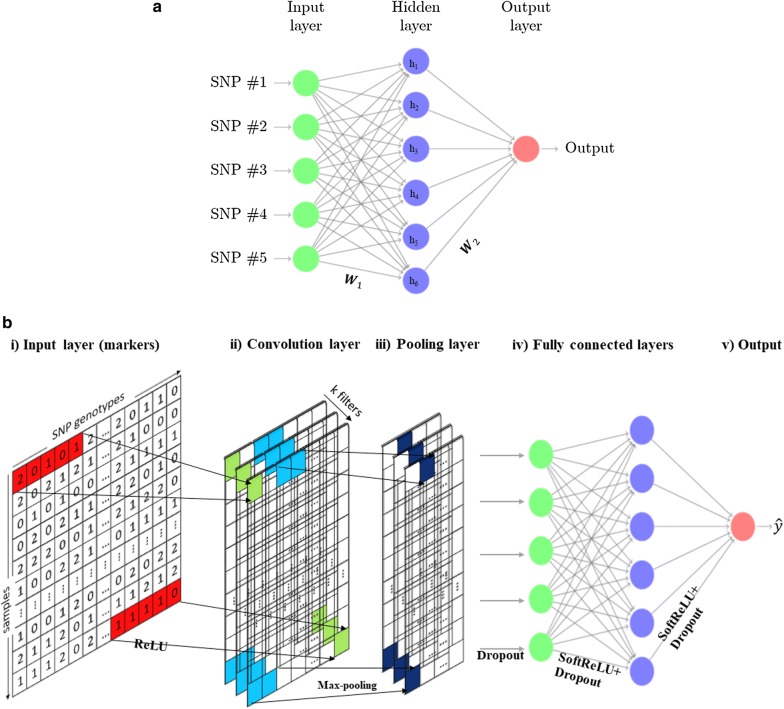
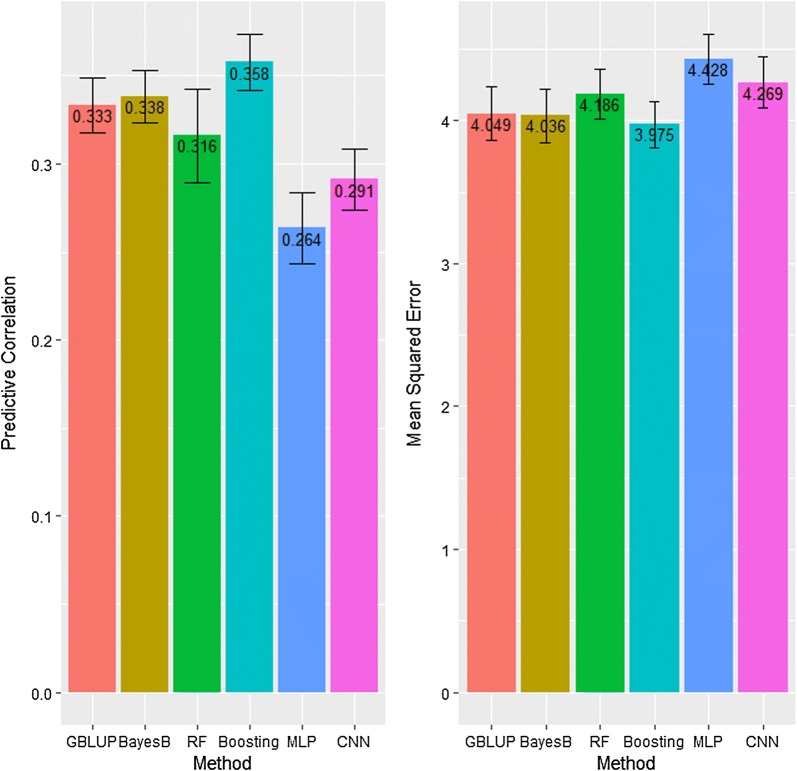
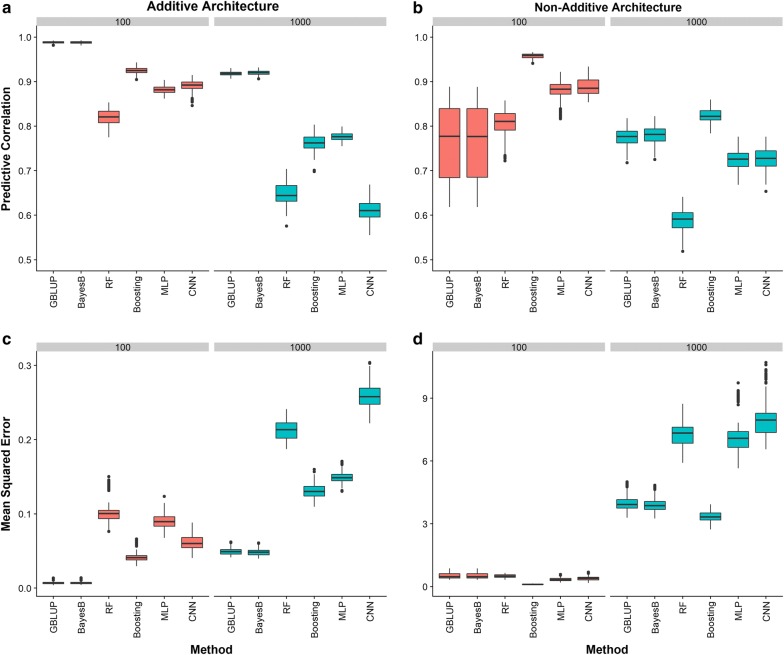
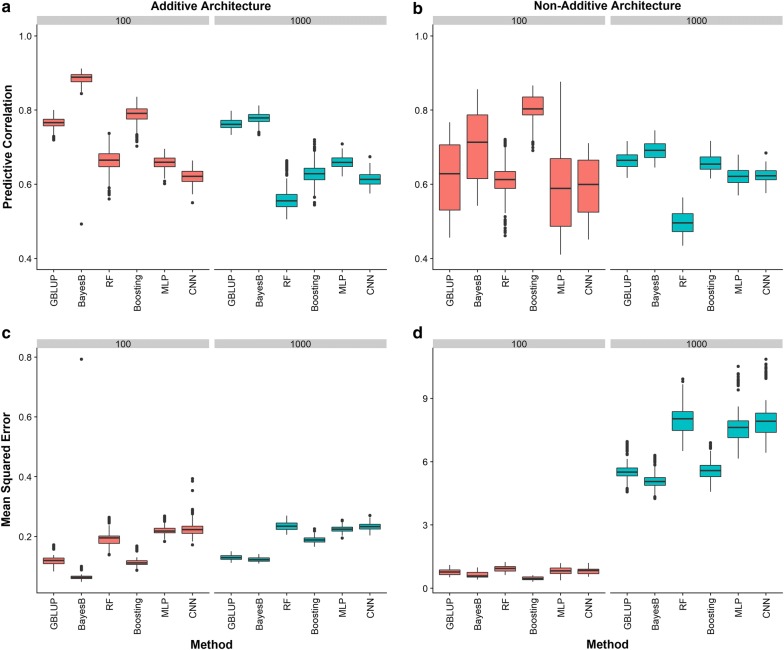
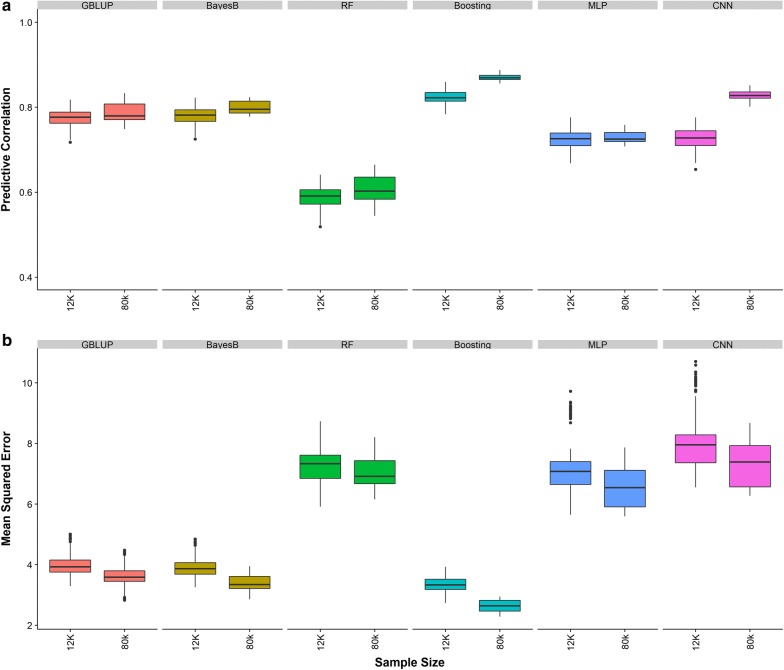
Background: Transforming large amounts of genomic data into valuable knowledge for predicting complex traits has been an important challenge for animal and plant breeders. Prediction of complex traits has not escaped the current excitement on machine-learning, including interest in deep learning algorithms such as multilayer perceptrons (MLP) and convolutional neural networks (CNN). The aim of this study was to compare the predictive performance of two deep learning methods (MLP and CNN), two ensemble learning methods [random forests (RF) and gradient boosting (GB)], and two parametric methods [genomic best linear unbiased prediction (GBLUP) and Bayes B] using real and simulated datasets. Methods: The real dataset consisted of 11,790 Holstein bulls with sire conception rate (SCR) records and genotyped for 58k single nucleotide polymorphisms (SNPs). To support the evaluation of deep learning methods, various simulation studies were conducted using the observed genotype data as template, assuming a heritability of 0.30 with either additive or non-additive gene effects, and two different numbers of quantitative trait nucleotides (100 and 1000). Results: In the bull dataset, the best predictive correlation was obtained with GB (0.36), followed by Bayes B (0.34), GBLUP (0.33), RF (0.32), CNN (0.29) and MLP (0.26). The same trend was observed when using mean squared error of prediction. The simulation indicated that when gene action was purely additive, parametric methods outperformed other methods. When the gene action was a combination of additive, dominance and of two-locus epistasis, the best predictive ability was obtained with gradient boosting, and the superiority of deep learning over the parametric methods depended on the number of loci controlling the trait and on sample size. In fact, with a large dataset including 80k individuals, the predictive performance of deep learning methods was similar or slightly better than that of parametric methods for traits with non-additive gene action. Conclusions: For prediction of traits with non-additive gene action, gradient boosting was a robust method. Deep learning approaches were not better for genomic prediction unless non-additive variance was sizable.
Overview
The claims and statistics of this paper haven’t been checked yet.
Free: it reads the open-access text and checks the first 5 claims that cite a source we can check. Create a free account to check every claim.
Integrity signals
Registry
Cites
Statistics
Figures
Verification
Claims the paper makes
The claims and statistics of this paper haven’t been checked yet.
Free: it reads the open-access text and checks the first 5 claims that cite a source we can check. Create a free account to check every claim.
Claims other papers make about this one
Each is checked against this paper’s own text: does it say what the citing paper says it does?
In the citing paper
“Additionally, Abdollahi-Arpanahi et al. (2020) reported that DL methods did not improve prediction accuracy compared to Gradient Boosting, random forest (RF), GBLUP, and Bayes B.”
From A review of multimodal deep learning methods for genomic-enabled prediction in plant breeding (2024) · cites this paper as Abdollahi-Arpanahi et al. (2020)
Self-check
Percentages, sums and reported differences re-computed from the paper’s own numbers.
The self-check needs the paper’s full text.
Citations
Cites
Breiman, L. (2001) · Machine Learning · doi:10.1023/a:1010933404324 · Cited by 133,538
Gradient-based learning applied to document recognition
Lecun, Y., Bottou, L., Bengio, Y., & Haffner, P. (1998) · Proceedings of the IEEE · doi:10.1109/5.726791 · Cited by 58,805
XGBoost: A Scalable Tree Boosting System
Chen, T., & Guestrin, C. (2016) · Proceedings of the 22nd ACM SIGKDD International Conference on Knowledge Discovery and Data Mining · doi:10.1145/2939672.2939785 · Cited by 54,569
Learning representations by back-propagating errors
Rumelhart, D. E., Hinton, G. E., & Williams, R. J. (1986) · Nature · doi:10.1038/323533a0 · Cited by 31,892
Greedy function approximation: A gradient boosting machine
Friedman, J. H. (2001) · The Annals of Statistics · doi:10.1214/aos/1013203451 · Cited by 30,731
The Elements of Statistical Learning
Hastie, T., Friedman, J., & Tibshirani, R. (2001) · Springer Series in Statistics · doi:10.1007/978-0-387-21606-5 · Cited by 24,162
A decision-theoretic generalization of on-line learning and an application to boosting
Freund, Y., & Schapire, R. E. (1997) · Journal of Computer and System Sciences · doi:10.1006/jcss.1997.1504 · Cited by 20,466
Classification and Regression by randomForest
Liaw, A. I., & Wiener, M. C. (2007) · Cited by 18,594
Second-generation PLINK: rising to the challenge of larger and richer datasets
Chang, C. C., Chow, C. C., Tellier, L. C., Vattikuti, S., Purcell, S. M., & Lee, J. J. (2015) · Gigascience · doi:10.1186/s13742-015-0047-8 · Cited by 12,709
(2016) · Cited by 11,679
Cited by
Items 101–200 of 227
Environment ensemble models for genomic prediction in common bean ( Phaseolus vulgaris L.)
Chiaravallotti, I., Pauptit, O., & Hoyos‐Villegas, V. (2025) · The Plant Genome · doi:10.1002/tpg2.70057 · Cited by 9
Residual networks without pooling layers improve the accuracy of genomic predictions
Xie, Z., Xu, X., Li, L., Wu, C., Ma, Y., He, J., Wei, S., Wang, J., & Feng, X. (2024) · Theoretical and Applied Genetics · doi:10.1007/s00122-024-04649-2 · Cited by 11
“Convolutional neural networks (CNNs) appear to be the most promising predictive tool compared to MLP and recurrent neural networks (RNN).”
InfluentialGenomic prediction in plants: opportunities for ensemble machine learning based approaches
Farooq, M., van Dijk, A. D. J., Nijveen, H., Mansoor, S., & de Ridder, D. (2022) · F1000Research · doi:10.12688/f1000research.122437.1 · Cited by 26
“12,15 18 Gradient boosting showed improved performances for many real traits 19,20 https://paperpile.com/c/ZyQHHy/b9hH+ha6M but was inferior to random forests on simulated datasets.”
Nishio, M., Arakawa, A., Inoue, K., Ichinoseki, K., Kobayashi, E., Okamura, T., Fukuzawa, Y., Ogawa, S., Taniguchi, M., Oe, M., et al. (2023) · Animal Science Journal · doi:10.1111/asj.13850 · Cited by 8
Akutsu, H., Na’iem, M., Widiyatno, W., Indrioko, S., Sawitri, Purnomo, S., Uchiyama, K., Tsumura, Y., & Tani, N. (2023) · Frontiers in Plant Science · doi:10.3389/fpls.2023.1241908 · Cited by 12
Wang, Y., Xin, C., Gao, Y., Li, P., Wang, M., Wu, S., Jin, C., Zhang, L., Wang, B., Bao, Z., et al. (2024) · Agriculture Communications · doi:10.1016/j.agrcom.2024.100042 · Cited by 11
Alves, A. A. C., Fernandes, A., Lopes, F. B., Breen, V. P., Hawken, R., Gianola, D., & Rosa, G. J. M. (2023) · G3 Genes Genomes Genetics · doi:10.1093/g3journal/jkad109 · Cited by 9
Nishio, M., Inoue, K., Arakawa, A., Ichinoseki, K., Kobayashi, E., Okamura, T., Fukuzawa, Y., Ogawa, S., Taniguchi, M., Oe, M., et al. (2023) · Animal Science Journal · doi:10.1111/asj.13883 · Cited by 9
Residual network improves the prediction accuracy of genomic selection
Wu, H., Gao, B., Zhang, R., Huang, Z., Yin, Z., Hu, X., Yang, C., & Du, Z. (2024) · Animal Genetics · doi:10.1111/age.13445 · Cited by 9
Shokor, F., Croiseau, P., Gangloff, H., Saintilan, R., Tribout, T., Mary‐Huard, T., & Cuyabano, B. C. D. (2025) · Journal of Dairy Science · doi:10.3168/jds.2024-26057 · Cited by 15
Breeding Without Breeding: Enabling Indirect Selection Schemes for Tropical Tree Improvement
Bedoya-Londoño, S., Cañas-Gutiérrez, G. P., & Cortés, A. J. (2025) · Springer eBooks · doi:10.1007/978-981-96-4616-6_2 · Cited by 7
Common Critiques and Recommendations for Studies in Neurology Using Machine Learning Methods
Speiser, J. L., Kerr, W. T., & Ziegler, A. (2024) · Neurology · doi:10.1212/wnl.0000000000209861 · Cited by 11
RiceSNP-BST: a deep learning framework for predicting biotic stress–associated SNPs in rice
Xu, J., Gao, Y., Lu, Q., Zhang, R., Gui, J., Liu, X., & Yue, Z. (2024) · Briefings in Bioinformatics · doi:10.1093/bib/bbae599 · Cited by 7
Karađuzović-Hadžiabdić, K., & Peters, A. (2021) · Elsevier eBooks · doi:10.1016/b978-0-12-822258-4.00020-1 · Cited by 11
Krishnakumar, R., & Ruffing, A. M. (2022) · PLoS Computational Biology · doi:10.1371/journal.pcbi.1009731 · Cited by 11
Passafaro, T. L., Lopes, F. B., Dórea, J. R. R., Craven, M. W., Breen, V. P., Hawken, R., & Rosa, G. J. M. (2020) · BMC Genomics · doi:10.1186/s12864-020-07181-x · Cited by 9
Gibbs, P. M., Paril, J. F., & Fournier‐Level, A. (2025) · Genetics · doi:10.1093/genetics/iyaf003 · Cited by 6
Progress and perspectives on genomic selection models for crop breeding
Zhang, D., Yang, F., Li, J., Liu, Z., Han, Y., Zhang, Q., Pan, S., Zhao, X., & Wang, K. (2025) · Technology in Agronomy · doi:10.48130/tia-0025-0002 · Cited by 16
Maddahi, N., Sadeghi, M., Ashtiani, S. R. M., Kholghi, M., & Sarghale, A. J. (2025) · BMC Genomics · doi:10.1186/s12864-025-11744-1 · Cited by 7
“Abdulahi Arpanahi et al. [28] reported that the correlation between SNP effects for heifer and cow fertility traits ranges from 0.29 to 0.41.”
InfluentialSalehi, A., Bazrafshan, M., & Abdollahi-Arpanahi, R. (2021) · Annals of Animal Science · doi:10.2478/aoas-2020-0087 · Cited by 7
Self-citationUsing mixed kernel support vector machine to improve the predictive accuracy of genome selection
Wang, J., Zong, W., Shi, L., Li, M., Li, J., Ren, D., Zhao, F., Wang, L., & Wang, L. (2024) · Journal of Integrative Agriculture · doi:10.1016/j.jia.2024.03.083 · Cited by 9
Yang, J. Y., Calus, M. P. L., Wientjes, Y. C. J., Meuwissen, T. H. E., & Duenk, P. (2025) · Journal of Animal Science and Biotechnology/Journal of animal science and biotechnology · doi:10.1186/s40104-025-01250-5 · Cited by 6
“Furthermore, some simulation studies have shown that ML models can outperform GBLUP in terms of the correlation between predicted values and breeding value [8, 32].”
Artificial intelligence in animal breeding and genetics: applications, opportunities, and challenges
Morota, G., Lee, H.-J., Lee, S. H., Park, H.-B., & Onogi, A. (2025) · Animal Frontiers · doi:10.1093/af/vfaf058 · Cited by 5
Li, J., Yu, L., Li, M., Han, R., Li, Y., Shaibu, A. S., Agyenim‐Boateng, K. G., Hao, Z., Liu, Y., Li, B., et al. (2026) · Nature Communications · doi:10.1038/s41467-026-71035-5 · Cited by 11
“16 and Supplementary Data 11).”
Khan, A. A., Dwivedi, P., Mugde, S., Sajidha, S. A., Sharma, G., & Soni, G. (2023) · Elsevier eBooks · doi:10.1016/b978-0-323-98352-5.00017-3 · Cited by 5
Mishra, S. (2021) · SN Computer Science · doi:10.1007/s42979-021-00785-4 · Cited by 7
Baratta, A. M., Brandner, A. J., Plasil, S. L., Rice, R. C., & Farris, S. P. (2022) · Frontiers in Molecular Neuroscience · doi:10.3389/fnmol.2022.905328 · Cited by 7
Wang, J., Tiezzi, F., Huang, Y., Maltecca, C., & Jiang, J. (2025) · Frontiers in Genetics · doi:10.3389/fgene.2025.1618891 · Cited by 5
Milek, J. J., Michel, S., Buchelt, A., Holzinger, A., & Sehr, E. M. (2026) · Frontiers in Plant Science · doi:10.3389/fpls.2025.1734247 · Cited by 5
Can We Convert Genotype Sequences Into Images for Cases/Controls Classification?
Muneeb, M., Feng, S. F., & Henschel, A. (2022) · Frontiers in Bioinformatics · doi:10.3389/fbinf.2022.914435 · Cited by 4
“(2020), and Abdollahi-Arpanahi et al. (2020). This article Ma et al. (2018) used 1DCNN to reduce the complexity of genotype data and for phenotype prediction.”
BackgroundMethodZheng, W., Zhang, Q., He, J., Han, B., Zhang, Q., & Sun, D. (2025) · BMC Genomics · doi:10.1186/s12864-025-12218-0 · Cited by 9
“Some studies have shown that MLP outperforms GBLUP and Bayesian LASSO in both simulated and real animal data-sets, particularly for traits with non-additive genetic architectures [27, 28].”
A Secure High-Order Gene Interaction Detection Algorithm Based on Deep Neural Network
Zhang, Y., Gao, Y., Wang, H., Wu, H., Xia, Y., & Wu, X. (2022) · IEEE Transactions on Computational Biology and Bioinformatics · doi:10.1109/tcbb.2022.3214863 · Cited by 8
“Wang et al. [23] studied the marginal epistasis by using DL, which combines the one-dimensional convolutional neural network and the Long-short Term Memory.”
MethodHong, J. K., Kim, Y., Cho, E.-S., Lee, J.-B., Kim, Y.-S., & Park, H.-B. (2024) · Animal Bioscience · doi:10.5713/ab.23.0264 · Cited by 4
“Several studies have been conducted using DL characteristics in genomic prediction [20-22].”
MethodInvestigating the Performance of Frequentist and Bayesian Techniques in Genomic Evaluation
Sahebalam, H., Gholizadeh, M., & Hafezian, H. (2024) · Biochemical Genetics · doi:10.1007/s10528-024-10842-1 · Cited by 6
Sahebalam, H., Gholizadeh, M., & Hafezian, S. H. (2024) · Mammalian Genome · doi:10.1007/s00335-024-10088-7 · Cited by 6
Zhang, Q.-X., Zhu, T., Lin, F., Fang, D., Chen, X., Lou, X.-Y., Tong, Z., Xiao, B., & Xu, H. (2024) · Briefings in Bioinformatics · doi:10.1093/bib/bbaf058 · Cited by 4
Martins, F. B., Aono, A. H., Moraes, A. D. C. L., Ferreira, R. C. U., Vilela, M. D. M., Pessoa‐Filho, M., Rodrigues‐Motta, M., Simeão, R. M., & de Souza, A. P. (2023) · Frontiers in Plant Science · doi:10.3389/fpls.2023.1303417 · Cited by 5
“, 2020; Varshney, 2021), ML techniques have consistently demonstrated superior or at least equivalent performance compared to conventional models in diverse scenarios (Bellot et al., 2018; Abdollahi-Arpanahi et al., 2020; Liang et al., 2021; Wang et al. 2022).”
Wang, X., Li, C., Xu, L., Jiang, S., Guan, C., Che, L., Wang, Y., Man, X., & Xu, Y. H. (2025) · Clinical Kidney Journal · doi:10.1093/ckj/sfaf080 · Cited by 4
“Conversely, LGBM and GBM incrementally develop trees through successive boosting iterations [16 ].”
Yang, C., Li, K., Zhang, H., He, J., Bai, C., Shen, Q., & Lu, W. (2025) · Renewable Energy · doi:10.1016/j.renene.2025.123280 · Cited by 3
Multi-task genomic prediction using gated residual variable selection neural networks
Fan, Y., & Waldmann, P. (2025) · BMC Bioinformatics · doi:10.1186/s12859-025-06188-z · Cited by 4
Predicting complex phenotypes using multi-omics data in maize
Creach, M., Webster, B., Newton, L. A., Turkus, J., Schnable, J. C., Thompson, A., & VanBuren, R. (2026) · The Plant Cell · doi:10.1093/plcell/koag185 · Cited by 3
“This result is consistent with previous comparisons of linear vs machine learning methods in genomic prediction, which have found no one-size-fits-all algorithm and only modest differences in accuracy in many cases (Azodi et al. 2019, 2020a; Abdollahi-Arpanahi et al. 2020; Perez et al. 2022b).”
Optimisation of genomic selection for harvest traits of Malabar red snapper (Lutjanus malabaricus)
Liang, B., Jerry, D. R., Vu, N. T., Purushothaman, K., Jones, D. B., Shen, X., Koh, J., Terence, C., Nayfa, M. G., Carrai, M., et al. (2025) · Aquaculture · doi:10.1016/j.aquaculture.2025.743314 · Cited by 3
Omics Technologies in Molecular Biology
Cortés, A. J. (2026) · International Journal of Molecular Sciences · doi:10.3390/ijms27083349 · Cited by 4
Mutual information stacking method for prediction of the growth traits in pigs
Su, R., Huang, B., Tan, J., Shen, Z., Zhong, P., & Liu, J. (2025) · Briefings in Bioinformatics · doi:10.1093/bib/bbaf231 · Cited by 4
“[9] compared the performance of six methods, including the multilayer perceptron network (MLP), convolutional neural network (CNN), RFR, gradient boosting (GB), GBLUP, and BayesB in real and simulated datasets.”
An interpretable integrated machine learning framework for genomic selection
Wang, J., Zhang, J., Hao, W., Zong, W., Liang, M., Zhao, F., Zhang, L., Wang, L., Gao, H., & Wang, L. (2025) · Smart Agricultural Technology · doi:10.1016/j.atech.2025.101138 · Cited by 5
Zhu, L., Lu, C., Xiao, D., Gao, S., Wang, Y., Zhu, Y., He, X., Li, Y., & Yang, J. (2025) · Geophysical Research Letters · doi:10.1029/2025gl117775 · Cited by 4
“Studies have demonstrated that it outperforms random forests, artificial neural networks, and convolutional neural networks (Abdollahi‐Arpanahi et al., 2020; Ma et al., 2018; Yan et al., 2021).”
Incorporating Omics Data in Genomic Prediction
Martini, J. W. R., Gao, N., & Crossa, J. L. (2022) · Methods in molecular biology · doi:10.1007/978-1-0716-2205-6_12 · Cited by 4
Ji, L., Hou, W., Xiong, L., Zhou, H., Liu, C., Li, L., & Yuan, Z. (2024) · Research Square · doi:10.21203/rs.3.rs-3991262/v1 · Cited by 4
A Feature Engineering Method for Whole-Genome DNA Sequence with Nucleotide Resolution
Wang, T., Cui, Y., Sun, T., Li, H., Wang, C., Hou, Y., Wang, M., Chen, L., & Wu, J. (2025) · International Journal of Molecular Sciences · doi:10.3390/ijms26052281 · Cited by 2
“…different nucleotides in DNA sequences, these methods are primarily restricted to analyses based on single-nucleotide polymorphism (SNP) arrays [2–4]. naDNA method primarily focuses on processing one human whole-genome sequence, and it outputs the feature construction for only a partial DNA…”
Purcell, C. M., Wringe, B. F., Boudry, P., Brieuc, M. S. O., Coulson, M. W., Kess, T., Solberg, M. F., Vehviläinen, H., & Calboli, F. C. F. (2025) · Aquatic Living Resources · doi:10.1051/alr/2025006 · Cited by 2
Shahi, D., Hoy, J. W., Hale, A. L., Blanchard, B. A., da Gama, A. B. N., & Baisakh, N. (2025) · Sugar Tech · doi:10.1007/s12355-025-01644-9 · Cited by 2
A Self-Supervised Pre-Trained Transformer Model for Accurate Genomic Prediction of Swine Phenotypes
Xiang, W., Li, Z., Sun, Q., Chai, X., & Sun, T. (2025) · Animals · doi:10.3390/ani15172485 · Cited by 2
“The primary limitation of existing methodologies lies in their inherent inability to fully decipher the complex, non-additive genetic architecture that governs most economically relevant traits [7].”
InfluentialSun, J., Zhang, X., You, X., Montesinos-López, O. A., Montesinos‐López, A., Crossa, J. L., & Sorrells, M. E. (2026) · Theoretical and Applied Genetics · doi:10.1007/s00122-025-05127-z · Cited by 4
“It has shown promising results in human, animal, and plant genomics (Bellot et al. 2018; Abdollahi-Arpanahi et al. 2020; Montesinos-López et al. 2019).”
Machine learning for evolutionary genetics and molecular evolution
Svetec, N., Lee, U., & Zhao, L. (2026) · Trends in Genetics · doi:10.1016/j.tig.2026.01.013 · Cited by 2
GPFN: Prior-Data Fitted Networks for Genomic Prediction
Ubbens, J. R., Stavness, I., & Sharpe, A. G. (2025) · IEEE Transactions on Computational Biology and Bioinformatics · doi:10.1109/tcbbio.2025.3596744 · Cited by 4
“Much recent [6],[7],[8]–however,classicalmethodsremainthe mostpopularbecausetheyempiricallyperformatleastaswell asnewermachinelearning-basedmethodswhilebeingsimpler, faster,andrequiringlesstuning[9],[10],[11],[12],[13],[14].”
Barbosa, W. F., Hashimoto, T. D. P., Matsuo, É., Nascimento, A. C. C., Azevedo, C. F., Bezerra, A. R. G., & Nascimento, M. (2023) · Australian Journal of Crop Science · doi:10.21475/ajcs.23.17.09.p3986 · Cited by 2
“Therefore, it is unsurprising that ANN models have been used in breeding programs to predict the genetic values of animals and plants (Abdollahi-Arpanahi et al., 2020; Rosado et al., 2020).”
BackgroundA Novel Automated Method for COVID-19 Infection and Lung Segmentation using Deep Neural NetworksPreprint
Mishra, S. (2020) · Research Square · doi:10.21203/rs.3.rs-86796/v1 · Cited by 2
“Many studies have been published which con rms the superiority of deep learning techniques over traditional machine learning methods, hand crafted methods, manual selection and texture analysis methods [24, 25].”
MethodGenomic prediction in plants: opportunities for machine learning-based approachesPreprint
Farooq, M., van Dijk, A. D. J., Nijveen, H., Mansoor, S., & de Ridder, D. (2022) · Research Square · doi:10.21203/rs.3.rs-1315622/v1 · Cited by 2
Barnaby, J. Y., & Cortés, A. J. (2026) · Frontiers in Plant Science · doi:10.3389/fpls.2026.1869724 · Cited by 2
“More recently, ensemble learning methods, which combine multiple algorithms to improve predictive performance, have gained popularity in genomic prediction studies (Abdollahi-Arpanahi et al., 2020; Banerjee et al., 2020).”
The Transformative Role of Artificial Intelligence in Advancing Bovine Reproductive Biology
Kılıç, K. D., Gökhan, A., & Çavuşoğlu, T. (2024) · Advances in medical diagnosis, treatment, and care (AMDTC) book series · doi:10.4018/979-8-3693-3629-8.ch004 · Cited by 1
Omics landscapes in molecular mechanisms with Amomum tsaoko as an example
Fu, D., Wang, Y., & Zhang, J. (2025) · Food Chemistry Molecular Sciences · doi:10.1016/j.fochms.2025.100294 · Cited by 3
Genomic prediction of feed efficiency in boars by deep learning
Onabanjo, O., Meuwissen, T. H. E., Gjøen, H. M., Machot, F. A., van Son, M., & Berg, P. (2025) · G3 Genes Genomes Genetics · doi:10.1093/g3journal/jkaf274 · Cited by 2
“…Rachmatia et al. 2017; Ma et al. 2018; Montesinos-López et al. 2018; Khaki and Wang 2019; Liu et al. 2019; Pook et al. 2020; Sandhu et al. 2020; Zingaretti et al. 2020) and animal breeding (Ehret et al. 2015; Abdollahi-Arpanahi et al. 2020; Pedrosa et al. 2024; Su et al. 2025; Wang et al. 2025).”
InfluentialLi, J., Guo, P., Zhang, Y., Ma, H., zhao, Z., Wang, Z., Wang, Z., Chen, Y., Xu, L., Zhang, L., et al. (2026) · Genetics Selection Evolution · doi:10.1186/s12711-025-01015-8 · Cited by 1
“In addition, it rarely requires extensive parameter optimization, as the initial settings often yield satisfactory results, which is also considered as its unique advantage [12–14].”
Chai, H., Yang, Y., Wang, D., Ning, C., Zhang, X., Wang, W., Zhang, Q., Bao, H., & Tang, H. (2026) · Genes · doi:10.3390/genes17030315 · Cited by 1
“These findings are consistent with those reported in Holstein bulls, supporting the view that model performance is highly dependent on the genetic architecture of the traits [29].”
Construction of genomic prediction models for leaf protein content in Nicotiana tabacum
Yu, L., Guo, L., Liu, L., Ren, M., Cheng, L., Liang, L., Yang, A., Si, H., Cai, C., & Zan, Y. (2026) · Industrial Crops and Products · doi:10.1016/j.indcrop.2026.123090 · Cited by 1
Research progress on genomic selection breeding technology for crops
Wu, Q., 窦雅静, Ahmad, H., Li, Z., & Zhou, L. (2026) · PROTOPLASMA · doi:10.1007/s00709-026-02218-6 · Cited by 2
Ye, H., Zhang, S., Qi, L., Liu, X., Bello, S. F., Zhao, C., Luo, W., & Nie, Q. (2026) · Poultry Science · doi:10.1016/j.psj.2026.107561 · Cited by 1
From linear models to deep learning: statistical advances in genomic selection for animal breeding
Zhang, L., Zhang, M., Wang, X., Chen, C., Wang, S., Zhao, Y., Zhang, Y., Wang, R., & Liu, Y. (2026) · Journal of Animal Science and Biotechnology/Journal of animal science and biotechnology · doi:10.1186/s40104-026-01477-w · Cited by 1
“…their theoretical promise, empirical results for ANNs in genomic prediction remain mixed; for instance, while some authors [130] reported improved prediction accuracy for complex traits in Nellore cattle, whereas others found that gradient boosting and SVM algorithms outperformed ANNs [71, 131].”
InfluentialOn Machine Learning Methods for Genome Enabled Prediction of Complex Phenotypes
Elenter, J., Etchebarne, G., & Hounie, I. (2020) · IEEE Congreso Bienal de Argentina (ARGENCON) · doi:10.1109/argencon49523.2020.9505410 · Cited by 1
Haselbeck, F., John, M., & Grimm, D. G. (2023) · Bioinformatics Advances · doi:10.1093/bioadv/vbad035 · Cited by 1
Automated Machine Learning: a case study of genomic “image-based” prediction in maize hybridsPreprint
Galli, G., Sabadin, F., Yassue, R. M., Galves, C., Carvalho, H. F., & Fritsche‐Neto, R. (2021) · Research Square · doi:10.21203/rs.3.rs-840380/v1 · Cited by 1
Mollandin, F., Rau, A., & Croiseau, P. (2020) · Research Square · doi:10.21203/rs.3.rs-94363/v1 · Cited by 1
Kick, D. R., & Washburn, J. D. (2023) · Research Square · doi:10.21203/rs.3.rs-2757632/v1 · Cited by 1
Shokor, F., Croiseau, P., Gangloff, H., Saintilan, R., Tribout, T., Mary‐Huard, T., & Cuyabano, B. C. D. (2024) · bioRxiv (Cold Spring Harbor Laboratory) · doi:10.1101/2024.03.23.585208 · Cited by 1
Liu, Q., Ma, H., Zhang, Z., Hu, Z., Wang, X., Li, R., Cai, Y., & Jiang, Y. (2024) · bioRxiv (Cold Spring Harbor Laboratory) · doi:10.1101/2024.12.26.630443 · Cited by 1
Network Structure to Estimate Prices of Basic Products: Dairy
Varela, N., Zelama, N., & Otálora, J. A. R. (2021) · Advances in intelligent systems and computing · doi:10.1007/978-981-15-8443-5_40
Aprenda a crear páginas Web: curso de iniciación
Bernaus, A., & Blanco, J. P. (2000) · Dialnet (Universidad de la Rioja)
(2021) · Elsevier eBooks · doi:10.1016/b978-0-12-817563-7.00029-5
Liu, X., Li, C., Liu, D., Grieneisen, M. L., Yang, F., Chen, C., & Yu, Z. (2022) · SSRN Electronic Journal · doi:10.2139/ssrn.4065281
Automated Machine Learning: a case study of genomic “image-based” prediction in maize hybridsPreprint
Galli, G., Sabadin, F., Yassue, R. M., Galves, C., Carvalho, H. F., & Fritsche‐Neto, R. (2021) · Research Square · doi:10.21203/rs.3.rs-840380/v2
Kick, D. R., & Washburn, J. D. (2023) · bioRxiv (Cold Spring Harbor Laboratory) · doi:10.1101/2023.03.30.532932
“…data are still considered the gold standard with their relative simplicity, when compared to machine learning, deep learning, and other approaches being a major benefit (Ma et al. 2018; Montesinos-López et al. 2018; Abdollahi-Arpanahi et al. 2020; Nazzicari and Biscarini 2022; Gianola et al. 2022).”
BackgroundDeep discourse analysis for early prediction of multi-type dementia
Alkenani, A. H. (2023) · Queensland University of Technology · doi:10.5204/thesis.eprints.240368
Genetic Parameter and Hyper-Parameter Estimation Underlie Nitrogen Use Efficiency in Bread Wheat
Sadeqi, M. B., Ballvora, A., Dadshani, S., & Léon, J. (2023) · International Journal of Molecular Sciences · doi:10.3390/ijms241814275 · Cited by 1
“, BLUE) are distributed across different decision trees [1,33].”
BackgroundMethodInfluentialMissima, J. O. D., Pérecin, D., & Schuster, I. (2023) · Research Square · doi:10.21203/rs.3.rs-3588755/v1
Islam, T., Kim, C. H., Shimono, H., Kimura, A., & Iwata, H. (2024) · bioRxiv (Cold Spring Harbor Laboratory) · doi:10.1101/2024.11.20.624609
Using deep learning to improve English writing skills
Min, Q. (2025) · Journal of Computational Methods in Sciences and Engineering · doi:10.1177/14727978251321403
“28,29 As can be seen in Table 4, the consistency between the scoring system and teacher ratings in both the experimental and control groups in both the pretest and posttest was high, indicating that the differences between the scoring system and teacher ratings were small and that the scoring…”
Ba, Q., Zhou, H., Yuan, Z., & Dai, Z. (2025) · Frontiers in Bioinformatics · doi:10.3389/fbinf.2025.1607119
Deep Learning for genomic prediction accounting for heterosis in crossbreeding systemsPreprint
Shokor, F., Croiseau, P., Gangloff, H., Fritz, S., Martín, A., Mary‐Huard, T., & Cuyabano, B. C. D. (2025) · bioRxiv (Cold Spring Harbor Laboratory) · doi:10.1101/2025.07.24.666530
MTDNGP: A Crop Phenotype Prediction Method Based on Channel Attention and Multi-Tower Convolution
Feng, Q., Li, J., Li, X., & Wu, X. (2025) · International Symposium on Bioinformatics and Computational Biology (BCB) · doi:10.1145/3747357.3747376
“Deep learning methods are capable of autonomously learning potential interactions in data and have become an important tool for processing complex genotype-phenotype data [ 9 ] [ 10 ] .”
A Gated Convolutional Neural Network-Based Method for Crop Phenotype Prediction
Xu, J., Sheng, Y., & Peng, W. (2025) · Chinese Control Conference (CCC) · doi:10.23919/ccc64809.2025.11179354
“Convolutional neural network (CNN) has demonstrated advantages in capturing nonlinear relationships and gene-gene interactions in genomic selection problems [11].”
Li, X., Yang, A., Liu, X., Xu, S., & Zhou, H. (2025) · Journal of Hypertension · doi:10.1097/hjh.0000000000004164
Yan, J., Xu, Y., Cheng, Q., Jiang, S., Wang, Q., Xiao, Y., Ma, C., Yan, J., & Wang, X. (2021) · Figshare · doi:10.6084/m9.figshare.16650275
Wang, X., Shi, S., Wang, G., Luo, W., Wei, X., Qiu, A., Luo, F., & Ding, X. (2022) · Figshare · doi:10.6084/m9.figshare.19777984
Wang, X., Shi, S., Ali Khan, M. Y., Zhang, Z., & Zhang, Y. (2024) · Figshare · doi:10.6084/m9.figshare.26133601
Mota, L. F. M., Giannuzzi, D., Pegolo, S., Sturaro, E., Daniel Gianola, B., Negrini, R., Trevisi, E., Ajmone Marsan, P., & Cecchinato, A. (2024) · Figshare · doi:10.6084/m9.figshare.25720099
Mota, L. F. M., Giannuzzi, D., Pegolo, S., Sturaro, E., Daniel Gianola, B., Negrini, R., Trevisi, E., Ajmone Marsan, P., & Cecchinato, A. (2024) · Figshare · doi:10.6084/m9.figshare.25720278
Metadata
- Authors
- Abdollahi-Arpanahi, R., Gianola, D., & Peñagaricano, F.
- Affiliations
- University of Florida (US)
- Corresponding author
- Peñagaricano, Francisco
- Venue
- Genetics Selection Evolution
- Published
- 2020-02-24
- Volume
- 52
- Issue
- 1
- Pages
- 12-12
- ISSN
- 0999-193X (ISSN-L)
- 1297-9686
- PMC
- PMC7038529
- OpenAlex
- W3012909962
- Semantic Scholar
- d230195d04584d9ba53abdf03e9feda185f97557
- Cited by
- 228
- References
- 52
- Citations by year
- 2026: 39 · 2025: 47 · 2024: 36 · 2023: 31 · 2022: 29 · 2021: 32 · 2020: 13
- FWCI
- 15.39
- Type
- journal article
- Language
- en
- Open access
- gold
- doi.org
- Licence
- cc-by
- creativecommons.org/licenses/by/4.0/ (tdm)
- creativecommons.org/licenses/by/4.0/ (vor)
- Locations
- Genetics Selection Evolution (publishedVersion, cc-by)
- PubMed Central (publishedVersion, cc-by)
- PubMed (publishedVersion)
- HAL (submittedVersion, other-oa)
- DOAJ (DOAJ: Directory of Open Access Journals) (submittedVersion, cc-by-sa)
- Topics
- Life Sciences › Biochemistry, Genetics and Molecular Biology › Genetics › Genetic and phenotypic traits in livestock
- Life Sciences › Biochemistry, Genetics and Molecular Biology › Genetics › Genetic Mapping and Diversity in Plants and Animals
- Life Sciences › Biochemistry, Genetics and Molecular Biology › Genetics › Genetic Associations and Epidemiology
- Keywords
- genomic prediction, complex traits, deep learning, multilayer perceptron, convolutional neural networks, random forest, gradient boosting, genomic best linear unbiased prediction, BayesB, Holstein bulls, non-additive gene action, dominance effects, epistasis, simulated data, prediction accuracy
- MeSH terms
- Deep Learning, Animals, Bayes Theorem, Cattle, Genotype, Models, Genetic, Phenotype, Quantitative Trait, Heritable, Multifactorial Inheritance, Polymorphism, Single Nucleotide, Genomics
About these checks
Registry, retraction, Cites and statistics results are computed, not judged, with one exception: a printed reference that no index lists is read once by a model before it counts as a citation error. Claims are extracted by a model and kept only when their quote appears verbatim in the text; each cited source is then checked, with a model’s help, for whether it says what the claim relies on. Those verdicts can be wrong — read the claim’s quote and the cited source before relying on one.
Statistics and arithmetic are recomputed, not judged.
Confidence bands are shown only for fields calibrated on our annotated test set. None is calibrated yet, so no band is shown.
What counts as a claim ›How we measure confidence ›How we check this ›
Are you an author, or do you see a problem with this page? Request a review
Data sources
Bibliographic data: Semantic Scholar, OpenAlex, Crossref.
Contains information from the Semantic Scholar Academic Graph Datasets, made available under the ODC Attribution License (ODC-BY 1.0).
Semantic Scholar’s data is described in: Kinney, R., et al. (2023). The Semantic Scholar Open Data Platform. arXiv:2301.10140.
