

Deep learning versus parametric and ensemble methods for genomic prediction of complex phenotypes
Open accessThe DOI matches its Crossref record; 49 of the 52 references it cites were found in a registry or an index.
Abstract
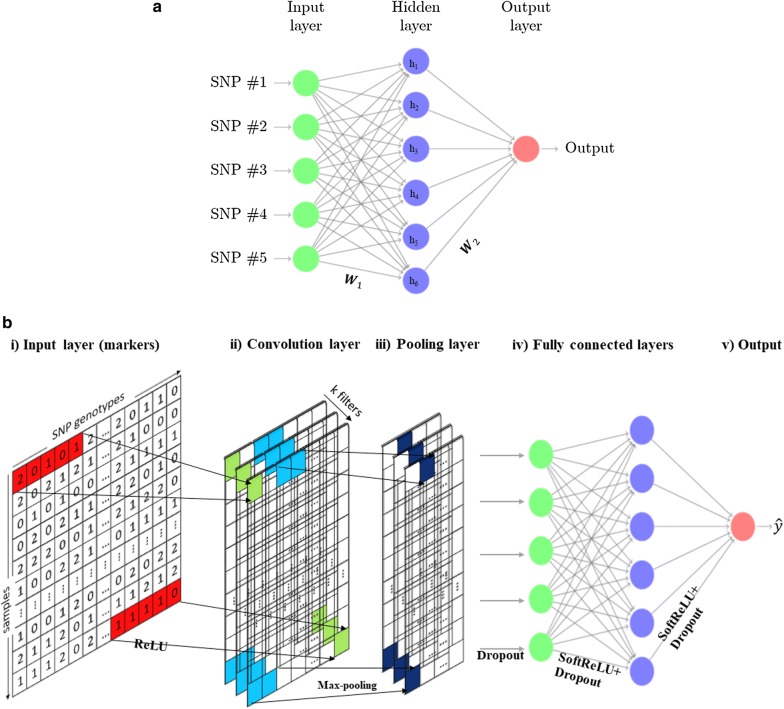
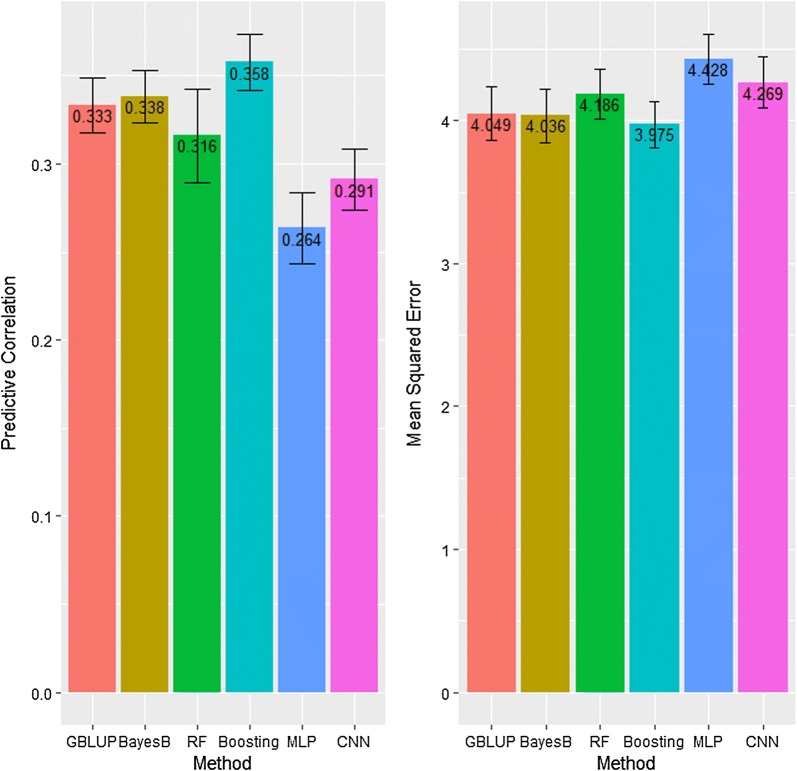
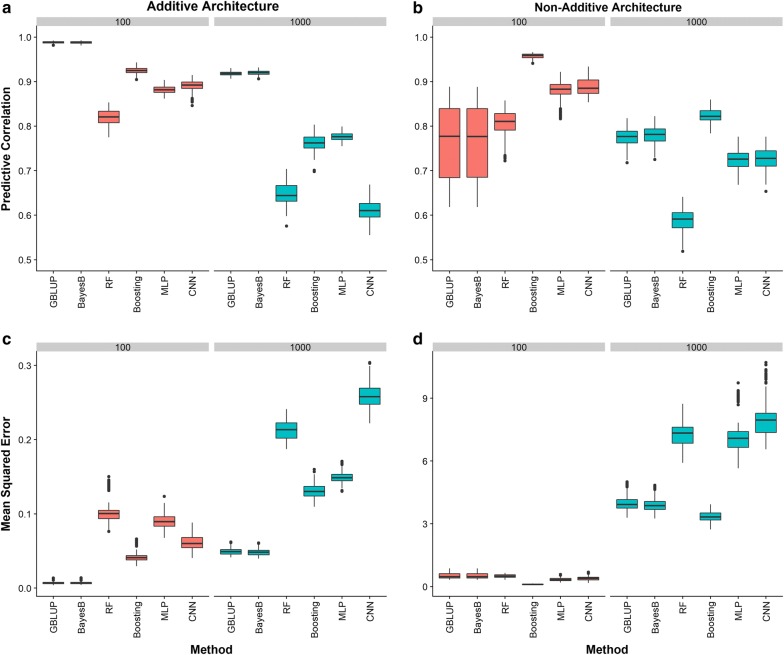
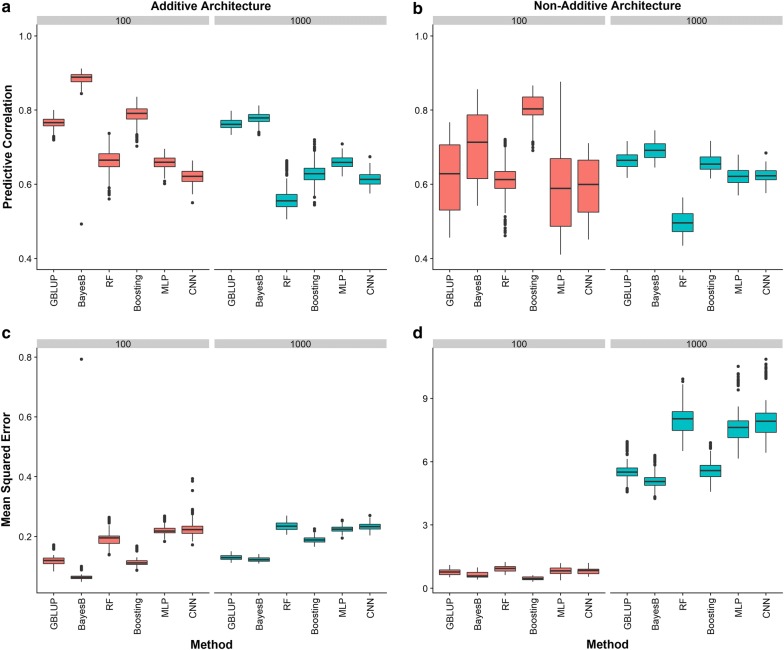
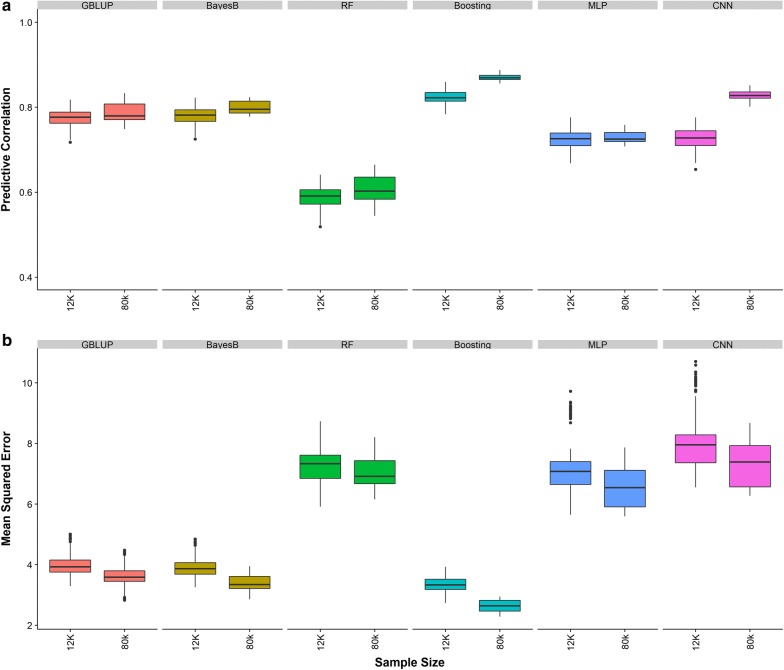
Background: Transforming large amounts of genomic data into valuable knowledge for predicting complex traits has been an important challenge for animal and plant breeders. Prediction of complex traits has not escaped the current excitement on machine-learning, including interest in deep learning algorithms such as multilayer perceptrons (MLP) and convolutional neural networks (CNN). The aim of this study was to compare the predictive performance of two deep learning methods (MLP and CNN), two ensemble learning methods [random forests (RF) and gradient boosting (GB)], and two parametric methods [genomic best linear unbiased prediction (GBLUP) and Bayes B] using real and simulated datasets. Methods: The real dataset consisted of 11,790 Holstein bulls with sire conception rate (SCR) records and genotyped for 58k single nucleotide polymorphisms (SNPs). To support the evaluation of deep learning methods, various simulation studies were conducted using the observed genotype data as template, assuming a heritability of 0.30 with either additive or non-additive gene effects, and two different numbers of quantitative trait nucleotides (100 and 1000). Results: In the bull dataset, the best predictive correlation was obtained with GB (0.36), followed by Bayes B (0.34), GBLUP (0.33), RF (0.32), CNN (0.29) and MLP (0.26). The same trend was observed when using mean squared error of prediction. The simulation indicated that when gene action was purely additive, parametric methods outperformed other methods. When the gene action was a combination of additive, dominance and of two-locus epistasis, the best predictive ability was obtained with gradient boosting, and the superiority of deep learning over the parametric methods depended on the number of loci controlling the trait and on sample size. In fact, with a large dataset including 80k individuals, the predictive performance of deep learning methods was similar or slightly better than that of parametric methods for traits with non-additive gene action. Conclusions: For prediction of traits with non-additive gene action, gradient boosting was a robust method. Deep learning approaches were not better for genomic prediction unless non-additive variance was sizable.
Overview
The claims and statistics of this paper haven’t been checked yet.
Free: it reads the open-access text and checks the first 5 claims that cite a source we can check. Create a free account to check every claim.
Integrity signals
Registry
Cites
Statistics
Figures
Verification
Claims the paper makes
The claims and statistics of this paper haven’t been checked yet.
Free: it reads the open-access text and checks the first 5 claims that cite a source we can check. Create a free account to check every claim.
Claims other papers make about this one
Each is checked against this paper’s own text: does it say what the citing paper says it does?
In the citing paper
“Additionally, Abdollahi-Arpanahi et al. (2020) reported that DL methods did not improve prediction accuracy compared to Gradient Boosting, random forest (RF), GBLUP, and Bayes B.”
From A review of multimodal deep learning methods for genomic-enabled prediction in plant breeding (2024) · cites this paper as Abdollahi-Arpanahi et al. (2020)
Self-check
Percentages, sums and reported differences re-computed from the paper’s own numbers.
The self-check needs the paper’s full text.
Citations
Cites
Breiman, L. (2001) · Machine Learning · doi:10.1023/a:1010933404324 · Cited by 133,538
Gradient-based learning applied to document recognition
Lecun, Y., Bottou, L., Bengio, Y., & Haffner, P. (1998) · Proceedings of the IEEE · doi:10.1109/5.726791 · Cited by 58,805
XGBoost: A Scalable Tree Boosting System
Chen, T., & Guestrin, C. (2016) · Proceedings of the 22nd ACM SIGKDD International Conference on Knowledge Discovery and Data Mining · doi:10.1145/2939672.2939785 · Cited by 54,569
Learning representations by back-propagating errors
Rumelhart, D. E., Hinton, G. E., & Williams, R. J. (1986) · Nature · doi:10.1038/323533a0 · Cited by 31,892
Greedy function approximation: A gradient boosting machine
Friedman, J. H. (2001) · The Annals of Statistics · doi:10.1214/aos/1013203451 · Cited by 30,731
The Elements of Statistical Learning
Hastie, T., Friedman, J., & Tibshirani, R. (2001) · Springer Series in Statistics · doi:10.1007/978-0-387-21606-5 · Cited by 24,162
A decision-theoretic generalization of on-line learning and an application to boosting
Freund, Y., & Schapire, R. E. (1997) · Journal of Computer and System Sciences · doi:10.1006/jcss.1997.1504 · Cited by 20,466
Classification and Regression by randomForest
Liaw, A. I., & Wiener, M. C. (2007) · Cited by 18,594
Second-generation PLINK: rising to the challenge of larger and richer datasets
Chang, C. C., Chow, C. C., Tellier, L. C., Vattikuti, S., Purcell, S. M., & Lee, J. J. (2015) · Gigascience · doi:10.1186/s13742-015-0047-8 · Cited by 12,709
(2016) · Cited by 11,679
Prediction of Total Genetic Value Using Genome-Wide Dense Marker Maps
Meuwissen, T. H. E., Hayes, B. J., & Goddard, M. E. (2001) · Genetics · doi:10.1093/genetics/157.4.1819 · Cited by 7,917
Efficient Methods to Compute Genomic Predictions
VanRaden, P. M. (2008) · Journal of Dairy Science · doi:10.3168/jds.2007-0980 · Cited by 6,050
XV.—The Correlation between Relatives on the Supposition of Mendelian Inheritance.
Fisher, R. A. (1919) · Transactions of the Royal Society of Edinburgh · doi:10.1017/s0080456800012163 · Cited by 4,387
Convolutional networks for images, speech, and time series
LeCun, Y., & Bengio, Y. (1998) · HAL (Le Centre pour la Communication Scientifique Directe) · doi:10.5555/303568.303704 · Cited by 4,231
The Electronic Medical Records and Genomics (eMERGE) Consortium, Wood, A. R., The MIGen Consortium, The PAGE Consortium, Study, T. L. C., Esko, T., Yang, J., Vedantam, S., Pers, T. H., Gustafsson, S., et al. (2014) · Nature Genetics · doi:10.1038/ng.3097 · Cited by 1,853
MXNet: A Flexible and Efficient Machine Learning Library for Heterogeneous Distributed Systems
Chen, T., Li, M., Li, Y., Lin, M., Wang, N., Wang, M., Xiao, T., Xu, B., Zhang, C., & Zhang, Z. (2015) · arXiv · doi:10.48550/arxiv.1512.01274 · Cited by 1,819 · cited 1×
“MLP was fitted with MXNet package [35] in the R language/environment, version 3.”
MethodGenome-Wide Regression and Prediction with the BGLR Statistical Package
Pérez, P., & de los Campos, G. (2014) · Genetics · doi:10.1534/genetics.114.164442 · Cited by 1,594
Epistasis and quantitative traits: using model organisms to study gene–gene interactions
Mackay, T. F. C. (2014) · Nature Reviews Genetics · doi:10.1038/nrg3627 · Cited by 833
Priors in whole-genome regression: the Bayesian alphabet returns
Gianola, D. (2013) · Genetics · doi:10.1534/genetics.113.151753 · Cited by 457
Gianola, D., & van Kaam, J. B. C. H. M. (2008) · Genetics · doi:10.1534/genetics.107.084285 · Cited by 457
Self-citationGenomic-Assisted Prediction of Genetic Value With Semiparametric Procedures
Gianola, D., Fernando, R. L., & Stella, A. (2006) · Genetics · doi:10.1534/genetics.105.049510 · Cited by 450
Self-citationMachine learning and complex biological data
Xu, C., & Jackson, S. A. (2019) · Genome Biology · doi:10.1186/s13059-019-1689-0 · Cited by 378
Epistasis dominates the genetic architecture of Drosophila quantitative traits
Huang, W., Richards, S., Carbone, M. A., Zhu, D., Anholt, R. R. H., Ayroles, J. F., Duncan, L., Jordan, K. W., Lawrence, F., Magwire, M. M., et al. (2012) · Proceedings of the National Academy of Sciences · doi:10.1073/pnas.1213423109 · Cited by 353
A deep convolutional neural network approach for predicting phenotypes from genotypes
Ma, W., Qiu, Z., Song, J., Li, J., Cheng, Q., Zhai, J., & Ma, C. (2018) · Planta · doi:10.1007/s00425-018-2976-9 · Cited by 341
The handbook of brain theory and neural networks
Cios, K. J., & Shields, M. E. (1997) · Neurocomputing · doi:10.1016/s0925-2312(97)00036-2 · Cited by 304
A comparison of random forests, boosting and support vector machines for genomic selection
Ogutu, J. O., Piepho, H.-P., & Schulz-Streeck, T. (2011) · BMC Proceedings · doi:10.1186/1753-6561-5-s3-s11 · Cited by 298
Machine Learning in Genomic Medicine: A Review of Computational Problems and Data Sets
Leung, M. K. K., Delong, A., Alipanahi, B., & Frey, B. J. (2016) · Proceedings of the IEEE · doi:10.1109/jproc.2015.2494198 · Cited by 275
Can deep learning improve genomic prediction of complex human traits?
Bellot, P., de los Campos, G., & Pérez-Enciso, M. (2018) · Genetics · doi:10.1534/genetics.118.301298 · Cited by 225
Howard, R., Carriquiry, A. L., & Beavis, W. D. (2014) · G3 Genes|Genomes|Genetics · doi:10.1534/g3.114.010298 · Cited by 222
A Guide on Deep Learning for Complex Trait Genomic Prediction
Pérez-Enciso, M., & Zingaretti, L. M. (2019) · Genes · doi:10.3390/genes10070553 · Cited by 197
Reproducing kernel Hilbert spaces regression: A general framework for genetic evaluation1
de los Campos, G., Gianola, D., & Rosa, G. J. M. (2009) · Journal of Animal Science · doi:10.2527/jas.2008-1259 · Cited by 194
Self-citationMulti-environment Genomic Prediction of Plant Traits Using Deep Learners With Dense Architecture
Montesinos-López, A., Montesinos-López, O. A., Gianola, D., Crossa, J., & Hernández-Suárez, C. M. (2018) · G3 Genes|Genomes|Genetics · doi:10.1534/g3.118.200740 · Cited by 180 · cited 2×
“It has also been demonstrated that deep learning algorithms may be useful for predicting individual genotypic value for traits that are affected by genotype-by-environment interactions [15].”
BackgroundMethodMachine learning methods and predictive ability metrics for genome-wide prediction of complex traits
González-Recio, O., Rosa, G. J. M., & Gianola, D. (2014) · Livestock Science · doi:10.1016/j.livsci.2014.05.036 · Cited by 177
Genome-wide prediction of discrete traits using bayesian regressions and machine learning
González-Recio, O., & Forni, S. (2011) · Genetics Selection Evolution · doi:10.1186/1297-9686-43-7 · Cited by 166
Forsberg, S. K. G., Bloom, J. S., Sadhu, M. J., Kruglyak, L., & Carlborg, Ö. (2017) · Nature Genetics · doi:10.1038/ng.3800 · Cited by 138
The butterfly effect in cancer: A single base mutation can remodel the cell
Hart, J. R., Zhang, Y., Liao, L., Ueno, L. A., Du, L., Jonkers, M., Yates, J. R., & Vogt, P. K. (2015) · Proceedings of the National Academy of Sciences · doi:10.1073/pnas.1424012112 · Cited by 89
Morgante, F., Huang, W., Maltecca, C., & Mackay, T. F. C. (2018) · Heredity · doi:10.1038/s41437-017-0043-0 · Cited by 88
Kuhn, M. T., & Hutchison, J. L. (2008) · Journal of Dairy Science · doi:10.3168/jds.2007-0743 · Cited by 83
Predicting bull fertility using genomic data and biological information
Abdollahi-Arpanahi, R., Morota, G., & Peñagaricano, F. (2017) · Journal of Dairy Science · doi:10.3168/jds.2017-13288 · Cited by 83
Self-citationPredictive ability of genome-assisted statistical models under various forms of gene action
Momen, M. M., Mehrgardi, A. A., Sheikhi, A., Kranis, A., Tusell, L., Morota, G., Rosa, G. J. M., & Gianola, D. (2018) · Scientific Reports · doi:10.1038/s41598-018-30089-2 · Cited by 76
Genome-wide prediction using Bayesian additive regression trees
Waldmann, P. (2016) · Genetics Selection Evolution · doi:10.1186/s12711-016-0219-8 · Cited by 67
González-Recio, Ó., Jiménez-Montero, J. A., & Alenda, R. (2012) · Journal of Dairy Science · doi:10.3168/jds.2012-5630 · Cited by 65
Approximate Bayesian neural networks in genomic prediction
Waldmann, P. (2018) · Genetics Selection Evolution · doi:10.1186/s12711-018-0439-1 · Cited by 52
Wittenburg, D., Melzer, N., & Reinsch, N. (2011) · BMC Genetics · doi:10.1186/1471-2156-12-74 · Cited by 51
Increasing the number of single nucleotide polymorphisms used in genomic evaluation of dairy cattle
Wiggans, G. R., Cooper, T. A., VanRaden, P. M., Tassell, C. P. V., Bickhart, D. M., & Sonstegard, T. S. (2016) · Journal of Dairy Science · doi:10.3168/jds.2015-10456 · Cited by 47
Nicolini, P., Amorín, R., Han, Y., & Peñagaricano, F. (2018) · BMC Genetics · doi:10.1186/s12863-018-0600-4 · Cited by 39
Self-citationGenomic prediction of bull fertility in US Jersey dairy cattle
de Rezende, F. M., Nani, J. P., & Peñagaricano, F. (2019) · Journal of Dairy Science · doi:10.3168/jds.2018-15810 · Cited by 36
Self-citationPrediction of Multiple-Trait and Multiple-Environment Genomic Data Using Recommender Systems
Montesinos-López, O. A., Montesinos‐López, A., Crossa, J. L., Montesinos-López, J. C., Mota‐Sanchez, D., Estrada-González, F., Gillberg, J., Singh, R. P., Mondal, S., & Juliana, P. (2018) · G3 Genes Genomes Genetics · doi:10.1534/g3.117.300309 · Cited by 31
The potential of shifting recombination hotspots to increase genetic gain in livestock breeding
Gonen, S., Battagin, M., Johnston, S. E., Gorjanc, G., & Hickey, J. M. (2017) · Genetics Selection Evolution · doi:10.1186/s12711-017-0330-5 · Cited by 29
Genomic Selection with Deep Neural Networks
Mcdowell, R. M. (2016) · doi:10.31274/etd-180810-5600 · Cited by 21 · cited 1×
“predicting semen fertility, machine-learning algorithms incorporating interaction effects may perform better than models capturing only additive effects [45].”
MethodNelson, R. M., Kierczak, M., & Carlborg, Ö. (2013) · Methods in molecular biology · doi:10.1007/978-1-62703-447-0_24 · Cited by 14
Cited by
Xu, Y., Zhang, X., Li, H., Zheng, H., Zhang, J., Olsen, M. S., Varshney, R. K., Prasanna, B. M., & Qian, Q. (2022) · Molecular Plant · doi:10.1016/j.molp.2022.09.001 · Cited by 363
A review of deep learning applications for genomic selection
Montesinos-López, O. A., Montesinos-López, A., Pérez-Rodríguez, P., Barrón-López, J. A., Martini, J. W. R., Fajardo-Flores, S. B., Gaytan-Lugo, L. S., Santana-Mancilla, P. C., & Crossa, J. (2021) · BMC Genomics · doi:10.1186/s12864-020-07319-x · Cited by 361
LightGBM: accelerated genomically designed crop breeding through ensemble learning
Yan, J., Xu, Y., Cheng, Q., Jiang, S., Wang, Q., Xiao, Y., Ma, C., Yan, J., & Wang, X. (2021) · Genome Biology · doi:10.1186/s13059-021-02492-y · Cited by 320
“When applying ANN or CNN for genomic prediction, the algorithm performs feature extraction by first estimating a weight for each SNP and then computing a reformed, grand feature based on the sum of the weighted features to represent a set of neighboring SNPs within a predefined genomic region [24, 25].”
BackgroundInfluentialMachine learning in plant science and plant breeding
van Dijk, A. D. J., Kootstra, G., Kruijer, W., & de Ridder, D. (2021) · iScience · doi:10.1016/j.isci.2020.101890 · Cited by 320
“In particular, DL improved accuracy for a number of simulated and real animal traits measured on large populations, in the presence of strong epistatic and dominance effects (Abdollahi-Arpanahi et al., 2020; Waldmann 2018).”
BackgroundArtificial intelligence in plant breeding
Farooq, M. A., Gao, S., Hassan, M. A., Huang, Z., Rasheed, A., Hearne, S., Prasanna, B., Li, X., & Li, H. (2024) · Trends in Genetics · doi:10.1016/j.tig.2024.07.001 · Cited by 288
Metadata
- Authors
- Abdollahi-Arpanahi, R., Gianola, D., & Peñagaricano, F.
- Affiliations
- University of Florida (US)
- Corresponding author
- Peñagaricano, Francisco
- Venue
- Genetics Selection Evolution
- Published
- 2020-02-24
- Volume
- 52
- Issue
- 1
- Pages
- 12-12
- ISSN
- 0999-193X (ISSN-L)
- 1297-9686
- PMC
- PMC7038529
- OpenAlex
- W3012909962
- Cited by
- 228
- References
- 52
- Citations by year
- 2026: 39 · 2025: 47 · 2024: 36 · 2023: 31 · 2022: 29 · 2021: 32 · 2020: 13
- FWCI
- 15.39
- Type
- journal article
- Language
- en
- Open access
- gold
- doi.org
- Licence
- cc-by
- creativecommons.org/licenses/by/4.0/ (tdm)
- creativecommons.org/licenses/by/4.0/ (vor)
- Locations
- Genetics Selection Evolution (publishedVersion, cc-by)
- PubMed Central (publishedVersion, cc-by)
- PubMed (publishedVersion)
- HAL (submittedVersion, other-oa)
- DOAJ (DOAJ: Directory of Open Access Journals) (submittedVersion, cc-by-sa)
- Topics
- Life Sciences › Biochemistry, Genetics and Molecular Biology › Genetics › Genetic and phenotypic traits in livestock
- Life Sciences › Biochemistry, Genetics and Molecular Biology › Genetics › Genetic Mapping and Diversity in Plants and Animals
- Life Sciences › Biochemistry, Genetics and Molecular Biology › Genetics › Genetic Associations and Epidemiology
- Keywords
- genomic prediction, complex traits, deep learning, multilayer perceptron, convolutional neural networks, random forest, gradient boosting, genomic best linear unbiased prediction, BayesB, Holstein bulls, non-additive gene action, dominance effects, epistasis, simulated data, prediction accuracy
- MeSH terms
- Deep Learning, Animals, Bayes Theorem, Cattle, Genotype, Models, Genetic, Phenotype, Quantitative Trait, Heritable, Multifactorial Inheritance, Polymorphism, Single Nucleotide, Genomics
About these checks
Registry, retraction, Cites and statistics results are computed, not judged, with one exception: a printed reference that no index lists is read once by a model before it counts as a citation error. Claims are extracted by a model and kept only when their quote appears verbatim in the text; each cited source is then checked, with a model’s help, for whether it says what the claim relies on. Those verdicts can be wrong — read the claim’s quote and the cited source before relying on one.
Statistics and arithmetic are recomputed, not judged.
Confidence bands are shown only for fields calibrated on our annotated test set. None is calibrated yet, so no band is shown.
What counts as a claim ›How we measure confidence ›How we check this ›
Are you an author, or do you see a problem with this page? Request a review
Data sources
Bibliographic data: Semantic Scholar, OpenAlex, Crossref.
Contains information from the Semantic Scholar Academic Graph Datasets, made available under the ODC Attribution License (ODC-BY 1.0).
Semantic Scholar’s data is described in: Kinney, R., et al. (2023). The Semantic Scholar Open Data Platform. arXiv:2301.10140.
