

The DOI matches its Crossref record; 2 of the 2 references it cites were found in a registry or an index.
A drug repositioning algorithm based on a deep autoencoder and adaptive fusion
Open accessAbstract
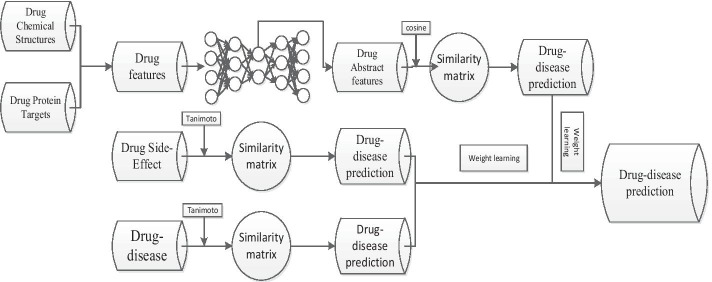
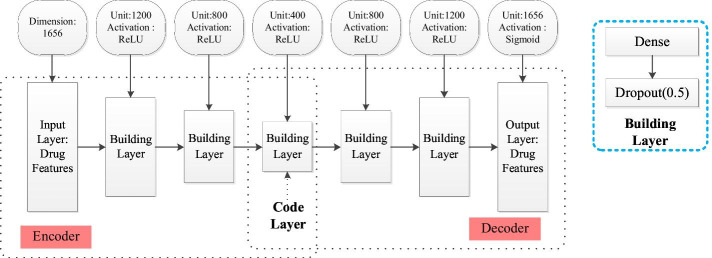
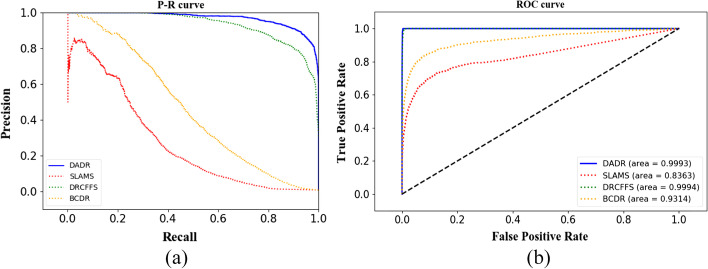
Background: Drug repositioning has caught the attention of scholars at home and abroad due to its effective reduction of the development cost and time of new drugs. However, existing drug repositioning methods that are based on computational analysis are limited by sparse data and classic fusion methods; thus, we use autoencoders and adaptive fusion methods to calculate drug repositioning. Results: In this study, a drug repositioning algorithm based on a deep autoencoder and adaptive fusion was proposed to mitigate the problems of decreased precision and low-efficiency multisource data fusion caused by data sparseness. Specifically, a drug is repositioned by fusing drug-disease associations, drug target proteins, drug chemical structures and drug side effects. First, drug feature data integrated by drug target proteins and chemical structures were processed with dimension reduction via a deep autoencoder to characterize feature representations more densely and abstractly. Then, disease similarity was computed using drug-disease association data, while drug similarity was calculated with drug feature and drug-side effect data. Predictions of drug-disease associations were also calculated using a top-k neighbor method that is commonly used in predictive drug repositioning studies. Finally, a predicted matrix for drug-disease associations was acquired after fusing a wide variety of data via adaptive fusion. Based on experimental results, the proposed algorithm achieves a higher precision and recall rate than the DRCFFS, SLAMS and BADR algorithms with the same dataset. Conclusion: The proposed algorithm contributes to investigating the novel uses of drugs, as shown in a case study of Alzheimer's disease. Therefore, the proposed algorithm can provide an auxiliary effect for clinical trials of drug repositioning.
Overview
The claims and statistics of this paper haven’t been checked yet.
Run the check — free, no account needed. It reads the open-access text and checks the sources it cites.
Integrity signals
Registry
Cites
Statistics
Figures
Verification
Claims the paper makes
The claims and statistics of this paper haven’t been checked yet.
Run the check — free, no account needed. It reads the open-access text and checks the sources it cites.
Claims other papers make about this one
Each is checked against this paper’s own text: does it say what the citing paper says it does?
The cited source says what the claim attributes to it.
In the citing paper
“Clozapine was initially proposed by a study published in 2016 (Issa et al., 2016), with subsequent support in five studies published between 2017 and 2022 (Choi et al., 2017;Chen et al., 2021;Chrétien et al., 2021;Gerring et al., 2021;Soleimani Zakeri et al., 2021).”
From Drug repurposing for Alzheimer’s disease from 2012–2022—a 10-year literature review (2023) · cites this paper as Chen et al., 2021
Self-check
Percentages, sums and reported differences re-computed from the paper’s own numbers.
The self-check needs the paper’s full text.
Citations
Cites
Drug target identification using side-effect similarity
Campillos, M., Kuhn, M., Gavin, A.-C., Jensen, L. J., & Bork, P. (2008) · Science · doi:10.1126/science.1158140 · Cited by 1,248
A review of network-based approaches to drug repositioning
Lotfi Shahreza, M., Ghadiri, N., Mousavi, S. R., Varshosaz, J., & Green, J. R. (2018) · Briefings in Bioinformatics · doi:10.1093/bib/bbx017 · Cited by 330
Research works printed but not linked: 28
- Booth B, Zemmel R. Quest for the best. Nat Rev Drug Discov. 2003;2(10):838–41. · DOI
- Sardana D, Zhu C, Zhang M, et al. Drug repositioning for orphan diseases. Brief Bioinform. 2011;12(4):346–56. · DOI · Paper page
- Nwose OM, Jones MR. Atypical mechanism of glucose modulation by colesevelam in patients with type 2 diabetes. Clin Med Insights: Endocrinol Diabetes. 2013;6(6):75–9.
- Cheng F, Zhao J, Fooksa M, et al. A network-based drug repositioning infrastructure for precision cancer medicine through targeting significantly mutated genes in the human cancer genomes. J Am Med Inform Assoc. 2016;23(4):681–91. · DOI
- Zhang P, Agarwal P, Obradovic Z. Computational drug repositioning by ranking and integrating multiple data sources. In: Joint European Conference on Machine Learning and Knowledge Discovery in Databases. Springer, Berlin, Heidelberg, 2013: 579–594. · DOI
- Zhang J, Li C, Lin Y, et al. Computational drug repositioning using collaborative filtering via multi-source fusion. Expert Syst Appl. 2017;84:281–9. · DOI
- Luo H, Wang J, Li M, et al. Drug repositioning based on comprehensive similarity measures and bi-random walk algorithm. Bioinformatics. 2016;32(17):2664–71. · DOI
- Zeng X, Zhu S, Liu X, et al. deepDR: a network-based deep learning approach to in silico drug repositioning. Bioinformatics. 2019;35(24):5191–8. · DOI
- Zhou Y, Hou Y, Shen J, Huang Y, Martin W, Cheng F. Network-based drug repurposing for human coronavirus. 2020. https://doi.org/10.1101/2020.02.03.20020263. · DOI
- Hinton GE, Salakhutdinov RR. Reducing the dimensionality of data with neural networks. Science. 2006;313(5786):504–7. · DOI · Paper page
- Ward R, Wu X, Bottou L. Adagrad stepsizes: Sharp convergence over nonconvex landscapes, from any initialization. arXiv preprint arXiv. 2018.
- Moridi M, Ghadirinia M, Sharifi-Zarchi A, et al. The assessment of efficient representation of drug features using deep learning for drug repositioning. BMC Bioinformatics. 2019;20(1):577. · DOI
- Glorot X, Bengio Y. Understanding the difficulty of training deep feedforward neural networks. J Mach Learn Res. 2010;9:249–56.
- Dudley JT, Deshpande T, Butte AJ. Exploiting drug-disease relationships for computational drug repositioning. Brief Bioinform. 2011;12(4):303–11. · DOI
- Li J, Zhu X, Chen JY, et al. Building disease-specific drug–protein connectivity maps from molecular interaction networks and PubMed abstracts. PLoS Comput Biol. 2009;5(7):631–41. · DOI
- Wang Y, Xiao J, Suzek T O, et al. PubChem: a public information system for analyzing bioactivities of small molecules. Nucleic Acids Research, 2009, 37(Web Server):W623-W633. · DOI
- Rolf A, Amos B, Wu CH, et al. UniProt: the Universal Protein knowledgebase. Nucleic Acids Research, 2004, 32(Data Issue):D115-D119. · DOI
- Kuhn M, Campillos M, Letunic I, et al. A side effect resource to capture phenotypic effects of drugs. Mol Syst Biol. 2010;6(01):343–343. · DOI · Paper page
- Chiang AP, Butte AJ. Systematic evaluation of drug-disease relationships to identify leads for novel drug uses. Clin Pharmacol Ther. 2009;86(5):507–10. · DOI
- Bodenreider O. The Unified Medical Language System (UMLS): integrating biomedical terminology. Nucleic Acids Research, 2004, 32(suppl_1): D267-D70. · DOI · Paper page
- Lin Y, Zhang J, Lin M, et al. Drug repositioning algorithm based on collaborative filtering. J Nanjing Univ (Natl Sci). 2015;51(04):834–41.
- Brown AS, Patel CJ. A standard database for drug repositioning. Sci Data. 2017;4(01):1–7. · DOI
- Choi Y, Jeong HJ, Liu QF, et al. Clozapine improves memory impairment and reduces Aβ level in the Tg-APPswe/PS1dE9 mouse model of Alzheimer’s disease. Mol Neurobiol. 2017;54(01):450–60. · DOI · Paper page
- Zhou Y, Long M, Ran H. Clinical trial of donepezil hydrochloride tablets combined with clozapine dispersible tablets in the treatment of elderly Alzheimer’s disease with behavioral disorder. Chin J Clin Pharmacol. 2017;33(19):1897–9.
- Bennett J, Burns J, Welch P, et al. Safety and tolerability of R (+) pramipexole in mild-to-moderate Alzheimer’s disease. J Alzheimers Dis. 2016;49(4):1179–87. · DOI
- Wu Y, Xu W, Liu X, et al. Efficacy and safety of olanzapine combined with repetitive transcranial magnetic stimulation in the treatment of behavioral and psychological symptoms of Alzheimer’s desease. Herald Med. 2016;35(10):1069–72.
- Zhang L, Wang L, Wang R, et al. Evaluating the effectiveness of GTM-1, rapamycin, and carbamazepine on autophagy and Alzheimer disease. Med Sci Monit: Int Med J Experim Clin Res. 2017;23:801–8. · DOI
- Sorial ME, El Sayed NSED. Protective effect of valproic acid in streptozotocin-induced sporadic Alzheimer’s disease mouse model: possible involvement of the cholinergic system. Naunyn Schmiedebergs Arch Pharmacol. 2017;390(6):581–93. · DOI
Cited by
Sorted by citations
Drug repurposing for Alzheimer’s disease from 2012–2022—a 10-year literature review
Grabowska, M. E., Huang, A., Wen, Z., Li, B., & Wei, W.-Q. (2023) · Frontiers in Pharmacology · doi:10.3389/fphar.2023.1257700 · Cited by 55
“Clozapine was initially proposed by a study published in 2016 (Issa et al., 2016), with subsequent support in fi ve studies published between 2017 and 2022 (Choi et al., 2017; Chen et al., 2021; Chrétien et al., 2021; Gerring et al., 2021; Soleimani Zakeri et al., 2021).”
Background
Metadata
- Authors
- Chen, P., Bao, T., Yu, X., & Liu, Z.
- Affiliations
- China Three Gorges University (CN)
- Corresponding author
- Liu, Zhongtu
- Venue
- BMC Bioinformatics
- Published
- 2021-10-30
- Volume
- 22
- Issue
- 1
- Pages
- 532-532
- ISSN
- 1471-2105 (ISSN-L)
- PMC
- PMC8556784
- OpenAlex
- W3116547330
- Cited by
- 8
- References
- 2
- Citations by year
- 2026: 2 · 2025: 3 · 2023: 3
- FWCI
- 1.05
- Type
- journal article
- Language
- en
- Open access
- gold
- doi.org
- Locations
- BMC Bioinformatics (publishedVersion, cc-by)
- Europe PMC (PubMed Central) (publishedVersion, other-oa)
- PubMed Central (publishedVersion, cc-by)
- PubMed (publishedVersion)
- DOAJ (DOAJ: Directory of Open Access Journals) (submittedVersion, cc-by-sa)
- Funders
- The National Key Research and Development Program of China (2016YFC0802500)
- Research Fund for Excellent Dissertation of China Three Gorges University (2020SSPY075)
- Topics
- Life Sciences › Pharmacology, Toxicology and Pharmaceutics › Drug Discovery › Computational Drug Discovery Methods
- Health Sciences › Medicine › Health Informatics › Biomedical Text Mining and Ontologies
- Life Sciences › Biochemistry, Genetics and Molecular Biology › Molecular Biology › Bioinformatics and Genomic Networks
- Keywords
- drug repurposing, deep autoencoder, adaptive fusion, multi-source data fusion, drug-disease association prediction, drug target proteins, drug chemical structure, adverse drug reactions, disease similarity, drug similarity, Alzheimer's disease, data sparsity
- MeSH terms
- Algorithms, Alzheimer Disease, Humans, Computational Biology, Drug Repositioning, Drug-Related Side Effects and Adverse Reactions
About these checks
Registry, retraction, Cites and statistics results are computed, not judged, with one exception: a printed reference that no index lists is read once by a model before it counts as a citation error. Claims are extracted by a model and kept only when their quote appears verbatim in the text; each cited source is then checked, with a model’s help, for whether it says what the claim relies on. Those verdicts can be wrong — read the claim’s quote and the cited source before relying on one.
Statistics and arithmetic are recomputed, not judged.
Confidence bands are shown only for fields calibrated on our annotated test set. None is calibrated yet, so no band is shown.
What counts as a claim ›How we measure confidence ›How we check this ›
Are you an author, or do you see a problem with this page? Request a review
How to cite
Cite CoChat for the checks on this page, and the paper for its own findings.
- This page
- CoChat. (2026). Citation check: A drug repositioning algorithm based on a deep autoencoder and adaptive fusion. https://app.cochat.ai/papers/10.1186/s12859-021-04406-y
- The paper
- Chen, P., Bao, T., Yu, X., & Liu, Z. (2021). A drug repositioning algorithm based on a deep autoencoder and adaptive fusion. BMC Bioinformatics. https://doi.org/10.1186/s12859-021-04406-y
