

Calcareous sponge genomes reveal complex evolution of α-carbonic anhydrases and two key biomineralization enzymes
Open accessThe DOI matches its Crossref record; 68 of the 69 references it cites were found in a registry or an index.
Abstract
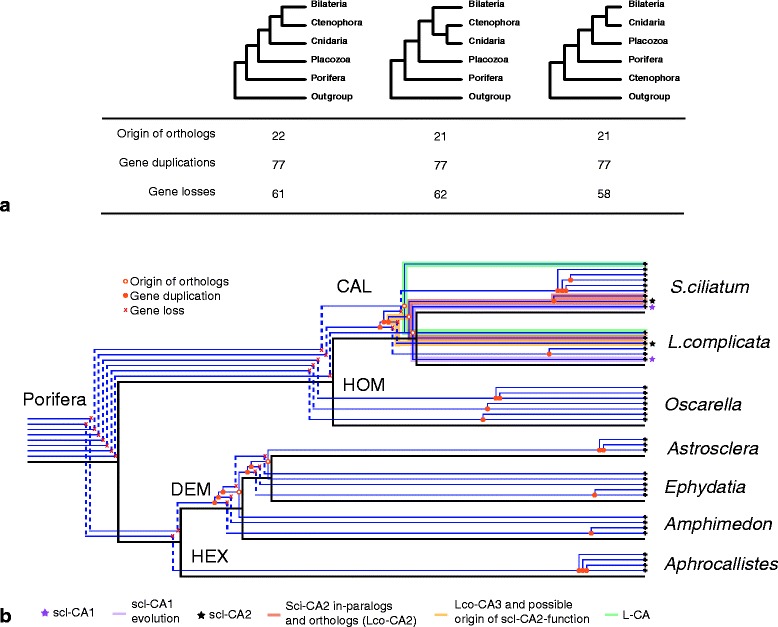
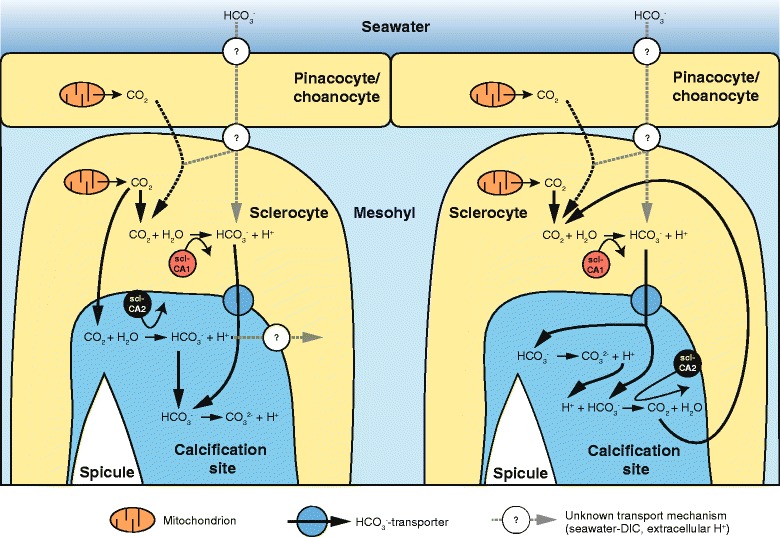
BACKGROUND: Calcium carbonate biominerals form often complex and beautiful skeletal elements, including coral exoskeletons and mollusc shells. Although the ability to generate these carbonate structures was apparently gained independently during animal evolution, it sometimes involves the same gene families. One of the best-studied of these gene families comprises the α- carbonic anhydrases (CAs), which catalyse the reversible transformation of CO2 to HCO3 - and fulfill many physiological functions. Among Porifera -the oldest animal phylum with the ability to produce skeletal elements- only the class of calcareous sponges can build calcitic spicules, which are the extracellular products of specialized cells, the sclerocytes. Little is known about the molecular mechanisms of their synthesis, but inhibition studies suggest an essential role of CAs. In order to gain insight into the evolution and function of CAs in biomineralization of a basal metazoan species, we determined the diversity and expression of CAs in the calcareous sponges Sycon ciliatum and Leucosolenia complicata by means of genomic screening, RNA-Seq and RNA in situ hybridization expression analysis. Active biomineralization was located with calcein-staining. RESULTS: We found that the CA repertoires of two calcareous sponge species are strikingly more complex than those of other sponges. By characterizing their expression patterns, we could link two CAs (one intracellular and one extracellular) to the process of calcite spicule formation in both studied species. The extracellular biomineralizing CAs seem to be of paralogous origin, a finding that advises caution against assuming functional conservation of biomineralizing genes based upon orthology assessment alone. Additionally, calcareous sponges possess acatalytic CAs related to human CAs X and XI, suggesting an ancient origin of these proteins. Phylogenetic analyses including CAs from genomes of all non-bilaterian phyla suggest multiple gene losses and duplications and presence of several CAs in the last common ancestor of metazoans. CONCLUSIONS: We identified two key biomineralization enzymes from the CA-family in calcareous sponges and propose their possible interaction in spicule formation. The complex evolutionary history of the CA family is driven by frequent gene diversification and losses. These evolutionary patterns likely facilitated the numerous events of independent recruitment of CAs into biomineralization within Metazoa.
Overview
The claims and statistics of this paper haven’t been checked yet.
Free: it reads the open-access text and checks the first 5 claims that cite a source we can check. Create a free account to check every claim.
Integrity signals
Registry
Cites
Statistics
Figures
Verification
Claims the paper makes
The claims and statistics of this paper haven’t been checked yet.
Free: it reads the open-access text and checks the first 5 claims that cite a source we can check. Create a free account to check every claim.
Claims other papers make about this one
Each is checked against this paper’s own text: does it say what the citing paper says it does?
The check wasn’t confident either way, so it gives no verdict — never disputed.
In the citing paper
“Inferred relationships among major sponge lineages (i.e., Demospongiae + Hexactinellida sister to Calcarea + Homoscleromorpha) were consistent with morphology (27,28) and most other molecular analyses that have recovered monophyletic sponges (datasets 1-27 in Figs. 2 and 3 and Figs.S1-S5) (4, 5, 8, 9, 28-30).”
From Error, signal, and the placement of Ctenophora sister to all other animals (2015) · cites this paper as [30]
Experimental — accuracy not yet measured
Self-check
Percentages, sums and reported differences re-computed from the paper’s own numbers.
The self-check needs the paper’s full text.
Citations
Cites
Basic local alignment search tool
Altschul, S. F., Gish, W., Miller, W., Myers, E. W., & Lipman, D. J. (1990) · Journal of Molecular Biology · doi:10.1006/jmbi.1990.9999 · Cited by 98,669
MAFFT Multiple Sequence Alignment Software Version 7: Improvements in Performance and Usability
Katoh, K., & Standley, D. M. (2013) · Molecular Biology and Evolution · doi:10.1093/molbev/mst010 · Cited by 46,209
MrBayes 3: Bayesian phylogenetic inference under mixed models
Ronquist, F., & Huelsenbeck, J. P. (2003) · Bioinformatics · doi:10.1093/bioinformatics/btg180 · Cited by 29,077
RSEM: accurate transcript quantification from RNA-Seq data with or without a reference genome
Li, B., & Dewey, C. N. (2011) · BMC Bioinformatics · doi:10.1186/1471-2105-12-323 · Cited by 22,179 · cited 1×
“sum of the posterior probability of each read coming from that gene over all reads [36] and adjusted with size factors of the RNASeq libraries”
BackgroundGuindon, S., Dufayard, J.-F., Lefort, V., Anisimova, M., Hordijk, W., & Gascuel, O. (2010) · Systematic Biology · doi:10.1093/sysbio/syq010 · Cited by 18,376 · cited 2×
“ML phylogenetic analysis was performed with PHYML [50], including 200 bootstrap replicates and SH-like aLRT to obtain support values.”
BackgroundMethodDifferential expression analysis for sequence count data
Anders, S., & Huber, W. (2010) · Genome Biology · doi:10.1186/gb-2010-11-10-r106 · Cited by 15,581
Selection of Conserved Blocks from Multiple Alignments for Their Use in Phylogenetic Analysis
Castresana, J. (2000) · Molecular Biology and Evolution · doi:10.1093/oxfordjournals.molbev.a026334 · Cited by 10,508
SignalP 4.0: discriminating signal peptides from transmembrane regions
Petersen, T. N., Brunak, S., von Heijne, G., & Nielsen, H. (2011) · Nature Methods · doi:10.1038/nmeth.1701 · Cited by 8,847 · cited 1×
“0 [31] and presence of the three zinc-binding histidines, considered to be required for the catalytic function of CA (e.”
BackgroundPredicting Subcellular Localization of Proteins Based on their N-terminal Amino Acid Sequence
Emanuelsson, O., Nielsen, H., Brunak, S., & von Heijne, G. (2000) · Journal of Molecular Biology · doi:10.1006/jmbi.2000.3903 · Cited by 4,263
ProtTest 3: fast selection of best-fit models of protein evolution
Darriba, D., Taboada, G. L., Doallo, R., & Posada, D. (2011) · Bioinformatics · doi:10.1093/bioinformatics/btr088 · Cited by 2,672
Research works printed but not linked: 3
- Wörheide G Hooper J Calcarea from the Great Barrier Reef. 1: Cryptic Calcinea from Heron Island and Wistari Reef (Capricorn-Bunker Group) Mem Queensl Mus 1999 43 2 859 891
- Manuel M Borchiellini C Alivon E Boury-Esnault N Molecular phylogeny of calcareous sponges using 18S rRNA and 28S rRNA sequences Boll Mus Ist Biol Univ Genova 2004 68 449 461
- GenBank. http://www.ncbi.nlm.nih.gov/genbank/.
Cited by
Error, signal, and the placement of Ctenophora sister to all other animals
Whelan, N. V., Kocot, K. M., Moroz, L. L., & Halanych, K. M. (2015) · Proceedings of the National Academy of Sciences · doi:10.1073/pnas.1503453112 · Cited by 331
The ‘biomineralization toolkit’ and the origin of animal skeletons
Murdock, D. J. E. (2020) · Biological Reviews · doi:10.1111/brv.12614 · Cited by 177
“Furthermore Voigt et al. (2014) find an even more complex repertoire of α-CAs in two calcarean sponges, and reconstruct eight α-CAs in the last common ancestor of Porifera, with different and independent histories of duplication and loss in each sponge lineage.”
BackgroundCavalier-Smith, T. (2017) · Philosophical Transactions of the Royal Society B: Biological Sciences · doi:10.1098/rstb.2015.0476 · Cited by 142
Roy, N. L., Ganot, P., Aranda, M., Allemand, D., & Tambutté, S. (2021) · BMC Ecology and Evolution · doi:10.1186/s12862-020-01734-0 · Cited by 109
Calcisponges have a ParaHox gene and dynamic expression of dispersed NK homeobox genes
Fortunato, S., Adamski, M., Ramos, O. M., Leininger, S., Liu, J. L., Ferrier, D. E. K., & Adamska, M. (2014) · Nature · doi:10.1038/nature13881 · Cited by 116
Self-citationThe Magellania venosa Biomineralizing Proteome: A Window into Brachiopod Shell Evolution
Jackson, D. J., Mann, K., Häussermann, V., Schilhabel, M. B., Lüter, C., Griesshaber, E., Schmahl, W., & Wörheide, G. (2015) · Genome Biology and Evolution · doi:10.1093/gbe/evv074 · Cited by 72
“…of metazoan biominerals have revealed at least one (and usually several) protein with these domains (Jackson et al. 2007; Mann et al. 2008; Marie et al. 2012, 2013; Zhang et al. 2012; Ramos-Silva et al. 2013; Le-Roy et al. 2014; Mann and Edsinger 2014; Mann and Jackson 2014; Voigt et al. 2014).”
BackgroundThe roles of calcium signaling and calcium deposition in microbial multicellularity
Kolodkin‐Gal, I., Parsek, M. R., & Patrauchan, M. A. (2023) · Trends in Microbiology · doi:10.1016/j.tim.2023.06.005 · Cited by 71
Marine enzymes: Classification and application in various industries
Ghattavi, S., & Homaei, A. A. (2023) · International Journal of Biological Macromolecules · doi:10.1016/j.ijbiomac.2023.123136 · Cited by 79
Biotechnological Applications of Marine Enzymes From Algae, Bacteria, Fungi, and Sponges
Parte, S. G., Vavilala, S. L., & D’Souza, J. S. (2016) · Advances in food and nutrition research · doi:10.1016/bs.afnr.2016.10.005 · Cited by 65
Evolution of the Avian Eggshell Biomineralization Protein Toolkit – New Insights From Multi-Omics
Roy, N. L., Stapane, L., Gautron, J., & Hincke, M. T. (2021) · Frontiers in Genetics · doi:10.3389/fgene.2021.672433 · Cited by 59
New Non-Bilaterian Transcriptomes Provide Novel Insights into the Evolution of Coral Skeletomes
Conci, N., Wörheide, G., & Vargas, S. (2019) · Genome Biology and Evolution · doi:10.1093/gbe/evz199 · Cited by 37
“…the carbonic anhydrases (CA) CruCA1-6 (Le Goff et al. 2016) were searched in all octocoral datasets considered and added to the CAs dataset used in Voigt et al. (2014) Phylogenetic analysis Protein sequences were aligned with MAFFT (Katoh and Standley 2013) and MUSCLE (Edgar 2004) to investigate…”
MethodVoigt, O., Adamska, M., Adamski, M., Kittelmann, A., Wencker, L. C. M., & Wörheide, G. (2017) · Scientific Reports · doi:10.1038/srep45658 · Cited by 34
Self-citationCarbonic Anhydrases in Cnidarians: Novel Perspectives from the Octocorallian Corallium rubrum
Goff, C. L., Ganot, P., Zoccola, D., Caminiti-Segonds, N., Allemand, D., & Tambutté, S. (2016) · PLoS ONE · doi:10.1371/journal.pone.0160368 · Cited by 36
“As in other metazoans’ calcium carbonate biominerals, such as calcareous sponges spicules [19], demosponges basal skeletons [21], molluscan shells [24,25] and statocyts [26], sea urchin tests and spines [25,27], CAs have also been found in the organic matrices of coral skeletons [28–33].”
BackgroundResultInfluentialConci, N., Lehmann, M., Vargas, S., & Wörheide, G. (2020) · Genome Biology and Evolution · doi:10.1093/gbe/evaa162 · Cited by 30
Germer, J., Mann, K., Wörheide, G., & Jackson, D. J. (2015) · PLoS ONE · doi:10.1371/journal.pone.0140100 · Cited by 33
“CA has been identified as a key enzyme employed in the biomineralization strategy of another Sycon species S . ciliatum [60], and it is therefore likely to be involved in the mineralization process of S . coacatum .”
The philosophy of extreme biomimetics
Ehrlich, H., Wysokowski, M., & Jesionowski, T. (2022) · Sustainable materials and technologies · doi:10.1016/j.susmat.2022.e00447 · Cited by 32
Lin, M., Moya, A., Ying, H., Chen, C. A., Cooke, I., Ball, E. E., Forêt, S., & Miller, D. J. (2016) · Genome Biology and Evolution · doi:10.1093/gbe/evw297 · Cited by 27
“As in the case of the Scleractinia, the repertoires of secreted and membrane-associated CAs have likewise been independently expanded in other calcifying invertebrates; this phenomenon has been documented in the case of calcisponges (Voigt et al. 2014).”
BackgroundThe early animal radiation: insights from interpreting the Cambrian problematic fossils
Cong, P. (2023) · Frontiers in Earth Science · doi:10.3389/feart.2023.1120118 · Cited by 24
“, 2018), a developmental pattern also known in living calcarean sponge Sycon ciliatum (Voigt et al., 2014).”
BackgroundDifferentiation and Transdifferentiation of Sponge Cells
Adamska, M. (2018) · Results and problems in cell differentiation · doi:10.1007/978-3-319-92486-1_12 · Cited by 28
Self-citationAssessing skeleton and microbiome responses of a calcareous sponge under thermal and pH stresses
Ribeiro, B. P., Padua, A., Barno, A. R., Villela, H., Duarte, G., ROSSI, A. L., Fernandes, F. D. C., Peixoto, R. S., & Klautau., M. R. L. (2020) · ICES Journal of Marine Science · doi:10.1093/icesjms/fsaa231 · Cited by 20
Carbonic Anhydrases: An Ancient Tool in Calcareous Sponge Biomineralization
Voigt, O., Fradusco, B., Gut, C., Kevrekidis, C., Vargas, S., & Wörheide, G. (2021) · Frontiers in Genetics · doi:10.3389/fgene.2021.624533 · Cited by 20
Self-citationNaked chancelloriids from the lower Cambrian of China show evidence for sponge-type growth
Cong, P., Harvey, T. H. P., Williams, M., Siveter, D. J., Siveter, D. J., Gabbott, S. E., Li, Y., Wei, F., & Hou, X. (2018) · Proceedings of the Royal Society B Biological Sciences · doi:10.1098/rspb.2018.0296 · Cited by 21
Aguilar-Camacho, J. M., Doonan, L. B., & McCormack, G. P. (2018) · Molecular Phylogenetics and Evolution · doi:10.1016/j.ympev.2018.11.015 · Cited by 22
Zhe, Z., Xiong, X., Zhang, J., Lv, S., Jiao, Y., & Deng, Y. (2019) · Fish & Shellfish Immunology · doi:10.1016/j.fsi.2019.05.037 · Cited by 18
Rocher, C., Vernale, A., Fierro‐Constaín, L., Séjourné, N., Chenesseau, S., Marschal, C., Issartel, J., Goff, E. L., Stroebel, D., Jouvion, J., et al. (2024) · Journal of Experimental Zoology Part B Molecular and Developmental Evolution · doi:10.1002/jez.b.23271 · Cited by 31
A Look Back Over 20 Years of Evo-Devo Studies on Sponges: A Challenged View of Urmetazoa
Schenkelaars, Q., Vernale, A., Fierro‐Constaín, L., Borchiellini, C., & Renard, E. (2019) · Springer eBooks · doi:10.1007/978-3-030-30363-1_7 · Cited by 16
Flores, R. L., Gonzales, K., Seaver, R. W., & Livingston, B. T. (2016) · AIMS molecular science · doi:10.3934/molsci.2016.3.357 · Cited by 12
Caglar, C., Ereskovsky, A. V., Laplante, M. A., Tokina, D. B., Leininger, S., Borisenko, I., Aisbett, G., Pan, D., Adamski, M., & Adamska, M. (2021) · bioRxiv (Cold Spring Harbor Laboratory) · doi:10.1101/2021.07.22.453456 · Cited by 14
Self-citationEmerging trends in environmental and industrial applications of marine carbonic anhydrase: a review
Iraninasab, S., Sharifian, S., Homaei, A. A., Homaee, M. B., Sharma, T., Nadda, A. K., Kennedy, J. F., Bilal, M., & Iqbal, H. M. N. (2021) · Bioprocess and Biosystems Engineering · doi:10.1007/s00449-021-02667-8 · Cited by 10
Wang, G., Wang, Q., Xu, Z.-C., Wang, Y., & Li, J. (2017) · Gene · doi:10.1016/j.gene.2017.08.031 · Cited by 9
Martins, E., Rocha, M. S., Silva, T. H., & Reis, R. L. (2019) · Springer series in biomaterials science and engineering · doi:10.1007/978-981-13-8855-2_2 · Cited by 14
Renewed perspectives on the sedentary-pelagic last common bilaterian ancestor
Martynov, A. V., & Korshunova, T. (2022) · Bijdragen tot de Dierkunde · doi:10.1163/18759866-bja10034 · Cited by 7
Capasso, L., Aranda, M., Cui, G., Pousse, M., Tambutté, S., & Zoccola, D. (2022) · Scientific Reports · doi:10.1038/s41598-022-17022-4 · Cited by 11
Rossi, M. E., Keating, J. N., Kenny, N. J., Giacomelli, M., Álvarez-Carretero, S., Schuster, A., Cárdenas, P., Taboada, S., Koutsouveli, V., Donoghue, P. C. J., et al. (2026) · Science Advances · doi:10.1126/sciadv.adx1754 · Cited by 13
“…distribution of carbonic anhydrase paralogs across Porifera is not unexpected, and while the last common sponge crown-ancestor certainly had multiple carbonic anhydrase paralogs [perhaps up to eight ( 32 , 38 )], this does not constitute evidence for a single origin of biocalcification in sponges.”
InfluentialLopez, J. V. (2019) · Springer eBooks · doi:10.1007/978-94-024-1612-1_8 · Cited by 12
Foster, B. M., Hugosson, F., Scucchia, F., Enjolras, C., Babonis, L. S., Hoaen, W., & Martindale, M. Q. (2024) · iScience · doi:10.1016/j.isci.2024.109131 · Cited by 7
Psychrophiles as Sources for Bioinspiration in Biomineralization and Biological Materials Science
Ehrlich, H., & Nikolaev, A. M. (2016) · Springer eBooks · doi:10.1007/978-3-319-45340-8_1 · Cited by 8
Molecular Responses of Sponges to Climate Change
Aguilar-Camacho, J. M., & McCormack, G. P. (2017) · Springer eBooks · doi:10.1007/978-3-319-59008-0_4 · Cited by 9
Rocher, C., Vernale, A., Fierro‐Constaín, L., Séjourné, N., Chenesseau, S., Marschal, C., Goff, E. L., Morgan, D., Matthews, C., Marschal, F., et al. (2020) · bioRxiv (Cold Spring Harbor Laboratory) · doi:10.1101/2020.06.23.167296 · Cited by 6
Calcareous sponges can synthesize their skeleton under short-term ocean acidification
Ribeiro, B. P., Lima, C., Pereira, S. E., Peixoto, R. S., & Klautau., M. R. L. (2023) · Scientific Reports · doi:10.1038/s41598-023-33611-3 · Cited by 5
Genetic parallels in biomineralization of the calcareous sponge Sycon ciliatum and stony corals
Voigt, O., Wilde, M. V., Fröhlich, T., Fradusco, B., Vargas, S., & Wörheide, G. (2025) · eLife · doi:10.7554/elife.106239.3 · Cited by 6
Self-citationLiu, P., Chiu, W.-C., Lim, S. L., Chen, H., Chen, Y., Wang, H.-I., Yang, C., Chen, C., Nozawa, Y., Yamashiro, H., et al. (2025) · BMC Genomics · doi:10.1186/s12864-025-11962-7 · Cited by 2
“1), Leucosolenia complicata [52], Oscarella pearsei [53], Stylissa carteri [54], Sycon ciliatum (GCA_964019385.”
Lanna, E., & Klautau., M. R. L. (2025) · Molecular Reproduction and Development · doi:10.1002/mrd.70060 · Cited by 2
“Moreover, different copies of α ‐ carbonic anhydrase genes are found in the genome of S. cilia-tum , being expressed differentially in terms of quantity and timings for the development of the different spicule types found in the individuals (Voigt et al. 2014).”
Genetic parallels in biomineralization of the calcareous sponge Sycon ciliatum and stony coralsPreprint
Voigt, O., Wilde, M. V., Fröhlich, T., Fradusco, B., Vargas, S., & Wörheide, G. (2025) · eLife · doi:10.7554/elife.106239 · Cited by 2
Self-citationProduce, carry/position, and connect: morphogenesis using rigid materials
Funayama, N. (2019) · Current Opinion in Genetics & Development · doi:10.1016/j.gde.2019.08.001 · Cited by 1
Differentiation of Crystal Cells, Gravity-Sensing Cells in the Placozoan Trichoplax adhaerens
Mayorova, T. D. (2021) · Journal of Marine Science and Engineering · doi:10.3390/jmse9111229 · Cited by 1
“Perhaps they supply carbonate ions, as was shown in other calcifying non-bilaterians: sponges [41] and corals [42].”
BackgroundMcCullough, A. (2022) · Open Access Victoria University of Wellington | Te Herenga Waka (Figshare) · doi:10.26686/wgtn.20156093 · Cited by 1
Germer, J. (2017) · eDiss (Georg-August-Universität Göttingen) · doi:10.53846/goediss-6604
Genetic parallels in biomineralization of the calcareous sponge Sycon ciliatum and stony coralsPreprint
Voigt, O., Wilde, M. V., Fröhlich, T., Fradusco, B., Vargas, S., & Wörheide, G. (2025) · eLife · doi:10.7554/elife.106239.1
Self-citationGenetic parallels in biomineralization of the calcareous sponge Sycon ciliatum and stony coralsPreprint
Voigt, O., Wilde, M. V., Fröhlich, T., Fradusco, B., Vargas, S., & Wörheide, G. (2025) · eLife · doi:10.7554/elife.106239.2
Self-citationMarine Sponge-Derived Biomaterials and Their Biomedical Applications
da Rocha, M. S., Dudik, O., Pires, R. A., Silva, T. H., & Reis, R. L. (2025) · Advances in marine bioprocesses and bioproducts · doi:10.1007/978-3-031-95183-1_9
Roy, N. L., Ganot, P., Aranda, M., Allemand, D., & Tambutté, S. (2021) · Figshare · doi:10.6084/m9.figshare.13558567
Roy, N. L., Ganot, P., Aranda, M., Allemand, D., & Tambutté, S. (2021) · Figshare · doi:10.6084/m9.figshare.13558555
Roy, N. L., Ganot, P., Aranda, M., Allemand, D., & Tambutté, S. (2021) · Figshare · doi:10.6084/m9.figshare.13558561
Roy, N. L., Ganot, P., Aranda, M., Allemand, D., & Tambutté, S. (2021) · Figshare · doi:10.6084/m9.figshare.13558558
Roy, N. L., Ganot, P., Aranda, M., Allemand, D., & Tambutté, S. (2021) · Figshare · doi:10.6084/m9.figshare.13558537
Roy, N. L., Ganot, P., Aranda, M., Allemand, D., & Tambutté, S. (2021) · Figshare · doi:10.6084/m9.figshare.13558552
Roy, N. L., Ganot, P., Aranda, M., Allemand, D., & Tambutté, S. (2021) · Figshare · doi:10.6084/m9.figshare.13558564
Sponges as Sources of Nanostructured Biomaterials
Ehrlich, H. (2025) · Advances in marine bioprocesses and bioproducts · doi:10.1007/978-3-031-95183-1_8
Molecular insight into ion transport for calcification in symbiotic and non-symbiotic corals
Capasso, L. (2021) · theses.fr (ABES) · doi:10.70675/341d37d1z90c5z4da7z8f7az77049c4699f4
Zhang, X., & Read, B. A. (2026) · G3 Genes Genomes Genetics · doi:10.1093/g3journal/jkag076
“Although α -CAs and β -CAs are most commonly linked to biomi-neralization processes (Chang et al. 2012; Voigt et al. 2014; Del Prete et al. 2017), our data indicate CA isoform regulation in G. hux-leyi is more complex.”
Olson, I., DeBiasse, M. B., Stubler, A. D., & Kelly, M. W. (2026) · Marine Biology · doi:10.1007/s00227-026-04901-x
“Given the high conservation of the CA gene within Porifera (e.g. (Jackson et al. 2007; Voigt et al. 2014, 2021), there is promising potential for this primer pair to serve as a universal tool for amplifying this gene across a wide array of sponge species, facilitating research and broader…”
Evolutionary histories of microbial calcification-associated genes across the tree of life
Liu, P., Wang, Y., Roberts, A., Meng, F., Zhang, R., Zhang, C., Zhu, K., Cao, Z., Pan, Y., & Li, J. (2026) · mSystems · doi:10.1128/msystems.00911-26
Metadata
- Authors
- Voigt, O., Adamski, M., Sluzek, K., & Adamska, M.
- Affiliations
- Ludwig-Maximilians-Universität München (DE)
- University of Bergen (NO)
- Corresponding author
- Voigt, Oliver
- Adamska, Maja
- Venue
- BMC Evolutionary Biology
- Published
- 2014-11-25
- Volume
- 14
- Issue
- 1
- Pages
- 230-230
- ISSN
- 1471-2148 (ISSN-L)
- PMC
- PMC4265532
- OpenAlex
- W2021311628
- Cited by
- 63
- References
- 69
- Citations by year
- 2026: 4 · 2025: 8 · 2024: 2 · 2023: 4 · 2022: 4 · 2021: 14 · 2020: 4 · 2019: 6 · 2018: 3 · 2017: 4 · 2016: 6 · 2015: 3 · 2014: 1
- FWCI
- 1.77
- Type
- journal article
- Language
- en
- Open access
- gold
- doi.org
- Locations
- BMC Evolutionary Biology (publishedVersion, cc-by)
- Europe PMC (PubMed Central) (publishedVersion, cc-by)
- PubMed Central (publishedVersion, cc-by)
- PubMed (publishedVersion)
- Zurich Open Repository and Archive (University of Zurich) (acceptedVersion, cc-by)
- ANU Open Research (Australian National University) (submittedVersion)
- NORA - Norwegian Open Research Archives (submittedVersion, cc-by)
- Open access LMU (Ludwid Maxmilian's Universitat Munchen) (submittedVersion)
- Zurich Open Repository and Archive (University of Zurich) (submittedVersion, cc-by)
- Zurich Open Repository and Archive (University of Zurich)
- Topics
- Physical Sciences › Materials Science › Biomaterials › Calcium Carbonate Crystallization and Inhibition
- Life Sciences › Biochemistry, Genetics and Molecular Biology › Molecular Biology › Enzyme function and inhibition
- Life Sciences › Agricultural and Biological Sciences › Animal Science and Zoology › Marine Invertebrate Physiology and Ecology
- Keywords
- alpha-carbonic anhydrase, calcareous sponges, sponges, biomineralization, gene family evolution, gene duplication and loss, paralogs, Sycon ciliatum, Leucosolenia complicata, sclerocytes, extracellular enzymes, metazoan origin
- MeSH terms
- Animals, Carbonic Anhydrases, Humans, Molecular Sequence Data, Phylogeny, Porifera, Genome, Evolution, Molecular
About these checks
Registry, retraction, Cites and statistics results are computed, not judged, with one exception: a printed reference that no index lists is read once by a model before it counts as a citation error. Claims are extracted by a model and kept only when their quote appears verbatim in the text; each cited source is then checked, with a model’s help, for whether it says what the claim relies on. Those verdicts can be wrong — read the claim’s quote and the cited source before relying on one.
Statistics and arithmetic are recomputed, not judged.
Confidence bands are shown only for fields calibrated on our annotated test set. None is calibrated yet, so no band is shown.
What counts as a claim ›How we measure confidence ›How we check this ›
Are you an author, or do you see a problem with this page? Request a review
Data sources
Bibliographic data: Semantic Scholar, OpenAlex, Crossref.
Contains information from the Semantic Scholar Academic Graph Datasets, made available under the ODC Attribution License (ODC-BY 1.0).
Semantic Scholar’s data is described in: Kinney, R., et al. (2023). The Semantic Scholar Open Data Platform. arXiv:2301.10140.
