

Genome-wide characterization and expression analysis of MYB transcription factors in Gossypium hirsutum
Open accessThe DOI matches its Crossref record; 59 of the 61 references it cites were found in a registry or an index.
Abstract
BACKGROUND: MYB family proteins are one of the most abundant transcription factors in the cotton plant and play diverse roles in cotton growth and evolution. Previously, few studies have been conducted in upland cotton, Gossypium hirsutum. The recent release of the G. hirsutum genome sequence provides a great opportunity to identify and characterize the entire upland cotton MYB protein family. RESULTS: In this study, we undertook a comprehensive genome-wide characterization and expression analysis of the MYB transcription factor family during cotton fiber development. A total of 524 non-redundant cotton MYB genes, among 1986 MYB and MYB-related putative proteins, were identified and classified into four subfamilies including 1R-MYB, 2R-MYB, 3R-MYB, and 4R-MYB. Based on phylogenetic tree analysis, MYB transcription factors were divided into 16 subgroups. The results showed that the majority (69.1 %) of GhMYBs genes belong to the 2R-MYB subfamily in upland cotton. CONCLUSION: Our comparative genomics analysis has provided novel insights into the roles of MYB transcription factors in cotton fiber development. These results provide the basis for a greater understanding of MYB regulatory networks and to develop new approaches to improve cotton fiber development.
Overview
The claims and statistics of this paper haven’t been checked yet.
Free: it reads the open-access text and checks the first 5 claims that cite a source we can check. Create a free account to check every claim.
Integrity signals
Registry
Cites
Statistics
Figures
Verification
Claims the paper makes
The claims and statistics of this paper haven’t been checked yet.
Free: it reads the open-access text and checks the first 5 claims that cite a source we can check. Create a free account to check every claim.
Claims other papers make about this one
Each is checked against this paper’s own text: does it say what the citing paper says it does?
The source backs part of the claim, not all of it — or backs it for a different population, condition or comparison.
In the citing paper
“Evolutionary analysis revealed that segmental types of gene duplication were the primary force underlying CDK genes expansion.”
From Whole Genome Analysis of Cyclin Dependent Kinase (CDK) Gene Family in Cotton and Functional Evaluation of the Role of CDKF4 Gene in Drought and Salt Stress Tolerance in Plants (2018) · cites this paper as [38]
Experimental — accuracy not yet measuredIn the citing paper
“The majority of the duplicated CDK genes were segmental as compared to the tandem type of duplication, this implied that segmental gene duplication had a major contributing factor during the evolution time [38].”
Self-check
Percentages, sums and reported differences re-computed from the paper’s own numbers.
The self-check needs the paper’s full text.
Citations
Cites
Analysis of Relative Gene Expression Data Using Real-Time Quantitative PCR and the 2−ΔΔCT Method
Livak, K. J., & Schmittgen, T. D. (2001) · Methods · doi:10.1006/meth.2001.1262 · Cited by 180,860
Controlling the False Discovery Rate: A Practical and Powerful Approach to Multiple Testing
Benjamini, Y., & Hochberg, Y. (1995) · Journal of the Royal Statistical Society Series B: Statistical Methodology · doi:10.1111/j.2517-6161.1995.tb02031.x · Cited by 109,482 · cited 1×
“The resulting P-values were adjusted using Benjamini’s and Hochberg’s method to control the false rate [39].”
MethodDnaSP v5: a software for comprehensive analysis of DNA polymorphism data
Librado, P., & Rozas, J. (2009) · Bioinformatics · doi:10.1093/bioinformatics/btp187 · Cited by 16,017
MYB transcription factors in Arabidopsis
Dubos, C., Stracke, R., Grotewold, E., Weisshaar, B., Martin, C., & Lepiniec, L. (2010) · Trends in Plant Science · doi:10.1016/j.tplants.2010.06.005 · Cited by 4,865 · cited 7×
“In contrast, the C-terminal promoter domain of different MYB proteins is quite diverse, leading to the broad variety of regulatory roles of the MYB gene family [7, 8].”
BackgroundResultInfluentialMutation of the mouse klotho gene leads to a syndrome resembling ageing
Kuro-o, M., Matsumura, Y., Aizawa, H., Kawaguchi, H., Suga, T., Utsugi, T., Ohyama, Y., Kurabayashi, M., Kaname, T., Kume, E., et al. (1997) · Nature · doi:10.1038/36285 · Cited by 3,837
Arabidopsis Transcription Factors: Genome-Wide Comparative Analysis Among Eukaryotes
Riechmann, J. L., Heard, J., Martin, G., Reuber, L., Jiang, C.-Z., Keddie, J., Adam, L., Pineda, O., Ratcliffe, O. J., Samaha, R. R., et al. (2000) · Science · doi:10.1126/science.290.5499.2105 · Cited by 2,807 · cited 2×
“Transcription factors play a key role in the regulation of gene transcription and commonly comprise four distinct domains: a DNA-binding domain, a nuclear localization signal, a transcription activation domain, and an oligomerization site [1].”
BackgroundThe R2R3-MYB gene family in Arabidopsis thaliana
Stracke, R., Werber, M., & Weisshaar, B. (2001) · Current Opinion in Plant Biology · doi:10.1016/s1369-5266(00)00199-0 · Cited by 2,197 · cited 4×
“Each repeat is comprised of 50–53 amino acids which encode three αhelices, the second and third of which form a helix–turn– helix (HTH) structure [4].”
BackgroundResultInfluentialHow eukaryotic transcriptional activators work
Ptashne, M. (1988) · Nature · doi:10.1038/335683a0 · Cited by 1,825
Zhang, T., Hu, Y., Jiang, W., Fang, L., Guan, X., Chen, J., Zhang, J., Saski, C. A., Scheffler, B. E., Stelly, D. M., et al. (2015) · Nature Biotechnology · doi:10.1038/nbt.3207 · Cited by 1,722 · cited 4×
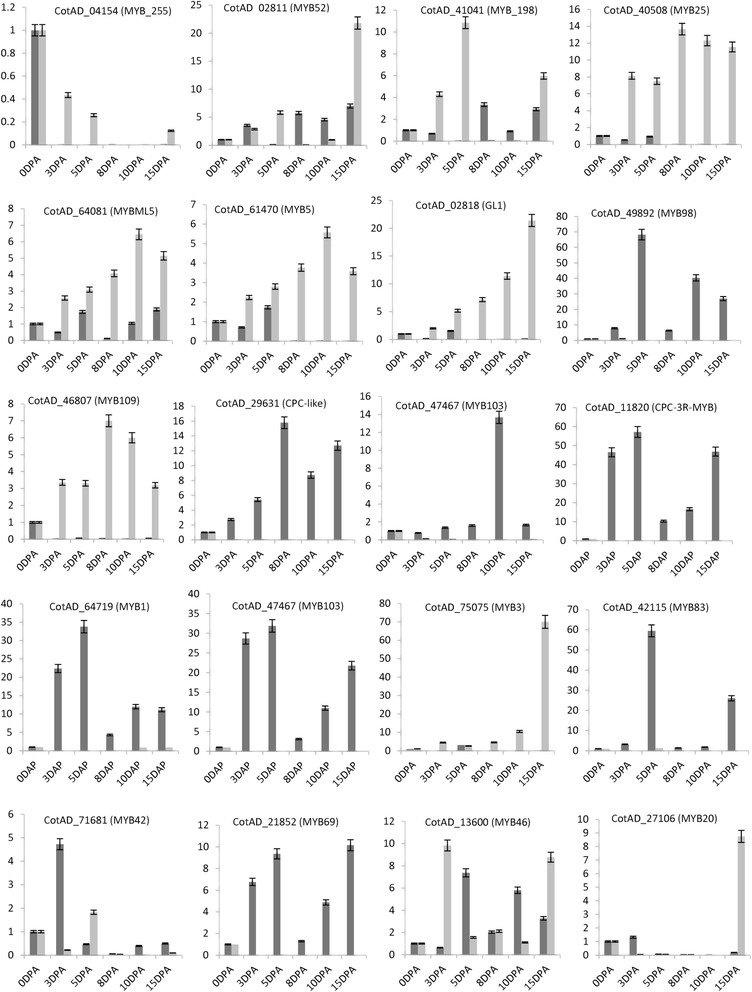
“In addition, MYB109 and CotAD_02818 (GL1) promoted cotton fiber development [29].”
BackgroundResultInfluentialEvolutionary and comparative analysis of MYB and bHLH plant transcription factors
Feller, A., Machemer, K., Braun, E. L., & Grotewold, E. (2011) · The Plant Journal · doi:10.1111/j.1365-313x.2010.04459.x · Cited by 1,348 · cited 1×
“This result was similar to Stracke and Dubos who suggested that if MYB genes from the same subgroup share similar protein motifs they probably share similar functions [8, 46].”
Result
Cited by
Items 101–151 of 151
He, L., Yuan, C., Cui, B., Wang, L., Zhang, S., Li, C., Li, J., Anwar, A., & Gao, J. (2024) · Frontiers in Plant Science · doi:10.3389/fpls.2024.1388924 · Cited by 6
“2R-MYB is the most prevalent type in plants (Katiyar et al., 2012; Salih et al., 2016).”
BackgroundShrestha, A., Shim, J., Mangat, P. K., Dhaliwal, L. K., Sweeney, M. E., & Angeles‐Shim, R. B. (2024) · International Journal of Molecular Sciences · doi:10.3390/ijms25137080 · Cited by 4
“The candidate genes represent a broad family of transcription factors with gene redundancies across the cotton genome [38,39].”
BackgroundHsu, C.-Y., Arick, M. A., Miao, Q., Saha, S., Jenkins, J. N., Sobitjonovich, A. M., Abdurakhmonov, I. Y., Peterson, D. G., & Ma, D.-P. (2018) · American Journal of Plant Sciences · doi:10.4236/ajps.2018.96098 · Cited by 5
Wang, F., & Li, X. (2017) · Genes & Genomics · doi:10.1007/s13258-017-0579-7 · Cited by 4
Salinity induced stress in wheat
Ilyas, M., Ahad, A., Batool, T. S., Jabbar, W., Ejaz, M., Gul, A., & Öztürk, M. (2022) · Journal of Cereal Research · doi:10.25174/2582-2675/2022/126891 · Cited by 3
Niyitanga, S., He, Q., Li, H., Wei, H., Ishimwe, C., Qi, J., Fang, P., Xu, J., Tao, A., & Zhang, L. (2023) · Industrial Crops and Products · doi:10.1016/j.indcrop.2023.116539 · Cited by 3
Shen, J., Cai, Z., Chen, S., Wang, D., & Wu, Z. (2021) · Ecological Genetics and Genomics · doi:10.1016/j.egg.2021.100093 · Cited by 3
Molecular markers that make energy cane differ from sugarcane cultivars (Saccharum spp.)
Benez, M. M., Maranho, R. C., Neto, H. Z., Mangolin, C. A., da Silva, J. C., & Machado, M. D. F. P. D. S. (2024) · Plant Gene · doi:10.1016/j.plgene.2024.100465 · Cited by 2
Enhanced abiotic stress tolerance in Arabidopsis overexpressing Ricinus communis FeSOD8 (RcFeSOD8)
Júnior, J. L. O., Neto, V. G., Santos, I. D., Soares, P. H. O. W., Rezende, N. T., dos Santos, A. N. C., de Almeida, C. P., Venâncio, T., Ferreira, A. G., ribeiro, P. R. R., et al. (2025) · Plant Physiology and Biochemistry · doi:10.1016/j.plaphy.2025.110370 · Cited by 4
Basharat, S., Saeed, W., Liu, P., & Waseem, M. (2025) · BMC Plant Biology · doi:10.1186/s12870-025-07336-6 · Cited by 2
“The Ka/Ks ratio is commonly used to assess the evolutionary dynamics of gene duplication following divergence from ancestral genes [21].”
Hormonal and ROS signaling networks governing stomatal dynamics and drought tolerance in cotton
Shahzad, M., Naeem, M., Manan, A., Hu, K., & Wang, Y. (2026) · Journal of Cotton Research · doi:10.1186/s42397-026-00270-4 · Cited by 3
“Overexpression of the GhEXLB2 helps against drought stress (Zhang et al. 2021) A positive role in drought tolerance (Salih et al. 2016)”
Ni, Y., Cui, Z., Zhang, Z., Chen, H., & Zhou, S. (2023) · Materials Express · doi:10.1166/mex.2023.2366 · Cited by 2
Xie, N., Guo, Q., Liao, M., Xiao, Y., Fu, C. H., & An, Y. (2025) · Plant Cell Tissue and Organ Culture (PCTOC) · doi:10.1007/s11240-025-02981-z · Cited by 2
“…MYB genes has been characterized, with the MYB gene family being identified across various plant species, such as Nicotiana benthami-ana (453 MYBs) (Salih et al. 2016), Chrysanthemum nan-kingense (324 MYBs) (Ai et al. 2023 ), potato (158 MYBs) (Sun et al. 2019 ), cassva (299 MYBs) (Ruan et al.…”
Yu, S., Wang, Y., Ren, W., Fang, Y. V., Wang, L., Zhang, Y., Song, C., & Luo, X. (2025) · Frontiers in Plant Science · doi:10.3389/fpls.2025.1536866 · Cited by 2
Chen, C., Zhao, W., Li, X., Wen, K., Zi, Y., Zhao, K., Chen, D., Zhang, H., & Liu, X. (2025) · Acta Physiologiae Plantarum · doi:10.1007/s11738-025-03819-z · Cited by 2
“Many families of MYB TFs have been identified and analyzed in detail; for example, 158 StMYB (Sun et al. 2019), 524 GhMYB (Salih et al. 2016), 155 OsMYB (Katiyar et al. 2012), and 55 CsMYB (Li et al. 2012) TFs have been identified from Solanum tuberosum , Gossypium hirsutum , O. sativa , and Cucumis sativus.”
PhMYB37 Promotes Shoot Branching in Petunia
Dong, L., Yang, T., Gao, D., Wang, T., & Deng, X. (2022) · Genes · doi:10.3390/genes13112064 · Cited by 2
“MYBs are one of the most prevalent family transcription factors in plants and they play a role in several processes that occur within plant cells, including secondary metabolism, hormone signaling, environmental stress, cell development, and organ growth [2].”
BackgroundCotton Genomes Are Sequenced Due to Their Economic and Agriculture Importance
Pan, Y., Meng, F., & Wang, X. (2021) · Springer eBooks · doi:10.1007/978-3-030-64504-5_4 · Cited by 1
Srivastava, S., Gupta, K., Yadav, K., Yadav, M. K., & Yadav, D. (2022) · Elsevier eBooks · doi:10.1016/b978-0-323-89778-5.00036-2 · Cited by 1
Plant MicroRNAs: Recent Advances in Their Roles Under Stress Conditions
Nayak, J., Pattnaik, S., Dweh, T. J., Kayastha, S., Sahoo, J. P., Mahapatra, M., & Pradhan, M. (2025) · CABI climate change series. · doi:10.1079/9781800626102.0025 · Cited by 1
Recent advances in genetic control of fiber length in upland cotton
Li, G., Wang, T., Yao, S., Yán, H., Gōng, J., Yuán, Y., & Shāng, H. (2026) · Journal of Integrative Plant Biology · doi:10.1111/jipb.70213 · Cited by 1
Hamid, R., Ghorbanzadeh, Z., & Panahi, B. (2026) · Plant Stress · doi:10.1016/j.stress.2026.101501 · Cited by 2
Wang, D., Liu, X., Wang, Z.-N., Li, H.-Y., Tan, X., Xia, Y., & Yang, N. (2026) · Food & medicine homology. · doi:10.26599/fmh.2027.9420145 · Cited by 3
Abiotic stress tolerance in wheat with emphasis on drought
Ahad, A., Arshad, M., Ahmad, N., Ilyas, M., Batool, T. S., Ejaz, M., Gul, A., & Öztürk, M. (2022) · Journal of Cereal Research · doi:10.25174/2582-2675/2022/126890 · Cited by 2
Xiāo, X., Liu, R., Wang, Y., Gōng, J., Li, P., Gǒng, W., Yang, R., Liú, À., Gě, Q., Zhang, H., et al. (2024) · Industrial Crops and Products · doi:10.1016/j.indcrop.2024.119093 · Cited by 1
Nazir, M. F., He, S., Ahmed, H., Sarfraz, Z., Jia, Y., Li, H., Sun, G., Iqbal, M. S., Pan, Z., & Du, X. (2020) · bioRxiv (Cold Spring Harbor Laboratory) · doi:10.1101/2020.09.03.280800 · Cited by 1
Self-citationTranscriptional Regulation of Cold Stress Tolerance in Plants. Present Status and Future ProspectsPreprint
Wani, S. H., Gupta, K., Razzaq, A., Reyes, V. P., Dubey, N. K., Panigrahi, J., Kumar, A., Kaur, S., Kumar, A., Choudhir, G., et al. (2022) · Research Square · doi:10.21203/rs.3.rs-1985628/v1 · Cited by 1
He, L., Yuan, C., Cui, B., Wang, L., Zhang, S., Li, C., Li, J., Anwar, A., & Gao, J. (2023) · Preprints.org · doi:10.20944/preprints202308.1324.v1 · Cited by 1
Importance of small RNA in plant metabolism
Zaid, A., & Wani, S. H. (2020) · Elsevier eBooks · doi:10.1016/b978-0-12-817112-7.00007-9
Lu, X., Lu, Y., & Lin, Y. (2019) · Research Square · doi:10.21203/rs.2.10939/v1
“For instance, a total of 1986 MYB and MYB-related putative proteins were identified in Gossypium hirsutum genome [80].”
BackgroundRahman, S. U., Shehzad, M., Qin, A., Zain, M., Shahzad, S. M., Ansari, M. J., & Alharbi, S. A. (2023) · Agronomy Journal · doi:10.1002/agj2.21512
Liu, T., Chen, T., Kan, J., Yao, Y., Guo, D., Yang, Y., Ling, X., Wang, J., & Zhang, B. (2024) · doi:10.22541/au.170665988.82621761/v1
Wang, X., Zhao, S., Zhou, R., Liu, Y., Guo, L., & Hu, H. (2023) · Figshare · doi:10.6084/m9.figshare.23208043
Wang, X., Zhao, S., Zhou, R., Liu, Y., Guo, L., & Hu, H.-L. (2023) · Figshare · doi:10.6084/m9.figshare.23208055
Wang, X., Zhao, S., Zhou, R., Liu, Y., Guo, L., & Hu, H. (2023) · Figshare · doi:10.6084/m9.figshare.23208040
Wang, X., Zhao, S., Zhou, R., Liu, Y., Guo, L., & Hu, H.-L. (2023) · Figshare · doi:10.6084/m9.figshare.23208037
Wang, X., Zhao, S., Zhou, R., Liu, Y., Guo, L., & Hu, H. (2023) · Figshare · doi:10.6084/m9.figshare.23208049
Wang, X., Zhao, S., Zhou, R., Liu, Y., Guo, L., & Hu, H. (2023) · Figshare · doi:10.6084/m9.figshare.23208064
Wang, X., Zhao, S., Zhou, R., Liu, Y., Guo, L., & Hu, H. (2023) · Figshare · doi:10.6084/m9.figshare.23208052
Wang, X., Zhao, S., Zhou, R., Liu, Y., Guo, L., & Hu, H. (2023) · Figshare · doi:10.6084/m9.figshare.23208067
Wang, X., Zhao, S., Zhou, R., Liu, Y., Guo, L., & Hu, H. (2023) · Figshare · doi:10.6084/m9.figshare.23208061
Wang, X., Zhao, S., Zhou, R., Liu, Y., Guo, L., & Hu, H. (2023) · Figshare · doi:10.6084/m9.figshare.23208058
Ma, X., Zhu, P., Ye, W., Yi, C., Tang, X., Liang, J., Wei, Z., Song, Q., Zhou, H., & Tang, S. (2026) · Plant Direct · doi:10.1002/pld3.70131
“The number of MYB genes detected in A. het-erophyllus was lower than that in Stevia rebaudiana (374) (Chen et al. 2024) and Gossypium hirsutum (524) (Salih et al. 2016) and higher than that in S. rebaudiana (127) (Chen et al. 2024) and Pyrus bretschneideri (231) (Li et al. 2016).”
Noor, U. E. A., Shaban, M., Azmat, M. A., Arshad, S., Hafeez, A., & Javed, K. (2026) · Biologia · doi:10.1007/s11756-026-02278-2
“Comparable duplication patterns are also documented for WRKY and MYB gene families in cotton (Ding et al. 2015; Salih et al. 2016).”
Metadata
- Authors
- Salih, H., Gong, W., He, S., Sun, G., Sun, J., & Du, X.
- Affiliations
- Huazhong Agricultural University (CN)
- Chinese Academy of Agricultural Sciences (CN)
- Anyang Institute of Technology (CN)
- Corresponding author
- Sun, Junling
- Du, Xiongming
- Venue
- BMC Genetics
- Published
- 2016-09-09
- Volume
- 17
- Issue
- 1
- Pages
- 129-129
- ISSN
- 1471-2156 (ISSN-L)
- PMC
- PMC5017022
- OpenAlex
- W2512789814
- Cited by
- 146
- References
- 61
- Citations by year
- 2026: 6 · 2025: 12 · 2024: 10 · 2023: 22 · 2022: 18 · 2021: 19 · 2020: 13 · 2019: 22 · 2018: 13 · 2017: 11
- FWCI
- 17.92
- Type
- journal article
- Language
- en
- Open access
- gold
- doi.org
- Licence
- cc-by
- Locations
- BMC Genetics (publishedVersion, cc-by)
- PubMed Central (publishedVersion, cc-by)
- PubMed (publishedVersion)
- Funders
- China Scholarship Council
- National Science and Technology Program during the Twelfth Five-year Plan Period
- Topics
- Life Sciences › Agricultural and Biological Sciences › Plant Science › Research in Cotton Cultivation
- Life Sciences › Biochemistry, Genetics and Molecular Biology › Molecular Biology › Plant Gene Expression Analysis
- Life Sciences › Agricultural and Biological Sciences › Plant Science › Plant Molecular Biology Research
- Keywords
- MYB transcription factors, Gossypium hirsutum, cotton fiber development, phylogenetic classification, gene family evolution, comparative genomics, gene expression
- MeSH terms
- Chromosome Mapping, Gossypium, Multigene Family, Phylogeny, Plant Proteins, Transcription Factors, Conserved Sequence, Gene Expression Regulation, Plant, Genome, Plant, Computational Biology, Proto-Oncogene Proteins c-myb, Gene Expression Profiling, Genomics, Databases, Nucleic Acid, Cotton Fiber, Genome-Wide Association Study, Genetic Association Studies, Molecular Sequence Annotation, High-Throughput Nucleotide Sequencing, Nucleotide Motifs
About these checks
Registry, retraction, Cites and statistics results are computed, not judged, with one exception: a printed reference that no index lists is read once by a model before it counts as a citation error. Claims are extracted by a model and kept only when their quote appears verbatim in the text; each cited source is then checked, with a model’s help, for whether it says what the claim relies on. Those verdicts can be wrong — read the claim’s quote and the cited source before relying on one.
Statistics and arithmetic are recomputed, not judged.
Confidence bands are shown only for fields calibrated on our annotated test set. None is calibrated yet, so no band is shown.
What counts as a claim ›How we measure confidence ›How we check this ›
Are you an author, or do you see a problem with this page? Request a review
Data sources
Bibliographic data: Semantic Scholar, OpenAlex, Crossref.
Contains information from the Semantic Scholar Academic Graph Datasets, made available under the ODC Attribution License (ODC-BY 1.0).
Semantic Scholar’s data is described in: Kinney, R., et al. (2023). The Semantic Scholar Open Data Platform. arXiv:2301.10140.
