

The DOI matches its Crossref record; 22 of the 23 references it cites were found in a registry or an index; none of the 38 sources its claims cite is checked for support yet.
The medieval Mongolian roots of Y-chromosomal lineages from South Kazakhstan
Open accessAbstract
Background: The majority of the Kazakhs from South Kazakhstan belongs to the 12 clans of the Senior Zhuz. According to traditional genealogy, nine of these clans have a common ancestor and constitute the Uissun tribe. There are three main hypotheses of the clans’ origin, namely, origin from early Wusuns, from Niru’un Mongols, or from Darligin Mongols. We genotyped 490 samples of South Kazakhs by 35 Y-chromosomal SNPs (single nucleotide polymorphism) and 17 STRs (short tandem repeat). Additionally, 133 samples from citizen science projects were included into the study. Results: We found that three Uissun clans have unique Y-chromosomal profiles, but the remaining six Uissun clans and one non-Uissun clan share a common paternal gene pool. They share a high frequency (> 40%) of the C2*-ST haplogroup (marked by the SNP F3796), which is associated with the early Niru’un Mongols. Phylogenetic analysis of this haplogroup carried out on 743 individuals from 25 populations of Eurasia has revealed a set of haplotype clusters, three of which contain the Uissun haplotypes. The demographic expansion of these clusters dates back to the 13-fourteenth century, coinciding with the time of the Uissun’s ancestor Maiky-biy known from historical sources. In addition, it coincides with the expansion period of the Mongol Empire in the Late Middle Ages. A comparison of the results with published aDNA (ancient deoxyribonucleic acid) data and modern Y haplogroups frequencies suggest an origin of Uissuns from Niru’un Mongols rather than from Wusuns or Darligin Mongols. Conclusions: The Y-chromosomal variation in South Kazakh clans indicates their common origin in 13th–14th centuries AD, in agreement with the traditional genealogy. Though genetically there were at least three ancestral lineages instead of the traditional single ancestor. The majority of the Y-chromosomal lineages of South Kazakhstan was brought by the migration of the population related to the medieval Niru’un Mongols.
Overview
CoChat Summary
Written by AI from the paper’s full text.
TL;DR
Y-chromosomal analysis of South Kazakh clans supports a common paternal origin in the 13th–14th centuries AD, largely from medieval Niru’un Mongols rather than early Wusuns or Darligin Mongols. The traditional single-ancestor genealogy is only partly reproduced: most Uissun and one non-Uissun clan share a C2*-ST/F3796 gene pool, but at least three ancestral lineages are genetically evident.
Key findings
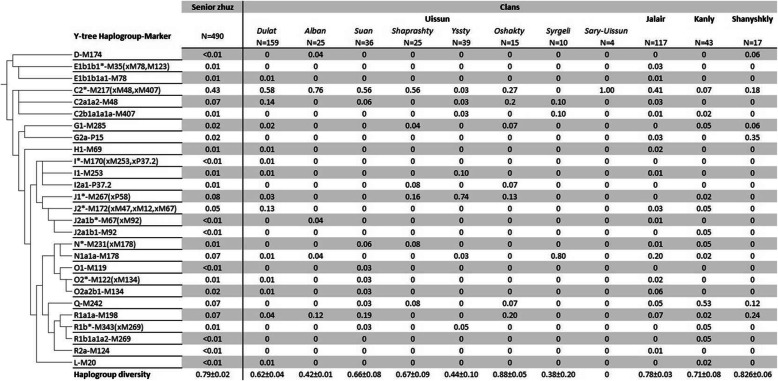
- Among 490 South Kazakh males from 11 clans, 51% of the Y-chromosomal gene pool belonged to three C2 clades; other common haplogroups were J-M172 (13%), N1a1a-M178 (7%), Q-M242 (7%), and R1a1a-M198 (7%).
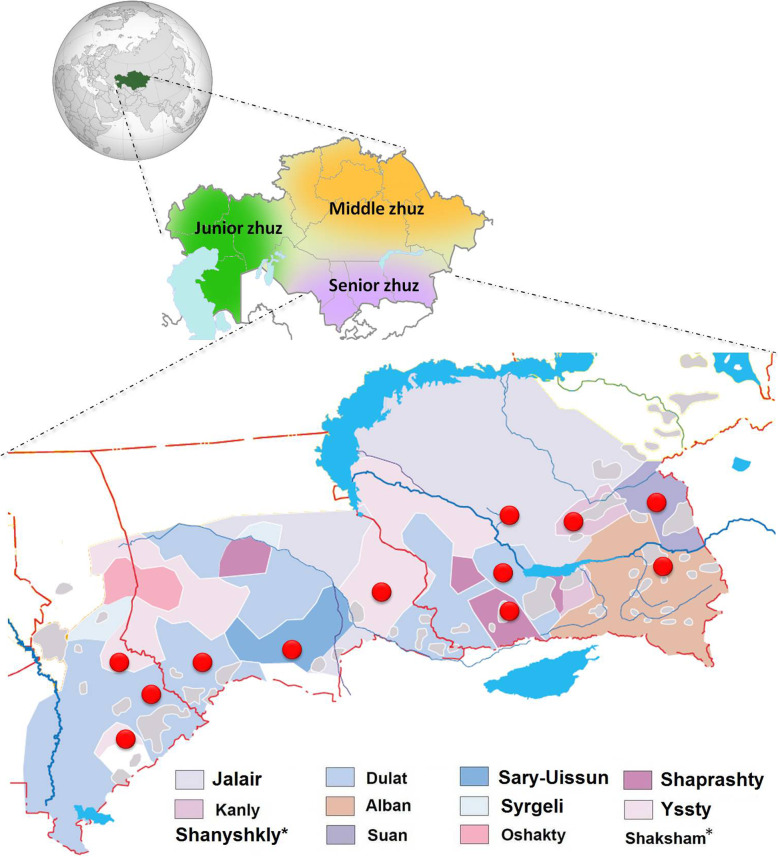
- Six Uissun clans and the non-Uissun Jalair clan shared a common paternal gene pool with high frequency (>40%) of C2*-ST (F3796), while three Uissun clans had unique profiles: Syrgeli was 80% N1a1a-M178, Yssty was 74% J1*-M267(xP58), and Oshakty was genetically specific.
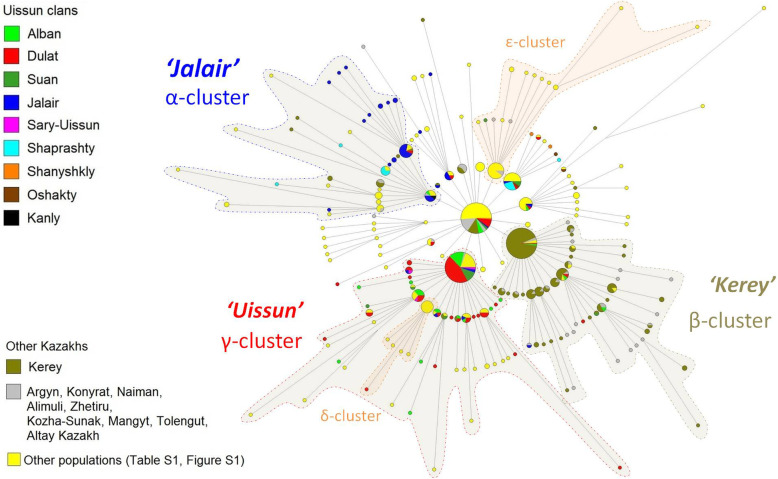
- Phylogenetic analysis of C2*-ST used 743 individuals from 25 Eurasian populations and found five clusters; South Kazakh samples fell mainly into α (N=44), γ (N=122), and β (N=9). Cluster ages were α 746 years (CI 95% 1104–388), γ 742 years (CI 95% 916–568), and β 701 years (CI 95% 909–493), coinciding with the Mongol Empire expansion and the proposed Uissun ancestor Maiky-biy.
- The downstream subbranch Y12782 was most frequent among South Kazakh F3796 samples (76%), especially Alban, Dulat, and Suan, with an absolute frequency of 31% in the Uissun tribe; most Zhalaiir (82%) belonged to the F5481 branch.
Methods
- Blood samples from Kazakh males were collected in Kazakhstan in 2009, 2010, and 2014; 490 samples from 11 South Kazakh clans were genotyped for 35 Y-chromosomal SNPs and 17 Y-STRs, with 133 additional Senior Zhuz samples from citizen science databases analyzed for discussion.
- SNP genotyping used TaqMan assays on the 7900HT Real-Time PCR System; Y-STR fragment analysis used the Y-filer PCR Amplification Kit on ABI 3130xl and 3500xl analyzers.
- Phylogenetic networks were built in Network 5/Network Publisher excluding DYS385a/b, using 549 previously published C2*-ST samples from 25 populations; cluster ages used the rho-statistic with a mutation rate of 2.1 × 10⁻³ per STR per generation and a 30-year generation time.
Limitations
- The paper states that no sequences of extended Y-chromosome sections were available for the γ-cluster, and the SNP marker defining this subclade has not yet been determined; it also calls for future full Y-chromosome sequencing, SNP typing for Y12782 and F8949, and ancient DNA comparisons with proto-Mongols and early Wusun people.
- The paper notes that sample sizes for four clans were small (N < 20), and that citizen science data for the Shanyshkly clan were contradictory: citizen projects detected high C2*, while the present study found only 18% C2* and 36% G2-P15.
- The text makes evident a dating discrepancy: C2*-ST TMRCA was 1544 years by STRs (CI 95% 1968–1120) but ~2600 years by SNPs, which the authors attribute to incomplete mapping of STR clusters and phylogenetic topology.
Model-written summary. Check it against the paper before relying on it.
Integrity signals
Registry
Cites
Statistics
Figures
Verification
Claims the paper makes
40 Own result · 18 Not checked yet · 10 Own interpretation · 4 Check pending · 4 No full text of the sources · 1 Sources not found · 1 Own method
A result the paper reports from its own data — it cites no other source for it, so there is none to check. The quote shows it is in the paper.
In the paper
“A single cluster for seven clans (Sary-Uissun, Dulat, Alban, Suan, Shaprashty, Oshakty and Jalair) is highlighted on the MDS chart (Additional file 5).”
§ The medieval Mongolian roots of Y-chromosomal lineages from South Kazakhstan > Results and discussion > Genetic structuring of the paternal gene pool of Uissun
plain- Asserted: passes — The authors put it forward as true.
- Checkable: passes — It can be checked against evidence.
- Load-bearing: passes — The paper’s conclusions depend on it.
- Based: passes — The paper gives a reason why it holds.
A result the paper reports from its own data — it cites no other source for it, so there is none to check. The quote shows it is in the paper.
In the paper
“Twenty-seven Y-chromosomal haplogroups were identified in this sample (Fig. 2, Additional file 2).”
§ The medieval Mongolian roots of Y-chromosomal lineages from South Kazakhstan > Results and discussion > Paternal genetic portraits of south Kazakh clans
plainn = 490- Asserted: passes — The authors put it forward as true.
- Checkable: passes — It can be checked against evidence.
- Load-bearing: unclear — It is unclear whether the paper’s conclusions depend on it.
- Based: passes — The paper gives a reason why it holds.
A result the paper reports from its own data — it cites no other source for it, so there is none to check. The quote shows it is in the paper.
In the paper
“For the two remaining non-Uissun clans, the major haplogroups are Q-M242 (53% of the Kanly clan) and G2-P15 (35% of the Shanyshkly clan).”
§ The medieval Mongolian roots of Y-chromosomal lineages from South Kazakhstan > Results and discussion > Paternal genetic portraits of south Kazakh clans
plain- Asserted: passes — The authors put it forward as true.
- Checkable: passes — It can be checked against evidence.
- Load-bearing: unclear — It is unclear whether the paper’s conclusions depend on it.
- Based: passes — The paper gives a reason why it holds.
A result the paper reports from its own data — it cites no other source for it, so there is none to check. The quote shows it is in the paper.
In the paper
“For the two remaining Uissun clans, the major haplogroups are N1a1a-M178 (80% of the Syrgeli clan) and J1*-M267(xP58) (74% of the Yssty clan).”
§ The medieval Mongolian roots of Y-chromosomal lineages from South Kazakhstan > Results and discussion > Paternal genetic portraits of south Kazakh clans
plain- Asserted: passes — The authors put it forward as true.
- Checkable: passes — It can be checked against evidence.
- Load-bearing: unclear — It is unclear whether the paper’s conclusions depend on it.
- Based: passes — The paper gives a reason why it holds.
A result the paper reports from its own data — it cites no other source for it, so there is none to check. The quote shows it is in the paper.
In the paper
“For most clans of South Kazakhstan, the haplogroup C2-M217 (xM48, M407) is a major one.”
§ The medieval Mongolian roots of Y-chromosomal lineages from South Kazakhstan > Results and discussion > Paternal genetic portraits of south Kazakh clans
plainn = 490- Asserted: passes — The authors put it forward as true.
- Checkable: passes — It can be checked against evidence.
- Load-bearing: passes — The paper’s conclusions depend on it.
- Based: passes — The paper gives a reason why it holds.
- It may state two separate claims as one. 35
- Probably not a substantial claim. 10
Create a free account to see these claims.
Create a free account to see these assumptions.
35 more claims
Create a free account to see all 78 claims and to verify the 30 references still open.
Claims other papers make about this one
Each is checked against this paper’s own text: does it say what the citing paper says it does?
In the citing paper
“The Kongyrat tribe has a significant prevalence of the C2-M407 branch, which accounts for 86% of the population [38].”
From Y-Chromosomal insights into the paternal genealogy of the Kerey tribe have called into question their descent from the Stepfather of Genghis Khan (2024) · cites this paper as [38]
In the citing paper
“The Sirgeli tribe exhibits a high prevalence (71%) of the N-M231 Y-chromosome haplogroup [9,38].”
From Y-Chromosomal insights into the paternal genealogy of the Kerey tribe have called into question their descent from the Stepfather of Genghis Khan (2024) · cites this paper as [38]
In the citing paper
“It was observed that the C2-Y12782 lineage had a rather high frequency of occurrence throughout the Uissun tribe, accounting for around 31% of the population [38].”
From Y-Chromosomal insights into the paternal genealogy of the Kerey tribe have called into question their descent from the Stepfather of Genghis Khan (2024) · cites this paper as [38]
Self-check
Percentages, sums and reported differences re-computed from the paper’s own numbers.
Each contradiction between two passages listed here was confirmed by an independent check.
Rated major: it would touch a result — a value a result rests on, reported and recomputed p-values on opposite sides of the significance level, two passages that conflict with no sign which is right, or a cited work retracted before this paper was published.
In the paper
§ The medieval Mongolian roots of Y-chromosomal lineages from South Kazakhstan > Conclusions
“In particular, SNP typing for Y12782 subclades (“Uissun” α-cluster), F8949 (“Kerey” β-cluster) and SNP subclade detection for the Jalair γ-cluster”
§ The medieval Mongolian roots of Y-chromosomal lineages from South Kazakhstan > Results and discussion > Phylogenetic analysis of haplogroup С2*-F3796
“The α-cluster (dated 746 CI 95% 1104–388 years) was mainly composed of the the (non-Uissun) Jalair clan members. The γ-cluster (dating 742 CI 95% 916–568 years), which we called “Uissun” cluster, mainly included representatives of the four Uissun clans, namely, Dulat, Alban, Suan, and Sary-Uissun (Fig. 3).”
Rated minor: it would not touch a result — a value no result rests on, a p-value that stays on the same side of the significance level, or a conflict that is clerical, resolved elsewhere in the paper, or outside its own findings.
In the paper
§ The medieval Mongolian roots of Y-chromosomal lineages from South Kazakhstan > Results and discussion > Genetic structuring of the paternal gene pool of Uissun
“The genetic portraits of the three Uissun clans (Yssty, Syrgeli, and Oshakty) are very specific (Fig. 2)”
§ The medieval Mongolian roots of Y-chromosomal lineages from South Kazakhstan > Conclusions
“The results indicated the genetic similarity of the six Uissun and one non-Uissun clans to each other, while the other four clans (two Uissun and two non-Uissun clans) have the specific paternal pools.”
Citations
Cites
Mitochondrial portraits of human populations using median networks.
Bandelt, H. J., Forster, P., Sykes, B. C., & Richards, M. B. (1995) · Genetics · doi:10.1093/genetics/141.2.743 · Cited by 1,071
The Genetic Legacy of the Mongols
Zerjal, T., Xue, Y., Bertorelle, G., Wells, R. S., Bao, W., Zhu, S., Qamar, R., Ayub, Q., Mohyuddin, A., Fu, S., et al. (2003) · The American Journal of Human Genetics · doi:10.1086/367774 · Cited by 563
Fenner, J. N. (2005) · American Journal of Physical Anthropology · doi:10.1002/ajpa.20188 · Cited by 508
A recent bottleneck of Y chromosome diversity coincides with a global change in culture
Karmin, M., Saag, L., Vicente, M., Sayres, M. A. W., Järve, M., Talas, U. G., Rootsi, S., Ilumäe, A.-M., Mägi, R., Mitt, M., et al. (2015) · Genome Research · doi:10.1101/gr.186684.114 · Cited by 485
Self-citation137 ancient human genomes from across the Eurasian steppes
Damgaard, P. D. B., Marchi, N., Rasmussen, S., Peyrot, M., Renaud, G., Korneliussen, T., Moreno-Mayar, J. V., Pedersen, M. W., Goldberg, A., Usmanova, E., et al. (2018) · Nature · doi:10.1038/s41586-018-0094-2 · Cited by 457
The first horse herders and the impact of early Bronze Age steppe expansions into Asia
de Barros Damgaard, P., Martiniano, R., Kamm, J., Moreno-Mayar, J. V., Kroonen, G., Peyrot, M., Barjamovic, G., Rasmussen, S., Zacho, C., Baimukhanov, N., et al. (2018) · Science · doi:10.1126/science.aar7711 · Cited by 370
In Search of the Indo-Europeans; Language, Archaeology and Myth
Sherratt, A. G., & Mallory, J. P. (1990) · Journal of Field Archaeology · doi:10.2307/530396 · Cited by 276
Two Sources of the Russian Patrilineal Heritage in Their Eurasian Context
Balanovsky, O. P., Rootsi, S., Pshenichnov, A., Kivisild, T., Churnosov, M. I., Evseeva, I., Pocheshkhova, E., Boldyreva, M. N., Yankovsky, N. K., Balanovska, E. V., et al. (2008) · The American Journal of Human Genetics · doi:10.1016/j.ajhg.2007.09.019 · Cited by 177
Self-citationThe phylogenetic and geographic structure of Y-chromosome haplogroup R1a
Underhill, P. A., Poznik, G. D., Rootsi, S., Järve, M., Lin, A. A., Wang, J., Passarelli, B., Kanbar, J., Myres, N. M., King, R. J., et al. (2015) · European Journal of Human Genetics · doi:10.1038/ejhg.2014.50 · Cited by 151
Self-citationAfghan Hindu Kush: Where Eurasian Sub-Continent Gene Flows Converge
Di Cristofaro, J., Pennarun, E., Mazières, S., Myres, N. M., Lin, A. A., Temori, S. A., Metspalu, M., Metspalu, E., Witzel, M., King, R. J., et al. (2013) · PLoS ONE · doi:10.1371/journal.pone.0076748 · Cited by 100
Mutation rates at Y chromosome short tandem repeats in Texas populations
Ge, J., Budowle, B., Aranda, X. G., Planz, J. V., Eisenberg, A. J., & Chakraborty, R. (2009) · Forensic Science International Genetics · doi:10.1016/j.fsigen.2009.01.007 · Cited by 92
Li, C., Li, H., Cui, Y., Xie, C., Cai, D., Li, W., Mair, V. H., Xu, Z., Zhang, Q., Abuduresule, I., et al. (2010) · BMC Biology · doi:10.1186/1741-7007-8-15 · Cited by 91
Wei, L.-H., Yan, S., Lu, Y., Wen, S.-Q., Huang, Y.-Z., Wang, L.-X., Li, S.-L., Yang, Y.-J., Wang, X.-F., Zhang, C., et al. (2018) · European Journal of Human Genetics · doi:10.1038/s41431-017-0012-3 · Cited by 57
Self-citationAbilev, S., Malyarchuk, B., Derenko, M., Wozniak, M., Grzybowski, T., & Zakharov, I. (2012) · Human Biology · doi:10.3378/027.084.0106 · Cited by 56
Phylogeography of the Y‐chromosome haplogroup C in northern Eurasia
Malyarchuk, B., Derenko, M., Denisova, G., Wozniak, M., Grzybowski, T., Dambueva, I., & Zakharov, I. (2010) · Annals of Human Genetics · doi:10.1111/j.1469-1809.2010.00601.x · Cited by 48
Afghanistan's Ethnic Groups Share a Y-Chromosomal Heritage Structured by Historical Events
Haber, M., Platt, D. E., Ashrafian Bonab, M., Youhanna, S. C., Soria-Hernanz, D. F., Martínez-Cruz, B., Douaihy, B., Ghassibe-Sabbagh, M., Rafatpanah, H., Ghanbari, M., et al. (2012) · PLoS ONE · doi:10.1371/journal.pone.0034288 · Cited by 46
Self-citationBalanovska, E. V., Zhabagin, M. K., Agdzhoyan, A. T., Chukhryaeva, M. I., Markina, N. V., Balaganskaya, O. A., Skhalyakho, R. A., Yusupov, Y. M., Utevska, O. M., Bogunov, Y. V., et al. (2016) · Russian Journal of Genetics · doi:10.1134/s1022795416120024 · Cited by 43
Self-citationThe Connection of the Genetic, Cultural and Geographic Landscapes of Transoxiana
Zhabagin, M., Balanovska, E., Sabitov, Z., Kuznetsova, M., Agdzhoyan, A., Balaganskaya, O., Chukhryaeva, M., Markina, N., Romanov, A., Skhalyakho, R., et al. (2017) · Scientific Reports · doi:10.1038/s41598-017-03176-z · Cited by 39
Self-citationZhabagin, M., Sarkytbayeva, A., Tazhigulova, I., Yerezhepov, D., Li, S., Akilzhanov, R., Yeralinov, A., Sabitov, Z., & Akilzhanova, A. (2019) · International Journal of Legal Medicine · doi:10.1007/s00414-018-1859-8 · Cited by 28
Self-citationRectifying long-standing misconceptions about the ρ statistic for molecular dating
Macaulay, V. A., Soares, P. A., & Richards, M. B. (2019) · PLoS ONE · doi:10.1371/journal.pone.0212311 · Cited by 26
Ashirbekov, Y. Y., Khrunin, A. V., Botbayev, D. M., Belkozhaev, A. M., Abaildayev, A. O., Rakhimgozhin, M. B., Mukushkina, D. D., Limborska, S. A., & Aitkhozhina, N. A. (2018) · Molecular Genetics, Microbiology and Virology · doi:10.3103/s0891416818020040 · Cited by 4
(1996) · PubMed Central
Research works printed but not linked: 7
- Sobakin A. Atameken atlas. Almaty: Brif Research Group; 1999. p. 1.
- Tiesenhausen VG. Collection of materials related to the history of the Golden Horde. Volume 2. Extracts from Persian works collected by Tizengauzen VG and edited by Romaskevich AA and Volin SL. Moscow-Leningdar: Publishing House of the Academy of Sciences of the USSR; 1941. p. 308.
- Massanov NE. Nomadic civilization of Kazakhs: the basics migratory habits of life of society. Almaty: Nurbolat Masanov Fund; 2011. p. 740.
- Tynyshpaev M. Materials on the history of Kyrgyz-kazakh people. Tashkent: Eastern branch of the Kyrgyz State Publishing; 1925. p. 77.
- Rashid Al-Din. Collection of histories. Volume 1. Book 1. Moscow-Leningrad: Publishing House of the Academy of Sciences of the USSR; 1952. p. 191.
- Irmukhanov BB. Uissun and Ethnogenesis of the Kazakh people. Almaty: Our World; 2006. p. 124.
- Sabitov Z, Baimukhanov N. The Niruns and the subclade С2а3-F4002 (the starcluster). Russ J Genet Geneal. 2014;6(2):1–9.
Cited by
Vitamin D Status, VDR, and TLR Polymorphisms and Pulmonary Tuberculosis Epidemiology in Kazakhstan
Yerezhepov, D., Gabdulkayum, A., Akhmetova, A., Kozhamkulov, U. A., Rakhimova, S., Kairov, U., Zhunussova, G., Kalendar, R. N., & Akilzhanova, A. R. (2024) · Nutrients · doi:10.3390/nu16040558 · Cited by 25
Self-citationZhabagin, M., Wei, L.-H., Sabitov, Z., Ma, P.-C., Sun, J., Dyussenova, Z., Balanovska, E., Li, H., & Ramankulov, Y. (2022) · Genes · doi:10.3390/genes13101776 · Cited by 17
Self-citationMedieval Super-Grandfather founder of Western Kazakh Clans from Haplogroup C2a1a2-M48
Zhabagin, M., Sabitov, Z., Tazhigulova, I., Alborova, I., Agdzhoyan, A., Wei, L.-H., Urasin, V., Koshel, S., Mustafin, K., Akilzhanova, A., et al. (2021) · Journal of Human Genetics · doi:10.1038/s10038-021-00901-5 · Cited by 16
Self-citationAshirbekov, Y., Sabitov, Z., Aidarov, B., Abaildayev, A., Junissova, Z., Cherusheva, A., Saidamarova, V. V., Sharipov, K., Ramankulov, Y., & Zhabagin, M. (2022) · Genes · doi:10.3390/genes13101826 · Cited by 15
Self-citationKhussainova, E., Kisselev, I., Iksan, O., Bekmanov, B., Skvortsova, L., Garshin, A., Kuzovleva, E., Zhaniyazov, Z., Zhunussova, G., Musralina, L., et al. (2022) · Frontiers in Genetics · doi:10.3389/fgene.2021.801295 · Cited by 12
Metadata
- Authors
- Zhabagin, M., Sabitov, Z., Tarlykov, P., Tazhigulova, I., Junissova, Z., Yerezhepov, D., Akilzhanov, R., Zholdybayeva, E., Wei, L.-H., Akilzhanova, A., Balanovsky, O., & Balanovska, E.
- Affiliations
- National Center for Biotechnology (KZ)
- L. N. Gumilyov Eurasian National University (KZ)
- Nazarbayev University (KZ)
- Toraighyrov University (KZ)
- Xiamen University (CN)
- Russian Academy of Sciences (RU)
- Research Centre for Medical Genetics (RU)
- Corresponding author
- Zhabagin, Maxat
- ORCID
- Venue
- BMC Genetics
- Published
- 2020-10
- Volume
- 21
- Issue
- S1
- Pages
- 87-87
- ISSN
- 1471-2156 (ISSN-L)
- PMC
- PMC7583311
- OpenAlex
- W3094601959
- Cited by
- 21
- References
- 23
- Citations by year
- 2026: 2 · 2025: 2 · 2024: 4 · 2023: 6 · 2022: 4 · 2021: 2 · 2020: 1
- FWCI
- 1.68
- Type
- journal article
- Language
- en
- Open access
- gold
- doi.org
- Licence
- Locations
- BMC Genetics (publishedVersion, cc-by)
- PubMed (publishedVersion)
- PubMed Central (publishedVersion, cc-by)
- Nazarbayev University Repository (Nazarbayev University) (submittedVersion, other-oa)
- Nazarbayev University Repository (Nazarbayev University) (submittedVersion, cc-by)
- DOAJ (DOAJ: Directory of Open Access Journals) (submittedVersion, cc-by-sa)
- Nazarbayev University Repository (Nazarbayev University) (submittedVersion, cc-by-nc-sa)
- Funders
- Ministry of Education and Science of the Republic of Kazakhstan (AP05134955, AP05130240)
- Russian Ministry of Science and Higher Education
- Russian Scientific Fund (17-14-01345)
- Topics
- Life Sciences › Biochemistry, Genetics and Molecular Biology › Genetics › Forensic and Genetic Research
- Life Sciences › Biochemistry, Genetics and Molecular Biology › Genetics › Genetic diversity and population structure
- Social Sciences › Arts and Humanities › History › Eurasian Exchange Networks
- Keywords
- haplotype phylogeny, citizen science
- MeSH terms
- Ethnicity, Gene Pool, Genetics, Population, Genotype, Haplotypes, Humans, Kazakhstan, Male, Mongolia, Phylogeny, Microsatellite Repeats, Polymorphism, Single Nucleotide, Chromosomes, Human, Y, Asian People
About these checks
Registry, retraction, Cites and statistics results are computed, not judged, with one exception: a printed reference that no index lists is read once by a model before it counts as a citation error. Claims are extracted by a model and kept only when their quote appears verbatim in the text; each cited source is then checked, with a model’s help, for whether it says what the claim relies on. Those verdicts can be wrong — read the claim’s quote and the cited source before relying on one.
A language model drew the claims from the paper on 2026-11-12, under version 3 of the claim definition (model deepseek-v4.1-flash, prompt extract-v3).
A second model labelled each claim on 2026-11-12 (model jev-1.13-20260917, definition revision gold-guideline-v0.2).
Statistics and arithmetic are recomputed, not judged.
Confidence bands are shown only for fields calibrated on our annotated test set. None is calibrated yet, so no band is shown.
What counts as a claim ›How we measure confidence ›How we check this ›
Are you an author, or do you see a problem with this page? Request a review
