

The DOI matches its Crossref record; 2 of the 2 references it cites were found in a registry or an index.
Genetic Polymorphism of 27 Y-STR Loci in the Western Kazakh Tribes from Kazakhstan and Karakalpakstan, Uzbekistan
Abstract
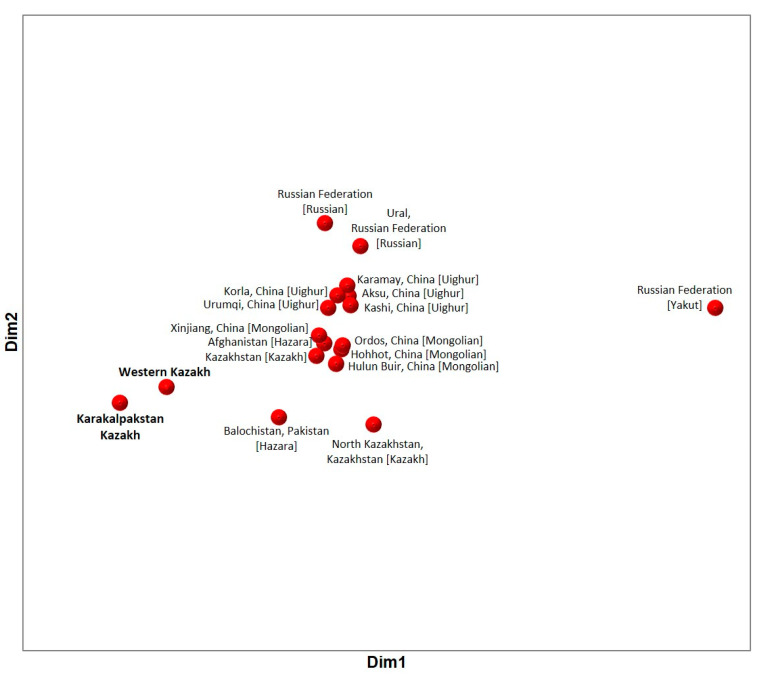
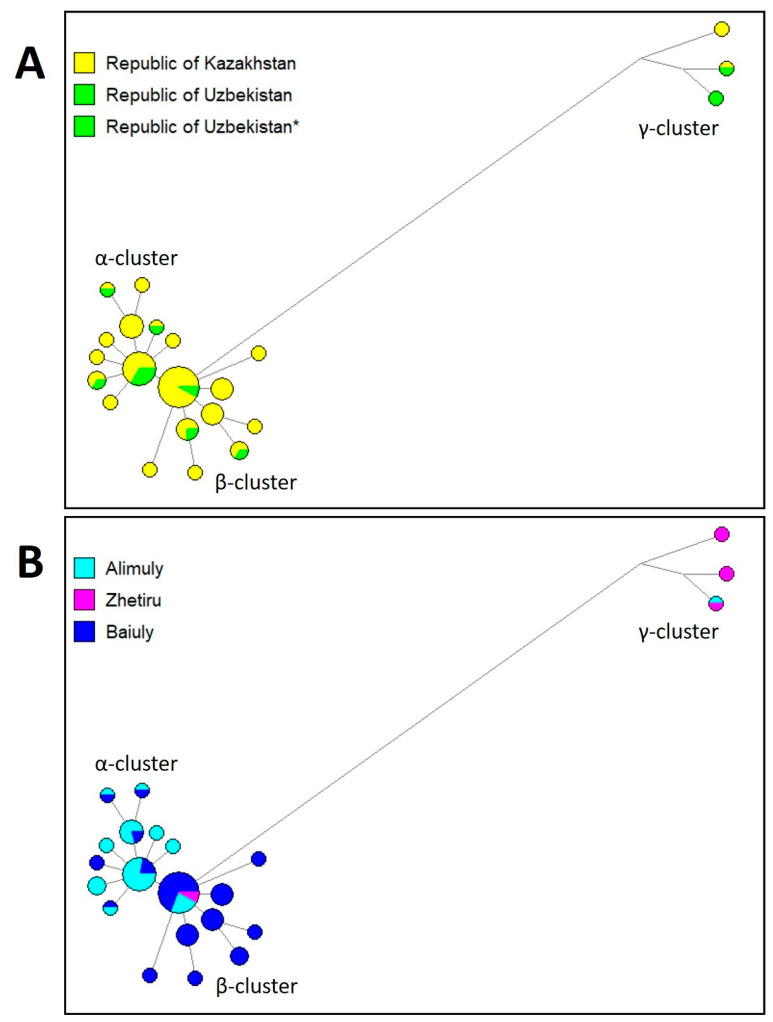
Data on the genetic polymorphism of 27 Y-STR in Kazakhs of the Junior Zhuz has been presented and analyzed in relation to forensic features. A total of 464 representatives of the Western Kazakh tribes of Kazakhstan (Western Kazakhs, n = 405) and Uzbekistan (Karakalpakstan Kazakhs, n = 59) were examined by the Yfiler Plus set. The data are available in the YHRD under accession numbers YA006010 and YA006009. Genetic analysis (AMOVA and MDS) did not show significant differences between the two groups (Kazakhstan and Karakalpakstan Kazakhs) in terms of Y-chromosome diversity. Both groups are characterized by haplogroup C2a1a2 as a founder effect, which dominated two of the three tribes: Alimuly (67%), Baiuly (74.6%), and Zhetiru (25.8%). At the same time, the phylogenetic network for each tribe found its own clusters within C2a1a2. Western Kazakhs and Karakalpakstan Kazakhs present high values of unique haplotypes (84.44% and 96.61%), discrimination capacity (90.37% and 98.30%), and haplotype diversity (0.9991 and 0.9994). A set of 27 Y-STR loci distinguishes closely related individuals within the Western Kazakh tribes quite well. It is suitable for forensic application, and is also optimal for population genetics studies.
Overview
The claims and statistics of this paper haven’t been checked yet.
Run the check — free, no account needed. It reads the open-access text and checks the sources it cites.
Integrity signals
Registry
Cites
Statistics
Figures
Verification
Claims the paper makes
The claims and statistics of this paper haven’t been checked yet.
Run the check — free, no account needed. It reads the open-access text and checks the sources it cites.
Claims other papers make about this one
Each is checked against this paper’s own text: does it say what the citing paper says it does?
In the citing paper
“The total sample includes 1796 Kazakh samples studied for 27 Y-STRs, including in our previous studies [22–25].”
From Genetic polymorphism of Y-chromosome in Kazakh populations from Southern Kazakhstan (2023) · cites this paper as [24]
In the citing paper
“These variants include E-M35, N-M231, and C2-M48.”
From Y-Chromosomal insights into the paternal genealogy of the Kerey tribe have called into question their descent from the Stepfather of Genghis Khan (2024) · cites this paper as [35]
In the citing paper
“Specifically, four individuals have been identified with such variants, [9,35,39].”
From Y-Chromosomal insights into the paternal genealogy of the Kerey tribe have called into question their descent from the Stepfather of Genghis Khan (2024) · cites this paper as [35]
Self-check
Percentages, sums and reported differences re-computed from the paper’s own numbers.
The self-check needs the paper’s full text.
Citations
Cites
The medieval Mongolian roots of Y-chromosomal lineages from South Kazakhstan
Zhabagin, M., Sabitov, Z., Tarlykov, P., Tazhigulova, I., Junissova, Z., Yerezhepov, D., Akilzhanov, R., Zholdybayeva, E., Wei, L.-H., Akilzhanova, A., et al. (2020) · BMC Genetics · doi:10.1186/s12863-020-00897-5 · Cited by 21
Self-citationMedieval Super-Grandfather founder of Western Kazakh Clans from Haplogroup C2a1a2-M48
Zhabagin, M., Sabitov, Z., Tazhigulova, I., Alborova, I., Agdzhoyan, A., Wei, L.-H., Urasin, V., Koshel, S., Mustafin, K., Akilzhanova, A., et al. (2021) · Journal of Human Genetics · doi:10.1038/s10038-021-00901-5 · Cited by 16
Self-citation
Research works printed but not linked: 19
- Roewer, 2019, Y-chromosome short tandem repeats in forensics–Sexing, profiling, and matching male DNA. Wiley Interdiscip, Rev. Forensic Sci., 1, e1336
- Willuweit, 2015, The new Y Chromosome Haplotype Reference Database, Forensic Sci. Int. Genet., 15, 43, 10.1016/j.fsigen.2014.11.024 · DOI
- Roewer, 2020, DNA commission of the International Society of Forensic Genetics (ISFG): Recommendations on the interpretation of Y-STR results in forensic analysis, Forensic Sci. Int. Genet., 48, 102308, 10.1016/j.fsigen.2020.102308 · DOI
- Pamjav, 2015, Testing Central and Inner Asian admixture among contemporary Hungarians, Forensic Sci. Int. Genet., 15, 121, 10.1016/j.fsigen.2014.11.007 · DOI
- Zhabagin, 2019, Development of the Kazakhstan Y-chromosome haplotype reference database: Analysis of 27 Y-STR in Kazakh population, Int. J. Legal. Med., 133, 1029, 10.1007/s00414-018-1859-8 · DOI · Paper page
- Ashirbekov, 2022, Genetic polymorphism of 27 Y-STR loci in Kazakh populations from Northern Kazakhstan, Ann. Hum. Biol., 49, 87, 10.1080/03014460.2022.2039292 · DOI · Paper page
- Chaix, 2004, The genetic or mythical ancestry of descent groups: Lessons from the Y chromosome, Am. J. Hum. Genet., 75, 1113, 10.1086/425938 · DOI · Paper page
- Khussainova, 2022, Genetic Relationship Among the Kazakh People Based on Y-STR Markers Reveals Evidence of Genetic Variation Among Tribes and Zhuz, Front Genet., 12, 801295, 10.3389/fgene.2021.801295 · DOI · Paper page
- Ralf, 2020, Identification and characterization of novel rapidly mutating Y-chromosomal short tandem repeat markers, Hum. Mutat., 41, 1680, 10.1002/humu.24068 · DOI
- Excoffier, 2010, Arlequin suite ver 3.5: A new series of programs to perform population genetics analyses under Linux and Windows, Mol. Ecol. Resour., 10, 564, 10.1111/j.1755-0998.2010.02847.x · DOI
- Gouy, 2017, STRAF-A convenient online tool for STR data evaluation in forensic genetics, Forensic Sci. Int. Genet., 30, 148, 10.1016/j.fsigen.2017.07.007 · DOI
- Bandelt, 1995, Mitochondrial portraits of human populations using median networks, Genetics, 141, 743, 10.1093/genetics/141.2.743 · DOI
- Muzzio, 2010, Technical note: A method for assignment of the weight of characters, Am. J. Phys. Anthropol., 143, 488, 10.1002/ajpa.21366 · DOI
- Adnan, 2021, Forensic features and genetic legacy of the Baloch population of Pakistan and the Hazara population across Durand line revealed by Y-chromosomal STRs, Int. J. Legal Med., 135, 1777, 10.1007/s00414-021-02591-2 · DOI
- Wang, 2019, Genetic polymorphisms of 27 Yfiler® Plus loci in the Daur and Mongolian ethnic minorities from Hulunbuir of Inner Mongolia Autonomous Region, China, Forensic Sci. Int. Genet., 40, e252, 10.1016/j.fsigen.2019.02.003 · DOI
- Gao, 2016, Population genetics of 23 Y-STR loci in the Mongolian minority population in Inner Mongolia of China, Int. J. Legal Med., 130, 1509, 10.1007/s00414-016-1433-1 · DOI
- Liu, 2020, Forensic characteristics and genetic affinity analyses of Xinjiang Mongolian group using a novel six fluorescent dye-labeled typing system including 41 Y-STRs and 3 Y-InDels, Mol. Genet. Genom. Med., 8, e1097, 10.1002/mgg3.1097 · DOI
- Adnan, 2019, Genetic characterization of Y-chromosomal STRs in Hazara ethnic group of Pakistan and confirmation of DYS448 null allele, Int. J. Legal Med., 133, 789, 10.1007/s00414-018-1962-x · DOI
- Semikhodskii, 2021, Population genetic data and forensic parameters of the 27 Y-STR panel Yfiler® Plus in Russian population, Int. J. Legal Med., 135, 1785, 10.1007/s00414-021-02599-8 · DOI
Cited by
Genetic polymorphism of Y-chromosome in Kazakh populations from Southern Kazakhstan
Ashirbekov, Y., Seidualy, M., Abaildayev, A., Maxutova, A., Zhunussova, A., Akilzhanova, A., Sharipov, K., Sabitov, Z., & Zhabagin, M. (2023) · BMC Genomics · doi:10.1186/s12864-023-09753-z · Cited by 12
Self-citationZhabagin, M., Bukayev, A., Dyussenova, Z., Zhuraliyeva, A., Tashkarayeva, A., Zhunussova, A., Aidarov, B., Darmenov, A., Akilzhanova, A., Schamiloglu, U., et al. (2024) · PLOS ONE · doi:10.1371/journal.pone.0309080 · Cited by 5
Self-citation
Metadata
- Authors
- Ashirbekov, Y., Sabitov, Z., Aidarov, B., Abaildayev, A., Junissova, Z., Cherusheva, A., Saidamarova, V. V., Sharipov, K., Ramankulov, Y., & Zhabagin, M.
- Venue
- Genes
- Publisher
- MDPI AG
- Published
- 2022-10-09
- Volume
- 13
- Issue
- 10
- Pages
- 1826
- ISSN
- 2073-4425
- PMC
- PMC9601638
- Cited by
- 15
- References
- 2
- Language
- en
- Funders
- Science Committee of the Ministry of Education and Science of the Republic of Kazakhstan (AP09259527, 4050/GF4, SST2019012)
- Faculty development competitive research grants programs of Nazarbayev University (AP09259527, 4050/GF4, SST2019012)
About these checks
Registry, retraction, Cites and statistics results are computed, not judged, with one exception: a printed reference that no index lists is read once by a model before it counts as a citation error. Claims are extracted by a model and kept only when their quote appears verbatim in the text; each cited source is then checked, with a model’s help, for whether it says what the claim relies on. Those verdicts can be wrong — read the claim’s quote and the cited source before relying on one.
Statistics and arithmetic are recomputed, not judged.
Confidence bands are shown only for fields calibrated on our annotated test set. None is calibrated yet, so no band is shown.
What counts as a claim ›How we measure confidence ›How we check this ›
Are you an author, or do you see a problem with this page? Request a review
How to cite
Cite CoChat for the checks on this page, and the paper for its own findings.
- This page
- CoChat. (2026). Citation check: Genetic Polymorphism of 27 Y-STR Loci in the Western Kazakh Tribes from Kazakhstan and Karakalpakstan, Uzbekistan. https://app.cochat.ai/papers/10.3390/genes13101826
- The paper
- Ashirbekov, Y., Sabitov, Z., Aidarov, B., Abaildayev, A., Junissova, Z., Cherusheva, A., Saidamarova, V. V., Sharipov, K., Ramankulov, Y., & Zhabagin, M. (2022). Genetic Polymorphism of 27 Y-STR Loci in the Western Kazakh Tribes from Kazakhstan and Karakalpakstan, Uzbekistan. Genes. https://doi.org/10.3390/genes13101826
