

Adaptive genomic evolution of opsins reveals that early mammals flourished in nocturnal environments
Open accessThe DOI matches its Crossref record; 78 of the 78 references it cites were found in a registry or an index; 7 of the 91 sources its claims cite were checked for support.
Abstract
BACKGROUND: Based on evolutionary patterns of the vertebrate eye, Walls (1942) hypothesized that early placental mammals evolved primarily in nocturnal habitats. However, not only Eutheria, but all mammals show photic characteristics (i.e. dichromatic vision, rod-dominated retina) suggestive of a scotopic eye design. RESULTS: Here, we used integrative comparative genomic and phylogenetic methodologies employing the photoreceptive opsin gene family in 154 mammals to test the likelihood of a nocturnal period in the emergence of all mammals. We showed that mammals possess genomic patterns concordant with a nocturnal ancestry. The loss of the RH2, VA, PARA, PARIE and OPN4x opsins in all mammals led us to advance a probable and most-parsimonious hypothesis of a global nocturnal bottleneck that explains the loss of these genes in the emerging lineage (> > 215.5 million years ago). In addition, ancestral character reconstruction analyses provided strong evidence that ancestral mammals possessed a nocturnal lifestyle, ultra-violet-sensitive vision, low visual acuity and low orbit convergence (i.e. panoramic vision). CONCLUSIONS: Overall, this study provides insight into the evolutionary history of the mammalian eye while discussing important ecological aspects of the photic paleo-environments ancestral mammals have occupied.
Overview
CoChat Summary
TL;DR
Using comparative genomics and phylogenetics of opsin genes across 154 mammals, this study finds genomic and ancestral-reconstruction evidence for a global nocturnal bottleneck in early mammals. It infers that ancestral mammals were nocturnal, UV-sensitive, and scotopic-adapted with low visual acuity and panoramic vision, with opsin losses dating the bottleneck to > >215.5 mya and ending around 66 mya.
Key findings
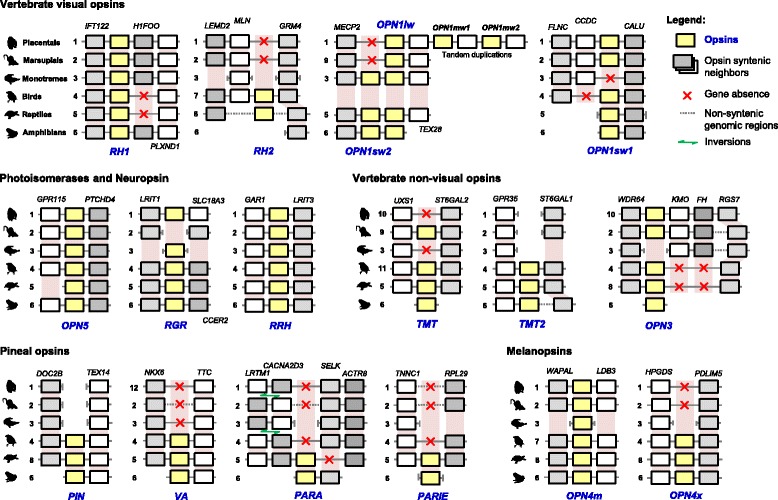
- Synteny/tblastn analyses identified only 10 opsin genes in mammals, versus 16 in amphibians, 17 in reptiles, and 15 in birds; RH2, VA, PARA, PARIE, and OPN4x were absent in all mammals, suggesting loss in the emerging mammalian lineage > >215.5 mya, while PIN and TMT2 losses could not be synteny-validated.
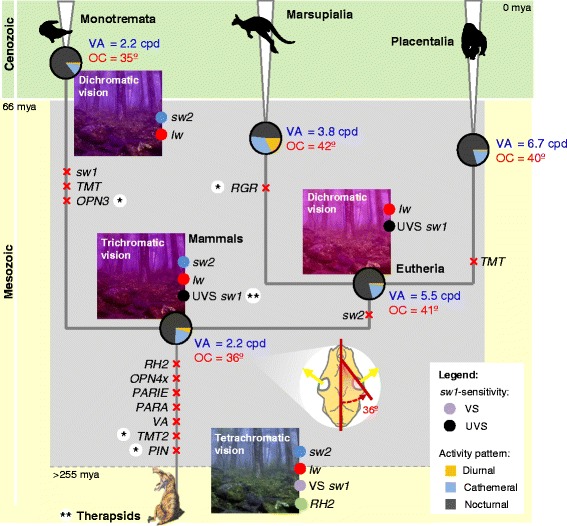
- Ancestral reconstructions on opsin ω-trees inferred a nocturnal lifestyle in ancestral nodes of mammals, monotremes, therians, marsupials, and placentals with probabilities 0.743, 0.859, 0.791, 0.482, and 0.794, respectively; UVS vision was supported with probability 1.000 in ancestral therians, marsupials, and placentals, but could not be determined for the ancestral mammal node because OPN1sw1 is absent in monotremes.
- Inferred ancestral mammals had low orbit convergence (<42°, panoramic vision) and low visual acuity (<7 cpd) across all studied nodes; extant nocturnal mammals tended to have divergent orbits while diurnal mammals had convergent orbits (p = 0.0076, Wilcoxon test), compared with the nocturnal brown rat (32°, 1.6 cpd) and humans (79.3°, 64 cpd).
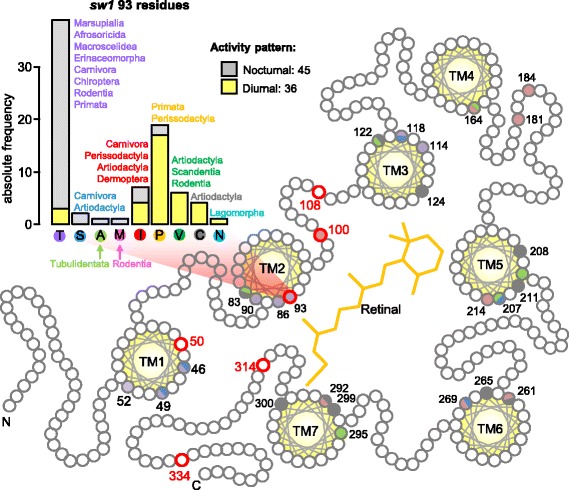
- Site-specific tests found positive selection in OPN1sw1, OPN4m, OPN3, and RRH, and negative selection in RH1; OPN1sw1 site 93 amino acid composition segregated with nocturnal/diurnal activity, and branch-specific tests were significant in platypus (RRH LRT = 11.849; OPN4m LRT = 19.186), bearded seal (RH1 LRT = 10.312), and Sowerby’s beaked whale (RH1 LRT = 29.651).
Methods
- Comparative genomic and phylogenetic study of the opsin gene family in 154 mammals; tblastn searches were performed in NCBI and Ensembl, synteny was assessed in Ensembl and Genomicus 64.1, sequences were aligned with MUSCLE 3.3, and jModelTest selected GTR + I + Γ for all opsins except RH1 (HKY + I + Γ).
- Selection analyses used PAML with the Meredith et al. (2011) mammalian species tree; site-specific models compared M7 vs. M8 and M8a vs. M8 via likelihood ratio tests, branch-specific models used free-ratios and one-ratio vs. two-ratio tests, and Bayes Empirical Bayes identified positively selected sites.
- Ancestral character reconstructions used opsin ω-trees in the R ape package; discrete characters (activity pattern, VS/UVS vision) used a time-continuous Markov model comparing equal-rates and all-rates-different matrices, while continuous characters (orbit convergence, visual acuity) were first tested for phylogenetic autocorrelation with Moran’s I and then inferred with maximum likelihood under Brownian motion.
Limitations
- The paper states that OPN1sw1 is absent in monotremes, so VS/UVS vision in the ancestral mammal node could not be determined; the therapsid opsin profile is unknown because genetic data are unavailable for therapsids, so the beginning of the nocturnal bottleneck cannot be stated precisely.
- The paper states that PIN and TMT2 losses could not be synteny-validated due to inconsistent syntenic patterns, and RGR absence in marsupials and OPN3 absence in monotremes could not be validated as lineage-specific losses due to genomic rearrangements; branch-site tests were discarded because they can retrieve misleading results, and root-to-tip linearization may dilute ω-lineage tendencies in internal branches, leading the authors to focus on more-recent adaptations.
- Evident from the text: inferences rely on extant genomes and reconstructed ancestral states, with no direct genetic data from extinct therapsids or early mammals; the ancestral mammal UVS condition is explicitly hypothetical, and the authors note that further studies on melanopsin and TMT gene families are still necessary.
Model-written summary. Check it against the paper before relying on it.
Integrity signals
Registry
Cites
Statistics
Figures
Verification
Claims the paper makes
2 Valid · 0 Not valid · 45 Not checked · 70 Own results and interpretations
The cited sources support only part of this claim — read each source’s verdict below.
In the paper
“However, not only Eutheria, but all mammals show photic characteristics (i.e. dichromatic vision, rod-dominated retina) suggestive of a scotopic eye design.”
- Also stated in: § Background · hedged
“However, not only Eutheria, but all mammals present photic-related structures that suggest past adaptation to nocturnal environments.”
§ Adaptive genomic evolution of opsins reveals that early mammals flourished in nocturnal environments > Abstract > Background
What the sources say
- Could not verifycites [3] Arendt J Melatonin and the pineal gland: influence on mammalian seasonal and circadian physiology Rev Reprod 1998 3 13 22 10.1530/ror.0.0030013 9509985 sourceExperimental — accuracy not yet measured
Our copy of Arendt (1998) is a review of melatonin and pineal function; the only eye-related passages concern the pineal as part of the visual system, retinal melatonin rhythms in lower vertebrates and hamster retina (Abstract), retinal melatonin receptors as possible sites for circadian light perception (Target sites of melatonin influencing circadian rhythms), and the unknown nature of the photoreceptors mediating circadian responses (Light suppression and entrainment of melatonin secretion). No passage addresses dichromatic vision, a rod-dominated retina, scotopic eye design, or a comparison of Eutheria with other mammals; searches for 'dichromatic vision rod-dominated retina scotopic', 'scotopic photopic colour vision Eutheria marsupial monotreme' and 'mammalian retina photoreceptors cones rods nocturnal' returned only these unrelated matches. The paper is not truncated, but it simply does not make the claim's point, so attribution can be neither supported nor contradicted. (LLM, conf=0.70)
- Partly supportedcites [4] Peirson S Halford S Foster R The evolution of irradiance detection: melanopsin and the non-visual opsins Philos Trans R Soc Lond Ser B Biol Sci 2009 364 2849 2865 10.1098/rstb.2009.0050 19720649 PMC2781857 sourceExperimental — accuracy not yet measured
Our copy supports the dichromacy element indirectly: in 'Opsin photopigments > Visual rod/cone opsins (Opn1, Opn2)' it states that of the four vertebrate cone opsin classes, 'The SWS2 and MWS opsins have been lost in the mammalian lineage (Bowmaker & Hunt 1999)', i.e. mammals retain two cone classes, and 'Evolutionary considerations of non-image-forming photoreception' invokes the early mammals' passage through a 'nocturnal bottleneck' (~100 Mya, nocturnal insectivores/omnivores). However, no passage anywhere in our copy describes the mammalian retina as rod-dominated, nor draws the conclusion that these features indicate a 'scotopic eye design'; the nocturnal-bottleneck passage is used there only to explain loss of extraocular photoreceptors and exclusive reliance on pRGCs, not retinal photoreceptor composition. The claim's explicit contrast ('not only Eutheria, but all mammals') is also not made — the paper speaks only of 'the mammalian lineage' without addressing eutherian versus other mammals. (LLM, conf=0.72)
- Partly supportedcites [5] Hunt DM Carvalho LS Cowing JA Davies WL Evolution and spectral tuning of visual pigments in birds and mammals Philos Trans R Soc Lond Ser B Biol Sci 2009 364 2941 2955 10.1098/rstb.2009.0044 19720655 PMC2781856 sourceExperimental — accuracy not yet measured
Hunt et al. (2009), section 2 'MAMMALS', supports the general point but at a weaker, non-universal level: 'Most mammals have a rod-dominated retina' (with cone-rich exceptions at ~85% cones in the ground squirrel and 95% in the tree shrew), and the reduction to two cone pigment classes is attributed to a nocturnal phase that 'may be the cause' of that reduction — a hedge, not a stated scotopic design in every mammal. The universal qualifier 'not only Eutheria, but all mammals' and the claim of dichromacy across all mammals is not what the source says: primates are trichromatic, some Australian marsupials (fat-tailed dunnart, honey possum, quokka, quenda) show trichromacy, monotremes retain LWS plus SWS2, and cetaceans and pinnipeds have lost a functional SWS1 gene and are L-cone monochromats (sections 2(a), 2(c), Conclusions). So the rod-dominated/dichromatic-with-nocturnal-ancestry theme is in the paper, but 'all mammals' and uniform dichromacy are overstated. (LLM, conf=0.78)
- Partly supportedcites [6] Bowmaker JK Evolution of vertebrate visual pigments Vision Res. [Internet]. 2008 48 2022 2041 10.1016/j.visres.2008.03.025 18590925 sourceExperimental — accuracy not yet measured
Section 12 (Mammals) supports the general framing: the class Mammalia 'includes not only main stream Eutheria ... but also Metatheria ... and ... Prototheria', dichromacy (loss of RH2 and SWS2) was assumed for all mammals other than primates, and that loss is tied to 'the nocturnal phase that ancestral mammals experienced about 150-200 MYA when colour vision would have been severely limited' — a scotopic-heritage point. But the same source qualifies 'all mammals': some Australian marsupials are trichromatic, monotremes retained a different subset of ancestral opsin classes, and §12.2 records cone monochromacy in all marine mammals and many nocturnal groups as 'a notable departure from the general dichromatic mammalian pattern'. Separately, no passage in our copy describes mammalian retinas as rod-dominated (searched: rod-dominated retina, rod dominance, scotopic; the only 'rod dominated retinas' phrasing is for amphibians, §9), so that element of the claim is not attributable to this paper. (LLM, conf=0.78)
- Partly supportedcites [7] Hall MI Kamilar JM Kirk EC Eye shape and the nocturnal bottleneck of mammals Proc R Soc B Biol Sci [Internet] 2012 279 4962 4968 10.1098/rspb.2012.2258 PMC3497252 23097513 sourceExperimental — accuracy not yet measured
The Discussion (p. 4, DISCUSSION) does support the broad framing: 'because all mammals have descended from a nocturnal ancestor that had already evolved an eye shape that was well adapted for scotopic conditions, the majority of mammals retain eyes that deviate comparatively little from that ancestral morphology regardless of their modern activity pattern', and the sample spans 23 orders including marsupials (Didelphimorphia, Diprotodontia in Table 2), so the 'not only Eutheria' extension is consistent with this paper. However, the specific photic characteristics the claim attributes here — dichromatic vision and a rod-dominated retina — are not stated anywhere in our copy (searched: rod/cone photoreceptors, dichromacy, visual pigment/opsin, retina); the Introduction only notes that mammals 'lost ... tetrachromatic colour vision and an active mechanism of visual accommodation', and credits that to Heesy & Hall 2010 [10], while colour-vision gains are cited to Jacobs 2009 [57]. Further, this paper treats diurnal anthropoids as the exception that diverges from the scotopic pattern, which qualifies the claim's 'all mammals'. (LLM, conf=0.72)
hedgedstates an association- Asserted: passes — The authors put it forward as true.
- Checkable: passes — It can be checked against evidence.
- Load-bearing: passes — The paper’s conclusions depend on it.
- Based: passes — The paper gives a reason why it holds.
- Also stated in: § Background · hedged
The cited sources support only part of this claim — read each source’s verdict below.
In the paper
“Two pieces of evidence corroborate this statement: (i) the preponderance of rods and (ii) the absence of the RH2 opsin in extant mammals [5, 6].”
§ Adaptive genomic evolution of opsins reveals that early mammals flourished in nocturnal environments > Discussion > Ecology of the mammalian ancestral eye
What the sources say
- Supportedcites [5] Hunt DM Carvalho LS Cowing JA Davies WL Evolution and spectral tuning of visual pigments in birds and mammals Philos Trans R Soc Lond Ser B Biol Sci 2009 364 2941 2955 10.1098/rstb.2009.0044 19720655 PMC2781856 source
Section 2 (MAMMALS) states both pieces of evidence attributed here: 'Most mammals have a rod-dominated retina' and 'In marsupial and eutherian mammals, the LWS gene is paired with the SWS1 gene, with the loss of the SWS2 and Rh2 genes' (monotremes likewise retain only LWS and SWS2, per the Conclusions, so RH2 is absent from extant mammals generally). The same section and the Abstract tie these extant features to a nocturnal phase marking early mammalian evolution (~150-200 Ma) that reduced the cone pigment complement, and Section 2(d) equates nocturnality with a rod-dominant retina, supporting the ancestral inference. The source hedges the causal link ('may be the cause', 'is thought to'), whereas the citing sentence states corroboration, but the substantive content of both evidence items and the nocturnal/rod-dominated ancestral reading are in our copy. (LLM, conf=0.85)
- Partly supportedcites [6] Bowmaker JK Evolution of vertebrate visual pigments Vision Res. [Internet]. 2008 48 2022 2041 10.1016/j.visres.2008.03.025 18590925 sourceExperimental — accuracy not yet measured
Bowmaker (2008) supports the RH2 part of the attributed evidence: Section 12 (Mammals) states that mammals, other than primates, were assumed to possess cones only from the two spectrally extreme opsin families, 'having lost the RH2 and SWS2 classes', and the monotreme subsection adds that the platypus 'presumable ... has been lost during evolution, along with the RH2 gene', while for marsupials 'no candidate gene, either an RH2 or modified LWS gene, has been identified'. The rod-preponderance part is not stated for extant mammals generally: our copy reports 'retinas dominated by rods' only for marine mammals (Section 12.2), with rod-dominated/pure-rod retinas discussed for anurans and caecilians (Section 9), not for mammals as a class. The paper does link the loss of two cone classes to the nocturnal phase of ancestral mammals ~150-200 MYA, but it does not offer these two lines of evidence as corroboration of a rod-dominated ancestral mammalian retina. (LLM, conf=0.75)
plainstates a cause- Asserted: passes — The authors put it forward as true.
- Checkable: passes — It can be checked against evidence.
- Load-bearing: passes — The paper’s conclusions depend on it.
- Based: passes — The paper gives a reason why it holds.
- Rests on an assumption not shown here.
- Supported
A result the paper reports from its own data — it cites no other source for it, so there is none to check. The quote shows it is in the paper.
In the paper
“The species-specific evolutionary rates (ω-lineages), corresponding to the sum of the root-to-tip ω-branches in each of the opsin ω-trees (i.e. a ω-tree linearization; Additional file 2: Table S2) were analysed and suggested outlier tendencies among Monotremata, Marsupialia, Carnivora, Chriroptera, Artiodactyla and Primata (Additional file 3: Figure S1).”
§ Adaptive genomic evolution of opsins reveals that early mammals flourished in nocturnal environments > Results > Site- and branch-selection in mammalian opsins
hedgedstates an association- Asserted: passes — The authors put it forward as true.
- Checkable: passes — It can be checked against evidence.
- Load-bearing: passes — The paper’s conclusions depend on it.
- Based: passes — The paper gives a reason why it holds.
A result the paper reports from its own data — it cites no other source for it, so there is none to check. The quote shows it is in the paper.
In the paper
“monotremes were the only lineage with OPN1sw2, but not OPN1sw1, which was only present in therians; TMT was only present in marsupials.”
§ Adaptive genomic evolution of opsins reveals that early mammals flourished in nocturnal environments > Results > Synteny analysis of tetrapod opsins
plain- Asserted: passes — The authors put it forward as true.
- Checkable: passes — It can be checked against evidence.
- Load-bearing: unclear — It is unclear whether the paper’s conclusions depend on it.
- Based: passes — The paper gives a reason why it holds.
A result the paper reports from its own data — it cites no other source for it, so there is none to check. The quote shows it is in the paper.
In the paper
“In addition, ancestral character reconstruction analyses provided strong evidence that ancestral mammals possessed a nocturnal lifestyle, ultra-violet-sensitive vision, low visual acuity and low orbit convergence (i.e. panoramic vision).”
- Also stated in: § Ancestral character reconstructions · hedged
“The maximum likelihood ancestral inferences suggested a nocturnal lifestyle (i.e. nocturnal state with higher probability) in the ancestral nodes of mammals, monotremes, therians, marsupials and placentals (0.743, 0.859, 0.791, 0.482 and 0.794 respectively; pie charts in Fig. 3 and Additional file 5: Figure S2).”
§ Adaptive genomic evolution of opsins reveals that early mammals flourished in nocturnal environments > Abstract > Results
boosted- Asserted: passes — The authors put it forward as true.
- Checkable: passes — It can be checked against evidence.
- Load-bearing: passes — The paper’s conclusions depend on it.
- Based: passes — The paper gives a reason why it holds.
- Also stated in: § Ancestral character reconstructions · hedged
59 more claims
Create a free account to see all 117 claims and to verify the 82 references still open.
- It may state two separate claims as one. 43
- Probably not a substantial claim. 16
Self-check
Percentages, sums and reported differences re-computed from the paper’s own numbers.
Each contradiction between two passages listed here was confirmed by an independent check.
Rated minor: it would not touch a result — a value no result rests on, a p-value that stays on the same side of the significance level, or a conflict that is clerical, resolved elsewhere in the paper, or outside its own findings.
In the paper
§ Adaptive genomic evolution of opsins reveals that early mammals flourished in nocturnal environments > Results > Ancestral character reconstructions
“indicated low orbit convergence (< 42°, i.e. panoramic vision; the orbit orientation can be used as a surrogate variable for the degree of panoramic/binocular vision [9]) and a low visual acuity (< 7 cpd) in all the studied nodes (mammals, monotremes, eutherians, marsupials and placentals;”
§ Adaptive genomic evolution of opsins reveals that early mammals flourished in nocturnal environments > Results > Ancestral character reconstructions
“A reconstruction of a skull with an orbital convergence angle of 46° (which correspond to the inferred angle in the node of mammals) is included.”
Citations
Cites
MUSCLE: multiple sequence alignment with high accuracy and high throughput
Edgar, R. C. (2004) · Nucleic Acids Research · doi:10.1093/nar/gkh340 · Cited by 44,662
PAML 4: Phylogenetic Analysis by Maximum Likelihood
Yang, Z. (2007) · Molecular Biology and Evolution · doi:10.1093/molbev/msm088 · Cited by 13,879
APE: analyses of phylogenetics and evolution in R language
Paradis, E., Claude, J., & Strimmer, K. (2004) · Bioinformatics · doi:10.1093/bioinformatics/btg412 · Cited by 11,335
jModelTest: Phylogenetic Model Averaging
Posada, D. (2008) · Molecular Biology and Evolution · doi:10.1093/molbev/msn083 · Cited by 10,499
Bayes Empirical Bayes Inference of Amino Acid Sites Under Positive Selection
Yang, Z. (2005) · Molecular Biology and Evolution · doi:10.1093/molbev/msi097 · Cited by 2,320
(1994) · Proceedings of the Royal Society of London. Series B: Biological Sciences · doi:10.1098/rspb.1994.0006 · Cited by 1,859 · cited 1×
“Discrete characters (type = “discrete”) were calculated based on a time-continuous Markovian model comparing the equal-rates (model = “SYM”) and all-rates-different (model = “ARD”) matrices on a LRT test [75].”
MethodJones, K. E., Bielby, J., Cardillo, M., Fritz, S. A., O'Dell, J., Orme, C. D. L., Safi, K., Sechrest, W., Boakes, E. H., Carbone, C., et al. (2009) · Ecology · doi:10.1890/08-1494.1 · Cited by 1,654
An index of substitution saturation and its application
Xia, X., Xie, Z., Salemi, M., Chen, L., & Wang, Y. (2003) · Molecular Phylogenetics and Evolution · doi:10.1016/s1055-7903(02)00326-3 · Cited by 1,542
Impacts of the Cretaceous Terrestrial Revolution and KPg extinction on mammal diversification
Meredith, R. W., Janečka, J. E., Gatesy, J., Ryder, O. A., Fisher, C. A., Teeling, E. C., Goodbla, A., Eizirik, E., Simão, T. L. L., Stadler, T., et al. (2011) · Science · doi:10.1126/science.1211028 · Cited by 1,464 · cited 2×
“5 million years ago (mya), which corresponds with the emergence of mammals [40]] and the earliest emerging lineages.”
BackgroundYang, Z., & Nielsen, R. (2002) · Molecular Biology and Evolution · doi:10.1093/oxfordjournals.molbev.a004148 · Cited by 1,374 · cited 2×
“two-ratio hypothesis to validate lineage-specific adaptive events [21].”
BackgroundMethodCunningham, F., Amode, M. R., Barrell, D., Beal, K., Billis, K., Brent, S., Carvalho-Silva, D., Clapham, P., Coates, G., Fitzgerald, S., et al. (2015) · Nucleic Acids Research · doi:10.1093/nar/gku1010 · Cited by 1,115
The Vertebrate Eye and Its Adaptive Radiation
Merriman, D., & Walls, G. L. (1943) · Copeia · doi:10.2307/1437897 · Cited by 1,010
LIKELIHOOD OF ANCESTOR STATES IN ADAPTIVE RADIATION
Schluter, D., Price, T., Mooers, A. Ø., & Ludwig, D. (1997) · Evolution · doi:10.1111/j.1558-5646.1997.tb05095.x · Cited by 943
Terakita, A. (2005) · Genome biology · doi:10.1186/gb-2005-6-3-213 · Cited by 776
Accuracy and Power of the Likelihood Ratio Test in Detecting Adaptive Molecular Evolution
Anisimova, M., Bielawski, J. P., & Yang, Z. (2001) · Molecular Biology and Evolution · doi:10.1093/oxfordjournals.molbev.a003945 · Cited by 736
Adaptation: Statistics and a Null Model for Estimating Phylogenetic Effects
Gittleman, J. L., & Kot, M. (1990) · Systematic Zoology · doi:10.2307/2992183 · Cited by 627
Wong, W. S. W., Yang, Z., Goldman, N., & Nielsen, R. (2004) · Genetics · doi:10.1534/genetics.104.031153 · Cited by 598
Hughes, A. (1977) · Handbook of Sensory Physiology · doi:10.1007/978-3-642-66468-7_11 · Cited by 588
Molecular evolution of vertebrate visual pigments
Yokoyama, S. (2000) · Progress in Retinal and Eye Research · doi:10.1016/s1350-9462(00)00002-1 · Cited by 586
Evolution of vertebrate visual pigments
Bowmaker, J. K. (2008) · Vision Research · doi:10.1016/j.visres.2008.03.025 · Cited by 451
Biogeography of time partitioning in mammals
Bennie, J. J., Duffy, J. P., Inger, R., & Gaston, K. J. (2014) · Proceedings of the National Academy of Sciences · doi:10.1073/pnas.1216063110 · Cited by 398
Melatonin and the pineal gland: influence on mammalian seasonal and circadian physiology
Arendt, J. (1998) · Reviews of Reproduction · doi:10.1530/revreprod/3.1.13 · Cited by 366
Fossil Evidence on Origin of the Mammalian Brain
Rowe, T. B., Macrini, T. E., & Luo, Z.-X. (2011) · Science · doi:10.1126/science.1203117 · Cited by 365 · cited 1×
“This hypothesis is consistent with both the predation pressures imposed by the successful reptiles during the Mesozoic, and the paleontological evidence, which suggests ancestral mammals were small arboreal animals and most likely, easy prey [50, 51].”
ResultLikelihood of Ancestor States in Adaptive Radiation
Schluter, D., Price, T. D., Mooers, A. Ø., et al. (1997) · Evolution · doi:10.2307/2410994 · Cited by 361
Distribution of photoreceptor subtypes in the retina of diurnal and nocturnal primates
Wikler, K., & Rakic, P. (1990) · The Journal of Neuroscience · doi:10.1523/jneurosci.10-10-03390.1990 · Cited by 354
The mammalian photoreceptor mosaic-adaptive design
Ahnelt, P. K., & Kolb, H. (2000) · Progress in Retinal and Eye Research · doi:10.1016/s1350-9462(00)00012-4 · Cited by 334
The nocturnal bottleneck and the evolution of activity patterns in mammals
Gerkema, M. P., Davies, W. I. L., Foster, R. G., Menaker, M., & Hut, R. A. (2013) · Proceedings of the Royal Society B: Biological Sciences · doi:10.1098/rspb.2013.0508 · Cited by 323
The Evolution of Maximum Body Size of Terrestrial Mammals
Smith, F. A., Boyer, A. G., Brown, J. H., Costa, D. P., Dayan, T., Ernest, S. K. M., Evans, A. R., Fortelius, M., Gittleman, J. L., Hamilton, M. J., et al. (2010) · Science · doi:10.1126/science.1194830 · Cited by 312
Yokoyama, S., Tada, T., Zhang, H., & Britt, L. (2008) · Proceedings of the National Academy of Sciences · doi:10.1073/pnas.0802426105 · Cited by 272
The evolution of irradiance detection: melanopsin and the non-visual opsins
Peirson, S. N., Halford, S., & Foster, R. G. (2009) · Philosophical Transactions of the Royal Society B: Biological Sciences · doi:10.1098/rstb.2009.0050 · Cited by 257
The allometry and scaling of the size of vertebrate eyes
Howland, H. C., Merola, S., & Basarab, J. R. (2004) · Vision Research · doi:10.1016/j.visres.2004.03.023 · Cited by 236
Evolution and spectral tuning of visual pigments in birds and mammals
Hunt, D. M., Carvalho, L. S., Cowing, J. A., & Davies, W. L. (2009) · Philosophical Transactions of the Royal Society B: Biological Sciences · doi:10.1098/rstb.2009.0044 · Cited by 234 · cited 8×
“Two pieces of evidence corroborate this statement: (i) the preponderance of rods and (ii) the absence of the RH2 opsin in extant mammals [5, 6].”
BackgroundMethodResultInfluentialA New Mammaliaform from the Early Jurassic and Evolution of Mammalian Characteristics
Luo, Z.-X., Crompton, A. W., & Sun, A.-L. (2001) · Science · doi:10.1126/science.1058476 · Cited by 223
Genomicus: a database and a browser to study gene synteny in modern and ancestral genomes
Muffato, M., Louis, A., Poisnel, C.-E., & Crollius, H. R. (2010) · Bioinformatics · doi:10.1093/bioinformatics/btq079 · Cited by 222
Vision under mesopic and scotopic illumination
Zele, A. J., & Cao, D. (2015) · Frontiers in Psychology · doi:10.3389/fpsyg.2014.01594 · Cited by 220
Molecular ecology and adaptation of visual photopigments in craniates
DAVIES, W. I. L., COLLIN, S. P., & HUNT, D. M. (2012) · Molecular Ecology · doi:10.1111/j.1365-294x.2012.05617.x · Cited by 216
Bellingham, J., Chaurasia, S. S., Melyan, Z., Liu, C., Cameron, M. A., Tarttelin, E. E., Iuvone, P. M., Hankins, M. W., Tosini, G., & Lucas, R. J. (2006) · PLoS Biology · doi:10.1371/journal.pbio.0040254 · Cited by 209
Visual Acuity in Mammals: Effects of Eye Size and Ecology
Veilleux, C. C., & Kirk, E. C. (2014) · Brain, Behavior and Evolution · doi:10.1159/000357830 · Cited by 205
Evolution of vertebrate visual pigments
Bowmaker, J. K., & Hunt, D. M. (2006) · Current Biology · doi:10.1016/j.cub.2006.06.016 · Cited by 188
The Vertebrate Eye and Its Adaptive Radiation
Post, L. T. (1943) · American Journal of Ophthalmology · doi:10.1016/s0002-9394(43)91539-9 · Cited by 177
Molecular genetics and the evolution of ultraviolet vision in vertebrates
Shi, Y., Radlwimmer, F. B., & Yokoyama, S. (2001) · Proceedings of the National Academy of Sciences · doi:10.1073/pnas.201257398 · Cited by 162
The Nocturnal Bottleneck and the Evolution of Mammalian Vision
Heesy, C. P., & Hall, M. I. (2010) · Brain, Behavior and Evolution · doi:10.1159/000314278 · Cited by 162
Self-citationTesting for phylogenetic signal in phenotypic traits: New matrices of phylogenetic proximities
Pavoine, S., Ollier, S., Pontier, D., & Chessel, D. (2007) · Theoretical Population Biology · doi:10.1016/j.tpb.2007.10.001 · Cited by 150
Eye shape and the nocturnal bottleneck of mammals
Hall, M. I., Kamilar, J. M., & Kirk, E. C. (2012) · Proceedings of the Royal Society B: Biological Sciences · doi:10.1098/rspb.2012.2258 · Cited by 147
Kim, J.-W., Yang, H.-J., Oel, A. P., Brooks, M. J., Jia, L., Plachetzki, D. C., Li, W., Allison, W. T., & Swaroop, A. (2016) · Developmental Cell · doi:10.1016/j.devcel.2016.05.023 · Cited by 142
Rod Monochromacy and the Coevolution of Cetacean Retinal Opsins
Meredith, R. W., Gatesy, J., Emerling, C. A., York, V. M., & Springer, M. S. (2013) · PLoS Genetics · doi:10.1371/journal.pgen.1003432 · Cited by 141
Eyes underground: Regression of visual protein networks in subterranean mammals
Emerling, C. A., & Springer, M. S. (2014) · Molecular Phylogenetics and Evolution · doi:10.1016/j.ympev.2014.05.016 · Cited by 133
On the relationship between orbit orientation and binocular visual field overlap in mammals
Heesy, C. P. (2004) · The Anatomical Record Part A: Discoveries in Molecular, Cellular, and Evolutionary Biology · doi:10.1002/ar.a.20116 · Cited by 128
Self-citationThe origin of mammalian endothermy: a paradigm for the evolution of complex biological structure
KEMP, T. S. (2006) · Zoological Journal of the Linnean Society · doi:10.1111/j.1096-3642.2006.00226.x · Cited by 127
COWING, J. A., POOPALASUNDARAM, S., WILKIE, S. E., ROBINSON, P. R., BOWMAKER, J. K., & HUNT, D. M. (2002) · Biochemical Journal · doi:10.1042/bj20020483 · Cited by 104
Spectral Tuning in the Mammalian Short-Wavelength Sensitive Cone Pigments
Fasick, J. I., Applebury, M. L., & Oprian, D. D. (2002) · Biochemistry · doi:10.1021/bi0200413 · Cited by 96
Hunt, D. M., Carvalho, L. S., Cowing, J. A., Parry, J. W. L., Wilkie, S. E., Davies, W. L., & Bowmaker, J. K. (2007) · Photochemistry and Photobiology · doi:10.1562/2006-06-27-ir-952 · Cited by 91
Nocturnality in synapsids predates the origin of mammals by over 100 million years
Angielczyk, K. D., & Schmitz, L. (2014) · Proceedings of the Royal Society B: Biological Sciences · doi:10.1098/rspb.2014.1642 · Cited by 88
Heesy, C. P. (2008) · Brain, Behavior and Evolution · doi:10.1159/000108621 · Cited by 88
Self-citationMemory acquisition and retrieval impact different epigenetic processes that regulate gene expression
Peixoto, L. L., Wimmer, M. E., Poplawski, S. G., Tudor, J. C., Kenworthy, C. A., Liu, S., Mizuno, K., Garcia, B. A., Zhang, N. R., Giese, K. P., et al. (2015) · BMC Genomics · doi:10.1186/1471-2164-16-s5-s5 · Cited by 87
Genetics and evolution of ultraviolet vision in vertebrates
Yokoyama, S., & Shi, Y. (2000) · FEBS Letters · doi:10.1016/s0014-5793(00)02269-9 · Cited by 76
Spectral-tuning mechanisms of marine mammal rhodopsins and correlations with foraging depth
FASICK, J. I., & ROBINSON, P. R. (2000) · Visual Neuroscience · doi:10.1017/s095252380017511x · Cited by 72
The sensory world of the platypus
Pettigrew, J. D., Manger, P. R., & Fine, S. L. B. (1998) · Philosophical Transactions of the Royal Society of London. Series B: Biological Sciences · doi:10.1098/rstb.1998.0276 · Cited by 66
Colour vision in aquatic mammals—facts and open questions
Griebel, U., & Peichl, L. (2003) · Aquatic Mammals · doi:10.1578/016754203101024040 · Cited by 64
Hauser, F. E., van Hazel, I., & Chang, B. S. W. (2014) · Journal of Experimental Zoology Part B: Molecular and Developmental Evolution · doi:10.1002/jez.b.22576 · Cited by 63
Gene loss, adaptive evolution and the co-evolution of plumage coloration genes with opsins in birds
Borges, R., Khan, I., Johnson, W. E., Gilbert, M. T. P., Zhang, G., Jarvis, E. D., O’Brien, S. J., & Antunes, A. (2015) · BMC Genomics · doi:10.1186/s12864-015-1924-3 · Cited by 63
Self-citationEmerling, C. A., & Springer, M. S. (2015) · Proceedings of the Royal Society B: Biological Sciences · doi:10.1098/rspb.2014.2192 · Cited by 56
Emerling, C. A., Huynh, H. T., Nguyen, M. A., Meredith, R. W., & Springer, M. S. (2015) · Proceedings of the Royal Society B: Biological Sciences · doi:10.1098/rspb.2015.1817 · Cited by 56
Night vision in barn owls: Visual acuity and contrast sensitivity under dark adaptation
Orlowski, J., Harmening, W., & Wagner, H. (2012) · Journal of Vision · doi:10.1167/12.13.4 · Cited by 51
Rhodopsin Molecular Evolution in Mammals Inhabiting Low Light Environments
Zhao, H., Ru, B., Teeling, E. C., Faulkes, C. G., Zhang, S., & Rossiter, S. J. (2009) · PLoS ONE · doi:10.1371/journal.pone.0008326 · Cited by 50
Flying characteristics of the new official rubber baseball
Aoki, K., Nagase, J., & Nakayama, Y. (2009) · Journal of Visualization · doi:10.1007/bf03181935 · Cited by 45
Spectral tuning and evolution of primate short-wavelength-sensitive visual pigments
Carvalho, L. S., Davies, W. L., Robinson, P. R., & Hunt, D. M. (2012) · Proceedings of the Royal Society B: Biological Sciences · doi:10.1098/rspb.2011.0782 · Cited by 44
The molecular origin and evolution of dim-light vision in mammals: BRIEF COMMUNICATION
Bickelmann, C., Morrow, J. M., Du, J., Schott, R. K., van Hazel, I., Lim, S., Müller, J., & Chang, B. S. W. (2015) · Evolution · doi:10.1111/evo.12794 · Cited by 41
The Role of the Pineal Body in Ectotherm Thermoregulation
RALPH, C. L., FIRTH, B. T., & TURNER, J. S. (1979) · American Zoologist · doi:10.1093/icb/19.1.273 · Cited by 40
Borges, R., Johnson, W. E., O’Brien, S. J., Vasconcelos, V. M., & Antunes, A. (2012) · PLoS ONE · doi:10.1371/journal.pone.0052413 · Cited by 39
Self-citationInactivation of Cone-Specific Phototransduction Genes in Rod Monochromatic Cetaceans
Springer, M. S., Emerling, C. A., Fugate, N., Patel, R., Starrett, J., Morin, P. A., Hayashi, C., & Gatesy, J. (2016) · Frontiers in Ecology and Evolution · doi:10.3389/fevo.2016.00061 · Cited by 34
Deep-sea and pelagic rod visual pigments identified in the mysticete whales
BISCHOFF, N., NICKLE, B., CRONIN, T. W., VELASQUEZ, S., & FASICK, J. I. (2012) · Visual Neuroscience · doi:10.1017/s0952523812000107 · Cited by 30
Wheeler, B. C., Bradley, B. J., & Kamilar, J. M. (2011) · Journal of Human Evolution · doi:10.1016/j.jhevol.2011.03.007 · Cited by 28
Thermal Properties of Rhodopsin
Liu, J., Liu, M. Y., Nguyen, J. B., Bhagat, A., Mooney, V., & Yan, E. C. Y. (2011) · Journal of Biological Chemistry · doi:10.1074/jbc.m111.233312 · Cited by 28
Heesy, C. P., Kamilar, J. M., & Willms, J. (2011) · Brain, Behavior and Evolution · doi:10.1159/000324860 · Cited by 16
Self-citationFunctional role of positively selected amino acid substitutions in mammalian rhodopsin evolution
Fernández-Sampedro, M. A., Invergo, B. M., Ramon, E., Bertranpetit, J., & Garriga, P. (2016) · Scientific Reports · doi:10.1038/srep21570 · Cited by 12
Visual acuity in the short-tailed opossum (Monodelphis domestica)
Dooley, J. C., Nguyen, H. M., Seelke, A. M. H., & Krubitzer, L. A. (2012) · Neuroscience · doi:10.1016/j.neuroscience.2012.07.065 · Cited by 9
(2002) · doi:10.14670/hh-17.555
Research works printed but not linked: 2
- McEntyre J Ostell J Pruitt K Brown G McEntyre JOJ The reference sequence (RefSeq) database The NCBI H 2012 2
- Fitzpatrick D. Vision: the eye. In: Neuroscience 3rd edition, editor: Purves D, Augustine GJ, Fitzpatrick D, Hall WC, Lamantia A.-S, Mcnamara JO, Willians SM. Sunderland; 2004. p. 240–4.
Cited by
Seeing the rainbow: mechanisms underlying spectral sensitivity in teleost fishes
Carleton, K. L., Escobar‐Camacho, D., Stieb, S. M., Cortesi, F., & Marshall, N. J. (2020) · Journal of Experimental Biology · doi:10.1242/jeb.193334 · Cited by 153
Measuring phylogenetic signal between categorical traits and phylogenies
Borges, R., Machado, J. P., Gomes, C., Rocha, A. P., & Antunes, A. (2019) · Bioinformatics · doi:10.1093/bioinformatics/bty800 · Cited by 144
Self-citationDiversity and evolution of the vertebrate chemoreceptor gene repertoire
Policarpo, M., Baldwin, M. W., Casañe, D., & Salzburger, W. (2024) · Nature Communications · doi:10.1038/s41467-024-45500-y · Cited by 99
Haswell, P. M., Kusak, J., Jones, K. A., & Hayward, M. W. (2020) · Behavioral Ecology and Sociobiology · doi:10.1007/s00265-020-02831-2 · Cited by 52
A review of the studies on nonvisual lighting effects in the field of physiological anthropology
Katsuura, T., & Lee, S. (2019) · Journal of PHYSIOLOGICAL ANTHROPOLOGY · doi:10.1186/s40101-018-0190-x · Cited by 28
Metadata
- Authors
- Borges, R., Johnson, W. E., O’Brien, S. J., Gomes, C., Heesy, C. P., & Antunes, A.
- Affiliations
- Universidade do Porto (PT)
- Smithsonian Conservation Biology Institute (US)
- St Petersburg University (RU)
- Midwestern University (US)
- Corresponding author
- Antunes, Agostinho
- Venue
- BMC Genomics
- Published
- 2018-02-05
- Volume
- 19
- Issue
- 1
- Pages
- 121-121
- ISSN
- 1471-2164 (ISSN-L)
- PMC
- PMC5800076
- OpenAlex
- W2791136402
- Cited by
- 45
- References
- 77
- Citations by year
- 2026: 9 · 2025: 3 · 2024: 11 · 2023: 5 · 2022: 4 · 2021: 3 · 2020: 2 · 2019: 5 · 2018: 3
- FWCI
- 1.80
- Type
- journal article
- Language
- en
- Open access
- gold
- doi.org
- Licence
- cc-by
- Locations
- BMC Genomics (publishedVersion, cc-by)
- PubMed (publishedVersion)
- PubMed Central (publishedVersion, cc-by)
- University of North Florida Digital Commons (University of North Florida) (submittedVersion)
- NSUWorks (Nova Southeastern University) (submittedVersion)
- DOAJ (DOAJ: Directory of Open Access Journals) (submittedVersion, cc-by-sa)
- Funders
- Saint Petersburg State University
- Russian Science Foundation
- Fundação para a Ciência e a Tecnologia
- European Regional Development Fund
- Topics
- Physical Sciences › Earth and Planetary Sciences › Paleontology › Evolution and Paleontology Studies
- Health Sciences › Medicine › Ophthalmology › Retinal Development and Disorders
- Health Sciences › Medicine › Anatomy › Comparative Animal Anatomy Studies
- Keywords
- placental mammals, rhodopsin gene, ancestral state reconstruction, ultraviolet vision, panoramic vision, dichromatic vision, paleoenvironment, comparative genomics
- MeSH terms
- Adaptation, Biological, Animals, Environment, Biological Evolution, Mammals, Selection, Genetic, Genome, Evolution, Molecular, Synteny, Opsins
About these checks
Registry, retraction, Cites and statistics results are computed, not judged, with one exception: a printed reference that no index lists is read once by a model before it counts as a citation error. Claims are extracted by a model and kept only when their quote appears verbatim in the text; each cited source is then checked, with a model’s help, for whether it says what the claim relies on. Those verdicts can be wrong — read the claim’s quote and the cited source before relying on one.
The claim verdicts this report counts are experimental: their accuracy is not yet measured.
A language model drew the claims from the paper on 2026-11-17, under version 3 of the claim definition (model deepseek-v4.1-flash, prompt extract-v3).
A second model labelled each claim on 2026-11-17 (model jev-1.13-20260917, definition revision gold-guideline-v0.2).
Cited sources are checked with a language model’s help (qwen3.8-omni-flash).
Statistics and arithmetic are recomputed, not judged.
Confidence bands are shown only for fields calibrated on our annotated test set. None is calibrated yet, so no band is shown.
What counts as a claim ›How we measure confidence ›How we check this ›
Are you an author, or do you see a problem with this page? Request a review
Data sources
Bibliographic data: Semantic Scholar, OpenAlex, Crossref.
Contains information from the Semantic Scholar Academic Graph Datasets, made available under the ODC Attribution License (ODC-BY 1.0).
Semantic Scholar’s data is described in: Kinney, R., et al. (2023). The Semantic Scholar Open Data Platform. arXiv:2301.10140.
