

Integrate multi-omics data with biological interaction networks using Multi-view Factorization AutoEncoder (MAE)
Open accessThe DOI matches its Crossref record; 38 of the 38 references it cites were found in a registry or an index.
Abstract
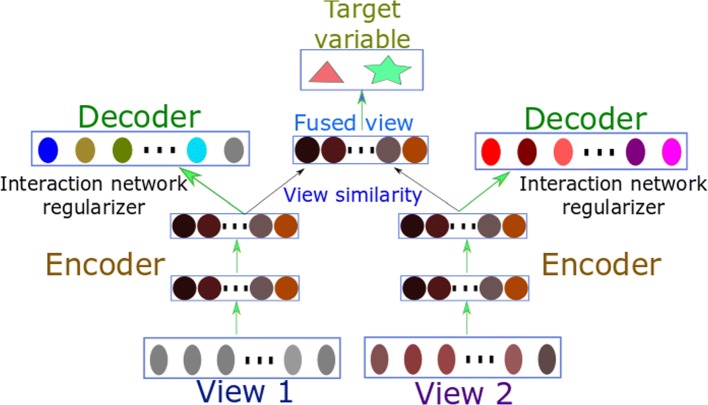
Background: Comprehensive molecular profiling of various cancers and other diseases has generated vast amounts of multi-omics data. Each type of -omics data corresponds to one feature space, such as gene expression, miRNA expression, DNA methylation, etc. Integrating multi-omics data can link different layers of molecular feature spaces and is crucial to elucidate molecular pathways underlying various diseases. Machine learning approaches to mining multi-omics data hold great promises in uncovering intricate relationships among molecular features. However, due to the “big p, small n” problem (i.e., small sample sizes with high-dimensional features), training a large-scale generalizable deep learning model with multi-omics data alone is very challenging. Results: We developed a method called Multi-view Factorization AutoEncoder (MAE) with network constraints that can seamlessly integrate multi-omics data and domain knowledge such as molecular interaction networks. Our method learns feature and patient embeddings simultaneously with deep representation learning. Both feature representations and patient representations are subject to certain constraints specified as regularization terms in the training objective. By incorporating domain knowledge into the training objective, we implicitly introduced a good inductive bias into the machine learning model, which helps improve model generalizability. We performed extensive experiments on the TCGA datasets and demonstrated the power of integrating multi-omics data and biological interaction networks using our proposed method for predicting target clinical variables. Conclusions: To alleviate the overfitting problem in deep learning on multi-omics data with the “big p, small n” problem, it is helpful to incorporate biological domain knowledge into the model as inductive biases. It is very promising to design machine learning models that facilitate the seamless integration of large-scale multi-omics data and biomedical domain knowledge for uncovering intricate relationships among molecular features and clinical features.
Overview
The claims and statistics of this paper haven’t been checked yet.
Free: it reads the open-access text and checks the first 5 claims that cite a source we can check. Create a free account to check every claim.
Integrity signals
Registry
Cites
Statistics
Figures
Verification
Claims the paper makes
The claims and statistics of this paper haven’t been checked yet.
Free: it reads the open-access text and checks the first 5 claims that cite a source we can check. Create a free account to check every claim.
Claims other papers make about this one
Each is checked against this paper’s own text: does it say what the citing paper says it does?
The cited source says what the claim attributes to it.
In the citing paper
“We have seen applications where prior biological knowledge has informed architectural decisions, such as separate branches according to chromosomal position [62], regularization terms in the training loss [49] or to encode pathways into the architecture [19, 67].”
From Multimodal deep learning for biomedical data fusion: a review (2022) · cites this paper as [49]
Self-check
Percentages, sums and reported differences re-computed from the paper’s own numbers.
The self-check needs the paper’s full text.
Citations
Cites
Deep Residual Learning for Image Recognition
He, K., Zhang, X., Ren, S., & Sun, J. (2016) · 2016 IEEE Conference on Computer Vision and Pattern Recognition (CVPR) · doi:10.1109/cvpr.2016.90 · Cited by 235,474 · cited 2×
“:3) e ( v ) (12) This idea is similar to ResNet [29].”
MethodAdam: A Method for Stochastic Optimization
Kingma, D. P., & Ba, J. (2014) · arXiv · doi:10.48550/arxiv.1412.6980 · Cited by 98,946 · cited 2×
“As our proposed model with network constraints is end-to-end differentiable, we trained it with Adam [32] with weight decay 10 − 4 .”
MethodLeCun, Y., Bengio, Y., & Hinton, G. (2015) · Nature · doi:10.1038/nature14539 · Cited by 84,126
Densely Connected Convolutional Networks
Huang, G., Liu, Z., Van Der Maaten, L., & Weinberger, K. Q. (2017) · 2017 IEEE Conference on Computer Vision and Pattern Recognition (CVPR) · doi:10.1109/cvpr.2017.243 · Cited by 48,566
Matrix Factorization Techniques for Recommender Systems
Koren, Y., Bell, R., & Volinsky, C. (2009) · Computer · doi:10.1109/mc.2009.263 · Cited by 11,673 · cited 3×
“In this paper, we present a framework called Multi-view Factorization AutoEncoder (MAE) with network constraints [3], combining multi-view learning [4] and matrix factorization [5] with deep learning for integrating multiomics data with biological domain knowledge.”
MethodInfluentialSTRING v10: protein–protein interaction networks, integrated over the tree of life
Szklarczyk, D., Franceschini, A., Wyder, S., Forslund, K., Heller, D., Huerta-Cepas, J., Simonovic, M., Roth, A., Santos, A., Tsafou, K. P., et al. (2015) · Nucleic Acids Research · doi:10.1093/nar/gku1003 · Cited by 10,436 · cited 4×
“Denote G ∈ R p × p as the interaction matrix among p genomic features, which can be obtained from biological databases such as STRING [26] and Reactome [27].”
BackgroundMethodInfluentialALGORITHMS FOR NON-NEGATIVE MATRIX FACTORIZATION
Lee, D. D., & Seung, H. S. (2000) · neural information processing systems · Cited by 9,875
Advances in Neural Information Processing Systems 14: Proceedings of the 2001 Conference
(2002) · The MIT Press eBooks · doi:10.7551/mitpress/1120.001.0001 · Cited by 8,890
The Reactome pathway Knowledgebase
Fabregat, A., Sidiropoulos, K., Garapati, P., Gillespie, M., Hausmann, K., Haw, R., Jassal, B., Jupe, S., Korninger, F., McKay, S., et al. (2016) · Nucleic Acids Research · doi:10.1093/nar/gkv1351 · Cited by 5,605
Multimodal Machine Learning: A Survey and Taxonomy
Baltrusaitis, T., Ahuja, C., & Morency, L.-P. (2019) · IEEE Transactions on Pattern Analysis and Machine Intelligence · doi:10.1109/tpami.2018.2798607 · Cited by 5,018
Cited by
Multimodal deep learning for biomedical data fusion: a review
Stahlschmidt, S. R., Ulfenborg, B., & Synnergren, J. (2022) · Briefings in Bioinformatics · doi:10.1093/bib/bbab569 · Cited by 766
“We have seen applications where prior biological knowledge has informed architectural decisions, such as separate branches according to chromosomal position [62], regularization terms in the training loss [49] or to encode pathways into the architecture [19, 67].”
MethodUtilizing graph machine learning within drug discovery and development
Gaudelet, T., Day, B., Jamasb, A. R., Soman, J., Regep, C., Liu, G., Hayter, J. B. R., Vickers, R., Roberts, C., Tang, J., et al. (2021) · Briefings in Bioinformatics · doi:10.1093/bib/bbab159 · Cited by 313
Deep learning-based approaches for multi-omics data integration and analysis
Ballard, J. L., Wang, Z., Li, W., Shen, L., & Long, Q. (2024) · BioData Mining · doi:10.1186/s13040-024-00391-z · Cited by 258
“Ma and Zhang [38] took another approach to incorporate network information into their model: rather than directly encode similarity networks into their model, as is done in graph-based models, they incorporate both domain knowledge and patient similarity networks as constraints.”
BackgroundArtificial intelligence assists precision medicine in cancer treatment
Liao, J., Li, X., Gan, Y., Han, S., Rong, P., Wang, W., Li, W., & Zhou, L. (2023) · Frontiers in Oncology · doi:10.3389/fonc.2022.998222 · Cited by 256
“For example, Ma et al. introduced a new approach that can analyze multi-omics information and related knowledge to reveal the complex relationship between molecular features and clinical characteristics (114).”
BackgroundMethodApplications of artificial intelligence in dentistry: A comprehensive review
Carrillo‐Perez, F., Pecho, O. E., Morales, J. C., Paravina, R. D., Della Bona, A., Ghinea, R., Pulgar, R., Pérez, M. D. M., & Herrera, L. J. (2022) · Journal of Esthetic and Restorative Dentistry · doi:10.1111/jerd.12844 · Cited by 251
Metadata
- Authors
- Ma, T., & Zhang, A.
- Affiliations
- University at Buffalo, State University of New York (US)
- University of Virginia (US)
- Corresponding author
- Zhang, Aidong
- Venue
- BMC Genomics
- Published
- 2019-12
- Volume
- 20
- Issue
- S11
- Pages
- 944-944
- ISSN
- 1471-2164 (ISSN-L)
- PMC
- PMC6923820
- OpenAlex
- W2995215286
- Cited by
- 105
- References
- 38
- Citations by year
- 2026: 14 · 2025: 15 · 2024: 23 · 2023: 14 · 2022: 12 · 2021: 21 · 2020: 6
- FWCI
- 3.23
- Type
- journal article
- Language
- en
- Open access
- gold
- doi.org
- Licence
- cc-by
- creativecommons.org/licenses/by/4.0 (tdm)
- creativecommons.org/licenses/by/4.0 (vor, 19 d)
- Locations
- BMC Genomics (publishedVersion, cc-by)
- PubMed Central (publishedVersion, cc-by)
- PubMed (publishedVersion)
- DOAJ (DOAJ: Directory of Open Access Journals) (submittedVersion)
- Funders
- National Science Foundation (1514204)
- Topics
- Life Sciences › Biochemistry, Genetics and Molecular Biology › Molecular Biology › Bioinformatics and Genomic Networks
- Life Sciences › Biochemistry, Genetics and Molecular Biology › Molecular Biology › Gene expression and cancer classification
- Life Sciences › Pharmacology, Toxicology and Pharmaceutics › Drug Discovery › Computational Drug Discovery Methods
- Keywords
- multi-omics integration, biological interaction networks, inductive bias, overfitting, patient embeddings, feature embedding, gene expression, DNA methylation, microRNA expression, clinical outcome prediction, TCGA
- MeSH terms
- Machine Learning, Algorithms, Humans, Models, Biological, Neoplasms, Bias, Genomics, Databases, Genetic, Systems Biology, Knowledge Bases, Data Mining
About these checks
Registry, retraction, Cites and statistics results are computed, not judged, with one exception: a printed reference that no index lists is read once by a model before it counts as a citation error. Claims are extracted by a model and kept only when their quote appears verbatim in the text; each cited source is then checked, with a model’s help, for whether it says what the claim relies on. Those verdicts can be wrong — read the claim’s quote and the cited source before relying on one.
Statistics and arithmetic are recomputed, not judged.
Confidence bands are shown only for fields calibrated on our annotated test set. None is calibrated yet, so no band is shown.
What counts as a claim ›How we measure confidence ›How we check this ›
Are you an author, or do you see a problem with this page? Request a review
How to cite
Cite CoChat for the checks on this page, and the paper for its own findings.
- This page
- CoChat. (2026). Citation check: Integrate multi-omics data with biological interaction networks using Multi-view Factorization AutoEncoder (MAE). https://app.cochat.ai/papers/10.1186/s12864-019-6285-x
- The paper
- Ma, T., & Zhang, A. (2019). Integrate multi-omics data with biological interaction networks using Multi-view Factorization AutoEncoder (MAE). BMC Genomics. https://doi.org/10.1186/s12864-019-6285-x
Data sources
Bibliographic data: Semantic Scholar, OpenAlex, Crossref.
Contains information from the Semantic Scholar Academic Graph Datasets, made available under the ODC Attribution License (ODC-BY 1.0).
Semantic Scholar’s data is described in: Kinney, R., et al. (2023). The Semantic Scholar Open Data Platform. arXiv:2301.10140.
