

The DOI matches its Crossref record; 82 of the 82 references it cites were found in a registry or an index.
Lactobacillus crispatus inhibits growth of Gardnerella vaginalis and Neisseria gonorrhoeae on a porcine vaginal mucosa model
Open accessAbstract
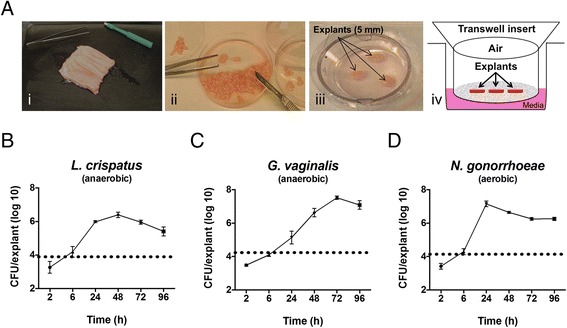
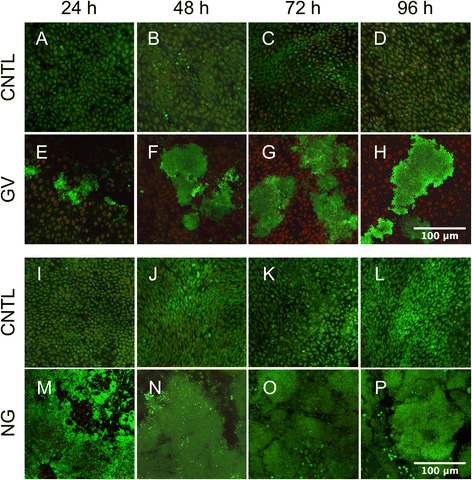
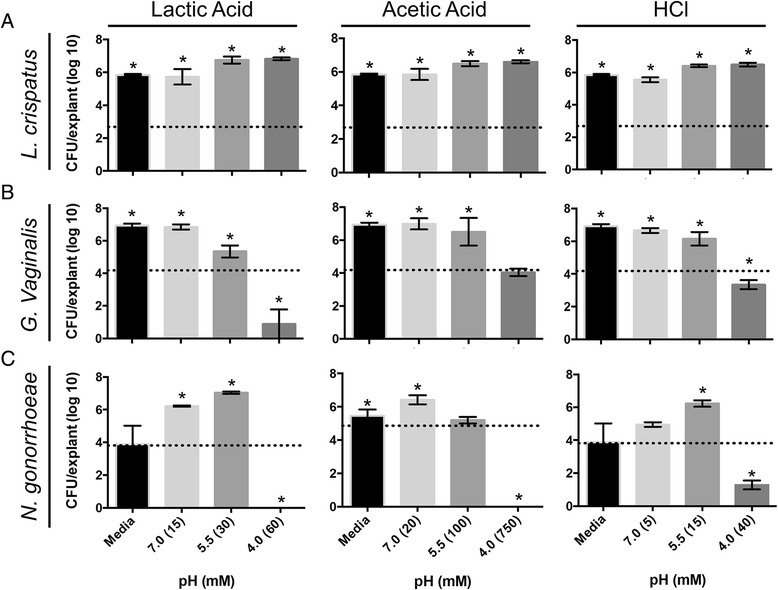
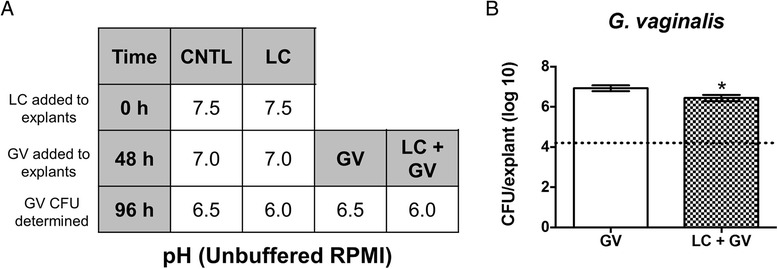
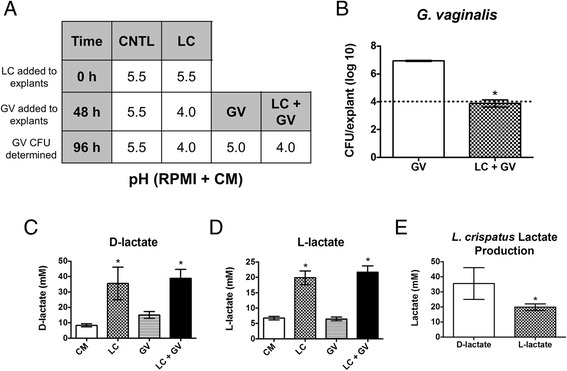
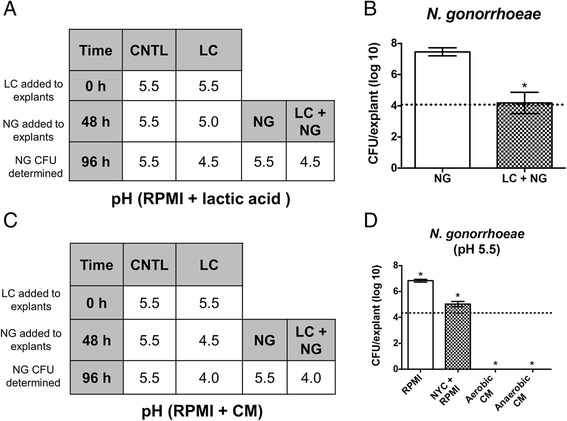
BACKGROUND: The vaginal microbiota can impact the susceptibility of women to bacterial vaginosis (BV) and sexually transmitted infections (STIs). BV is characterized by depletion of Lactobacillus spp., an overgrowth of anaerobes (often dominated by Gardnerella vaginalis) and a pH > 4.5. BV is associated with an increased risk of acquiring STIs such as chlamydia and gonorrhea. While these associations have been identified, the molecular mechanism(s) driving the risk of infections are unknown. An ex vivo porcine vaginal mucosal model (PVM) was developed to explore the mechanistic role of Lactobacillus spp. in affecting colonization by G. vaginalis and Neisseria gonorrhoeae. RESULTS: The data presented here demonstrate that all organisms tested can colonize and grow on PVM to clinically relevant densities. Additionally, G. vaginalis and N. gonorrhoeae form biofilms on PVM. It was observed that lactic acid, acetic acid, and hydrochloric acid inhibit the growth of G. vaginalis on PVM in a pH-dependent manner. N. gonorrhoeae grows best in the presence of lactic acid at pH 5.5, but did not grow well at this pH in the presence of acetic acid. Finally, a clinical Lactobacillus crispatus isolate (24-9-7) produces lactic acid and inhibits growth of both G. vaginalis and N. gonorrhoeae on PVM. CONCLUSIONS: These data reveal differences in the effects of pH, various acids and L. crispatus on the growth of G. vaginalis and N. gonorrhoeae on a live vaginal mucosal surface. The PVM is a useful model for studying the interactions of commensal vaginal microbes with pathogens and the mechanisms of biofilm formation on the vaginal mucosa.
Overview
The claims and statistics of this paper haven’t been checked yet.
Run the check — free, no account needed. It reads the open-access text and checks the sources it cites.
Integrity signals
Registry
Cites
Statistics
Figures
Verification
Claims the paper makes
The claims and statistics of this paper haven’t been checked yet.
Run the check — free, no account needed. It reads the open-access text and checks the sources it cites.
Claims other papers make about this one
Each is checked against this paper’s own text: does it say what the citing paper says it does?
In the citing paper
“This is significant because it then follows that vaginal Lactobacillus spp. (sensu lato) limit colonization of BV-associated microbes and thus by extension are protective against the aforementioned deleterious viral effects through maintenance of a low pH (Breshears et al., 2015), and bacteriocin production (Stoyancheva et al., 2014).”
From Viral Infections, the Microbiome, and Probiotics (2021) · cites this paper as Breshears et al., 2015
Self-check
Percentages, sums and reported differences re-computed from the paper’s own numbers.
The self-check needs the paper’s full text.
Citations
Cites
Vaginal microbiome of reproductive-age women
Ravel, J., Gajer, P., Abdo, Z., Schneider, G. M., Koenig, S. S. K., McCulle, S. L., Karlebach, S., Gorle, R., Russell, J., Tacket, C. O., et al. (2011) · Proceedings of the National Academy of Sciences · doi:10.1073/pnas.1002611107 · Cited by 4,254
Self-citationNugent, R. P., Krohn, M. A., & Hillier, S. L. (1991) · Journal of Clinical Microbiology · doi:10.1128/jcm.29.2.297-301.1991 · Cited by 3,332
Temporal Dynamics of the Human Vaginal Microbiota
Gajer, P., Brotman, R. M., Bai, G., Sakamoto, J. M., Schütte, U. M. E., Zhong, X., Koenig, S. S. K., Fu, L., Ma, Z. S., Zhou, X., et al. (2012) · Science Translational Medicine · doi:10.1126/scitranslmed.3003605 · Cited by 1,583
Self-citationMolecular Identification of Bacteria Associated with Bacterial Vaginosis
Fredricks, D. N., Fiedler, T. L., & Marrazzo, J. M. (2005) · New England Journal of Medicine · doi:10.1056/nejmoa043802 · Cited by 1,303
Eschenbach, D. A., Davick, P., Williams, B. L., Klebanoff, S. J., Young-Smith, K., Critchlow, C. M., & Holmes, K. K. (1989) · Journal of Clinical Microbiology · doi:10.1128/jcm.27.2.251-256.1989 · Cited by 709
HIV-1 infection associated with abnormal vaginal flora morphology and bacterial vaginosis
Sewankambo, N. K., Gray, R. H., Wawer, M. J., Paxton, L. A., McNairn, D., Wabwire‐Mangen, F., Serwadda, D., Li, C., Kiwanuka, N., Hillier, S. L., et al. (1997) · The Lancet · doi:10.1016/s0140-6736(97)01063-5 · Cited by 657
Wiesenfeld, H. C., Hillier, S. L., Krohn, M. A., Landers, D. V., & Sweet, R. L. (2003) · Clinical Infectious Diseases · doi:10.1086/367658 · Cited by 546
Beamer, M. A., Hawes, S. E., & Hillier, S. L. (1999) · The Journal of Infectious Diseases · doi:10.1086/315109 · Cited by 500
Adherent Biofilms in Bacterial Vaginosis
Swidsinski, A. V., Mendling, W., Loening-Baucke, V. A., Ladhoff, A., Swidsinski, S., Hale, L. P., & Lochs, H. H. (2005) · Obstetrics and Gynecology · doi:10.1097/01.aog.0000183594.45524.d2 · Cited by 484
Defense factors of vaginal lactobacilli
Aroutcheva, A. A., Gariti, D., Simon, M., Shott, S., Faro, J. P., Simoes, J. A., Gurguis, A., & Faro, S. (2001) · American Journal of Obstetrics and Gynecology · doi:10.1067/mob.2001.115867 · Cited by 426
Cited by
Sorted by citations
Vaginal microbiota and the potential of Lactobacillus derivatives in maintaining vaginal health
Chee, W. J. Y., Chew, S. Y., & Than, L. T. L. (2020) · Microbial Cell Factories · doi:10.1186/s12934-020-01464-4 · Cited by 761
The role of lactic acid production by probiotic Lactobacillus species in vaginal health
Tachedjian, G., Aldunate, M., Bradshaw, C. S., & Cone, R. A. (2017) · Research in Microbiology · doi:10.1016/j.resmic.2017.04.001 · Cited by 557
Mitra, A., MacIntyre, D. A., Marchesi, J. R., Lee, Y. S., Bennett, P. R., & Kyrgiou, M. (2016) · Microbiome · doi:10.1186/s40168-016-0203-0 · Cited by 484
Mitra, A., MacIntyre, D. A., Ntritsos, G., Smith, A., Tsilidis, K. K., Marchesi, J. R., Bennett, P. R., Moscicki, A., & Kyrgiou, M. (2020) · Nature Communications · doi:10.1038/s41467-020-15856-y · Cited by 263
Options and Limitations in Clinical Investigation of Bacterial Biofilms
Magana, M., Sereti, C., Ioannidis, A., Mitchell, C. A., Ball, A. R., Magiorkinis, E., Chatzipanagiotou, S., Hamblin, M. R., Hadjifrangiskou, M., & Tegos, G. P. (2018) · Clinical Microbiology Reviews · doi:10.1128/cmr.00084-16 · Cited by 259
Metadata
- Authors
- Breshears, L. M., Edwards, V. L., Ravel, J., & Peterson, M. L.
- Affiliations
- University of Minnesota (US)
- University of Maryland, Baltimore (US)
- Corresponding author
- Peterson, Marnie L.
- Venue
- BMC Microbiology
- Published
- 2015-12
- Volume
- 15
- Issue
- 1
- Pages
- 276-276
- ISSN
- 1471-2180 (ISSN-L)
- PMC
- PMC4675025
- OpenAlex
- W2192796897
- Cited by
- 140
- References
- 82
- Citations by year
- 2026: 10 · 2025: 12 · 2024: 22 · 2023: 12 · 2022: 13 · 2021: 17 · 2020: 15 · 2019: 11 · 2018: 13 · 2017: 12 · 2016: 3
- FWCI
- 7.86
- Type
- journal article
- Language
- en
- Open access
- gold
- doi.org
- Licence
- Locations
- BMC Microbiology (publishedVersion, cc-by)
- Europe PMC (PubMed Central) (publishedVersion, cc-by)
- PubMed Central (publishedVersion, cc-by)
- PubMed (publishedVersion)
- Funders
- University of Minnesota (22928)
- National Institute of Allergy and Infectious Diseases (U19AI084044)
- Topics
- Life Sciences › Immunology and Microbiology › Microbiology › Reproductive tract infections research
- Life Sciences › Agricultural and Biological Sciences › Food Science › Probiotics and Fermented Foods
- Life Sciences › Biochemistry, Genetics and Molecular Biology › Molecular Biology › Gut microbiota and health
- Keywords
- Lactobacillus crispatus, Gardnerella vaginalis, Neisseria gonorrhoeae, bacterial vaginosis, vaginal microbiota, biofilm formation, lactic acid, vaginal pH, sexually transmitted infections, vaginal colonization
- MeSH terms
- Animals, Antibiosis, Carboxylic Acids, Female, Gardnerella vaginalis, Humans, Hydrogen-Ion Concentration, Lactobacillus, Male, Mucous Membrane, Neisseria gonorrhoeae, Organ Culture Techniques, Swine, Vagina, Models, Animal
About these checks
Registry, retraction, Cites and statistics results are computed, not judged, with one exception: a printed reference that no index lists is read once by a model before it counts as a citation error. Claims are extracted by a model and kept only when their quote appears verbatim in the text; each cited source is then checked, with a model’s help, for whether it says what the claim relies on. Those verdicts can be wrong — read the claim’s quote and the cited source before relying on one.
Statistics and arithmetic are recomputed, not judged.
Confidence bands are shown only for fields calibrated on our annotated test set. None is calibrated yet, so no band is shown.
What counts as a claim ›How we measure confidence ›How we check this ›
Are you an author, or do you see a problem with this page? Request a review
