

Juvenile stress induces behavioral change and affects perineuronal net formation in juvenile mice
Open accessThe DOI matches its Crossref record; 129 of the 129 references it cites were found in a registry or an index.
Abstract
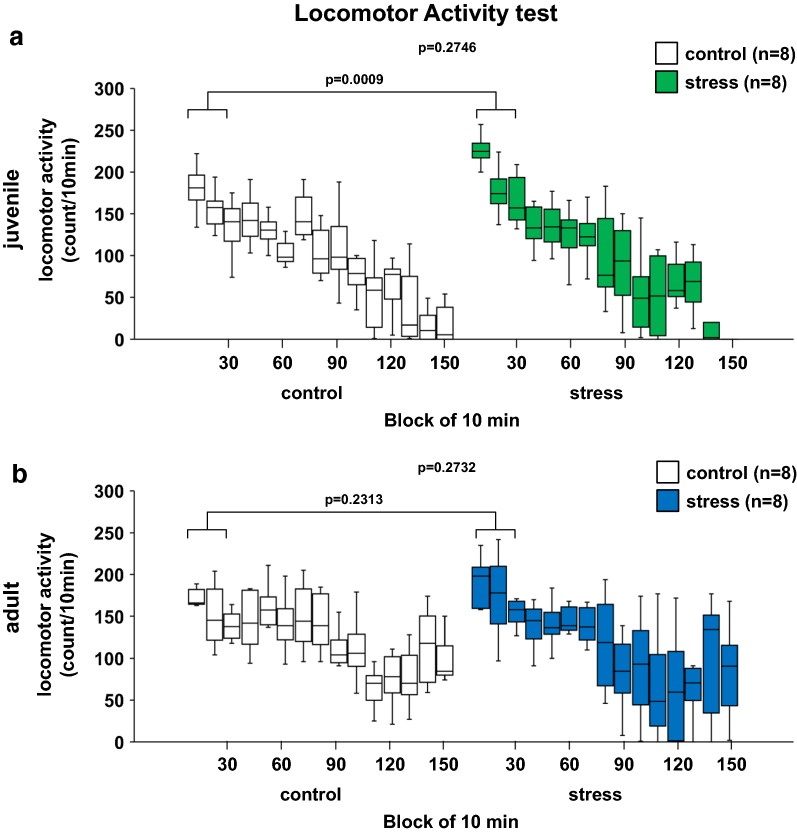
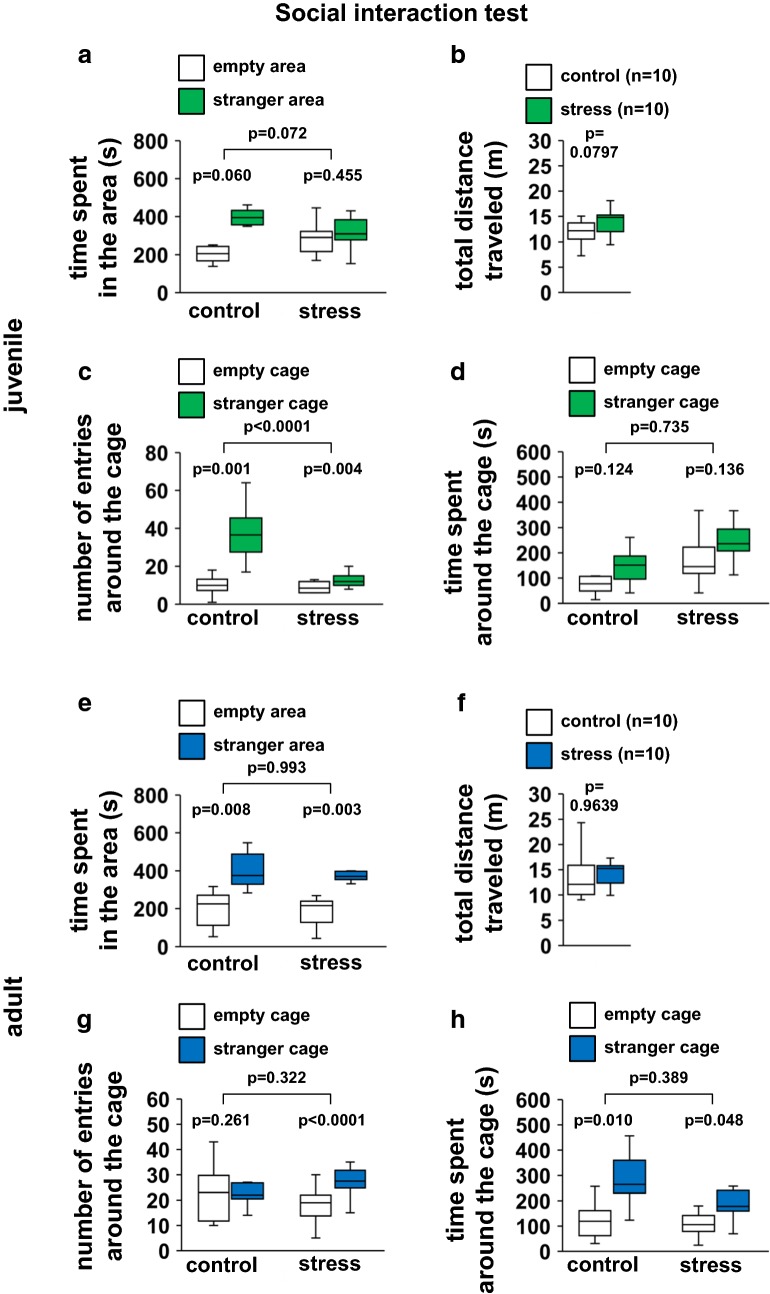
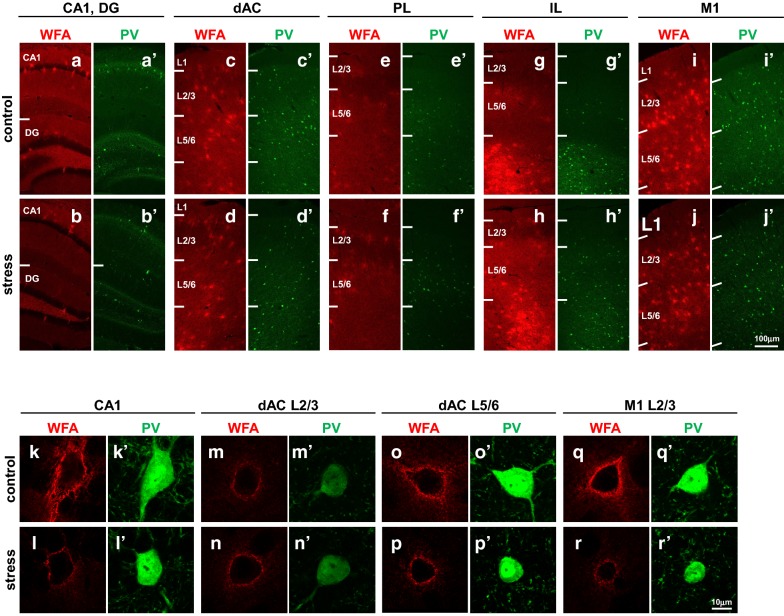
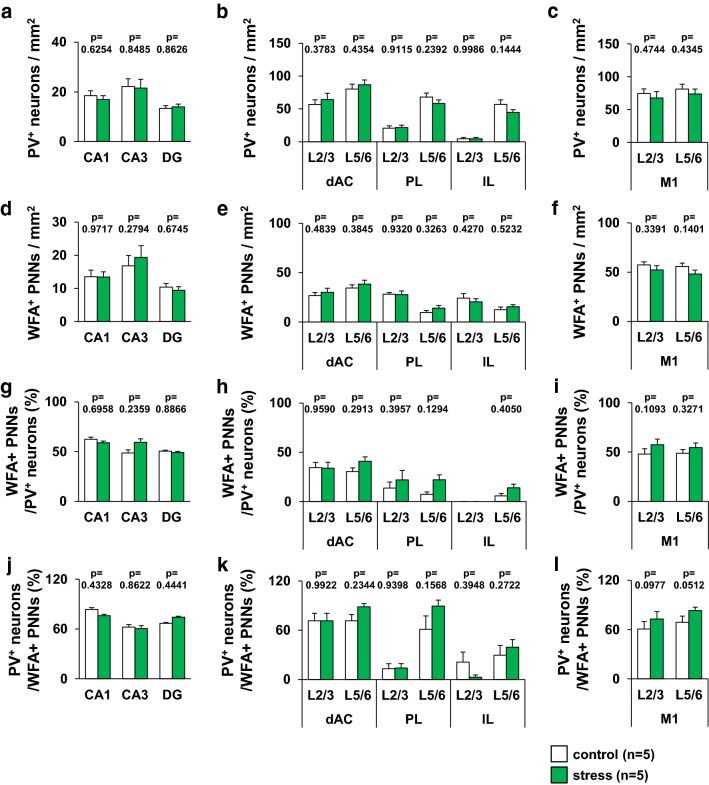
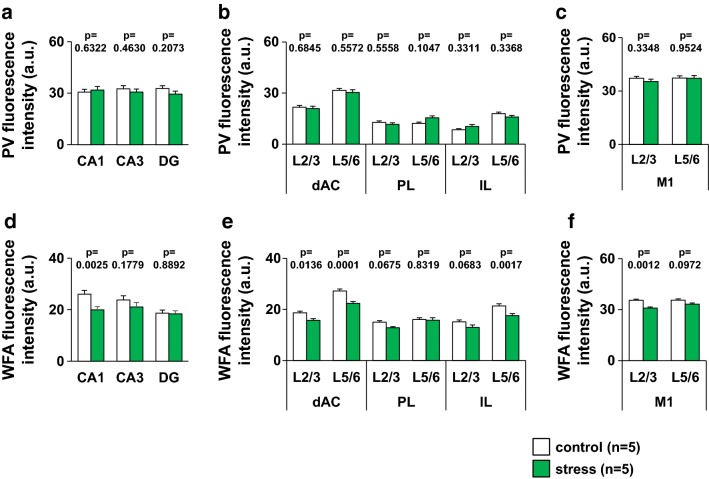
BACKGROUND: Many neuropsychiatric disorders develop in early life. Although the mechanisms involved have not been elucidated, it is possible that functional abnormalities of parvalbumin-positive interneurons (PV neurons) are present. Several previous studies have shown that juvenile stress is implicated in the development of neuropsychiatric disorders. We aimed to clarify the effects of juvenile stress on behavior and on the central nervous system. We investigated behavioral abnormalities of chronically-stressed mice during juvenilehood and the effect of juvenile stress on PV neurons and WFA-positive perineuronal nets (PNNs), which are associated with vulnerability and plasticity in the mouse brain. RESULTS: Due to juvenile stress, mice showed neurodevelopmental disorder-like behavior. Juvenile stressed mice did not show depressive-like behaviors, but on the contrary, they showed increased activity and decreased anxiety-like behavior. In the central nervous system of juvenile stressed mice, the fluorescence intensity of WFA-positive PNNs decreased, which may signify increased vulnerability. CONCLUSION: This study suggested that juvenile stressed mice showed behavioral abnormalities, resembling those seen in neuropsychiatric disorders, and increased brain vulnerability.
Overview
The claims and statistics of this paper haven’t been checked yet.
Free: it reads the open-access text and checks the first 5 claims that cite a source we can check. Create a free account to check every claim.
Integrity signals
Registry
Cites
Statistics
Figures
Verification
Claims the paper makes
The claims and statistics of this paper haven’t been checked yet.
Free: it reads the open-access text and checks the first 5 claims that cite a source we can check. Create a free account to check every claim.
Claims other papers make about this one
Each is checked against this paper’s own text: does it say what the citing paper says it does?
The cited source says what the claim attributes to it.
In the citing paper
“suggesting that PNNs may be disrupted in MDD, similar to SZ.”
From Mechanisms of synaptic transmission dysregulation in the prefrontal cortex: pathophysiological implications (2022) · cites this paper as [219]
In the citing paper
“The density of PNNs is also reduced in PFC of stressed mice 219 and rats 220”
From Mechanisms of synaptic transmission dysregulation in the prefrontal cortex: pathophysiological implications (2022) · cites this paper as [219]
Self-check
Percentages, sums and reported differences re-computed from the paper’s own numbers.
The self-check needs the paper’s full text.
Citations
Cites
Kessler, R. C., Berglund, P., Demler, O., Jin, R., Merikangas, K. R., & Walters, E. E. (2005) · Archives of General Psychiatry · doi:10.1001/archpsyc.62.6.593 · Cited by 20,391
Shrestha, S., & Offer, S. M. (2016) · Medical Epigenetics · doi:10.1159/000444713 · Cited by 8,914
The adolescent brain and age-related behavioral manifestations
Spear, L. P. (2000) · Neuroscience & Biobehavioral Reviews · doi:10.1016/s0149-7634(00)00014-2 · Cited by 5,433
Prevalence and development of psychiatric disorders in childhood and adolescence
Costello, E. J., Mustillo, S., Erkanli, A., Keeler, G., & Angold, A. (2003) · Archives of General Psychiatry · doi:10.1001/archpsyc.60.8.837 · Cited by 4,035
Personality Development: Stability and Change
Caspi, A., Roberts, B. W., & Shiner, R. L. (2005) · Annual Review of Psychology · doi:10.1146/annurev.psych.55.090902.141913 · Cited by 2,699
Parvalbumin neurons and gamma rhythms enhance cortical circuit performance
Sohal, V. S., Zhang, F., Yizhar, O., & Deisseroth, K. (2009) · Nature · doi:10.1038/nature07991 · Cited by 2,606
Causal Relationship Between Stressful Life Events and the Onset of Major Depression
Kendler, K. S., Karkowski, L. M., & Prescott, C. A. (1999) · American Journal of Psychiatry · doi:10.1176/ajp.156.6.837 · Cited by 2,566
Critical period plasticity in local cortical circuits
Hensch, T. K. (2005) · Nature Reviews Neuroscience · doi:10.1038/nrn1787 · Cited by 2,323
Semple, B. D., Blomgren, K., Gimlin, K., Ferriero, D. M., & Noble-Haeusslein, L. J. (2013) · Progress in Neurobiology · doi:10.1016/j.pneurobio.2013.04.001 · Cited by 2,132
The neurobiology of stress and development.
Gunnar, M., & Quevedo, K. (2007) · Annual Review of Psychology · doi:10.1146/annurev.psych.58.110405.085605 · Cited by 2,011
Research works printed but not linked: 3
- Slaker M Blacktop JM Sorg BA Caught in the net: perineuronal nets and addiction Neural Plast 2016 2016 7538208 10.1155/2016/7538208 26904301 PMC4745418 · DOI · Paper page
- Jeong JY Lee DH Kang SS Effects of chronic restraint stress on body weight, food intake, and hypothalamic gene expressions in mice Endocrinol Metab (Seoul) 2013 28 288 296 10.3803/EnM.2013.28.4.288 24396694 PMC3871039 · DOI · Paper page
- Yoshioka N Miyata S Tamada A Watanabe Y Kawasaki A Kitagawa H Takao K Miyakawa T Takeuchi K Igarashi M Abnormalities in perineuronal nets and behavior in mice lacking CSGalNAcT1, a key enzyme in chondroitin sulfate synthesis Mol. Brain. 2017 10 47 10.1186/s13041-017-0328-5 28982363 PMC5629790 · DOI · Paper page
Cited by
Yan, Z., & Rein, B. (2022) · Molecular Psychiatry · doi:10.1038/s41380-021-01092-3 · Cited by 300
The extracellular matrix and perineuronal nets in memory
Fawcett, J. W., Fyhn, M., Jendelova, P., Kwok, J. C. F., Ruzicka, J., & Sorg, B. A. (2022) · Molecular Psychiatry · doi:10.1038/s41380-022-01634-3 · Cited by 169
Wingert, J. C., & Sorg, B. A. (2021) · Frontiers in Synaptic Neuroscience · doi:10.3389/fnsyn.2021.673210 · Cited by 129
Parvalbumin interneuron alterations in stress-related mood disorders: A systematic review
Perlman, G., Tanti, A., & Mechawar, N. (2021) · Neurobiology of Stress · doi:10.1016/j.ynstr.2021.100380 · Cited by 81
Tanti, A., Belliveau, C., Nagy, C., Maitra, M., Denux, F., Perlman, K., Chen, F. Y., Mpai, R., Canonne, C., Théberge, S., et al. (2021) · Molecular Psychiatry · doi:10.1038/s41380-021-01372-y · Cited by 78
Metadata
- Authors
- Ueno, H., Suemitsu, S., Murakami, S., Kitamura, N., Wani, K., Matsumoto, Y., Okamoto, M., Aoki, S., & Ishihara, T.
- Affiliations
- Okayama University (JP)
- Kawasaki Medical School (JP)
- Corresponding author
- Ueno, Hiroshi
- Venue
- BMC Neuroscience
- Published
- 2018-07-16
- Volume
- 19
- Issue
- 1
- Pages
- 41-41
- ISSN
- 1471-2202 (ISSN-L)
- PMC
- PMC6048828
- OpenAlex
- W2884314696
- Cited by
- 39
- References
- 129
- Citations by year
- 2025: 4 · 2024: 5 · 2023: 6 · 2022: 7 · 2021: 8 · 2020: 6 · 2019: 3
- FWCI
- 2.45
- Type
- journal article
- Language
- en
- Open access
- gold
- doi.org
- Licence
- cc-by
- creativecommons.org/licenses/by/4.0/ (tdm)
- Locations
- BMC Neuroscience (publishedVersion, cc-by)
- Europe PMC (PubMed Central) (publishedVersion, cc-by)
- PubMed Central (publishedVersion, cc-by)
- PubMed (publishedVersion)
- DOAJ (DOAJ: Directory of Open Access Journals) (submittedVersion, cc-by-sa)
- Funders
- Kawasaki Medical School
- Topics
- Life Sciences › Neuroscience › Behavioral Neuroscience › Stress Responses and Cortisol
- Life Sciences › Neuroscience › Cellular and Molecular Neuroscience › Neuroscience and Neuropharmacology Research
- Life Sciences › Neuroscience › Developmental Neuroscience › Neurogenesis and neuroplasticity mechanisms
- Keywords
- juvenile stress, perineuronal nets, parvalbumin interneurons, anxiety-like behavior, neurodevelopmental disorders, neuropsychiatric disorders, brain vulnerability, chronic stress, behavioral abnormalities
- MeSH terms
- Aging, Animals, Behavior, Animal, Extracellular Matrix, Hippocampus, Interneurons, Male, Mice, Inbred C57BL, Nerve Net, Parvalbumins, Stress, Physiological, GABAergic Neurons
About these checks
Registry, retraction, Cites and statistics results are computed, not judged, with one exception: a printed reference that no index lists is read once by a model before it counts as a citation error. Claims are extracted by a model and kept only when their quote appears verbatim in the text; each cited source is then checked, with a model’s help, for whether it says what the claim relies on. Those verdicts can be wrong — read the claim’s quote and the cited source before relying on one.
Statistics and arithmetic are recomputed, not judged.
Confidence bands are shown only for fields calibrated on our annotated test set. None is calibrated yet, so no band is shown.
What counts as a claim ›How we measure confidence ›How we check this ›
Are you an author, or do you see a problem with this page? Request a review
Data sources
Bibliographic data: Semantic Scholar, OpenAlex, Crossref.
Contains information from the Semantic Scholar Academic Graph Datasets, made available under the ODC Attribution License (ODC-BY 1.0).
Semantic Scholar’s data is described in: Kinney, R., et al. (2023). The Semantic Scholar Open Data Platform. arXiv:2301.10140.
