

The DOI matches its Crossref record; 51 of the 52 references it cites were found in a registry or an index.
Propofol vs. inhalational agents to maintain general anaesthesia in ambulatory and in-patient surgery: a systematic review and meta-analysis
Open accessAbstract
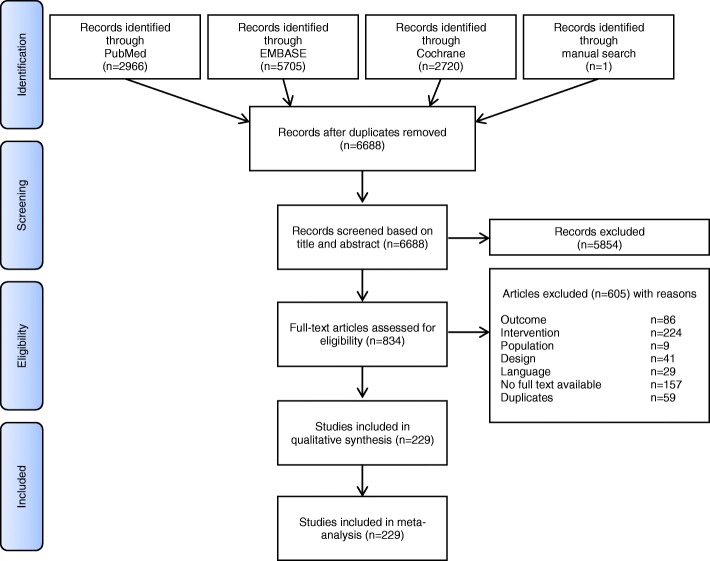
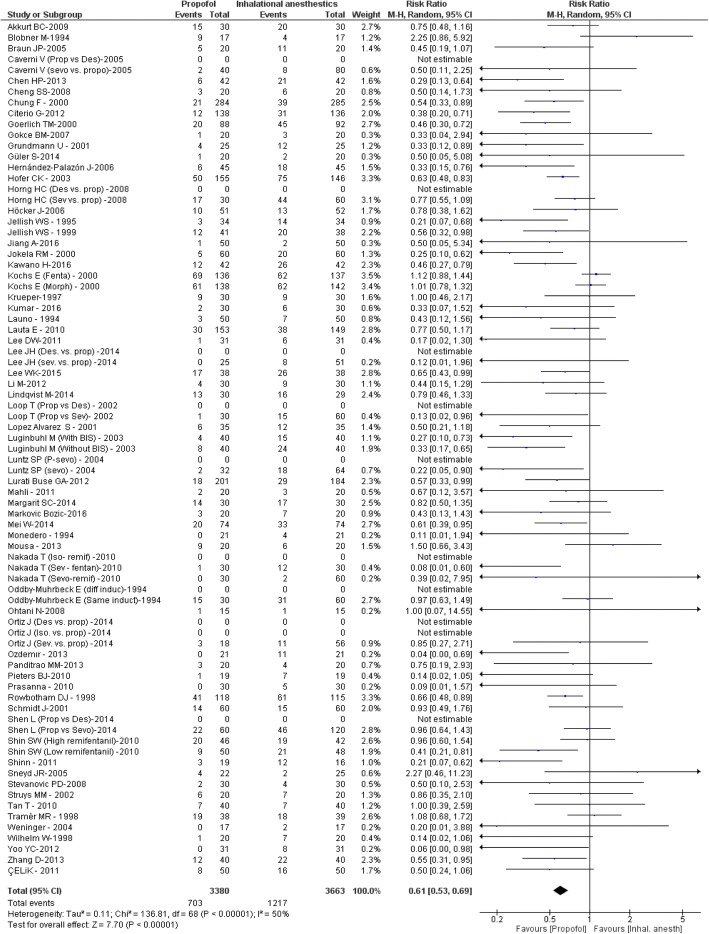
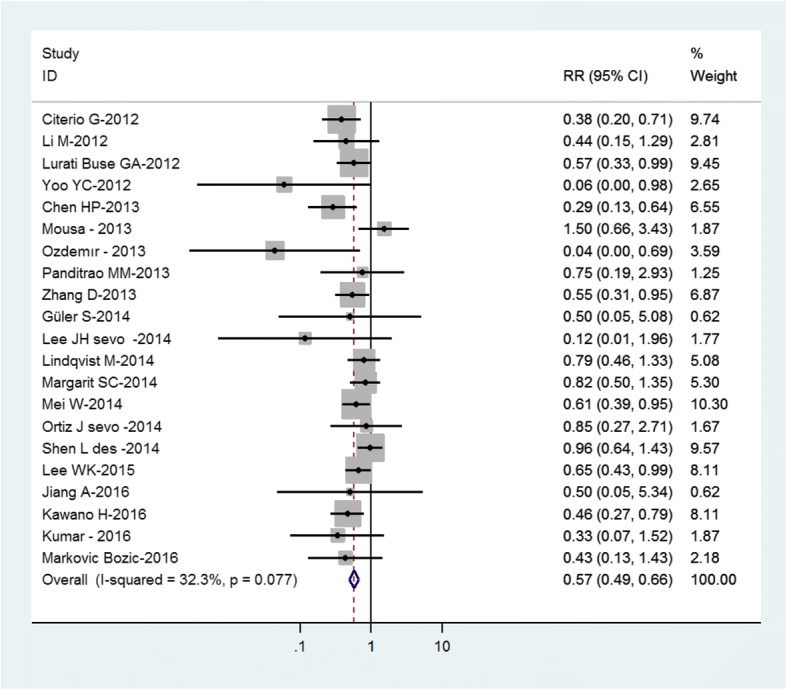
BACKGROUND: It is unclear if anaesthesia maintenance with propofol is advantageous or beneficial over inhalational agents. This study is intended to compare the effects of propofol vs. inhalational agents in maintaining general anaesthesia on patient-relevant outcomes and patient satisfaction. METHODS: Studies were identified by electronic database searches in PubMed™, EMBASE™ and the Cochrane™ library between 01/01/1985 and 01/08/2016. Randomized controlled trials (RCTs) of peer-reviewed journals were studied. Of 6688 studies identified, 229 RCTs were included with a total of 20,991 patients. Quality control, assessment of risk of bias, meta-bias, meta-regression and certainty in evidence were performed according to Cochrane. Common estimates were derived from fixed or random-effects models depending on the presence of heterogeneity. Post-operative nausea and vomiting (PONV) was the primary outcome. Post-operative pain, emergence agitation, time to recovery, hospital length of stay, post-anaesthetic shivering and haemodynamic instability were considered key secondary outcomes. RESULTS: The risk for PONV was lower with propofol than with inhalational agents (relative risk (RR) 0.61 [0.53, 0.69], p < 0.00001). Additionally, pain score after extubation and time in the post-operative anaesthesia care unit (PACU) were reduced with propofol (mean difference (MD) - 0.51 [- 0.81, - 0.20], p = 0.001; MD - 2.91 min [- 5.47, - 0.35], p = 0.03). In turn, time to respiratory recovery and tracheal extubation were longer with propofol than with inhalational agents (MD 0.82 min [0.20, 1.45], p = 0.01; MD 0.70 min [0.03, 1.38], p = 0.04, respectively). Notably, patient satisfaction, as reported by the number of satisfied patients and scores, was higher with propofol (RR 1.06 [1.01, 1.10], p = 0.02; MD 0.13 [0.00, 0.26], p = 0.05). Secondary analyses supported the primary results. CONCLUSIONS: Based on the present meta-analysis there are several advantages of anaesthesia maintenance with propofol over inhalational agents. While these benefits result in an increased patient satisfaction, the clinical and economic relevance of these findings still need to be addressed in adequately powered prospective clinical trials.
Overview
The claims and statistics of this paper haven’t been checked yet.
Run the check — free, no account needed. It reads the open-access text and checks the sources it cites.
Integrity signals
Registry
Cites
Statistics
Figures
Verification
Claims the paper makes
The claims and statistics of this paper haven’t been checked yet.
Run the check — free, no account needed. It reads the open-access text and checks the sources it cites.
Claims other papers make about this one
Each is checked against this paper’s own text: does it say what the citing paper says it does?
The cited source says what the claim attributes to it.
In the citing paper
“Compared with inhalational anesthesia, TIVA reduces the risk of postoperative nausea and vomiting, pain scores after extubation, and duration of in postoperative anesthesia care unit stay; on the other hand, it prolongs the time to respiratory recovery and tracheal extubation.69”
From A call for immediate climate action in anesthesiology: routine use of minimal or metabolic fresh gas flow reduces our ecological footprint (2023) · cites this paper as [69]
Self-check
Percentages, sums and reported differences re-computed from the paper’s own numbers.
The self-check needs the paper’s full text.
Citations
Cites
Preferred Reporting Items for Systematic Reviews and Meta-Analyses: the PRISMA statement
Moher, D., Liberati, A., Tetzlaff, J., Altman, D. G., & for the PRISMA Group (2009) · BMJ · doi:10.1136/bmj.b2535 · Cited by 83,823
Preferred Reporting Items for Systematic Reviews and Meta-Analyses: The PRISMA Statement
Moher, D., Liberati, A., Tetzlaff, J., Altman, D. G., & The PRISMA Group (2009) · PLoS Medicine · doi:10.1371/journal.pmed.1000097 · Cited by 64,042
Preferred reporting items for systematic reviews and meta-analyses: the PRISMA Statement.
(2009) · PubMed Central · Cited by 44,859
Meta-analysis in clinical trials
DerSimonian, R., & Laird, N. (1986) · Controlled Clinical Trials · doi:10.1016/0197-2456(86)90046-2 · Cited by 39,552
PRISMA-P Group, Moher, D., Shamseer, L., Clarke, M., Ghersi, D., Liberati, A., Petticrew, M., Shekelle, P., & Stewart, L. A. (2015) · Systematic Reviews · doi:10.1186/2046-4053-4-1 · Cited by 26,223
GRADE: an emerging consensus on rating quality of evidence and strength of recommendations
Guyatt, G. H., Oxman, A. D., Vist, G. E., Kunz, R., Falck-Ytter, Y., Alonso-Coello, P., & Schünemann, H. J. (2008) · BMJ · doi:10.1136/bmj.39489.470347.ad · Cited by 23,305
Wang, G., Ma, R., Qiao, G., Wada, K., Aizawa, Y., & Satoh, T. (2015) · Integrative Medicine International · doi:10.1159/000368408 · Cited by 18,762
Wan, X., Wang, W., Liu, J., & Tong, T. (2014) · BMC Medical Research Methodology · doi:10.1186/1471-2288-14-135 · Cited by 11,735
An estimation of the global volume of surgery: a modelling strategy based on available data
Weiser, T. G., Regenbogen, S. E., Thompson, K. D., Haynes, A. B., Lipsitz, S. R., Berry, W. R., & Gawande, A. A. (2008) · The Lancet · doi:10.1016/s0140-6736(08)60878-8 · Cited by 2,579
A Factorial Trial of Six Interventions for the Prevention of Postoperative Nausea and Vomiting
Apfel, C. C., Korttila, K. T., Abdalla, M., Kerger, H., Turan, A., Vedder, I., Zernak, C., Danner, K., Jokela, R. M., Pocock, S., et al. (2004) · New England Journal of Medicine · doi:10.1056/nejmoa032196 · Cited by 1,550
Cited by
Sorted by citations
Fourth Consensus Guidelines for the Management of Postoperative Nausea and Vomiting
Gan, T. J., Belani, K. G., Bergese, S. D., Chung, F. F., Diemunsch, P. A., Habib, A. S., Jin, Z., Kovac, A. L., Meyer, T. A., Urman, R. D., et al. (2020) · Anesthesia & Analgesia · doi:10.1213/ane.0000000000004833 · Cited by 1,307
The Surgical Stress Response and Anesthesia: A Narrative Review
Ivaşcu, R., Torsin, L. I., Hostiuc, L., Niţipir, C., Corneci, D. E., & Duţu, M. (2024) · Journal of Clinical Medicine · doi:10.3390/jcm13103017 · Cited by 178
Irani, J., Hedrick, T. L., Miller, T. E., Lee, L., Steinhagen, E. F., Shogan, B. D., Goldberg, J. E., Feingold, D. L., Lightner, A. L., & Paquette, I. M. (2022) · Surgical Endoscopy · doi:10.1007/s00464-022-09758-x · Cited by 161
Irani, J., Hedrick, T. L., Miller, T. E., Lee, L., Steinhagen, E. F., Shogan, B. D., Goldberg, J. E., Feingold, D. L., Lightner, A. L., & Paquette, I. M. (2022) · Diseases of the Colon & Rectum · doi:10.1097/dcr.0000000000002650 · Cited by 140
Jin, Z., Gan, T. J., & Bergese, S. D. (2020) · Therapeutics and Clinical Risk Management · doi:10.2147/tcrm.s256234 · Cited by 95
Metadata
- Authors
- Schraag, S., Pradelli, L., Alsaleh, A. J. O., Bellone, M., Ghetti, G., Chung, T. L., Westphal, M., & Rehberg, S.
- Affiliations
- Golden Jubilee National Hospital (GB)
- Fresenius (Germany) (DE)
- University Hospital Münster (DE)
- Universitätsmedizin Greifswald (DE)
- Corresponding author
- Schraag, Stefan
- Venue
- BMC Anesthesiology
- Published
- 2018-11-08
- Volume
- 18
- Issue
- 1
- Pages
- 162-162
- ISSN
- 1471-2253 (ISSN-L)
- PMC
- PMC6225663
- OpenAlex
- W2899852599
- Cited by
- 194
- References
- 52
- Citations by year
- 2026: 25 · 2025: 23 · 2024: 29 · 2023: 21 · 2022: 25 · 2021: 38 · 2020: 25 · 2019: 8
- FWCI
- 4.36
- Type
- journal article
- Language
- en
- Open access
- gold
- doi.org
- Licence
- Locations
- BMC Anesthesiology (publishedVersion, cc-by)
- Europe PMC (PubMed Central) (publishedVersion, other-oa)
- PubMed Central (publishedVersion, cc-by)
- PubMed (publishedVersion)
- DOAJ (DOAJ: Directory of Open Access Journals) (submittedVersion, cc-by-sa)
- Funders
- Fresenius Kabi (Not applicable)
- Topics
- Health Sciences › Medicine › Anesthesiology and Pain Medicine › Anesthesia and Sedative Agents
- Health Sciences › Medicine › Anesthesiology and Pain Medicine › Anesthesia and Pain Management
- Health Sciences › Medicine › Surgery › Nausea and vomiting management
- Keywords
- propofol, inhalational anesthetics, postoperative nausea and vomiting, postoperative pain, emergence agitation, recovery time, extubation, patient satisfaction, outpatient surgery, inpatient surgery, hemodynamic instability, length of hospital stay, patient safety
- MeSH terms
- Ambulatory Surgical Procedures, Anesthesia, General, Hospitalization, Humans, Pain, Postoperative, Postoperative Pain, Propofol, Randomized Controlled Trials as Topic, Anesthetics, Inhalation, Anesthetics, Intravenous
About these checks
Registry, retraction, Cites and statistics results are computed, not judged, with one exception: a printed reference that no index lists is read once by a model before it counts as a citation error. Claims are extracted by a model and kept only when their quote appears verbatim in the text; each cited source is then checked, with a model’s help, for whether it says what the claim relies on. Those verdicts can be wrong — read the claim’s quote and the cited source before relying on one.
Statistics and arithmetic are recomputed, not judged.
Confidence bands are shown only for fields calibrated on our annotated test set. None is calibrated yet, so no band is shown.
What counts as a claim ›How we measure confidence ›How we check this ›
Are you an author, or do you see a problem with this page? Request a review
