

Classification and prevalence of spin in abstracts of non-randomized studies evaluating an intervention
Open accessThe DOI matches its Crossref record; 38 of the 38 references it cites were found in a registry or an index.
Abstract
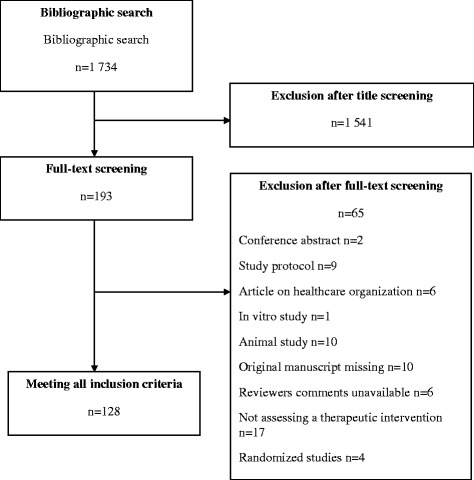
BACKGROUND: Spin represents specific reporting strategies, either intentional or unintentional, to convince the reader that the beneficial effect of the experimental intervention in terms of efficacy and safety is greater than that shown by the results. The objectives of this study were to 1) develop a classification of spin specific to non-randomized studies assessing an intervention and 2) estimate the prevalence of spin in abstracts of reports of such studies. METHODS: In a first step, we developed a specific classification of spin for non-randomized studies by a literature review and pilot study. In a second step, 2 researchers trained in the field of methodology evaluated the prevalence of spin in the abstract of all non-randomized studies assessing an intervention published in the BioMed Central Medical Series journals between January 1, 2011 and December 31, 2013. All disagreements were resolved by consensus. We also determined whether the level of spin in abstract conclusions was high (spin reported without uncertainty or recommendations for further trials), moderate (spin reported with some uncertainty or recommendations for further trials) or low (spin reported with uncertainty and recommendations for further trials). RESULTS: Among the 128 assessed articles assessed, 107 (84%) had at least one example of spin in their abstract. The most prevalent strategy of spin was the use of causal language, identified in 68 (53%) abstracts. Other frequent strategies were linguistic spin, inadequate implications for clinical practice, and lack of focus on harm, identified in 33 (26%), 25 (20%), and 34 (27%) abstracts respectively. Abstract conclusions of 61 (48%) articles featured a high level of spin. CONCLUSION: Abstract of reports of non-randomized studies assessing an intervention frequently includes spin. Efforts to reduce the prevalence of spin in abstract for such studies are needed.
Overview
The claims and statistics of this paper haven’t been checked yet.
Free: it reads the open-access text and checks the first 5 claims that cite a source we can check. Create a free account to check every claim.
Integrity signals
Registry
Cites
Statistics
Figures
Verification
Claims the paper makes
The claims and statistics of this paper haven’t been checked yet.
Free: it reads the open-access text and checks the first 5 claims that cite a source we can check. Create a free account to check every claim.
Claims other papers make about this one
Each is checked against this paper’s own text: does it say what the citing paper says it does?
The source backs part of the claim, not all of it — or backs it for a different population, condition or comparison.
In the citing paper
“Moreover, their capacity to detect errors [10, 11], identify deficiencies in reporting [12] and spin [13] has been found lacking.”
From Tools used to assess the quality of peer review reports: A methodological systematic review (2019) · cites this paper as [13]
Experimental — accuracy not yet measuredIn the citing paper
“There are several ways to spin a report (4, 6, 8–10).”
From Misrepresentation and distortion of research in biomedical literature (2018) · cites this paper as [10]
In the citing paper
“Specific classifications of spin have been developed for different study designs and contexts [randomized controlled trials with nonstatistically significant results (4), observational studies evaluating an intervention (10), diagnostic accuracy studies (8), systematic reviews (9)].”
From Misrepresentation and distortion of research in biomedical literature (2018) · cites this paper as [10]
Self-check
Percentages, sums and reported differences re-computed from the paper’s own numbers.
The self-check needs the paper’s full text.
Citations
Cites
Boutron, I. (2010) · JAMA · doi:10.1001/jama.2010.651 · Cited by 842 · cited 2×
“To develop the classification of spin, we performed a literature review of studies of spin for other study designs [3 – 5, 9, 11] as well as studies of distorted presentation and interpretation of findings from non-randomized studies [12 – 19].”
Self-citationComparison of Registered and Published Primary Outcomes in Randomized Controlled Trials
Mathieu, S. (2009) · JAMA · doi:10.1001/jama.2009.1242 · Cited by 730 · cited 1×
“To develop the classification of spin, we performed a literature review of studies of spin for other study designs [3 – 5, 9, 11] as well as studies of distorted presentation and interpretation of findings from non-randomized studies [12 – 19].”
Chan, A.-W., & Altman, D. G. (2005) · BMJ · doi:10.1136/bmj.38356.424606.8f · Cited by 613
When are observational studies as credible as randomised trials?
Vandenbroucke, J. P. (2004) · The Lancet · doi:10.1016/s0140-6736(04)16261-2 · Cited by 538 · cited 1×
“Particularly, contrary to randomized clinical trials, they may not allow for establishing causal inferences but rather, only an association [8 – 10].”
Boutron, I., Altman, D. G., Hopewell, S., Vera-Badillo, F., Tannock, I., & Ravaud, P. (2014) · Journal of Clinical Oncology · doi:10.1200/jco.2014.56.7503 · Cited by 368
Self-citationCausation in epidemiology: Table 1
Parascandola, M., & Weed, D. L. (2001) · Journal of Epidemiology and Community Health · doi:10.1136/jech.55.12.905 · Cited by 276 · cited 2×
“Particularly, contrary to randomized clinical trials, they may not allow for establishing causal inferences but rather, only an association [8 – 10].”
Comparisons against baseline within randomised groups are often used and can be highly misleading
Bland, J. M., & Altman, D. G. (2011) · Trials · doi:10.1186/1745-6215-12-264 · Cited by 241
Effect of interpretive bias on research evidence
Kaptchuk, T. J. (2003) · BMJ · doi:10.1136/bmj.326.7404.1453 · Cited by 222 · cited 1×
“This situation is problematic because it has been demonstrated [6] that spin in the abstract conclusions of randomized controlled trial reports could bias the interpretation of the results by clinicians [29].”
Overinterpretation and Misreporting of Diagnostic Accuracy Studies: Evidence of “Spin”
Ochodo, E. A., de Haan, M. C., Reitsma, J. B., Hooft, L., Bossuyt, P. M., & Leeflang, M. M. G. (2013) · Radiology · doi:10.1148/radiol.12120527 · Cited by 158 · cited 1×
“Spin was found in more than half of the abstract conclusions of randomized controlled trials with statistically non-significant results for the primary outcome [3]; moreover, one third of reports of diagnostic accuracy studies contained a form of over-interpretation [4].”
Brown, A. W., Bohan Brown, M. M., & Allison, D. B. (2013) · The American Journal of Clinical Nutrition · doi:10.3945/ajcn.113.064410 · Cited by 155 · cited 1×
“Brown et al. [32] evidenced a 26 % to 50 % rate of studies ascribing greater inferential strength than the study design warranted.”
MabsBase: A Mycobacterium abscessus Genome and Annotation Database
Heydari, H., Wee, W. Y., Lokanathan, N., Hari, R., Mohamed Yusoff, A., Beh, C. Y., Yazdi, A. H., Wong, G. J., Ngeow, Y. F., & Choo, S. W. (2013) · PLoS ONE · doi:10.1371/journal.pone.0062443 · Cited by 151
Horton, R. (1995) · BMJ · doi:10.1136/bmj.310.6985.985 · Cited by 132 · cited 1×
“Spin, or distortion of study findings, can be used by authors to enhance their study findings more than the results justify [1, 2].”
Vera-Badillo, F. E., Shapiro, R., Ocana, A., Amir, E., & Tannock, I. F. (2013) · Annals of Oncology · doi:10.1093/annonc/mds636 · Cited by 117 · cited 2×
“To develop the classification of spin, we performed a literature review of studies of spin for other study designs [3 – 5, 9, 11] as well as studies of distorted presentation and interpretation of findings from non-randomized studies [12 – 19].”
Chan, K. B. Y., Man‐Son‐Hing, M., Molnar, F., & Laupacis, A. (2001) · Europe PMC (PubMed Central) · Cited by 102
"Spin" in scientific writing: scientific mischief and legal jeopardy.
Fletcher, R. H., & Black, B. (2007) · PubMed · Cited by 100
Briones Claudett, K. H., Briones Claudett, M., Chung Sang Wong, M., Nuques Martinez, A., Soto Espinoza, R., Montalvo, M., Esquinas Rodriguez, A., Gonzalez Diaz, G., & Grunauer Andrade, M. (2013) · BMC Pulmonary Medicine · doi:10.1186/1471-2466-13-12 · Cited by 97
Internet-based cognitive behavior therapy for obsessive compulsive disorder: A pilot study
Andersson, E., Ljótsson, B., Hedman, E., Kaldo, V., Paxling, B., Andersson, G., Lindefors, N., & Rück, C. (2011) · BMC Psychiatry · doi:10.1186/1471-244x-11-125 · Cited by 94 · cited 1×
“with therapist support reduces [obsessive-compulsive disorder] OCD symptoms, depressive symptoms and improves general functioning” [27], with no report of the lack of improvement in quality of life found in this study).”
Use of causal language in observational studies of obesity and nutrition
Cofield, S. S., Corona, R. V., & Allison, D. B. (2010) · Obesity Facts · doi:10.1159/000322940 · Cited by 74 · cited 2×
“[30] observed a 31 % rate of causal language in a series of 525 peer-reviewed papers on obesity and nutrition.”
Can the Learning Health Care System Be Educated With Observational Data?
Dahabreh, I. J., & Kent, D. M. (2014) · JAMA · doi:10.1001/jama.2014.4364 · Cited by 71
The effect of scientific misconduct on the results of clinical trials: A Delphi survey
Al-Marzouki, S., Roberts, I., Marshall, T., & Evans, S. (2005) · Contemporary Clinical Trials · doi:10.1016/j.cct.2005.01.011 · Cited by 70 · cited 1×
“To develop the classification of spin, we performed a literature review of studies of spin for other study designs [3–5, 9, 11] as well as studies of distorted presentation and interpretation of findings from non-randomized studies [12–19].”
Why do the results of randomised and observational studies differ?
Vandenbroucke, J. P. (2011) · BMJ · doi:10.1136/bmj.d7020 · Cited by 65 · cited 1×
“To develop the classification of spin, we performed a literature review of studies of spin for other study designs [3 – 5, 9, 11] as well as studies of distorted presentation and interpretation of findings from non-randomized studies [12 – 19].”
Causality in complex interventions
Rickles, D. P. (2008) · Medicine Health Care and Philosophy · doi:10.1007/s11019-008-9140-4 · Cited by 59 · cited 2×
“To develop the classification of spin, we performed a literature review of studies of spin for other study designs [3 – 5, 9, 11] as well as studies of distorted presentation and interpretation of findings from non-randomized studies [12 – 19].”
Listen to the data when results are not significant
Hewitt, C. E., Mitchell, N., & Torgerson, D. J. (2008) · BMJ · doi:10.1136/bmj.39379.359560.ad · Cited by 57
Svensson, B., Markström, U., Bejerholm, U., Björkman, T., Brunt, D., Eklund, M., Hansson, L., Leufstadius, C., Gyllensten, A. L., Sandlund, M., et al. (2011) · BMC Psychiatry · doi:10.1186/1471-244x-11-11 · Cited by 47
Inatomi, O., Bamba, S., Shioya, M., Mochizuki, Y., Ban, H., Tsujikawa, T., Saito, Y., Andoh, A., & Fujiyama, Y. (2013) · BMC Gastroenterology · doi:10.1186/1471-230x-13-31 · Cited by 42 · cited 1×
“…implications for clinical practice occurred mainly when authors extrapolated some recommendations for clinical practice from their results (e.g., in a retrospective study of 42 patients: “ it is a suitable therapeutic option not only for initial drainage but also for salvage therapy ” [26]).”
Kohli, P., & Cannon, C. P. (2012) · Clinical Cardiology · doi:10.1002/clc.22066 · Cited by 37 · cited 1×
“In 2012, journal editors of the HEART Group published an editorial review about “ the importance of matching language to type of evidence ” [34] and concluded with a plea to investigators and editors to “ carefully select language used during reporting to match the type of study conducted.”
Romeiro, F. G., Yamashiro, F. D. S., Américo, M. F., Corá, L. A., Silva, G. F., Miranda, J. R. D. A., & Caramori, C. A. (2013) · BMC Gastroenterology · doi:10.1186/1471-230x-13-13 · Cited by 31
Hernandez, A. V., Pasupuleti, V., Deshpande, A., Thota, P., Collins, J. A., & Vidal, J. E. (2013) · PLoS ONE · doi:10.1371/journal.pone.0063272 · Cited by 29
Helbok, R., Shaker, E. H., Beer, R., Chemelli, A., Sojer, M., Sohm, F., Broessner, G., Lackner, P., Beck, M., Zangerle, A., et al. (2012) · BMC Neurology · doi:10.1186/1471-2377-12-32 · Cited by 29 · cited 1×
“…oxygen partial pressure in the brain tissue … in poor grade SAH [subarachnoid aneurismal hemorrhage] … patients with severe cerebral vasospasm ” [23] and in another prospective study including 22 patients, they stated “ [Bi-level positive airway pressure-spontaneous/timed] BiPAP S/T with AVAP…”
Tiamkao, S., Sawanyawisuth, K., & Chancharoen, A. (2013) · BMC Neurology · doi:10.1186/1471-2377-13-98 · Cited by 25 · cited 1×
“…54 patients, the authors reported “ Intravenous sodium val-proate is as effective as intravenous phenytoin as the first-line treatment in status epilepticus … with no significant cardiovascular compromise ” [28], despite more than twice as many deaths in the intravenous penytoin group (30 % vs 11”
On the causal structure of information bias and confounding bias in randomized trials
Shahar, E., & Shahar, D. J. (2009) · Journal of Evaluation in Clinical Practice · doi:10.1111/j.1365-2753.2009.01347.x · Cited by 23 · cited 1×
“Such designs, as opposed to randomized studies, do not allow for concluding a cause-and-effect link between the assessed intervention and the observed outcome but rather, provide information only about association [8, 30, 31].”
LI, L. C., Moja, L., Romero, A., Sayre, E. C., & Grimshaw, J. (2009) · Journal of Clinical Epidemiology · doi:10.1016/j.jclinepi.2008.10.008 · Cited by 23 · cited 1×
“” The rating of causal inference by researchers was assessed in a study of 38 randomized clinical trials and 35 non-randomized clinical trials [35].”
Macfadden, W., Adler, C. M., Turkoz, I., Haskins, J. T., Turner, N., & Alphs, L. D. (2011) · BMC Psychiatry · doi:10.1186/1471-244x-11-171 · Cited by 22 · cited 1×
“…causal language was used when authors stated only a co-occurrence between the intervention and the outcome (e.g., “ subjects with symptomatic bipolar disorders who relapse frequently showed improvements in each of these areas after treatment with RLAI [risperidone long-acting injection] ” [21]).”
Dekkers, O. M. (2011) · Preventive Medicine · doi:10.1016/j.ypmed.2011.08.003 · Cited by 19 · cited 1×
“We did not consider causal language as spin in studies using a propensity score or instrumental variables [22].”
Identifying spin in health management evaluations
Linden, A. (2011) · Journal of Evaluation in Clinical Practice · doi:10.1111/j.1365-2753.2010.01611.x · Cited by 15
Critical reading of epidemiological papers. A guide
Blettner, M., Heuer, C., & Razum, O. (2001) · European Journal of Public Health · doi:10.1093/eurpub/11.1.97 · Cited by 15 · cited 1×
“Causal claims in epidemiology are a cornerstone of the interpretation of results [33], especially for complex interventions for which randomization is difficult or impossible [11].”
Ito, H., Yamanaka, H., Hagiwara, M., Furuuchi, T., Matsumoto, K., Kanai, K., Kodaira, K., Ninomiya, A., & Nakamura, S. (2011) · BMC Urology · doi:10.1186/1471-2490-11-13 · Cited by 13 · cited 1×
“” [20]); 2) use of terms belonging to the semantic field of causal relationship (e.g., “ effective ” , “ improve ” , “ enhance ” ); or 3) use of a tone inferring a strong result (e.g., “ The results demonstrate ” or “ This study shows that ” ).”
Arnarsdottir, L., Hjalmarsson, C., Bokemark, L., & Andersson, B. (2012) · BMC Neurology · doi:10.1186/1471-2377-12-67 · Cited by 8 · cited 1×
“…662 patients, the authors stated “ a tendency towards lower all-cause mortality at 3 months with use of Aspirin + dipyramidol ” (p = 0.12) [25] and others used superla-tives or “ hype ” to highlight a beneficial effect of the intervention assessed (e.g., “ high potential, ” “ considerably…”
Influential
Cited by
‘Spin’ in published biomedical literature: A methodological systematic review
Chiu, K., Grundy, Q., & Bero, L. (2017) · PLOS Biology · doi:10.1371/journal.pbio.2002173 · Cited by 317
Misrepresentation and distortion of research in biomedical literature
Boutron, I., & Ravaud, P. (2018) · Proceedings of the National Academy of Sciences · doi:10.1073/pnas.1710755115 · Cited by 273
“In observational studies evaluating an intervention, spin was identified in the abstract’s conclusions in more than 80% of reports, the most frequent type of spin being the use of causal language (10).”
BackgroundSelf-citationVinkers, C. H., Tijdink, J. K., & Otte, W. M. (2015) · BMJ · doi:10.1136/bmj.h6467 · Cited by 237
Yavchitz, A., Ravaud, P., Altman, D. G., Moher, D., Hrobjartsson, A., Lasserson, T., & Boutron, I. (2016) · Journal of Clinical Epidemiology · doi:10.1016/j.jclinepi.2016.01.020 · Cited by 224
“, understate efficacy and/or overstate harm) because these types of spin were not considered in previous works about spin for other study designs [4,7,9,11].”
BackgroundSelf-citationBruce, R., Chauvin, A., Trinquart, L., Ravaud, P., & Boutron, I. (2016) · BMC Medicine · doi:10.1186/s12916-016-0631-5 · Cited by 218
“the study results [17–19].”
Self-citation
Metadata
- Authors
- Lazarus, C., Haneef, R., Ravaud, P., & Boutron, I.
- Affiliations
- Inserm (FR)
- Corresponding author
- Boutron, Isabelle
- Venue
- BMC Medical Research Methodology
- Published
- 2015-10-13
- Volume
- 15
- Issue
- 1
- Pages
- 85-85
- ISSN
- 1471-2288 (ISSN-L)
- PMC
- PMC4604617
- OpenAlex
- W1953064436
- Cited by
- 137
- References
- 38
- Citations by year
- 2026: 11 · 2025: 11 · 2024: 15 · 2023: 10 · 2022: 13 · 2021: 20 · 2020: 13 · 2019: 15 · 2018: 10 · 2017: 11 · 2016: 7 · 2015: 1
- FWCI
- 8.82
- Type
- journal article
- Language
- en
- Open access
- gold
- doi.org
- Licence
- Locations
- BMC Medical Research Methodology (publishedVersion, cc-by)
- Europe PMC (PubMed Central) (publishedVersion, cc-by)
- PubMed Central (publishedVersion, cc-by)
- PubMed (publishedVersion)
- Funders
- Assistance Publique - Hôpitaux de Paris
- Topics
- Social Sciences › Decision Sciences › Statistics, Probability and Uncertainty › Meta-analysis and systematic reviews
- Health Sciences › Nursing › Issues, ethics and legal aspects › Pharmaceutical industry and healthcare
- Social Sciences › Library and Information Sciences › Academic Publishing and Open Access
- Keywords
- spin, non-randomized studies, abstracts, reporting bias, causal language, harms reporting, clinical implications, intervention research, research integrity
- MeSH terms
- Abstracting and Indexing, Humans, Research Design, Bias
About these checks
Registry, retraction, Cites and statistics results are computed, not judged, with one exception: a printed reference that no index lists is read once by a model before it counts as a citation error. Claims are extracted by a model and kept only when their quote appears verbatim in the text; each cited source is then checked, with a model’s help, for whether it says what the claim relies on. Those verdicts can be wrong — read the claim’s quote and the cited source before relying on one.
Statistics and arithmetic are recomputed, not judged.
Confidence bands are shown only for fields calibrated on our annotated test set. None is calibrated yet, so no band is shown.
What counts as a claim ›How we measure confidence ›How we check this ›
Are you an author, or do you see a problem with this page? Request a review
Data sources
Bibliographic data: Semantic Scholar, OpenAlex, Crossref.
Contains information from the Semantic Scholar Academic Graph Datasets, made available under the ODC Attribution License (ODC-BY 1.0).
Semantic Scholar’s data is described in: Kinney, R., et al. (2023). The Semantic Scholar Open Data Platform. arXiv:2301.10140.
