

The DOI matches its Crossref record; 18 of the 19 references it cites were found in a registry or an index.
Single screening versus conventional double screening for study selection in systematic reviews: a methodological systematic review
Open accessAbstract
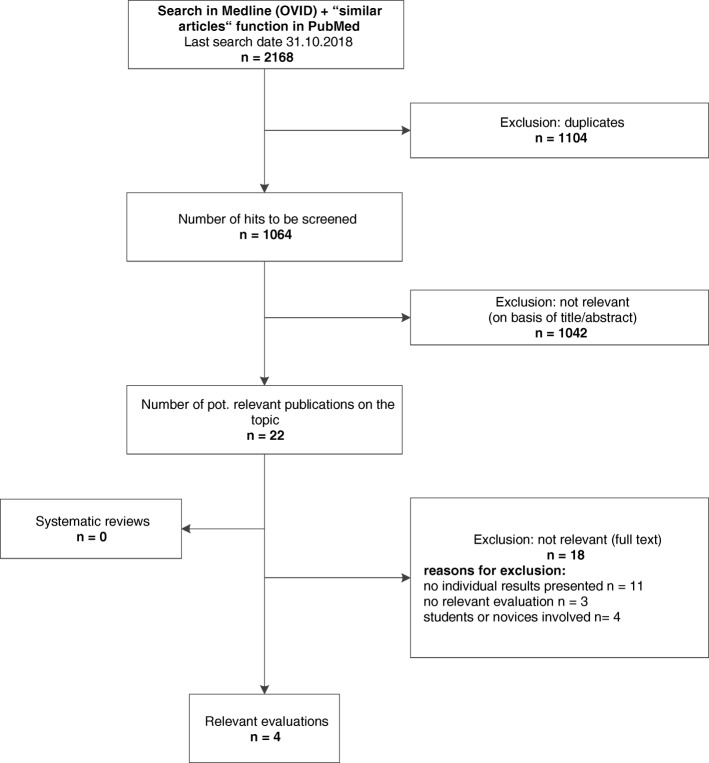
BACKGROUND: Stringent requirements exist regarding the transparency of the study selection process and the reliability of results. A 2-step selection process is generally recommended; this is conducted by 2 reviewers independently of each other (conventional double-screening). However, the approach is resource intensive, which can be a problem, as systematic reviews generally need to be completed within a defined period with a limited budget. The aim of the following methodological systematic review was to analyse the evidence available on whether single screening is equivalent to double screening in the screening process conducted in systematic reviews. METHODS: We searched Medline, PubMed and the Cochrane Methodology Register (last search 10/2018). We also used supplementary search techniques and sources ("similar articles" function in PubMed, conference abstracts and reference lists). We included all evaluations comparing single with double screening. Data were summarized in a structured, narrative way. RESULTS: The 4 evaluations included investigated a total of 23 single screenings (12 sets for screening involving 9 reviewers). The median proportion of missed studies was 5% (range 0 to 58%). The median proportion of missed studies was 3% for the 6 experienced reviewers (range: 0 to 21%) and 13% for the 3 reviewers with less experience (range: 0 to 58%). The impact of missing studies on the findings of meta-analyses had been reported in 2 evaluations for 7 single screenings including a total of 18,148 references. In 3 of these 7 single screenings - all conducted by the same reviewer (with less experience) - the findings would have changed substantially. The remaining 4 of these 7 screenings were conducted by experienced reviewers and the missing studies had no impact or a negligible on the findings of the meta-analyses. CONCLUSIONS: Single screening of the titles and abstracts of studies retrieved in bibliographic searches is not equivalent to double screening, as substantially more studies are missed. However, in our opinion such an approach could still represent an appropriate methodological shortcut in rapid reviews, as long as it is conducted by an experienced reviewer. Further research on single screening is required, for instance, regarding factors influencing the number of studies missed.
Overview
The claims and statistics of this paper haven’t been checked yet.
Free: it reads the open-access text and checks the first 5 claims that cite a source we can check. Create a free account to check every claim.
Integrity signals
Registry
Cites
Statistics
Figures
Verification
Claims the paper makes
The claims and statistics of this paper haven’t been checked yet.
Free: it reads the open-access text and checks the first 5 claims that cite a source we can check. Create a free account to check every claim.
Claims other papers make about this one
Each is checked against this paper’s own text: does it say what the citing paper says it does?
The source backs part of the claim, not all of it — or backs it for a different population, condition or comparison.
In the citing paper
“Previous research suggests that non-experienced reviewers can miss up to 13% of the records in a systematic review, which can significantly impact the results of a metaanalysis (Waffenschmidt et al., 2019).”
From Screening Smarter, Not Harder: A Comparative Analysis of Machine Learning Screening Algorithms and Heuristic Stopping Criteria for Systematic Reviews in Educational Research (2024) · cites this paper as Waffenschmidt et al., 2019
Experimental — accuracy not yet measuredThe cited source says what the claim attributes to it.
In the citing paper
“Single screening is an efficient use of time and resources, but there is a higher risk of missing relevant studies49 50 51”
From PRISMA 2020 explanation and elaboration: updated guidance and exemplars for reporting systematic reviews (2021) · cites this paper as [50]
The cited source says what the claim attributes to it.
In the citing paper
“This approach may be more reliable than single screening but at the expense of increased reviewer time, given the time needed to resolve discrepancies49 50 51”
From PRISMA 2020 explanation and elaboration: updated guidance and exemplars for reporting systematic reviews (2021) · cites this paper as [50]
The cited source says what the claim attributes to it.
In the citing paper
“Single screening is an efficient use of time and resources, but there is a higher risk of missing relevant studies49 50 51”
From PRISMA 2020 explanation and elaboration: updated guidance and exemplars for reporting systematic reviews (2021) · cites this paper as [50]
5 more claims about this paper
Create a free account to see every claim other papers make about this one.
Self-check
Percentages, sums and reported differences re-computed from the paper’s own numbers.
The self-check needs the paper’s full text.
Citations
Cites
Finding What Works in Health Care: Standards for Systematic Reviews
Eden, J., Levit, L. A., Berg, A. O., & Morton, S. C. (2013) · Cited by 943
O’Mara-Eves, A., Thomas, J., McNaught, J., Miwa, M., & Ananiadou, S. (2015) · Systematic Reviews · doi:10.1186/2046-4053-4-5 · Cited by 681
Haby, M. M., Chapman, E., Clark, R., Barreto, J., Reveiz, L., & Lavis, J. N. (2016) · Health Research Policy and Systems · doi:10.1186/s12961-016-0155-7 · Cited by 409
O’Mara-Eves, A., Thomas, J., McNaught, J., Miwa, M., & Ananiadou, S. (2015) · Systematic Reviews · doi:10.1186/s13643-015-0031-5 · Cited by 353
Edwards, P., Clarke, M., DiGuiseppi, C., Pratap, S., Roberts, I., & Wentz, R. (2002) · Statistics in Medicine · doi:10.1002/sim.1190 · Cited by 340 · cited 8×
“Edwards 2002 is the only evaluation with a comparable research question and their results are similar to ours.”
BackgroundMethodResultInfluentialFinding What Works in Health Care: Standards for Systematic Reviews
Committee on Standards for Systematic Reviews of Comparative Effectiveness Research, Board on Health Care Services, & Institute of Medicine (2011) · doi:10.17226/13059 · Cited by 289
Mathes, T., Klaßen, P., & Pieper, D. (2017) · BMC Medical Research Methodology · doi:10.1186/s12874-017-0431-4 · Cited by 240
Self-citationInstitut für Qualität und Wirtschaftlichkeit Im Gesundheitswesen
Culyer, A. J. (2014) · Cited by 190
Shemilt, I., Khan, N., Park, S., & Thomas, J. (2016) · Systematic Reviews · doi:10.1186/s13643-016-0315-4 · Cited by 168 · cited 7×
“Two re-ran the meta-analysis without the missed studies (Pham 2016, Shemilt 2016).”
BackgroundMethodInfluentialDoust, J. A., Pietrzak, E., Sanders, S., & Glasziou, P. P. (2005) · Journal of Clinical Epidemiology · doi:10.1016/j.jclinepi.2004.09.011 · Cited by 106 · cited 4×
“We ultimately included 4 evaluations (Edwards 2002 [12], Doust 2005 [13], Pham 2016 [11], Shemilt 2016 [10]).”
BackgroundMethodInfluential
Cited by
Page, M. J., Moher, D., Bossuyt, P. M., Boutron, I., Hoffmann, T. C., Mulrow, C. D., Shamseer, L., Tetzlaff, J. M., Akl, E. A., Brennan, S. E., et al. (2021) · BMJ · doi:10.1136/bmj.n160 · Cited by 13,262
Cochrane Rapid Reviews Methods Group offers evidence-informed guidance to conduct rapid reviews
Garritty, C., Gartlehner, G., Nussbaumer-Streit, B., King, V. J., Hamel, C., Kamel, C., Affengruber, L., & Stevens, A. (2021) · Journal of Clinical Epidemiology · doi:10.1016/j.jclinepi.2020.10.007 · Cited by 1,141
“Findings from two recent studies indicate that single screening of the titles and abstracts is not equivalent to dual screening, as more studies are missed [25,32].”
Page, M. J., Moher, D., Bossuyt, P., Boutron, I., Hoffmann, T., mulrow, C., Shamseer, L., Tetzlaff, J., Akl, E., Brennan, S. E., et al. (2020) · doi:10.31222/osf.io/gwdhk · Cited by 916
A scoping review on incentives for adoption of sustainable agricultural practices and their outcomes
Piñeiro, V., Arias, J., Dürr, J., Elverdin, P., Ibáñez, A. M., Kinengyere, A., Opazo, C. M., Owoo, N., Page, J. R., Prager, S. D., et al. (2020) · Nature Sustainability · doi:10.1038/s41893-020-00617-y · Cited by 747
Li, Y., Scherer, N., Felix, L., & Kuper, H. (2021) · PLOS ONE · doi:10.1371/journal.pone.0246454 · Cited by 536
“Not all studies were screened by two reviewers at title and abstract, and although evidence suggests that limited dual review processes remain an effective procedure, there may have been eligible studies missed [98, 99].”
Background
Metadata
- Authors
- Waffenschmidt, S., Knelangen, M., Sieben, W., Bühn, S., & Pieper, D.
- Affiliations
- Institute for Quality and Efficiency in Health Care (DE)
- Witten/Herdecke University (DE)
- Corresponding author
- Waffenschmidt, Siw
- Venue
- BMC Medical Research Methodology
- Published
- 2019-06-28
- Volume
- 19
- Issue
- 1
- Pages
- 132-132
- ISSN
- 1471-2288 (ISSN-L)
- PMC
- PMC6599339
- OpenAlex
- W2955273711
- Semantic Scholar
- ffee5cf6b88f24a1bc583d308035058d1fee7eb1
- Cited by
- 626
- References
- 19
- Citations by year
- 2026: 111 · 2025: 106 · 2024: 117 · 2023: 93 · 2022: 88 · 2021: 74 · 2020: 34 · 2019: 3
- FWCI
- 10.08
- Type
- journal article
- Language
- en
- Open access
- gold
- doi.org
- Licence
- cc-by
- creativecommons.org/licenses/by/4.0/ (tdm)
- creativecommons.org/licenses/by/4.0/ (vor)
- Locations
- BMC Medical Research Methodology (publishedVersion, cc-by)
- PubMed Central (publishedVersion, cc-by)
- PubMed (publishedVersion)
- DOAJ (DOAJ: Directory of Open Access Journals) (submittedVersion, cc-by-sa)
- Topics
- Social Sciences › Decision Sciences › Statistics, Probability and Uncertainty › Meta-analysis and systematic reviews
- Social Sciences › Sociology and Political Science › Delphi Technique in Research
- Physical Sciences › Mathematics › Statistics and Probability › Statistical Methods in Epidemiology
- Keywords
- study selection, title and abstract screening, reviewer experience, rapid review
- MeSH terms
- Abstracting and Indexing, Systematic Reviews as Topic, Humans, Information Systems, Publications, Information Storage and Retrieval, PubMed
About these checks
Registry, retraction, Cites and statistics results are computed, not judged, with one exception: a printed reference that no index lists is read once by a model before it counts as a citation error. Claims are extracted by a model and kept only when their quote appears verbatim in the text; each cited source is then checked, with a model’s help, for whether it says what the claim relies on. Those verdicts can be wrong — read the claim’s quote and the cited source before relying on one.
Statistics and arithmetic are recomputed, not judged.
Confidence bands are shown only for fields calibrated on our annotated test set. None is calibrated yet, so no band is shown.
What counts as a claim ›How we measure confidence ›How we check this ›
Are you an author, or do you see a problem with this page? Request a review
How to cite
Cite CoChat for the checks on this page, and the paper for its own findings.
- This page
- CoChat. (2026). Citation check: Single screening versus conventional double screening for study selection in systematic reviews: a methodological systematic review. https://app.cochat.ai/papers/10.1186/s12874-019-0782-0
- The paper
- Waffenschmidt, S., Knelangen, M., Sieben, W., Bühn, S., & Pieper, D. (2019). Single screening versus conventional double screening for study selection in systematic reviews: a methodological systematic review. BMC Medical Research Methodology. https://doi.org/10.1186/s12874-019-0782-0
Data sources
Bibliographic data: Semantic Scholar, OpenAlex, Crossref.
Contains information from the Semantic Scholar Academic Graph Datasets, made available under the ODC Attribution License (ODC-BY 1.0).
Semantic Scholar’s data is described in: Kinney, R., et al. (2023). The Semantic Scholar Open Data Platform. arXiv:2301.10140.
