

The DOI matches its Crossref record; 63 of the 64 references it cites were found in a registry or an index.
Facilitators and barriers of implementing the chronic care model in primary care: a systematic review
Open accessAbstract
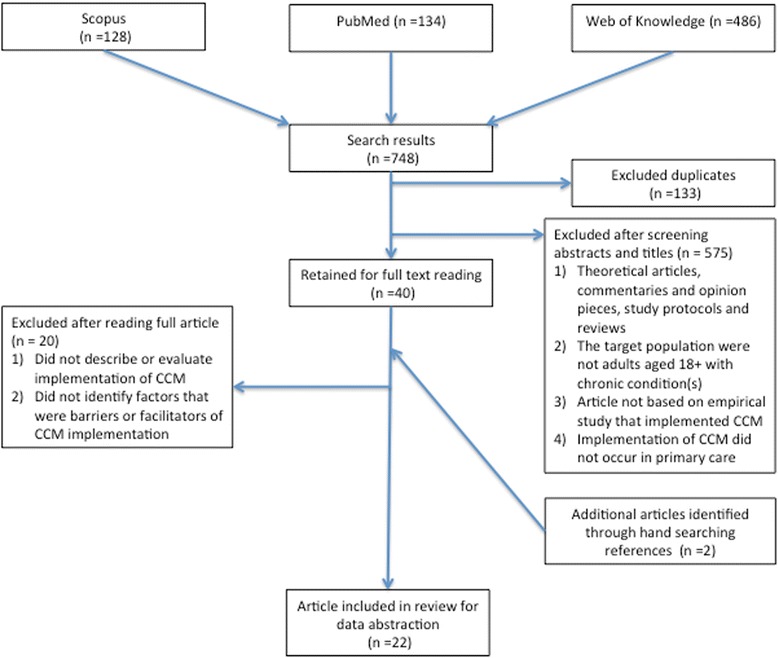
BACKGROUND: The Chronic Care Model (CCM) is a framework developed to redesign care delivery for individuals living with chronic diseases in primary care. The CCM and its various components have been widely adopted and evaluated, however, little is known about different primary care experiences with its implementation, and the factors that influence its successful uptake. The purpose of this review is to synthesize findings of studies that implemented the CCM in primary care, in order to identify facilitators and barriers encountered during implementation. METHODS: This study identified English-language, peer-reviewed research articles, describing the CCM in primary care settings. Searches were performed in three data bases: Web of Knowledge, Pubmed and Scopus. Article abstracts and titles were read based on whether they met the following inclusion criteria: 1) studies published after 2003 that described or evaluated the implementation of the CCM; 2) the care setting was primary care; 3) the target population of the study was adults over the age of 18 with chronic conditions. Studies were categorized by reference, study design and methods, participants and setting, study objective, CCM components used, and description of the intervention. The next stage of data abstraction involved qualitative analysis of cited barriers and facilitators using the Consolidating Framework for Research Implementation. RESULTS: This review identified barriers and facilitators of implementation across various primary care settings in 22 studies. The major emerging themes were those related to the inner setting of the organization, the process of implementation and characteristics of the individual healthcare providers. These included: organizational culture, its structural characteristics, networks and communication, implementation climate and readiness, presence of supportive leadership, and provider attitudes and beliefs. CONCLUSIONS: These findings highlight the importance of assessing organizational capacity and needs prior to and during the implementation of the CCM, as well as gaining a better understanding of health care providers' and organizational perspective.
Overview
The claims and statistics of this paper haven’t been checked yet.
Run the check — free, no account needed. It reads the open-access text and checks the sources it cites.
Integrity signals
Registry
Cites
Statistics
Figures
Verification
Claims the paper makes
The claims and statistics of this paper haven’t been checked yet.
Run the check — free, no account needed. It reads the open-access text and checks the sources it cites.
Claims other papers make about this one
Each is checked against this paper’s own text: does it say what the citing paper says it does?
In the citing paper
“Research papers more often tend to report clinical level variables (such as information given to patients to support self-management) than to assess organisational factors, such as professional culture, governance, financial management, communication patterns, implementation readiness, or presence of supportive leadership 35 .”
From Integrated care for people with long-term mental and physical health conditions in low-income and middle-income countries (2019) · cites this paper as [35]
In the citing paper
“In other similar studies, positive effects have been shown for people with depression 34 35 , chronic obstructive pulmonary disease 35 , asthma 35 36 , diabetes 35 36 and heart failure 36 .”
From Integrated care for people with long-term mental and physical health conditions in low-income and middle-income countries (2019) · cites this paper as [35]
Self-check
Percentages, sums and reported differences re-computed from the paper’s own numbers.
The self-check needs the paper’s full text.
Citations
Cites
Liberati, A., Altman, D. G., Tetzlaff, J., Mulrow, C., Gøtzsche, P. C., Ioannidis, J. P. A., Clarke, M., Devereaux, P. J., Kleijnen, J., & Moher, D. (2009) · PLoS Medicine · doi:10.1371/journal.pmed.1000100 · Cited by 28,164 · cited 1×
“The PRISMA statement provides an evidence-based checklist intended to improve the standards of reporting in systematic reviews [31].”
MethodDamschroder, L. J., Aron, D. C., Keith, R. E., Kirsh, S. R., Alexander, J. A., & Lowery, J. C. (2009) · Implementation Science · doi:10.1186/1748-5908-4-50 · Cited by 14,496 · cited 13×
“The CFIR was selected because it includes multiple constructs and theories from peer reviewed studies on evidence-based knowledge dissemination and translation, organizational change and implementation, and uptake of research.”
BackgroundMethodInfluentialLiberati, A., Altman, D. G., Tetzlaff, J., Mulrow, C., Gøtzsche, P. C., Ioannidis, J. P. A., Clarke, M., Devereaux, P. J., Kleijnen, J., & Moher, D. (2009) · Annals of Internal Medicine · doi:10.7326/0003-4819-151-4-200908180-00136 · Cited by 10,349
Diffusion of Innovations in Service Organizations: Systematic Review and Recommendations
GREENHALGH, T., ROBERT, G., MACFARLANE, F., BATE, P., & KYRIAKIDOU, O. (2004) · The Milbank Quarterly · doi:10.1111/j.0887-378x.2004.00325.x · Cited by 7,448 · cited 1×
“It provides a conceptual framework which can be used to understand factors that influence successful implementation in health care, and is based on theories identified by Greenhalgh and colleagues’ widely cited systematic review [26,32].”
Background(2005) · Cited by 3,748
Improving chronic illness care: translating evidence into action
Wagner, E. H., Austin, B. T., Davis, C., Hindmarsh, M., Schaefer, J., & Bonomi, A. (2001) · Health Affairs · doi:10.1377/hlthaff.20.6.64 · Cited by 3,446 · cited 1×
“CCM articles by Wagner and colleagues and Bodenheimer and colleagues [8-10,14,27,28].”
Improving Primary Care for Patients With Chronic Illness
Bodenheimer, T. (2002) · JAMA · doi:10.1001/jama.288.14.1775 · Cited by 2,961 · cited 7×
“and colleagues [10], thus reflecting studies that”
BackgroundMethodInfluentialOrganizing Care for Patients with Chronic Illness
Wagner, E. H., Austin, B. T., & Korff, M. V. (1996) · The Milbank Quarterly · doi:10.2307/3350391 · Cited by 2,877 · cited 1×
“CCM articles by Wagner and colleagues and Bodenheimer and colleagues [8-10,14,27,28].”
Danaei, G., Ding, E. L., Mozaffarian, D., Taylor, B., Rehm, J., Murray, C. J. L., & Ezzati, M. (2009) · PLoS Medicine · doi:10.1371/journal.pmed.1000058 · Cited by 2,860
The challenge of complexity in health care
Plsek, P. E., & Greenhalgh, T. (2001) · BMJ · doi:10.1136/bmj.323.7313.625 · Cited by 2,578
Research works printed but not linked: 3
- World Health Organization. Innovative care for chronic conditions: building blocks for action, global report. Geneva: World Health Organization; 2002.
- Public Health Agency of Canada. Chronic diseases in Canada: United Nations non-communicable disease summit. Ottawa: Public Health Agency of Canada; 2011.
- Iles V, Sutherland K. Organisational change: a review for health care managers, professionals and researchers. In: National Coordinating Center for National Health Service Delivery and Organization. 2001. p. 12–68.
Cited by
Sorted by citations
Items 101–200 of 203
Henny, K. D., Duke, C. C., & Sutton, M. Y. (2020) · AIDS Care · doi:10.1080/09540121.2020.1822986 · Cited by 7
“Although not examined in our analyses, other studies found that successful translation of PCP training to practice involved factors such as organization-wide capacity assessments (Kadu & Stolee, 2015; Shook et al., 2016).”
ResultDelameillieure, A., Vandekerkhof, S., Grootven, B. V., Wuyts, W. A., & Dobbels, F. (2021) · Respiratory Research · doi:10.1186/s12931-021-01815-8 · Cited by 7
“Potential barriers and facilitators should be addressed as both play an enormous role when aiming to redesigning care [59].”
BackgroundSopcak, N., Fernandes, C., Ofosu, D., Wong, M., Khalil, I., Wong, T., & Manca, D. P. (2023) · Global Implementation Research and Applications · doi:10.1007/s43477-023-00074-7 · Cited by 7
“We chose this framework as the five CFIR domains are accessible and concise, have been consolidated by a synthesis of existing frameworks, and are recognized as the main elements in program implementation in the health sciences (Damschroder et al., 2009; Kadu & Stolee, 2015).”
MethodTowards an Integrated Care Organisation from a CEO Perspective
Amunarriz, G., & Alcalde‐Heras, H. (2020) · International Journal of Integrated Care · doi:10.5334/ijic.5559 · Cited by 7
Dissemination of the Women-Centred HIV Care Model: A Multimodal Process and Evaluation
Koebel, J., Kazemi, M., Kennedy, V. L., Medeiros, P., Bertozzi, B., Bevan, L., Tharao, W. E., Logie, C. H., Underhill, A., Pick, N., et al. (2024) · Journal of the International Association of Providers of AIDS Care (JIAPAC) · doi:10.1177/23259582231226036 · Cited by 6
“46 We planned for this need by involving community members and service providers from the very beginning stages of toolkit development and dissemination and continued with consultations at all points of the process.”
BackgroundRoberti, J. E., Belizán, M., Ini, N., Alonso, J. P., Mazzoni, A., Guglielmino, M., Mazzaresi, Y., Falaschi, A., Gómez-Portillo, J. M., Masier, G., et al. (2025) · Chronic Illness · doi:10.1177/17423953251318614 · Cited by 6
Liu, Y., Wang, L., & Zhu, L. (2023) · Gastrointestinal Nursing · doi:10.12968/gasn.2023.21.sup4.s14 · Cited by 6
Ricketts, T., Wood, E., Soady, J., Saxon, D. H., Hulin, J., Ohlsen, S., & Mitchell, C. A. (2017) · Journal of Affective Disorders · doi:10.1016/j.jad.2017.10.029 · Cited by 6
van Bruggen, S., Kasteleyn, M. J., Rauh, S. P., Meijer, J. S., Busch, K., Numans, M. E., & Chavannes, N. H. (2021) · BMC Health Services Research · doi:10.1186/s12913-021-07198-2 · Cited by 6
“related to providers and to the organisational context both receive sufficient attention [36].”
BackgroundLinkages between health systems and communities for chronic care: a scoping review protocol
George, N. C., Radman, D. P., Zomahoun, H. T. V., Boivin, A., & Ahmed, S. (2022) · BMJ Open · doi:10.1136/bmjopen-2021-060430 · Cited by 6
Kambalame, D. M., Arnesen, T. M., Mtambo, J., Banda, E. C., Phuka, J. C., & Muula, A. S. (2026) · Frontiers in Public Health · doi:10.3389/fpubh.2026.1758944 · Cited by 6
Mandyam, N. K., Lau, J., Keck, C., Chen, E., & Yip, A. W. (2025) · Digital Health · doi:10.1177/20552076251337032 · Cited by 5
Silocchi, C., Junges, J. R., & Martinó, A. (2020) · Saúde e Sociedade · doi:10.1590/s0104-12902020190633 · Cited by 5
Paci, M., Bianchi, L., Buonandi, E., Rosiello, L., & Moretti, S. (2023) · Archives of Physiotherapy · doi:10.1186/s40945-023-00176-3 · Cited by 8
“These issues are shown to be key elements to make an organizational change possible in the field of chronic and complex diseases [26, 27].”
BackgroundKim, S., Park, S., & Kim, B. (2015) · Health and Social Welfare Review · doi:10.15709/hswr.2015.35.2.405 · Cited by 4
Palozzi, G., Binci, D., & Schettini, I. (2020) · EAI/Springer Innovations in Communication and Computing · doi:10.1007/978-3-030-30911-4_31 · Cited by 4
Rethinking long‐term condition management: An actor‐level framework
Vågan, A., Olsson, A. B. S., Arntzen, C., Rise, M. B., Grue, J., Haugland, T., Langeland, E., Stenberg, U., & Solvang, P. K. (2021) · Sociology of Health & Illness · doi:10.1111/1467-9566.13228 · Cited by 4
Evaluation of the Implementation of an Integrated Program for Musculoskeletal System Care
Larrañaga, I., Soto‐Gordoa, M., Arrospide, A., Jauregi, M. L., Millas, J., Vicente, R. S., Aguirrebeña, J., & Mar, J. (2017) · Reumatología Clínica (English Edition) · doi:10.1016/j.reumae.2016.04.013 · Cited by 4
Moin, T., Harwood, J. M., Mangione, C. M., JACKSON, N. J., Ho, S., Ettner, S. L., & Duru, O. K. (2020) · Medical Care · doi:10.1097/mlr.0000000000001318 · Cited by 4
“04* Pennsylvania 21,211 (6) 7854 (5) 0.”
Pedroni, C., Djurić, O., Bassi, M. C., Mione, L., Caleffi, D., Testa, G., Prandi, C., Navazio, A., & Rossi, P. G. (2023) · Healthcare · doi:10.3390/healthcare11091227 · Cited by 4
“With the exception of self-care interventions [22], it is unknown which elements or combination of CCM elements could improve healthcare practice and health outcomes since there is substantial heterogeneity in the interventions implemented in primary care to improve CHF care delivery [23].”
BackgroundDetection and Characterization of E-Health Research: A Bibliometrics (2001–2016)
Liu, Z., Su, J., & Lei, J. (2019) · IntechOpen eBooks · doi:10.5772/intechopen.88610 · Cited by 4
“Jane does an organizational analysis of the implementation of telehealth in view of whole systems [71].”
BackgroundLarrañaga, I., Mar, J., Gorostiza, A., García‐Lorenzo, B., Zubeltzu, B., Vega, R., Kaye, R., Levy, G., Vishnevetsky, O., Christensen, R. L., et al. (2025) · Frontiers in Public Health · doi:10.3389/fpubh.2025.1682492 · Cited by 3
Facilitators of palliative care quality improvement team cohesion
Connell, N. B., Zupanc, S. N., Lorenz, K., Bhatnagar, S., Fereydooni, S., Gamboa, R., Ganesh, A., Satija, A., Singh, N. K., Spruijt, O., et al. (2023) · Health Care Management Review · doi:10.1097/hmr.0000000000000368 · Cited by 3
Goh, L. H., Siah, C. J. R., Szücs, A., Tai, E. S., Valderas, J. M., & Young, D. (2024) · BMJ Open · doi:10.1136/bmjopen-2024-083992 · Cited by 3
“51 Team camaraderie, trust and relationship built through joining the PCNs was unexpected but welcoming to the HCPs. Trust among the PCN HCPs indicated their will-ingness to collaborate to deliver care, have informal peer sharing and learning, exchange of patients’ information through electronic…”
BackgroundSajatovic, M., Shegog, R., Kiriakopoulos, E. T., Adeniyi, C., Black, J., Jobst, B. C., Johnson, E. K., McGee, R. E., Spruill, T. M., & Escoffery, C. (2025) · Epilepsy & Behavior · doi:10.1016/j.yebeh.2025.110488 · Cited by 3
Chien, S.-Y., Chuang, M., & Chen, I. (2020) · Health · doi:10.4236/health.2020.125039 · Cited by 3
“Additionally, facilitators and barriers for people as to whether they participate in health screening for chronic diseases are heterogeneous [28] [29] [30] [31], and these factors play an important role in the decision-making process that leads to the utilization of health services.”
BackgroundImplementation of a novel rehabilitation model of care across Alberta, Canada: a focused ethnography
Manhas, K. P., Olson, K. L., Churchill, K., Vohra, S., & Wasylak, T. (2021) · BMJ Open Quality · doi:10.1136/bmjoq-2020-001261 · Cited by 3
Mateo-Gavira, I., Carrasco-García, S., Larrán, L., Fierro, M. J., Zarallo, A., Sánchez, E. M., & Aguilar‐Diosdado, M. (2021) · Endocrinología Diabetes y Nutrición (English ed ) · doi:10.1016/j.endien.2021.05.002 · Cited by 3
Kurpas, D., Petrazzuoli, F., Szwamel, K., Randall-Smith, J., Blahová, B., Dumitra, G. G., Javorská, Mohos, A. A. S., es, J. E. S. O., Tkachenko, V., et al. (2021) · Rural and Remote Health · doi:10.22605/rrh6509 · Cited by 3
Beaulieu, M., Tremblay, J., & Bertrand, K. (2022) · International Journal of Mental Health and Addiction · doi:10.1007/s11469-022-00982-z · Cited by 3
“Identified as an important issue in the implementation of long-term services, special attention should be paid to supporting practitioners, team leaders, and partners in the paradigm shift involved in these service improvements (Kadu & Stolee, 2015).”
Advanced Practice Physiotherapy in Canada: A Survey of Canadian Physiotherapists
Matifat, E., Zidarov, D., Woodhouse, L. J., & Desmeules, F. (2024) · Physiotherapy Canada · doi:10.3138/ptc-2023-0060 · Cited by 3
Integrated Care for Heart Failure in Primary Care
Lorenzini, M., Ricci, C., Riccomi, S., Abate, F., Casalgrandi, B., Quattrini, B., Spagnoli, G., Reggianini, L., & Capelli, O. (2016) · InTech eBooks · doi:10.5772/63946 · Cited by 3
“The importance of assessing organisational capacity and needs is crucial prior to and during the implementation of the CCM, as well as gaining a better understanding of health care providers and organisational perspective [26].”
BackgroundFrugal Innovations in Healthcare: Factors Affecting the Diffusion in Developing Economies
Arshad, H. (2021) · Contributions to management science · doi:10.1007/978-3-030-67119-8_2 · Cited by 3
Hernández-Sánchez, D., Leyva‐Moral, J. M., Olalla, J., Negredo, E., & On Behalf Of The Hola Study Group (2025) · Viruses · doi:10.3390/v17070993 · Cited by 2
“The implementation of complex chronic treatments in non-hospital settings presents both significant opportunities and challenges, according to the available scientific evidence [12,13].”
Chronic disease management: Discussing the perspectives of general practitioners in Italy
Barsanti, S., & Guarneri, F. (2019) · Health Services Management Research · doi:10.1177/0951484819871011 · Cited by 2
“The opinions of key stakeholders concerning the readiness of the healthcare system to deliver an effective CDM are vital when assessing on-going reforms within a complex system such as healthcare.(8) GPs in particular are central to the reorganization model and are responsible for the continuity and coordination of ca…”
BackgroundPerformance of family health teams for tackling chronic diseases in a state of the Amazon
Alves, K. C. G., Guimarães, R. A., de Souza, M. R., & Neto, O. L. D. M. (2020) · PLoS ONE · doi:10.1371/journal.pone.0241765 · Cited by 2
“Problems related to a lack of proficiency in user registration and the use of electronic medical records are a barrier to the implementation of a chronic disease care model [67] along the lines of the CCM.”
BackgroundRoohi, E., Lo, C., Martinusen, D. J., & Levin, A. (2023) · Canadian Journal of Kidney Health and Disease · doi:10.1177/20543581231177840 · Cited by 3
Philbin, S. E., Gleason, L. P., Persell, S. D., Walter, E., Petito, L. C., Tibrewala, A., Yancy, C. W., Beidas, R. S., Wilcox, J. E., Mutharasan, R. K., et al. (2025) · Journal of General Internal Medicine · doi:10.1007/s11606-025-09515-5 · Cited by 4
High-Touch vs Low-Touch Strategy for Implementing a CRC Screening Digital Health Intervention
MILLER, D. P., Snavely, A. C., Dharod, A., Wright, E., Randazzo, A., Bundy, R. A., Dignan, M., & Foley, K. L. (2025) · JAMA Internal Medicine · doi:10.1001/jamainternmed.2025.0779 · Cited by 2
Filliettaz, S. S., Moiroux, S., Marchand, G., Gilles, I., & Peytremann‐Bridevaux, I. (2021) · Home Health Care Services Quarterly · doi:10.1080/01621424.2021.1989356 · Cited by 2
Amunarriz, G., & Alcalde‐Heras, H. (2022) · ZERBITZUAN · doi:10.5569/1134-7147.76.02 · Cited by 2
Kamalu, A. O., Ekeoba, A. E., Uzor, E. C., Duru, C. C., Anyatonwu, O. P., Adiele, O. E., Amuzie, C. R., & Odoemenam, C. L. (2024) · Open Journal of Ophthalmology · doi:10.4236/ojoph.2024.142010 · Cited by 2
Denson, R. (2020) · doi:10.46409/sr.chjt9855 · Cited by 2
“There is a gap between evidence-based practice and care delivery in primary care clinics for diabetes (Kadu & Stolee, 2015; Shelby et al., 2020).”
BackgroundMateo-Gavira, I., Carrasco-García, S., Larrán, L., Fierro, M. J., Zarallo, A., Sánchez, E. M., Aguilar‐Diosdado, M., Ortego-Rojo, J., López, F. J. V., Rodríguez, M. R., et al. (2020) · Endocrinología Diabetes y Nutrición · doi:10.1016/j.endinu.2019.12.010 · Cited by 1
Heaven, A., Foster, M., Foy, R., Hawkins, R., Hulme, C. T., Humphrey, S., & Smith, J. E. (2025) · BJGP Open · doi:10.3399/bjgpo.2024.0163 · Cited by 1
Bongaerts, B. W. C., Leuwer, A., Sadiq, F., Wolters, B., Guo, Y., Tapinova, K., Alade, O. T., Janka, H., & Franco, J. V. A. (2025) · Cochrane Database of Systematic Reviews · doi:10.1002/14651858.cd016214 · Cited by 1
Izumi, S., Mood, L., Velk, L., Szper, C., Fifield, A., Ayala, D., Dawson, W. D., & Womack, D. M. (2025) · BMC Health Services Research · doi:10.1186/s12913-025-13788-1 · Cited by 1
“The CCM has been widely adopted in healthcare systems and reportedly improves practice and patient outcomes [12–14].”
The patient/industry trade-off in medical artificial intelligence
Khan, R., Sauve, A., Bayoumi, I., Simpson, A. L., & Stinson, C. (2026) · AI and Ethics · doi:10.1007/s43681-025-00936-w · Cited by 1
“In areas of healthcare such as chronic illness treatment, having patients be the managers of the long-term goals of their care has shown significant improvements in patient wellness [34].”
Lyberg, A. M., Berggren, I., Holm, A. L., & Severinsson, E. (2015) · Open Journal of Nursing · doi:10.4236/ojn.2015.54041 · Cited by 1
“In order to gain a better understanding of organisational and healthcare professionals’ perspectives, assessment of organisational capacity and needs is essential prior to and during and during the implementation of CCM interventions [43].”
BackgroundManaging Chronic Disease in Affordable Primary Care
Holstein, B. (2018) · The Journal for Nurse Practitioners · doi:10.1016/j.nurpra.2018.03.007 · Cited by 1
Defining a Supportive Organizational Context for IPC in Primary Care: A Mixed Methods Study
Cataldo, J. (2022) · Health Interprofessional Practice and Education · doi:10.7710/2641-1148.2184 · Cited by 1
Silalahi, V. H. C., Purba, B. K. F., & Sihombing, R. A. (2024) · Jurnal Cakrawala Akademika · doi:10.70182/jca.v1i3.12 · Cited by 1
“Teori Chronic Care Model oleh Wagner dalam Kadu & Stolee (2015) menyarankan bahwa pencegahan tersier dapat ditingkatkan dengan koordinasi layanan kesehatan yang berfokus pada pasien, penggunaan teknologi informasi kesehatan, dan keterlibatan pasien dalam pengambilan keputusan perawatan mereka.”
Cheng, L. J., & Lau, Y. (2020) · Public Health Nursing · doi:10.1111/phn.12732 · Cited by 1
Nudging CHronic disease mANaGemEnt for empowering citizens: The CHANGE project
Pietrabissa, G., Cattivelli, R., Castelnuovo, G., Bertuzzi, V., & Giusti, E. M. (2020) · Cited by 1
Irwin, R. (2017) · University of Birmingham Institutional Research Archive (University of Birmingham)
The impact of risk stratification on care coordination
Sheets, L., Lyttle, K., Popejoy, L., Petroski, G. F., Geltman, J., Mosa, A. S. M., Wilkinson, K., & Parker, J. C. (2017) · IEEE International Conference on Bioinformatics and Biomedicine (BIBM) · doi:10.1109/bibm.2017.8217898
“The implementation of this model, which addresses the “Triple Aim” [5] of managed care – better health outcomes, better health care delivery, and lower costs – has been shown to improve patient outcomes across multiple settings [6].”
BackgroundDunning, T. L. (2018) · Springer eBooks · doi:10.1007/978-3-319-74360-8_4
Developing a complex intervention to coordinate care for people with dementia
Backhouse, A. (2017) · Open Research Exeter (University of Exeter)
Improving the structure of diabetes care in primary care: A pilot study
Stattin, N. S., Kane, K., Stenbäck, M., Wajngot, A., & Seijboldt, K. (2019) · Primary care diabetes · doi:10.1016/j.pcd.2019.05.005 · Cited by 1
Organizational Implementation Strategies
Wensing, M., Laurant, M. G. H., & Grol, R. P. T. M. (2020) · Wiley eBooks · doi:10.1002/9781119488620.ch15
Methodological challenges of complex proactive primary care programs for older people
Smit, A. C. (2021) · Utrecht University Repository (Utrecht University) · doi:10.33540/837
Manhas, K. P., Olson, K. L., Churchill, K., Vohra, S., & Wasylak, T. (2019) · Research Square · doi:10.21203/rs.2.14360/v1
“Barriers-wise, limited resources, lack of buy-in, communication, and overwhelmed or unsupported staff were present in Alberta as in other jurisdictions that struggled with model-of-care implementation [18, 20, 21, 24, 27].”
BackgroundInfluentialDETERMINING THE PRACTİCES AND APPROACHES OF FAMILY HEALTH PERSONNEL TO CHRONIC DISEASES
Kabasakal, E., & Özpulat, F. (2022) · Balıkesır Health Sciences Journal · doi:10.53424/balikesirsbd.1094868
Sánchez-Molla, M., García, I. C., Orozco‐Beltrán, D., Gil-Guillén, V. F., Carratalá‐Munuera, C., & Nouni-García, R. (2023) · Atención Primaria · doi:10.1016/j.aprim.2023.102814
Graever, L., Mafra, P. C., Figueira, V. K., Miler, V. N., Sobreiro, J. D. S. L., da Silva, G. P. D. C., Issa, A. F. C., Savassi, L. C. M., Dias, M. B., Melo, M. M., et al. (2025) · JMIR Cardio · doi:10.2196/64438 · Cited by 3
“Specifically, chronic disease management involving multidisciplinary collaboration is known to improve the quality of care [6,7].”
Digital Health Systems in Integrated Care
Gray, C. S., Gagnon, D., Guldemond, N., & Kenealy, T. W. (2025) · Springer eBooks · doi:10.1007/978-3-031-96286-8_28 · Cited by 1
Howlett, N., Antonopoulou, V., McKinlay, A. R., Lorencatto, F., McGowan, L. J., Osborn, D., O'Donnell, A. J., Oliver, E., Vlaev, I., Sniehotta, F. F., et al. (2025) · Systematic Reviews · doi:10.1186/s13643-025-02970-5
“For example, Kadu and Stolee [34] reviewed 22 studies examining the influences of implementation of the Chronic Care Model in primary care.”
Sarkies, M., Long, J. C., Pomare, C., Wu, W., Clay‐Williams, R., Nguyen, H. M., Francis‐Auton, E., Westbrook, J., Lévesque, J., Watson, D. E., et al. (2020) · Figshare · doi:10.6084/m9.figshare.13126752
Delameillieure, A., Vandekerkhof, S., Grootven, B. V., Wuyts, W. A., & Dobbels, F. (2021) · Figshare · doi:10.6084/m9.figshare.15179618
Sarkies, M., Long, J. C., Pomare, C., Wu, W., Clay‐Williams, R., Nguyen, H. M., Francis‐Auton, E., Westbrook, J., Lévesque, J., Watson, D. E., et al. (2020) · Figshare · doi:10.6084/m9.figshare.13126749
Keller, M. S., Guevara, N., Guerrero, J.-A., Mays, A. M., McCleskey, S. G., Reyes, C. E., & Sarkisian, C. A. (2024) · Figshare · doi:10.6084/m9.figshare.26944548
Piat, M., Wainwright, M., Sofouli, E., Vachon, B., Deslauriers, T., Préfontaine, C., & Frati, F. (2021) · Figshare · doi:10.6084/m9.figshare.14545090
Piat, M., Wainwright, M., Sofouli, E., Vachon, B., Deslauriers, T., Préfontaine, C., & Frati, F. (2021) · Figshare · doi:10.6084/m9.figshare.14545078
Piat, M., Wainwright, M., Sofouli, E., Vachon, B., Deslauriers, T., Préfontaine, C., & Frati, F. (2021) · Figshare · doi:10.6084/m9.figshare.14545072
Piat, M., Wainwright, M., Sofouli, E., Vachon, B., Deslauriers, T., Préfontaine, C., & Frati, F. (2021) · Figshare · doi:10.6084/m9.figshare.14545084
Trankle, S. A., Usherwood, T., Abbott, P., Roberts, M. M., Crampton, M., Girgis, C. M., Riskallah, J., Chang, Y., Saini, J., & Reath, J. (2020) · Figshare · doi:10.6084/m9.figshare.13064283
Piat, M., Wainwright, M., Sofouli, E., Vachon, B., Deslauriers, T., Préfontaine, C., & Frati, F. (2021) · Figshare · doi:10.6084/m9.figshare.14545093
Lewinski, A. A., Shapiro, A. S., Gierisch, J. M., Goldstein, K. M., Blalock, D. V., Luedke, M. W., Gordon, A. M., Bosworth, H. B., Drake, C., Lewis, J. D., et al. (2020) · Figshare · doi:10.6084/m9.figshare.12197352
Piat, M., Wainwright, M., Sofouli, E., Vachon, B., Deslauriers, T., Préfontaine, C., & Frati, F. (2021) · Figshare · doi:10.6084/m9.figshare.14545075
Delameillieure, A., Vandekerkhof, S., Grootven, B. V., Wuyts, W. A., & Dobbels, F. (2021) · Figshare · doi:10.6084/m9.figshare.15179615
Delameillieure, A., Vandekerkhof, S., Grootven, B. V., Wuyts, W. A., & Dobbels, F. (2021) · Figshare · doi:10.6084/m9.figshare.15179612
Delameillieure, A., Vandekerkhof, S., Grootven, B. V., Wuyts, W. A., & Dobbels, F. (2021) · Figshare · doi:10.6084/m9.figshare.15179603
Trankle, S. A., Usherwood, T., Abbott, P., Roberts, M. M., Crampton, M., Girgis, C. M., Riskallah, J., Chang, Y., Saini, J., & Reath, J. (2020) · Figshare · doi:10.6084/m9.figshare.13064286
Piat, M., Wainwright, M., Sofouli, E., Vachon, B., Deslauriers, T., Préfontaine, C., & Frati, F. (2021) · Figshare · doi:10.6084/m9.figshare.14545081
van Bruggen, S., Kasteleyn, M. J., Rauh, S. P., Meijer, J. S., Busch, K., Numans, M. E., & Chavannes, N. H. (2021) · Figshare · doi:10.6084/m9.figshare.16969312
Lewinski, A. A., Shapiro, A. S., Gierisch, J. M., Goldstein, K. M., Blalock, D. V., Luedke, M. W., Gordon, A. M., Bosworth, H. B., Drake, C., Lewis, J. D., et al. (2020) · Figshare · doi:10.6084/m9.figshare.12197364
Delameillieure, A., Vandekerkhof, S., Grootven, B. V., Wuyts, W. A., & Dobbels, F. (2021) · Figshare · doi:10.6084/m9.figshare.15179609
Delameillieure, A., Vandekerkhof, S., Grootven, B. V., Wuyts, W. A., & Dobbels, F. (2021) · Figshare · doi:10.6084/m9.figshare.15179606
van Bruggen, S., Kasteleyn, M. J., Rauh, S. P., Meijer, J. S., Busch, K., Numans, M. E., & Chavannes, N. H. (2021) · Figshare · doi:10.6084/m9.figshare.16969309
Lewinski, A. A., Shapiro, A. S., Gierisch, J. M., Goldstein, K. M., Blalock, D. V., Luedke, M. W., Gordon, A. M., Bosworth, H. B., Drake, C., Lewis, J. D., et al. (2020) · Figshare · doi:10.6084/m9.figshare.12197343
Leslie, M., Khayatzadeh‐Mahani, A., Birdsell, J., Forest, P., Henderson, R., Gray, R. P., Schraeder, K. E., Seidel, J. E., Zwicker, J., & Green, L. A. (2020) · Figshare · doi:10.6084/m9.figshare.13337710
Digital Health Systems in Integrated Care
Gray, C. S., Gagnon, D., Guldemond, N., & Kenealy, T. (2024) · Springer eBooks · doi:10.1007/978-3-031-25376-8_28-1
Roberti, J. E., Mazzoni, A., Guglielmino, M., Silva, C., Mazzaresi, Y., Falaschi, A., Hirschhorn, L. R., Parker, J., & García‐Elorrio, E. (2025) · Health Expectations · doi:10.1111/hex.70536
“Integrating PHC necessitates substantial changes in financing, management, and delivery of health services [14, 15].”
O’Flynn, J., McMorrow, R., Foley, T., Forde, R., McHugh, S., Newman, C., & Jennings, A. (2026) · Endocrine Practice · doi:10.1016/j.eprac.2026.02.006
Supporting Integrated Care through Visualization of Shared Medical Documents and Communication
Marref, R. (2023) · theses.fr (ABES) · doi:10.70675/1db4aef8z7294z4c7bzb0b1z000f40d4de6d
Haque, N. B., Lystad, R. P., Braithwaite, J., & Mitchell, R. J. (2026) · Journal of Health Services Research & Policy · doi:10.1177/13558196261454533
Metadata
- Authors
- Kadu, M. K., & Stolee, P.
- Affiliations
- University of Waterloo (CA)
- Corresponding author
- Stolee, Paul
- Venue
- BMC Family Practice
- Published
- 2015-02-06
- Volume
- 16
- Issue
- 1
- Pages
- 12-12
- ISSN
- 1471-2296 (ISSN-L)
- PMC
- PMC4340610
- OpenAlex
- W2006530818
- Cited by
- 204
- References
- 64
- Citations by year
- 2026: 7 · 2025: 15 · 2024: 11 · 2023: 16 · 2022: 12 · 2021: 38 · 2020: 40 · 2019: 23 · 2018: 11 · 2017: 15 · 2016: 11 · 2015: 5
- FWCI
- 2.53
- Type
- journal article
- Language
- en
- Open access
- gold
- doi.org
- Locations
- BMC Family Practice (publishedVersion, cc-by)
- Europe PMC (PubMed Central) (publishedVersion, cc-by)
- PubMed Central (publishedVersion, cc-by)
- PubMed (publishedVersion)
- Funders
- University of Waterloo
- Topics
- Health Sciences › Health Professions › General Health Professions › Health Policy Implementation Science
- Health Sciences › Medicine › Family Practice › Primary Care and Health Outcomes
- Health Sciences › Medicine › Public Health, Environmental and Occupational Health › Clinical practice guidelines implementation
- Keywords
- Chronic Care Model, implementation barriers, implementation facilitators, primary care, chronic care, organizational culture, implementation climate, leadership, provider attitudes, organizational capacity
- MeSH terms
- Chronic Disease, Humans, Organizational Innovation, Patient Care Management, Primary Health Care, Organizational Culture, Models, Organizational, Needs Assessment, Quality Improvement
About these checks
Registry, retraction, Cites and statistics results are computed, not judged, with one exception: a printed reference that no index lists is read once by a model before it counts as a citation error. Claims are extracted by a model and kept only when their quote appears verbatim in the text; each cited source is then checked, with a model’s help, for whether it says what the claim relies on. Those verdicts can be wrong — read the claim’s quote and the cited source before relying on one.
Statistics and arithmetic are recomputed, not judged.
Confidence bands are shown only for fields calibrated on our annotated test set. None is calibrated yet, so no band is shown.
What counts as a claim ›How we measure confidence ›How we check this ›
Are you an author, or do you see a problem with this page? Request a review
