

The DOI matches its Crossref record; 63 of the 64 references it cites were found in a registry or an index.
Facilitators and barriers of implementing the chronic care model in primary care: a systematic review
Open accessAbstract
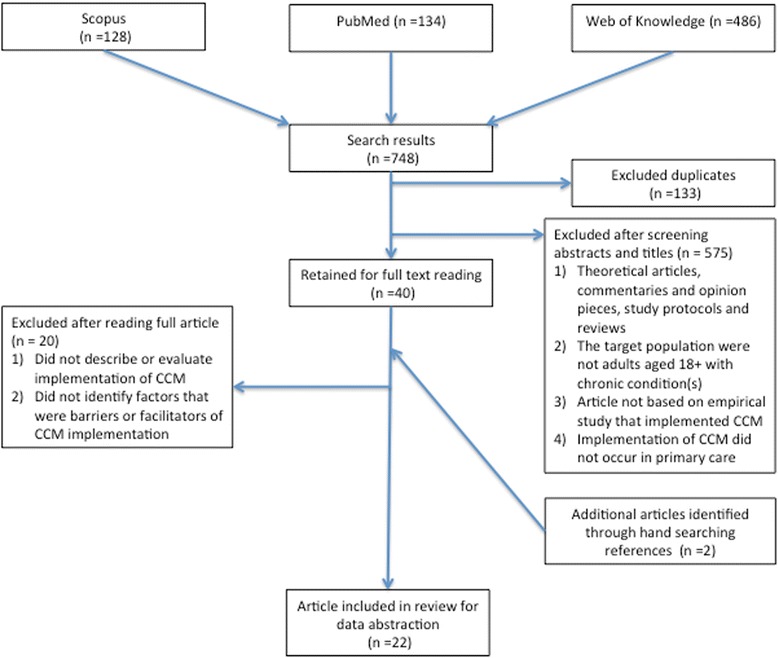
BACKGROUND: The Chronic Care Model (CCM) is a framework developed to redesign care delivery for individuals living with chronic diseases in primary care. The CCM and its various components have been widely adopted and evaluated, however, little is known about different primary care experiences with its implementation, and the factors that influence its successful uptake. The purpose of this review is to synthesize findings of studies that implemented the CCM in primary care, in order to identify facilitators and barriers encountered during implementation. METHODS: This study identified English-language, peer-reviewed research articles, describing the CCM in primary care settings. Searches were performed in three data bases: Web of Knowledge, Pubmed and Scopus. Article abstracts and titles were read based on whether they met the following inclusion criteria: 1) studies published after 2003 that described or evaluated the implementation of the CCM; 2) the care setting was primary care; 3) the target population of the study was adults over the age of 18 with chronic conditions. Studies were categorized by reference, study design and methods, participants and setting, study objective, CCM components used, and description of the intervention. The next stage of data abstraction involved qualitative analysis of cited barriers and facilitators using the Consolidating Framework for Research Implementation. RESULTS: This review identified barriers and facilitators of implementation across various primary care settings in 22 studies. The major emerging themes were those related to the inner setting of the organization, the process of implementation and characteristics of the individual healthcare providers. These included: organizational culture, its structural characteristics, networks and communication, implementation climate and readiness, presence of supportive leadership, and provider attitudes and beliefs. CONCLUSIONS: These findings highlight the importance of assessing organizational capacity and needs prior to and during the implementation of the CCM, as well as gaining a better understanding of health care providers' and organizational perspective.
Overview
The claims and statistics of this paper haven’t been checked yet.
Run the check — free, no account needed. It reads the open-access text and checks the sources it cites.
Integrity signals
Registry
Cites
Statistics
Figures
Verification
Claims the paper makes
The claims and statistics of this paper haven’t been checked yet.
Run the check — free, no account needed. It reads the open-access text and checks the sources it cites.
Claims other papers make about this one
Each is checked against this paper’s own text: does it say what the citing paper says it does?
In the citing paper
“Research papers more often tend to report clinical level variables (such as information given to patients to support self-management) than to assess organisational factors, such as professional culture, governance, financial management, communication patterns, implementation readiness, or presence of supportive leadership 35 .”
From Integrated care for people with long-term mental and physical health conditions in low-income and middle-income countries (2019) · cites this paper as [35]
In the citing paper
“In other similar studies, positive effects have been shown for people with depression 34 35 , chronic obstructive pulmonary disease 35 , asthma 35 36 , diabetes 35 36 and heart failure 36 .”
From Integrated care for people with long-term mental and physical health conditions in low-income and middle-income countries (2019) · cites this paper as [35]
Self-check
Percentages, sums and reported differences re-computed from the paper’s own numbers.
The self-check needs the paper’s full text.
Citations
Cites
Liberati, A., Altman, D. G., Tetzlaff, J., Mulrow, C., Gøtzsche, P. C., Ioannidis, J. P. A., Clarke, M., Devereaux, P. J., Kleijnen, J., & Moher, D. (2009) · PLoS Medicine · doi:10.1371/journal.pmed.1000100 · Cited by 28,164 · cited 1×
“The PRISMA statement provides an evidence-based checklist intended to improve the standards of reporting in systematic reviews [31].”
MethodDamschroder, L. J., Aron, D. C., Keith, R. E., Kirsh, S. R., Alexander, J. A., & Lowery, J. C. (2009) · Implementation Science · doi:10.1186/1748-5908-4-50 · Cited by 14,496 · cited 13×
“The CFIR was selected because it includes multiple constructs and theories from peer reviewed studies on evidence-based knowledge dissemination and translation, organizational change and implementation, and uptake of research.”
BackgroundMethodInfluentialLiberati, A., Altman, D. G., Tetzlaff, J., Mulrow, C., Gøtzsche, P. C., Ioannidis, J. P. A., Clarke, M., Devereaux, P. J., Kleijnen, J., & Moher, D. (2009) · Annals of Internal Medicine · doi:10.7326/0003-4819-151-4-200908180-00136 · Cited by 10,349
Diffusion of Innovations in Service Organizations: Systematic Review and Recommendations
GREENHALGH, T., ROBERT, G., MACFARLANE, F., BATE, P., & KYRIAKIDOU, O. (2004) · The Milbank Quarterly · doi:10.1111/j.0887-378x.2004.00325.x · Cited by 7,448 · cited 1×
“It provides a conceptual framework which can be used to understand factors that influence successful implementation in health care, and is based on theories identified by Greenhalgh and colleagues’ widely cited systematic review [26,32].”
Background(2005) · Cited by 3,748
Improving chronic illness care: translating evidence into action
Wagner, E. H., Austin, B. T., Davis, C., Hindmarsh, M., Schaefer, J., & Bonomi, A. (2001) · Health Affairs · doi:10.1377/hlthaff.20.6.64 · Cited by 3,446 · cited 1×
“CCM articles by Wagner and colleagues and Bodenheimer and colleagues [8-10,14,27,28].”
Improving Primary Care for Patients With Chronic Illness
Bodenheimer, T. (2002) · JAMA · doi:10.1001/jama.288.14.1775 · Cited by 2,961 · cited 7×
“and colleagues [10], thus reflecting studies that”
BackgroundMethodInfluentialOrganizing Care for Patients with Chronic Illness
Wagner, E. H., Austin, B. T., & Korff, M. V. (1996) · The Milbank Quarterly · doi:10.2307/3350391 · Cited by 2,877 · cited 1×
“CCM articles by Wagner and colleagues and Bodenheimer and colleagues [8-10,14,27,28].”
Danaei, G., Ding, E. L., Mozaffarian, D., Taylor, B., Rehm, J., Murray, C. J. L., & Ezzati, M. (2009) · PLoS Medicine · doi:10.1371/journal.pmed.1000058 · Cited by 2,860
The challenge of complexity in health care
Plsek, P. E., & Greenhalgh, T. (2001) · BMJ · doi:10.1136/bmj.323.7313.625 · Cited by 2,578
Improving Primary Care for Patients With Chronic Illness: The Chronic Care Model, Part 2
Bodenheimer, T., Wagner, E. H., & Grumbach, K. (2002) · JAMA · doi:10.1001/jama.288.15.1909 · Cited by 2,413
Global strategy on diet, physical activity and health
Samuelson, G. (2004) · Food & Nutrition Research · doi:10.3402/fnr.v48i2.1503 · Cited by 2,318
Global strategy on diet, physical activity and health
Samuelson, G. (2004) · Scandinavian Journal of Nutrition · doi:10.1080/11026480410034349 · Cited by 1,781
Evidence on the Chronic Care Model in the new millennium
Coleman, K., Austin, B. T., Brach, C., & Wagner, E. H. (2009) · Health Affairs · doi:10.1377/hlthaff.28.1.75 · Cited by 1,606 · cited 4×
“CCM articles by Wagner and colleagues and Bodenheimer and colleagues [8-10,14,27,28].”
BackgroundInfluentialFerlie, E. B., & Shortell, S. M. (2001) · The Milbank Quarterly · doi:10.1111/1468-0009.00206 · Cited by 1,335 · cited 1×
“It is impossible to achieve change without adopting an approach that considers the individual and the team of providers, the organization setting and the greater system within which it is embedded [54].”
BackgroundPrimary care: America's health in a new era
(1997) · Choice Reviews Online · doi:10.5860/choice.34-6304 · Cited by 814
An exploration of the factors that influence the implementation of evidence into practice
Rycroft‐Malone, J., Harvey, G., Seers, K., Kitson, A., McCormack, B., & Titchen, A. (2004) · Journal of Clinical Nursing · doi:10.1111/j.1365-2702.2004.01007.x · Cited by 623 · cited 3×
“This suggests the need to involve clinicians in early stages of intervention development and implementation [22].”
BackgroundChronic Illness Management: What Is the Role of Primary Care?
Rothman, A. A., & Wagner, E. H. (2003) · Annals of Internal Medicine · doi:10.7326/0003-4819-138-3-200302040-00034 · Cited by 566 · cited 1×
“Given the need for continuity, comprehensiveness and coordination, primary care has been suggested as potentially playing a central role in effective management and integration of care [6].”
BackgroundMair, F. S., May, C., O’Donnell, C., Finch, T., Sullivan, F., & Murray, E. (2012) · Bulletin of the World Health Organization · doi:10.2471/blt.11.099424 · Cited by 553 · cited 1×
“and colleagues [33].”
Luxford, K., Safran, D. G., & Delbanco, T. (2011) · International Journal for Quality in Health Care · doi:10.1093/intqhc/mzr024 · Cited by 509 · cited 2×
“Some of the factors previously identified include: evidence fit and relevance to the organizational context, staff relationships and collaboration, availability of resources, strong and committed leadership, and a culture supportive of change [22-24].”
BackgroundCaring for people with chronic conditions: a health system perspective
Dobrow, M. (2009) · International Journal of Integrated Care · doi:10.5334/ijic.298 · Cited by 407 · cited 1×
“The current health care system is oriented towards episodic and acute care, making it unprepared to address the multi-faceted and complex needs of those with chronic diseases [4,5].”
BackgroundAssessment of Chronic Illness Care (ACIC): A Practical Tool to Measure Quality Improvement
Bonomi, A. E., Wagner, E. H., Glasgow, R. E., & VonKorff, M. (2002) · Health Services Research · doi:10.1111/1475-6773.00049 · Cited by 392 · cited 1×
“Despite the extensive evaluation of quality improvement (QI) initiatives, and research on CCM-based interventions, particularly across the United States, little is known about different primary care experiences with its implementation, and the factors that influence its successful uptake [10,14,17,18].”
BackgroundA Survey of Leading Chronic Disease Management Programs: Are They Consistent with the Literature?
Wagner, E. H., Davis, C., Schaefer, J. K., Korff, M. V., & Austin, B. T. (2002) · Journal of Nursing Care Quality · doi:10.1097/00001786-200201000-00008 · Cited by 377
Caring for People with Chronic Conditions: A Health System Perspective
Nolte, E., & McKee, M. (2008) · Cited by 375
Chin, M. H., Cook, S., Drum, M. L., Jin, L., Guillen, M., Humikowski, C. A., Koppert, J., Harrison, J. F., Lippold, S. A., & Schaefer, C. T. (2004) · Diabetes Care · doi:10.2337/diacare.27.1.2 · Cited by 208 · cited 10×
“Many studies found that execution of the intervention processes was challenging without support and accountability from senior leadership [19,20,44].”
BackgroundMethodInfluentialA survey of leading chronic disease management programs: are they consistent with the literature?
Wagner, E. H., Davis, C., Schaefer, J., Korff, M. V., & Austin, B. (1999) · PubMed · Cited by 207
Assessing the Implementation of the Chronic Care Model in Quality Improvement Collaboratives
Pearson, M. L., Wu, S., Schaefer, J. K., Bonomi, A. E., Shortell, S. M., Mendel, P. J., Marsteller, J. A., Louis, T. A., Rosen, M., & Keeler, E. B. (2005) · Health Services Research · doi:10.1111/j.1475-6773.2005.00397.x · Cited by 205 · cited 3×
“[46] USA Quantitative study, measured fidelity to and intensity of CCM implementation Health care organizations (n = 42) part of QI collaboratives (n = 3) Measure organizations’ implementation of CCM interventions for chronic care QI A, B, C, D, E, F Health care organizations attended three learning sessions together…”
BackgroundMethodChanging The Chronic Care System To Meet People’s Needs
Anderson, G., & Knickman, J. R. (2001) · Health Affairs · doi:10.1377/hlthaff.20.6.146 · Cited by 200 · cited 1×
“The current health care system is oriented towards episodic and acute care, making it unprepared to address the multi-faceted and complex needs of those with chronic diseases [4,5].”
BackgroundGuided Care for Multimorbid Older Adults
Boyd, C. M., Boult, C., Shadmi, E., Leff, B. A., Brager, R., Dunbar, L., Wolff, J. L., & Wegener, S. T. (2007) · The Gerontologist · doi:10.1093/geront/47.5.697 · Cited by 198 · cited 5×
“Implementation was most successful when there was a shared vision and a recognized need across the organization for new care change approaches to promote effective execution of the CCM [35,36,39,44,52].”
BackgroundMethodInfluentialDietz, N. A., Westphal, L., Arheart, K. L., Lee, D. J., Huang, Y., Sly, D. F., & Dávila, E. (2010) · PubMed Central · Cited by 193
Challenges of Change: A Qualitative Study of Chronic Care Model Implementation
Hroscikoski, M. C. (2006) · The Annals of Family Medicine · doi:10.1370/afm.570 · Cited by 165 · cited 10×
“Leadership roles were not limited to physicians, other health care providers such as nurse practitioners were found to play a major role in implementation [40].”
BackgroundMethodInfluentialAn Evaluation of Collaborative Interventions to Improve Chronic Illness Care
Cretin, S., Shortell, S. M., & Keeler, E. B. (2004) · Evaluation Review · doi:10.1177/0193841x03256298 · Cited by 165 · cited 1×
“The CCM and its various components have been widely adopted and evaluated, with results showing that it improves patient care and clinical outcomes, and reduces care utilization and costs [12-16].”
BackgroundKirsh, S. R., Watts, S. A., Pascuzzi, K., O’Day, M. E., Davidson, D., Strauss, G., Kern, E., & Aron, D. C. (2007) · BMJ Quality & Safety · doi:10.1136/qshc.2006.019158 · Cited by 149 · cited 3×
“Provider knowledge about CCM interventions was promoted through observing the execution process by other staff and education about project goals [42,50,51].”
BackgroundUntangling Practice Redesign from Disease Management: How Do We Best Care for the Chronically Ill?
Coleman, K., Mattke, S., Perrault, P. J., & Wagner, E. H. (2008) · Annual Review of Public Health · doi:10.1146/annurev.publhealth.031308.100249 · Cited by 116 · cited 1×
“disease management, and little coordination and communication among care providers [7].”
BackgroundImplementing a Multidisease Chronic Care Model in Primary Care Using People and Technology
Dorr, D. A., Wilcox, A. B., Burns, L., Brunker, C. P., Narus, S. P., & Clayton, P. D. (2006) · Disease Management · doi:10.1089/dis.2006.9.1 · Cited by 113 · cited 1×
“The CCM and its various components have been widely adopted and evaluated, with results showing that it improves patient care and clinical outcomes, and reduces care utilization and costs [12-16].”
BackgroundWatts, S. A., Gee, J., O’Day, M. E., Schaub, K., Lawrence, R. H., Aron, D. C., & Kirsh, S. R. (2009) · Journal of the American Academy of Nurse Practitioners · doi:10.1111/j.1745-7599.2008.00379.x · Cited by 105 · cited 3×
“[53] [USA] Qualitative, case study analysis using interviews Staff and patients from disease-specific shared medical appointments groups (N = 3) To describe the roles of nurse practitioners in shared medical appointment group visits A, B, C, D, E, F Implementation of nurse practitioners in shared medical appointments”
BackgroundMethodRestructuring Primary Care Practices to Manage Geriatric Syndromes: The ACOVE‐2 Intervention
Reuben, D. B., Roth, C. P., KAMBERG, C. J., & Wenger, N. S. (2003) · Journal of the American Geriatrics Society · doi:10.1046/j.1532-5415.2003.51565.x · Cited by 100
Care Quality and Implementation of the Chronic Care Model: A Quantitative Study
Solberg, L. I. (2006) · The Annals of Family Medicine · doi:10.1370/afm.571 · Cited by 99 · cited 1×
“elements across different settings [25].”
Implementation and Maintenance of Quality Improvement for Treating Depression in Primary Care
Meredith, L. S., Mendel, P. J., Pearson, M. L., Wu, S., Joyce, G., Straus, J. B., Ryan, G. W., Keeler, E. B., & Unützer, J. (2006) · Psychiatric Services · doi:10.1176/appi.ps.57.1.48 · Cited by 98 · cited 1×
“On the other hand, clinical leaders and champions can be drivers of change by ensuring the availability of resources and providing adequate staff supports [58].”
BackgroundUsing collaborative learning to improve diabetes care and outcomes: The VIDA project
Barceló, A., Cafiero, E. T., de Boer, M., Mesa, A. E., Lopez, M. G., Jiménez, R. A., Esqueda, A. L., Martinez, J. A., Holguin, E., Meiners, M. M. M. D. A., et al. (2010) · Primary care diabetes · doi:10.1016/j.pcd.2010.04.005 · Cited by 96 · cited 4×
“organization, such as a lack of staff and financial resources or a lack of clinician expertise, can impede organizational readiness for implementation and cause unexpected setbacks [34,48,52].”
BackgroundMethodInfluentialKirsh, S. R., Lawrence, R. H., & Aron, D. C. (2008) · Implementation Science · doi:10.1186/1748-5908-3-34 · Cited by 96
Boyd, C. M., Shadmi, E., Conwell, L. J., Griswold, M. E., Leff, B. A., Brager, R., Sylvia, M. L., & Boult, C. (2008) · Journal of General Internal Medicine · doi:10.1007/s11606-008-0529-9 · Cited by 96 · cited 6×
“Implementation was most successful when there was a shared vision and a recognized need across the organization for new care change approaches to promote effective execution of the CCM [35,36,39,44,52].”
BackgroundInfluentialDoes the Collaborative Model Improve Care for Chronic Heart Failure?
Asch, S. M., Baker, D. W., KEESEY, J. W., Broder, M. S., Schonlau, M., Rosen, M., Wallace, P., & Keeler, E. B. (2005) · Medical Care · doi:10.1097/01.mlr.0000167182.72251.a1 · Cited by 95
Effect of Primary Health Care Orientation on Chronic Care Management
Schmittdiel, J. A. (2006) · The Annals of Family Medicine · doi:10.1370/afm.520 · Cited by 71 · cited 1×
“[49] USA Quantitative study, questionnaire measuring organization characteristics and care management processes Administrative leaders of physician organizations (n = 957), including medical groups (n = 621), independent practice associations (n = 336) across the US Examine the relationship between measures of primary…”
BackgroundQuality improvement in small office settings: an examination of successful practices
Wolfson, D. B., Bernabeo, E. C., Leas, B. F., Sofaer, S., Pawlson, G., & Pillittere, D. M. (2009) · BMC Family Practice · doi:10.1186/1471-2296-10-14 · Cited by 70 · cited 2×
“change, are negatively associated with implementation of care change processes [55].”
BackgroundEstablishing Diabetes Self-Management in a Community Health Center Serving Low-Income Latinos
Liebman, J., Heffernan, D., & Sarvela, P. (2007) · The Science of Diabetes Self-Management and Care · doi:10.1177/0145721707304075 · Cited by 69 · cited 6×
“Lack of resources that influenced readiness included low funding, lack of provider reimbursement strategies and low staff numbers [34,43,45,50].”
BackgroundInfluentialNewton, P. J., Halcomb, E., Davidson, P. M., & Denniss, A. R. (2007) · BMJ Quality & Safety · doi:10.1136/qshc.2006.019125 · Cited by 59 · cited 2×
“Some of the factors previously identified include: evidence fit and relevance to the organizational context, staff relationships and collaboration, availability of resources, strong and committed leadership, and a culture supportive of change [22-24].”
BackgroundMarshall, M., Sheaff, R., Rogers, A. E., Campbell, S., Halliwell, S., Pickard, S., Sibbald, B., & Roland, M. O. (2002) · Europe PMC (PubMed Central) · Cited by 56
Henke, R. M., Chou, A. F., Chanin, J. C., Zides, A. B., & Scholle, S. H. (2008) · Implementation Science · doi:10.1186/1748-5908-3-40 · Cited by 53
Sanchez, I. (2011) · The Science of Diabetes Self-Management and Care · doi:10.1177/0145721711401667 · Cited by 51 · cited 9×
“Sustainability of the intervention was found to be difficult in some studies; in some instances, staff buy-in, an important aspect of implementation, was not enough to ensure program longevity [48].”
BackgroundResultInfluentialNutting, P. A., Gallagher, K. M., Riley, K., White, S., Dietrich, A. J., & Dickinson, W. P. (2006) · Administration and Policy in Mental Health and Mental Health Services Research · doi:10.1007/s10488-006-0090-y · Cited by 50 · cited 10×
“Organizational readiness for the CCM was found to be impacted by the lack of interest and commitment from leadership and unavailability of resources for implementation [40,45].”
BackgroundInfluentialGraber, J., Huang, E. S., Drum, M. L., Chin, M. H., Walters, A. E., Heuer, L., Tang, H. N., Schaefer, C. T., & Quinn, M. T. (2008) · Health Services Research · doi:10.1111/j.1475-6773.2007.00828.x · Cited by 39 · cited 9×
“Willingness to advance and manage change was evident through incentivizing provider buy-in using financial reimbursement and work credit for project involvement [37,42,51].”
BackgroundMethodInfluentialDiabetes and the Chronic Care Model: A Review
Warm, E. J. (2007) · Current Diabetes Reviews · doi:10.2174/1573399076 · Cited by 38 · cited 2×
“formation technology, linkages to community resources, and health care system organization [10,11].”
BackgroundHolm, A. L., & Severinsson, E. (2012) · International Journal of Mental Health Nursing · doi:10.1111/j.1447-0349.2012.00827.x · Cited by 36 · cited 2×
“Many studies found that execution of the intervention processes was challenging without support and accountability from senior leadership [19,20,44].”
BackgroundSunaert, P., Bastiaens, H., Nobels, F. R. E., Feyen, L., Verbeke, G. N., Vermeire, E., Maeseneer, J. D., Willems, S. J. T., & Sutter, A. D. (2010) · BMC Health Services Research · doi:10.1186/1472-6963-10-207 · Cited by 35 · cited 10×
“Provider knowledge about CCM interventions was promoted through observing the execution process by other staff and education about project goals [42,50,51].”
BackgroundMethodInfluentialDisease management projects and the Chronic Care Model in action: baseline qualitative research
Walters, B. H., Adams, S., Nieboer, A. P., & Bal, R. A. (2012) · BMC Health Services Research · doi:10.1186/1472-6963-12-114 · Cited by 34 · cited 7×
“An organizational culture that promotes multidisciplinary, or patient centered care, was identified as important during implementation [45,51,52].”
BackgroundInfluentialChronic Care Model Implementation for Cancer Screening and Follow-up in Community Health Centers
Haggstrom, D. A., Taplin, S. H., Monahan, P. O., & Clauser, S. B. (2012) · Journal of Health Care for the Poor and Underserved · doi:10.1353/hpu.2012.0131 · Cited by 24 · cited 4×
“Patient needs & resources “Community health workers important in addressing patient needs” [43], “Program accessible and offered peer support” [43] “Need for patient resources” [19], “Patients uninsured or Medicare insured” [38], “Language barriers” [38], “Language and literacy issues” [44]”
BackgroundInfluentialJohnson, P., & Raterink, G. (2009) · Journal of Clinical Nursing · doi:10.1111/j.1365-2702.2008.02774.x · Cited by 18 · cited 6×
“[41] USA Quantitative study Physicians (n = 17) and nurse practitioners (n = 5) in a metropolitan family practice clinic Describe steps to successfully implement clinic-in-a-clinic diabetes self-management that uses PDSA A, B, C, D, E, F Education, behaviour change support, goal setting and follow up provided by nurse…”
BackgroundMethodInfluentialCaring for the Adult With Sickle Cell Disease: Results of a Multidisciplinary Pilot Program
Artz, N., Whelan, C. T., & Feehan, S. (2010) · Journal of the National Medical Association · doi:10.1016/s0027-9684(15)30727-6 · Cited by 17 · cited 1×
“The CCM and its various components have been widely adopted and evaluated, with results showing that it improves patient care and clinical outcomes, and reduces care utilization and costs [12-16].”
BackgroundRestructuring Primary Care Practices to Manage Geriatric Syndromes
Reuben, D. B., Roth, C. P., KAMBERG, C. J., & Wenger, N. S. (2003) · Cited by 17
Increasing the Involvement of Specialist Physicians in Chronic Disease Management
Taylor, D. A., & Lahey, M. (2008) · Journal of Health Services Research & Policy · doi:10.1258/jhsrp.2007.007068 · Cited by 14 · cited 9×
“Willingness to advance and manage change was evident through incentivizing provider buy-in using financial reimbursement and work credit for project involvement [37,42,51].”
BackgroundMethodInfluentialLemay, C. A., Beagan, B. M., Ferguson, W. J., & Hargraves, J. L. (2010) · PubMed Central · Cited by 11
The Chronic Care Model: Which Physician Practice Organizations Adapt Best?
Rondeau, K. V., & Bell, N. R. (2009) · Healthcare Management Forum · doi:10.1016/s0840-4704(10)60140-8 · Cited by 6
Research works printed but not linked: 3
- World Health Organization. Innovative care for chronic conditions: building blocks for action, global report. Geneva: World Health Organization; 2002.
- Public Health Agency of Canada. Chronic diseases in Canada: United Nations non-communicable disease summit. Ottawa: Public Health Agency of Canada; 2011.
- Iles V, Sutherland K. Organisational change: a review for health care managers, professionals and researchers. In: National Coordinating Center for National Health Service Delivery and Organization. 2001. p. 12–68.
Cited by
Sorted by citations
Implementation Mapping: Using Intervention Mapping to Develop Implementation Strategies
Fernandez, M. E., ten Hoor, G. A., van Lieshout, S., Rodriguez, S. A., Beidas, R. S., Parcel, G., Ruiter, R. A. C., Markham, C. M., & Kok, G. (2019) · Frontiers in Public Health · doi:10.3389/fpubh.2019.00158 · Cited by 914
Briggs, A. M., Cross, M., Hoy, D. G., Sànchez-Riera, L., Blyth, F., Woolf, A. D., & MARCH, L. M. (2016) · The Gerontologist · doi:10.1093/geront/gnw002 · Cited by 764
A systematic review of chronic disease management interventions in primary care
Reynolds, R. C., Dennis, S. M., Hasan, I., Slewa, J., Chen, W. T., Tian, D. H., Bobba, S., & Zwar, N. A. (2018) · BMC Family Practice · doi:10.1186/s12875-017-0692-3 · Cited by 615
“The need for further research in this area is highlighted by both our finding and reviews by Kadu and Stolle [27] and Dauvrin et al. [28] who suggested that the scope of chronic care interventions should be expanded to transform health care organizations and systems.”
BackgroundResultInfluentialThe SELFIE framework for integrated care for multi-morbidity: Development and description
Leijten, F., Struckmann, V., van Ginneken, E., Czypionka, T., Kraus, M., Reiss, M., Tsiachristas, A., Boland, M. R. S., Bont, A. A. D., Bal, R. A., et al. (2017) · Health Policy · doi:10.1016/j.healthpol.2017.06.002 · Cited by 263
“Appropriate workforce planning at organisational level is necessary and includes attention for workload and sufficient team resources [71,104,111], professional education, and sustainability of staff and informal caregivers [111].”
BackgroundRelevant models and elements of integrated care for multi-morbidity: Results of a scoping review
Struckmann, V., Leijten, F., van Ginneken, E., Kraus, M., Reiss, M., Spranger, A., Boland, M. R. S., Czypionka, T., Busse, R., & Mölken, M. R. (2017) · Health Policy · doi:10.1016/j.healthpol.2017.08.008 · Cited by 174
Metadata
- Authors
- Kadu, M. K., & Stolee, P.
- Affiliations
- University of Waterloo (CA)
- Corresponding author
- Stolee, Paul
- Venue
- BMC Family Practice
- Published
- 2015-02-06
- Volume
- 16
- Issue
- 1
- Pages
- 12-12
- ISSN
- 1471-2296 (ISSN-L)
- PMC
- PMC4340610
- OpenAlex
- W2006530818
- Cited by
- 204
- References
- 64
- Citations by year
- 2026: 7 · 2025: 15 · 2024: 11 · 2023: 16 · 2022: 12 · 2021: 38 · 2020: 40 · 2019: 23 · 2018: 11 · 2017: 15 · 2016: 11 · 2015: 5
- FWCI
- 2.53
- Type
- journal article
- Language
- en
- Open access
- gold
- doi.org
- Locations
- BMC Family Practice (publishedVersion, cc-by)
- Europe PMC (PubMed Central) (publishedVersion, cc-by)
- PubMed Central (publishedVersion, cc-by)
- PubMed (publishedVersion)
- Funders
- University of Waterloo
- Topics
- Health Sciences › Health Professions › General Health Professions › Health Policy Implementation Science
- Health Sciences › Medicine › Family Practice › Primary Care and Health Outcomes
- Health Sciences › Medicine › Public Health, Environmental and Occupational Health › Clinical practice guidelines implementation
- Keywords
- Chronic Care Model, implementation barriers, implementation facilitators, primary care, chronic care, organizational culture, implementation climate, leadership, provider attitudes, organizational capacity
- MeSH terms
- Chronic Disease, Humans, Organizational Innovation, Patient Care Management, Primary Health Care, Organizational Culture, Models, Organizational, Needs Assessment, Quality Improvement
About these checks
Registry, retraction, Cites and statistics results are computed, not judged, with one exception: a printed reference that no index lists is read once by a model before it counts as a citation error. Claims are extracted by a model and kept only when their quote appears verbatim in the text; each cited source is then checked, with a model’s help, for whether it says what the claim relies on. Those verdicts can be wrong — read the claim’s quote and the cited source before relying on one.
Statistics and arithmetic are recomputed, not judged.
Confidence bands are shown only for fields calibrated on our annotated test set. None is calibrated yet, so no band is shown.
What counts as a claim ›How we measure confidence ›How we check this ›
Are you an author, or do you see a problem with this page? Request a review
