

The DOI matches its Crossref record; 63 of the 64 references it cites were found in a registry or an index.
Facilitators and barriers of implementing the chronic care model in primary care: a systematic review
Open accessAbstract
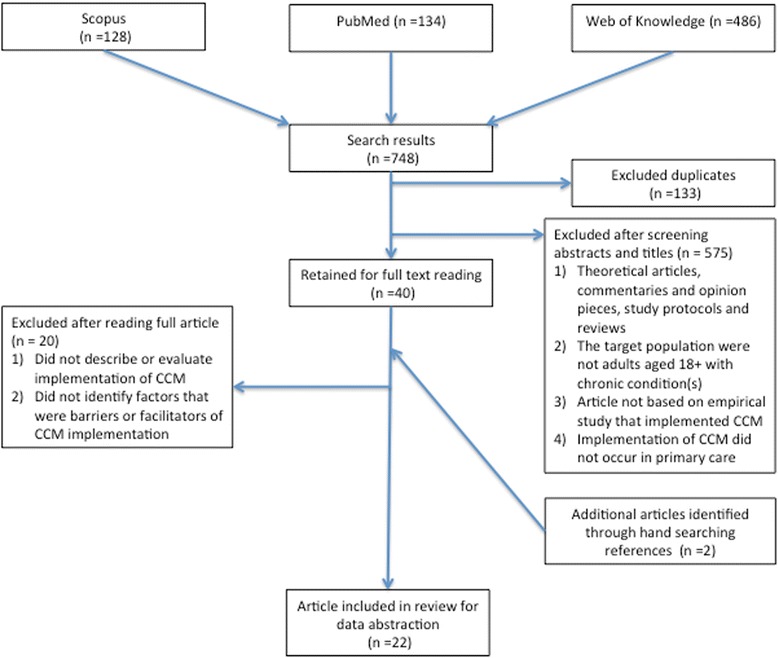
BACKGROUND: The Chronic Care Model (CCM) is a framework developed to redesign care delivery for individuals living with chronic diseases in primary care. The CCM and its various components have been widely adopted and evaluated, however, little is known about different primary care experiences with its implementation, and the factors that influence its successful uptake. The purpose of this review is to synthesize findings of studies that implemented the CCM in primary care, in order to identify facilitators and barriers encountered during implementation. METHODS: This study identified English-language, peer-reviewed research articles, describing the CCM in primary care settings. Searches were performed in three data bases: Web of Knowledge, Pubmed and Scopus. Article abstracts and titles were read based on whether they met the following inclusion criteria: 1) studies published after 2003 that described or evaluated the implementation of the CCM; 2) the care setting was primary care; 3) the target population of the study was adults over the age of 18 with chronic conditions. Studies were categorized by reference, study design and methods, participants and setting, study objective, CCM components used, and description of the intervention. The next stage of data abstraction involved qualitative analysis of cited barriers and facilitators using the Consolidating Framework for Research Implementation. RESULTS: This review identified barriers and facilitators of implementation across various primary care settings in 22 studies. The major emerging themes were those related to the inner setting of the organization, the process of implementation and characteristics of the individual healthcare providers. These included: organizational culture, its structural characteristics, networks and communication, implementation climate and readiness, presence of supportive leadership, and provider attitudes and beliefs. CONCLUSIONS: These findings highlight the importance of assessing organizational capacity and needs prior to and during the implementation of the CCM, as well as gaining a better understanding of health care providers' and organizational perspective.
Overview
The claims and statistics of this paper haven’t been checked yet.
Run the check — free, no account needed. It reads the open-access text and checks the sources it cites.
Integrity signals
Registry
Cites
Statistics
Figures
Verification
Claims the paper makes
The claims and statistics of this paper haven’t been checked yet.
Run the check — free, no account needed. It reads the open-access text and checks the sources it cites.
Claims other papers make about this one
Each is checked against this paper’s own text: does it say what the citing paper says it does?
In the citing paper
“Research papers more often tend to report clinical level variables (such as information given to patients to support self-management) than to assess organisational factors, such as professional culture, governance, financial management, communication patterns, implementation readiness, or presence of supportive leadership 35 .”
From Integrated care for people with long-term mental and physical health conditions in low-income and middle-income countries (2019) · cites this paper as [35]
In the citing paper
“In other similar studies, positive effects have been shown for people with depression 34 35 , chronic obstructive pulmonary disease 35 , asthma 35 36 , diabetes 35 36 and heart failure 36 .”
From Integrated care for people with long-term mental and physical health conditions in low-income and middle-income countries (2019) · cites this paper as [35]
Self-check
Percentages, sums and reported differences re-computed from the paper’s own numbers.
The self-check needs the paper’s full text.
Citations
Cites
Liberati, A., Altman, D. G., Tetzlaff, J., Mulrow, C., Gøtzsche, P. C., Ioannidis, J. P. A., Clarke, M., Devereaux, P. J., Kleijnen, J., & Moher, D. (2009) · PLoS Medicine · doi:10.1371/journal.pmed.1000100 · Cited by 28,164 · cited 1×
“The PRISMA statement provides an evidence-based checklist intended to improve the standards of reporting in systematic reviews [31].”
MethodDamschroder, L. J., Aron, D. C., Keith, R. E., Kirsh, S. R., Alexander, J. A., & Lowery, J. C. (2009) · Implementation Science · doi:10.1186/1748-5908-4-50 · Cited by 14,496 · cited 13×
“The CFIR was selected because it includes multiple constructs and theories from peer reviewed studies on evidence-based knowledge dissemination and translation, organizational change and implementation, and uptake of research.”
BackgroundMethodInfluentialLiberati, A., Altman, D. G., Tetzlaff, J., Mulrow, C., Gøtzsche, P. C., Ioannidis, J. P. A., Clarke, M., Devereaux, P. J., Kleijnen, J., & Moher, D. (2009) · Annals of Internal Medicine · doi:10.7326/0003-4819-151-4-200908180-00136 · Cited by 10,349
Diffusion of Innovations in Service Organizations: Systematic Review and Recommendations
GREENHALGH, T., ROBERT, G., MACFARLANE, F., BATE, P., & KYRIAKIDOU, O. (2004) · The Milbank Quarterly · doi:10.1111/j.0887-378x.2004.00325.x · Cited by 7,448 · cited 1×
“It provides a conceptual framework which can be used to understand factors that influence successful implementation in health care, and is based on theories identified by Greenhalgh and colleagues’ widely cited systematic review [26,32].”
Background(2005) · Cited by 3,748
Improving chronic illness care: translating evidence into action
Wagner, E. H., Austin, B. T., Davis, C., Hindmarsh, M., Schaefer, J., & Bonomi, A. (2001) · Health Affairs · doi:10.1377/hlthaff.20.6.64 · Cited by 3,446 · cited 1×
“CCM articles by Wagner and colleagues and Bodenheimer and colleagues [8-10,14,27,28].”
Improving Primary Care for Patients With Chronic Illness
Bodenheimer, T. (2002) · JAMA · doi:10.1001/jama.288.14.1775 · Cited by 2,961 · cited 7×
“and colleagues [10], thus reflecting studies that”
BackgroundMethodInfluentialOrganizing Care for Patients with Chronic Illness
Wagner, E. H., Austin, B. T., & Korff, M. V. (1996) · The Milbank Quarterly · doi:10.2307/3350391 · Cited by 2,877 · cited 1×
“CCM articles by Wagner and colleagues and Bodenheimer and colleagues [8-10,14,27,28].”
Danaei, G., Ding, E. L., Mozaffarian, D., Taylor, B., Rehm, J., Murray, C. J. L., & Ezzati, M. (2009) · PLoS Medicine · doi:10.1371/journal.pmed.1000058 · Cited by 2,860
The challenge of complexity in health care
Plsek, P. E., & Greenhalgh, T. (2001) · BMJ · doi:10.1136/bmj.323.7313.625 · Cited by 2,578
Research works printed but not linked: 3
- World Health Organization. Innovative care for chronic conditions: building blocks for action, global report. Geneva: World Health Organization; 2002.
- Public Health Agency of Canada. Chronic diseases in Canada: United Nations non-communicable disease summit. Ottawa: Public Health Agency of Canada; 2011.
- Iles V, Sutherland K. Organisational change: a review for health care managers, professionals and researchers. In: National Coordinating Center for National Health Service Delivery and Organization. 2001. p. 12–68.
Cited by
Sorted by citations
Implementation Mapping: Using Intervention Mapping to Develop Implementation Strategies
Fernandez, M. E., ten Hoor, G. A., van Lieshout, S., Rodriguez, S. A., Beidas, R. S., Parcel, G., Ruiter, R. A. C., Markham, C. M., & Kok, G. (2019) · Frontiers in Public Health · doi:10.3389/fpubh.2019.00158 · Cited by 914
Briggs, A. M., Cross, M., Hoy, D. G., Sànchez-Riera, L., Blyth, F., Woolf, A. D., & MARCH, L. M. (2016) · The Gerontologist · doi:10.1093/geront/gnw002 · Cited by 764
A systematic review of chronic disease management interventions in primary care
Reynolds, R. C., Dennis, S. M., Hasan, I., Slewa, J., Chen, W. T., Tian, D. H., Bobba, S., & Zwar, N. A. (2018) · BMC Family Practice · doi:10.1186/s12875-017-0692-3 · Cited by 615
“The need for further research in this area is highlighted by both our finding and reviews by Kadu and Stolle [27] and Dauvrin et al. [28] who suggested that the scope of chronic care interventions should be expanded to transform health care organizations and systems.”
BackgroundResultInfluentialThe SELFIE framework for integrated care for multi-morbidity: Development and description
Leijten, F., Struckmann, V., van Ginneken, E., Czypionka, T., Kraus, M., Reiss, M., Tsiachristas, A., Boland, M. R. S., Bont, A. A. D., Bal, R. A., et al. (2017) · Health Policy · doi:10.1016/j.healthpol.2017.06.002 · Cited by 263
“Appropriate workforce planning at organisational level is necessary and includes attention for workload and sufficient team resources [71,104,111], professional education, and sustainability of staff and informal caregivers [111].”
BackgroundRelevant models and elements of integrated care for multi-morbidity: Results of a scoping review
Struckmann, V., Leijten, F., van Ginneken, E., Kraus, M., Reiss, M., Spranger, A., Boland, M. R. S., Czypionka, T., Busse, R., & Mölken, M. R. (2017) · Health Policy · doi:10.1016/j.healthpol.2017.08.008 · Cited by 174
Esponda, G. M., Hartman, S. J., Qureshi, O., Sadler, E., Cohen, A., & Kakuma, R. (2019) · The Lancet Psychiatry · doi:10.1016/s2215-0366(19)30125-7 · Cited by 176
Thornicroft, G., Ahuja, S., Barber, S., Chisholm, D., Collins, P. Y., Docrat, S., Fairall, L., Lempp, H., Niaz, U., Ngo, V., et al. (2019) · The Lancet Psychiatry · doi:10.1016/s2215-0366(18)30298-0 · Cited by 138
Squires, J. E., Aloisio, L. D., Grimshaw, J., Bashir, K., Dorrance, K., Coughlin, M., Hutchinson, A. M., Francis, J., Michie, S., Sales, A. E., et al. (2019) · Implementation Science · doi:10.1186/s13012-019-0900-8 · Cited by 121
Wood, E., Ohlsen, S., & Ricketts, T. (2017) · Journal of Affective Disorders · doi:10.1016/j.jad.2017.02.028 · Cited by 107
“…strategy was developed from combining search terms from previous systematic reviews looking at depression (Coventry et al., 2014), primary care (Kadu and Stolee, 2015) and collaborative care (Coventry et al., 2014) and combining them with acceptability outcome search terms adapted from Smith…”
BackgroundMethodInfluentialBriggs, A. M., Houlding-Braunberger, E., Hinman, R. S., Desmond, L., Bennell, K. L., Darlow, B. J. S., Pizzari, T., Leech, M. T., MacKay, C., Larmer, P. J., et al. (2019) · Osteoarthritis and Cartilage · doi:10.1016/j.joca.2018.12.024 · Cited by 107
Factors influencing the implementation of chronic care models: A systematic literature review
Davy, C. P., Bleasel, J. M., Liu, H., Tchan, M., Ponniah, S., & Brown, A. D. H. (2015) · BMC Family Practice · doi:10.1186/s12875-015-0319-5 · Cited by 102
“A number of systematic literature reviews have already considered the effectiveness of CCMs [11–17].”
BackgroundSopcak, N., Aguilar, C., O’Brien, M. A., Nykiforuk, C. I. J., Aubrey‐Bassler, K., Cullen, R. M., Grunfeld, E., & Manca, D. P. (2016) · Implementation Science · doi:10.1186/s13012-016-0525-0 · Cited by 90
“Moreover, the CFIR has been specifically used to review facilitators and barriers of complex implementations in primary care [13].”
BackgroundMethodMistry, S. K., Harris, E., & Harris, M. (2021) · Journal of General Internal Medicine · doi:10.1007/s11606-021-06667-y · Cited by 103
“While there is increasing recognition of the importance of primary care in management of chronic illnesses, there is often lack of coordination among different health providers.(13) Studies carried out in different countries point out that lack of time during the clinical visit is one of the most important barriers to…”
BackgroundChen, L., Xiao, L. D., & Chamberlain, D. J. (2020) · Journal of Advanced Nursing · doi:10.1111/jan.14446 · Cited by 79
Clinical leadership and integrated primary care: A systematic literature review
Nieuwboer, M. S., van der Sande, R., van der Marck, M. A., Rikkert, M. G. M. O., & Perry, M. (2018) · European Journal of General Practice · doi:10.1080/13814788.2018.1515907 · Cited by 95
“However, lack of leadership power is often reported in integrated-care studies [7,8] and few studies support the assertion that leadership advances integrated care [15].”
ResultBriggs, A. M., Chan, M. T.-L., & Slater, H. (2016) · Best Practice & Research Clinical Rheumatology · doi:10.1016/j.berh.2016.09.009 · Cited by 74
Dziedzic, K., French, S., Davis, A. M., Geelhoed, E. A., & Porcheret, M. (2016) · Best Practice & Research Clinical Rheumatology · doi:10.1016/j.berh.2016.08.004 · Cited by 70
Determinants of access to eHealth services in regional Australia
Alam, K., Mahumud, R. A., Alam, F., Keramat, S. A., Erdiaw‐Kwasie, M. O., & Sarker, A. R. (2019) · International Journal of Medical Informatics · doi:10.1016/j.ijmedinf.2019.103960 · Cited by 68
Operationalizing the Chronic Care Model with Goal-Oriented Care
Grudniewicz, A., Gray, C. S., Boeckxstaens, P., Maeseneer, J. D., & Mold, J. W. (2023) · Patient · doi:10.1007/s40271-023-00645-8 · Cited by 74
“The Chronic Care Model (CCM), also referred to as the Care Model, has been widely adopted and implemented in health care settings [25].”
MethodThe Global Spine Care Initiative: model of care and implementation
Johnson, C. D., Haldeman, S., Chou, R., Nordin, M. C., Green, B. N., Côté, P., Hurwitz, E. L., Kopansky-Giles, D. R., Acaroglu, E. R., Cedraschi, C., et al. (2018) · European Spine Journal · doi:10.1007/s00586-018-5720-z · Cited by 70
Speerin, R., Needs, C., Chua, J., Woodhouse, L. J., Nordin, M. C., McGlasson, R. A., & Briggs, A. M. (2020) · Best Practice & Research Clinical Rheumatology · doi:10.1016/j.berh.2020.101548 · Cited by 66
Kuipers, S. J., Nieboer, A. P., & Cramm, J. M. (2021) · International Journal of Environmental Research and Public Health · doi:10.3390/ijerph18116057 · Cited by 64
“, integrated primary care for community-dwelling frail older persons, interventions based on the chronic care model) [54,55].”
BackgroundSarkies, M., Long, J. C., Pomare, C., Wu, W., Clay‐Williams, R., Nguyen, H. M., Francis‐Auton, E., Westbrook, J. I., Lévesque, J., Watson, D. E., et al. (2020) · Implementation Science · doi:10.1186/s13012-020-01049-0 · Cited by 60
“Specific to improving the management of chronic conditions, Kadu and Stolee [31] identified implementation determinants considered important to the environmental characteristics within organisations (e.g. inner setting organisational culture) and among individual healthcare professionals (e.g. attitudes and beliefs).”
BackgroundInfluentialPiat, M., Wainwright, M., Sofouli, E., Vachon, B., Deslauriers, T., Préfontaine, C., & Frati, F. (2021) · Systematic Reviews · doi:10.1186/s13643-021-01646-0 · Cited by 67
Kamvura, T. T., Dambi, J. M., Chiriseri, E., Turner, J., Verhey, R., & Chibanda, D. (2022) · BMC Nursing · doi:10.1186/s12912-022-00841-1 · Cited by 55
Briggs, A. M., Jordan, J. M., Jennings, M. D., Speerin, R., Bragge, P., Chua, J., Woolf, A. D., & Slater, H. (2016) · Arthritis Care & Research · doi:10.1002/acr.22948 · Cited by 50
“, communication, understanding of organizational culture, and appetite for change) is critical (14,18).”
BackgroundLeslie, M., Khayatzadeh‐Mahani, A., Birdsell, J., Forest, P., Henderson, R., Gray, R. P., Schraeder, K. E., Seidel, J. E., Zwicker, J. D., & Green, L. A. (2020) · BMC Family Practice · doi:10.1186/s12875-020-01330-7 · Cited by 48
“The value of this cultural feature – this rough agreement on the importance of flexibility – is that it appears to bridge the other divides that separate the players and so supports the transformation agenda [76].”
BackgroundWang, W., Schweickle, M. J., Arnold, E. R., & Vella, S. A. (2025) · Sports Medicine · doi:10.1007/s40279-024-02173-3 · Cited by 75
The Odyssey of Integration: Is Management its Achilles’ Heel?
Miller, R. J., & Stein, K. V. (2020) · International Journal of Integrated Care · doi:10.5334/ijic.5440 · Cited by 45
Obstacles to access to community care in urban senior-only households: a qualitative study
Gong, N., Meng, Y., Qin, H., Du, Q., Wu, X., Zou, W., Zhu, M., Chen, J., Luo, L., Cheng, Y., et al. (2022) · BMC Geriatrics · doi:10.1186/s12877-022-02816-y · Cited by 45
“At the same time, lack of integration and clear path guidance in the process of community care delivery exacerbated the difficulties of seeking care services for older adults [54].”
BackgroundIntegrated care in Switzerland: Results from the first nationwide survey
Filliettaz, S. S., Berchtold, P., Kohler, D., & Peytremann‐Bridevaux, I. (2018) · Health Policy · doi:10.1016/j.healthpol.2018.03.006 · Cited by 44
“In short, policy is necessary but not sufficient [33], strengthening health workforce is imperative [34], interacting barriers and facilitators to implementation exist [18,35–38] and finally, individual leadership [39,40] as well as attitude towards change and innovation [41] play important roles.”
BackgroundScientometrics Recent Advances
Kunosić, S., & Zerem, E. (2019) · IntechOpen eBooks · doi:10.5772/intechopen.77450 · Cited by 44
Kim, H., Jung, Y., Kim, G.-S., Choi, H., & Park, Y. (2020) · The Gerontologist · doi:10.1093/geront/gnaa090 · Cited by 43
Koopman, R. J., Canfield, S. M., Belden, J. L., Wegier, P., Shaffer, V. A., Valentine, K. D., Jain, A., Steege, L. M. B., Patil, S. J., Popescu, M., et al. (2020) · BMC Medical Informatics and Decision Making · doi:10.1186/s12911-020-01194-y · Cited by 43
Chronic Care Nursing: A Framework for Practice
Malone, L., & Anderson, J. (2016) · Cited by 40
Paulo, M. S., Loney, T., & Lapão, L. V. (2019) · Human Resources for Health · doi:10.1186/s12960-019-0345-9 · Cited by 42
Toward digital transformation in healthcare: a framework for remote monitoring adoption
Binci, D., Palozzi, G., & Scafarto, F. (2021) · The TQM Journal · doi:10.1108/tqm-04-2021-0109 · Cited by 43
Ring, N., Booth, H., Wilson, C., Hoskins, G., Pinnock, H., Sheikh, A., & Jepson, R. G. (2015) · BMC Family Practice · doi:10.1186/s12875-015-0352-4 · Cited by 36
“General practices could also set ‘realistic implementation goals’ [31], for example, targeting PAAP issuing/review towards those groups, such as the newly diagnosed, that are perceived by patients and professionals as a priority for receiving them.”
BackgroundSullivan, J. L., Adjognon, O. L., Engle, R. L., Shin, M. H., Afable, M. K., Rudin, W., White, B., Shay, K., & Lukas, C. V. (2017) · Health Care Management Review · doi:10.1097/hmr.0000000000000152 · Cited by 36
“…were consistent with the research on program implementation, which has shown that there are certain issues that need to be addressed during program implementation (Bradley et al., 2004, 2005; Damschroder& Lowery, 2013; Feldstein&Glasgow, 2008; Kadu & Stolee, 2015; Tomoaia-Cotisel et al., 2013).”
BackgroundResultBaker, E., Gwernan‐Jones, R., Britten, N., Cox, M., McCabe, C., Retzer, A., Gill, L., Plappert, H., Reilly, S., Pinfold, V., et al. (2019) · BMC Psychiatry · doi:10.1186/s12888-018-1997-z · Cited by 33
Liu, Y., Wang, L., & Zhu, L. (2023) · British Journal of Nursing · doi:10.12968/bjon.2023.32.6.s28 · Cited by 32
Riordan, F., McHugh, S., O’Donovan, C., Mtshede, M. N., & Kearney, P. M. (2020) · Journal of General Internal Medicine · doi:10.1007/s11606-020-05676-7 · Cited by 33
McHugh, S., Riordan, F., Kerins, C., Curran, G. M., Lewis, C. C., Presseau, J., Wolfenden, L., & Powell, B. J. (2023) · HRB Open Research · doi:10.12688/hrbopenres.13675.1 · Cited by 28
“The relationships between data will be categorised as: (1) silence (only one data source out of the two being compared contained data on a particular finding), (2) dissonance (conflicting findings in the data), (3) partial agreement (complementarity between data) or (4) agreement (convergence in the data)(77)”
BackgroundEffectiveness of care models for chronic disease management: A scoping review of systematic reviews
Kroenke, K., Corrigan, J. D., Ralston, R. K., ZAFONTE, R. D., Brunner, R. C., Giacino, J. T., Hoffman, J. M., Esterov, D., Cifu, D. X., Mellick, D., et al. (2023) · PM&R · doi:10.1002/pmrj.13027 · Cited by 30
McKillop, A., Shaw, J., Sheridan, N., Gray, C. S., Carswell, P., Wodchis, W. P., Connolly, M. J., Denis, J., Baker, G. R., & Kenealy, T. W. (2017) · International Journal of Integrated Care · doi:10.5334/ijic.2516 · Cited by 29
“Reviews of the PARHIS framework [30] and CFIR [1, 32] indeed suggest that the strength of these models is their attention to the interplay of contextual factors, which may suggest an interpretivist approach.”
BackgroundMethodInfluentialon behalf of the PVS group, Gonzalo Grandes, O., Sánchez, Á., Cortada, J. M., Pombo, H., Martinez, C., Balagué, L., Corrales, M. H., de la Peña, E., Mugica, J., et al. (2017) · BMC Research Notes · doi:10.1186/s13104-017-3040-8 · Cited by 28
“Such frameworks provide no specific blueprints on how they should be operationalized in practice and researchers trying to design implementation strategies for health promotion interventions need detailed examples such as that provided herein on how they should be used [51].”
BackgroundLewinski, A. A., Shapiro, A. S., Gierisch, J. M., Goldstein, K. M., Blalock, D. V., Luedke, M. W., Gordon, A. M., Bosworth, H. B., Drake, C., Lewis, J. D., et al. (2020) · Systematic Reviews · doi:10.1186/s13643-020-01322-9 · Cited by 27
Peer support for traumatic injury survivors: a scoping review
Wasilewski, M. B., Rios, J., Simpson, R., Hitzig, S. L., Conn, L. G., MacKay, C., Mayo, A. L., & Robinson, L. R. (2022) · Disability and Rehabilitation · doi:10.1080/09638288.2022.2083702 · Cited by 27
Nock, A. M., Metzing, S., Jürgensen, I.-N., & Petersen‐Ewert, C. (2023) · Nursing Reports · doi:10.3390/nursrep13020072 · Cited by 29
“This applies especially for people with chronic conditions as they are diagnosed, treated and informed about their condition and the course of disease in primary care services [17,18].”
BackgroundSocial theory for software engineering research
Ralph, P., Chiasson, M. W., & Kelley, H. M. (2016) · International Conference on Evaluation and Assessment in Software Engineering (EASE) · doi:10.1145/2915970.2915998 · Cited by 25
“While this situation appears conducive to technological solutions, clinician buy-in is critical for success [33].”
BackgroundReady, set, go!: exploring use of a readiness process to implement pharmacy services
Livet, M., Yannayon, M., Richard, C., Sorge, L. A., & Scanlon, P. (2020) · Implementation Science Communications · doi:10.1186/s43058-020-00036-2 · Cited by 26
Leonardsen, A. L., Moen, E. K., Karlsøen, G., & Hovland, T. (2019) · Nursing Reports · doi:10.4081/nursrep.2019.8041 · Cited by 24
Warner, G., Kervin, E. K., Pesut, B., Urquhart, R., Duggleby, W., & Hill, T. G. (2021) · BMC Health Services Research · doi:10.1186/s12913-020-06031-6 · Cited by 23
Javanparast, S., Roeger, L. S., & Reed, R. L. (2021) · Australian Health Review · doi:10.1071/ah20328 · Cited by 23
Schor, A., Yellin, L. B., Landsberger, D., Kolobov, T., & Baron-Epel, O. B. (2019) · Israel Journal of Health Policy Research · doi:10.1186/s13584-019-0318-4 · Cited by 23
Buja, A., Francesconi, P., Bellini, I., Barletta, V., Girardi, G., Braga, M., Cosentino, M., Marvulli, M., Baldo, V., & Damiani, G. (2020) · Primary Health Care Research & Development · doi:10.1017/s1463423620000080 · Cited by 23
“For instance, one previous review (Kadu and Paul, 2015) found that the inner setting of the organization, the process of implementation, and characteristics of the individual healthcare providers could mediate the effectiveness of the primary care model.”
BackgroundThe integral role of nurses in primary care for transgender people: A qualitative descriptive study
Ziegler, E. (2020) · Journal of Nursing Management · doi:10.1111/jonm.13190 · Cited by 22
Castiglione, S. A., & Lavoie‐Tremblay, M. (2021) · JONA The Journal of Nursing Administration · doi:10.1097/nna.0000000000001011 · Cited by 21
“Another barrier was the increase of responsibilities for staff with time constraints.(23)”
BackgroundInfluentialLebina, L., Oni, T., Alaba, O. A., & Kawonga, M. (2020) · BMC Health Services Research · doi:10.1186/s12913-020-05455-4 · Cited by 20
Walker, D., Moucheraud, C., Butler, D., Vente, J. D., Tangonan, K., SHOPTAW, S. J., Currier, J. S., Gladstein, J., & Hoffman, R. M. (2023) · BMC Health Services Research · doi:10.1186/s12913-023-09107-1 · Cited by 20
“These data suggest that perceived leadership buy-in can affect the culture of a clinic and the subsequent implementation of telemedicine, and the literature has shown that these factors are responsible for impacting the implementation of all types of health service delivery [23, 24].”
BackgroundGray, C. S., Wodchis, W. P., Baker, G. R., Carswell, P., Kenealy, T. W., McKillop, A., Breton, M., Parsons, J. G. M., & Sheridan, N. (2018) · International Journal of Integrated Care · doi:10.5334/ijic.3082 · Cited by 19
“In order to collect key variables from this framework pertinent to the provider perspective, the team used the Assessment of Chronic Illness Care (ACIC) tool, a survey designed to capture key components of the CCM [22].”
BackgroundInfluentialBriggs, A. M., Jordan, J. M., Speerin, R., Jennings, M. D., Bragge, P., Chua, J., & Slater, H. (2015) · BMC Health Services Research · doi:10.1186/s12913-015-1173-9 · Cited by 17
“Such network-developed models are reported to be acceptable to stakeholders [26, 42], associated with improved outcomes for consumers [43], and identified as a facilitator to implementation of chronic care models [40].”
BackgroundKey stakeholder experiences of an integrated healthcare pilot in Australia: a thematic analysis
Trankle, S. A., Usherwood, T. P., Abbott, P., Roberts, M. M., Crampton, M., Girgis, C. M., Riskallah, J., Chang, Y., Saini, J., & Reath, J. (2020) · BMC Health Services Research · doi:10.1186/s12913-020-05794-2 · Cited by 17
Pinter, K. A., Zhang, H., Liu, C., Tran, B. X., Chokshi, M., Lucero‐Prisno, D. E., Sharma, V., & Tang, S. (2021) · International Journal of Integrated Care · doi:10.5334/ijic.5439 · Cited by 16
“A 2015 systematic review of the facilitators and barriers of implementing chronic care models in countries across North America and Europe found that the strongest general facilitators included strong networks and communication, a culture and implementation climate which supported integration and uptake of chronic car…”
BackgroundKolko, D. J., McGuier, E. A., Turchi, R. M., Thompson, E., Iyengar, S., Smith, S. N., Hoagwood, K., Liebrecht, C., Bennett, I. M., Powell, B. J., et al. (2022) · Implementation Science · doi:10.1186/s13012-022-01195-7 · Cited by 16
“At the leadership and organizational levels, successful CCM implementation requires supportive leadership, positive organizational climate and culture, and strong implementation climate [26].”
BackgroundTimpel, P., Lang, C., Wens, J., Contel, J. C., Schwarz, P. E. H., & On behalf of the MANAGE CARE Study Group (2020) · International Journal of Integrated Care · doi:10.5334/ijic.4646 · Cited by 22
Baum, R., King, M. A., & Wissow, L. S. (2018) · Psychiatric Services · doi:10.1176/appi.ps.201800163 · Cited by 15
En Route to Implementation Science 3.0
Albers, B., Shlonsky, A., & Mildon, R. L. (2020) · Springer eBooks · doi:10.1007/978-3-030-03874-8_1 · Cited by 18
Danish, A., Chouinard, M., Aubrey‐Bassler, K., Burge, F., Doucet, S. A., Ramsden, V. R., Bisson, M., Cassidy, M., Condran, B. R., Lambert, M., et al. (2020) · BMJ Open · doi:10.1136/bmjopen-2020-038241 · Cited by 15
Vandervelde, S., Scheepmans, K., Milisen, K., van Achterberg, T., Vlaeyen, E., Flamaing, J., & de Casterlé, B. D. (2021) · BMC Geriatrics · doi:10.1186/s12877-020-01946-5 · Cited by 18
“staff, training, strategic planning, resources) and the extent to which a new intervention fits in the current workflow influence the implementation process [20, 37, 42, 43].”
BackgroundHosey, G. M., Rengiil, A., Maddison, R., Agapito, A. U., Lippwe, K., Wally, O. D., Agapito, D. D., Seremai, J., Primo, S., Luther, X.-N., et al. (2016) · Journal of Health Care for the Poor and Underserved · doi:10.1353/hpu.2016.0187 · Cited by 14
Horn, B. P., Crandall, C. S., Moffett, M. L., Hensley, M., Howarth, S., Binder, D. S., & Sklar, D. P. (2016) · Population Health Management · doi:10.1089/pop.2015.0142 · Cited by 14
“2,13 Relatedly, the Care Management Model uses long-term, patient-centered approaches that focus on improving patient functional health, enhancing care coordination, and eliminating service duplication.”
Adjognon, O. L., Shin, M. H., Steffen, M. J. A., Moye, J. A., Solimeo, S. L., & Sullivan, J. L. (2021) · Health Services Research · doi:10.1111/1475-6773.13859 · Cited by 14
Ngangue, P., Brown, J. B., Forgues, C., Ahmed, M. A. A., Nguyen, T. N., Sasseville, M., Loignon, C., Gallagher, F., Stewart, M., & Fortin, M. (2021) · BMJ Open · doi:10.1136/bmjopen-2020-046914 · Cited by 14
“Therefore, the research team and social desirability may have influenced the perspectives of these participants.”
Vijayasingham, L., Ansbro, É., Zmeter, C., Abbas, L. A., Schmid, B., Sanga, L. A., Larsen, L. B., Perone, S. A., & Perel, P. (2024) · Journal of Migration and Health · doi:10.1016/j.jmh.2024.100228 · Cited by 15
“• Leadership turnover (Kadu and Stolee, 2015).”
BackgroundInfluentialVolker, N., Williams, L. T., Davey, R., Cochrane, T., & Clancy, T. (2017) · BMC Family Practice · doi:10.1186/s12875-017-0580-x · Cited by 14
“In their review of Chronic Care Model-framed interventions which aim to improve chronic disease outcomes, Kadu and Stolee found the need for more research focused on understanding the inner settings of organisations, including the characteristics of the work of individual practitioners, in order to better understand h…”
Backgroundvan Bruggen, S., Rauh, S. P., Kasteleyn, M. J., Bonten, T. N., Chavannes, N. H., & Numans, M. E. (2019) · BMJ Open · doi:10.1136/bmjopen-2018-027208 · Cited by 12
“However, a review on chronic care programmes in primary care reported that doubts among care providers on the clinical effects of an intervention are a barrier for adoption.(27) To our knowledge, little is known about the relationship between full monitoring of biomedical as well as lifestyle-related target diabetes i…”
BackgroundHazazi, A., & Wilson, A. J. (2022) · Health Services Insights · doi:10.1177/11786329221088694 · Cited by 12
Practice change in chronic conditions care: an appraisal of theories
Harris, M., Lawn, S., Morello, A., Battersby, M., Ratcliffe, J., McEvoy, R. D., & Tieman, J. (2017) · BMC Health Services Research · doi:10.1186/s12913-017-2102-x · Cited by 14
“Structuring the analysis of retrospectively collected qualitative data appears to be the main reported use of theories, generally [49, 50] and in chronic and complex care [9].”
MethodKim, M., Lin, Y. C., Luna, G., Ma, J., & Stiehl, E. (2020) · Journal of Occupational and Environmental Medicine · doi:10.1097/jom.0000000000002007 · Cited by 12
Keller, M. S., Guevara, N., Guerrero, J.-A., Mays, A. M., McCleskey, S. G., Reyes, C. E. S., & Sarkisian, C. A. (2024) · BMC Geriatrics · doi:10.1186/s12877-024-05323-4 · Cited by 11
“Moreover, primary care providers report having little connection to social services, community organizations, or interdisciplinary teams which could assist care-givers with dementia management [38, 41].”
BackgroundBell, J. S., Hagaman, A. M., Beattey, J., Fears, G., White, W. L., & Watson, D. P. (2024) · Journal of Substance Use and Addiction Treatment · doi:10.1016/j.josat.2024.209612 · Cited by 11
Realising the potential of community-based multidisciplinary teams: insights from evidence
Lloyd, T., Beech, J., Wolters, A., & Tallack, C. (2023) · doi:10.37829/hf-2023-iau01 · Cited by 11
“41,42,43 They also appear to be here to stay: the ambition for ICSs and PCNs in England involves developing MDTs to join up health and care services in the community.”
BackgroundAmo-Setién, F. J., Abajas‐Bustillo, R., Manrique, B. T., Martín-Melón, R., Sarabia‐Cobo, C., Molina‐Mula, J., & Ortego, C. (2019) · PLoS ONE · doi:10.1371/journal.pone.0218903 · Cited by 10
“subscale and Mental Component Summary measure, where, in any case, the impact on HRQoL was very small, in agreement with similar systematic reviews [8,9,12,63,64].”
BackgroundResultCheng, A. S. K., Liu, X., Ng, P. H. F., Kwok, C. T. T., Zeng, Y., & Feuerstein, M. A. (2020) · BMJ Open · doi:10.1136/bmjopen-2019-034655 · Cited by 10
Addressing Physical Activity Behavior in Multiple Sclerosis Management
Donkers, S. J., Oosman, S. N., Milosavljevic, S., & Musselman, K. E. (2019) · International Journal of MS Care · doi:10.7224/1537-2073.2019-029 · Cited by 10
Hemler, J. R., Edwards, S. T., Valenzuela, S. H., Baron, A. N., Hall, J. D., Perry, C. K., Balasubramanian, B. A., Damschroder, L. J., Solberg, L. I., Crabtree, B. F., et al. (2022) · The Journal of the American Board of Family Medicine · doi:10.3122/jabfm.2022.01.210205 · Cited by 9
Paulo, M. S., Loney, T., & Lapão, L. V. (2018) · BMJ Open · doi:10.1136/bmjopen-2017-020189 · Cited by 9
“Increasing evidence has shown that changes in at least four of the six categories of the CCM led to clear advances in health outcomes.2 Some interventions have focused on one or two specific CCM components, and these studies also showed improvements in the development of the CCM.2 3 This model has been mostly applied…”
BackgroundCareer Impact of the Chief Resident in Quality and Safety Training Program: An Alumni Evaluation
Aboumrad, M., Carluzzo, K. L., Lypson, M. L., & Watts, B. V. (2019) · Academic Medicine · doi:10.1097/acm.0000000000002938 · Cited by 9
Physician leadership and health information exchange: literature review
Heath, M. L., & Porter, T. H. (2019) · BMJ Health & Care Informatics · doi:10.1136/bmjhci-2019-100080 · Cited by 9
Path taken by morbidly obese people in search of bariatric surgery in the public health system
Conz, C. A., Jesús, M., Kortchmar, E., Braga, V. A. S., Tavares, R. E., & Merighi, M. A. B. (2020) · Revista Latino-Americana de Enfermagem · doi:10.1590/1518-8345.3579.3294 · Cited by 9
“In order to favor the path taken by people with obesity in the health system, evidence pointed out that it is necessary to establish a strong communication network between care providers, to share information, to respect regional beliefs and cultures(5), use tools available for clinical evaluation and referral to spec…”
BackgroundPaciocco, S., Kothari, A., Licskai, C., Ferrone, M., & Sibbald, S. (2021) · BMC Health Services Research · doi:10.1186/s12913-021-06636-5 · Cited by 11
Challenges and successes to the implementation of a zoo conservation-education program
Mellish, S., Ryan, J. C., McLeod, E. M., Tuckey, M. R., & Pearson, E. L. (2021) · Evaluation and Program Planning · doi:10.1016/j.evalprogplan.2021.101950 · Cited by 9
Digital Health Systems in Integrated Care
Gray, C. S., Gagnon, D., Guldemond, N., & Kenealy, T. W. (2021) · Springer eBooks · doi:10.1007/978-3-030-69262-9_28 · Cited by 9
Marcial, L. H., Johnston, D., Shapiro, M. R., Jacobs, S., Blumenfeld, B. H., & Smith, L. R. (2019) · JAMIA Open · doi:10.1093/jamiaopen/ooz002 · Cited by 9
Vincenzo, J. L., Bergen, G., Casey, C. M., & Eckstrom, E. (2024) · The Gerontologist · doi:10.1093/geront/gnae035 · Cited by 9
Bazzano, A. N., Monnette, A., Wharton, M. K., Price‐Haywood, E. G., Nauman, E., Dominick, P., Glover, C., Hu, G., & Shi, L. (2019) · Patient Preference and Adherence · doi:10.2147/ppa.s201072 · Cited by 8
Ryan, G. W., Whitmire, P., Batten, A. J., Goulding, M., Nelson, B. B., Lemon, S. C., & Pbert, L. A. (2023) · Preventive Medicine Reports · doi:10.1016/j.pmedr.2023.102449 · Cited by 7
“The CFIR was designed to help researchers consider multi-level influential factors on implementation and has been used in numerous studies to identify barriers and facilitators to uptake of evidence-based practices in healthcare settings (Kadu and Stolee, 2015; Garbutt et al., 2018).”
Larrañaga, I., Soto‐Gordoa, M., Arrospide, A., Jauregi, M. L., Millas, J., Vicente, R. S., Aguirrebeña, J., & Mar, J. (2016) · Reumatología Clínica · doi:10.1016/j.reuma.2016.04.014 · Cited by 7
Ledford, C. J. W., Sadler, K. P., Jackson, J. T., Womack, J. J., Rider, H. A., & Seehusen, A. B. (2018) · Patient Education and Counseling · doi:10.1016/j.pec.2018.04.017 · Cited by 7
Metadata
- Authors
- Kadu, M. K., & Stolee, P.
- Affiliations
- University of Waterloo (CA)
- Corresponding author
- Stolee, Paul
- Venue
- BMC Family Practice
- Published
- 2015-02-06
- Volume
- 16
- Issue
- 1
- Pages
- 12-12
- ISSN
- 1471-2296 (ISSN-L)
- PMC
- PMC4340610
- OpenAlex
- W2006530818
- Cited by
- 204
- References
- 64
- Citations by year
- 2026: 7 · 2025: 15 · 2024: 11 · 2023: 16 · 2022: 12 · 2021: 38 · 2020: 40 · 2019: 23 · 2018: 11 · 2017: 15 · 2016: 11 · 2015: 5
- FWCI
- 2.53
- Type
- journal article
- Language
- en
- Open access
- gold
- doi.org
- Locations
- BMC Family Practice (publishedVersion, cc-by)
- Europe PMC (PubMed Central) (publishedVersion, cc-by)
- PubMed Central (publishedVersion, cc-by)
- PubMed (publishedVersion)
- Funders
- University of Waterloo
- Topics
- Health Sciences › Health Professions › General Health Professions › Health Policy Implementation Science
- Health Sciences › Medicine › Family Practice › Primary Care and Health Outcomes
- Health Sciences › Medicine › Public Health, Environmental and Occupational Health › Clinical practice guidelines implementation
- Keywords
- Chronic Care Model, implementation barriers, implementation facilitators, primary care, chronic care, organizational culture, implementation climate, leadership, provider attitudes, organizational capacity
- MeSH terms
- Chronic Disease, Humans, Organizational Innovation, Patient Care Management, Primary Health Care, Organizational Culture, Models, Organizational, Needs Assessment, Quality Improvement
About these checks
Registry, retraction, Cites and statistics results are computed, not judged, with one exception: a printed reference that no index lists is read once by a model before it counts as a citation error. Claims are extracted by a model and kept only when their quote appears verbatim in the text; each cited source is then checked, with a model’s help, for whether it says what the claim relies on. Those verdicts can be wrong — read the claim’s quote and the cited source before relying on one.
Statistics and arithmetic are recomputed, not judged.
Confidence bands are shown only for fields calibrated on our annotated test set. None is calibrated yet, so no band is shown.
What counts as a claim ›How we measure confidence ›How we check this ›
Are you an author, or do you see a problem with this page? Request a review
