

Comparative effectiveness of psychological treatments for depressive disorders in primary care: network meta-analysis
Open accessThe DOI matches its Crossref record; 37 of the 40 references it cites were found in a registry or an index.
Abstract
BACKGROUND: A variety of psychological interventions to treat depressive disorders have been developed and are used in primary care. In a systematic review, we compared the effectiveness of psychological treatments grouped by theoretical background, intensity of contact with the health care professional, and delivery mode for depressed patients in this setting. METHODS: Randomized trials comparing a psychological treatment with usual care, placebo, another psychological treatment, pharmacotherapy, or a combination treatment in adult depressed primary care patients were identified by database searches up to December 2013. We performed both conventional pairwise meta-analysis and network meta-analysis combining direct and indirect evidence. Outcome measures were response to treatment (primary outcome), remission of symptoms, post-treatment depression scores and study discontinuation. RESULTS: A total of 37 studies with 7,024 patients met the inclusion criteria. Among the psychological treatments investigated in at least 150 patients face-to-face cognitive behavioral therapy (CBT; OR 1.80; 95 % credible interval 1.35-2.39), face-to-face counselling and psychoeducation (1.65; 1.27-2.13), remote therapist lead CBT (1.87; 1.38-2.53), guided self-help CBT (1.68; 1.22-2.30) and no/minimal contact CBT (1.53; 1.07-2.17) were superior to usual care or placebo, but not face-to-face problem-solving therapy and face-to-face interpersonal therapy. There were no statistical differences between psychological treatments apart from face-to-face interpersonal psychotherapy being inferior to remote therapist-lead CBT (0.60; 0.37-0.95). Remote therapist-led (0.86; 0.21-3.67), guided self-help (0.93; 0.62-1.41) and no/minimal contact CBT (0.85; 0.54-1.36) had similar effects as face-to-face CBT. CONCLUSIONS: The limited available evidence precludes a sufficiently reliable assessment of the comparative effectiveness of psychological treatments in depressed primary care patients. Findings suggest that psychological interventions with a cognitive behavioral approach are promising, and primarily indirect evidence indicates that it applies also when they are delivered with a reduced number of therapist contacts or remotely. SYSTEMATIC REVIEW REGISTRATION: 01KG1012 at http://www.gesundheitsforschung-bmbf.de/de/2852.php.
Overview
The claims and statistics of this paper haven’t been checked yet.
Free: it reads the open-access text and checks the first 5 claims that cite a source we can check. Create a free account to check every claim.
Integrity signals
Registry
Cites
Statistics
Figures
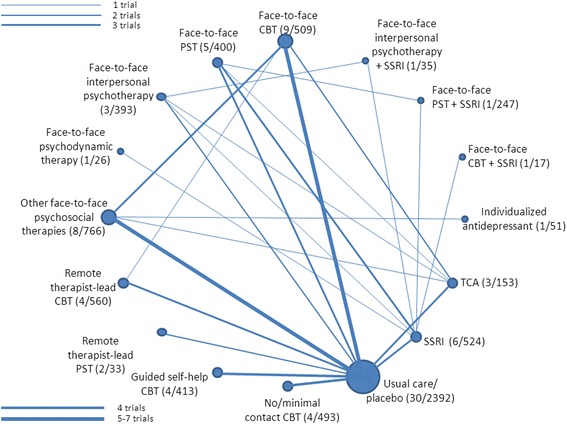
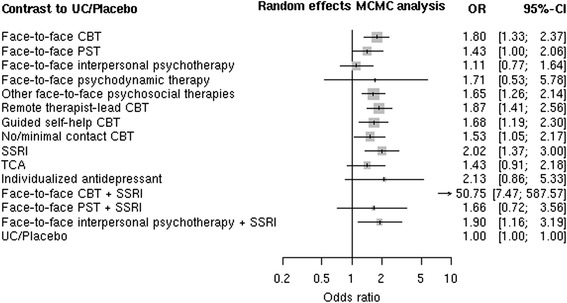
Verification
Claims the paper makes
The claims and statistics of this paper haven’t been checked yet.
Free: it reads the open-access text and checks the first 5 claims that cite a source we can check. Create a free account to check every claim.
Claims other papers make about this one
Each is checked against this paper’s own text: does it say what the citing paper says it does?
The cited source says what the claim attributes to it.
In the citing paper
“Some meta-analytic comparisons between specific models of psychological treatment have shown no significant differences in efficacy, 57 with others showing modest differences.58”
From Canadian Network for Mood and Anxiety Treatments (CANMAT) 2016 Clinical Guidelines for the Management of Adults with Major Depressive Disorder (2016) · cites this paper as [58]
Self-check
Percentages, sums and reported differences re-computed from the paper’s own numbers.
The self-check needs the paper’s full text.
Citations
Cites
Developing and evaluating complex interventions: the new Medical Research Council guidance
Craig, P., Dieppe, P., Macintyre, S., Michie, S., Nazareth, I., & Petticrew, M. (2008) · BMJ · doi:10.1136/bmj.a1655 · Cited by 10,995 · cited 1×
“We classified treatments consistently with our previous work [11] (pages 58–59): “As psychological treatments are considered complex interventions [21], grouping them can be performed along several dimensions and remains controversial [22].”
Method(2008) · Cited by 3,790
Assessing Risk of Bias in Included Studies
Higgins, J. P., & Altman, D. G. (2008) · Cochrane Handbook for Systematic Reviews of Interventions · doi:10.1002/9780470712184.ch8 · Cited by 3,396 · cited 1×
“The Cochrane tool for assessing risk of bias was used to assess internal validity [20].”
MethodSalanti, G. (2012) · Research Synthesis Methods · doi:10.1002/jrsm.1037 · Cited by 1,729
Dias, S., Sutton, A. J., Ades, A. E., & Welton, N. J. (2013) · Medical Decision Making · doi:10.1177/0272989x12458724 · Cited by 1,207
Network meta‐analysis, electrical networks and graph theory
Rücker, G. (2012) · Research Synthesis Methods · doi:10.1002/jrsm.1058 · Cited by 730 · cited 1×
“org/] [27, 28], using the generalized method-of-moments estimator of between-study heterogeneity given in [29].”
MethodSelf-citationDias, S., Welton, N. J., Sutton, A. J., Caldwell, D. M., Lu, G., & Ades, A. E. (2013) · Medical Decision Making · doi:10.1177/0272989x12455847 · Cited by 728
The ESEMeD/MHEDEA 2000 investigators, Alonso, J., Angermeyer, M. C., Bernert, S., Bruffaerts, R., Brugha, T. S., Bryson, H., de Girolamo, G., de Graaf, R., Demyttenaere, K., et al. (2004) · Acta Psychiatrica Scandinavica · doi:10.1111/j.1600-0047.2004.00329.x · Cited by 580 · cited 1×
“First, can we extrapolate the findings from trials in specialized settings to primary care? Patients with depression in primary care sometimes have less severe [6–8] and more somatic symptoms [9, 10] than * Correspondence: Klaus.”
BackgroundQuantifying the impact of between-study heterogeneity in multivariate meta-analyses
Jackson, D., White, I. R., & Riley, R. D. (2012) · Statistics in Medicine · doi:10.1002/sim.5453 · Cited by 577 · cited 1×
“org/] [27, 28], using the generalized method-of-moments estimator of between-study heterogeneity given in [29].”
MethodBarth, J., Munder, T., Gerger, H., Nüesch, E., Trelle, S., Znoj, H., Jüni, P., & Cuijpers, P. (2013) · PLoS Medicine · doi:10.1371/journal.pmed.1001454 · Cited by 569 · cited 5×
“[5] did not find a difference between individualized face-to-face and all other delivery modes.”
BackgroundMethodInfluentialRecognition, management, and outcomes of depression in primary care
Simon, G. E. (1995) · Archives of Family Medicine · doi:10.1001/archfami.4.2.99 · Cited by 515 · cited 1×
“First, can we extrapolate the findings from trials in specialized settings to primary care? Patients with depression in primary care sometimes have less severe [6–8] and more somatic symptoms [9, 10] than * Correspondence: Klaus.”
BackgroundInterpersonal Psychotherapy for Depression: A Meta-Analysis
Cuijpers, P., Geraedts, A. S., van Oppen, P., Andersson, G., Markowitz, J. C., & van Straten, A. (2011) · American Journal of Psychiatry · doi:10.1176/appi.ajp.2010.10101411 · Cited by 511
Mynors-Wallis, L. M., Gath, D. H., Lloyd-Thomas, A. R., & Tomlinson, D. (1995) · BMJ · doi:10.1136/bmj.310.6977.441 · Cited by 492 · cited 1×
“An inconsistency analysis, based on changes of the between-designs Q statistic following [27], located inconsistency in the comparison PST vs UC of a three-arm study [33] that showed an exaggerated effect of PST vs UC (OR 4.”
MethodDias, S., Sutton, A. J., Welton, N. J., & Ades, A. E. (2013) · Medical Decision Making · doi:10.1177/0272989x13485157 · Cited by 466
A graphical tool for locating inconsistency in network meta-analyses
Krahn, U., Binder, H., & König, J. (2013) · BMC Medical Research Methodology · doi:10.1186/1471-2288-13-35 · Cited by 458 · cited 3×
“Homogeneity and consistency were investigated using a net heat plot [27].”
MethodSymptoms in the Community: Prevalence, Classification, and Psychiatric Comorbidity
Kroenke, K. (1993) · Archives of Internal Medicine · doi:10.1001/archinte.1993.00410210102011 · Cited by 408 · cited 1×
“First, can we extrapolate the findings from trials in specialized settings to primary care? Patients with depression in primary care sometimes have less severe [6–8] and more somatic symptoms [9, 10] than * Correspondence: Klaus.”
BackgroundHow to Use an Article Reporting a Multiple Treatment Comparison Meta-analysis
Mills, E. J., Ioannidis, J. P. A., Thorlund, K., Schünemann, H. J., Puhan, M. A., & Guyatt, G. H. (2012) · JAMA · doi:10.1001/2012.jama.11228 · Cited by 360 · cited 2×
“For a network meta-analysis to be valid, three assumptions should be met [12, 13]: 1) among trials available for head-to-head comparison study findings should be sufficiently homogeneous for each intervention group (homogeneity assumption); 2) effect estimates derived from different sources of evidence (e.”
BackgroundImputing response rates from means and standard deviations in meta-analyses
Furukawa, T. A., Cipriani, A., Barbui, C., Brambilla, P., & Watanabe, N. (2005) · International Clinical Psychopharmacology · doi:10.1097/00004850-200501000-00010 · Cited by 337 · cited 1×
“[23].”
Luce, B. R., Kramer, J. M., Goodman, S. N., Connor, J. T., Tunis, S., Whicher, D., & Schwartz, J. S. (2009) · Annals of Internal Medicine · doi:10.7326/0003-4819-151-3-200908040-00126 · Cited by 330
Cape, J., Whittington, C., Buszewicz, M., Wallace, P., & Underwood, L. (2010) · BMC Medicine · doi:10.1186/1741-7015-8-38 · Cited by 283
Rücker, G., & Schwarzer, G. (2014) · Statistics in Medicine · doi:10.1002/sim.6236 · Cited by 217 · cited 1×
“We also calculated a generalized I(2) statistic [30].”
MethodSelf-citationLinde, K., Sigterman, K., Kriston, L., Rucker, G., Jamil, S., Meissner, K., & Schneider, A. (2015) · The Annals of Family Medicine · doi:10.1370/afm.1719 · Cited by 196
Self-citationParikh, S. V., Segal, Z. V., Grigoriadis, S., Ravindran, A. V., Kennedy, S. H., Lam, R. W., & Patten, S. B. (2009) · Journal of Affective Disorders · doi:10.1016/j.jad.2009.06.042 · Cited by 183
Psychological treatment of depression in primary care: a meta-analysis
Cuijpers, P., van Straten, A., van Schaik, A., & Andersson, G. (2009) · British Journal of General Practice · doi:10.3399/bjgp09x395139 · Cited by 172 · cited 1×
“We searched trial registries for unpublished and ongoing studies, and screened published systematic reviews focusing on primary care studies on depression treatments [16–19] for additional trials.”
MethodLinde, K., Kriston, L., Rucker, G., Jamil, S., Schumann, I., Meissner, K., Sigterman, K., & Schneider, A. (2015) · The Annals of Family Medicine · doi:10.1370/afm.1687 · Cited by 151 · cited 1×
“Within the overall project we also reviewed trials comparing antidepressant drugs among each other or with placebo [15].”
MethodSelf-citationBortolotti, B., Menchetti, M., Bellini, F., Montaguti, M. B., & Berardi, D. (2008) · General Hospital Psychiatry · doi:10.1016/j.genhosppsych.2008.04.001 · Cited by 136 · cited 1×
“We searched trial registries for unpublished and ongoing studies, and screened published systematic reviews focusing on primary care studies on depression treatments [16–19] for additional trials.”
MethodGroup psychological therapies for depression in the community: systematic review and meta-analysis
Huntley, A. L., Araya, R., & Salisbury, C. (2012) · British Journal of Psychiatry · doi:10.1192/bjp.bp.111.092049 · Cited by 132 · cited 1×
“We searched trial registries for unpublished and ongoing studies, and screened published systematic reviews focusing on primary care studies on depression treatments [16–19] for additional trials.”
MethodTwomey, C., O’Reilly, G., & Byrne, M. (2015) · Family Practice · doi:10.1093/fampra/cmu060 · Cited by 123
Kriston, L., von Wolff, A., Westphal, A., Hölzel, L. P., & Härter, M. (2014) · Depression and Anxiety · doi:10.1002/da.22236 · Cited by 119 · cited 2×
“The reduced effectiveness of psychological interventions in patients with dysthymia/minor depression is in agreement with current evidence [38].”
ResultSelf-citationEffectiveness of cognitive behavioural therapy in primary health care: a review
Hoifodt, R. S., Strom, C., Kolstrup, N., Eisemann, M., & Waterloo, K. (2011) · Family Practice · doi:10.1093/fampra/cmr017 · Cited by 104 · cited 1×
“We searched trial registries for unpublished and ongoing studies, and screened published systematic reviews focusing on primary care studies on depression treatments [16–19] for additional trials.”
MethodSchwenk, T. L., Coyne, J. C., & Fechner-Bates, S. (1996) · General Hospital Psychiatry · doi:10.1016/s0163-8343(96)00062-x · Cited by 100 · cited 1×
“First, can we extrapolate the findings from trials in specialized settings to primary care? Patients with depression in primary care sometimes have less severe [6–8] and more somatic symptoms [9, 10] than * Correspondence: Klaus.”
BackgroundDealing with clinical heterogeneity in meta‐analysis. Assumptions, methods, interpretation
Kriston, L. (2013) · International Journal of Methods in Psychiatric Research · doi:10.1002/mpr.1377 · Cited by 94 · cited 1×
“We classified treatments consistently with our previous work [11] (pages 58–59): “As psychological treatments are considered complex interventions [21], grouping them can be performed along several dimensions and remains controversial [22].”
MethodSelf-citationVeroniki, A. A., Mavridis, D., Higgins, J. P., & Salanti, G. (2014) · BMC Medical Research Methodology · doi:10.1186/1471-2288-14-106 · Cited by 79 · cited 1×
“The homogeneity and consistency assumptions were met sufficiently in our analyses, but due to the limited number of trials for most comparisons, power of these tests was rather low and impaired sensitivity of the investigations [34].”
BackgroundIssues in performing a network meta-analysis
Senn, S., Gavini, F., Magrez, D., & Scheen, A. (2013) · Statistical Methods in Medical Research · doi:10.1177/0962280211432220 · Cited by 75
The initial presentation of depression in family practice and psychiatric outpatients
Williamson, P. S., & Yates, W. R. (1989) · General Hospital Psychiatry · doi:10.1016/0163-8343(89)90040-6 · Cited by 37 · cited 1×
“First, can we extrapolate the findings from trials in specialized settings to primary care? Patients with depression in primary care sometimes have less severe [6–8] and more somatic symptoms [9, 10] than * Correspondence: Klaus.”
BackgroundLinde, K., Schumann, I., Meißner, K., Jamil, S., Kriston, L., Rücker, G., Antes, G., & Schneider, A. (2011) · BMC Family Practice · doi:10.1186/1471-2296-12-127 · Cited by 22 · cited 1×
“Details of the methods have been described in our published protocol [14] and in our conventional metaanalysis [11].”
MethodSelf-citationMeister, R., von Wolff, A., & Kriston, L. (2015) · Journal of Clinical Epidemiology · doi:10.1016/j.jclinepi.2015.02.006 · Cited by 11
Self-citation
Research works printed but not linked: 2
- National Collaborating Centre for Mental Health (commissioned by the National Institute for Health & Clinical Excellence) Depression: The NICE Guideline on the Treatment and Management of Depression in Adults, updated edition 2004 Leicester & London British Psychological Society and the Royal College of Psychiatrists
- Mitchell J Trangle M Degnan B Gabert T Haight B Kessler D Major depression in adults in primary care 2012 Bloomington (MN) Institute for Clinical Systems Improvement (ICSI
Cited by
Malhi, G. S., & Mann, J. J. (2018) · The Lancet · doi:10.1016/s0140-6736(18)31948-2 · Cited by 4,099
Otte, C., Gold, S. M., Penninx, B. W., Pariante, C. M., Etkin, A., Fava, M., Mohr, D. C., & Schatzberg, A. F. (2016) · Nature Reviews Disease Primers · doi:10.1038/nrdp.2016.65 · Cited by 2,269
The Role of Common Factors in Psychotherapy Outcomes
Cuijpers, P., Reijnders, M., & Huibers, M. J. H. (2019) · Annual Review of Clinical Psychology · doi:10.1146/annurev-clinpsy-050718-095424 · Cited by 748
“Recently, a number of network meta-analyses of the effects of psychotherapies have been published (Barth et al. 2013, Gerger et al. 2014, Kriston et al. 2014, Linde et al. 2015, Mayo-Wilson et al. 2014, Pompoli et al. 2018, Skapinakis et al. 2016, Slade et al. 2018).”
BackgroundParikh, S. V., Quilty, L. C., Ravitz, P., Rosenbluth, M., Pavlova, B., Grigoriadis, S., Velyvis, V., Kennedy, S. H., Lam, R. W., MacQueen, G. M., et al. (2016) · The Canadian Journal of Psychiatry · doi:10.1177/0706743716659418 · Cited by 562
“Some meta-analytic comparisons between specific models of psychological treatment have shown no significant differences in efficacy,(57) with others showing modest differences.(58) When only bona-fide therapies (defined as delivered by trained therapists, based on psychological principles, and designed to be a viable…”
Network meta‐analysis of multicomponent interventions
Rücker, G., Petropoulou, M., & Schwarzer, G. (2020) · Biometrical Journal · doi:10.1002/bimj.201800167 · Cited by 195
“The combination face-to-face CBT + SSRI was only assessed in one small two-arm study (n = 34), compared to SSRI alone, where it showed an implausible large direct effect with a very long uncertainty interval (OR = 18 [2.95–109.66]) (Linde et al., 2015, 2016).”
InfluentialSelf-citation
Metadata
- Authors
- Linde, K., Rücker, G., Sigterman, K., Jamil, S., Meissner, K., Schneider, A., & Kriston, L.
- Affiliations
- Technical University of Munich (DE)
- University of Freiburg (DE)
- Institut für Medizinische Psychologie (DE)
- University Medical Center Hamburg-Eppendorf (DE)
- Corresponding author
- Linde, Klaus
- Venue
- BMC Family Practice
- Published
- 2015-08-19
- Volume
- 16
- Issue
- 1
- Pages
- 103-103
- ISSN
- 1471-2296 (ISSN-L)
- PMC
- PMC4545315
- OpenAlex
- W2103908481
- Cited by
- 56
- References
- 40
- Citations by year
- 2026: 1 · 2025: 3 · 2024: 6 · 2023: 5 · 2022: 5 · 2021: 9 · 2020: 6 · 2019: 6 · 2018: 5 · 2017: 4 · 2016: 5 · 2015: 1
- FWCI
- 8.09
- Type
- journal article
- Language
- en
- Open access
- gold
- doi.org
- Licence
- Locations
- BMC Family Practice (publishedVersion, cc-by)
- Europe PMC (PubMed Central) (publishedVersion, cc-by)
- PubMed Central (publishedVersion, cc-by)
- PubMed (publishedVersion)
- Open access LMU (Ludwid Maxmilian's Universitat Munchen) (submittedVersion)
- FreiDok plus (Universitätsbibliothek Freiburg) (submittedVersion)
- mediaTUM (Technical University of Munich) (submittedVersion, other-oa)
- mediaTUM – the media and publications repository of the Technical University Munich (Technical University Munich) (submittedVersion)
- Topics
- Social Sciences › Psychology › Applied Psychology › Digital Mental Health Interventions
- Social Sciences › Psychology › Clinical Psychology › Psychotherapy Techniques and Applications
- Social Sciences › Psychology › Experimental and Cognitive Psychology › Anxiety, Depression, Psychometrics, Treatment, Cognitive Processes
- Keywords
- depressive disorders, depression, psychological intervention, primary care, cognitive behavioral therapy, guided self-help, interpersonal psychotherapy, problem-solving therapy, treatment response, remission, mode of delivery, comparative effectiveness, usual care, drug therapy comparison, circumstantial evidence
- MeSH terms
- Antidepressive Agents, Combined Modality Therapy, Depressive Disorder, Humans, Primary Health Care, Psychotherapy, Models, Statistical, Treatment Outcome
About these checks
Registry, retraction, Cites and statistics results are computed, not judged, with one exception: a printed reference that no index lists is read once by a model before it counts as a citation error. Claims are extracted by a model and kept only when their quote appears verbatim in the text; each cited source is then checked, with a model’s help, for whether it says what the claim relies on. Those verdicts can be wrong — read the claim’s quote and the cited source before relying on one.
Statistics and arithmetic are recomputed, not judged.
Confidence bands are shown only for fields calibrated on our annotated test set. None is calibrated yet, so no band is shown.
What counts as a claim ›How we measure confidence ›How we check this ›
Are you an author, or do you see a problem with this page? Request a review
Data sources
Bibliographic data: Semantic Scholar, OpenAlex, Crossref.
Contains information from the Semantic Scholar Academic Graph Datasets, made available under the ODC Attribution License (ODC-BY 1.0).
Semantic Scholar’s data is described in: Kinney, R., et al. (2023). The Semantic Scholar Open Data Platform. arXiv:2301.10140.
